
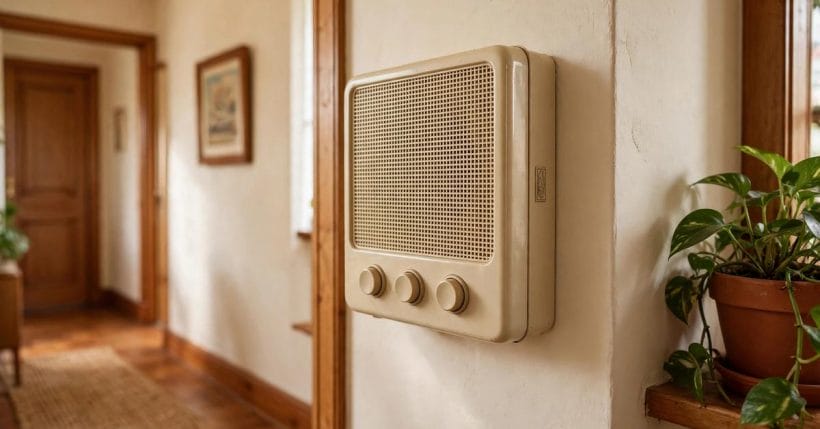
It sits by the front door or glows faintly in the kitchen: a cream plastic grille with buttons nobody presses, wired into a house that has long since moved on to phones. An old wired intercom is harmless to live with and surprisingly awkward to get rid of — because behind that grille are wires, a power supply, and a wall opening that needs a plan.
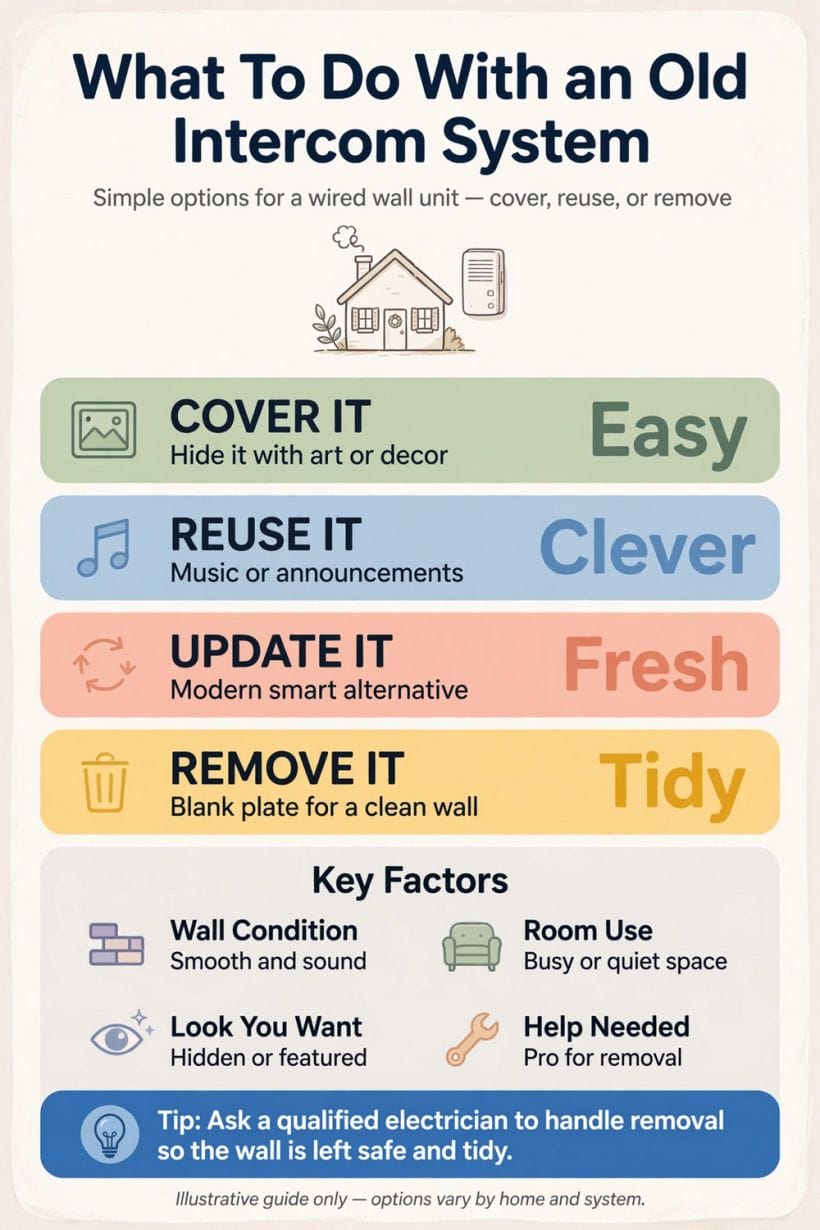
This guide works through what to do with an old intercom system in the order the decision actually happens: identify what you have, keep it safe, then choose between keeping, covering, reusing, updating or removing it — with the wiring decisions left, firmly, to a qualified electrician.
1. Old Wired Intercoms at a Glance
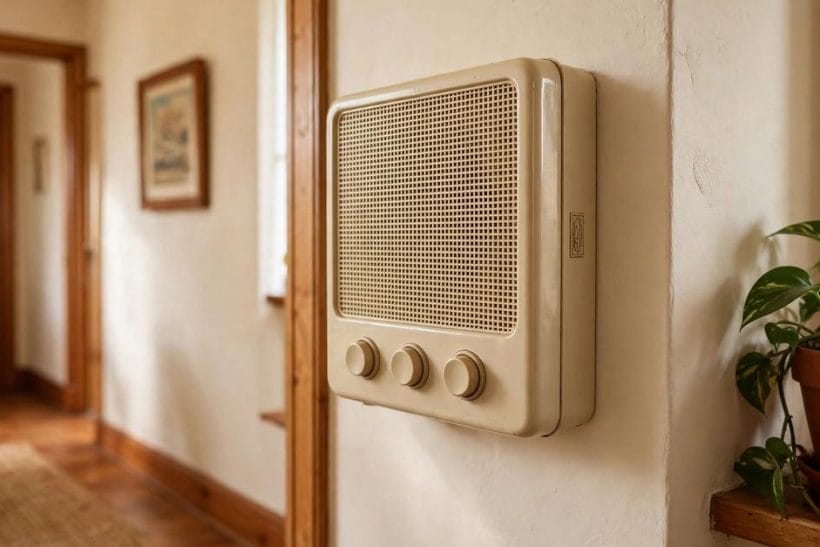
A typical system has one master station — often in the kitchen or hall — wired room stations in the bedrooms and hallways, a door station at the entry, and a transformer supplying low-voltage power, usually tucked near the electrical panel or in a cupboard. Many systems also played the radio, which is why the master unit is often the size of a small television. Whether yours still hums with power decides everything that follows, so that question comes before any decorating decision.
| Question | Short answer |
|---|---|
| Can I just pull it off the wall? | No — stations are wired and powered; disconnecting safely comes first, and that is an electrician’s job |
| What are the realistic options? | Keep and tidy it, cover it, reuse its place, update to a modern system, or remove it and finish the wall |
| Is the wiring dangerous? | Intercom wiring is generally low-voltage, but transformers connect to the mains, and old wiring should always be verified dead before it is touched |
| What does removal involve? | Safe disconnection, capping and labelling the wires, then patching the hole or fitting a blank plate |
2. First, Know What You Have
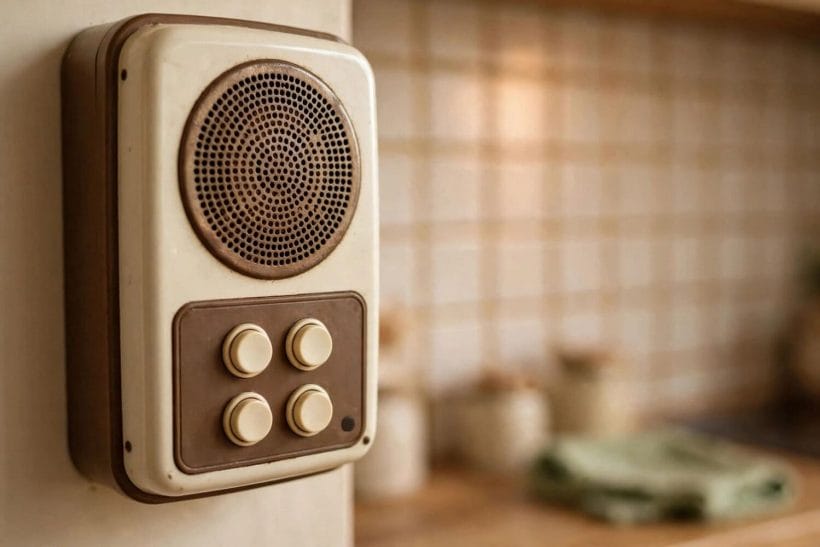
Ten minutes of detective work now prevents every surprise later. You are not diagnosing for repair — you are establishing what exists, what is live, and what the system is connected to.
1. Count the stations
Walk the house and note every unit: master, room stations, the door station, any patio or garage speaker. The count tells you the scale of every option — covering one master is a weekend; covering eight stations is a decorating scheme.
2. Find the power source
Systems are fed by a transformer, commonly near the electrical panel, a boiler cupboard or behind the master station itself. Locating it — without touching it — is the information your electrician will ask for first.
3. Test whether it still works
Try the master: a light, a hum, a radio burst all mean the system is alive. A working system widens your options considerably, because keeping or reusing it costs nothing in repairs.
4. Check what else it does
Older systems often double as the doorbell, and some control a gate or door release. Before planning removal, press the doorbell and see which box chimes — removing the intercom should never silently remove the bell.
3. Safety Before Anything Else

Everything cosmetic in this guide is safe for a homeowner. Everything involving the wires themselves follows the same discipline as the wiring explainers elsewhere on Togaze, such as our conduit guide: know where the power is, and stop at the point where a qualification exists for a reason.
5. Low voltage is not no voltage
Room stations usually carry low-voltage wiring, but the transformer feeding them is mains-connected, and decades of DIY can leave surprises in any wall. Treat every wire as live until a qualified person proves otherwise.
6. Power off before covers come off
If you are opening a unit to clean or photograph the wiring for an electrician, switch the circuit off at the panel first and check the unit is dead. It takes a minute and it is the whole of the safety argument.
7. Never bury live connections
The one forbidden shortcut is pulling a station out, pushing its wires into the wall and plastering over them. Connections must be disconnected properly or terminated in an accessible, approved way — an electrician will tell you which applies in your case.
8. Know the homeowner’s boundary
Painting around a unit, hanging a cover, fitting a picture over it: yours. Disconnecting transformers, altering circuits, certifying dead wiring: a qualified electrician’s. The boundary is bright, and staying on the right side of it is cheap.
4. Option One: Keep It and Tidy It

The zero-cost option is underrated. A clean, quiet intercom in a period house reads as original fabric, like picture rails or a bell board — and in some homes it still earns its keep.
9. Clean and de-yellow the plastics
Gentle cleaning lifts decades of kitchen grease from grilles and knobs. Work with the power off, keep moisture out of the speaker, and never soak a unit — a barely damp cloth and patience do the work. This kind of measured approach suits the whole house’s wiring, as our tiny house electrical wiring guide also argues.
10. Paint the wall, mask the unit
When redecorating, mask the station carefully and paint around it rather than over it. Painted-shut grilles and gummed buttons are what make old units look derelict; a crisp paint line makes the same unit look kept.
11. Use it if it works
A working system still does real jobs: calling the garden, answering the door from upstairs, radio in the kitchen. Plenty of households keep a system for the door station alone and let the rest retire gracefully.
5. Option Two: Cover It
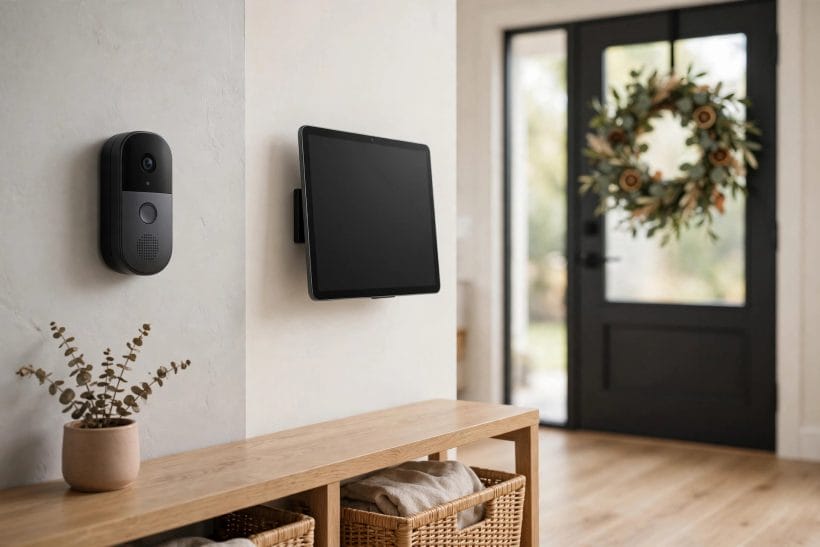
Covering is the renter’s friend and the undecided owner’s pause button: nothing is disconnected, everything is reversible, and the wall looks intentional instead of apologetic.
12. The hinged picture
A framed print on small hinges, hung over the master station, hides the unit and swings open if it is ever needed. Choose a frame deeper than the unit’s projection and the cover looks like ordinary art — the trick our feature image’s cousin demonstrates in the pin above.
13. A shallow cabinet or panel
A slim wall cabinet, a fabric panel or a piece of pegboard across the unit gives the hallway a designed feature and the intercom a hiding place. Ventilation matters if the unit still runs warm; leave air room behind panels.
14. Furniture placement
A bookcase, a console or a tall plant in front of a low station is the oldest cover of all. It suits room stations you never use, and it costs nothing but a furniture shuffle.
15. A cover for the door station
Outside, a tired door station can sit behind a house-number plaque or a small weatherproof cover while its bell duties are taken over by a modern wireless button placed nearby — no wiring touched, entry transformed.
6. Option Three: Reuse Its Place
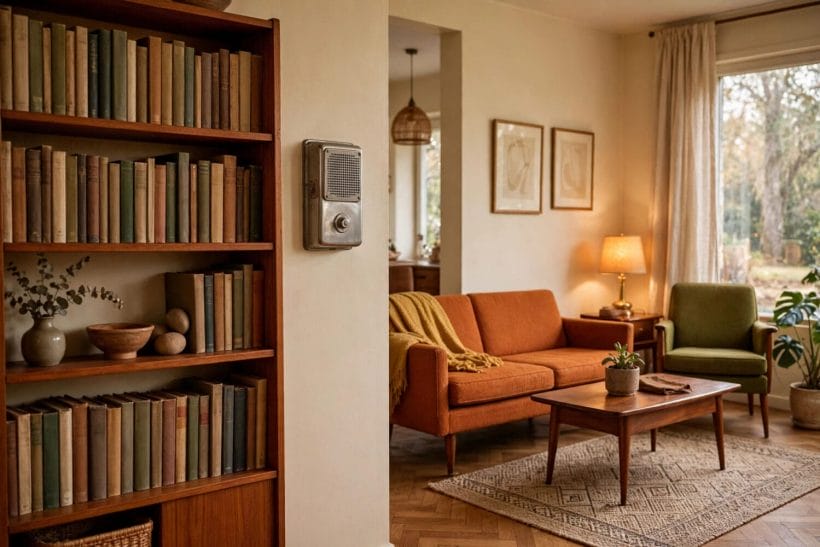
The system’s locations are good ones — by the door, in the kitchen, beside the bed — chosen for daily life. If the intercom retires, its places can be promoted rather than abandoned.
16. The recess as a niche
Once an electrician has disconnected a station and made its opening safe, the recess itself can become a small display niche or a shelf for keys and post. The order matters: professional disconnection first, carpentry second.
17. A message centre at the master
The master station usually commands the kitchen or hall — the household’s crossroads. A noticeboard, calendar or family organiser mounted over the covered unit keeps the location’s job while changing its uniform.
18. Keep one station as the exhibit
In a period home, a single cleaned station left visible is a small piece of social history — the house’s original group chat. Visitors notice it with delight, which is more than most wall fittings achieve.
19. The charging shelf nearby
Households often want a device-charging spot exactly where the intercom hangs. A shelf beneath or beside the covered unit serves the modern habit while the old one retires in place — any new socket work, again, belongs to an electrician.
7. Option Four: Update to Something Modern

If you still want the function — talk to the door, call the garden, hear the baby — modern equivalents deliver it with less hardware. The update path ranges from a single wireless doorbell to a whole smart system, and the wiring questions belong to the installer.
20. A wireless video doorbell
The door station’s job — see and speak to callers — is now done by battery or plug-in video doorbells that talk to a phone. For many houses this one change retires the entire intercom, and the design questions become the ones in our smart tiny house design ideas: placement, light and privacy.
21. Smart speakers as the new room stations
Voice-assistant speakers and displays offer room-to-room calling, announcements and music — the intercom’s feature list, rebuilt without wires. They sit where stations stood and ask only for a socket and Wi-Fi.
22. Retrofit systems that reuse wiring
Some modern intercom systems are designed to work over existing intercom wiring, replacing the stations one for one. Whether yours qualifies depends on the wiring’s type and condition, which is precisely what an installer inspects before quoting.
23. A modern panel at the master
Where the master station dominated a kitchen wall, a single modern display or control panel in the same spot keeps the household’s command centre where it always was — with the swap, and any power work, done professionally.
8. Option Five: Remove It Properly
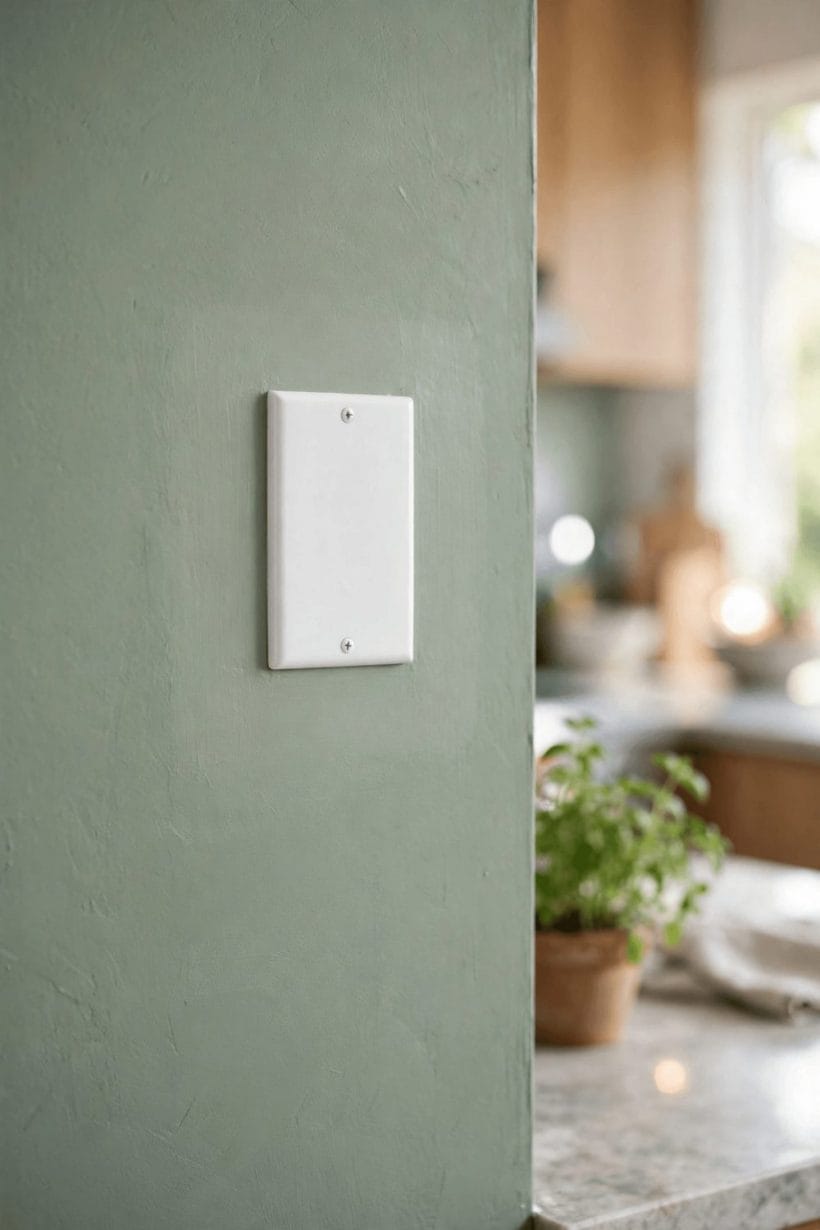
Full removal is the cleanest ending and the one with the most steps. Done properly it leaves a wall that gives no sign the system ever existed; done casually it leaves live wires in a cavity, which is the one outcome this guide exists to prevent.
24. Disconnect at the source
The electrician isolates the transformer and confirms the whole system is dead before any station is touched. This single visit can cover the disconnection of every station in the house, which is why the counting in section two matters.
25. Cap, label and record the wires
Disconnected wires are terminated safely, labelled and their routes noted for the future. A labelled wire is a favour to the next owner; an anonymous one is a puzzle with a small but real risk attached — the same record-keeping our tiny house electrical load planner recommends for any installation.
26. Decide the doorbell’s future first
If the system carried the doorbell, fit its replacement before removal day, not after. A house briefly without a bell is a trivial thing; a house whose bell wiring was removed in the tidy-up is an avoidable second project.
27. Patch the opening or fit a blank plate
Small station holes patch like any plaster repair. Larger master openings can be closed with a neat blank plate painted with the wall — tidy, reversible and honest — or properly filled and skimmed by a decorator for a seamless finish.
28. Retire the hardware responsibly
Old stations and transformers are electronic waste: use your local e-waste or recycling route rather than the household bin, and consider offering a handsome vintage master unit to a salvage yard before it goes anywhere near a skip.
9. Renting, Selling and Period Homes
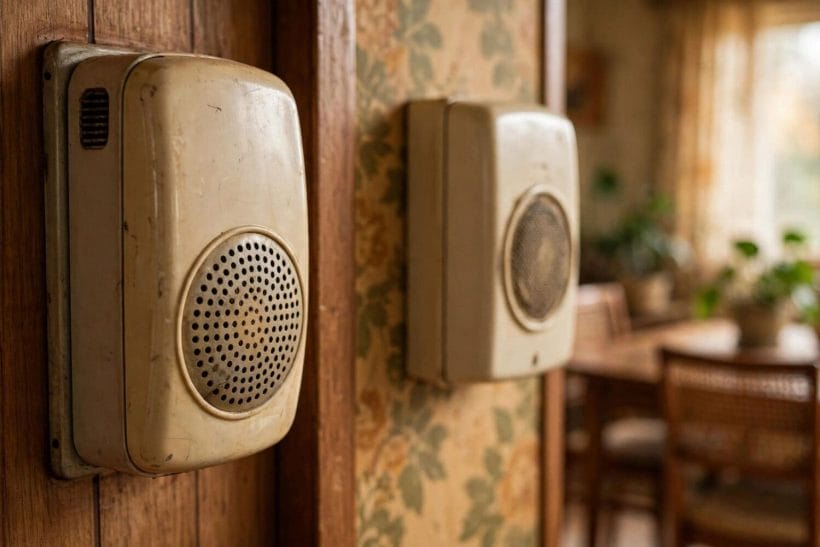
Three situations change the answer. Renters should stay entirely within the reversible options: covers, furniture placement and cleaning, with nothing disconnected and nothing painted that the tenancy does not allow — and the landlord informed before anything beyond that is even discussed. Sellers face a presentation question rather than a technical one: a working system can be listed as a feature, a dead one should be either tidied behind a cover or removed properly, because loose plates and dangling wires in a viewing read as neglect far beyond their size. Period homes sit at the other extreme, where an original system in good order is part of the house’s story; there, keeping and cleaning is often the conservation-correct answer, and removal is the option that needs justifying.
10. Costs and Who Does What
No honest figure can be printed without knowing your system, your walls and your town, so this guide gives drivers instead of numbers. Covering costs the price of a frame or panel and your own time. Keeping costs cleaning materials and nothing else. Updating costs the devices you choose, plus an installer’s visit if wiring or a new panel is involved. Full removal costs an electrician’s disconnection visit — usually covering all stations at once — plus patching or a decorator, scaled by how many openings the system leaves behind. The consistent pattern is that the electrical hour is the small part of the bill and the wall-finishing is the variable one. Everything divides cleanly: you may clean, cover, furnish and decorate; the electrician disconnects, terminates and certifies; a decorator patches and skims. Keeping those lanes separate is what makes an old intercom a small project instead of a saga.
Final Considerations
An old wired intercom is a modest problem with five honest answers: keep it, cover it, reuse its place, update its job or remove it properly. The only wrong answers are the rough ones — wires buried live, transformers left feeding empty grilles, stations ripped out on a Saturday impulse. Identify the system, respect the boundary between decorating and electrical work, and the box by the door becomes either a tidy feature, a hidden secret or a clean wall.
For the room the master station usually overlooks, our living room ideas pillar covers the decorating side of the wall, and the interior design ideas survey places this kind of small, unglamorous decision where it belongs: among the finishing touches that make an older house feel deliberately kept.




0 Comments