

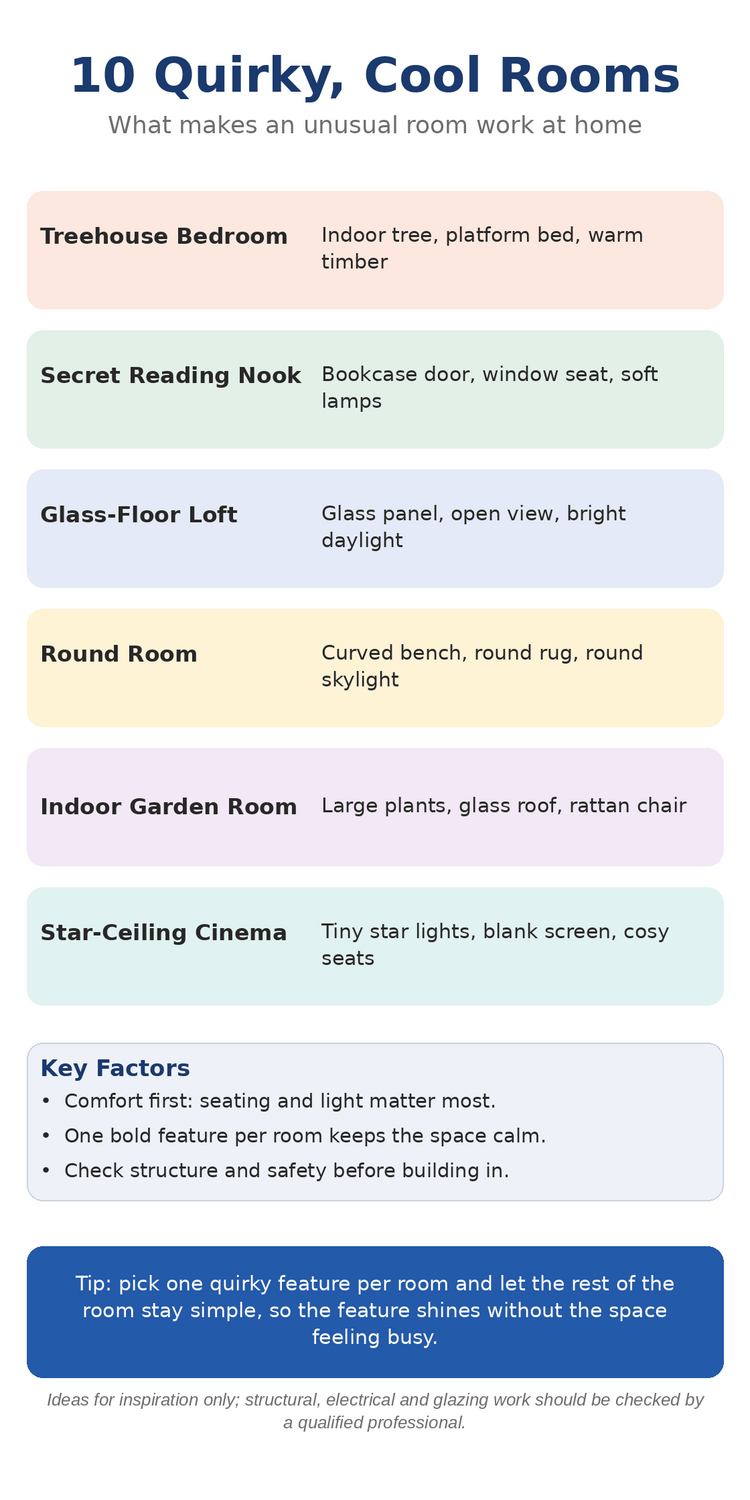
Some rooms are easy to forget the moment you leave them. Others stay with you: a bedroom built around a tree, a reading nook hidden behind a bookcase, a ceiling that glows like a night sky. The coolest rooms are rarely the grandest ones. They are the rooms where one bold, playful idea has been carried through with care, so the space feels personal rather than staged, and comfortable rather than merely unusual.
This guide gathers ten such rooms. Each one is described in general terms, with notes on what makes it work: the light, the seating, the storage, the materials, and the practical checks worth making before anything is built in. A quirky feature should make a room more enjoyable to live in, not harder to use, so every idea below is paired with the everyday realities that keep it working — daylight, access, upkeep, and safety. Structural work, electrical work, glazing, and anything that changes how a floor or ceiling carries weight should always be planned and checked by a qualified professional.
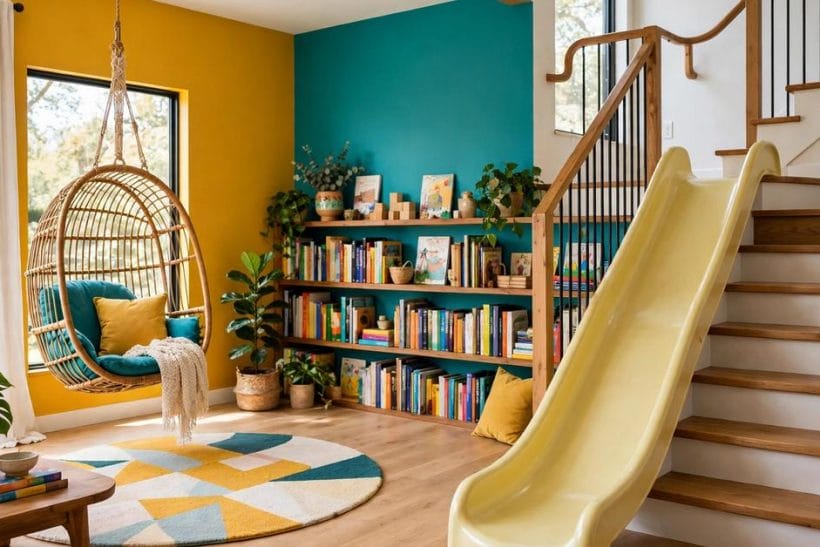
1. A Living Room With a Slide
A slide beside a staircase turns an ordinary route between floors into the most talked-about feature in the house. The idea works best where the staircase already runs along an open wall, so the slide can follow the same line without cutting across walkways or blocking doors. A generous landing at the bottom matters more than the slide itself: somewhere to arrive, step aside, and carry on into the room without colliding with furniture or foot traffic.
Colour does much of the work here. A slide in a bright, cheerful tone against calm walls reads as playful rather than chaotic, and the same accent colour repeated in cushions, a rug, or shelving ties the feature into the room instead of leaving it stranded. Seating should face the room’s natural gathering point, not the slide, so everyday living — conversation, reading, watching the evening light — stays the focus, and the slide stays a delight rather than a distraction. Tiny house designs show how a single bold feature can carry a whole compact home when the rest of the plan stays simple and well ordered.
Safety and upkeep deserve honest attention. The slide needs a secure fixing, a clear run, and a landing zone kept free of hard edges and clutter, and the fixings should be checked as part of routine home maintenance. Noise is another everyday factor: a slide used often will be heard in rooms below, so its position relative to bedrooms and quiet spaces is worth thinking about before it is built. Done well, it is a room that makes visitors smile and residents use the stairs with a little more joy.
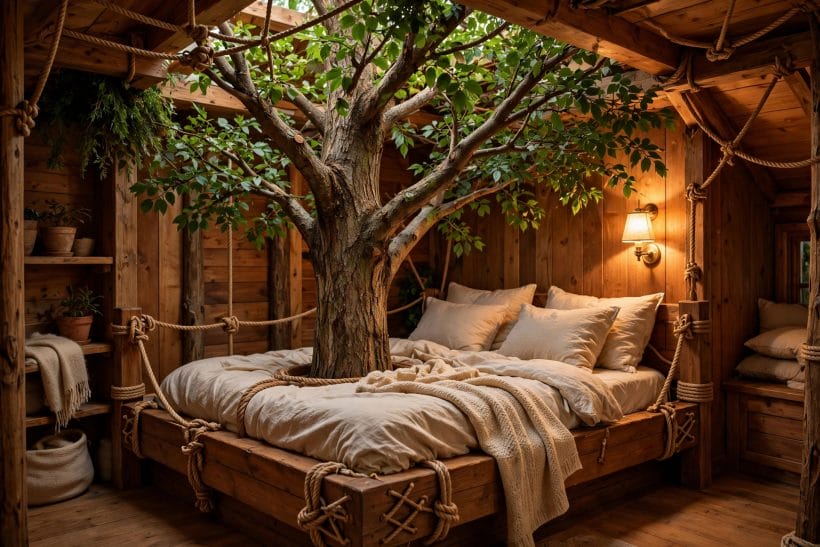
2. A Treehouse Bedroom
A bedroom built around an indoor tree brings the outside in more completely than any houseplant could. The trunk rises through the room, the canopy spreads overhead, and the bed sits low and wide beneath it, so waking up feels like waking in a woodland shelter. Warm timber walls, soft bedding, and low lamplight complete the effect, making the room feel enclosed and calm even though its centrepiece is gloriously dramatic.
The practical heart of this room is care for the tree itself. A living tree indoors needs light, air, water, and room for its roots, and those needs shape everything from flooring to drainage to the choice of species. Where a living tree is not practical, a well-made timber trunk and branches can carry the same look without the upkeep, and the room still gains its woodland character. Either way, the bed should be simple and sturdy, with bedding in natural tones that lets the timber and foliage take the visual lead.
Light is the detail that makes or breaks this room. Soft, warm lighting at bed height keeps the canopy from looming at night, while daylight from a nearby window keeps the room from feeling like a cave during the day. Keep the floor clear and the furniture low, so the eye travels up to the branches rather than tripping over clutter. It is a bedroom for slow mornings and early nights, and it suits anyone who wants their sleeping space to feel like a retreat from the rest of the house.
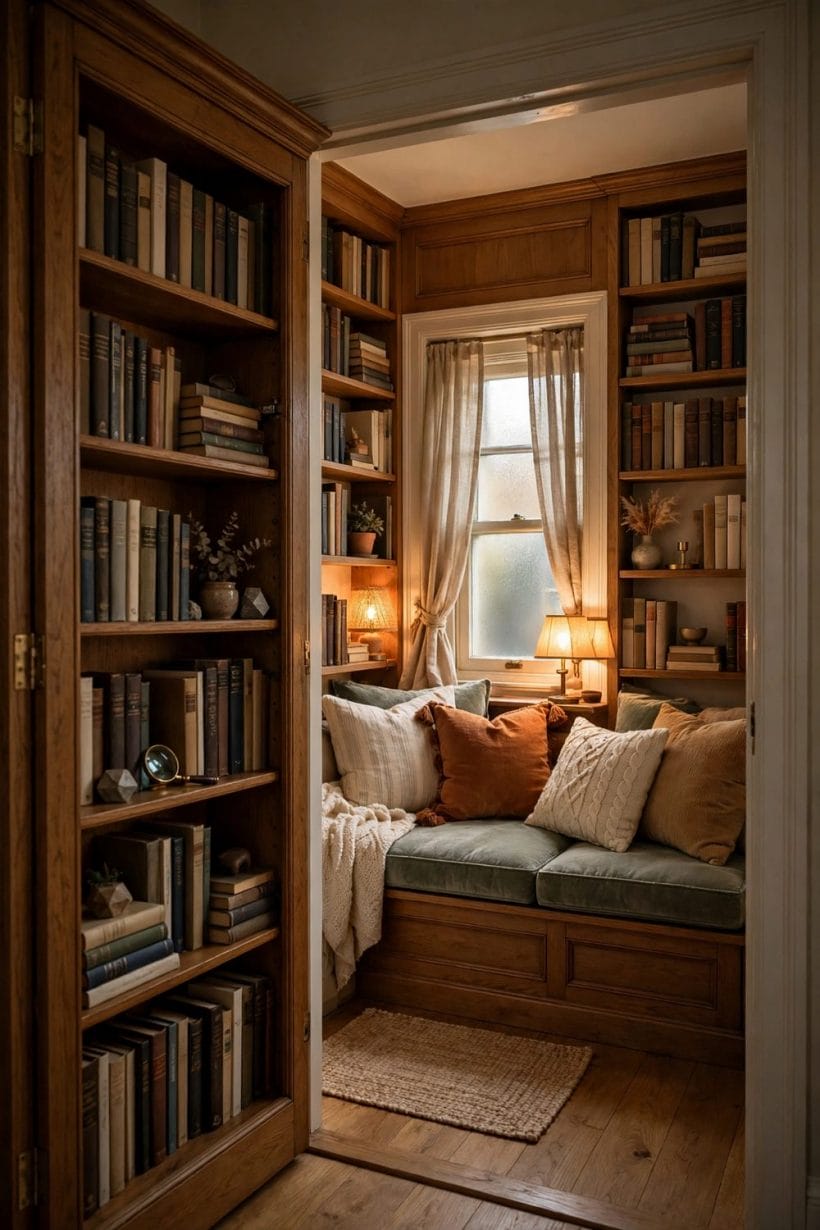
3. A Secret Reading Nook Behind a Bookcase
Every home has a corner that could hide a secret, and a bookcase door is the most charming way to use one. From the main room it looks like an ordinary wall of books; swung open, it reveals a small nook with a window seat, deep cushions, and shelves of its own. The pleasure is partly theatrical — the hidden entrance — and partly practical, because the nook is genuinely quiet, enclosed, and made for long, undisturbed reading.
Storage is what makes this idea more than a novelty. The bookcase itself must hold real books, with shelves deep enough for the volumes it displays, and the hidden door needs hinges and a latch that work smoothly day after day. Inside, the window seat should be wide enough to curl up on, with cushions that support a long sit and a lamp placed where it lights the page without glare. Tiny house storage ideas are a useful reminder that hidden storage only earns its keep when it is easy to open, easy to reach, and built to be used daily rather than admired once.
Ventilation and light keep the nook comfortable. A window, even a small one, stops the space feeling closed in, and a warm lamp makes it usable after dark. Keep the doorway clear and the mechanism simple: a secret that sticks, squeaks, or needs a trick to open will soon stop being used. At its best, this is a room within a room, a private corner that turns reading from a habit into a small daily ceremony.
4. A Glass-Floor Loft
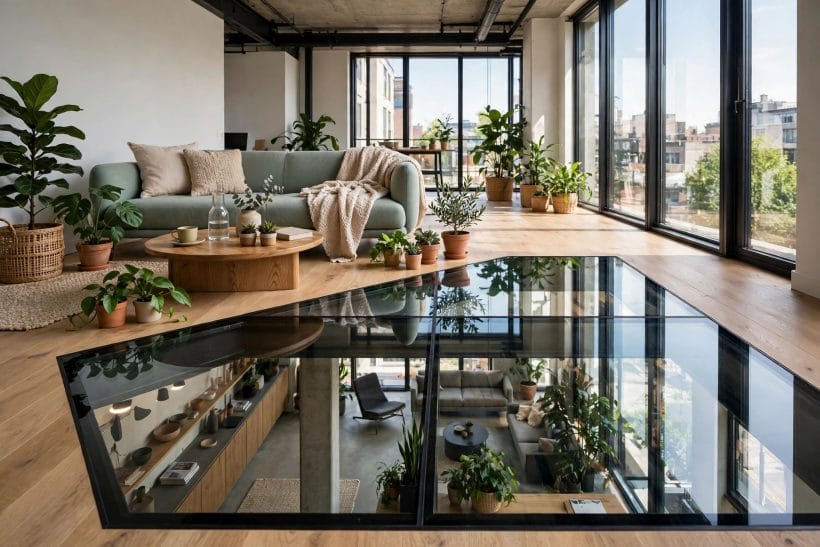
A glass floor panel changes how a loft feels entirely. Standing on it, you look down into the room below, and the two levels stop feeling separate and start feeling like one tall, connected space. Daylight travels through the panel too, so the lower room borrows brightness from the loft’s windows, and the loft itself feels lighter because its floor does not close off the space beneath.
Layout is everything here. The glass panel should sit where the view down is worth having — over a sitting area or a planted corner, rather than over a corridor or a cluttered workspace — and the furniture around it should leave a clear, comfortable route across the loft. A low sofa, a round table, and plants soften the modern edge of the glass, keeping the room welcoming rather than stark. Tiny house floor plans make the same point at a smaller scale: when levels and sightlines are planned together, even a modest home can feel open and connected.
Glazing of this kind is specialist work, and it should be specified and fitted by qualified professionals, with the panel’s strength, framing, and slip resistance all confirmed before anyone walks on it. Cleaning is the everyday reality: glass floors show dust and footprints, so a simple cleaning routine is part of owning one. For households comfortable with that, the reward is a room that feels daring and light, and a home where the two floors genuinely talk to each other.
5. A Round Room
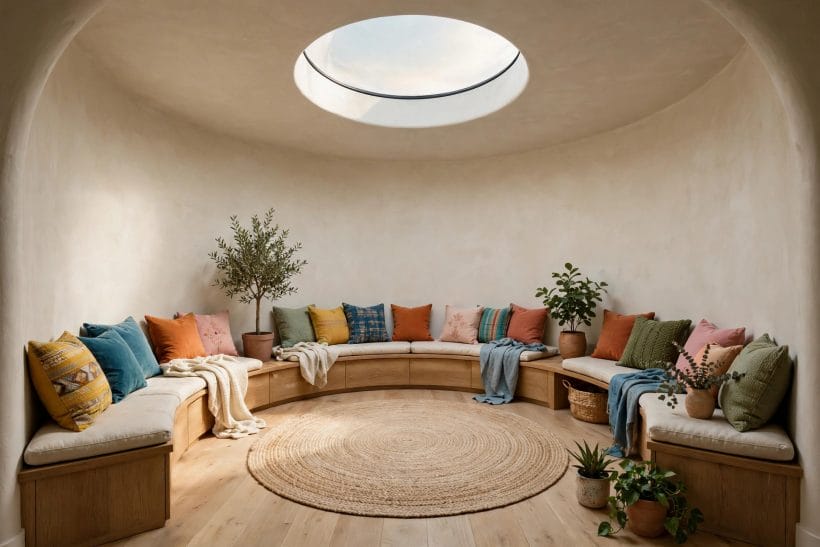
Most rooms are boxes, so a round room feels surprising the moment you step inside. Curved walls, a bench seat that follows the curve, and a round rug in the middle create a space that naturally draws people together, with no corners for furniture to get lost in and no head of the table. A round skylight overhead completes the geometry, pouring daylight down into the centre of the room.
Furnishing a curved room calls for furniture that follows the wall rather than fighting it. A built-in bench with colourful cushions uses the curve beautifully, giving generous seating without crowding the floor, and a round rug anchors the middle so the room feels gathered rather than empty. Low, soft pieces work better than tall, rigid ones, and plants in the curve’s corners add life without breaking the room’s gentle line. Tiny house interiors show how built-in seating can make an awkward shape feel generous, and the same thinking turns a round room from a curiosity into a favourite gathering place.
Acoustics are a quiet bonus: curved walls soften echoes, so conversation feels easy and music sounds warm. The trade-off is that standard rectangular furniture and shelving fit poorly, so built-ins and custom pieces are usually part of the plan. Keep the palette calm and let the shape itself be the statement. A round room does not need loud decoration; its geometry is already the most interesting thing about it.
6. An Indoor Garden Room
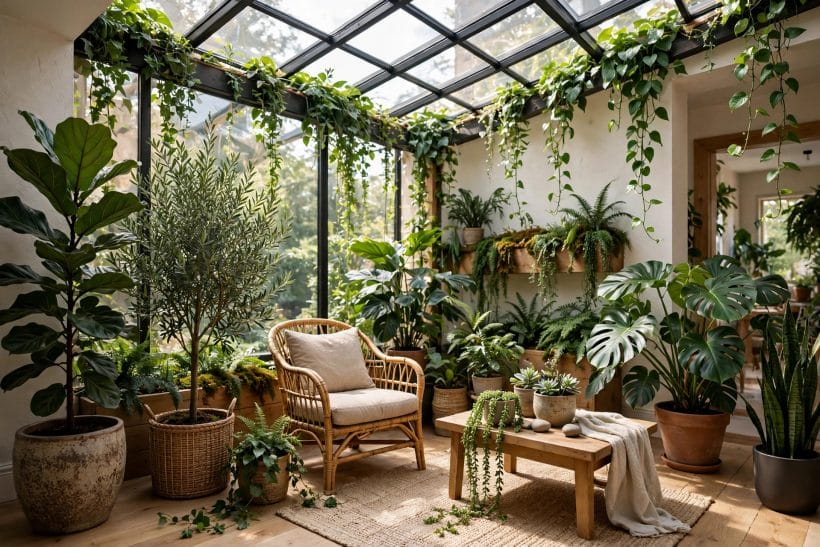
An indoor garden room is a living space that happens to be full of plants, rather than a greenhouse that happens to have a chair in it. Large potted plants, trailing vines, and a rattan armchair beneath a glass roof make a room that smells green, sounds soft, and changes with the seasons as plants grow, flower, and shed. It is the most calming room in this collection, and the one most likely to become the household’s favourite.
Light and water are the two systems this room runs on. A glass roof gives plants the daylight they need, but it also brings heat on bright days, so shading and ventilation matter as much as the glazing itself. Watering needs a practical routine: pots with trays, a nearby water point, and flooring that tolerates the occasional splash. Choose plants for the light the room actually gets, not the light you wish it had, and group them by their needs so care stays simple. Home design ideas often treat a garden room as an extension of the living space, and that is the right way to think of it — a room for sitting first, with planting that supports the sitting rather than taking it over.
Upkeep is honest work: leaves fall, pots need repotting, and vines need guiding. But the return is a room that feels alive in a way no decorated room can match, and that softens the whole house around it. Keep one clear path through the planting, one comfortable chair in the best light, and a small table for a book and a drink, and the garden room will be used every day rather than admired from the doorway.
7. An Art Studio With a Chalkboard Wall
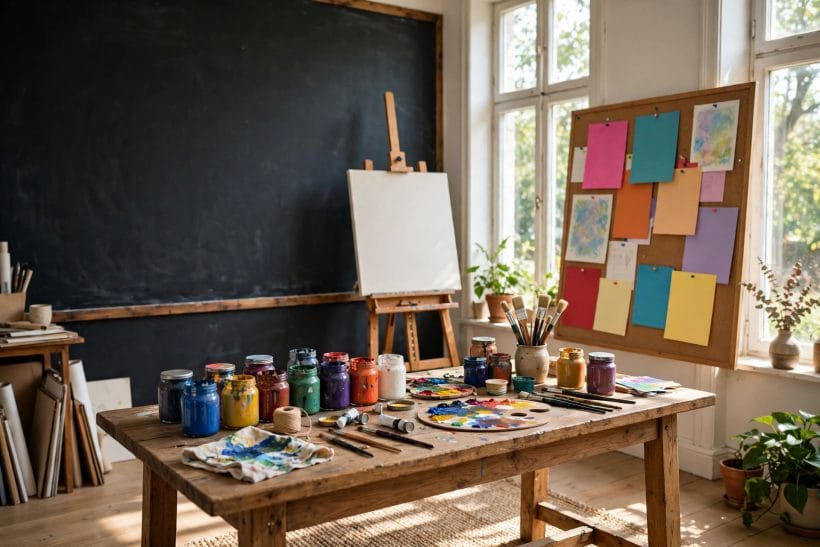
A room with a wall you can draw on invites creativity in a way no finished decoration can. A large chalkboard wall, kept blank and ready, turns one whole side of a studio into a sketchbook: ideas, colour tests, notes, and half-formed plans can live on it for days, then be wiped away when the next project begins. Around it, an easel, paints on a wooden table, and daylight from tall windows make a working room that feels both serious and playful.
Organisation keeps a creative room usable. Paints, brushes, and paper need homes of their own — jars on the table, boards for pinned work, shelves for finished pieces — so the chalkboard wall stays the focus rather than competing with clutter. Light matters more here than in almost any other room: daylight from windows, kept clear of heavy curtains, lets colours read truly, and a good overhead light extends the working day. The floor should be easy to clean, because a studio that cannot get messy is a studio that will not get used.
The chalkboard wall also changes how the room is shared. Visitors can leave a sketch, children can draw beside adults, and a project can grow across the wall over days rather than being squeezed onto a single sheet. Keep chalk and erasers within reach, keep the wall itself free of permanent marks, and the room stays a flexible workshop. It is a quirky room with a practical soul: the quirk is not decoration, it is the work itself.
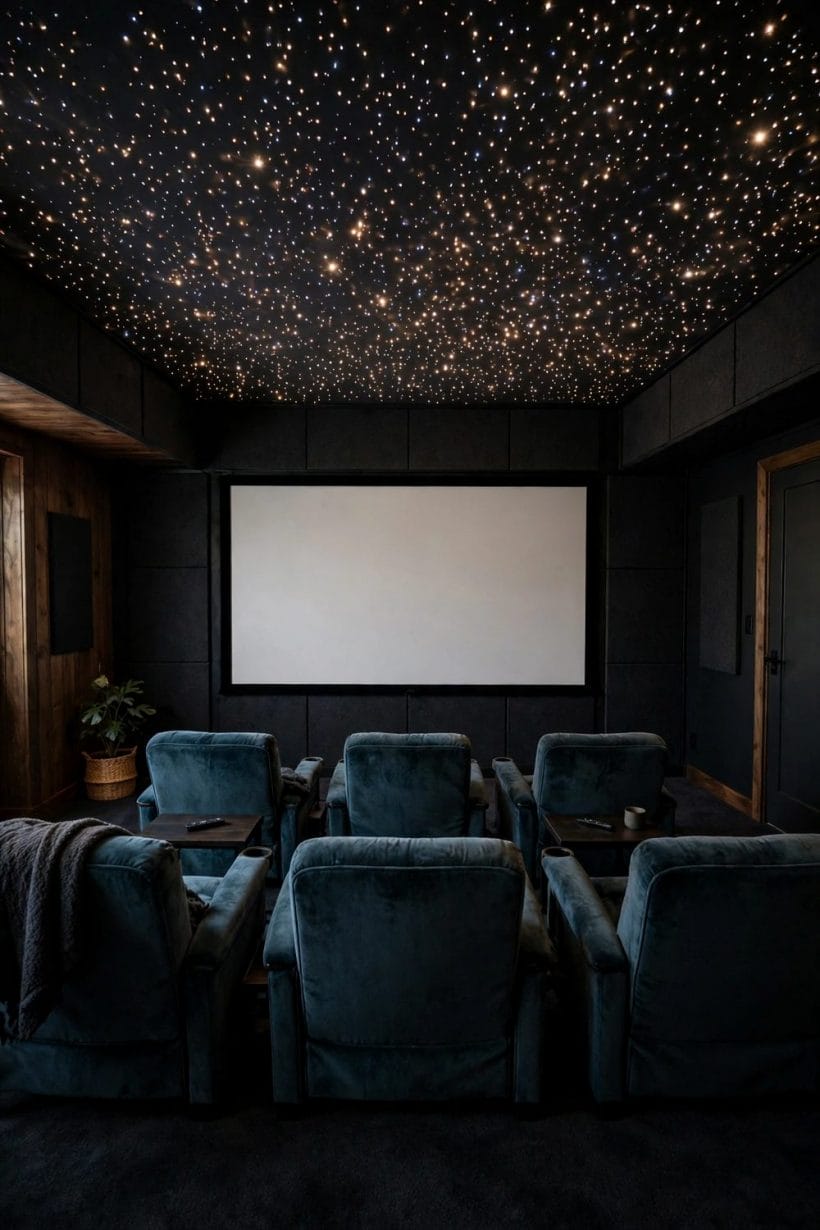
8. A Star-Ceiling Cinema Room
A cinema room with a ceiling of tiny star lights turns film night into an occasion. The lights go down, the screen glows, and overhead a scattered field of small stars makes the room feel like an open-air theatre, even in the middle of winter. Cosy armchairs in rows, soft furnishings, and a large blank screen complete a room designed for settling in and staying a while.
Comfort is the measure of this room. Seating should support a long film without fidgeting, with room to stretch and a place for a drink, and the screen should sit at a height that lets every seat see it clearly without craning. Sound matters too: soft furnishings, rugs, and curtains calm echoes, so dialogue stays clear and the room feels intimate rather than hollow. The star ceiling itself should be dimmable, so it can glow gently during a film and shine properly when the room is used for stargazing-style relaxation afterwards.
Electrical work for ceiling lights and screen equipment should be planned by a qualified professional, and cables kept tidy and out of walkways. Keep the room’s palette dark and calm, so the screen and the stars are the brightest things in it, and keep snacks and seating simple. Done right, this is a room the whole household will book into — not just for films, but for quiet evenings under its small, permanent sky.
9. A Nautical Cabin Bedroom
A bedroom shaped like a ship’s cabin is pure escapism, and it works because the details are consistent. A bed shaped like a wooden boat, round porthole windows, rope details, and timber wall panels together create a cabin that feels complete, not costumey. Navy and white bedding keeps the palette fresh, and daylight through the portholes makes the small, enclosed space feel bright rather than cramped.
The trick is restraint. One boat bed is a statement; a room full of competing nautical props becomes a theme park. Choose the bed and the portholes as the two hero features, then let the rest of the room stay simple: plain timber, natural fibres, and a few well-chosen details like rope shelving or a lantern-style lamp. Storage should be built in where possible — under the bed, along the walls — so the cabin feel is not broken by wardrobes that belong in an ordinary bedroom.
This room suits children and grown-ups alike, though for different reasons: children love the adventure of sleeping in a boat, while adults tend to love the calm, orderly cabin feel. Keep the bedding washable, the timber easy to dust, and the portholes clear, and the room stays fresh. It is a reminder that a quirky room does not need to be large or expensive in spirit — it needs one strong idea, carried through consistently, and a bed you genuinely want to sleep in.

10. A Hammock Lounge for Slow Afternoons
A room built around hammocks is a room with a single instruction: slow down. Hammocks strung across a bright corner, with cushions, throws, and plants nearby, make a lounge that is used for reading, napping, and long conversations. There is no desk, no screen competing for attention, and no formal seating arrangement — just a space that sways gently and invites you to stay.
Fixings are the serious part of this light-hearted room. Hammock supports must be anchored securely to structure that can carry the load, and that anchoring should be checked by a qualified professional before the room is used. Once the fixings are sound, the rest is soft: washable hammock fabric, cushions that can be moved around, and a small table within reach for a book or a drink. Small living room ideas often rely on flexible, movable seating to make a modest room feel generous, and a hammock lounge takes that thinking to its happiest extreme.
Light should be gentle and plentiful — daylight by day, warm lamps by evening — and the room should stay uncluttered, so getting in and out of a hammock never means navigating obstacles. It is the simplest room in this collection and, for many households, the most used: a place where the day’s pace drops, shoulders drop with it, and an ordinary afternoon feels like a small holiday.
Final Considerations
Across all ten rooms, the same pattern holds. One strong idea, carried through with care, beats a room full of competing novelties. Light, seating, storage, and access decide whether a quirky room is loved daily or admired once, and the practical checks — structure, electrics, glazing, fixings, ventilation, and cleaning — decide whether it stays safe and pleasant over time. Start with the room you already use most, add a single feature that suits how you actually live, and let the rest of the room stay calm around it.
It also helps to think beyond the rooms in this guide. A kitchen, a hallway, or a bathroom can carry one quirky feature just as happily as a bedroom or a living room, and the same rules apply: one idea, well made, with light and storage considered from the start. Kitchen ideas are a good place to look for how a working room can still carry personality, from colour and open shelving to a feature wall that makes daily cooking feel less routine.
The coolest rooms, in the end, are not the ones that impress visitors for a minute. They are the ones that make everyday life a little more delightful: a slide that starts the day with a smile, a nook that holds an evening’s reading, a ceiling of stars above a quiet film, a garden room that smells of green leaves. Choose the room that fits your home and your habits, build it properly with professional help where it counts, and let its quirk earn its keep by being used, loved, and lived in every single day.


0 Comments