


Morning light changes a room before anything else does. It softens the edges of the furniture, wakes the colour in the walls, and decides whether a small room feels open or shut in. Sheer curtains work with that first light rather than against it, letting the day in while keeping the room feeling dressed.
This guide walks through sheer curtain forms, fabrics, colours, lengths and rooms, so you can choose a look that suits your windows and the way you live with them.
1. What Sheer Curtains Are, and What They Are Not
A sheer curtain is a light, translucent panel hung at a window to filter daylight and soften the view in and out. The fabric is thin enough for light to pass through, yet present enough to give the window a finished outline. Sheer curtain panels with designs range from plain voile to woven textures and quiet patterns, and the design is part of the fabric itself rather than something printed loudly across it.
That distinction matters. A sheer curtain is not a blackout curtain, and it is not a blind. It will not darken a room for sleeping, and it will not give full privacy after dark when the lights are on inside. What it does, during the day, is remarkable: it takes hard sunlight and turns it into a glow, it blurs the street view without closing the room off, and it makes a bare window look intentional.
Rooms that suit sheers best are the ones lived in by daylight. A living room that faces the morning sun, a bedroom that needs a soft start, a kitchen window over the sink, all of these gain from a layer that tempers light without removing it. The wider family of window dressings is worth a look too, and the tiny house curtain ideas post shows how curtains of every weight sit in small rooms. Here, though, the focus stays narrow: sheers only, and how each form behaves.
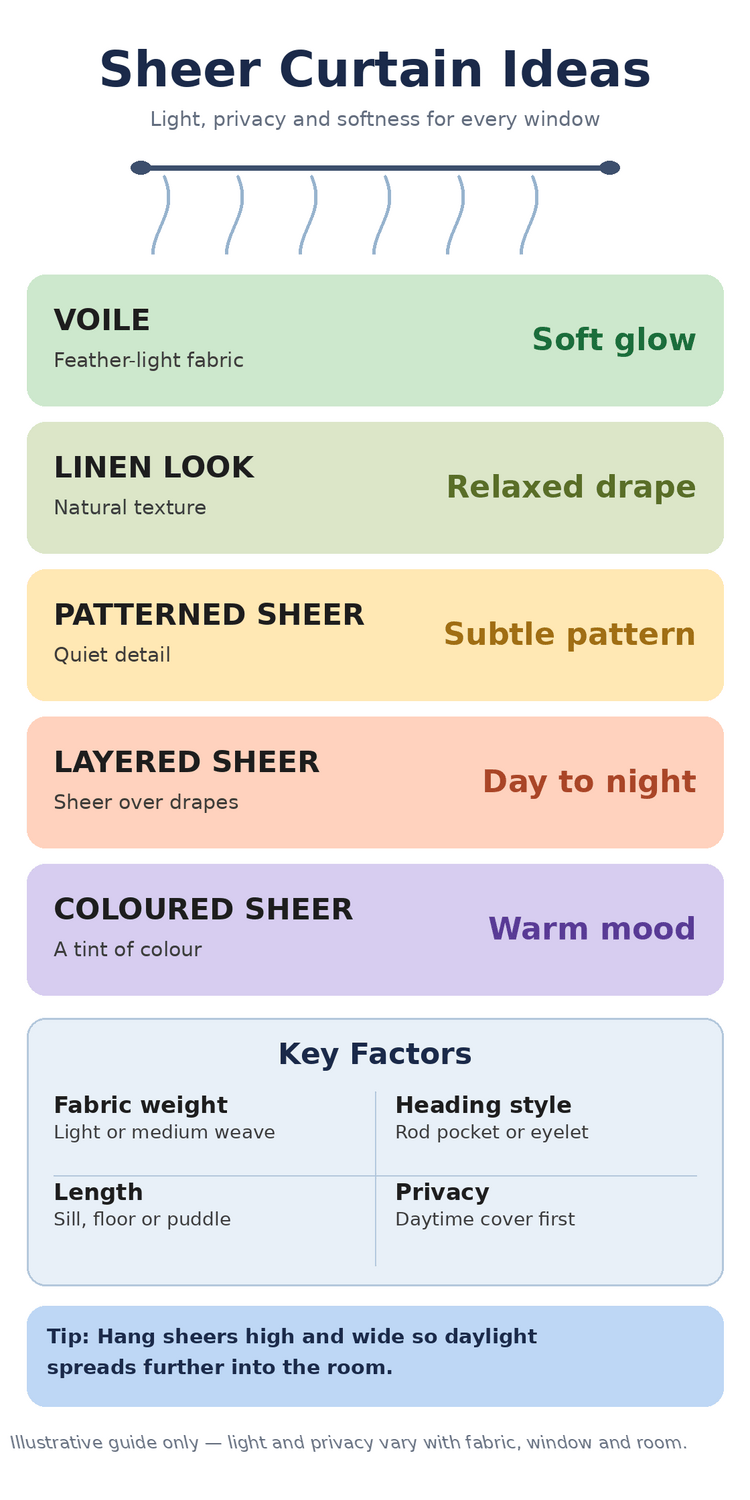
The table below sets out the main forms at a glance. Each form gets its own section later, so you can jump to the one that matches your window.
| Sheer form | What it feels like | Where it shines |
|---|---|---|
| Voile | Feather-light and airy | Soft glow |
| Linen look | Textured and relaxed | Relaxed drape |
| Patterned sheer | Detailed but quiet | Subtle pattern |
| Layered sheer | Sheer over a heavier layer | Day to night |
| Coloured sheer | Tinted and warm | Warm mood |
Keep that table in mind while reading. A sheer that disappoints usually disappoints in one row of it: the wrong weight for the window, the wrong length for the wall, or a pattern that fights the room instead of settling into it.
2. Voile: The Feather-Light Classic
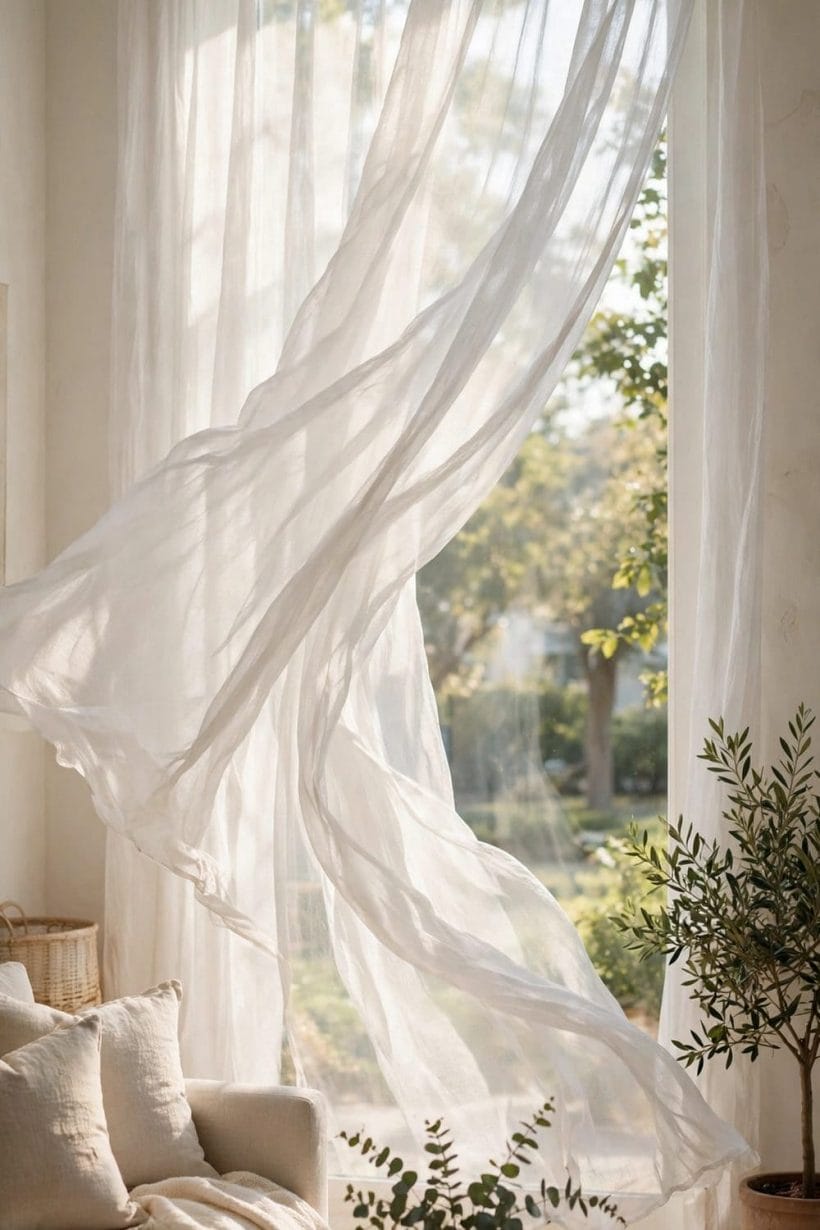
Voile is the sheer most people picture first, and for good reason. It is a plain, finely woven fabric that hangs in soft, even folds and lets daylight through almost untouched. In a living room it reads as barely-there; from the street, the window looks dressed rather than bare, and inside, the light takes on a gentle, diffused quality that flatters everything it touches.
Voile suits wide windows and sliding doors, where a single generous panel can run the full width without visual weight. It also suits rooms that already carry a lot of pattern or colour, because it adds nothing to argue with. Where voile struggles is in rooms that need the curtain to do more work: a north-facing room that is already dim can feel washed out behind a second light-filtering layer, and a bedroom that faces a busy street will want a heavier partner for the night hours.
Hang voile with a little extra width so the folds stay soft when the curtain is drawn. Pulled flat and tight, voile looks thin and stretched; given room to gather, it falls in the loose waves that make it beautiful. A simple rod pocket or a set of rings both suit it, and the heading should be light enough not to drag the fabric down. In a small sleeping room, the same lightness pays off again, and the tiny bedroom ideas post shows how little visual weight a compact room can carry before it feels crowded.
Colour for voile is usually white or ivory, and the choice between them is worth a moment. White voile keeps daylight crisp and cool, while ivory warms the same light slightly, which suits rooms with warm wood or cream walls. Either way, the curtain should be washed gently and dried away from harsh heat, since voile creases easily and holds a crease stubbornly once it sets.
3. Linen-Look Sheers: Texture Without Weight
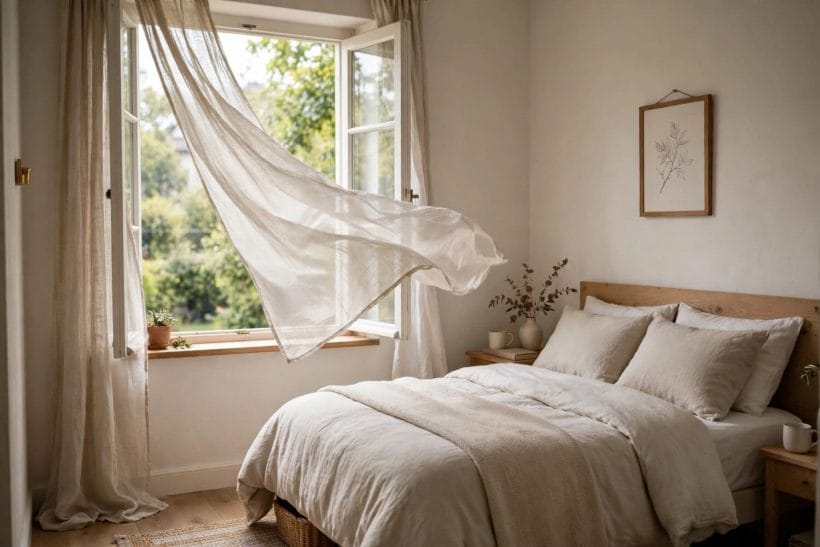
Linen-look sheers trade voile’s smoothness for texture. The weave is slightly slubbed, with tiny irregularities in the threads that catch the light and give the fabric a natural, lived-in surface. The effect is relaxed rather than formal: the curtain looks like something made from a plant fibre, even when the fabric itself is a blend chosen for easier care.
This texture is the reason linen-look sheers suit rooms with other natural materials. Against timber floors, rattan, wool throws and stone, they sit comfortably, adding a layer that feels honest rather than dressed up. In a very sleek, minimal room they can look out of place, the way a rough linen tablecloth would on a glass table, so match the curtain’s texture to the room’s mood, not just to the window.
Linen-look sheers drape a little more heavily than voile, which makes them good for windows where you want the curtain to hold its shape. They fall in broader folds and move less in a draught, so a window that is often open will not send them billowing across the room. That steadiness also makes them forgiving of a slightly uneven hem, since the eye reads the texture before it reads the edge.
One caution: texture shows dust and fading more plainly than a smooth fabric does. A linen-look sheer in a sunny window will age visibly, softening in colour over time, and many owners like that patina. If you want a curtain that looks the same year after year, a smoother weave is the safer choice. The same judgement applies in the main gathering room, where the small living room ideas post shows how texture, kept in check, stops a compact room feeling flat.
4. Patterned and Embroidered Sheers
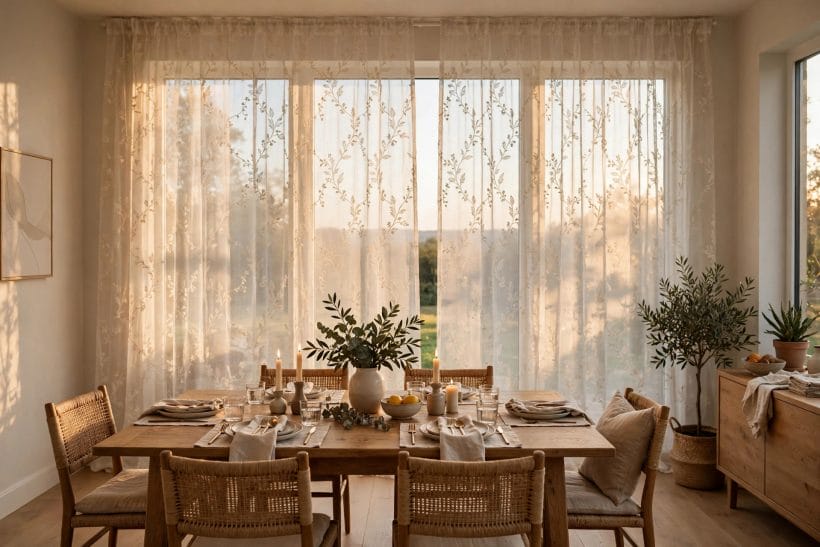
Patterned sheers carry their design in the weave or in embroidery worked through the fabric. From a distance the pattern reads as a soft texture; up close, it resolves into leaves, dots, stripes or geometric repeats. The best patterns for sheers are quiet ones, because the fabric’s job is to filter light, and a loud pattern turns a glowing window into a billboard.
Small, scattered motifs work better than large, dense ones. A trailing vine, a scattered dot, a fine stripe, each of these lets light through the open ground of the fabric while the motif itself casts a faint shadow pattern into the room. That shadow play is one of the quiet pleasures of a patterned sheer: on a sunny morning the design repeats itself, enlarged and softened, across the floor.
Pattern also changes how a room reads. A sheer with a botanical motif leans a room toward a garden feeling; a geometric repeat leans it toward something more tailored. Choose the motif the way you would choose a wallpaper for one wall only, as an accent that the rest of the room can stay calm around. If the room already has patterned cushions, a rug with a strong design, or busy artwork, a plain sheer is the kinder choice, and the pattern can live elsewhere.
Embroidered sheers need a little more care than plain ones. The embroidery threads can catch on rings and hooks, so draw the curtain by the leading edge rather than yanking it along the rod, and wash it in a bag or by hand where the maker advises it. Hung well, an embroidered sheer is the most decorative form in this survey, and it suits a window that is meant to be looked at, not just looked through.
5. Layering Sheers Over Drapes and Blinds
Layering is where sheers earn their keep in rooms that need more than one mood. A sheer hung closest to the glass, with a heavier drape or a blind behind it or in front of it, gives the window two settings: sheer alone by day for filtered light, and the heavier layer drawn at night for privacy and darkness. The sheer never leaves the window; the heavier layer comes and goes around it.
The usual arrangement puts the sheer on its own rod or track nearest the glass, with the drape on a second rod in front. That order matters, because the sheer needs to hang flat and undisturbed while the drape moves. A double rod or a ceiling track with two channels does the job neatly, and the gap between the layers should be wide enough that the drape does not crush the sheer when both are drawn.
Layering also solves the small-room problem of a curtain that must do everything. A family room that is a play space by day and a television room at night, for instance, wants daylight and softness in the morning and a darker, cosier feel in the evening. One window dressing cannot do both unless it is layered, and the living in a tiny house with kids post shows how shared rooms change their job through the day. The same logic applies at any scale: give the window two layers, and the room gains two moods.
Keep the colour relationship simple. A white or ivory sheer works with almost any drape colour, while a coloured sheer narrows the drape choices to tones that sit happily beside it. If the drape is patterned, the sheer should be plain, so the window has one voice at a time rather than two competing ones.
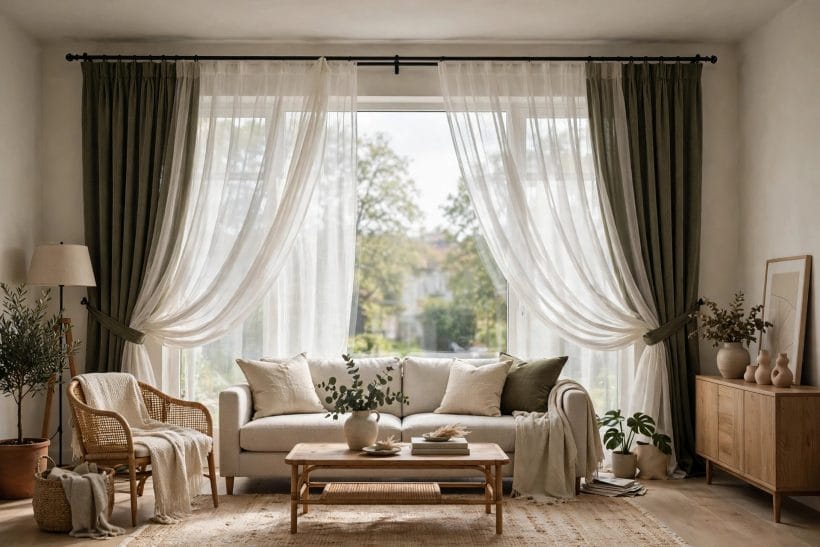
6. Colour: White, Ivory and Soft Tints
White is the default sheer colour because it interferes least with daylight. It keeps the light honest, it matches any wall colour, and it disappears against a bright window in the best way, leaving only the softness it creates. If you are choosing sheers for the first time and want the safest result, white is the answer, and it is the colour most of the rooms in this survey wear.
Ivory is white with the chill taken off. It warms daylight slightly, which flatters warm wall colours, timber and brass, and it softens the contrast between the curtain and a cream wall. In a room that already leans warm, ivory looks intentional where white can look stark. In a cool, grey-toned room, the reverse holds, and white is the better partner.
Soft tints, blush, sage, pale grey, dusty blue, are where sheers start to act as colour in the room rather than as light alone. A tinted sheer colours the daylight that passes through it, so the whole room takes on a faint wash of that colour in the morning. The effect is gentle but real, and it is worth testing with a single panel before committing a whole wall of windows, because a tint that looks pretty in the shop can feel insistent across a large window.
Dark sheers exist too, in charcoal and deep grey, and they behave differently from pale ones. They cut glare more strongly, they read as a deliberate design statement, and they give better daytime privacy than a white sheer because the darker fabric is harder to see through from outside. They also darken the room more than a pale sheer does, so they suit a room with generous windows and plenty of light to spare, not a small, dim one.
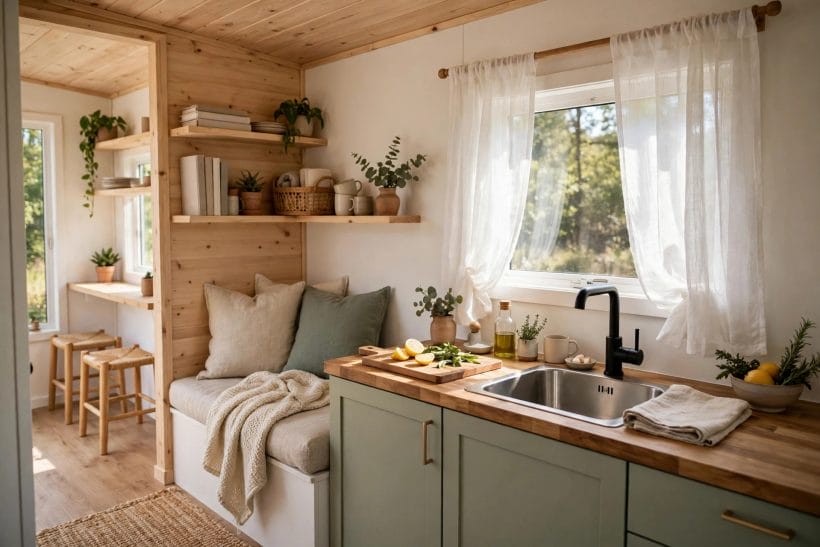
7. Lengths and Headings: How Sheers Hang
Length changes a sheer more than almost any other choice. A sill-length sheer ends at the windowsill and suits kitchens, bathrooms and windows with furniture beneath them, where a longer curtain would bunch or trail. It is practical, tidy, and the easiest length to live with, since it never gets caught under a chair leg or tangled with a radiator.
A floor-length sheer is the formal choice, and it makes a window look taller than it is, especially when the rod is hung well above the frame. The curtain should just kiss the floor or hover a breath above it; a sheer that puddles on the floor looks romantic in a photograph and collects dust and footsteps in real life. In a room with a low ceiling, floor-length sheers are one of the simplest ways to add height without touching the architecture.
Headings decide how the curtain gathers and moves. A rod pocket gathers the fabric into soft, fixed folds and suits a curtain that rarely moves. Eyelets make larger, even waves and slide easily, which suits a curtain drawn daily. A tab top gives a relaxed, informal gather, and a pinch pleat gives a tailored, even fall that suits a more formal room. The heading should match how often the curtain moves: a curtain that is drawn every morning deserves a heading that slides, not one that drags.
Width matters as much as length. A sheer that spans the window exactly, with no extra fabric, hangs flat and looks mean. A sheer with generous extra width gathers into the soft folds that make the fabric beautiful, and it still covers the window when drawn. As a rough guide, the curtain should look full even when it is closed, not stretched thin across the glass.
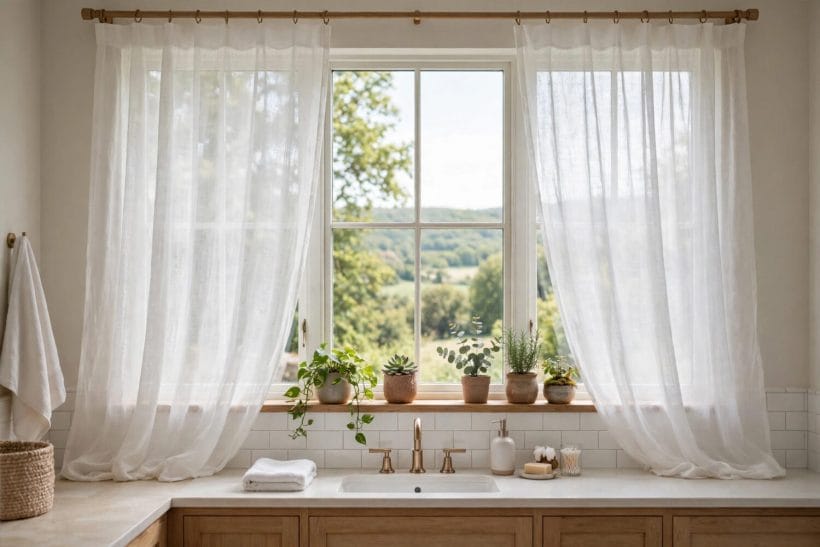
8. Sheers Room by Room: Living, Sleeping and Bathing Spaces
In the living room, sheers do their most visible work. The room is used by daylight, guests see it first, and the windows are often the largest in the house. Floor-length voile or linen-look sheers suit here, hung high and wide so the window feels generous. If the room opens onto a porch or a garden, the sheer becomes part of the threshold between inside and out, softening the boundary without closing it, and the tiny house porch ideas post shows how that indoor-outdoor edge is dressed on the outside.
In the bedroom, sheers are a morning curtain. They let the sleeper wake to filtered light rather than bare glass, and they give the room a softness that heavier curtains alone cannot. Pair them with a heavier layer for the night, and the bedroom gains both moods without a second window dressing. A bedroom sheer should be easy to draw from the bed, so a smooth-sliding heading matters more here than in any other room.
In the kitchen, sheers need to be practical first. A cafe curtain, which covers only the lower half of the window, gives privacy at eye level while leaving the upper half open to the sky, and it suits a kitchen window over a sink or a counter perfectly. The fabric should be washable, since kitchen air carries cooking grease, and a short length keeps the curtain clear of taps, hobs and worktops.
In the bathroom, sheers solve a specific problem: the window must give privacy without giving up daylight, and it must cope with damp air. A sheer in a moisture-tolerant fabric, hung where it does not sit against wet tiles, does that job well, and it looks far softer than a frosted pane. Keep the length short, the fabric washable, and the heading simple, and the bathroom window becomes a pleasant thing rather than a problem to hide. Where the house opens to a patio, the same thinking applies at the glass doors, and the tiny house patio ideas post shows how those openings are framed from the outside.
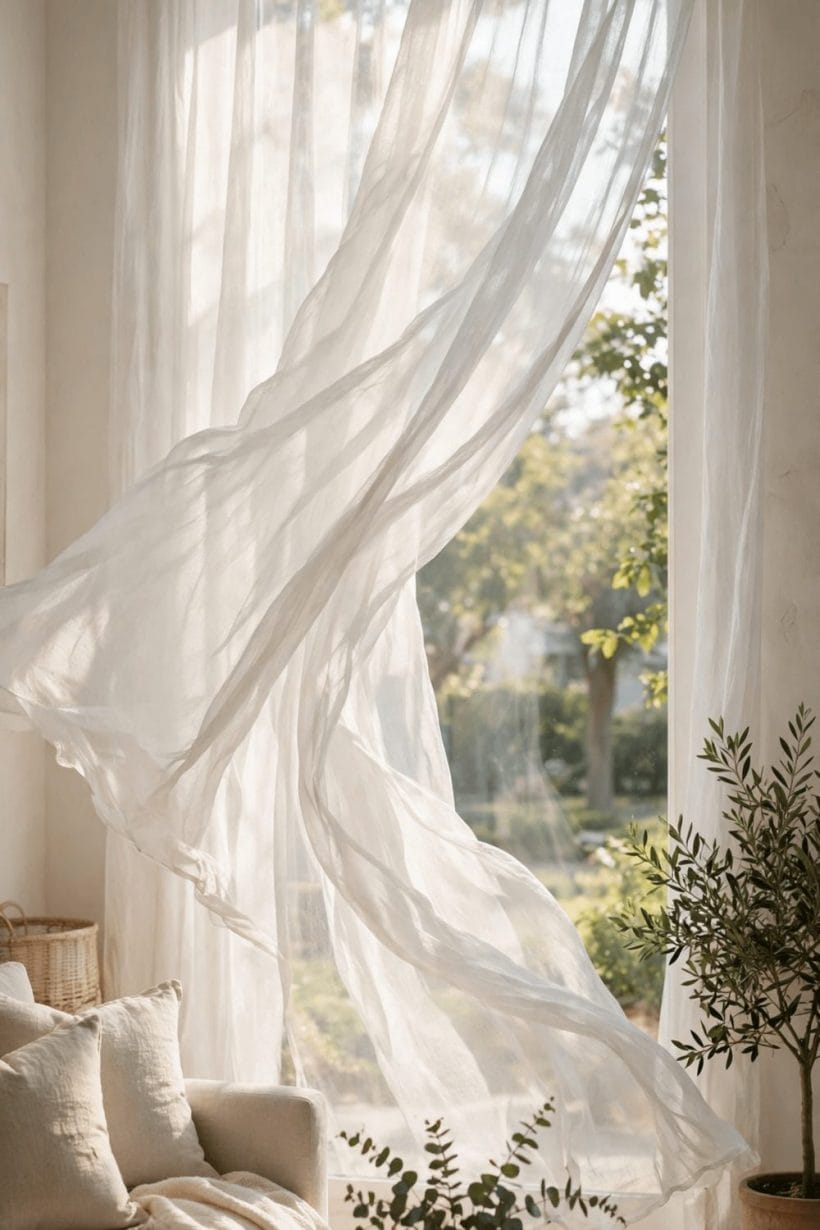
9. Privacy and Light: Getting the Balance Right
Privacy and light pull in opposite directions, and a sheer sits exactly on the line between them. By day, a sheer gives good privacy from the street, because a person outside sees the bright fabric rather than the dim room behind it. That holds while the outside is brighter than the inside, which is true for most of the day in most rooms. It reverses at night, when the room is lit and the street is dark, and then the sheer becomes almost transparent from outside.
The honest way to live with that reversal is to pair the sheer with a second layer for the evening, as the layering section describes, or to accept that the sheer is a daytime curtain and draw something heavier when the lamps come on. A sheer alone is not a privacy solution for a bedroom or a bathroom after dark, and no honest guide should pretend otherwise.
Light, meanwhile, is the sheer’s gift, and it deserves a little attention to direction. An east-facing window gives sharp morning light that a voile softens beautifully; a west-facing window gives warm evening light that a tinted sheer can enrich; a north-facing window gives even, shadowless light that a sheer barely dims at all. Watch your window through a day before choosing, and you will choose the weight that suits the light you actually have, not the light you imagine.
Outside spaces change the balance too. A window that faces a deck or a garden, where people sit close to the glass in the evening, needs its evening layer more urgently than a window facing an empty field, and the tiny house deck ideas post shows how closely those outdoor rooms sit to the glass. The rule is simple: the closer the outside life, the more the evening layer matters.
10. Care, Hanging and Everyday Living
Sheers are easy to live with if they are hung well and washed gently. Most sheers can be machine washed on a gentle cycle, but the safest habit is to follow the care label on the curtain you own, since blends vary. Wash sheers on their own or with similar light fabrics, avoid harsh spin cycles that crease fine weaves, and hang them back at the window while still slightly damp, where their own weight pulls the creases out as they dry.
Hanging is worth doing carefully, because a sheer shows every fault in its rod. The rod should be level, firmly fixed, and wide enough that the curtain clears the window frame on both sides when drawn. A rod that sags in the middle will drag the sheer down with it, and a rod fixed too close to the frame will crush the folds. Fix the rod first, hang the curtain second, and step back to look at the whole window before deciding the job is done.
Everyday living with sheers means accepting a little movement. They stir in a draught, they billow when a door opens, and they catch the light differently through the day. That movement is part of their charm, and it is why rooms with sheers feel alive in a way that rooms with blinds sometimes do not. If the movement bothers you, a slightly heavier linen-look weave will calm it, or a tieback will hold the curtain to one side for the hours you want the window clear.
Children and pets change the calculation a little. Long sheers at floor level will be pulled, climbed and slept on, and a sheer that puddles is an invitation to both. In a house with small children or lively animals, a shorter length, a sturdy rod and a fabric that washes well are worth more than the most beautiful drape, and the curtain can always be lengthened later when the household calms down.
Final Considerations
A sheer curtain is a small decision that changes a room out of proportion to its size. It asks little attention, it needs gentle care, and it repays that care every morning when the light comes through it softened and kind. Choose the weight for the light you have, the length for the wall you have, and the colour for the room you have, and the window will largely take care of itself.
Start with one window, not the whole house. Hang a voile or a linen-look sheer, live with it through a week of mornings and evenings, and notice what it does to the room at different hours. That week will tell you more than any guide can about which form suits your home, and the rest of the windows can follow once you know.




0 Comments