

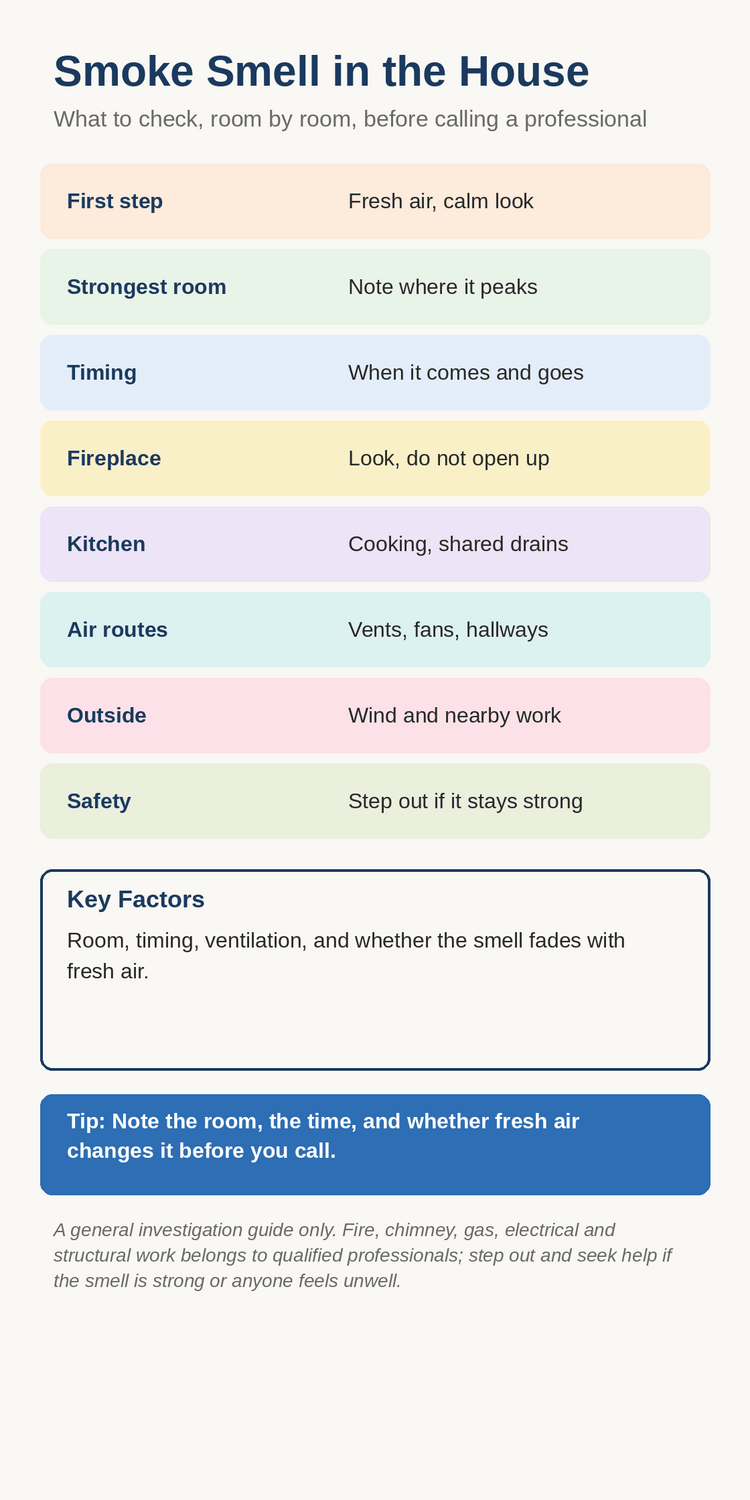
A smoke smell in the home can be unsettling, especially when it reminds you of a campfire and there is no fire lit in the house. It may drift through one room and fade, or it may hang in the air near a particular corner, a fireplace, or a doorway. People often describe the problem with the search phrase “my house smells like campfire”, and that description is a useful starting point, because it captures the character of the smell without yet explaining where it comes from. Before worrying about the cause, it helps to slow down, let fresh air through the home, and work through the rooms one at a time. This guide is about investigation in general terms: noticing where the smell is strongest, when it appears, and which rooms seem connected to it, so you can describe it clearly if you need professional help.
One boundary runs through the whole guide. It offers no instructions for handling, cleaning, or neutralising a smoke smell, and it never suggests opening up a fireplace, a chimney, a flue, a vent, or any fixed fitting. Fire, chimney, gas, electrical, and structural work belongs to qualified professionals, and anything involving those parts of the home should be left to them. The checks below are about looking, listening, and noticing patterns, not about taking things apart, lighting or relighting anything, or trying to remove a smell. If the smell feels strong, if a smoke alarm is sounding, or if anyone in the home feels unwell, leave the home, get fresh air, and seek professional help rather than continuing to investigate.
It also helps to keep notes as you go. A short note of the room, the time of day, and whether windows were open can reveal a pattern that a single sniff cannot. A smell that appears on an evening when a neighbour has a fire lit outdoors points in a different direction from one that appears whenever the heating runs, and a smell that fades quickly once windows are opened tells a different story from one that lingers in a single room. Patterns, not guesses, are what help a professional narrow the search.
1. Start With Fresh Air and a Calm First Look
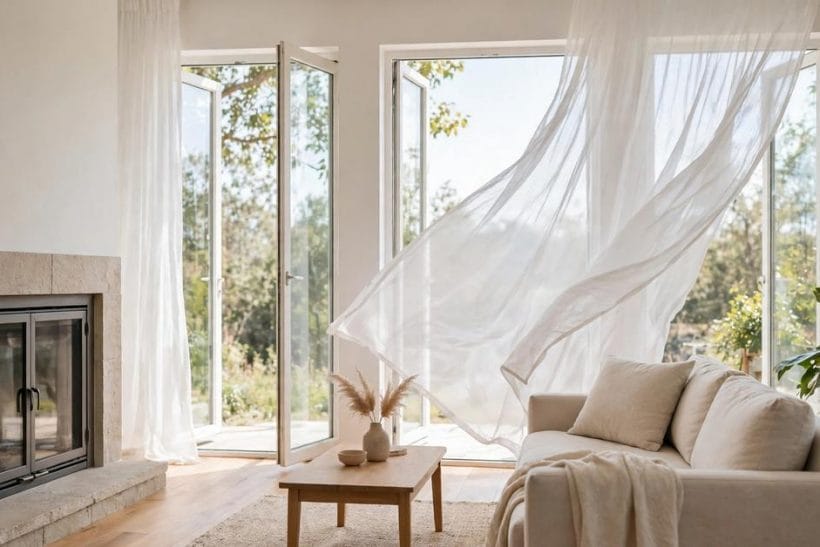
The first step is the simplest, and it is also the most useful. Open windows on opposite sides of the home where you can, so air can move through rather than sitting still. A gentle cross-breeze often makes a smell easier to judge: you can tell whether it weakens as fresh air arrives, whether it returns when windows close, and whether it seems to come from inside the home or drift in from outside. There is no need to rush this step. Give the air a little time to change, and notice what changes with it.
While the air is moving, take a calm look around the room where the smell is strongest. Notice whether a fire was recently lit anywhere in the home, whether cooking has recently taken place, and whether any doors to smaller rooms are closed. Closed doors can hold a smell in one place, while an open door lets it spread, so the layout of open and closed doors is itself a useful clue. None of this requires touching a fireplace, a vent, or a fitting. It is simply about observing the room as it is.
If the smell feels strong while you are looking around, step outside for fresh air and come back later, or leave the investigation to a professional. A strong smell is a signal to pause, not a challenge to push through. Fresh air, time, and a clear head will serve the investigation better than hurrying, and the notes you take afterwards will be more reliable for it.
2. Notice Where the Smell Is Strongest
Walk slowly from room to room and notice where the smell is clearest and where it fades. A smell that is sharp near the fireplace and faint everywhere else points the search in one direction, while a smell that is even throughout the home points in another. Doorways are useful testing points: pause at each doorway, notice whether the smell grows stronger or weaker as you cross it, and jot down what you find. This kind of room-by-room comparison costs nothing and often narrows the search more than any single guess.
Pay attention to smaller spaces too. Hallways, stairwells, and rooms beside a chimney breast can hold smells that larger rooms soften, so a faint smell in a living room may be much clearer near its source. At the same time, remember that air moves through a home in ways that are not always obvious. A smell that seems to come from one room may have travelled along a hallway, through a shared vent, or from an adjoining space, so treat the strongest room as a starting point for questions, not as a proven source.
It can help to sketch a simple plan of the home and mark the rooms where the smell is strong, mild, or absent. That sketch becomes a useful thing to show a chimney specialist, a heating engineer, or another professional, because it turns a vague impression into a clear picture. If the pattern changes over the day, add a second sketch later and compare the two. Changes in the pattern are often as informative as the pattern itself. Tiny house interiors show how compact homes connect their rooms, which may help you picture how air reaches each room in your own home.
3. Notice When the Smell Appears and Fades
Timing is one of the most revealing clues in a smell investigation. Notice whether the smell appears at a particular time of day, after a particular household activity, or only when certain rooms are in use. A smell that appears when the heating runs suggests a different line of enquiry from one that appears in the evening regardless of what has been happening in the home, and a smell that appears after cooking suggests yet another. Write down the time and the activity alongside each observation, even when the connection seems uncertain.
Also notice how the smell fades. Does it clear quickly once windows are opened, or does it linger for a long time? Does it return when windows are closed again, or does it stay away? A smell that clears fast with ventilation and returns slowly may behave differently from one that stays stubbornly in one room. Neither pattern proves a cause on its own, but both help a professional decide where to look first, and both are worth recording honestly rather than tidying into a neater story than the facts support.
Seasonal and weather patterns can matter as well. Wind direction, still air, cold days, and warm days can all change how smells travel around and into a home, so a smell that appears on some days and not others may still have an ordinary explanation. Note the weather in passing when you note the smell, and look for repeats over days rather than drawing conclusions from a single occasion. Patience here prevents a great deal of unnecessary worry.
4. Check the Fireplace and Chimney Area in General Terms
Where a home has a fireplace, the fireplace area is a natural place to notice, because a smoke-like smell and a fireplace are often connected in people’s minds. Notice whether the smell is stronger near the fireplace than elsewhere, whether it follows a fire having been lit, and whether the fireplace doors, where fitted, are open or closed. Observing the room around the fireplace is enough: whether the smell gathers near the hearth, whether it fades as you move away, and whether it changes when the room is ventilated. There is no need to open the firebox, reach into the flue, or handle anything connected with the fireplace to learn this.
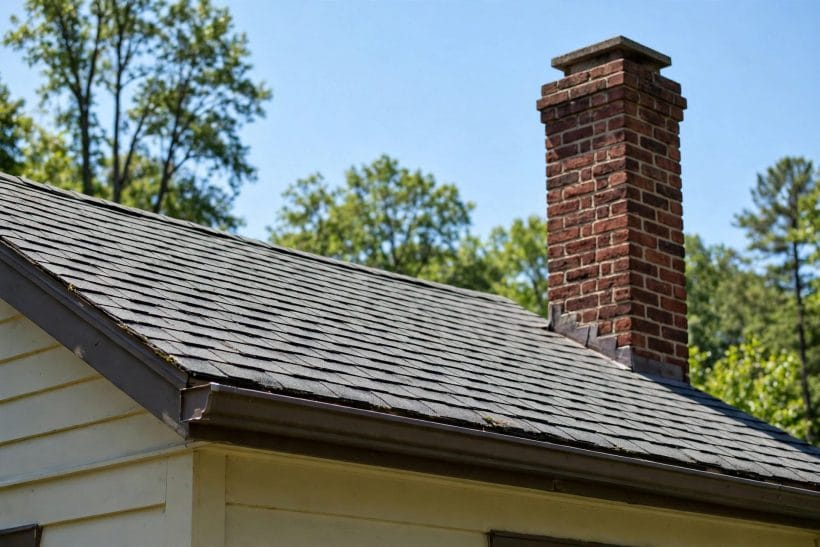
Also notice the chimney breast and the rooms that share it. Rooms above, below, or beside a chimney breast can sometimes carry a faint smell even when the fireplace itself is not in use, and a smell that is clearest in a bedroom above a fireplace room tells a different story from one that is clearest beside the hearth itself. Keep the observation at the level of rooms and timing: which room, when, and how strong. Anything involving the firebox, the flue, the chimney, or the fitting of doors or vents belongs to a qualified chimney or fireplace professional.
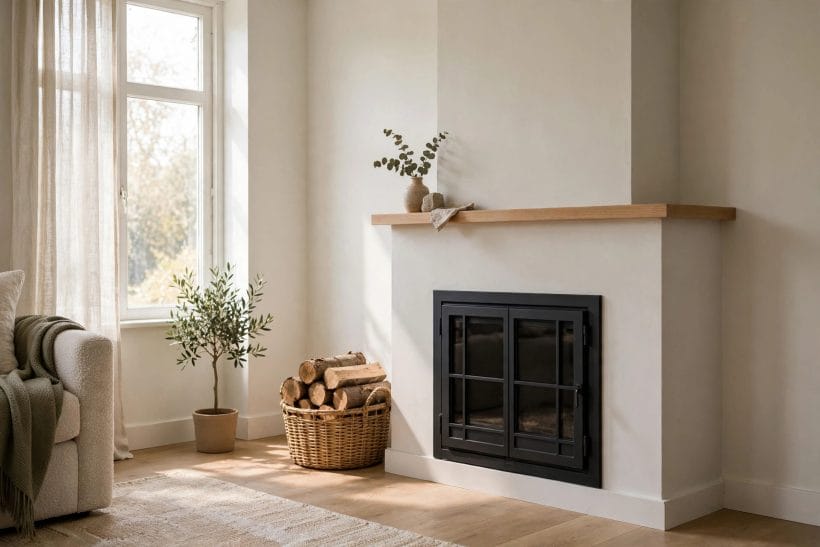
If the fireplace area seems connected to the smell, the next step is still observation rather than action. Note what you found, keep the room ventilated in general terms, and do not light, relight, or tend a fire in order to test the smell. A professional can judge the fireplace and chimney far better than a guess from the surface, and a clear description of rooms, times, and patterns will help them far more than any attempt to investigate fittings yourself.
5. Check the Kitchen and Cooking Areas
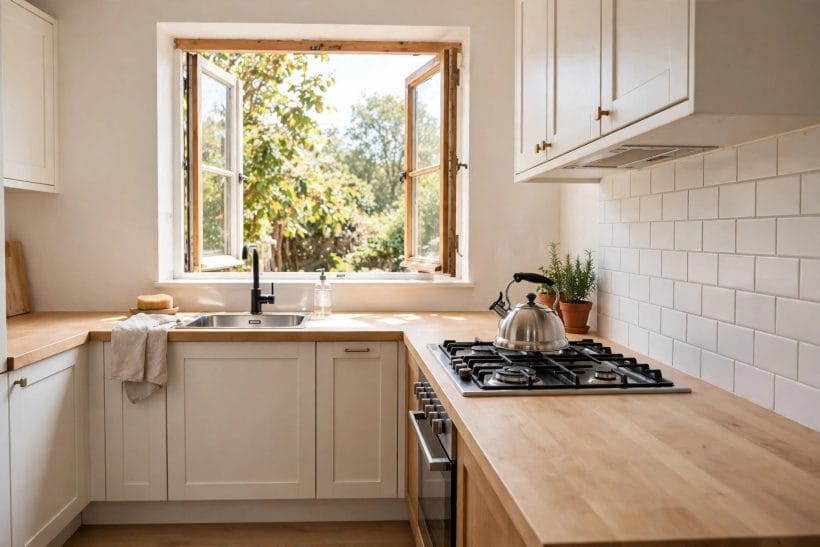
Kitchens are worth a careful look, because cooking can leave a smoke-like smell that lingers long after the cooking itself has finished. Notice whether the smell is stronger in the kitchen than in neighbouring rooms, whether it appears after cooking, and whether it changes when the kitchen window is opened or the cooker hood fan runs. As with other rooms, timing and place are the clues that matter, and a short written note will preserve them better than memory.
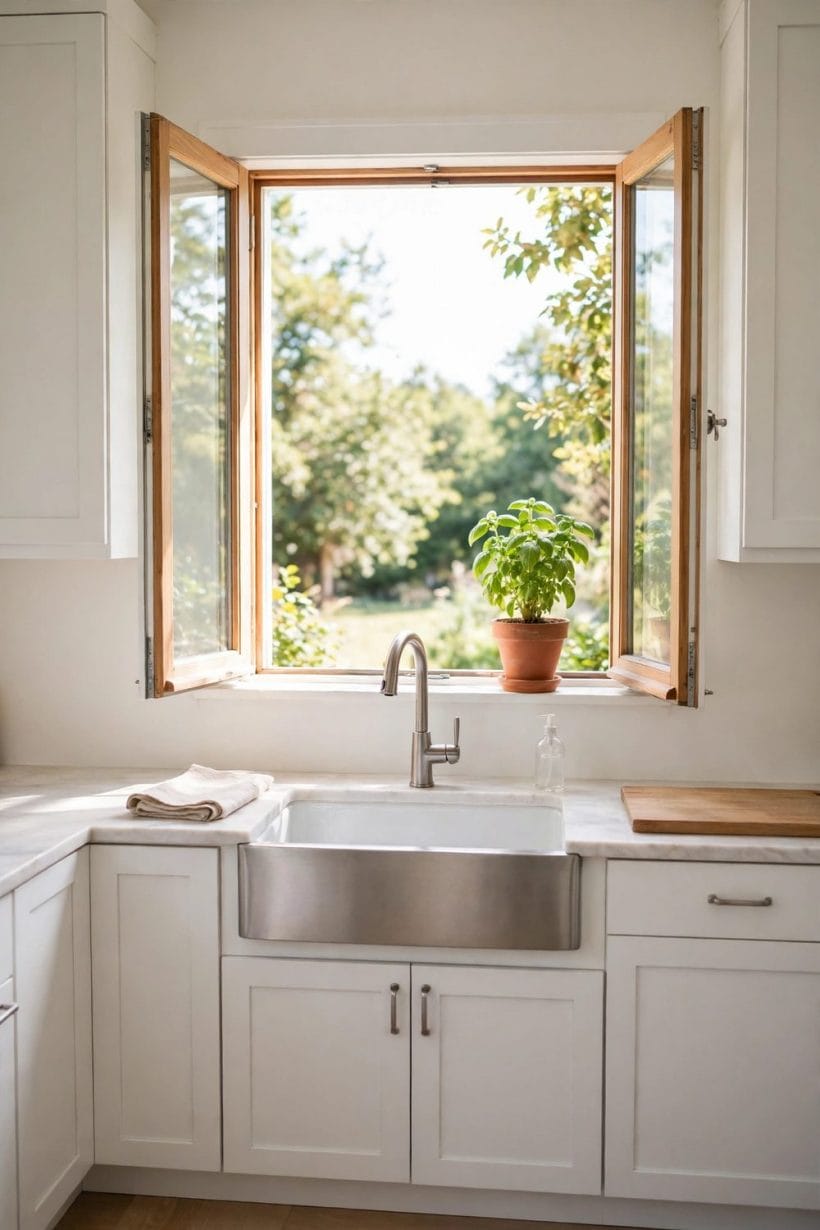
Also notice how the kitchen connects to the rest of the home. A kitchen that opens onto a living room will share its air with that room, while a kitchen with a door that is usually kept closed will hold a smell longer. Kitchen ideas show how kitchen layouts are commonly arranged, which can help you picture which rooms sit closest to your kitchen and might share its air. That picture is useful background for a professional, who can judge what is connected to what far better than a guess from the surface.

As elsewhere, keep the kitchen ventilated in general terms while you observe, and do not attempt to investigate cooker fittings, flues, or ducting yourself. If the smell is persistent, if it seems connected to cooking equipment or to a shared flue, or if you are unsure about anything you have noticed, a qualified professional is the right person to ask. A clear note of rooms, times, and patterns will make that conversation shorter and more useful.
6. Check Heating and Ventilation Routes
Heating and ventilation routes deserve attention, because they move air between rooms and can carry a smell from one part of the home to another. Notice whether the smell appears when the heating runs, whether it seems stronger near a vent or a warm-air outlet, and whether it fades when the system is off. A smell that spreads whenever a system runs tells a different story from one that stays in a single room regardless of the system, and both patterns are worth noting.
Ventilation fans are also worth noticing in general terms. A bathroom fan, a kitchen fan, or a whole-home system changes how air moves, and a room that relies entirely on a fan will behave differently from a room with a window that opens. Tiny house ventilation explains ventilation thinking in small homes in general terms, which can help you describe your own arrangement to a ventilation specialist. Again, the goal is noticing, not fixing: anything involving fan fittings, wiring, ducting, or heating equipment is work for a professional.
Filters, vents, and grilles can be observed from the room side without being opened or removed. Notice whether a vent looks blocked by furniture or curtains, whether a grille sits behind a closed door, and whether air seems to reach a room at all. Those are ordinary features of a home, and noticing them is part of understanding the smell. Never open ducting, remove fixed panels, or attempt to service heating or ventilation equipment yourself.
7. Think About Air Movement Through the Home
Air movement shapes every smell investigation, because smells travel on air. Notice which windows open, which doors are usually closed, and whether air seems to flow through the home or sit still in certain rooms. A home with windows on one side only will air differently from a home with windows on opposite sides, and a room with its door closed will hold a smell longer than a room that opens onto a breezy hallway. These are ordinary features of a home, and noticing them is part of understanding the smell.
Living rooms are often where a smell is first noticed, simply because that is where people spend time. Tiny living room ideas and small living room ideas show how compact living spaces are arranged, which may help you think about how air reaches the room where you first noticed the smell. If the living room is the only room affected, the search may focus on its windows, doors, and adjoining spaces; if every room is affected, the search may need to look wider.
Stairwells and hallways matter here too, because warm air rises and carries smells with it. A smell noticed upstairs may have started downstairs, and a smell noticed downstairs may have drifted in from outside at ground level. Sketching the path of air through the home, from the rooms where it enters to the rooms where it gathers, can reveal a route that a single room cannot. That sketch, together with your timing notes, is exactly the kind of material a professional finds useful.
8. Consider Sources Beyond Your Own Rooms
Not every smell starts inside your own rooms. Smells can drift in from outside, from neighbouring homes, from shared spaces in a building, or from work happening nearby. A campfire-like smell in particular may arrive from outdoors: a neighbour’s outdoor fire, garden burning nearby, or a distant fire can leave a smell that drifts through open windows and then clears. Notice whether the smell is stronger near a particular window or door, whether it appears when neighbours are active outdoors, and whether it fades when the wind changes. A smell that is clearest near one outside wall, and faint everywhere else, may be arriving from outside rather than arising inside.
Shared buildings add another possibility. Hallways, stairwells, and spaces above or below your home can all carry smells between homes. If you live in a shared building and the smell seems to come from a shared space, that is useful information for a building manager or a professional, who can look at shared areas that are not yours to investigate. There is no need to enter spaces that are not yours, or to ask neighbours about their household habits; simply noting where the smell is strongest is enough.
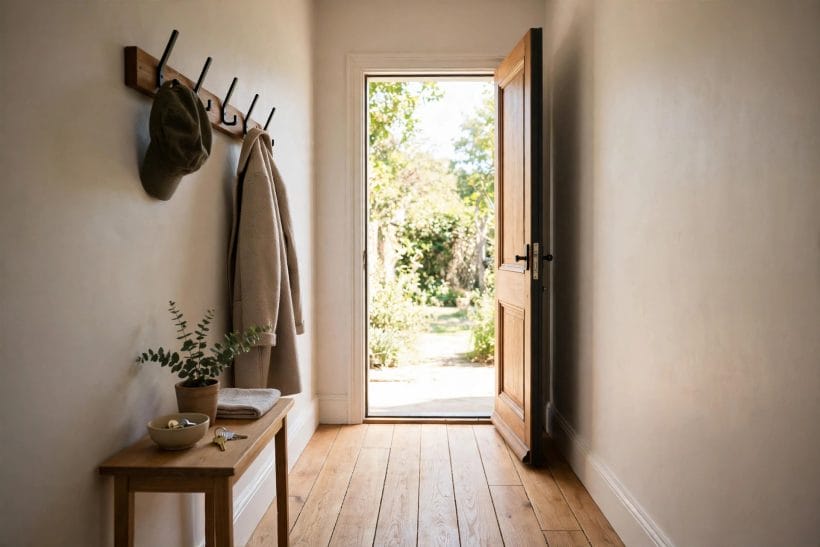
Work nearby can also matter. Building work, maintenance, or outdoor burning in a neighbouring home or nearby can leave a smell that drifts for a while and then clears. If the smell began around the time such work started, note that timing without drawing conclusions. A professional can weigh that timing alongside the other patterns you have recorded, and a note made at the time will be more reliable than a memory reconstructed later. Tiny house designs show how compact homes sit within their plots and beside neighbouring homes, which may help you picture the routes by which an outside smell could reach your rooms.
9. Know When to Step Out and Seek Help
Most smell investigations are calm, slow affairs, but some situations call for stepping out rather than continuing. If the smell is strong, if it grows stronger rather than fading with ventilation, if a smoke alarm is sounding, or if anyone in the home feels unwell, dizzy, or irritated in the eyes, nose, or throat, leave the home and get fresh air. Do not try to identify the source by staying in a strongly smelling home, and do not attempt to deal with anything that might be causing it. Fresh air and distance come first, and questions can wait until you are somewhere comfortable.
Professional help comes in different forms depending on what you have noticed. A chimney or fireplace specialist can advise on fireplaces and flues, a heating and ventilation specialist can advise on fans and air movement, and an emergency service can advise when a smoke alarm sounds or when there is worry about fire. You do not need to decide in advance which one fits; a clear description of the smell, the rooms, and the timing will help whichever professional you reach first point you in the right direction. No phone numbers are given here, because the right service varies by place, and a local directory or emergency guidance for your area is the reliable source for contact details.
If you are ever unsure whether a situation is safe, treat uncertainty as a reason to seek advice rather than a reason to keep investigating. Professionals would far rather answer a cautious question than be called after someone has spent a long time in a strongly smelling home. Stepping out, ventilating in general terms, and asking for help are not overreactions; they are the sensible core of any smell investigation.
10. What to Tell a Professional When You Call
When you do call a professional, a short, organised account will help them more than a long, uncertain one. Start with the basics: which rooms are affected, when the smell first appeared, and whether it comes and goes or stays constant. Then add the patterns you noticed: whether ventilation changes it, whether it follows heating, cooking, or a fire having been lit, and whether it seems stronger near a particular window, door, fireplace, or room. Those details give a professional a place to start, and they often narrow the search before anyone visits.
It also helps to mention what you have already observed about ventilation and layout: which windows open, whether fans run, whether doors are usually closed, and whether the smell seems to come from inside or outside. Tiny house living room ideas may help you picture how rooms connect in a compact home, which can make your description clearer. You do not need to offer a theory about the cause, and it is better not to: a careful professional will prefer honest observations to a confident guess, because guesses can send a search in the wrong direction.
Finally, mention anything that worries you plainly, including whether anyone has felt unwell, whether a smoke alarm has sounded, and whether the smell is getting stronger. Professionals need that information to judge urgency, and holding it back helps no one. Write your notes down before you call if you can, so you do not forget a detail in the moment. A calm, factual account is the most helpful thing a householder can offer, and it is well within reach after even a short period of careful observation.
Final Considerations
A smoke-like smell in the home is usually a puzzle with an ordinary explanation, but it deserves a patient, observant approach rather than a hurried one. Fresh air, room-by-room noticing, timing notes, and a willingness to ask a professional when the picture stays unclear will resolve most cases more reliably than guesswork. The rooms, the ventilation, and the timing together tell a story, and that story is worth recording carefully before any conclusions are drawn. That is the whole point of the search phrase “my house smells like campfire”: it names the smell honestly, and the investigation that follows turns that name into a clear, checkable pattern.
Keep the safety boundaries in mind throughout. Never open up a fireplace, chimney, flue, vent, or fixed fitting yourself, never light or relight anything in order to test a smell, never attempt fire, chimney, gas, electrical, or structural work yourself, and never stay in a strongly smelling home to investigate further. Ventilation in general terms and professional help are the two responses that fit every stage of this guide, from the first faint smell to a persistent one. If the smell lingers, if its source stays unclear, or if anyone feels unwell, those two responses are also the right next step.
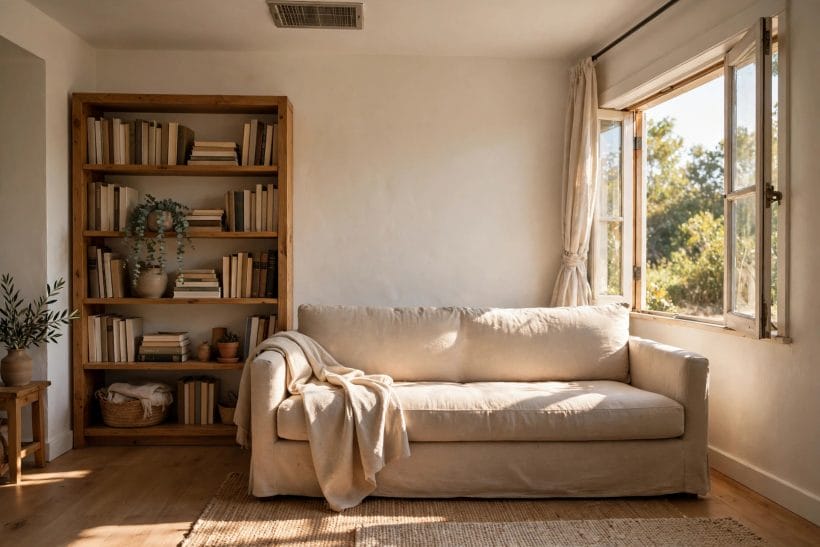
With notes in hand and a clear description ready, you are well placed to get useful help quickly, whether that help comes from a chimney specialist, a heating engineer, a ventilation specialist, or another professional. A smell investigation done calmly, with fresh air and good notes, is a small piece of home care that protects both the home and the people in it, and it leaves you with a clearer understanding of how air moves through your own rooms.



0 Comments