

For many tiny house dwellers, water independence is the ultimate goal: park off-grid and live off the sky. Buying a tank and a pump is the easy part. The part most builders overlook is the roof itself — yet the pitch and shape of that roof decide not just how much water you catch, but how clean it is when it reaches your tank.
1. Roof Pitch and the Harvest at a Glance
Roof pitch for water collection is really two decisions wearing one name. The first is the material the rain lands on, because the surface decides what washes into the tank along with the water. The second is geometry: the steepness of the slope, measured as rise over run, and the shape of the roof — which together decide how fast the water moves, what it carries with it, and how many gutters and downspouts stand between the sky and your storage. The table below gathers the whole system — material, pitch bands, shape and yield — in one place; the sections after it take each row apart.
| Attribute | Detail |
|---|---|
| The Goal | Water independence: park off-grid and live off the sky |
| The Overlooked Part | Designing the roof itself for collection — most builders stop at the tank and the pump |
| The Material | Metal roofing, standing seam or corrugated — the only serious choice |
| The Rejected Surfaces | Asphalt shingles shed petroleum granules and grit; cedar shakes release tannins |
| The Measure | Pitch is rise over run: 4:12 rises 4 inches for every 12 inches of horizontal length |
| The Steep Band | 6:12 to 12:12 — self-cleaning, but a heavy height penalty |
| The Shallow Band | 1:12 to 3:12 — maximizes loft space, but traps debris |
| The Sweet Spot | 3:12 to 4:12 — sheds bulk water, prevents pooling, keeps a functional loft |
| The Shape Winner | A shed roof sends 100% of the rain to one single gutter |
| The Shape Loser | A gable roof splits the rain 50/50 and doubles the plumbing |
| The Yield Rule | Footprint, not slope, sets the volume: 1 sq ft × 1 inch of rain ≈ 0.623 gallons |
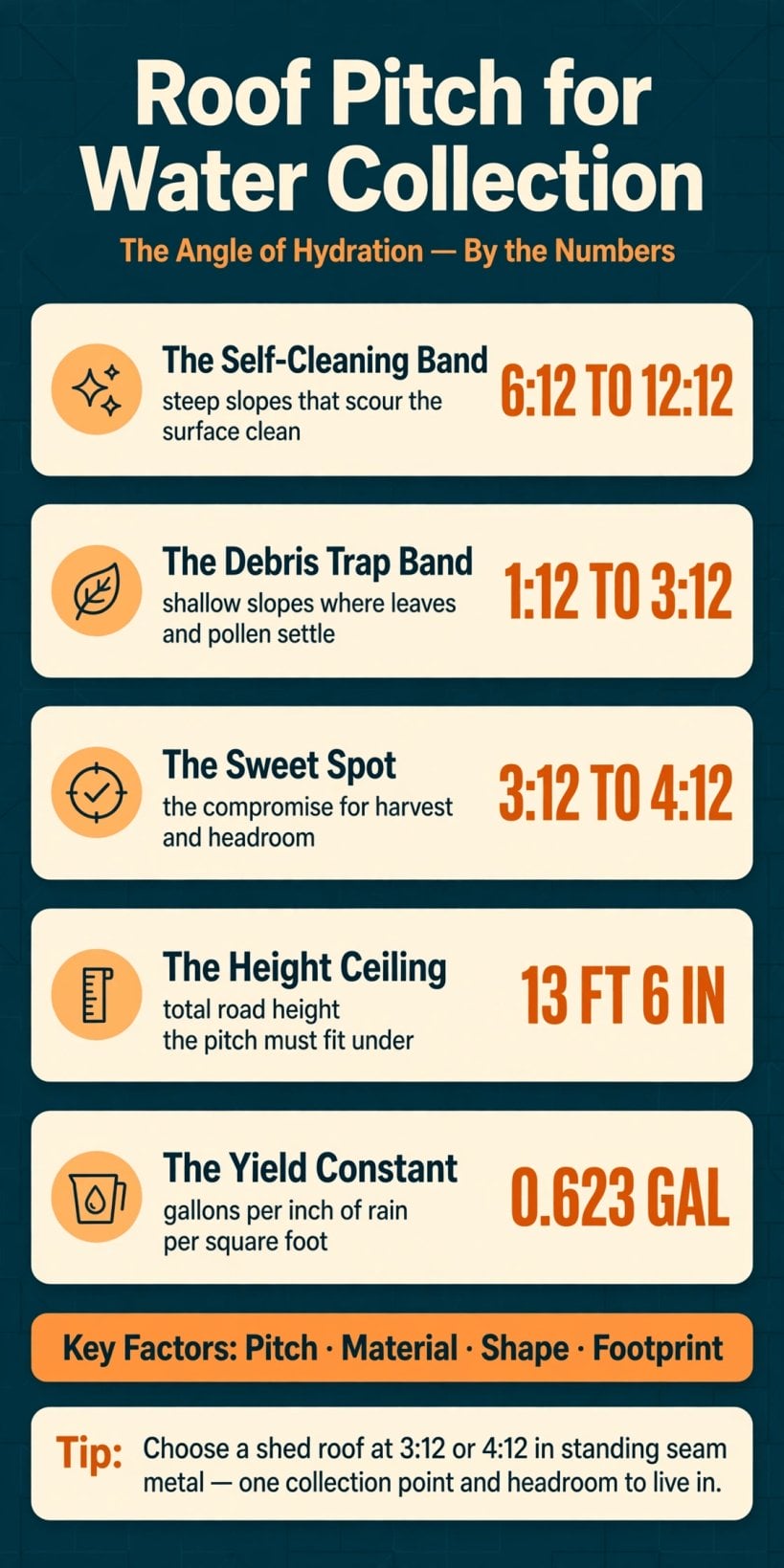
A 3:12 to 4:12 sweet spot, a 13′ 6″ height ceiling and 0.623 gallons per square foot per inch of rain — the harvest angle on one card.
2. Material First: Why Metal Is King
Before debating angles, settle the material, because the surface is where the water’s cleanliness is decided. For rainwater harvesting, metal roofing — standing seam or corrugated — is the only serious choice. The alternatives each contaminate the catch in their own way. Asphalt shingles shed petroleum granules and grit into your water, and they are hard to clean. Cedar shakes release tannins that turn your water brown, like tea — the same cedar celebrated in cedar shakes on a tiny house is, as a catchment surface, a tea bag over your tank.
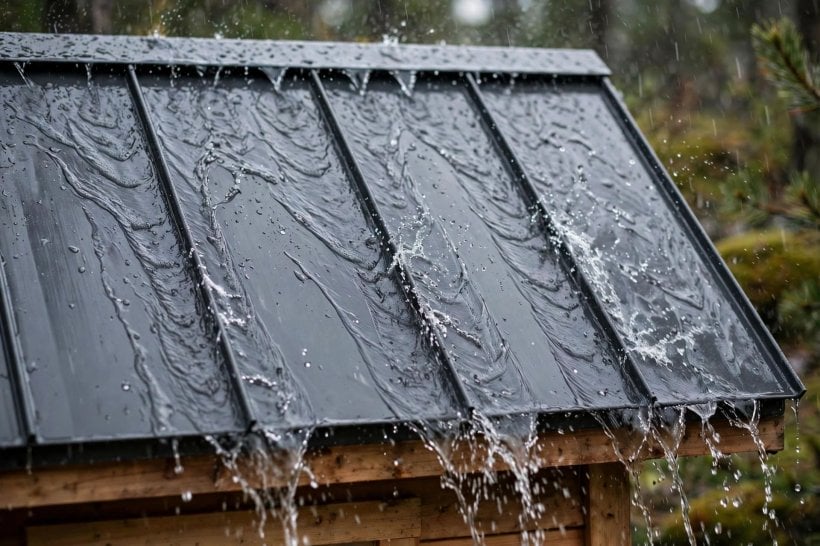
Metal’s virtues are exactly the ones a catchment surface needs. It is slick, so water and debris move across it instead of soaking in. It is non-porous, so nothing the sky delivers is absorbed and later released into the flow. And it sheds debris instantly, which means the leaves and droppings that land on it leave with the first rain rather than rotting in place. Put together, metal provides the cleanest “catch” of any common roofing surface — and every angle decision that follows assumes this surface, because pitch can only manage what the material lets the water carry. One member of the metal family carries a geometric warning of its own, though: corrugated profiles behave differently on shallow slopes, a caveat §7 returns to — the profile choice itself is weighed in corrugated metal siding, vertical vs. horizontal. At the far end of the surface spectrum sits the opposite instinct entirely, a living planted surface rather than a slick one, weighed on its own terms in our look at green roofs on tiny houses.
3. Reading a Pitch: Rise Over Run
Roof pitch is measured in “rise over run”: the first number is how many inches the roof climbs, the second is the horizontal distance over which it climbs them. A 4:12 pitch, in the original’s own example, means the roof rises 4 inches for every 12 inches of horizontal length. The notation is simple, but what it encodes is behaviour. A pitch figure is a prediction about water: how fast it will move across the surface, how much of what lands on the roof it will carry away, and how much vertical space the slope will take out of the house beneath it.
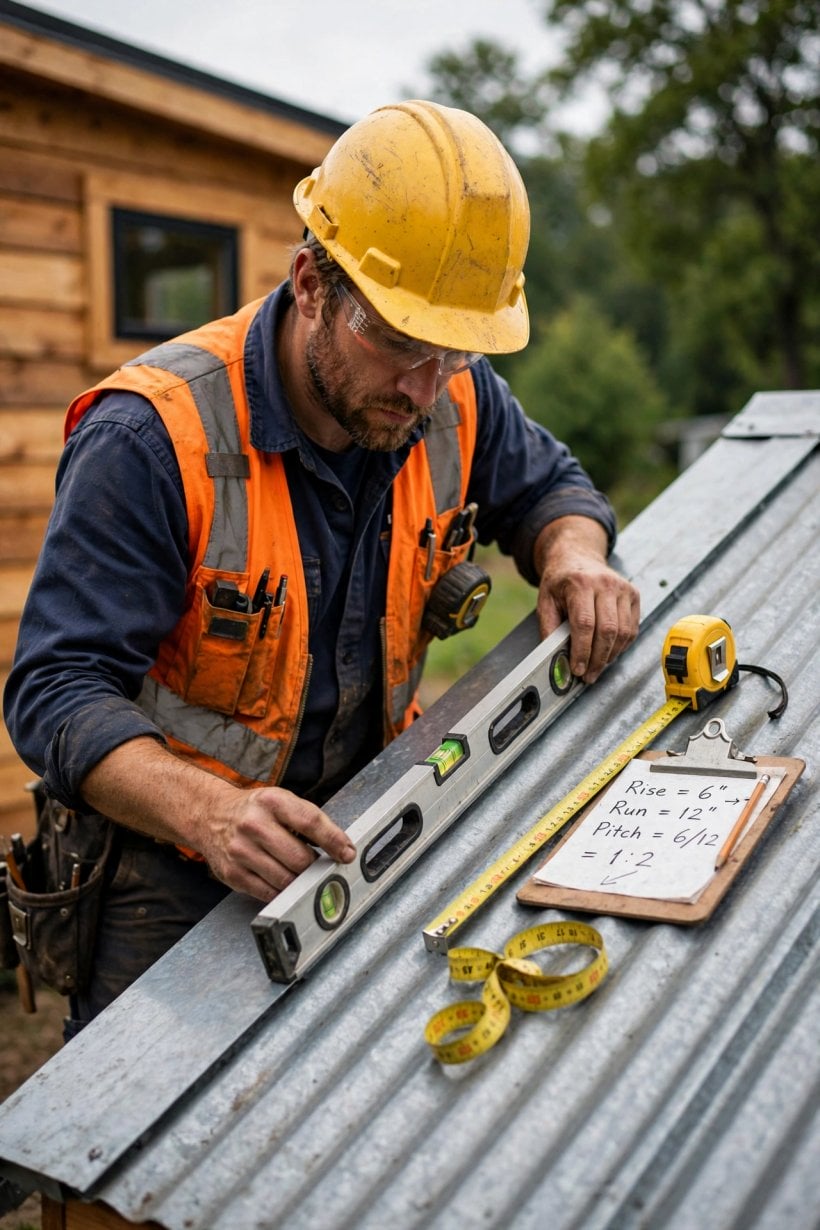
For a Tiny House on Wheels, the useful range of that prediction falls into three bands, and the next three sections take them in turn. At the top are the steep pitches, 6:12 to 12:12, where gravity does the cleaning for you — at a price measured in headroom. At the bottom are the shallow pitches, 1:12 to 3:12, which protect the loft and tax the water. Between them sits the compromise band, 3:12 to 4:12, that the original lands on for a house that has to harvest and be lived in at the same time. Read the bands as a trade, not a ranking: every inch of rise you add buys speed and cleanliness, and pays for them out of the same fixed height budget the whole house lives under.
4. The Steep Band (6:12 to 12:12): The Self-Cleaning Effect
The steep pitch’s virtue has a name in the original: the “Self-Cleaning” Effect. Gravity moves water so fast down a 6:12-to-12:12 slope that the flow scours the roof surface as it goes. Leaves, bird droppings and pollen — the three contaminants that land on every roof — are washed into the first-flush diverter almost immediately, instead of sitting on the surface, soaking, and breaking down into the next rainfall. The steep roof, in other words, does not merely deliver water; it delivers water that has swept its own catchment clean on the way down.

For a harvesting system, that speed is a water-quality feature, not a cosmetic one. Everything organic that stays on a roof becomes part of what the tank eventually receives, so a surface that clears itself with every storm is doing treatment work before the water ever reaches a filter or a diverter. The steep band is the pitch range where the roof behaves most like a chute and least like a shelf. What it costs is not measured on the roof at all, though — it is measured inside the house, in the vertical space the slope consumes. That bill is the subject of the next section, and on a house with a legal height ceiling, it is not a small one.
5. The Height Penalty: 13′ 6″ and the Loft
The steep pitch’s con is the Height Penalty, and it is specific to a house on wheels. On a tiny house, you are limited to 13′ 6″ of total height. That ceiling is absolute: trailer, walls and roof all have to fit beneath it, every mile of every trip. A steep roof eats up precious vertical space within that budget — the slope has to climb somewhere, and where it climbs is out of the interior. The cost lands, precisely, on the sleeping loft: a steep roof drastically reduces the headroom in the space where you sleep.

That is the real arithmetic of the steep band on a THOW. The self-cleaning effect is genuine, and on a stationary house with no height ceiling it might settle the argument on its own. On wheels, every unit of rise is purchased with loft volume, and the loft is the room that can least afford to shrink — it is already the tightest space in the house, used daily, at the top of a ladder. The height budget is the same one that governs everything else mounted on the roof, which is why roof hatch installation has to argue its inches against the same 13′ 6″ line. A pitch is never just a water decision; on a tiny house it is a claim on the scarcest dimension the build has.
6. The Shallow Band (1:12 to 3:12): Loft Space Against the Debris Trap
The shallow pitch makes the opposite trade, and its pro is the mirror of §5’s con: loft space. A flatter roof maximizes interior volume. You get a comfortable sit-up loft while keeping the exterior low — the house keeps its headroom, its low profile, and its easy fit under the height ceiling. For builders whose priority is living space, the 1:12-to-3:12 band looks like the pitch that asks nothing of the interior at all.
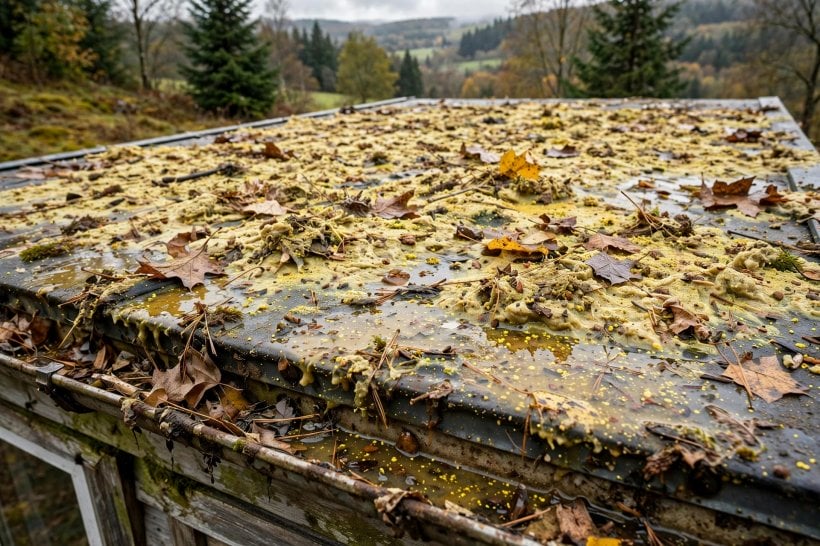
The bill arrives on the surface instead. The original names the shallow band’s con the “Debris Trap”: water moves slowly across a shallow slope, so what lands on it tends to stay. Leaves stick. Pollen settles in a thick paste that doesn’t wash off easily — the flow that should carry it away arrives too gently to scour. And the consequence is a water-quality failure, not just an untidy roof: this organic matter can rot on the roof, feeding bacteria into your tank. Where the steep roof sends its contaminants away with the first storm, the shallow roof stores them, wet, directly upstream of the water you drink and wash in. The loft is comfortable; the catchment is a composting surface. That is the trade, stated plainly — and it is why the shallow band, for all its interior generosity, is the hardest of the three to defend on a harvesting house.
7. The Corrugated Caveat and the Sweet Spot (3:12 to 4:12)
One risk belongs to the shallow band specifically, and it is a profile problem rather than a pitch problem. If you have horizontal corrugated roofing on a shallow pitch, the ribs act as dams, holding water and dirt. Each rib is a small wall across the flow, and on a slope too gentle to push water over them decisively, every wall ponds a little water and traps a little sediment behind it. The surface that metal’s slickness was supposed to keep clean is interrupted, rib by rib, into a ladder of miniature reservoirs — the debris trap given a regular geometry.

Between the scouring steep band and the trapping shallow band sits the compromise the original recommends: the sweet spot, 3:12 to 4:12. It is steep enough to shed bulk water and prevent pooling, but shallow enough to allow for a functional loft — the slope moves water with intent without spending the loft to do it. The compromise comes with one honest maintenance note: with this pitch, you will need to manually brush or wash your roof with a broom periodically if you are parked under trees. The sweet spot is not self-cleaning like the steep band; it is cleanable, and its keeper accepts a broom as the price of keeping both the harvest moving and the headroom livable.
8. Shape One: The Shed Roof, the Gold Standard
Pitch is only half the geometry. The shape of your roof determines the complexity of your plumbing — and the first shape is the one the original calls the gold standard for rainwater collection: the shed roof, a single slope. Its efficiency is total: 100% of the rain that hits your house is directed to one single gutter. There is no split, no second eave, no orphaned slope draining away from the system. Every drop the footprint catches arrives at the same collection line.
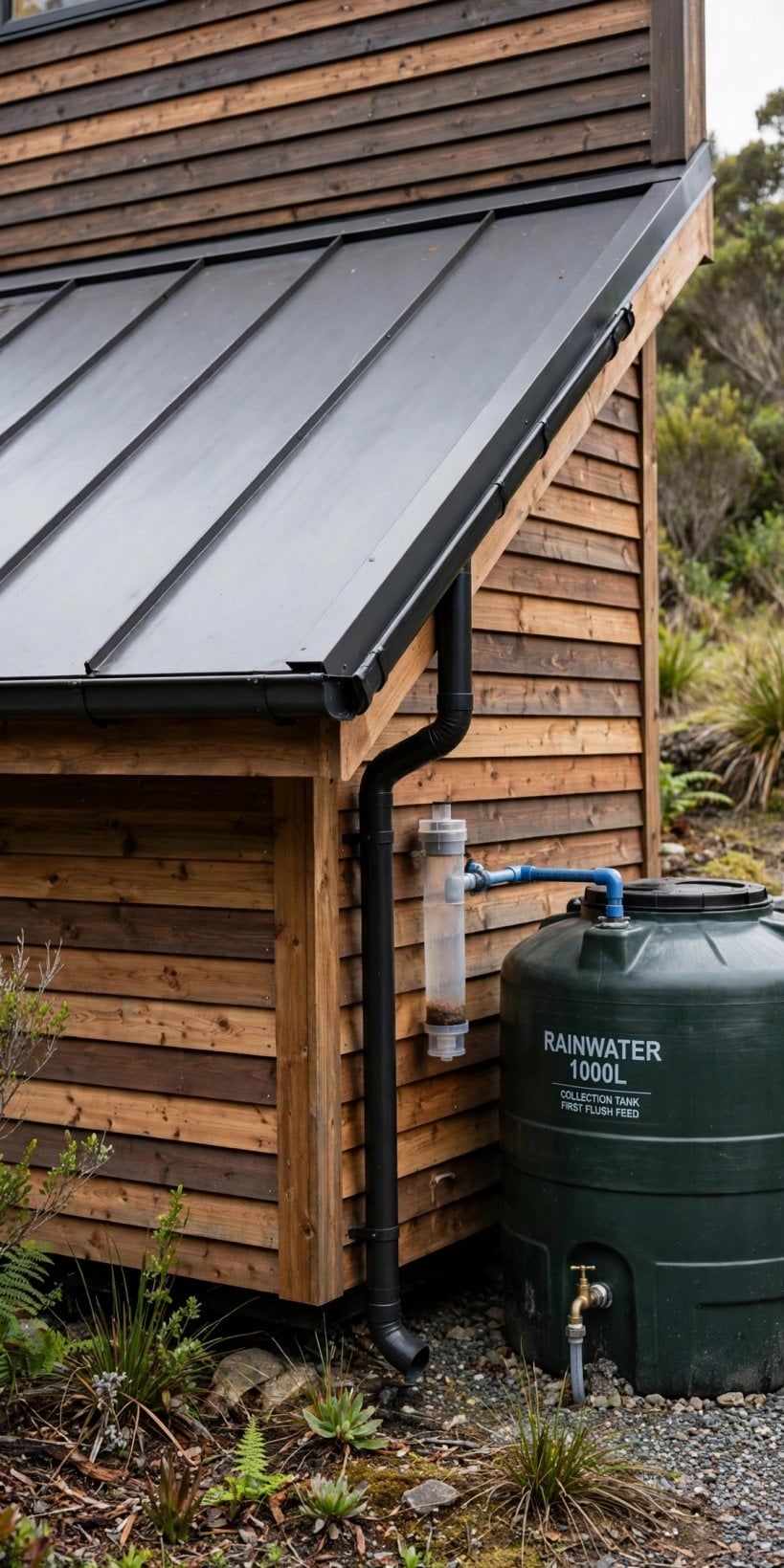
The plumbing follows the simplicity. You only need one downspout and one first-flush diverter — it is simple, elegant, and fewer parts mean fewer leaks, because every joint in a collection system is a place water can escape or enter wrongly, and the shed roof has the fewest joints a roof can offer. The shape also organizes the house beneath it: the shed roof is perfect for a “high side” wall full of windows and a “low side” for services, so the architecture and the plumbing divide the walls between them — light and view on the tall side, pipes and collection on the short side. Even the gutter itself has to survive the highway on a house that moves, which is the thinking behind removable gutter systems: one gutter, doing all the work, designed to travel.
9. Shape Two: The Gable Roof and the 50/50 Split
The classic alternative is the gable roof, the familiar peak — and for collection it is the problem shape. Its inefficiency is structural: the rain is split 50/50, half falling to each side of the house. The plumbing that follows earns the original’s label of a nightmare: you need gutters on both sides of the house, and to catch 100% of the water, you have to plumb the two downspouts together — often running a pipe under the trailer — to feed a single tank. Two gutters, two downspouts, a joining run beneath the house: every part the shed roof does without, the harvesting gable requires.

The predictable result is surrender by halves: most gable-roof tiny house owners only gutter one side, instantly losing 50% of their potential water yield. The peak still looks like the classic house shape, and the roof edges themselves still do the work described in our guide to eaves and overhangs for tiny homes — but as a catchment, an unjoined gable is two half-systems, and most owners end up running only one of them. The gable is not a bad roof; it is a roof whose shape taxes collection at exactly 50%, forever, unless the owner pays the plumbing price of joining both sides under the trailer.
10. The Yield Math: Footprint, Not Slope
After pitch, material and shape, one question remains — and its answer surprises most builders. Does the pitch change the amount of water you catch? Technically, no. It is the “footprint” of the roof that matters, not the surface area of the slope. A steep roof has more surface than a shallow one covering the same house, but rain does not fall on a slope’s surface; it falls on the ground plan beneath it, and the roof intercepts the rain that would have landed on its footprint — no more, whatever the angle.
The formula is one line: 1 square foot of footprint × 1 inch of rain ≈ 0.623 gallons. Run the original’s own example: an 8.5′ × 24′ tiny house has a 204 sq ft footprint, and in a 1-inch rainstorm the arithmetic is 204 × 0.623 = 127 gallons. Whether your roof is flat or steep, if it covers 204 sq ft of ground, it catches the same volume of rain, assuming no wind loss. So the division of labour across this whole guide is clean: footprint decides how much water you get, and everything else — the metal surface, the pitch band, the single-slope shape — decides how clean that water is and how simply it reaches the tank, which is why the collection system belongs in the same plan as the rest of the tiny house utilities it feeds.
Final Considerations
The original’s conclusion assembles the whole system in one specification: for the ultimate off-grid water setup, design a shed roof with a 3:12 or 4:12 pitch using standing seam metal. Each element answers one of the problems this guide has walked through. The single slope gives a single collection point, so the plumbing is one gutter, one downspout and one diverter. The sweet-spot pitch gives decent self-cleaning properties without the pooling of the shallow band or the full height penalty of the steep one — and accepts a broom, now and then, as its maintenance price. The standing seam surface keeps the catch clean at the source, shedding debris instead of feeding it to the tank. And the loft keeps enough interior headroom to live comfortably while filling your tanks. Pitch, material, shape, footprint: get the four in that order, and the roof stops being the overlooked part of the water system and becomes its hardest-working one.


1 Comment