

Alaska is the state tiny house people daydream about when a building department says no — and the daydream is half right. Vast areas of Alaska have no zoning at all, no residential building code enforcement for owner-built homes, and land prices that look like typos next to the Lower 48. The other half of the truth is that Alaska replaces bureaucratic difficulty with physical difficulty: design temperatures of -40°F in the Interior, permafrost that shifts foundations, seismic zones, and winters that punish every shortcut the absence of inspectors allowed. Understanding tiny house laws in Alaska means understanding that the state regulates lightly and the climate regulates brutally — and that the populated places most people actually choose, like Anchorage, regulate much more conventionally.
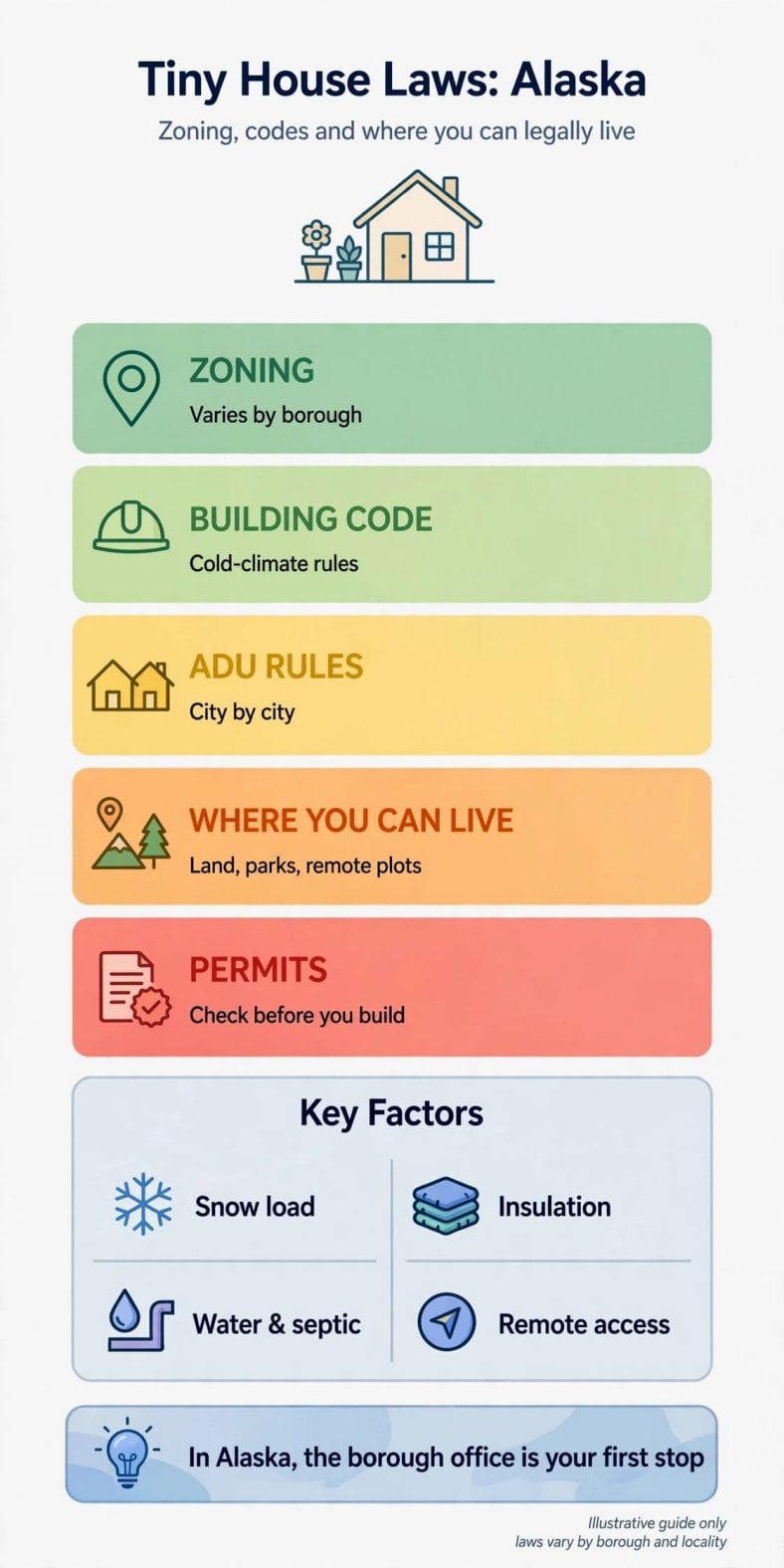
This guide walks the full attribute set for Alaska: the legal status of tiny houses on wheels versus on foundations, how building codes work (and mostly do not) at state level, the status of IRC Appendix Q, minimum sizes, zoning and placement, ADU rules, where you can legally live, the permits and approvals that DO exist — including septic approval, which is statewide — and borough-level examples, ending with practical steps and the pitfalls that catch newcomers. Because regulation here is local or absent, treat this guide as a map of what to verify, not a substitute for it: before buying land, confirm the current rules with the borough or municipality and the state agencies named below. Rules and code adoptions change, and this article states general reported guidance, not legal advice.
1. Tiny House Laws in Alaska at a Glance
| Question | Alaska in brief |
|---|---|
| Statewide residential building code for owner-built homes? | No general statewide code enforcement — regulation is mostly local |
| State zoning? | None — zoning exists only where a borough or city has adopted it |
| Tiny house on wheels classified as? | Generally an RV / recreational vehicle |
| IRC Appendix Q statewide? | Not adopted statewide; a local question where the IRC is enforced |
| Statewide minimum house size? | None at state level; local codes where they exist govern |
| One state approval that does apply almost everywhere | Wastewater/septic approval through the Alaska DEC |
| The real regulator | Climate: extreme cold, snow load, seismic, permafrost |
Read the table’s spirit correctly: “no rule” in Alaska usually means “no official checks,” not “no consequences.” Insurers, lenders, and the laws of physics still apply, and they apply harder at -40°F than anywhere else in the country.
2. On Wheels vs On Foundation: Legal Status
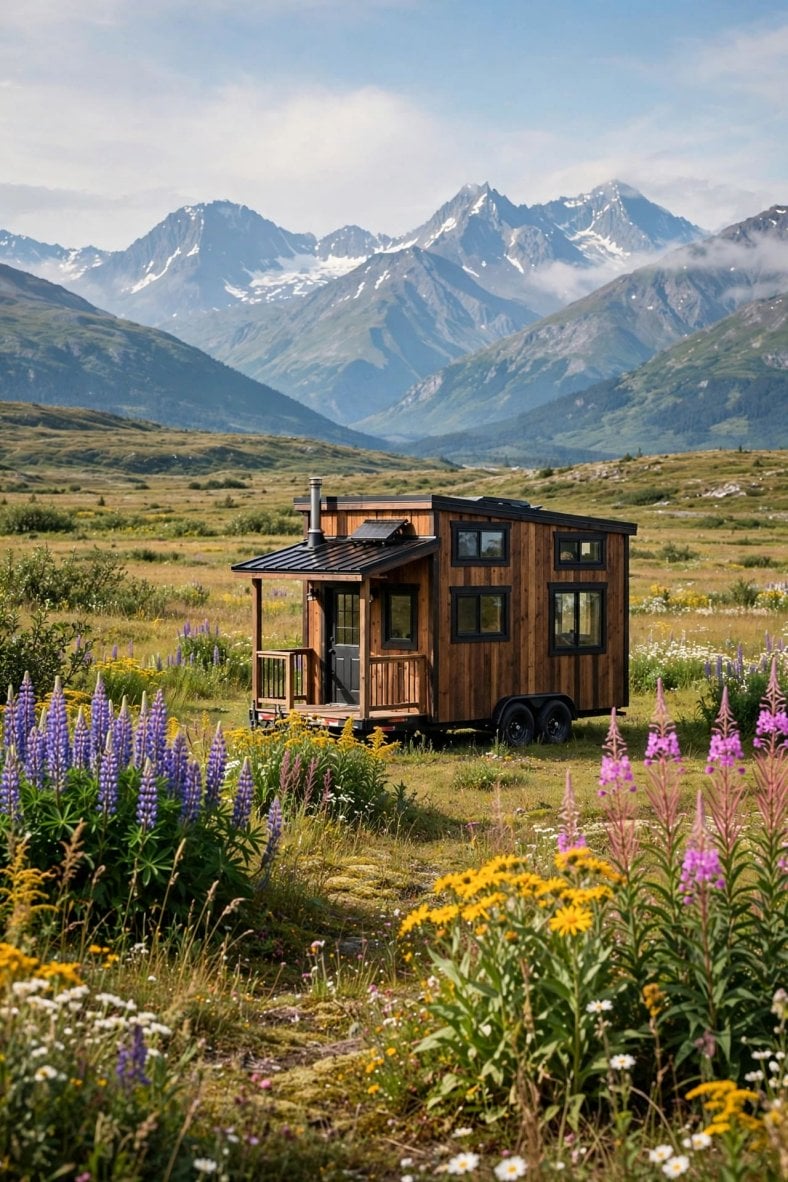
A tiny house on wheels is treated in Alaska, as in most states, as a recreational vehicle: it is titled and registered as a vehicle, it is not a dwelling in the eyes of land-use law, and whether you may live in it full-time depends on where it is parked. In unzoned rural areas with no local prohibition, long-term THOW living on your own land is widely practised and rarely disturbed; inside municipalities with zoning — Anchorage is the big example — occupancy of an RV as a residence on a residential lot is restricted by municipal code, and enforcement is a real possibility. Keep the registration pathway straight with our guide to how to register a tiny house as an RV, and note that certification still matters in the far north for insurance and resale: see what RVIA certification is and why your tiny house needs it.
A tiny house on a permanent foundation becomes a dwelling. Outside code-enforcing jurisdictions, that transition is mostly a physical fact — the house is fixed, serviced, and lived in. Inside code-enforcing municipalities, it is a legal process: building permit, code-compliant construction, inspections, and a certificate of occupancy. The distinction matters most to your wallet and your exit: a foundation home in a regulated area is mortgageable and insurable as real estate, while in unregulated areas it is simply yours — valuable, but valued by negotiation rather than appraisal formulas. Our explainer on how to talk to officials, zoning laws for tiny houses: how to talk to your local officials and win, is written for regulated states but its method — ask in writing, keep records, get names — is exactly right for Alaska’s borough offices too.
3. Building Codes and the IRC Appendix Q Question
Alaska has no single state-adopted residential building code that is enforced for ordinary owner-built homes in most of the state. Instead, building regulation is largely a municipal and borough choice: larger municipalities such as Anchorage enforce building codes based on the International Residential Code with local amendments, while enormous unincorporated and unzoned areas have no building permits for a house at all. Some state-level rules do exist around specific systems and trades — and the state’s housing finance agency becomes relevant below — but there is no Alaskan equivalent of a statewide tiny house statute to cite, and any source claiming a specific statewide code section for tiny houses should be treated with suspicion until verified with the jurisdiction itself.
Appendix Q — the IRC’s tiny house appendix that relaxes ceiling heights, loft access, and stair rules for homes under 400 square feet — is therefore a local question in Alaska: it applies only where a jurisdiction has adopted the IRC edition containing it and chosen to include the appendix, which is not automatic even in code-enforcing cities. Before designing around Appendix Q dimensions, read our full explainer, the International Residential Code (IRC) Appendix Q: what it means for tiny homes, then confirm adoption with the specific building department. Where no code is enforced, Appendix Q remains useful as a respected design standard — building to a recognised code is your best evidence of quality for insurers and future buyers even when no inspector ever visits.
4. Minimum Sizes and Design Expectations
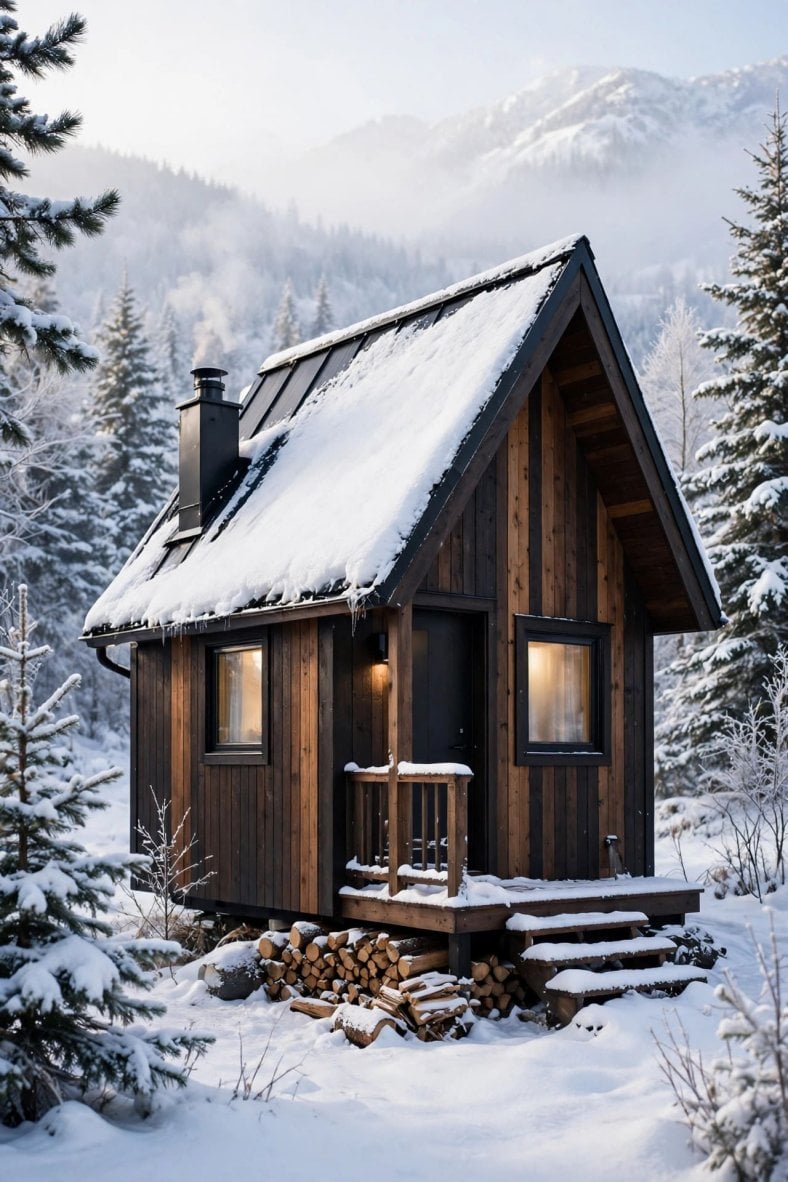
At state level there is no minimum dwelling size for Alaska. Where a local IRC-based code applies, conventional rules ride along — habitable rooms with minimum dimensions and ceiling heights, egress windows, smoke and CO alarms, sanitation — sometimes softened by Appendix Q where adopted. In unregulated areas, the binding design constraints are practical rather than legal, and they are severe:
- Insulation and air sealing: Interior Alaska (Fairbanks and north) sees design temperatures around -40°F and colder; builds commonly target wall and roof insulation values far above Lower-48 norms, with meticulous vapour management to keep moisture out of the wall cavity.
- Snow load: Ground snow loads in parts of Southcentral and the panhandle are among the highest in the nation; roof pitch, structure, and snow-shed paths away from doors are life-safety items, not aesthetics.
- Seismic design: Much of populated Alaska is high-seismic country — the 1964 Good Friday earthquake was centred near Prince William Sound — so anchoring, bracing, and flexible utility connections matter even in a 300-square-foot house.
- Freeze protection: Water lines, traps, and tanks must live inside the thermal envelope or be heat-traced and insulated; a single frozen burst pipe in January can end a build.
Buyers planning a climate-proof build should pair this legal picture with our vetted designs in tiny house plans for cold climates — in Alaska, the plan is a legal strategy too, because it is the document your insurer and lender will judge.
5. Zoning and Placement Rules
Zoning exists in Alaska only where a local government has created it, and large parts of the state — including much of the unorganized borough — have none. In those areas, placement rules reduce to a short list: you may generally build on land you own (subject to subdivision covenants, easements, floodplain considerations, and the statewide wastewater rules in Section 8), setbacks come from deeds or local platting rather than zoning maps, and nobody approves your house’s appearance or size. Organized boroughs and cities are the spectrum’s other end: Anchorage has full zoning and land-use code; the Matanuska-Susitna Borough has land-use rules that are comparatively light but real (floodplain, setbacks from water bodies, and special land use districts in places); the Fairbanks North Star Borough and Kenai Peninsula Borough sit between, with zoning in core areas and a lighter touch outside. Because borough boundaries and rules decide everything, verify the parcel’s exact jurisdiction before you buy — a road’s difference can be a code’s difference. For the land hunt itself, start with our guide to where to buy tiny house lots, then do the Alaska-specific homework in Section 9.
6. ADU Rules: A Tiny House Behind a Main House
Accessory dwelling units are the most promising regulated pathway in Alaska’s biggest city: Anchorage permits ADUs under its municipal land-use code, with conditions that have been revisited in recent years to encourage them — expect rules about lot size, owner occupancy, size limits relative to the main home, parking, and design, and confirm the current text before designing, because the details genuinely change. Outside Anchorage, ADU treatment follows local code where it exists and is often simply unaddressed where it does not — in unzoned areas, a second small dwelling on a large parcel is typically a non-event legally. Two cautions: a tiny house on wheels in a city backyard is usually classified as an RV, not an ADU, no matter what the family calls it; and utility connections for an ADU (especially sewer and water capacity) are where Anchorage projects most often slow down. Treat the ADU route as a permits project with a tiny house attached, and it goes well.
7. Where You Can Legally Live in a Tiny House in Alaska
Your own rural land outside code/zoning jurisdictions — the classic Alaska play, and genuinely available: buy land in an unzoned area, site the house (wheels or foundation), install an approved wastewater system, and live. Respect covenants in subdivisions, keep access legal (some parcels are landlocked or seasonal-access only), and plan services — water wells, septic, power (often solar/generator off-grid), and road maintenance are yours to solve. RV parks — year-round RV living exists in Alaska but the park stock is heavily summer-weighted; confirm winter operation, water/sewer freeze arrangements, and monthly tenancy terms before assuming a park is a housing solution. Inside Anchorage and other regulated municipalities — full-time tiny living typically means a foundation dwelling built to code, an approved ADU, or a licensed park; a THOW in a driveway is storage, not housing, in the eyes of the code. Tiny house communities — Alaska’s community scene is informal compared to the Lower 48: clusters form around rural subdivisions, faith and homesteading networks, and seasonal work, rather than branded villages; vet any “community” by the same land-and-wastewater checks as a solo purchase. Sequencing the physical setup once land is chosen follows our walkthrough of how to prepare your land for a tiny house — with Alaskan amendments: schedule earthwork for the short summer, and design every buried service for frost depth.
8. Permits, Inspections, and the Approvals That Do Exist
The permit list in unregulated Alaska is short but not empty. Wastewater: on-site septic systems are approved under state environmental rules administered by the Alaska Department of Environmental Conservation — soil conditions, setbacks from wells and water bodies, and system design standards apply essentially statewide, and permafrost and high water tables rule out conventional systems in many areas (engineered or alternative systems cost more; budget accordingly). Water wells have their own practical and record-keeping expectations through state water resources channels. Financed homes: if you borrow through programs connected to the Alaska Housing Finance Corporation, expect energy standards — Alaska’s cold-climate building and energy requirements tied to financing can demand an energy rating and construction standards stricter than any local code, a quirk that surprises buyers: in Alaska, your lender may be your building code. Inspections inside code-enforcing municipalities mirror the Lower 48 (foundation, framing, mechanical, final). Outside them, inspections are largely what you commission yourself — commission some anyway, and photograph everything: the documentation file becomes your resale and insurance evidence.
9. Borough and City Examples (Verify Before You Rely)
Municipality of Anchorage — the state’s regulatory heavyweight: zoning, building permits and code enforcement, ADU provisions, and restrictions on living in RVs on residential lots. If your Alaska plan says “Anchorage,” plan a conventional, permitted project. Matanuska-Susitna Borough — the popular counterweight: comparatively light land-use regulation across much of the borough and a deep stock of affordable rural parcels in places like the greater Wasilla and Palmer areas and beyond; still check floodplain maps, water-body setbacks, and subdivision covenants parcel by parcel. Fairbanks North Star Borough — zoning in and around Fairbanks with a more frontier approach outside the core; the governing constraint here is climate engineering (permafrost pockets, extreme cold, heating-fuel logistics) rather than paperwork. Kenai Peninsula Borough — mixed: borough-wide rules are relatively light, while some cities within it (and its coastal flood/snow realities) add layers; popular with tiny house owners for land access plus services in towns like Soldotna and Homer. Every one of these sketches is a starting point for questions, not an answer — borough codes are amended regularly.
10. Practical Steps and Alaska-Specific Pitfalls
Steps: (1) Pick the jurisdiction before the parcel — decide how much regulation you actually want. (2) Confirm wastewater feasibility early through the DEC framework; a failed perc picture can veto cheap land. (3) Check access in the worst month, not the best: winter road maintenance, break-up season limits, and distance to fuel and services. (4) Design to climate first (Section 4) and to code second — in that order. (5) If financing touches AHFC channels, get the energy requirements in writing before building. (6) Document the build as if an inspector were coming: photos, invoices, specs. Pitfalls: assuming “no zoning” means “no rules” (wastewater and covenants still bite); buying landlocked or easement-less parcels at dream prices; under-designing for permafrost — foundations on thawing ground fail slowly and then suddenly; ignoring moose-season… no — ignoring break-up: spring thaw turns unbuilt access into mud for weeks, and your moving truck does not care about your schedule; and finally, insuring too late — remote, wood-heated, uninspected homes are exactly the profile insurers price hardest, so get quotes before the build, not after.
Final Considerations
Alaska offers the rarest thing in American tiny house life: places where the law genuinely steps back. What it never offers is a place where consequences step back. Choose your jurisdiction with open eyes, let the climate set your construction standard, clear the wastewater question before the land question, and keep a documentation file worthy of a permitted build even where no permit exists. Do that, and Alaska is not merely permissive — it is the most honest tiny house state in the union: it will never lie to you about what your house must survive.