

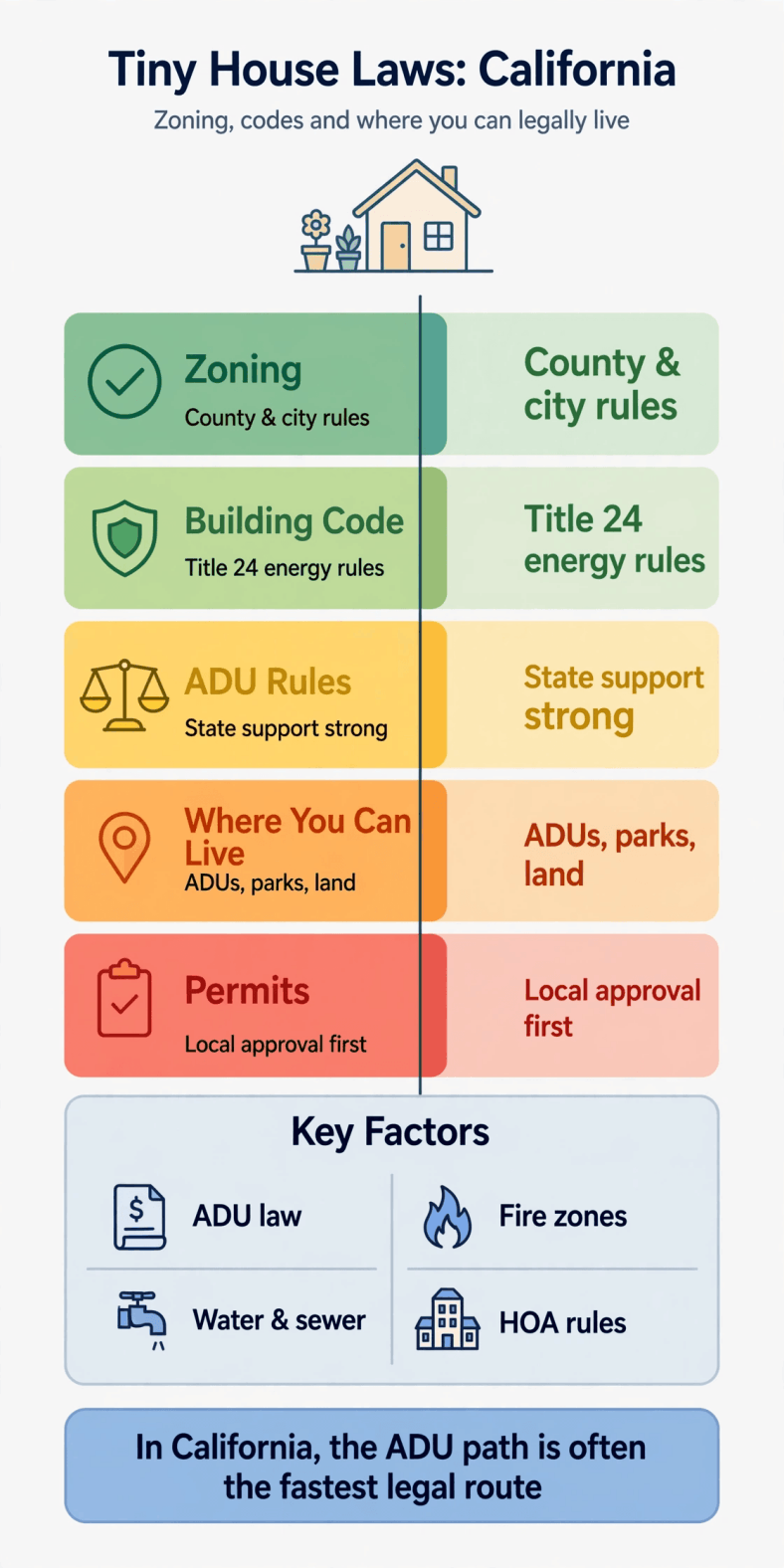
California draws more tiny-house interest than almost any other state, and it also produces the most confused owners. The confusion starts with identity. A tiny house in California is regulated as one of two completely different things: a dwelling, when it sits on a permanent foundation and goes through the building department like any other small home, or a vehicle, when it sits on wheels and is treated as a recreational vehicle that was never designed to be a full-time residence. Almost every rule you will meet — where you may park, what you may hook up, whether you may live in it year-round — flows from that single classification, which is why general answers about tiny house laws in California mislead until the identity question is settled first.
This guide works through both identities in the order an owner actually meets them. It covers the state building standards and the Title 24 energy rules that shape a foundation build, the minimum sizes the codes will accept, how zoning and the state’s accessory dwelling unit (ADU) framework decide placement, where a tiny house can legally be lived in, and the permits and inspections each route demands. California amends its codes on a three-year cycle and cities layer their own rules on top, so treat every specific below as a starting point to confirm with your city or county planning and building departments — in writing — before money changes hands.
1. Tiny House Laws in California at a Glance
| Question | Short answer |
|---|---|
| Does California have one statewide tiny-house law? | No. State building standards set the floor, but each city and county decides through its own zoning and amendments whether and where a tiny house may be lived in. |
| Can I live in a tiny house on wheels full time on my own land? | Almost never as of right. A house on wheels is a vehicle in the state’s eyes, and most residential zones prohibit living in a vehicle outside an approved park. |
| Which code governs a tiny house on a foundation? | The California Building Standards Code (Title 24), built on the national model codes with state amendments, as enforced by your local building department. |
| Do the Title 24 energy rules apply to a tiny build? | Yes. A permitted tiny dwelling must meet the current energy code like any new home, including its envelope, lighting, and rooftop-solar expectations. |
| Is there a minimum size for a legal tiny house? | No single tiny-house minimum. Habitable-room, ceiling-height, and efficiency-dwelling rules still apply, and small-home provisions can relax some of them — the local code book decides. |
| Can a tiny house qualify as an ADU? | Often, yes. California’s statewide ADU framework is the most reliable legal route for a small second dwelling, and some cities extend it to movable tiny houses. |
| What is the easiest legal way to live tiny in California? | For most owners, a permitted tiny ADU behind an existing house, or a code-built foundation tiny on a lot where dwellings are allowed. |
| Where do I start? | With the planning counter of the city or county where the land sits. Get the classification and zoning answer in writing before you buy or build. |
2. The Legal Status of Tiny Houses in California: Vehicle or Dwelling
California law gives a tiny house no category of its own, so it falls into whichever existing category matches how it is built and supported. A tiny house on a permanent foundation, connected to utilities and permitted through the local building department, is a dwelling. It is appraised, taxed, financed, and inspected as real property, and nothing in state law disqualifies it for being small — it simply has to satisfy the same dwelling codes as a larger house, which is the subject of the next section.
A tiny house on wheels takes the other path. Built to recreational-vehicle construction standards and registered with the Department of Motor Vehicles, it is personal property — a vehicle. Voluntary RVIA certification for a tiny house signals that the build follows the RV industry’s standards for plumbing, electrical, and fire safety, and it helps with insurance and park acceptance, but it does not convert the unit into a dwelling or create any right to live in it on residential land. Understanding how to register a tiny house as an RV matters for towing, titling, and plates — not for residential legality.
A third, narrower category is worth knowing about: the movable tiny house. A handful of California cities have written rules that accept a certified house on wheels as a form of accessory dwelling on a lot with a main house, subject to conditions on skirting, utility connections, and how long the wheels stay on. Factory-built housing is a fourth route: a home built to the federal manufactured-housing code and installed on a permanent foundation follows the state housing department’s program rather than local site-built rules. Each identity trades freedom for certainty — the wheeled routes stay mobile but legally fragile, while the foundation and ADU routes cost more up front and hold up.
3. Building Codes for Tiny Houses in California
A foundation tiny house is permitted under the California Building Standards Code, published as Title 24 of the state regulations. The residential volume adapts the national residential code with California amendments, and cities and counties may add local amendments for their climate, geology, and fire conditions. In practice your plan reviewer works from the state code plus a short list of local changes, so the same 400-square-foot design can pass in one city and draw corrections in the next.
The part of Title 24 that surprises tiny builders most is the energy code. New California homes must meet demanding envelope, window, lighting, and ventilation standards, and the current code expects rooftop solar on most new low-rise homes, with battery-readiness and heat-pump provisions layered in. On a tiny roof, fitting the expected solar array alongside vents and a skylight is a genuine design problem, and the energy model has to be run before permit, not after framing. Budget for the energy consultant and the verification testing the code requires; it is a fixed cost that lands harder on 300 square feet than on 3,000.
Seismic and fire rules are the other California signatures. A foundation home needs engineered anchorage and a braced-wall design suited to the site’s seismic category, and parcels in mapped wildland-urban interface zones fall under ignition-resistant construction rules — ember-resistant vents, covered eaves, and specified exterior materials. Factory-built and small-home pathways can soften some dimensional rules: ask whether your jurisdiction applies the residential code’s tiny-house appendix or an equivalent local small-dwelling provision, and read our guide to IRC Appendix Q for tiny homes before that conversation so you know which relaxations — loft headroom, compact stairs, reduced ceiling heights — to ask about by name.
4. Minimum Sizes and Space Standards in California
California sets no minimum size for a house as such, and that cuts both ways: a 250-square-foot dwelling is not illegal for its size, but it must still satisfy the code’s space standards. Habitable rooms carry minimum floor areas and ceiling heights, sleeping rooms need emergency escape openings, and kitchens and bathrooms have their own fixture and ventilation rules. Where a small-home appendix or efficiency-dwelling provision applies, some of those numbers relax for compact plans — lofts, for example, are typically allowed lower ceilings than main rooms when the provision is in force.
State housing law has long recognized efficiency dwelling units — compact units built around one combined living and sleeping space with a kitchen and bathroom — and a living area of roughly 220 square feet is the figure most often quoted for them. Treat that number as orientation, not a promise: whether your building department permits efficiency units, and at what size, is a local determination, and ADU size rules follow their own track under the state ADU framework, which sets generous maximums and prevents cities from imposing large minimum unit sizes. The honest summary is that California’s size floor for a legal tiny dwelling is set by a handful of room-level rules rather than one headline number, so bring your floor plan to the counter and test it directly.
5. Zoning and Placement Rules in California
If the building code decides how a tiny house must be built, zoning decides where it may exist at all. Zoning is written by each city and county, district by district: single-family residential, rural residential, agricultural, and commercial zones each carry their own list of allowed dwellings, minimum lot sizes, setbacks, and height limits. A foundation tiny house that fits the dwelling definition is generally allowed wherever a conventional house is, subject to the lot’s setbacks and coverage limits — the building’s small footprint rarely offends zoning even when it surprises the plan reviewer.
The wheeled identity fares worse under zoning. Most residential zones prohibit occupying a recreational vehicle as a dwelling outside an approved RV or mobilehome park, and many cities separately ban sleeping in vehicles on residential lots. The ADU framework overrides some of that local resistance for second units — state law limits how far cities can push setbacks, parking, and design conditions for qualifying ADUs — which is why so much California tiny living funnels through the ADU door. Before relying on any of it, work through the same questions we lay out in our guide to zoning laws for tiny houses: written confirmation beats counter conversation, every time.
Two overlays redraw the map on otherwise willing parcels. Land in the coastal zone can require a coastal development permit on top of local approvals, and mapped floodplains impose elevation and foundation conditions that hit a small budget hard. Homeowners’ association rules sit outside government entirely and can ban small dwellings, wheeled units, or both regardless of what the city allows — read the CC&Rs before you fall for a lot.
6. Tiny Houses as ADUs in California
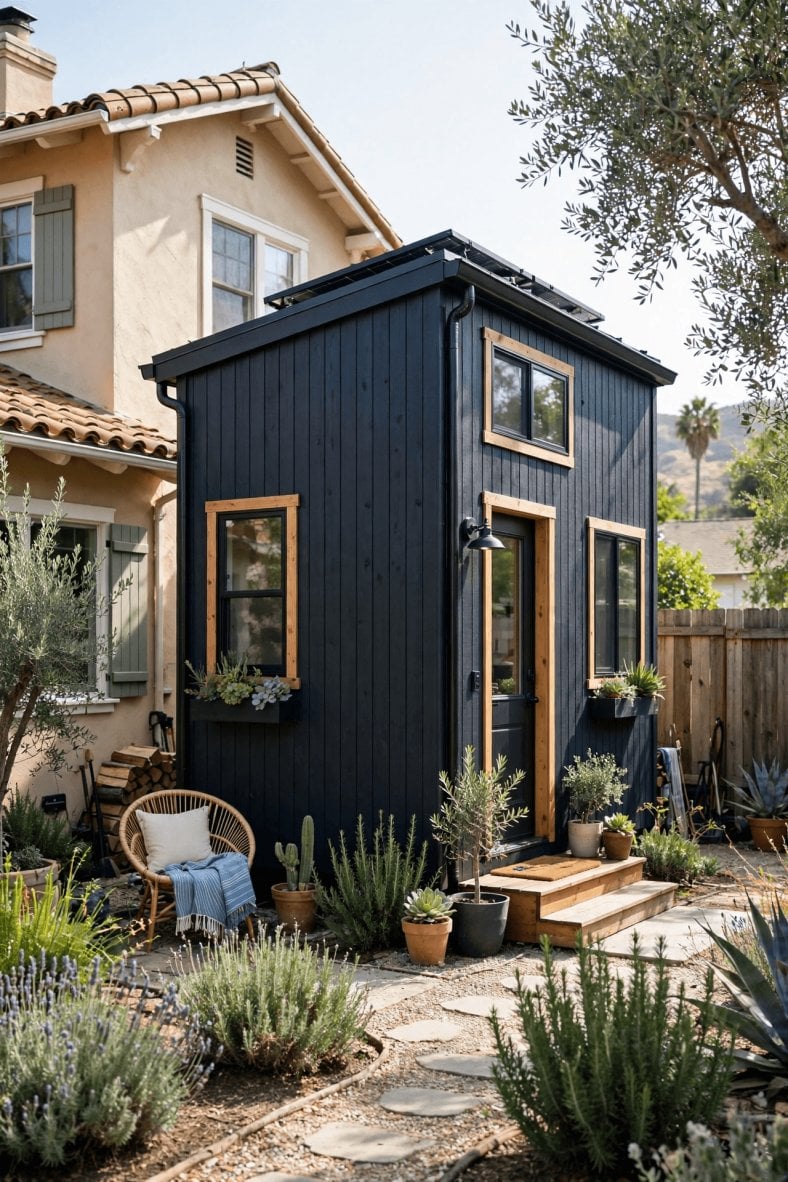
The accessory dwelling unit is where California’s housing policy and tiny houses genuinely meet. Over the past decade the state has rewritten its ADU framework several times in the direction of permission: approvals are ministerial rather than discretionary when a proposal meets the written standards, hearings and neighbour vetoes are largely designed out, and the state housing department publishes guidance and reviews local ordinances that stray too far. For a tiny-house owner, that machinery matters more than any tiny-house-specific rule, because a well-designed tiny home and a small ADU are usually the same building wearing different paperwork.
The framework covers several shapes a tiny build can take. A detached new-construction ADU is the classic backyard tiny house, placed behind a main home on the same lot. A junior ADU carves a small unit — with an efficiency kitchen and its own entrance — out of space inside an existing house, a conversion route that suits large homes and tight budgets. Garage and outbuilding conversions count too. State law restrains the usual local friction points: parking requirements shrink or vanish near transit, impact fees scale down for smaller units, and owner-occupancy demands have been removed for most ADUs in recent versions of the law — all of which you should confirm against the current state guidance and your city’s ADU page, because this framework is amended often.
The movable-tiny-house variant belongs in this section because participating cities deliver it through the ADU framework: the wheeled unit is certified, registered, placed behind a main house, skirted, and hooked to water, sewer, and power like an ADU, in exchange for permission to live in it full time. Where it exists it is the only route that keeps wheels and legality together — and where it does not exist, no amount of certification creates it.
7. Where You Can Legally Live in a Tiny House in California
On a foundation, on your own lot. Wherever zoning allows a dwelling and the building is permitted, a code-built tiny house is simply a small house. This is the most secure footing available and the benchmark the other options are measured against.
As an ADU behind a main house. The highest-volume legal route in the state. You need a willing lot — your own or a family member’s — and a design that fits the local ADU standards for size, setbacks, and utilities. Start your search with our notes on where to buy tiny house lots if you are land-hunting with this route in mind.
As a movable tiny house in a participating city. Genuine but local. The list of cities is short and changes; if yours is on it, the wheeled route becomes legitimate on a host lot, subject to the city’s conditions.
In an RV or mobilehome park. Legal within the park’s own permits, but park rules and state park regulations commonly cap how long a recreational vehicle may stay, and space rent plus rules about unit age and appearance apply. A tiny house on wheels can work here; a permanent home expectation usually cannot.
On rural land, quietly. The riskiest option on this list. Rural counties enforce less visibly, but a complaint, a resale, an insurance claim, or a septic problem can surface an unpermitted dwelling all at once, and well and septic approvals from the county health department are real requirements even where nobody is watching. Land in farm zones may also carry dwelling restrictions tied to agricultural use. Quiet is not the same as legal.
8. Permits, Inspections, and Fees in California
The foundation and ADU routes run on permits; the wheeled route mostly runs on registrations. For a permitted build, expect a plan-review set that shows the foundation and anchorage, framing and braced walls, the energy model demonstrating Title 24 compliance, and the mechanical, electrical, and plumbing layouts. Fire-zone parcels add their ignition-resistant construction details, and coastal or flood parcels add their own exhibits. Reviewers issue correction lists; small projects are not exempt from second rounds, so schedule float is part of the budget.
Inspections follow the build: foundation and anchorage before concrete, framing and rough trades before anything is covered, insulation and energy features before drywall closes them in, and a final inspection — including any required energy verification testing — before the certificate of occupancy that makes living there legal. Skipping a stage and covering the work is the classic self-inflicted wound; inspectors can and do require covered work to be opened. On the ADU track, add the utility side: sewer or septic capacity confirmation and water service can gate the permit earlier than the building plans do.
Fees deserve their own paragraph because they routinely shock tiny builders. Building permit and plan-check fees scale partly with valuation, but school fees, utility connection charges, and capacity buy-ins carry minimums that do not shrink with square footage. The state ADU framework relieves some of this — smaller ADUs are shielded from impact fees in many cases — yet connection charges for water and sewer remain the line items most likely to exceed the cost of the tiny structure itself on an undeveloped lot. Get every fee in writing, per department, before you commit.
9. City and County Examples Across California
Fresno earned its tiny-house reputation early by welcoming backyard cottages while other large cities were still resisting them, and it has kept a comparatively open ADU posture since — a useful reminder that the Central Valley’s big cities sometimes move faster than the coastal ones. Los Angeles processes ADUs at a scale no other California city matches, with standard plan programs that let applicants adapt pre-reviewed designs; the sheer volume has professionalized the process, for better and for paperwork. Both cities illustrate the same lesson: where the ADU machine is mature, a tiny dwelling rides it.
San Jose is the name to know for movable tiny houses, having written wheeled units into its ADU rules as a recognised category with conditions on certification, connections, and placement — verify the current ordinance before assuming eligibility, because these programs are amended. San Diego layers local incentives over the state ADU framework, including bonus-unit programs tied to affordability in some areas, which can change the economics of a backyard build. In the rural north and Sierra foothills, counties offer the land prices tiny builders dream about, paired with the placement realities this guide keeps returning to: health-department septic and well approvals, wildfire-zone construction standards, and long distances to the counter where it all gets decided. Unincorporated county land answers to the county, not the nearest city — confirm which counter is yours before applying anywhere.
10. Practical Steps and Common Pitfalls in California
Step one: fix the identity. Decide — dwelling, ADU, movable tiny, or vehicle — before you price anything, because each identity buys a different building, a different permit, and a different legal life. Step two: identify the jurisdiction. City or county, which zone, which overlays; one phone call to the planning desk with the parcel number resolves it. Step three: get the answer in writing. Ask the classification and placement questions by email or through the counter’s written-confirmation process, and keep the reply with the parcel paperwork. Step four: price the whole route. Structure, foundation, energy compliance, utility connections, and fees together — our walkthrough of how to prepare your land for a tiny house covers the site side of that ledger. Step five: insure and finance against the real classification, using the distinctions in our tiny house insurance guide for wheels versus foundation builds rather than a sales brochure’s promises.
The pitfalls repeat across the state. Buying the house first and the legality second is the master error — a beautiful build with the wrong classification is an expensive lawn ornament. Treating RV certification as a residence permit is the second: certification speaks to construction standards, not land use. Third, underestimating the energy code until plan review, when the solar layout and the energy model come back with corrections that move walls. Fourth, ignoring fire and coastal overlays until the parcel is already purchased. Fifth, trusting a seller’s assurance that a unit is “legal anywhere in California” — no such unit exists, and the claim itself is the warning.
Final Considerations
California is neither the tiny-house free-for-all of the brochures nor the blanket prohibition of the forums. It is a state that has decided, as policy, to make small dwellings easier through the ADU door while keeping its building, energy, seismic, and fire standards fully in force — and that combination rewards owners who pick their legal identity early and build honestly to it. The foundation and ADU routes demand more money and patience up front than parking a wheeled house and hoping, and they return something the hopeful route never does: a home whose legality survives a complaint, a refinance, an insurance claim, and a resale. Choose the lot and the city as carefully as the floor plan, confirm everything in writing, and a tiny house in California is a thoroughly achievable — and durable — way to live.