

West Virginia is the state where the tiny-house question inverts. In most of this series the challenge is persuading a regulatory system to make room for a small house; here the system, across most of the state’s 55 counties, barely shows up. Much of rural West Virginia has no zoning at all. There is no county planning office reviewing your house plans in many counties, no minimum dwelling size on the books, and land priced at levels the rest of the country retired decades ago. What the state does regulate, it regulates through public health and safety channels that follow the land rather than the building: county health departments permit wells and septic systems, floodplain ordinances guard the creek bottoms where the flat land is, and a state building code exists on paper whose enforcement depends heavily on whether your county or town runs a programme at all. Tiny house laws in West Virginia therefore reward a different skill set: not permit choreography, but due diligence — soils, water, flood maps, mineral rights, winter access — performed by the buyer, because in much of this state the buyer is the only inspector the project will ever have.
This guide works through that diligence in order: how wheeled and foundation houses are classified, where zoning exists and where it famously does not, what the state building code means in practice, the sizes nobody regulates and the clearances physics does, accessory dwellings in a state without an ADU law, the places you can legally live full-time, and the health-department permits and floodplain rules that form the real approval chain. The one-line summary: West Virginia offers the cheapest legal path to a small house on your own land in this entire series, and prices it in homework instead of fees.
1. Tiny House Laws in West Virginia at a Glance
The table below answers the questions West Virginia readers ask first. Notice how often the honest answer is a health department, a floodplain map or a deed, rather than a zoning code — that is the state’s whole character in one pattern.
| Question | West Virginia in brief |
|---|---|
| Are tiny houses legal in West Virginia? | Generally yes. A small house on a foundation, with permitted water and septic, is lawful across most of the state. Most counties have no zoning, so there is often no district approval to obtain at all; in the counties and cities that do zone, their ordinances decide placement. |
| Is a tiny house on wheels a house or an RV? | Classified as a vehicle or recreational unit, titled and registered as such. Formal rules on living in one vary by locality, and enforcement in rural unzoned counties is light, but light enforcement is not legal status — the septic and water rules apply to occupied land however the unit is classified. |
| Which building code applies? | West Virginia has a state building code adopted at state level from the international model codes. Its reach in practice depends on local adoption and enforcement: many cities and some counties run permit and inspection programmes, while large rural areas have no local building department at all. |
| How small can a house be? | No statewide minimum house size applies, and most unzoned counties set none. Where a locality has adopted code enforcement or zoning with dwelling standards, check there. In practice, septic capacity, egress and winter access limit small houses here more than floor-area rules do. |
| Are ADUs allowed? | There is no statewide ADU mandate. In unzoned counties an accessory cottage is generally a matter of health-department capacity rather than zoning permission; in zoned cities and counties, the local ordinance’s accessory-dwelling and second-unit rules apply. Ask the county or city directly. |
| What permits does a tiny house need? | Most reliably: a septic permit and a well permit (or public water connection) through the county health department, a floodplain permit if the site sits in a mapped flood hazard area, and building permits where the locality runs a programme. Driveway access to a state route follows state highway rules. |
| Where can you live full-time? | On your own land in a house with lawful water and wastewater, in an accessory dwelling where allowed, in a manufactured-home community that accepts the unit, or in a campground or RV park within its rules. The eastern panhandle and resort areas add local zoning and rental rules to the picture. |
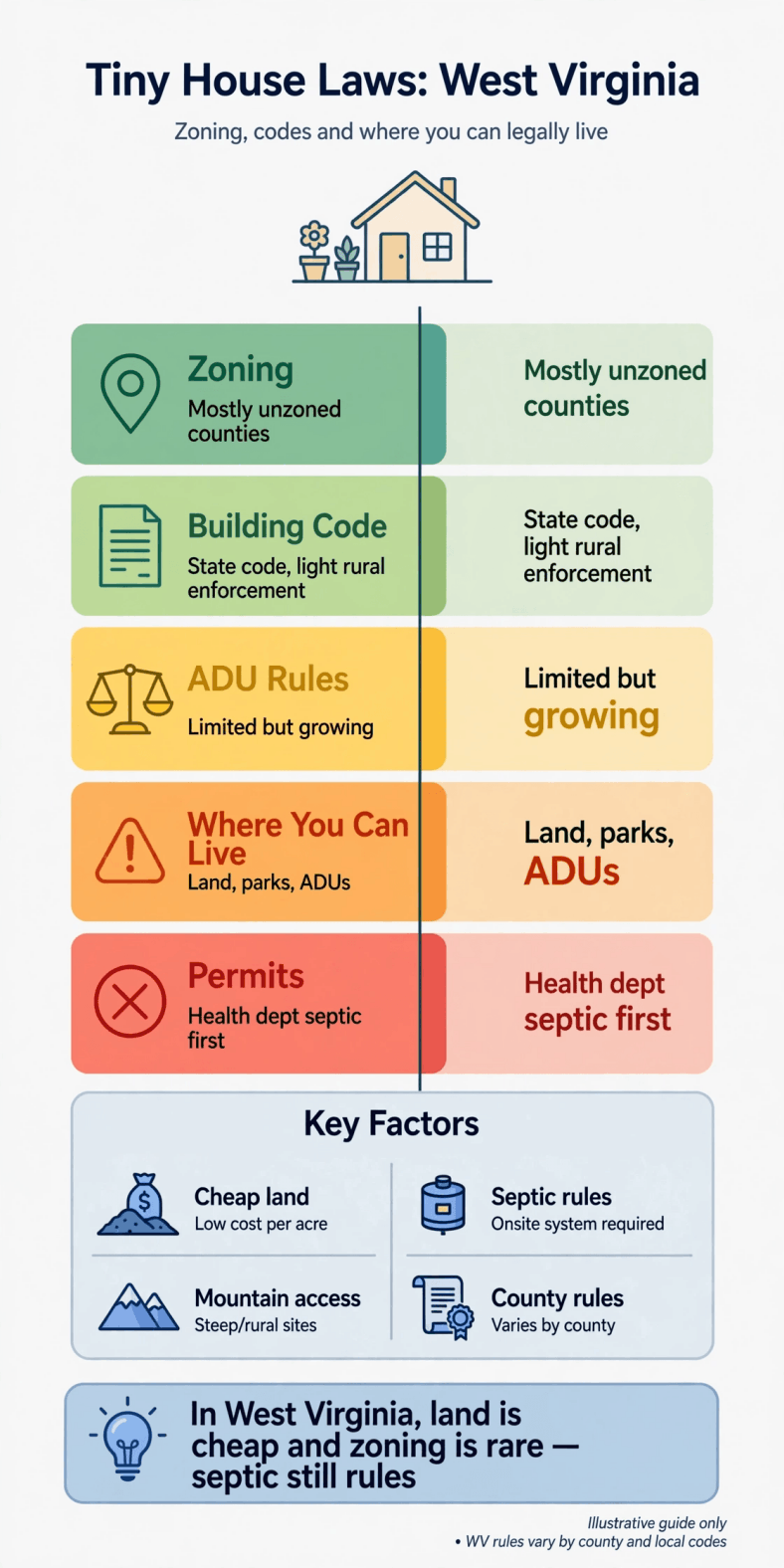
Infographic: the West Virginia pattern — health-department permits at the centre, floodplain and mineral checks around them, and zoning present only in patches.
2. Legal Status: Wheels vs Foundation in West Virginia
A small house set on a permanent foundation on your own land, drinking from a permitted well or public water and draining to a permitted septic system, is a dwelling in West Virginia by any functional test: it is assessed as a home, addressed for emergency services, and lived in as of right in the great majority of the state where no zoning says otherwise. Manufactured homes follow their own familiar track — HUD-code construction, state titling that can convert to real property when the home is permanently affixed — and they are deeply woven into West Virginia’s housing stock, which normalises small, factory-built footprints in a way newcomers notice immediately.
The wheeled unit is, on paper, a vehicle or camper, and on paper the answer about living in one comes from the locality: zoned cities and counties restrict RV occupancy on house lots in the usual ways, while unzoned counties typically have no rule to violate and very little appetite for inventing one. That tolerance, however, ends where wastewater begins. An occupied unit parked permanently is generating sewage, and the health department’s authority attaches to the land use, not to the wheels. The paperwork logic in what RVIA certification means for a tiny house and how to register a tiny house as an RV still governs titling, towing, insurance and resale here; it simply meets a quieter zoning environment than in most states. Buy the wheeled unit with the same discipline as anywhere else — legal identity sorted, septic answered — and West Virginia’s lightness becomes a genuine advantage instead of a postponed problem.
3. Zoning and Placement: The Mostly Unzoned Map
West Virginia’s zoning map is best described as islands. Cities and larger towns zone within their boundaries in the conventional way — districts, setbacks, use tables — and a minority of counties, concentrated in the eastern panhandle’s growth corridor and around the larger metros, run countywide zoning of varying depth. Outside those islands, most of the state’s land area answers to no zoning ordinance at all: no district, no use table, no zoning permit, and no minimum lot size imposed by a planning office. Deed restrictions survive where a subdivision imposed them, and they are the placement rule most likely to surprise a buyer of cheap rural parcels carved from old farms, so read the deed and any covenants with the same care you would give an ordinance elsewhere.
Placement checklist for West Virginia: zoning island or open county, floodplain status, deed restrictions, then water and soils.
The placement controls that do operate statewide are the quiet ones. Floodplain ordinances, adopted by counties and communities that participate in the national flood insurance programme — which is to say nearly all of them — require permits and elevation care for building in mapped flood hazard areas, and in a state whose flat land runs in ribbons along creeks, the flood map is a placement code in disguise. Subdivision and land-development rules in the organised counties govern how land is split, which matters if your plan involves carving a family parcel. And the health rules in the next sections govern where on the lot a house can physically go. The interview habit taught in the guide to zoning laws for tiny houses and talking to local officials compresses here into two phone calls — the county clerk or planning office to confirm zoning status, the health department to confirm the site — but skipping either is how cheap land turns expensive.
4. Building Codes in West Virginia: A State Code, Locally Uneven
West Virginia has done the first half of code policy properly: a state building code, adopted by the state fire commission from the international model codes, exists as the commonwealth’s — the state’s — official standard, and the state fire marshal’s office anchors the system alongside state electrical licensing and inspection arrangements. The second half is where West Virginia diverges from, say, Virginia. Enforcement of the building code is a local act: cities and counties that adopt and staff programmes issue permits and inspect to the state code, and many do, especially in the towns and the panhandle. Large rural stretches, however, run no local building department, and in those places no official will ever ask to see your framing.
Read that freedom the way an engineer would, as transferred responsibility. The code remains the best available answer to how a small house should be built in a state of steep snow-shedding roofs, freeze-thaw winters at elevation, humid summers in the hollows and wood heat everywhere: footing depth below frost, egress from sleeping spaces, safe stairs or a defensible loft ladder, proper flue clearances, GFCI protection near water, and electrical work by a licensed electrician where the work is hired out. Lenders, insurers and future buyers all quietly assume something code-shaped, and a house built to the state code with documentation — permits where they exist, photos and receipts where they do not — keeps its value in a market where an undocumented structure is discounted as a camp. Build to the code whether or not anyone inspects; in West Virginia that decision is the whole difference between a house and a liability with a roof.
5. Minimum Sizes and Mountain Engineering
No statewide minimum dwelling size constrains a West Virginia tiny house, and the unzoned majority of counties adds none of its own. Zoned localities may carry dwelling standards, and adopted code programmes apply the model’s room-level rules — habitable room sizes, ceiling heights, escape openings — at their counters, so a quick written check with the specific county or city is the entire size investigation in this state. Square footage, in other words, is close to a free variable here. What is not free is geometry: the state’s small houses live on slopes, and the engineering budget goes into the site.
Start with access and water. Mountain parcels need a driveway a delivery truck and, eventually, an ambulance can climb in February; switchbacks and shared hollow roads are charming until they are icy. Foundations meet frost that deepens with elevation, and hillside footings meet soils that range from shale to deep colluvium that creeps — a geotechnical conversation is cheap insurance on steep lots. Roofs shed snow and mountain rain into drainage that must be carried away from the foundation on the downhill side, not into the septic field. Heating a small, tight house at elevation is straightforward with the planning in the guide to heating a tiny house, and the envelope advice in how to insulate a tiny house earns its keep against both January wind on the ridges and August humidity in the valleys. In this state, siting is engineering, and engineering is the permit nobody issues and everybody should pass.
6. ADUs and Second Cottages Without an ADU Law
West Virginia has no statewide accessory-dwelling statute pushing cities to allow cottages, and no state preemption to hide behind; the accessory question resolves locally, in both directions. In the unzoned counties — most of the map — a second small dwelling on a family parcel generally faces no zoning barrier at all, and the operative approvals are the health department’s: can the site support water and wastewater for two households, whether through one properly sized system or two permitted ones. Multi-generational compounds of a house, a cottage and a manufactured home are an old West Virginia pattern precisely because the regulatory friction is so low, and a tiny cottage joins that pattern naturally.
In the zoned islands, conventional rules apply: accessory dwellings may be allowed as secondary uses with size or occupancy conditions, restricted to family, or not addressed, in which case the ordinance’s silence is itself the answer to take to the planning office in writing. The eastern panhandle’s growth counties and the resort communities near the New River Gorge and the ski areas are the places most likely to have current, specific text — and, increasingly, short-term-rental rules that decide whether a cottage may be let to visitors rather than lived in. There is no shortcut around reading the one ordinance that governs your parcel; there is, mercifully, usually only one.
7. Where You Can Legally Live in a Tiny House in West Virginia
The lawful map is broad. Your own land with a foundation house and permitted systems is full tenure, available across most of the state at land prices that remain the series’ outliers — routinely a fraction of equivalent acreage one state east. An accessory cottage on a family parcel shares that strength where health approvals line up. Manufactured-home communities form a third route and are common; confirm whether the community accepts site-built small homes or wheeled units alongside its HUD-code stock. Campgrounds and RV parks, plentiful along the rivers and the gorge, operate within their own licences and seasons, and the line between a long-stay park and a residence is theirs to draw — the distinctions in tiny house communities vs RV parks are worth a read before treating a park pad as a housing plan.
Two West Virginia traps deserve bold type. The first is mineral rights. In much of the state the surface and the minerals beneath it were severed generations ago, and a deed may not include the coal, gas or timber rights under your cottage; a title examination that reports exactly what you own is not optional paperwork here, it is the purchase. The second is the creek-bottom bargain: the flattest, cheapest, prettiest meadow lots are floodplain, and West Virginia’s flood history is written in those bottoms. Check the flood map before the survey, price flood insurance honestly, and let a slightly steeper, drier lot win. A state that asks so little of you administratively asks, in exchange, that you choose your ground like an adult.
8. Permits, Inspections and Septic via the Health Departments
The closest thing West Virginia has to a universal tiny-house permit is issued not by a building department but by the county health department’s environmental health office. Under state public-health rules, an on-site sewage system needs a permit before installation: the site is evaluated, soils and separation distances to wells, streams and property lines are checked, and the system — conventional or, on the state’s difficult mountain soils, an alternative design — is approved, installed and inspected under that permit. Individual water supplies follow the same office: wells are permitted and sited away from contamination sources, and in a state of springs, cisterns and shallow wells, the sanitary survey conversation is worth having even where a private well for a single home is lightly documented. Public water and sewer, available in the towns and some valleys through public service districts, substitute connection approvals for the on-site permits.
The West Virginia approval chain: title and minerals, floodplain check, health-department water and septic, building permits where the locality runs them.
Around that core, the remaining approvals are situational. Floodplain permits come from the local floodplain administrator — often the county commission’s office — for sites in mapped hazard areas. Building permits and inspections exist where the city or county operates a programme; where none exists, the inspection regime is self-imposed, which is an argument for hiring licensed trades and photographing everything. Driveways meeting state routes follow the highway division’s access rules, and a new entrance on a state road is a permit, not a favour. The site-work order in how to prepare your land for a tiny house and the systems choices in the tiny house utilities guide both apply, with the West Virginia edit that the health department and the flood map are consulted before the excavator, the real-estate closing and, ideally, the first site visit’s enthusiasm.
9. Notable Regional Examples
The eastern panhandle — Berkeley, Jefferson and Morgan counties — is West Virginia’s regulated frontier: Washington, D.C. commuter growth has brought county zoning, permit programmes and prices that behave like exurbs, alongside genuine small-town cottage stock in places like Shepherdstown and Harpers Ferry, where historic-district rules add their own layer. Morgantown and the northern metros pair university demand with city codes and county health oversight, a middle regime of real permits and real services. Charleston and the Kanawha valley add city ordinances and hillside lots where the engineering, not the paperwork, is the project.
The middle and south are the cheap-land heartland the state is famous for: counties along the New River Gorge — the country’s newest national park, which has tightened attention on lodging and rentals in gateway towns like Fayetteville — and through the Greenbrier and Potomac highlands, where unzoned ground, national-forest borders and resort pockets near Snowshoe create a patchwork of total freedom and very specific local rules within a few miles of each other. The southern coalfields return the state’s lowest prices and its most serious mineral-rights and flood homework. Region by region the constant is the method from this guide: confirm zoning or its absence, read the flood map, price the title examination, and let the health department bless the dirt before anything is built on it.
10. Practical Steps: From Land Listing to Move-In
- Decide the classification first — foundation dwelling, accessory cottage, manufactured placement or wheeled unit — because titles, insurance and health permits all follow it.
- Screen counties by zoning status with the method in where to buy tiny house lots, and record which of your shortlist are unzoned, which are islands, and which run building programmes.
- Order a title examination that reports mineral, timber and gas rights explicitly; do not close on surface-only assumptions.
- Pull the flood map for every finalist parcel and walk away from pretty bottoms that fail it, or price elevation and insurance honestly if you stay.
- Take the health department’s site evaluation before closing; make the purchase contingent on a septic permit path and a lawful water supply.
- Confirm driveway access — private road maintenance, hollow easements, or a state-route entrance permit — in writing.
- Design to the state building code whether or not your county inspects, and hire licensed trades for electrical and fuel work.
- Run the complete budget with how to finance a tiny house, remembering that cheap land plus septic, well, drive and power can total more than the house.
- Insure by true classification using the tiny house insurance guide for wheels vs foundation, keep every permit, evaluation and photo in one file, and establish the 911 address with the county before move-in day.
Final Considerations
West Virginia tests a different virtue than the other states in this series. Where Vermont asks for sequence and Washington for paperwork fluency, the Mountain State asks for judgment: the freedom is real, the land is cheap, the officials are few, and nearly every protection a buyer gets is one the buyer arranged. The failures here are equally characteristic — a hollow lot bought for its price and drowned by its creek, a septic surprise under a shale ledge, mineral rights discovered after the foundation, a winter road nobody ploughs. None of those failures involve the size of the house, and all of them are prevented by the unglamorous checklist in this guide. Do that homework and West Virginia gives a tiny-house buyer the rarest commodity in American housing: a legal small home, on your own mountain land, at a price that leaves money left over to build it properly.