

A tiny cabin looks like the simplest purchase in small housing: pick a plan, write a cheque, watch a building appear in a clearing. The market is happy to encourage that impression, because what is actually being sold under the word “cabin” spans four different products — a stack of numbered logs with an instruction manual, a dried-in shell you finish yourself, a factory-built unit delivered whole, and a land-plus-cabin package where the building is almost the smaller half of the deal. Those products differ in what arrives, what it weighs, which rules it satisfies and what it costs to make habitable, and the headline price describes only the first of those things. Tiny cabins for sale therefore reward a buyer who reads offers as construction scopes rather than as cottages: what exactly is included, what state does it arrive in, and what still stands between that delivery and a warm, legal, plumbed home?
This guide separates the routes cleanly. It defines what counts as a tiny cabin, walks through kit cabins and what their packages really contain, factory prefab and panelised cabins, and land packages, then prices the whole project honestly — delivery, foundation, permits, utility hookups — before turning to certification, financing, inspection checks and the red flags that end purchases. The short version: the cabin is the easy part. The land, the foundation, the permits and the last twenty feet of every utility line are the project, and they are priced separately almost every time.
1. Tiny Cabins for Sale at a Glance
The table below answers the questions cabin shoppers ask first. Watch the pattern: questions about the building have product answers, questions about the total have project answers, and the gap between the two is where budgets quietly double.
| Question | Tiny cabins in brief |
|---|---|
| What is a tiny cabin? | A small, usually single-storey dwelling, often timber-built, roughly in the few-hundred-square-foot range. The word describes a style and a size, not a legal class — the same cabin can be a kit, a shell, a manufactured unit or a code-built house depending on how it is made and labelled. |
| What are the main ways to buy one? | As a kit of parts to assemble on site, as a dried-in shell, as a prefab unit built in a factory and delivered whole or in panels, bought used on its existing site, or bundled with land in a land-and-cabin package. |
| What does the headline price usually include? | The building package or unit as described — and often little else. Delivery, foundation, assembly labour, interior finishing, permits and utility connections are routinely excluded or priced as extras, so the scope list matters more than the number. |
| Do kits include everything needed to live in the cabin? | Generally no. Many kits cover the structure — logs or framing, roof, windows and doors — while insulation packages, plumbing, electrical, kitchen, bathroom and interior finishes are options or separate purchases. Read the inclusion list line by line. |
| Which rules apply once it is built? | The same ones as any small dwelling: local zoning and permits for a foundation cabin, building-code inspection where the jurisdiction requires it, and classification rules (dwelling, manufactured home or RV) decided by how the unit was built and certified. |
| Can you finance a tiny cabin? | Sometimes, by several different routes — construction or land loans for code-built cabins on owned land, chattel or personal loans for movable units — but each route has conditions, and kits in particular can be hard to finance before they exist as a finished house. |
| What is the biggest buying mistake? | Paying for the building before proving the site: access for delivery, zoning and permits for the placement, a foundation plan, and water, power and sewage solutions that are priced and possible on that specific parcel. |
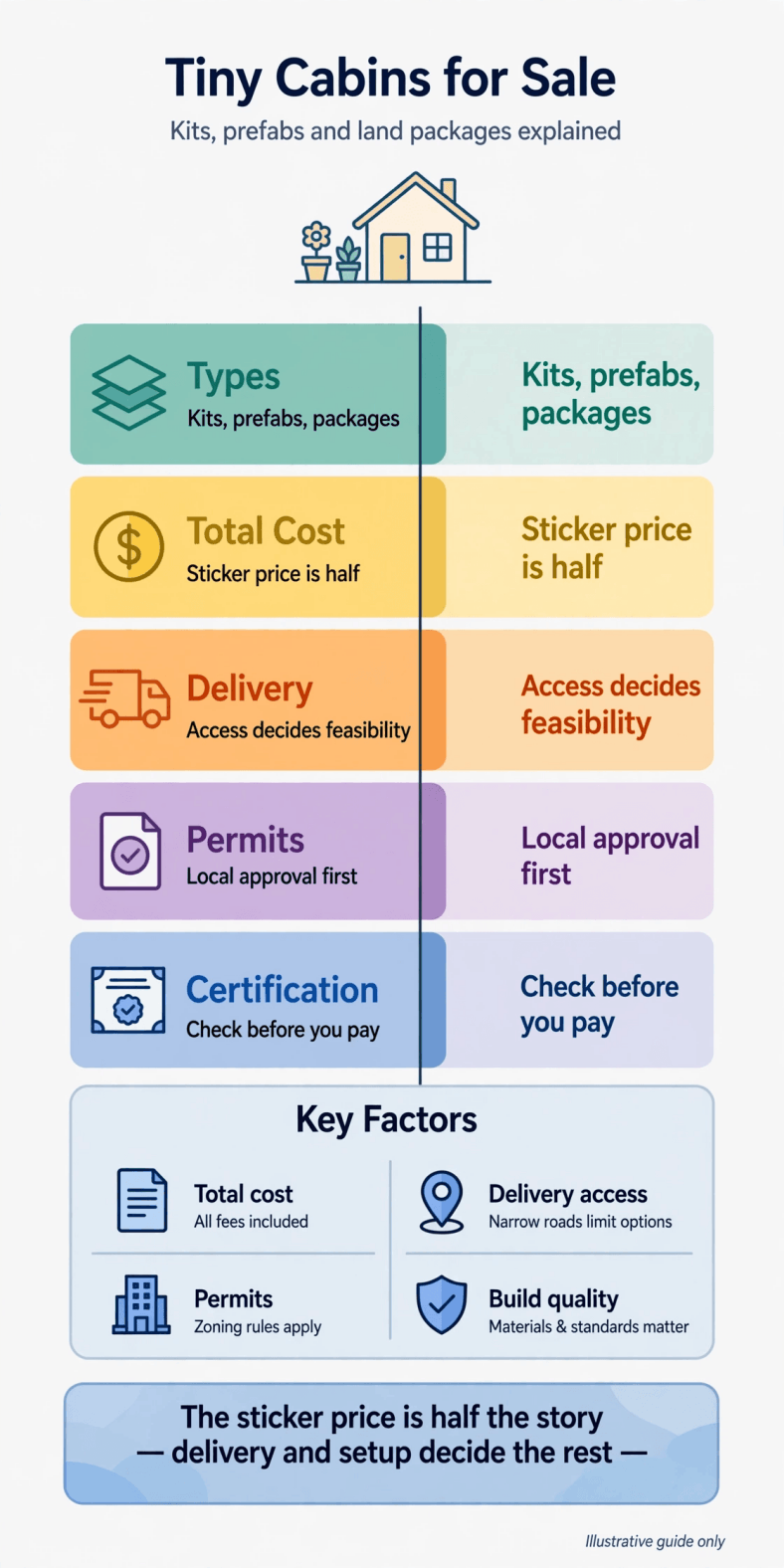
Infographic: the three buying routes — kit, prefab and land package — and the costs each one leaves out.
2. What Counts as a Tiny Cabin? Shells, Cabins and Log Kits
“Cabin” is a marketing word laid over several different constructions, and unpicking it is the first buying skill. At one end sits the true log or timber cabin: solid or milled logs, a pitched roof, a porch if you are lucky, built for a wooded or rural setting and sized anywhere from a one-room hunting shelter to a small family house. In the middle sits the framed tiny cabin — conventional stud construction wearing cabin clothes, with rustic siding and a stove flue doing the visual work. At the far end sits the park-model or RV-styled unit in a cabin costume, wheeled underneath and built to a vehicle standard rather than a housing one. All three photograph identically in a listing. They are not the same product.
The second distinction is completeness. A full cabin, finished inside, is a dwelling. A shell is weather-tight structure only: roof on, windows and doors in, interior a single open volume with studs showing. A kit is not a building at all yet — it is a bill of materials with instructions. Listings slide between these states without flagging the transitions, and the price differences between a finished cabin and its shell version routinely exceed the price of the shell. Train yourself to ask of every offer: when the truck leaves, what state is the building in, and who does everything after that?
Size is the third distinction, and it is mostly about classification rather than comfort. Cabins marketed as tiny generally sit in the same few-hundred-square-foot territory as other tiny houses, and once a cabin is placed on a foundation and lived in year-round, it meets the same code, zoning and sanitation rules as any small house — the subjects of our state-guide series and of the general guides linked throughout this article. Treat “cabin” as a style word, classify the actual product in front of you, and the rest of the buying process becomes legible.
3. Kit Cabins: What the Package Actually Includes
A cabin kit is a manufactured pile of parts: logs or pre-cut framing, roof structure and covering, floor system where included, windows, doors, fasteners and a manual, shipped flat or bundled to your site for assembly by you or a contractor you hire. The appeal is real — the structural package is engineered as a system, the parts are cut to fit, and the headline price is the lowest of any route to a cabin-shaped building. Our pricing comparison in the true cost of tiny houses for sale, prefab vs DIY, sets that sticker in its wider context, and the context is this: the kit is the beginning of the spend, not the bulk of it.
Read the inclusion list like an auditor, because kit scopes vary enormously and the exclusions are standardised by nobody. Common questions that decide real cost: Is the floor system included or only the walls and roof? Is insulation in the package or an upgrade — and is the roof insulation the climate-appropriate build-up or a summer-camp specification? Are interior wall finishes, stairs to the loft, and the porch in the base kit or in the options columns? What exactly is the hardware allowance — hinges and latches included, fasteners counted, or “hardware by others”? A kit whose manual assumes parts the package does not contain will stall a build in week two, which is the most expensive week to stall in.
Assembly is the other quiet line item. A small, simple kit is a genuine self-build project for a competent DIYer with help, tools and a season; a large or complex log kit is a contractor job measured in weeks of crew time. Either way, someone erects it on a foundation that must exist first — Section 6 prices that sequence. Before ordering, get the manual, the full bill of materials and the delivery specification (truck type, unloading responsibility, site access requirements) and read all three as one document. The kits that disappoint are rarely badly made; they are badly matched to the buyer’s assumptions about scope.
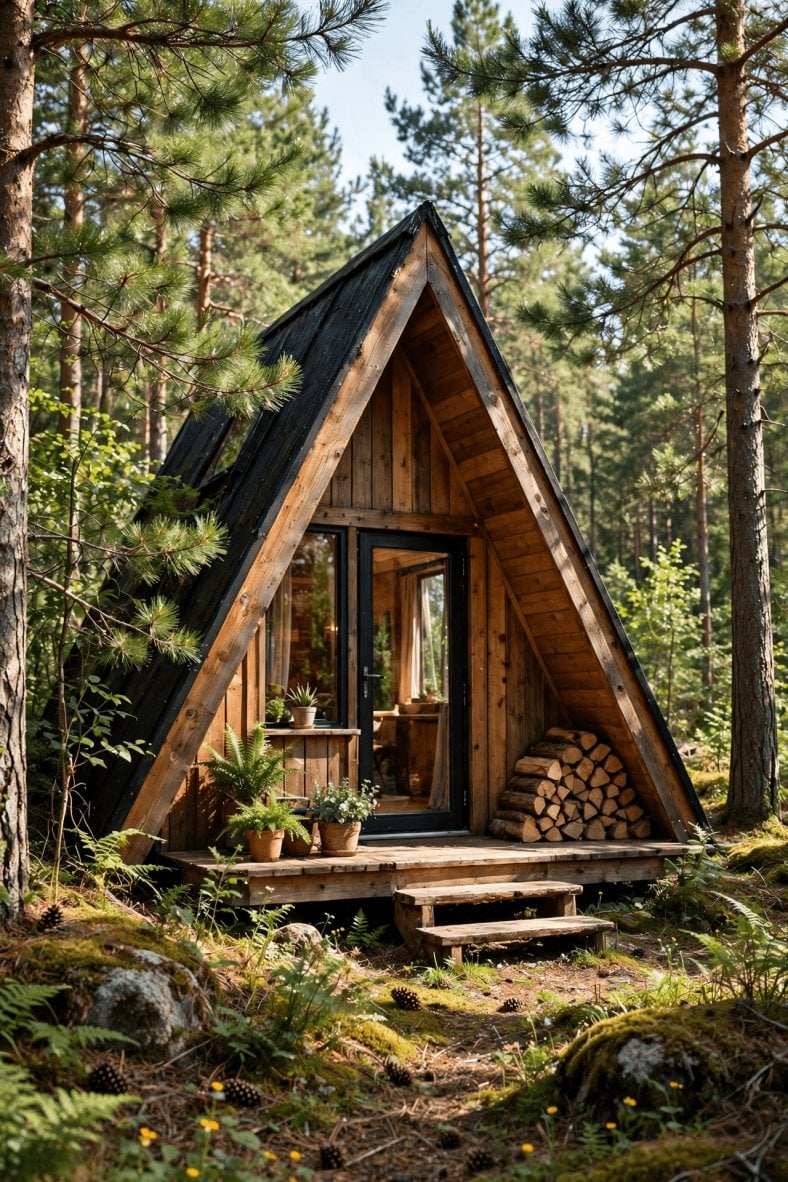
Pin it: compare routes by what arrives on the truck — parts, a shell, or a finished building.
4. Prefab and Factory-Built Cabins: Delivered Whole or in Panels
Prefab cabins move the labour indoors. In the strongest version, the cabin is built complete in a factory — structure, insulation, wiring, plumbing, finishes — and delivered as one unit on a trailer, craned or rolled onto a prepared foundation, connected and occupied in days. In the panelised version, walls and roof arrive as factory-made sections that a crew assembles on site in a fraction of stick-build time, with interiors finished by the factory, the crew or the buyer depending on the package. Both routes trade a higher building price for speed, weather-independent construction and factory quality control, and both concentrate risk into a single logistical event: delivery day.
Delivery is an engineering problem before it is a date. A whole-unit cabin travels as an oversize load on a specific route, and the last stretch decides everything: road width, turning room, overhead lines and trees, ground firmness, and the crane or specialised trailer’s working space at the foundation. Reputable sellers survey or interrogate the route in detail; a seller content to “sort it out on the day” is telling you who pays when it cannot be sorted. Get the delivery specification, the buyer’s site obligations and the failed-delivery terms in writing before contracts, not after.
Classification rides along with the factory. A prefab cabin built as a modular unit to residential code, set permanently on a foundation, is a house for permitting, financing and resale. A unit built and certified as a park-model RV remains a vehicle however woody its interior. That label — decided in the factory, before you ever saw the listing — follows the cabin forever, and Section 7 explains how to verify it. The listings collected in our round-up of tiny homes for sale near me show how often these categories sit side by side under similar wording, which is why the paperwork, not the photograph, is the product description.
5. Land Packages: When the Cabin and the Parcel Come Together
A land package bundles the two purchases — a parcel and a cabin to put on it — into one offer, usually from a developer, a cabin company with land inventory, or a seller marketing recreational lots. The convenience is genuine: the parcel is (in principle) chosen for the product, the pairing is pre-thought, and one negotiation covers both. So is the risk: bundling hides the price of each component, and a package can be a fair parcel with an overpriced cabin, a fair cabin on a poor parcel, or — the case to detect — a parcel whose difficulties (access, water, restrictions) are exactly why it is being sold with a building attached to sweeten it.
Unbundle the deal on paper before judging it. Value the land against comparable local parcels — our guide to where to buy tiny house lots lays out the land-side checks on access, utilities, zoning and covenants — and value the cabin against the same model sold alone. Then interrogate the package specifics: Is the land sold outright, leased, or held under a licence or HOA regime — and what do the covenants say about dwelling type, minimum size and time limits on construction? Are utilities at the lot line, stubbed to the site, or merely “available in the area”? Who builds the foundation and connects the services, and is that work in the package price or in the buyer’s future?
The paperwork standard is two transactions wearing one coat: a land purchase with title, survey and easements to verify like any other, and a building purchase with the scope, certification and delivery terms of Sections 3, 4 and 7. Insist on seeing both sets of documents in full. A package seller who resists separating the components is answering the most important question for you — walk away and buy the two halves separately, in the order land first, cabin second, which is the order that keeps every option open.
6. The True Total Cost: Delivery, Foundation, Permits and Hookups
Here is the arithmetic that governs every route in this guide. Kits often start in the low five figures for the package alone, finished prefab cabins run far higher, and in both cases the building is only one column of the budget. The other columns are stubbornly similar across projects, and they are the difference between a cabin that gets occupied and a structure that sits in a clearing awaiting money:
- Delivery and setting. Freight for the kit or unit, oversize permits and escorts where they apply, crane or setting crew, and the return of all of it if the site is not ready on the day.
- Foundation. Piers, a stem wall or a slab, engineered for the soil and the climate’s frost depth, plus the access and excavation work to build it. The foundation is never in the kit price.
- Assembly and finishing. Crew labour for kits and shells, interior build-out, insulation upgrades, kitchen and bathroom fit-out, heating, and the trades for electrical and plumbing rough-in and connection.
- Permits and fees. Building permit, plan review, septic and well permits where applicable, utility connection charges — individually modest, collectively a real line.
- Utility hookups. Power run to the site, well drilling or water connection, septic system or sewer connection — frequently the largest single column on rural land, and the one most often estimated by hope.
Total these columns with actual quotes for your parcel before comparing cabins, because the ranking inverts: the cheapest building on an unprepared parcel is routinely the most expensive project. Our sequencing guide, how to prepare your land for a tiny house, orders that site work the way contractors price it, and tiny house utilities for power, water and sewage details the systems themselves. The disciplined version of cabin buying is simply this: budget the site first, and let the cabin be whatever the remaining money buys well.
7. Certification and Code Reality: HUD, Modular and RV Labels
Every factory-built cabin carries a legal identity assigned at manufacture, and verifying it is a paperwork exercise with permanent consequences. A modular cabin is built to the same residential building code as a site-built house, in sections, and is labelled or documented state by state; placed on a permanent foundation it is financed, taxed and resold as real property. A manufactured home is built to the federal HUD code and carries its certification label and data plate; it has its own financing, titling and placement rules. A park-model or RV-certified cabin is a vehicle: titled, not permitted as a dwelling, and dependent on zoning and park rules for where it may be lived in.
For kit and site-assembled cabins there is no factory label — the code identity is created locally, through the permit and inspection process where the cabin is built, which is why a kit cabin in a permitting jurisdiction ends as a documented house, and the identical kit raised quietly in the woods ends as an undocumented structure whose legal existence is discovered at sale or claim time. Neither outcome is about build quality; both are about paper. If year-round residential use is the goal, decide before purchase which documentary route the cabin will take, and confirm the jurisdiction accepts it: some towns restrict HUD-code or RV units as dwellings regardless of condition.
Verification is unglamorous: photograph the labels and data plates, match serial numbers against the title or certificate of origin, and ask the seller which code the unit was built to — in writing. For wheeled units, our explainer on what RVIA certification is and why it matters shows what genuine certification looks like and why insurers and parks ask for it. A cabin whose seller cannot or will not document its standard is priced as the lowest category it could be — because that is how every later buyer, lender and insurer will treat it.
8. Financing Reality: Chattel, Personal and Land Loans
Financing follows classification, so this section is short on romance. A code-built or modular cabin on a permanent foundation, on land you own, is the closest a tiny cabin gets to a conventional mortgage: lenders can value it as real property, though small floor areas, rural locations and a thin set of comparable sales still shrink the pool of willing lenders and lengthen timelines. A manufactured cabin may qualify for manufactured-home loan products with their own down-payment and foundation conditions. A wheeled or RV-certified cabin leaves mortgage territory entirely: chattel loans (loans on the unit alone, secured by the unit) and personal loans are the standard instruments, at personal-loan pricing and terms, and some lenders will not touch a unit without recognised certification.
Kits are the financing trap. A lender cannot mortgage a bill of materials, so kit purchases are commonly funded in stages — land loan, construction loan that converts on completion where a lender offers one, or cash and personal credit for the package itself — and every stage wants the permits and the finished classification settled first. Land packages split similarly: the land and the building may need different instruments, and a package marketed as “financing available” usually means one preferred lender for one component, on terms to read as carefully as the cabin scope.
The workable method is to finance backwards from the finished state: decide what the completed property will legally be (Section 7), then ask lenders who lend on exactly that, in that county, before signing for land or building in either order. Our broader guide, how to finance a tiny house, maps the loan types and the questions lenders ask, and tiny house insurance for wheels vs foundation covers the parallel insurance split — because a cabin that can be financed but not insured, or insured but not legally placed, is not yet a purchase, whatever the listing says.
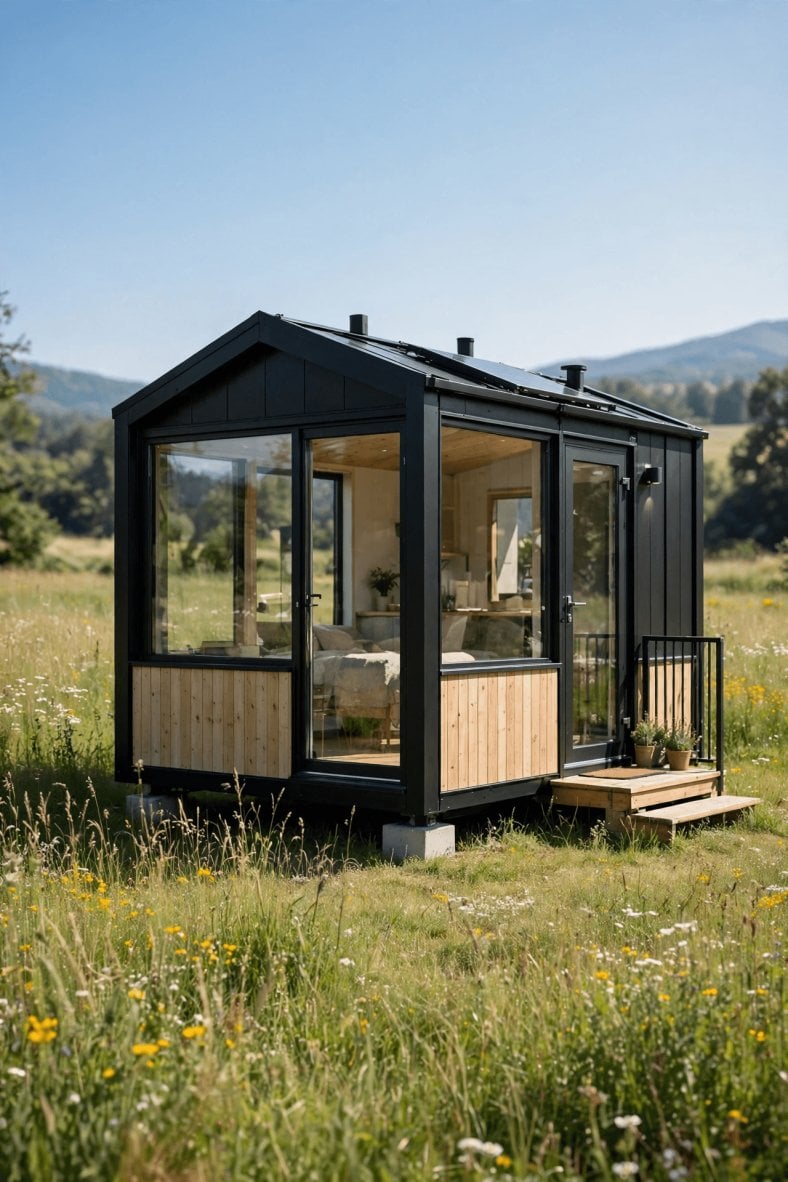
Pin it: the building is one column of the budget — delivery, foundation, permits and hookups are the others.
9. Inspection Checks Before You Buy Any Cabin
Whether the cabin is new from a factory, a kit on a pallet or a used unit on its own land, a structured inspection converts a listing’s adjectives into facts. For a finished or used cabin, work in this order:
- Paperwork first. Title or certificate of origin, certification labels and data plates, permit and inspection records for placed units, and the inclusion list for anything not yet built — checked against Sections 3 and 7 before the physical inspection begins.
- Structure and envelope. Roof condition and flashing, log or siding condition (rot, checking, insect sign on timber), foundation contact and levelling, floor stiffness, and any daylight or daylight-shaped gaps at corners and openings.
- Water management. Roof overhangs and drainage, ground slope away from the base, staining under windows and at the floor line, plumbing pressure and drainage, and the state of any existing septic and well, with records.
- Systems. Electrical panel and visible wiring standard, heating appliance age, flue and clearances, insulation you can verify rather than be told about, and ventilation in the bathroom and loft — small timber buildings fail on moisture more than on structure.
- Fit and function. Doors and windows that still close squarely (a moved or settled cabin announces itself here first), loft access safety, and clearances around stoves and heaters.
For kits and new prefabs, inspect the contract instead: scope inclusions and exclusions, delivery specification and site obligations, warranty terms and who honours them after delivery, and the payment schedule — staged payments tied to verifiable milestones protect the buyer; a large unrefundable deposit against a photograph protects only the seller. On used cabins, a professional home or RV inspector (matched to the unit’s classification) is money spent at the cheapest possible moment: before the money moves.
10. Red Flags: Listings and Sellers to Walk Away From
Cabin listings fail in predictable dialects, and learning them saves deposits. Vague scope is the first: a price with no inclusion list, photographs of a finished show cabin attached to a shell or kit offer, or “fully equipped” language sitting over an options sheet where the equipment lives. The second is classification fog — a seller who cannot say which code or certification the unit carries, who describes an RV-certified unit as “basically a house”, or who suggests permits are a formality the buyer can “sort out later” in a jurisdiction the seller has already quietly asked.
Site fog is the third dialect: packages and used cabins marketed with “utilities available” that means a power line somewhere on the road, “year-round access” on an unploughed track, or land shown in summer photographs only. Pressure is the fourth: expiring discounts on a product with no scarcity, deposits demanded before documents, and contracts offered for signature before the inclusion list, the title position or the delivery terms have been produced. Each of these is survivable in isolation with enough discount; in combination they describe a transaction whose risks are being transferred to you deliberately, priced as if they did not exist.
The counterweight is equally predictable: sellers who produce documents before being asked, who separate the land and building prices, who specify delivery obligations in writing, and who encourage independent inspection are not merely nicer people — they are revealing that the transaction survives scrutiny. In a market with no central listing standards, the seller’s paperwork behaviour is the most reliable quality signal available, and it is free. Weight it accordingly, and be genuinely willing to walk: cabins are manufactured every week, while a bad parcel, a mislabelled unit or a vanished deposit is a multi-year problem.
Final Considerations
A tiny cabin is a good purchase when it is bought as what it actually is: one component — the visible one — of a small housing project whose other components are land, foundation, permits, utilities and paperwork. Choose the route that fits your skills honestly (kit if you can build, shell if you can finish, prefab if you can pay for factory labour, package only if both halves survive unbundled scrutiny), verify the classification before the financing, price the whole project before comparing buildings, and let the red flags in Section 10 spend your scepticism where it earns the most. Do that, and the cabin in the clearing at the end of the process is the one in the photograph — with the difference that it is legal, serviced, insured and yours.