

“Micro” is the least standardised word in small housing. It has no legal definition, no certification body and no agreed size line, yet it is attached to everything from a converted cargo trailer with a bed and a kettle to a factory-built dwelling smaller than a single garage. That looseness is exactly why micro listings reward a slower read than other small homes: the same word can describe a titled, towable, insurable product or an anonymous structure with no paperwork, no axle rating and no legal route to being lived in anywhere. Micro homes for sale therefore sort less by square footage than by documentation — what the unit is, what it is called on paper, and what that paper lets you do with it.
This guide gives the micro end of the market a working structure. It defines what counts as micro in practice, maps where listings actually live, profiles the main types, prices the project beyond the listing number, and deals honestly with the two subjects micro buyers meet late: financing that falls between loan products, and inspections that have to cover title and axles as well as taps and wiring. It closes with the paperwork of private sales and the red flags specific to very small, very movable homes. The short version: at micro scale, you are not mainly buying space. You are buying a classification, a chassis and a set of documents, with a small home attached.
1. Micro Homes for Sale at a Glance
The table below answers the questions micro shoppers ask first. Watch the pattern: size questions have marketing answers, while title, weight and utility questions have factual ones — and the factual ones decide the purchase.
| Question | Micro homes in brief |
|---|---|
| What counts as a micro home? | By usage, the smallest end of tiny living — compact units below the typical tiny-house range, from trailer-based micro dwellings to small modular and container units. There is no official threshold, so every listing must be classified by construction and paperwork, not by the label. |
| Where are they listed? | Across general marketplaces, tiny-house-specific listing sites and groups, builder and manufacturer pages, and local classifieds — with the least standardised descriptions in the general channels, where title and certification details are most often missing. |
| What types exist? | Mainly wheeled micro homes on trailers, small modular or prefab units, container conversions, and flat-pack or kit micro structures — each with different transport, placement and code implications. |
| Is the listing price the real cost? | Rarely. Transport, placement, utility connection and any work needed to make the unit legally habitable sit outside the headline number, and at micro prices those extras can rival the purchase price itself. |
| Can you get a loan for one? | Often only through personal or chattel-style lending, if at all. Micro units routinely fall below lenders’ minimum loan sizes, lack the certification mortgage products require, or are titled as vehicles — plan on the financing being negotiated, not assumed. |
| What should you inspect first? | The paperwork: title status and VIN or serial, classification and certification, and ownership chain. Then the running gear — axles, tyres, brakes, frame — and the utility systems, in that order. |
| Where can you legally live in one? | Wherever its classification allows: as a dwelling where a foundation unit meets local code and zoning, or as an RV-style unit where parks, campgrounds or local rules accept it. Smallness itself grants no exemptions. |
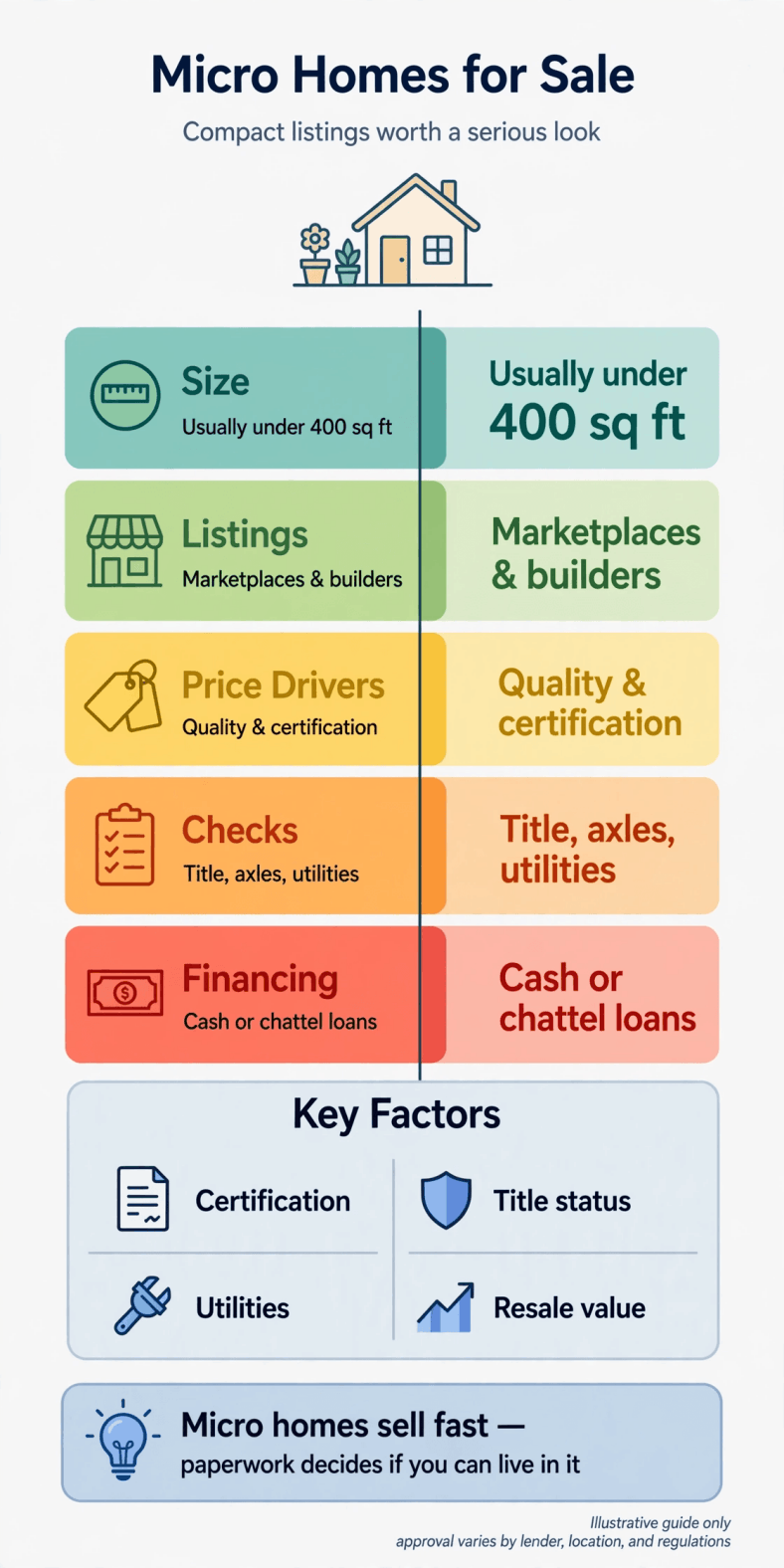
Infographic: micro homes by type and paperwork — and the checks that matter at this scale.
2. What Counts as a Micro Home? Size Bands and Labels
Start by discarding the idea that micro is a category with edges. In listings, the word is used for the smallest band of the tiny market — homes noticeably smaller than typical tiny houses, down to units whose entire plan is a bed, a galley and a wet room — but sellers draw the line wherever flattery suggests, and a generous “micro” can overlap an ordinary tiny house entirely. The useful response is to classify every candidate by the three facts that actually govern it: how it is built (site-built, factory-built, converted), what it stands on (foundation, trailer, skids), and what it is on paper (dwelling, manufactured home, RV, untitled structure). Two homes of identical size in different cells of that grid are different purchases in law, lending and resale.
Weight is the micro-specific fourth fact. Very small homes are often sold as towable by ordinary vehicles, and sometimes they are — but the only numbers that matter are the trailer’s rated capacity and the unit’s actual weighed weight, wet and loaded, against the tow vehicle’s limits. Sellers quote dry weights, design weights and occasionally hopes. Our guide to the tiny house trailer buying guide explains ratings and running gear in the depth a micro purchase needs, because at this scale the trailer is frequently an afterthought — a light utility chassis under a structure that has quietly outgrown it.
Finally, read “micro” claims about livability with an engineer’s squint. A unit can be genuinely sufficient for one person and genuinely mis-sold to two; ceiling height, bed access, bathroom arrangement and storage decide daily life more than the floor area figure in the headline. None of this is knowable from photographs shot through a wide lens, which is why Section 8’s checklist ends with standing inside the thing, lying on the bed and closing every door — at micro scale, ergonomics is a structural feature.
3. Where Micro Home Listings Actually Live
Micro homes are scattered across more channels than any other small housing, and each channel has its own information quality. Tiny-house-specific marketplaces and listing sites give the most structured descriptions — classification, dimensions and location fields exist because the audience asks — and our round-up of tiny homes for sale near me explains how those local searches work. Builder and manufacturer pages suit new units: specifications are fuller, but the product is a range with options, and the listed unit may be a demonstrator configuration rather than the deliverable one.
General marketplaces and social-media groups carry the volume and the variance. Here the micro label does the most work and the paperwork the least: listings lead with interiors, omit titles, weights and certification, and describe transport as an afterthought. That is not a reason to avoid these channels — private sellers with honest units use them too — but it sets the buyer’s job: every missing fact in the template has to be requested explicitly, and a seller’s response to document requests is itself listing data. Local classifieds and word of mouth complete the map for used units already placed on land; these rarely reach searchable channels at all, which is one reason micro resale pricing is so anecdotal (Section 9).
Search technique follows from the vocabulary problem. Search by construction and classification words — park model, THOW, modular, container home, cabin — as well as by “micro” and “tiny”, follow sold listings to calibrate asking prices against outcomes where platforms expose them, and keep a notes file per candidate with the factual fields (title, year, weight, certification, utilities) filled from documents rather than descriptions. At micro scale the disciplined spreadsheet beats the saved-search alert, because the listings most aggressively marketed are systematically not the best documented ones.

Pin it: listings live in more channels than any other small housing — and the paperwork varies by channel.
4. The Main Types: Wheeled, Modular, Container and Flat-Pack
Wheeled micro homes — tiny houses on wheels at their smallest — dominate the listings. Their virtues are mobility and the RV route to placement; their costs are the trailer compromises (width and height limits, wheel-well intrusions, weight discipline) and a legal identity as a vehicle. Judge them as vehicles with interiors: chassis, rating, brakes and title first, floor plan second. A pre-owned wheeled micro with clean title and certified construction is a defined product; the same shell home-built on an unrated trailer is a project with unknowns in every system.
Modular and prefab micro units trade wheels for a foundation. Built in a factory to residential or manufactured standards depending on the maker, delivered whole or in sections, they behave legally like small houses once placed — permits, inspections and real-property treatment where the classification supports it. Their micro risk is different: minimum-size and placement rules in local zoning were not written with them in mind, so the placement conversation with the local office (Section 6) matters more, not less, for being factory-made.
Container conversions and flat-pack kits fill the third cell. A shipping-container micro is a steel structure with genuine virtues — robustness, stackability, transportability — and conversion-specific questions: cutting and reinforcement, insulation and condensation control, and the container’s prior cargo history. Flat-pack micro kits are the cabin-kit logic of our cabins guide at smaller scale: a materials package whose finished legality is created, or not, by local permitting where it is assembled. In every type, the same closing question applies: what will this be on paper when it is finished and placed — because that, and not the brochure category, is what you will own.
5. Total Cost Beyond the Listing Price
Micro prices are small enough to make the surrounding costs look minor until they are totalled. Transport is the first: a micro unit still needs a suitable tow vehicle or a transport company, permits where its dimensions require them, and a delivery route its size and weight can actually travel. Placement is the second: a prepared pad or foundation, levelling and tie-downs where wheeled, and the access work — gates, corners, soft ground — that small parcels specialise in. Our land-sequencing guide, how to prepare your land for a tiny house, scales down to micro sites without changing its logic.
Utilities are the third and most underestimated. A micro home needs the same four services as any dwelling — power, water, sewage, heat — and while its consumption is small, connection costs are famously indifferent to the size of the building at the end of the trench. Off-grid substitutions (solar, tanks, composting) have their own capital costs and their own acceptance questions with local authorities; tiny house utilities for power, water and sewage works through the options and their trade-offs in full. Add insurance from the first day, registration and title transfer fees, and any catch-up maintenance a used unit announces in its first season.
The comparison discipline is total-in-place cost per usable outcome, not price per square foot — a metric that flatters micro units while hiding their fixed-cost floor. A very cheap micro that needs transport, a pad, a septic solution and a title rescue can land above a dearer unit already legally placed, and the placed unit also starts its life insurable and resalable. Price the whole arrival, every time, in writing, before the listing’s number is allowed to anchor the negotiation.
6. Permits, Zoning and Placement for Very Small Homes
No jurisdiction exempts a dwelling for being small; several effectively exclude micro homes through rules written for other purposes. Minimum dwelling floor areas in local zoning, where they exist, bite hardest at micro scale. Rules on RV occupancy govern wheeled units on private land, time-limited in many towns. Subdivision covenants add minimum sizes and use restrictions of their own. The practical sequence is therefore placement-first: identify the parcel or park, establish what classification of unit may live there and for how long, and only then shop for a unit inside that answer. Our state-guide series works this through state by state for the broader tiny market, and the method — classification, zoning, covenants, in that order — is identical for micro.
Parks and communities built for small units are the placement shortcut: RV parks that accept long-term wheeled units, tiny-house communities with their own lot rules, and campgrounds with seasonal limits that suit some buyers and quietly exclude others (a “seasonal” permission is not a residence). For land you own, the building department conversation for a foundation micro is a miniature of any house permit: plan, foundation, sanitation, inspections. Smallness occasionally helps — a micro unit as an accessory dwelling where ADUs are allowed — and occasionally triggers the minimum-size wall instead; only the local document answers which.
Document the placement answer before purchase with the same care as the unit’s title. A micro home is exceptionally easy to buy and, in the wrong jurisdiction, exceptionally easy to be ordered to move — its mobility, which the listing sold as freedom, becomes the enforcing officer’s remedy. The buyers who fare best treat a written zoning confirmation or a park’s written acceptance as part of the purchase price and obtain it before money moves, not as an administrative errand for afterwards.
7. Financing Gaps: Why Micro Homes Fall Between Loan Products
Micro homes are hard to finance for structural reasons, and naming them helps buyers stop shopping for products that cannot fit. Mortgage lending wants real property: a dwelling on a foundation, on owned land, with comparable sales — a description most micro units fail on at least two counts. Manufactured-home lending wants HUD-code units on approved foundations. RV lending wants recognised certification and a titled vehicle. Personal and chattel lending will often fund the purchase, but at consumer-loan pricing, shorter terms and smaller maximums that can sit below the all-in cost of even a micro project once Section 5’s extras are added.
Minimum loan sizes are the quiet disqualifier: many lenders simply do not write loans as small as a micro purchase, and those who do price the fixed cost of origination into rates that surprise buyers comparing against mortgage headlines. Valuation is the second: with thin comparable sales, appraisals for anything unusual come in conservative, and a lender advancing against a low valuation leaves a cash gap the buyer discovers mid-transaction. Sellers of micro units know this terrain — which is why “financing available” in a micro listing usually means a specific arrangement (a manufacturer’s partner lender, or seller financing on terms to scrutinise like any other credit) rather than a general truth.
The practical responses are unglamorous and effective: establish the cash position honestly, including the placement costs; approach lenders with the classification documents in hand, since a certified, titled unit is a different conversation from an undocumented one (our guide to how to finance a tiny house maps the products and their conditions); and treat seller financing as a contract to be reviewed, with title handling, default terms and payoff conditions spelled out. Tiny house insurance for wheels vs foundation deserves the same pre-purchase hour, because a unit that can be financed but not insured to a lender’s standard stalls at the same desk.
8. The Inspection Checklist: Title, Axles and Utilities
Micro inspection inverts the usual order: documents before structure, running gear before interiors, because at this scale the expensive failures are legal and mechanical before they are cosmetic. Work through it in sequence:
- Title and identity. Clean title in the seller’s name for wheeled units, VIN or serial plate present and matching the documents, no liens, and a bill of sale that describes the unit by its identifiers. Our registration guide, how to register a tiny house as an RV, shows the titling chain a legitimate unit should be able to reproduce.
- Classification and certification. Labels and data plates photographed; the claimed standard (RV certification, HUD, modular) verified against the physical plates, not the listing text.
- Frame and axles. Trailer frame rails for rust, cracks and amateur welding; axle rating against the unit’s weight; suspension, brakes and breakaway system; tyre age and rating; coupler condition. A professional weighbridge ticket settles the weight argument in one visit.
- Envelope. Roof seams and penetrations, water staining at corners and under windows, floor softness, door and window operation — the moved-and-settled unit announces itself in its openings.
- Utilities. Electrical panel and visible wiring, plumbing pressure and drainage test, water heater and heating appliance age and flueing, propane lines and tank certification where fitted, and battery/solar components tested under load where off-grid gear is included in the price.
- Livability. Bed dimensions and access, ceiling height at the places you stand, bathroom function, ventilation and condensation history (mould in a micro is a whole-house condition, not a corner condition).
Our dedicated used-buying walkthrough, how to inspect a used tiny home before buying, expands each system check; use it alongside this list, and budget a professional inspection for any unit whose price would hurt to lose. On micro units the inspector’s visit is cheap relative to the classic disasters — an unrated axle discovered on a weighbridge, a title that belongs to a previous owner, a roof that has been quietly irrigating the walls — each of which converts a bargain into a liability at exactly the moment it becomes yours.

Pin it: documents first, axles second, interiors last — the micro inspection order.
9. Negotiation and Paperwork for Private Micro Sales
Most used micro homes change hands privately, without the listing standards, escrow habits or regulatory paper trail of house sales — which puts the transaction’s quality entirely in the two parties’ documents. The minimum competent set: a written bill of sale identifying buyer, seller, unit (by VIN or serial), price and date; the title, signed over correctly for its jurisdiction; any lien release; and an inventory of included equipment, because micro sales have a tradition of the photographed extras (mattress systems, solar gear, hitches, skirting) evaporating between viewing and collection. Photograph the unit’s plates and condition jointly on the day; memories diverge faster than ink fades.
Negotiation at micro scale runs on the factual findings, not on theatre. The legitimate levers are documented: transport cost to your site, catch-up maintenance the inspection priced, title or certification gaps and what curing them costs, and the thinness of the resale market itself (a micro seller’s buyer pool is small, and both parties know it). Asking prices in private micro listings are frequently anchored to the seller’s build cost or purchase price rather than to comparable outcomes, and the respectful correction is evidence — similar units’ asking and, where visible, sold prices — offered as market information rather than as an argument about the seller’s choices.
Payment mechanics deserve the same care as price. Use traceable payment, complete the title transfer immediately and in person where the system allows, and register and insure the unit before its first tow, not after its first incident. Where any element cannot be completed — a title in transit, a lien being discharged — hold the balance against the document, in writing, with dates. Private micro sales fail on trust extended across paperwork gaps; the paperwork is short, so there is no excuse for the gaps.
10. Red Flags in Micro Home Listings
Micro listings concentrate the small-housing warning signs into a smaller, faster transaction, which makes pattern recognition valuable. The classification fog comes first: a unit described with house vocabulary and priced with house confidence that proves, on request for documents, to be untitled or home-built on an unrated trailer. Weight fog follows: no weighed figure, a tow rating implied by a photograph of the unit behind a large truck, or a seller vague about whether the quoted weight includes water, propane and the interior fit-out. Both fogs clear instantly when documents exist; a seller who experiences document requests as hostility is providing the inspection result free of charge.
Photographic tells are the third pattern: all-interior listings with no exterior, chassis or plate photographs; wide-angle shots that avoid ceilings and the bathroom entirely; a unit photographed in a scenic location it does not come with, implying a placement the price excludes. The fourth is transactional pressure adapted to small sums — because the amount feels minor, buyers skip steps they would never skip on a house: no title sighting, deposit by instant transfer, collection arranged before paperwork. The losses are equally real for being smaller, and recovery is harder precisely because the transaction left no paper.
The positive pattern is by now familiar across this whole buying series: documents produced early, identifiers matching, weight and classification stated factually, inspection welcomed, placement discussed as the buyer’s problem to solve honestly rather than waved away. At micro scale more than anywhere, the seller’s administrative behaviour is the product — a careful owner produces a careful unit, and the listing that reads like a maintenance log is worth travelling for over the one that reads like a brochure.
Final Considerations
Micro homes deliver the genuine core of tiny living — low purchase cost, low running cost, a small footprint on land and budget alike — at the price of living at the edge of every system designed for housing: lending minimums, zoning minimums, appraisal comparables, even the vocabulary of listings. Buyers who thrive at this scale are the ones who make the systems explicit before purchase: classify the unit, weigh it, title it, place it on paper, finance it knowingly and inspect it in the order Section 8 sets out. Do that, and a micro home is exactly what its best listings promise — the least house that still works, bought with the most diligence in the market.