

Wisconsin splits its tiny-house rules along a line most states blur. For the building itself, the answer is singular and statewide: the Wisconsin Uniform Dwelling Code, one code for one- and two-family homes, written by the state and enforced from Superior to Kenosha, so a small house is engineered to the same standard in every county. For the land underneath, the answer multiplies: counties zone the unincorporated ground, towns bargain over whether to accept that zoning, cities and villages run their own ordinances, and along the state’s thousands of lake and river shores a state-floored shoreland regime adds setbacks and lot rules of its own. Over everything sits the climate, because Wisconsin designs buildings for some of the deepest frost and heaviest snow loads in the continental United States. Tiny house laws in Wisconsin therefore reward a buyer who separates the questions cleanly: the code decides how the house is built, the town or county decides where it may stand, the shoreland map decides how close to the water, and the frost decides how deep it all has to go.
This guide follows that separation. It covers how wheeled and foundation houses are classified, what the Uniform Dwelling Code demands of a very small dwelling, the sizes that bind and the ones that do not, zoning across towns, counties and cities, accessory dwellings in a state where the movement is city-led, the places you can legally live full-time, permits and inspections including the state’s POWTS septic system and shoreland approvals, and regional examples from Madison to the Northwoods. The short version: Wisconsin is administratively tidy and climatically serious. Get the code details and the frost details right, and the rest of the state mostly asks which shore, town and school district you had in mind.
1. Tiny House Laws in Wisconsin at a Glance
The table below answers the questions Wisconsin readers ask first. Watch the pattern: construction questions have one state answer, land questions have a local one, and water questions — shoreland, septic, floodplain — have a county answer nearly everywhere in lake country.
| Question | Wisconsin in brief |
|---|---|
| Are tiny houses legal in Wisconsin? | Yes, on a foundation, built to the Wisconsin Uniform Dwelling Code, on a lot whose zoning allows a dwelling. No state provision bans small homes; local minimum-size rules in some ordinances and shoreland lot standards are the checks that matter. |
| Is a tiny house on wheels a house or an RV? | An RV or vehicle for legal purposes. Occupying one as a dwelling is governed by local zoning, and many Wisconsin towns and lake communities restrict camper and RV stays on residential lots, especially beyond short seasonal use. |
| Which building code applies? | The Wisconsin Uniform Dwelling Code, the statewide one- and two-family code administered by the state Department of Safety and Professional Services and enforced through municipal or state-credentialed inspectors. It applies to small dwellings just as to large ones. |
| How small can a house be? | The code regulates habitable rooms, ceiling heights, exits and stairs rather than total floor area. Some local zoning ordinances set minimum dwelling floor areas, commonly a few hundred square feet or more where they exist, so read the local ordinance before finalising a very small plan. |
| Are ADUs allowed? | There is no statewide ADU mandate. Wisconsin’s cities are leading: Madison and Milwaukee and a growing list of others have written accessory dwellings into their zoning with size and occupancy conditions. Elsewhere, town and county ordinances decide, and many rural areas address second dwellings case by case. |
| What permits does a tiny house need? | A uniform building permit and inspections for the dwelling, a county sanitary permit for a POWTS septic system where there is no sewer, zoning approval for the lot, and shoreland or floodplain approvals on mapped sites near water. |
| Where can you live full-time? | In a permitted foundation house on a legal lot, in an approved accessory dwelling, in a manufactured-home community that accepts the unit, or year-round in a campground only where its approvals genuinely allow it. Seasonal cabins and campers do not become legal residences by being occupied anyway. |
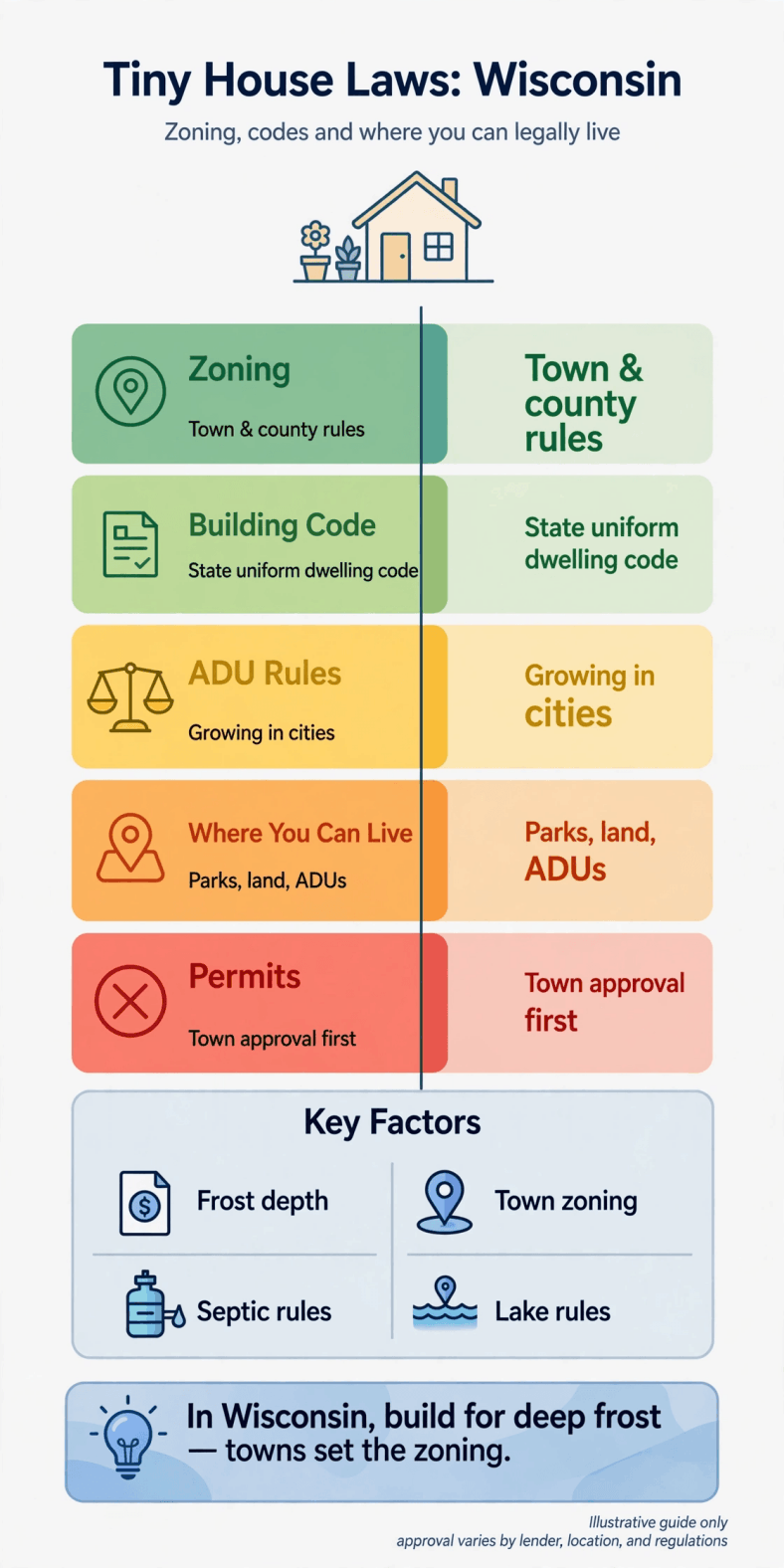
Infographic: the Wisconsin stack — one state dwelling code, town and county zoning, shoreland rules near water, and frost depth under everything.
2. Legal Status: Wheels vs Foundation in Wisconsin
A small house built on site, on a permanent foundation, under a uniform building permit, is a dwelling under the Uniform Dwelling Code, and Wisconsin’s system treats it exactly like any other one-family home: permitted, inspected at the standard stages, assessed as real estate and occupied as of right where zoning allows dwellings. Factory-built housing splits into its usual channels — manufactured homes under the federal code with state administration, and modular homes built to the same Uniform Dwelling Code as site-built houses and inspected at the factory — and confusing the three channels at purchase time is the most common paperwork error in the state.
Wheels put the unit in vehicle territory. A tiny house on a trailer is titled and registered as a recreational vehicle or trailer, and whether it may be lived in is a zoning question, answered town by town and city by city. Wisconsin adds two local wrinkles: lake-country and Northwoods communities, long accustomed to seasonal cabins, often regulate camping on vacant or residential land with stay limits measured in nights per year, and many ordinances distinguish a camper used during construction or as a guest from a camper used as the dwelling. The written answer from the zoning office is the only safe basis for a wheeled plan. For the vehicle side itself, what RVIA certification means for a tiny house and how to register a tiny house as an RV cover the titling, plate and insurance logic that follows the chassis wherever in Wisconsin it parks.
3. Zoning and Placement: Towns, Counties and Cities
Wisconsin zoning is a three-body problem. Counties adopt zoning for unincorporated territory, but towns hold a historic power in the system: a town may operate under county zoning, adopt its own ordinance with county involvement, or in some cases stand apart, which is why two adjoining rural parcels in different towns can answer to different rulebooks. Cities and villages zone inside their boundaries and sometimes review development in an extraterritorial band beyond them. The working consequence for a tiny-house buyer is to identify, in order, the parcel’s municipality, the zoning authority for that town or city, and the district — residential, rural and agricultural districts with their lot sizes and setbacks, and conservancy or floodplain districts that can retire a pretty parcel from building altogether.
Placement checklist for Wisconsin: municipality and zoning authority first, then district, shoreland status, and the septic site.
On top of base zoning sits the layer that defines Wisconsin’s most desirable land: shoreland zoning. Counties administer shoreland rules — under state minimum standards — for land near navigable lakes and rivers, and those rules set the terms lake buyers actually live by: minimum lot widths and areas, setbacks of homes from the ordinary high-water mark, vegetation protection near the shore, and limits on expanding older small cabins that predate the rules. A tiny footprint can be an asset inside those constraints, but a substandard shoreland lot is a legal category with its own restrictions, and it must be read before purchase, not argued after. The official-conversation method in the guide to zoning laws for tiny houses and talking to local officials applies directly: parcel, district, shoreland status and footprint, answered by the county or town zoning office in writing.
4. Building Codes: The Uniform Dwelling Code
Wisconsin was an early believer in one code for houses, and the Uniform Dwelling Code remains the centre of its system: a statewide code for one- and two-family dwellings, maintained by the Department of Safety and Professional Services, covering structure, energy, plumbing, electrical and heating in a single framework that its drafters built with manufactured-scale and modest homes in mind. Permits are issued locally — by the municipality or, where a town has not taken up enforcement, through county or state-arranged credentialed inspectors — and the permit itself is the famous uniform building permit, with inspections at footing, framing, rough-in and completion stages by inspectors holding state credentials.
For a tiny house, the code’s demands are the residential fundamentals applied honestly at small scale. Habitable rooms carry minimum areas and ceiling heights, sleeping rooms need escape and rescue openings, stairs and any loft access must meet the geometry the code allows, and the dwelling needs heating capable of holding habitable temperatures through a Wisconsin January — a performance test no loft ladder debate can distract from. Energy provisions are serious and climate-matched, and Wisconsin’s approach treats the thermal envelope as part of the code, not a lifestyle choice. The genuine kindness of the system is predictability: a plan that passes in Ashland County passes in Dane County, builders across the state price the same details, and a permitted small house carries its paperwork value at resale. Design to the code book your inspector will hold, confirm who that inspector is before the permit is filed, and the state’s tidiness works for you.
5. Minimum Sizes and Deep-Frost Design
Total minimum house size is not a Uniform Dwelling Code concept; the code’s floors are per room and per function, so a compact plan is a drafting exercise rather than a legal fight. The minimums that can bind a Wisconsin tiny house live in zoning: a meaningful minority of town, village and city ordinances set minimum dwelling floor areas or widths, historically used to keep out undersized cabins and older mobile homes, and those numbers — read in the current ordinance, never from a neighbour’s memory — decide how small a primary dwelling may be on a given lot. Accessory dwellings in the cities that allow them carry their own caps and minimums in the ADU text. In shoreland districts the effective minimum is often set by the lot, not the house: a legal lot of record with its setbacks and septic separation distances may leave exactly one sensible building envelope, and the house must be designed to fit it.
Then there is frost, the state’s senior building official. Design frost depth across Wisconsin runs roughly four feet in the south and five feet or more in the northern counties, so footings, frost walls and water services are planned deep, or protected by an engineered frost-protected shallow foundation detailed to the code — insulation, drainage and non-frost-susceptible fill working as one system, never improvised. Snow loads climb toward Lake Superior, and roof structure, ice-dam detailing and attic ventilation belong in the first design conversation, alongside the envelope strategy in how to insulate a tiny house and the climate playbook in tiny house living in cold climates. A Wisconsin tiny house is a heated box on deep footings with a serious roof; get those three right and the state’s winters become scenery instead of litigation with physics.
6. ADUs and Accessory Dwellings: The City-Led Story
Wisconsin has no statewide accessory-dwelling mandate, so its ADU map is a portrait of its cities’ choices. Madison rewrote its zoning in recent years to welcome accessory dwellings on residential lots across the city, with standards for size, height and occupancy, and Milwaukee and a lengthening list of suburbs, college towns and small cities have followed with their own versions. Where a city has done this work, the backyard cottage becomes the most predictable small home in the state: defined in the ordinance, permitted through a known process, and financeable as part of a property a lender already understands.
Outside the adopting cities, the accessory question returns to first principles. Towns and counties may allow a second dwelling or an accessory unit as a conditional use, may address farm and family second homes in agricultural districts, or may allow one dwelling per lot, full stop — in which case the honest options are a single small primary house, or land in a jurisdiction that says yes. Septic capacity quietly co-governs every version: the county sanitary permit for the property must account for the total bedrooms and flows of house plus cottage, and an undersized older system upgrades or the cottage waits. Ask for the ADU or second-dwelling text by name when you call the zoning office; in Wisconsin the answer is written down somewhere, and reading it is faster than discovering it.
7. Where You Can Legally Live in a Tiny House in Wisconsin
Full-time options follow the state’s tidy logic. A permitted foundation house on your own lot is complete tenure anywhere zoning allows a dwelling, from a Milwaukee side street to a Bayfield County clearing. An approved accessory dwelling on a host lot is next, strongest in the adopting cities. Manufactured-home communities are a long-established Wisconsin sector; match the unit’s category to the community’s rules before assuming a site-built tiny or wheeled unit will be welcomed. Campgrounds and seasonal RV resorts are for seasons, and the state’s cabin culture makes the seasonal-versus-year-round distinction a real legal line: a park or a town that permits a camper for the summer has not permitted a residence for the winter, a distinction the comparison of tiny house communities vs RV parks helps keep clear when a listing blurs it.
Lake country deserves its own warning label. The Northwoods and Door County run on seasonal population, and their ordinances were written to manage exactly that: rules on campers on vacant lots, on converting seasonal cabins to year-round use, on minimum sizes in shore districts, and on holding tanks versus full septic systems for older cottages. None of it is hostile to small houses — the classic Wisconsin cabin is a small house — but year-round living in a place permitted and plumbed for July is a specific approval to obtain, not a default to assume. Buy the winter version of the dream only after the county confirms, in writing, that the parcel, the system and the dwelling class all support it.
8. Permits, Inspections, POWTS Septic and Shoreland
The Wisconsin approval chain has four links, and most projects touch all of them. Zoning approval confirms the district, the lot and any shoreland or floodplain conditions. The county sanitary permit covers the POWTS — the state’s term for a private on-site wastewater treatment system — with a soil and site evaluation by a certified soil tester, a system design matched to the site’s soils and water table, and county inspection of the installation; holding tanks, mound systems and conventional fields each follow from what the ground reports. The uniform building permit then covers the dwelling itself, with credentialed inspections through construction. Municipal sewer and water, where they exist, replace the sanitary permit with connection approvals, which is why village lots are the fast lane for small builds.
The permit chain in Wisconsin order: zoning and shoreland, sanitary permit for the POWTS, uniform building permit, inspections, occupancy.
Shoreland and floodplain reviews run in parallel, not at the end: building near water can require county shoreland permits, setbacks measured from the high-water mark, mitigation for lot coverage near the shore, and floodplain elevation documentation in mapped areas along rivers and the Great Lakes coasts. Wetlands, which Wisconsin protects at state level and which lace the northern half of the state, can quietly occupy the middle of an otherwise perfect lot, so the wetland map belongs in the same first-week homework as the flood map. The sequencing in how to prepare your land for a tiny house and the systems survey in the tiny house utilities guide map well onto Wisconsin, with the local translation that the county — zoning office and sanitary office alike — is usually the single counter where the whole project is blessed.
9. Notable City and County Examples
Madison and Dane County show the state’s modern face: a city ADU framework, active infill, professional permit counters, and prices that push small houses toward accessory and modest-lot roles, ringed by towns where county zoning and farmland preservation shape what can be built. Milwaukee and its suburbs add scale and variety — city ADU provisions, older streetcar suburbs with small original lots where a compact house fits the historic pattern, and lakefront rules along Lake Michigan. Green Bay and the Fox Valley sit in the practical middle: full city codes, county systems outside, and winters that take the frost chapter personally.
The Northwoods — Vilas, Oneida, Bayfield, Sawyer and their neighbours — are Wisconsin’s cabin heartland and its most specialised tiny-house market: shoreland rules on nearly every desirable parcel, seasonal-versus-year-round law, mound and holding-tank septic realities, snow loads at the top of the state charts, and land prices that swing wildly with the quality of the shoreline. Door County layers peninsula tourism and tight shore rules over the same base. The Driftless southwest offers the counterpoint: coulee farms, small towns with light-touch zoning, and ridge-top building sites where the engineering is wind, drive and well depth rather than shoreland setbacks. In each region the method from this guide holds unchanged — municipality, zoning authority, shoreland status, soils, code, frost — and only the order of difficulty shuffles.
10. Practical Steps: From Lot Search to First Winter
- Fix the classification first: site-built dwelling, modular, manufactured placement, or wheeled unit, with permits and financing that match.
- Screen land by municipality and zoning authority, adapting where to buy tiny house lots to a state where the town line can change the rulebook.
- Confirm district standards — including any minimum dwelling size — and shoreland status with the zoning office, in writing, for your specific parcel and footprint.
- Order the soil and site evaluation for the POWTS early; make closing contingent on a sanitary permit path.
- Identify who issues your uniform building permit and who inspects, then design to the Uniform Dwelling Code with frost depth and snow load for your county.
- Choose the heating and envelope specification for a full Wisconsin winter, using the guide to heating a tiny house alongside the insulation decisions already linked above.
- Run the full budget — land, septic, well or connections, driveway, build — with how to finance a tiny house, and keep a contingency line for ledge, water table or wetland surprises.
- Build under permit, photograph every inspected stage, and file the permit set, sanitary records and as-builts together.
- Insure the finished home by its true classification with the tiny house insurance guide for wheels vs foundation, set the winterisation checklist, and move in before the ground freezes if the calendar gives you the choice.
Final Considerations
Wisconsin’s offer to the tiny-house buyer is unusually adult: one serious code, honestly enforced, that makes no exception for small houses and therefore makes them fully legitimate; a local zoning layer that must be read parcel by parcel; water rules that protect the lakes everyone came for; and a climate that grades every decision the following January. The failures in this state are not stories of banned houses. They are stories of a shoreland lot whose buildable envelope was never measured, a seasonal cabin mistaken for a year-round approval, a foundation poured to a warmer state’s frost line. Avoid those three, and a Wisconsin tiny house is simply a Wisconsin house, built to the same code as the farmhouse down the road, at the size its owners actually wanted. In the Northwoods or on a Madison side street, that is exactly what legal looks like.