

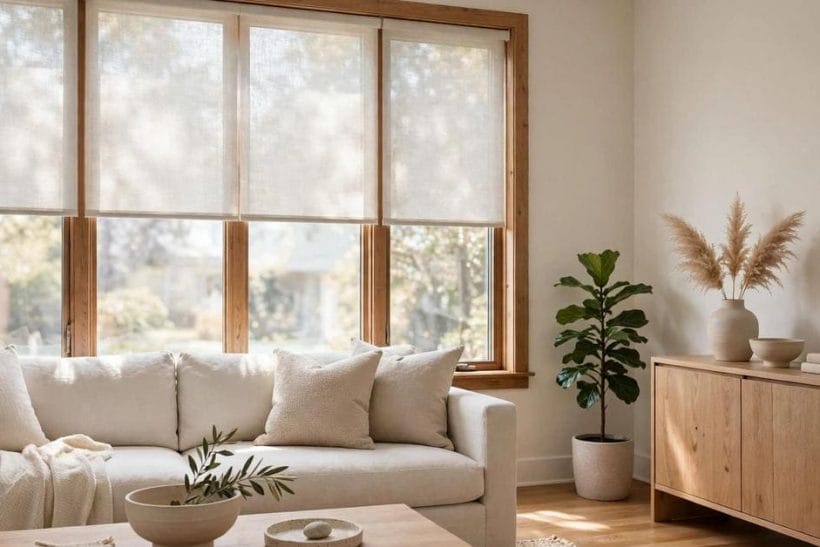
A window covering is one of the few home choices you live with every day, in every light. It softens the morning sun, shields a room after dark, and changes how private, calm, and comfortable a space feels. Getting it right is less about finding a single perfect style and more about checking each window against the room it serves.
This guide works through those checks in order, from measuring the opening to confirming the fitting. Use it room by room, note what each window needs most, and let those notes narrow the choice before you order anything.
1. Measure the Window Before Anything Else
Start with the opening itself, not with a catalogue. Look at the shape of the window, the depth of the reveal, and anything that stands in the way, such as handles, vents, locks, or trim that projects from the wall. A covering that cannot clear those details will never sit neatly, however well it suits the room in other respects. Note every quirk on paper, window by window, so nothing is forgotten when the order is placed.
Measuring is best treated as a professional job, and this guide gives no measuring instructions for that reason. A professional measurer will check the opening at several points, because walls and frames are rarely perfectly square, and will confirm how the covering should sit, inside the reveal or across the wall. Your part is to point out the quirks, the uses of the room, and any problem the window already has, such as a draught, a stiff handle, or a pane that is hard to reach.
| Room | First check | Second check |
|---|---|---|
| Living room | Daylight softness | Evening privacy |
| Bedroom | Darkness for sleep | Privacy after dark |
| Bathroom | Full privacy | Steam tolerance |
| Kitchen | Bright working light | Easy cleaning |
| Home office | Glare-free screen light | Daytime privacy |
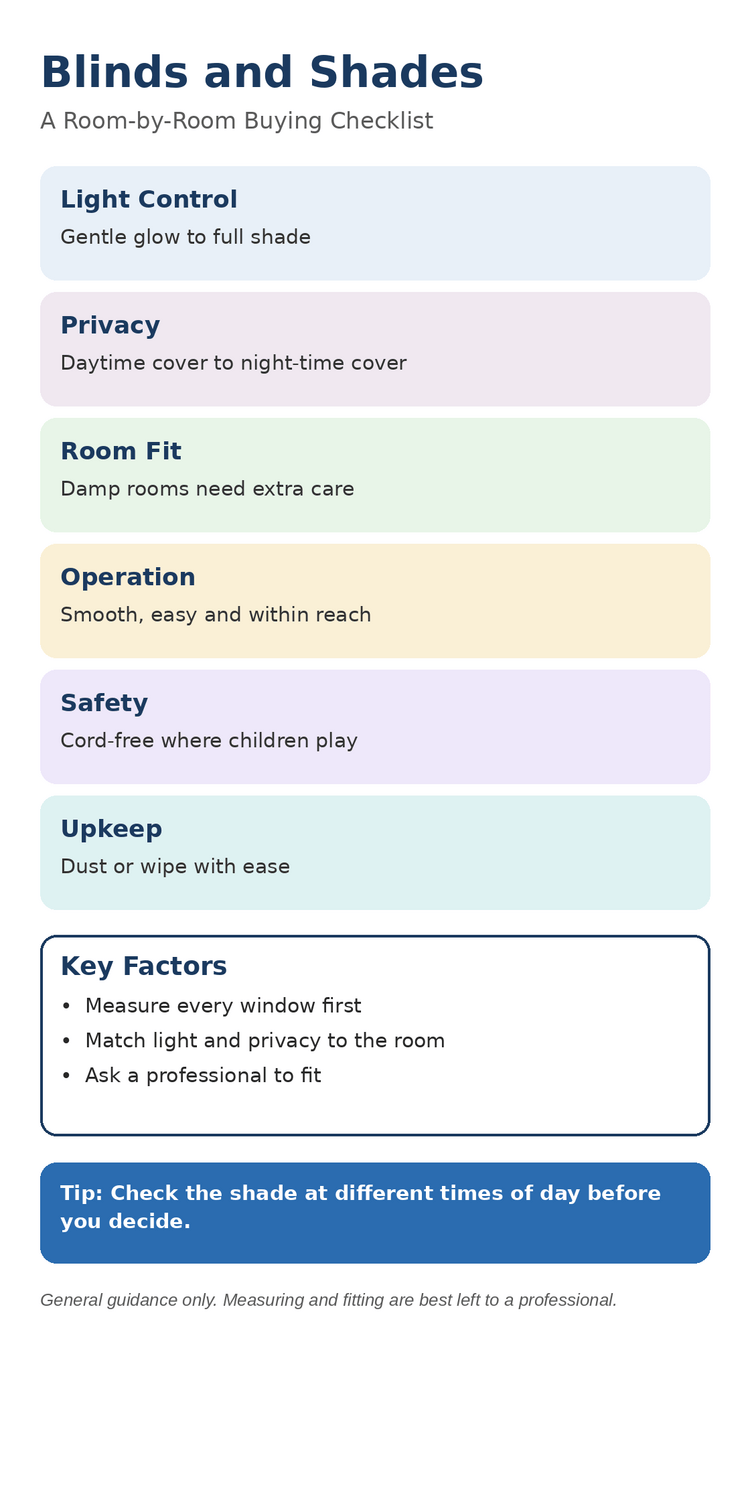
Keep the room-first order from the table through the rest of this guide. It is the same practical habit that shapes good room planning, from tiny living room ideas to the smallest bedroom corner. A covering chosen for its window and its room will always outlast one chosen for a showroom display alone.

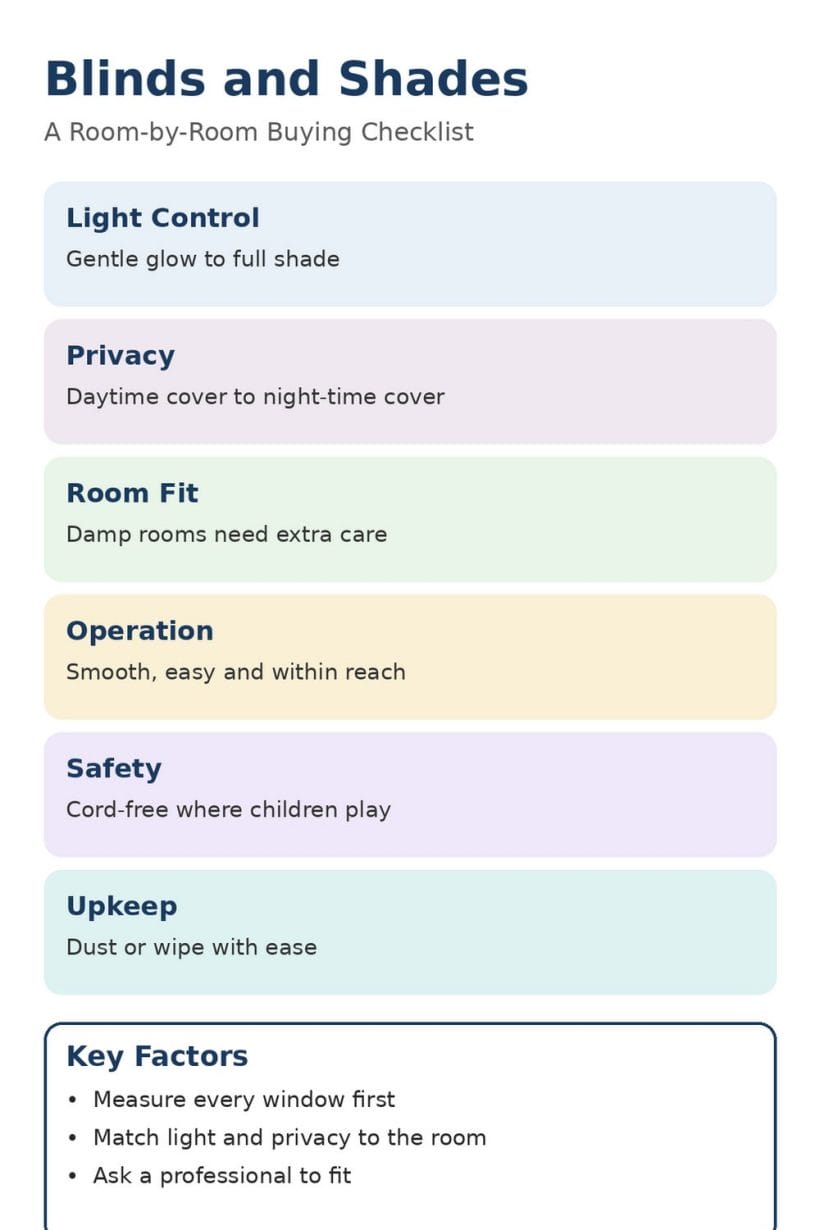
2. Match Light Control to How You Use the Room
Light is the main reason most people change a window covering, and it is also the hardest quality to judge from a small sample. A fabric that glows gently in a bright shop can darken a shaded room, while a covering that seems sheer enough indoors can blaze at sunset on a sun-facing window. The honest test is time: notice how the room feels through a full day, and when light helps the room and when it gets in the way.
Think in terms of range rather than a single setting. The most useful coverings offer more than open or shut, letting you soften strong sun, angle light away from a seating area, or close fully for sleep. Ask how the room is used at each hour, and whether the covering can follow that rhythm without constant fiddling. A living room that hosts morning coffee, afternoon reading, and evening television needs a wider range than a hallway window that simply needs softening.
Glare deserves its own thought, especially where screens, glossy worktops, or pale floors bounce light around. A covering that angles light rather than blocking it keeps the room bright without the harsh beam, and layering a sheer layer with a fuller layer gives you both softness and control. If a room already struggles with glare, a small living room idea that pairs soft coverings with matte surfaces will do more than a darker fabric alone. Judge light by how the room feels to sit in, not by how the covering looks on its own.

3. Set Privacy Levels for Day and Night
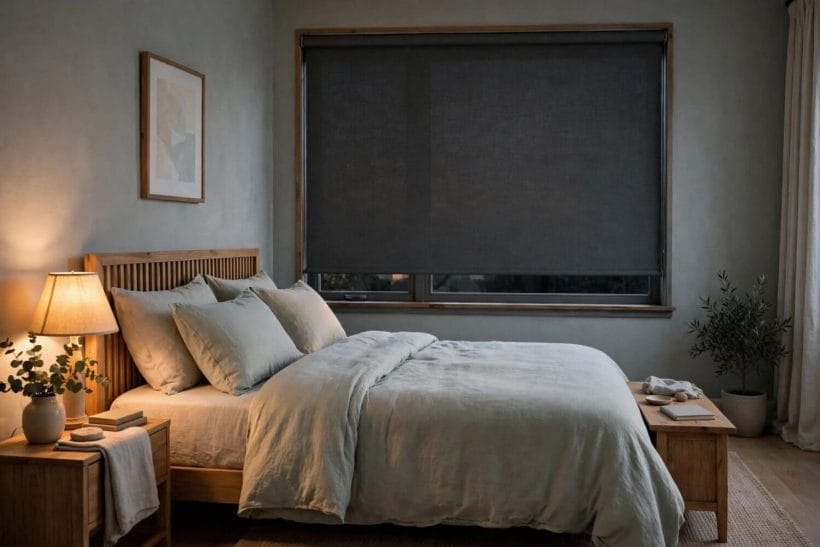
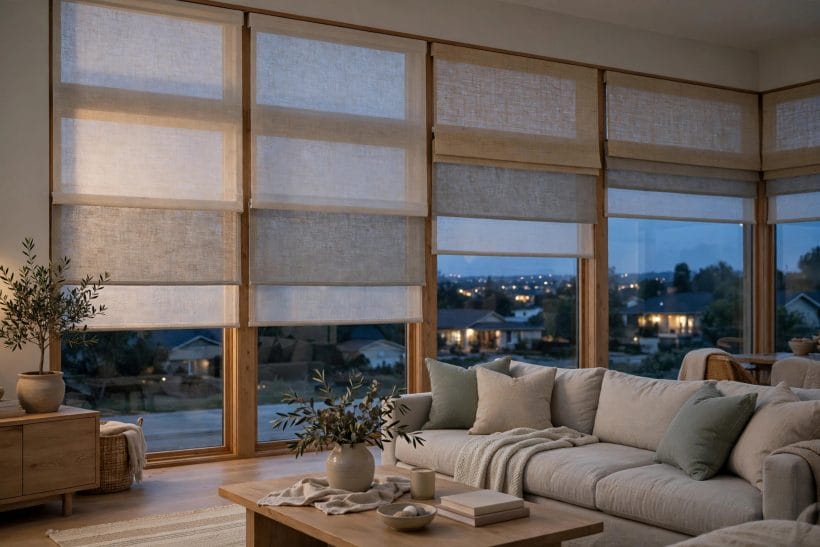
Privacy changes with the light, and many buyers discover this too late. By day, a sheer covering can shield you while keeping the view, because bright outdoor light stops eyes from reading the dimmer interior. After dark the balance flips: interior lights turn the window into a display, and that same sheer layer shows shapes clearly. Test any covering both ways before you commit, with the room lit as you actually live in it.
Consider who can see in, and from where. A ground-floor window facing a pavement needs more than an upper-floor window facing trees, and a bathroom or bedroom needs more than a hallway. Layering solves most of these cases gracefully: a sheer layer for daytime softness plus a fuller layer for night gives you both moods without swapping coverings. Where only one layer is practical, choose for the stricter case, which is almost always night.
Privacy also matters within the home and toward shared outdoor spaces. A bedroom window that faces a shared garden, a bathroom window beside a neighbouring terrace, or a street-facing study all deserve a deliberate choice rather than a matching set carried through the house. The guides for tiny bedroom ideas treat sleep and privacy as one problem, which is exactly how a covering should be judged: if it fails at night, it fails.
4. Choose Materials for Damp Rooms and Strong Sun
Material decides how a covering looks, hangs, and ages. Heavier weaves drape smoothly and block more light, while lighter weaves glow and keep a room airy. Texture matters as much as colour: a slubbed weave softens a stark room, a smooth plain weave suits a tidy modern interior, and a patterned weave can carry a plain room on its own. Handle samples in your own light, against your own walls, before deciding, because shop lighting flatters almost everything.
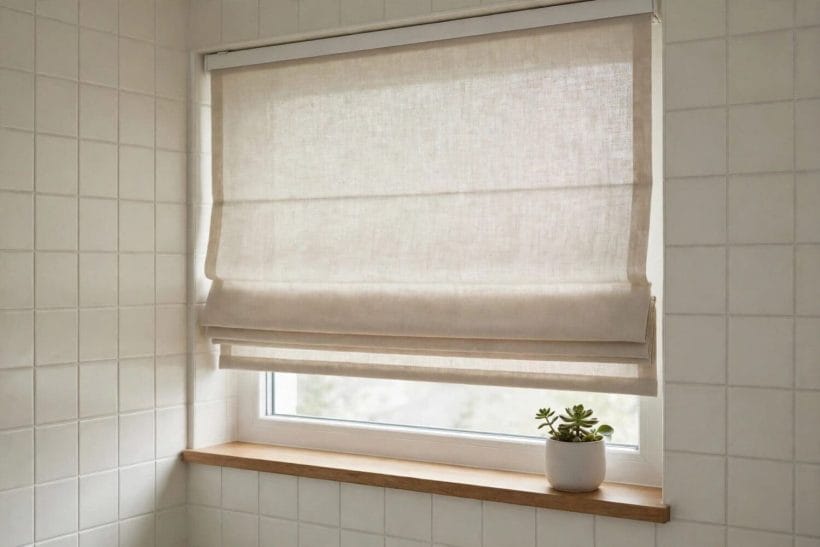
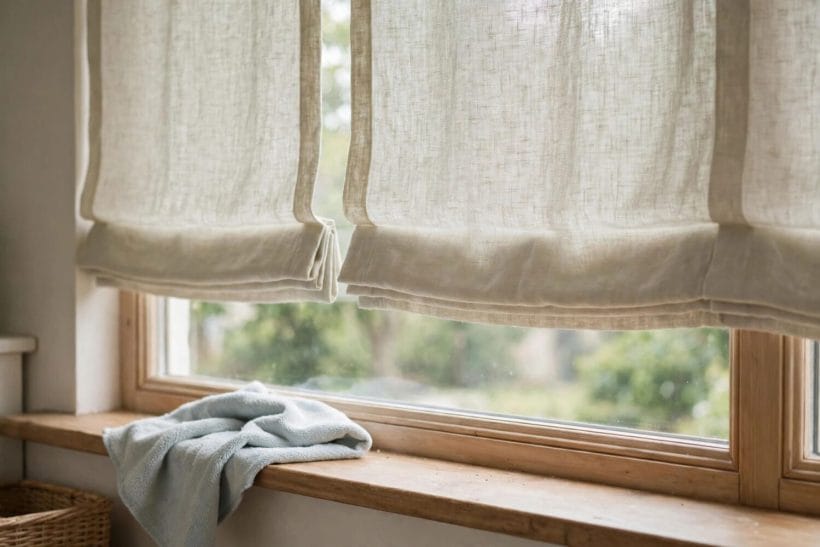
Wet rooms punish the wrong material quickly. Steam, splashes, and cooking grease settle into fabric, and a covering that cannot be wiped or aired will stain, stiffen, or smell within a season. Bathrooms and kitchens therefore need coverings chosen for wipeable surfaces and easy cleaning, with privacy that does not depend on a delicate fabric. If a covering cannot survive the room’s daily moisture, no amount of beauty will save it. The room guides help here: tiny bathroom ideas show how privacy, moisture, and small windows interact, and tiny kitchen ideas show how a window covering must share space with cooking, steam, and daily splashes.
Strong sun is the other great test of material. Sun can fade colour and weaken fibres over time, so a sun-facing window deserves a material chosen for that exposure rather than one chosen for shade. Pale materials keep rooms bright and make small windows feel larger, while deeper tones ground a room and hide marks better. If your walls and floors already carry strong colour, a quiet covering lets the room breathe; if the room is plain, the covering can supply warmth and pattern. Either way, judge the sample in the room, at the window, in daylight and lamplight alike.
5. Compare How Each Style Opens and Closes
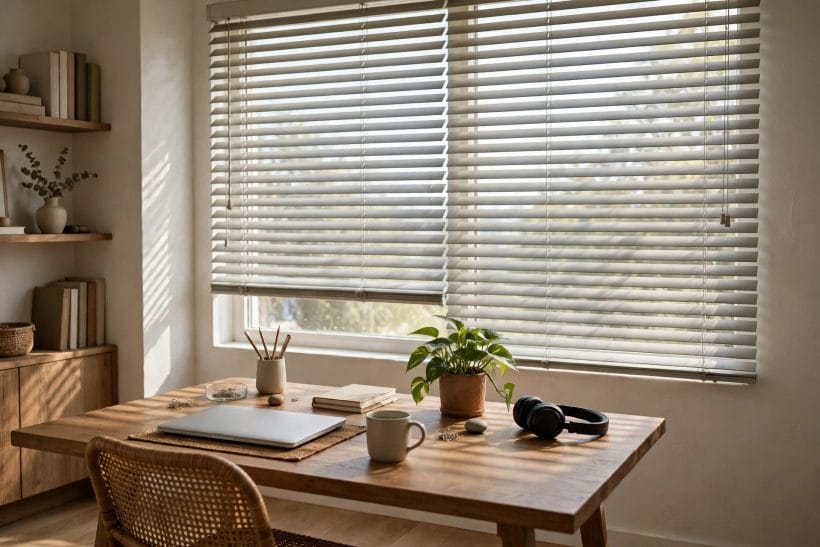
Operation sounds dull until you live with it. A covering that is awkward to raise, slow to lower, or hard to reach will end up stuck in one position, and a stuck covering is a wasted one. Try the mechanism before you buy: does it move smoothly, stop where you leave it, and sit level? Can everyone in the household use it comfortably, including anyone shorter, older, or less strong? Daily ease matters more than any single feature.
Consider how often each window will move. A bedroom covering that opens every morning and closes every night earns a smooth, reliable mechanism, while a high hallway window that rarely moves can accept something simpler. Cordless options suit hard-to-reach windows and homes where dangling cords are unwelcome, while a simple wand suits a window you adjust once a day. Match the mechanism to the habit, not to novelty.
Also check what happens when the covering is partway open. Does it hang evenly, or does one side creep? Does it rattle in a draught or swing when a door closes? These small behaviours reveal build quality faster than any description, and they predict whether the covering will still please you after months of daily use. A quiet, level, steady covering is a well-chosen one.
6. Plan for Safety Around Cords and Children
Safety belongs at the top of the list wherever children or pets share the home. Loose cords and loops can catch curious hands and paws, so cordless designs, short pulls kept out of reach, or cleats that hold cords flat against the wall are worth choosing deliberately. Check the finished installation from a child’s height, not an adult’s, and look for anything dangling near a bed, a cot, or climbing furniture. A covering is only safe when it is safe in the room as actually used.
Furniture placement matters as much as the mechanism. A bed, chair, or toy box pushed against a window turns a safe cord into a reachable one, so plan the room layout alongside the covering. Heavy coverings also deserve secure fixings into solid material, not just plaster, because a falling covering is a hazard in itself. These are fitting questions, and they are exactly why installation belongs with a qualified professional wherever fixings, height, or safety are involved.
Older coverings deserve the same scrutiny. If an existing covering has long loose cords, frayed pulls, or a mechanism that no longer holds, treat it as a safety job before a decorating job. Replacing or securing it promptly protects everyone in the room, and it lets the new covering start from a clean, safe baseline rather than inheriting an old risk.
7. Fit Awkward Windows, Doors and Wide Openings
Unusual shapes need extra thought. Tall narrow windows, wide sliding panes, bay angles, and windows with deep reveals each suit different solutions, and a covering designed for a standard window can struggle on any of them. Sliding panes need a covering that clears the moving panel, bay windows need joints that follow the angle without bunching, and deep reveals may suit a covering set inside the opening rather than across the wall. Name the quirk early, and let it narrow the choice.
Doors with glass panels raise a similar question. A covering on a door must clear the handle, survive daily opening and closing, and stay out of the way of anyone passing through. A covering that swings, catches, or blocks the handle will be pushed aside and then ignored, so test the door’s full swing with the covering in place, in your mind at least, before ordering. The same logic applies to windows that open inward: the covering must leave room for the pane to move.
How the covering sits also changes the room. A covering mounted inside the reveal looks tailored and saves wall space, which suits compact rooms and clean interiors, while one mounted outside the reveal can make a small window look larger and block more side light. Neither is universally better; the right choice depends on the window, the wall around it, and how much light you can accept at the edges. Planning a room around its windows, as in tiny house floor plans, makes these decisions easier, because window size and position are settled before coverings are chosen.
8. Think About Cleaning and Long-Term Upkeep
A covering you cannot clean will not stay beautiful. Dust settles on every horizontal surface, kitchen grease travels further than expected, and sun bakes both into fabric over time. Before choosing, ask how the covering is cleaned: can it be dusted in place, wiped with a damp cloth, or does it need removal and specialist care? The honest answer determines whether it will look good in a year or only on installation day.
Match cleaning effort to the room and your routine. A low, reachable living-room window can carry a fabric that needs occasional attention, while a high stairwell window or a busy kitchen window deserves something you can wipe in minutes. Pale fabrics show dust sooner but also show when they need care, while darker fabrics hide dust longer and then surprise you. Neither is wrong; the question is which rhythm fits your household.
Small habits extend any covering’s life. Regular light dusting prevents build-up, gentle handling of mechanisms prevents fraying and misalignment, and prompt attention to marks stops them setting. If a covering needs more care than you will realistically give it, choose a simpler one: the covering that still looks cared for, with the routine you actually keep, is the right covering for your home.
9. Check the Order Details Before You Commit
The final check is a conversation, not a catalogue page. Before ordering, confirm the finished size, the mounting position, the light and privacy behaviour at night, the cleaning routine, and the safety arrangement for cords and fixings. Ask what happens if the fit is imperfect, who adjusts it, and whether the mechanism is guaranteed to hold its position. Clear answers here prevent most disputes later, because they turn vague expectations into agreed details.
Also confirm the practicalities of fitting day. Who moves furniture, who protects floors and sills, and how long the room will be out of use? A good fitter will welcome questions about fixings and finish, and will explain what the household needs to do before arrival. If answers feel evasive, treat that as information and seek a second opinion before committing. A careful order, checked twice, costs far less trouble than a rushed one corrected afterwards.
Live with the decision briefly before paying in full where that option exists. A sample at your own window, a photograph of the room with the sample held in place, or a night-time check with the lights on can confirm what no description can. Samples also let you compare light, privacy, and colour together, in the room where the covering will actually live, rather than judging each quality on its own.
10. Work With a Professional for Measuring and Fitting
Measuring and fitting are professional work in this guide, not do-it-yourself tasks. A professional brings the measuring method, the fixing knowledge, and the eye for quirks that a first-time measurer cannot be expected to have. That matters most where fixings carry weight, windows are high, walls are uneven, or safety depends on the result. The fee for professional work buys accuracy and accountability, and it protects the covering itself, which is made to the measurements given.
When you brief a professional, share everything this guide has helped you note: the room’s light through the day, its privacy needs after dark, its moisture and sun exposure, the mechanism the household can use comfortably, and any safety concern around children or pets. The more complete the brief, the fewer surprises on fitting day, and the more likely the finished result matches the room you imagined. Ask the professional to walk the finished installation with you, checking light gaps, level hanging, smooth operation, and cord safety, before the job is signed off.
After fitting, keep the care notes and any adjustment guidance the professional leaves with you. Knowing how to dust, wipe, and operate the covering gently will keep it level and smooth for far longer than a careful installation alone. Tiny house design rewards exactly this habit: small spaces forgive nothing, so every choice is tested in place before it is final. Window coverings deserve the same discipline at any scale.
Final Considerations
Choosing blinds and shades well comes down to a short discipline: measure with a professional, judge light and privacy through a full day, match material to moisture and sun, choose a mechanism the household can use with ease, and put safety first where children and pets are concerned. No single style wins for every window, and that is the point. The right covering is the one that fits its window, serves its room, and stays easy to live with.
Work through this checklist window by window, and let each room speak for itself. The result will not be a matching set imposed on the whole house, but a house where every window does its own job quietly, and where light, privacy, and comfort fall into place without daily struggle.




0 Comments