

A box bay window is the squarest member of the bay family, and that simple fact shapes everything about how it looks and how it is used. Where a canted bay angles its sides and a bow bay curves them, the box bay steps straight out from the wall with flat sides and a flat front, forming a shallow rectangular alcove that reads as a small room added to a room. The effect is calm and architectural rather than fussy: clean lines, a generous sill, and a seat-height ledge that invites use. This guide stays with that one form, the box bay, and looks at how it works in living rooms, kitchens and bedrooms, how to dress its faces, and what to leave to a professional.
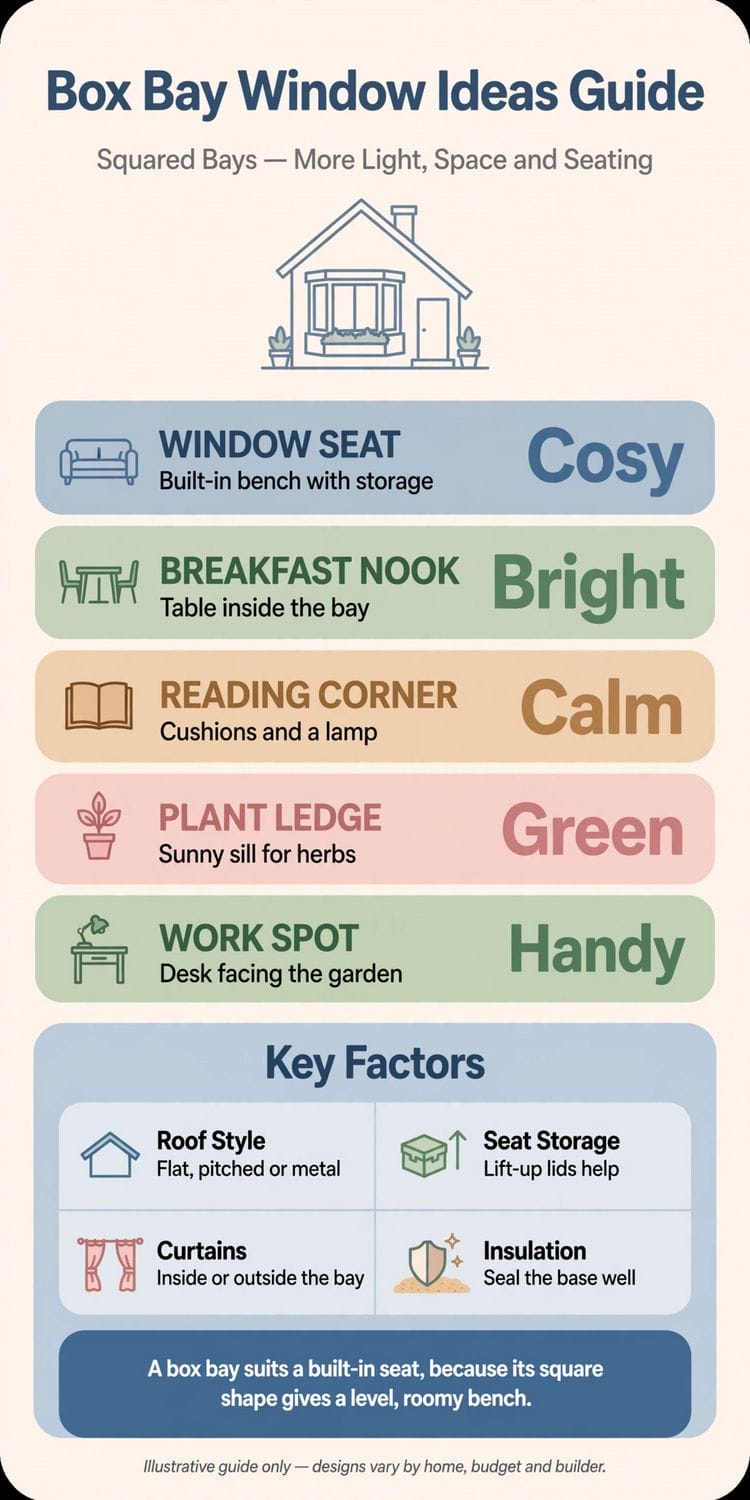
Box bay window ideas suit houses of many periods because the form itself is so plain. A Victorian terrace, a modest cottage, a modern extension and a small house can all carry one without the window shouting for attention. What changes is the dressing: painted timber and soft cushions in one home, bare plaster and a single plant in another, a dining bench and a table pulled up to the glass in a third. The window does the same job in each case, borrowing daylight and a little extra floor, and the room around it decides the mood. The sections below follow that logic, one room and one decision at a time, so you can picture the form in your own home before you think about changing anything in it.
1. What Makes a Bay a Box Bay
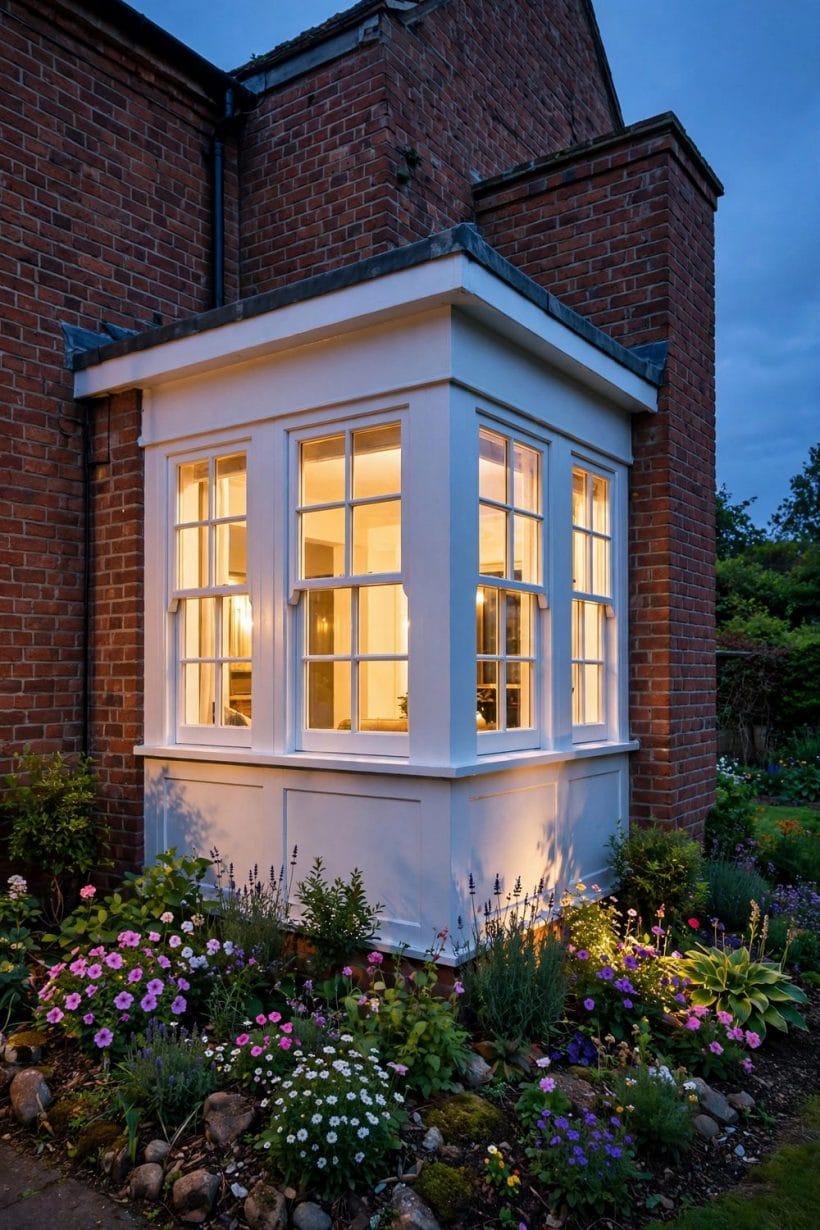
The box bay is defined by its geometry. It projects from the main wall in a rectangle: a front face parallel to the wall and two side faces at right angles to it, so the whole projection reads as a box rather than an angled or curved swelling. That shape gives it a particular character indoors. The alcove it creates is regular and easy to furnish, because its back is flat, its sides are flat, and nothing in it forces furniture into an awkward angle. A chair, a bench or a small table can sit squarely inside it, and the sill line runs level all the way round.
Outside, the same regularity matters. A box bay presents a flat front to the street or garden, which suits houses whose elevations are themselves flat and orderly. It can carry a small flat or gently pitched roof of its own, and its cladding or render can match the house or quietly contrast with it. The broad guide to bay windows in general covers the canted, bow and oriel cousins as well, and reading it alongside this guide helps place the box form in its family; the broad guide to bay windows sets out how each shape behaves, while this post stays with the square-cornered one. Knowing the family helps you name what you have, and naming it correctly helps when you talk to a joiner, a glazier or a surveyor about it.
Inside, the box bay changes the feeling of a room out of proportion to its size. Because its glass wraps three faces, daylight enters from more than one direction, and the room gains a pocket of brightness that shifts through the day. Morning light may come through one side face, afternoon light through the front, and the change gives the room a gentle rhythm. The projection also breaks up a long flat wall, giving the eye a place to rest and the room a natural focal point that needs no feature wall or artwork to earn it.
2. The Window Seat at the Heart of the Box
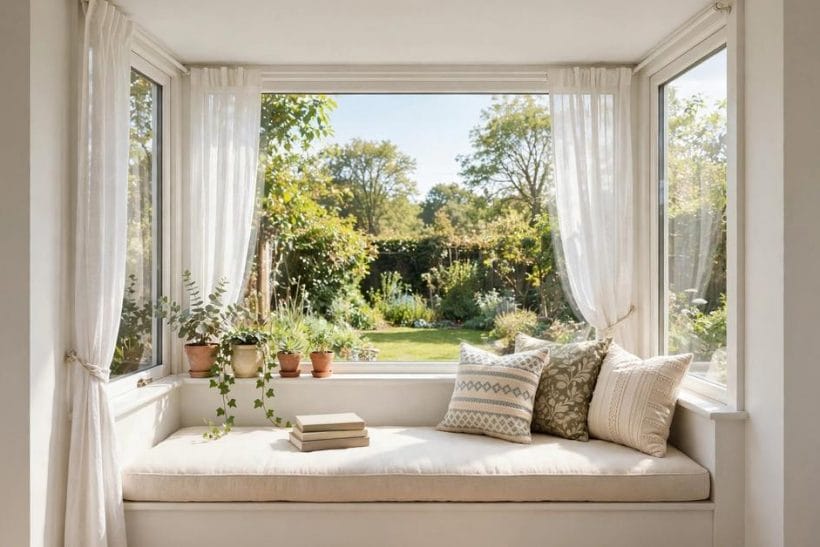
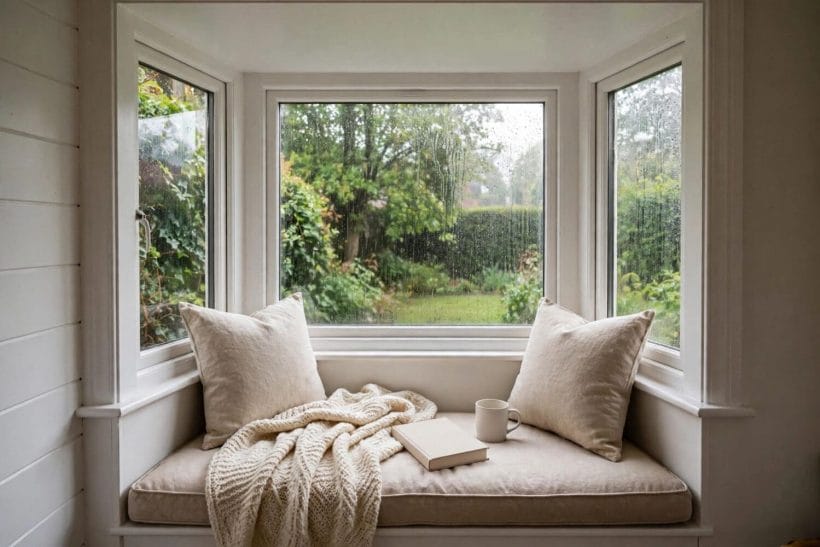
For many people, the window seat is the whole point of a box bay. The sill of a box bay sits at a height that naturally suggests sitting, and a cushion laid along it turns the alcove into the best seat in the house: daylight on your book, a view over the garden or street, and the room at your back. It is a seat that asks little of a room, needing no extra floor space beyond the projection itself, and it rewards the household daily, for morning coffee, homework, phone calls and quiet minutes that would otherwise have nowhere to go.
A good window seat in a box bay is generous with cushions and light on fuss. A single long cushion in a hard-wearing fabric, a couple of scatter cushions for the back, and a throw for cold evenings are enough. Because the seat runs along the front face and partly along the sides, it can hold one person stretched out or two people side by side, and the side faces give a place to lean a shoulder or rest a cup. Keep the dressing low enough that the view stays open: tall piles of cushions defeat the purpose of sitting in a window, and a seat that is hard to climb onto will go unused.
Think about what the seat is for before you dress it. A reading seat wants a small shelf or a basket for books within reach and a lamp that can be switched on without getting up. A seat for watching the street or garden wants nothing at all except a clear sill and a cushion that does not slide. A seat in a family room wants fabric that can be wiped or washed, because it will collect crumbs, muddy paws and wet coats. Each use points to a slightly different cushion, a slightly different basket, a slightly different habit, and the box bay is forgiving enough to hold all of them across the day.
3. Living Rooms with a Square Bay
In a living room, a box bay does two jobs at once: it gives the room a destination and it gives it light. Armchairs can turn toward the bay rather than the television, a sofa can sit with its back to the room and its face to the glass, or the bay can stand alone as a quiet corner while the main seating gathers elsewhere. The choice depends on the room’s size and on how the household actually lives in it, and there is no wrong answer, only arrangements that get used and arrangements that do not.
Smaller living rooms gain the most from a box bay, because the projection adds usable floor without adding a new room. A compact living room with a square bay can hold a reading chair in the alcove and still keep its main seating clear, and the extra daylight makes the whole room feel larger than its walls suggest. Ideas for small living rooms often return to this trick of borrowing light and a pocket of floor, and the box bay is one of the tidiest versions of it. Keep furniture low around the bay so the light travels, and resist filling the alcove with a tall bookcase that blocks the very glass that earns the room its brightness.
Larger living rooms use the bay differently, as a room within the room. A pair of chairs and a small table in the alcove make a conversation corner; a chaise or daybed makes a lounging spot; a desk tucked into one side face makes a writing place that borrows daylight all day. The flat sides of the box form help here, because a desk or a chair can sit square against a side face without a gap behind it. Dress the alcove as its own small zone, with a rug or a lamp that belongs to it, and the living room gains a second use without a wall being built.
Whatever the size, the living-room bay benefits from restraint. One strong choice, a colour on the cushions, a timber on the bench, a plant on the sill, carries further than a crowd of ornaments competing with the view. The glass is the decoration for much of the day, changing with the weather and the seasons, and a bay that is kept clear lets that changing picture do its work. For broader living-room planning, the tiny living room ideas collection shows how small rooms in general borrow light and layout tricks that suit a bay room well.
4. Kitchen Nooks and Breakfast Corners
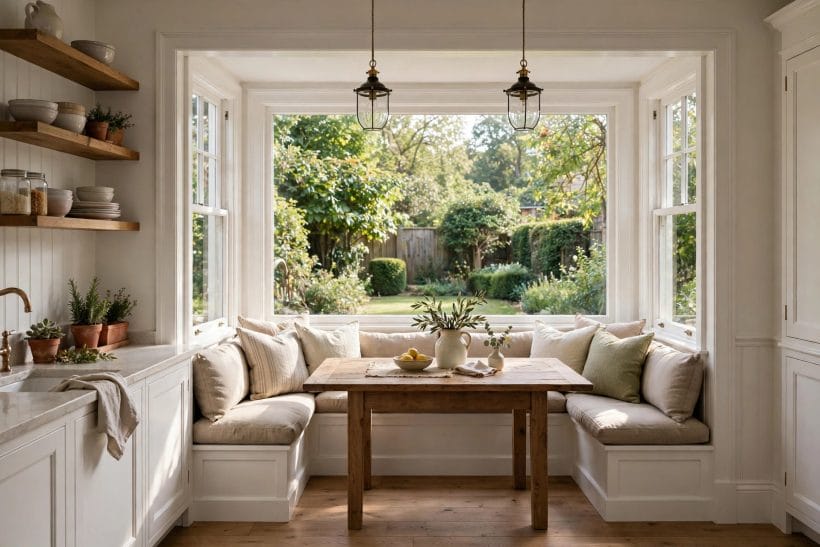
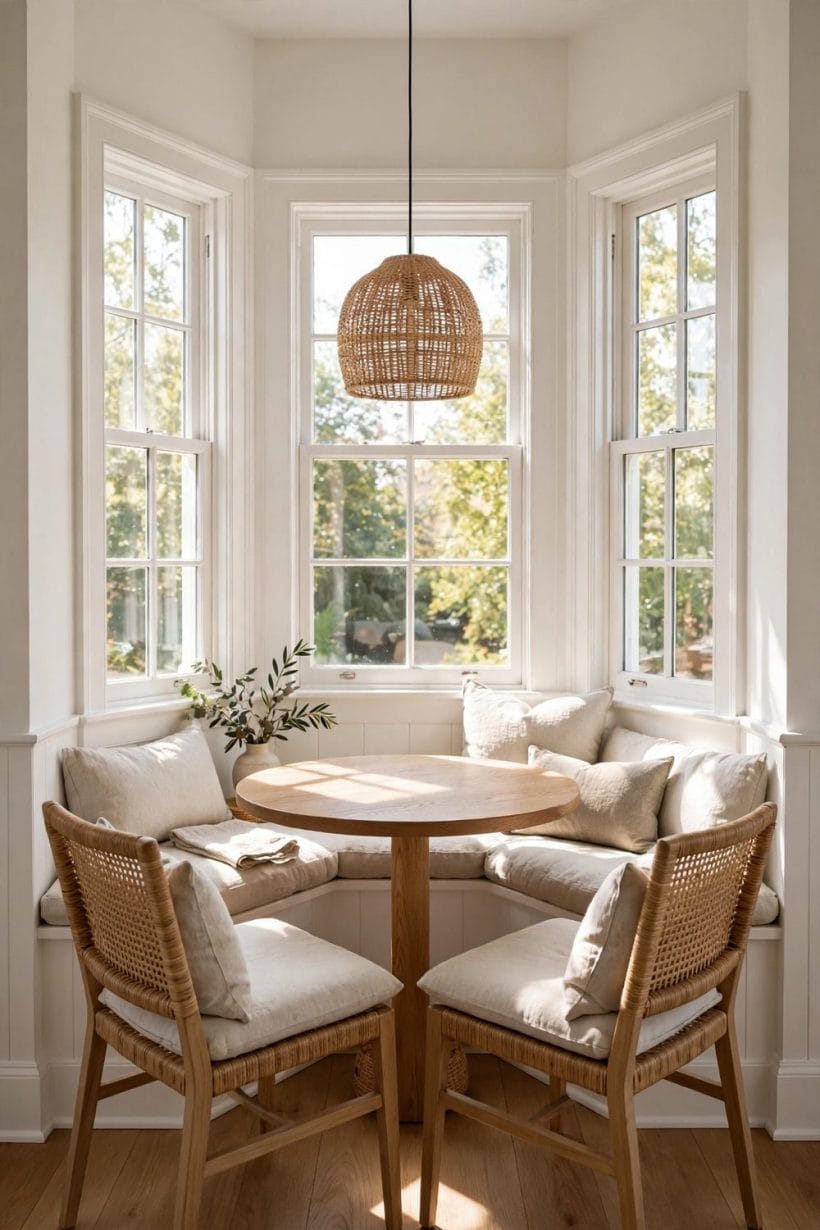
A box bay in a kitchen is a natural breakfast nook. The bench seat along the sill, a small table pulled up to it, and chairs on the open side make a dining spot that feels separate from the cooking zone yet stays part of the kitchen’s life. Morning light falls on the table, the cook can talk to whoever is sitting there, and the household gains a table that does not need a whole dining room to justify itself. In a small house, that nook may be the only dining table, and it earns its keep at every meal.
The flat front of the box bay suits a table better than a curved or angled bay does, because the table can sit parallel to the glass with no wasted wedge of floor behind it. A rectangular or oval table works well; a round table works too, pulled slightly forward so chairs can tuck in on three sides. Keep the table small enough that someone can slide onto the bench without moving it, and choose a bench cushion in a fabric that tolerates breakfast. The kitchen’s working surfaces stay clear because the nook holds the eating, and the eating stays pleasant because the nook holds the light.
Storage belongs under the bench in a kitchen bay, if the bench is built that way. A lift-up seat or a set of drawers beneath it can hold table linen, board games, cookbooks or the clutter that otherwise colonises a kitchen table. But a bench that is hard to open will stay shut, and a bench full of rarely used things is just a cupboard with a cushion on it, so keep what lives there to things the nook actually uses. The general kitchen collection, including kitchen ideas, shows how nooks like this fit into kitchens of many sizes, and the box bay version is among the most straightforward to live with.
5. Bedrooms, Reading Corners and Quiet Seats
In a bedroom, a box bay becomes a private corner, a place to sit before sleep or on waking, to read, to dress, or simply to look out. A bedroom bay does not need to be a grand feature to be loved; a cushion, a throw and a small shelf are enough to make it the room’s favourite spot. The light that makes a living-room bay sociable makes a bedroom bay restful, especially in the morning, when the first daylight of the day falls on the seat rather than directly on the bed.
Privacy matters more in a bedroom bay than anywhere else, and the dressing should answer it first. Sheers that soften the glass without shutting out the day, blinds that can be lowered at night, or shutters that close the bay off entirely each have their place, and the choice depends on how close the neighbours are and which way the window faces. A bedroom that faces a garden can stay open and sheer; a bedroom that faces a street will want a layer that can be closed. The dressing section below looks at these options in detail, and the bedroom collection, including tiny bedroom ideas, shows how small bedrooms in general balance a bay, a bed and storage without crowding any of them.
A reading corner is the bedroom bay’s most natural second life. A cushion on the sill, a lamp on a small table at one side face, and a basket for books turn the alcove into a nook that keeps reading out of bed and out of the living room alike. Children love bedroom bays too, as dens, homework spots and secret places, and a bay that a child can claim as their own often becomes the most used seat in the house. Dress it sturdily, with washable fabric and a basket rather than a fragile display, and it will survive that love.
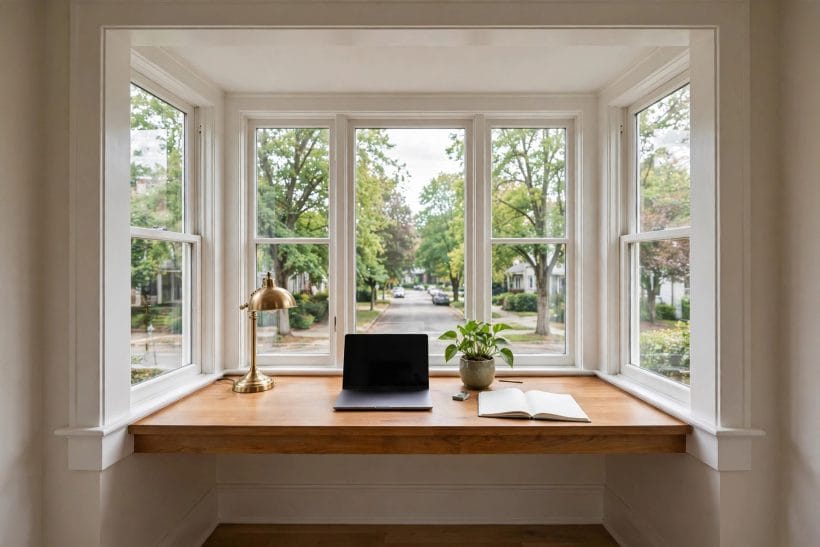
6. Dressing the Three Faces: Curtains, Blinds and Shutters
Dressing a box bay is simpler than dressing an angled or curved bay, but it still deserves thought, because the dressing has to serve three faces that meet at corners. The usual approaches are a curtain track or pole that runs round all three faces, separate blinds or shutters fitted to each face, or a layered combination of the two. Each approach has a character: curtains soften the whole alcove and can be drawn right back to the sides; blinds and shutters give each face its own control, so one side can be shaded while another stays open.
Curtains on a box bay generally run on a track that follows the rectangle, with returns to the wall at each end, or on a pole with corner joints. Full-length curtains that pool slightly on the floor suit a formal living room; shorter curtains that end at the sill suit a kitchen nook or a bedroom where the seat is used daily. The key habit is to give the curtains somewhere to stack when they are open, clear of the glass, so the bay’s light is not lost to bunched fabric. A curtain that cannot open fully is a curtain that is always in the way, and the box bay’s flat sides make full stacking easy if the track runs far enough to each side.
Blinds and shutters suit the box bay’s flat faces particularly well, because each face takes a straight, standard fitting. Roller blinds, pleated blinds and wooden slatted blinds can each be fitted face by face, and shutters can be framed into each opening. The advantage is independent control: the side that catches the low sun can be shaded while the front stays clear, and a bedroom bay can be darkened face by face at night. The disadvantage is fuss, more cords, more slats, more cleaning, so a household that wants simplicity may prefer one curtain track to a set of blinds. The broader survey of window treatments sets out these options room by room, and the curtain collection, including tiny house curtain ideas, shows how small rooms keep their bay dressing light and practical.
Whatever the dressing, keep the corners honest. A box bay’s corners are where a poor fitting shows: a track that stops short, a blind that leaves a gap, a shutter that will not close square. Ask the fitter how each corner is handled before the work starts, and look at the corners when the work is done, with the dressing open and closed. A well-dressed box bay looks finished from inside the room and from the seat itself, and the corners, more than the fabric, are what make it so.
7. Light, Proportion and the View Out
A box bay earns its place by light. Glass on three faces gathers daylight from three directions, and a room with a box bay feels brighter than the same room with a single flat window, even when the total glass area is similar. That brightness changes through the day, and part of the pleasure of a bay is watching the change: the morning side bright first, the front at midday, the other side in the afternoon. Furnish the bay to enjoy that movement rather than fight it, with a seat that can be used at any hour and plants that tolerate sun on one face and shade on another.
Proportion matters as much as light. A box bay that is too deep for its room can feel like a corridor; one that is too shallow can feel like a ledge rather than a seat. The right depth is a matter of the room and the house, not a formula, and an existing bay should be judged by how it feels to sit in, not by a measurement. Sit in it, at different times of day, before deciding to change its dressing or its use. A bay that feels generous when you sit in it is generous enough, whatever its size on paper, and a bay that feels cramped will not be improved by cushions alone.
The view out is the bay’s other gift, and it deserves a clear sill. A box bay frames a view in three panels, like a picture in three parts, and the side panels often show something the front does not: a stretch of garden, a tree, a street scene. Keep the sill low and clear so the view starts at seat height, and avoid tall ornaments on the sill that cut the picture in half. If the view is poor, a fence, a wall, a busy road, then the bay’s job changes: it becomes a light-gatherer and a seat rather than a lookout, and its dressing should soften the glass rather than frame a view that disappoints.
At night the bay reverses, becoming a lit alcove seen from outside and a dark glass wall seen from inside. Curtains or blinds that close fully make the night-time bay feel like part of the room again, rather than a black panel at its edge. A small lamp in the bay, on a side table or a shelf, keeps the alcove present after dark and stops it feeling like a cold corner. The day-to-night change is one of the box bay’s quiet rhythms, and dressing that answers both halves of the day serves the room best.
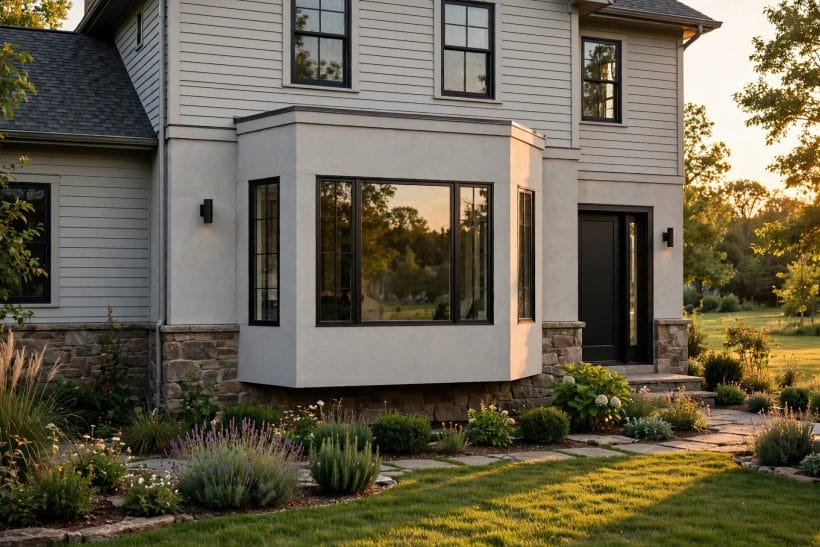
8. Storage, Benches and Everyday Use
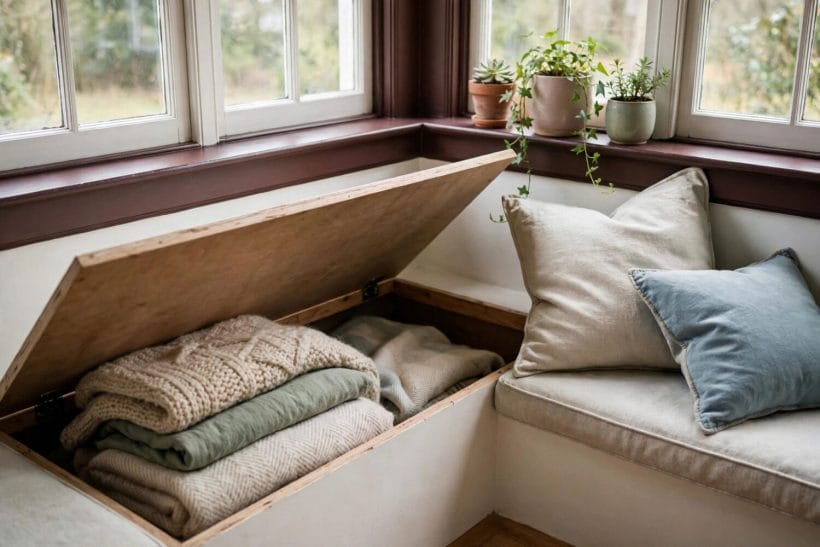
Below the seat, a box bay often hides its most practical asset: storage. Where the bench is built as a box, its interior can hold things the room would otherwise have to find a home for, from blankets and board games in a living room to table linen in a kitchen nook and toys in a child’s bedroom. The storage works best when it is matched to the room’s real clutter, not to an ideal of tidiness. Open the bench, look at what is actually in it after a month, and keep what is used; move the rest elsewhere.
A bench that is used daily should open easily. Lift-up seats need a lid that stays up while you reach inside and a hinge that does not pinch; drawers need runners that run true and handles that do not catch clothing. If the bench is awkward to open, it will quietly stop being storage and become a dead box with a cushion on it, which is a waste of the bay’s best trick. Test the opening before you fill the bench, and choose the mechanism, lid or drawer, that the household will actually use.
Everyday use also means wear. A window seat is sat on, climbed on, spilled on and slept on, and its fabric and finish should expect that life. Hard-wearing, washable covers, a bench top that can be wiped, and cushions that can be turned or recovered will outlast a delicate dressing by years. The same applies to the sill and the faces around it: paint or timber that can be touched up, rather than a finish that shows every mark, keeps the bay looking cared for without constant attention.
9. Colour, Timber and Finishes That Suit the Form
The box bay’s plain geometry takes colour and finish gracefully, because there is no curve or angle competing with the palette. Painted white or cream keeps the alcove bright and lets the view dominate; a soft grey or sage gives the bay a calm presence of its own; a deeper colour on the bench or the inner faces makes the alcove read as a distinct nook within the room. The choice should follow the room: a bay painted to match the walls disappears into the room, while a bay painted to contrast with them declares itself as a feature.
Timber suits the box form particularly well. A timber bench top, a timber sill, or timber lining on the inner faces warms the alcove and gives it a crafted feel, and the flat faces of the box bay take timber boards without cutting around curves. Painted timber is the more forgiving choice in a damp or sunny bay, because it can be repainted when the sun fades it; natural timber needs a finish that tolerates light and occasional condensation, and a little more care. Either way, keep the timber simple, plain boards and a clear finish, rather than ornate mouldings that fight the bay’s clean lines.
Finishes around the bay should be chosen for light as much as for looks. A matt paint on the inner faces avoids glare, which matters when the sun strikes the side faces at a low angle. A washable paint on the bench and the lower faces survives feet, paws and bags. And a sill finish that tolerates a plant pot, a cup and a book without marking will save the bay from looking tired. These are small decisions, but they are the ones that decide whether the bay still looks good after a year of daily use.
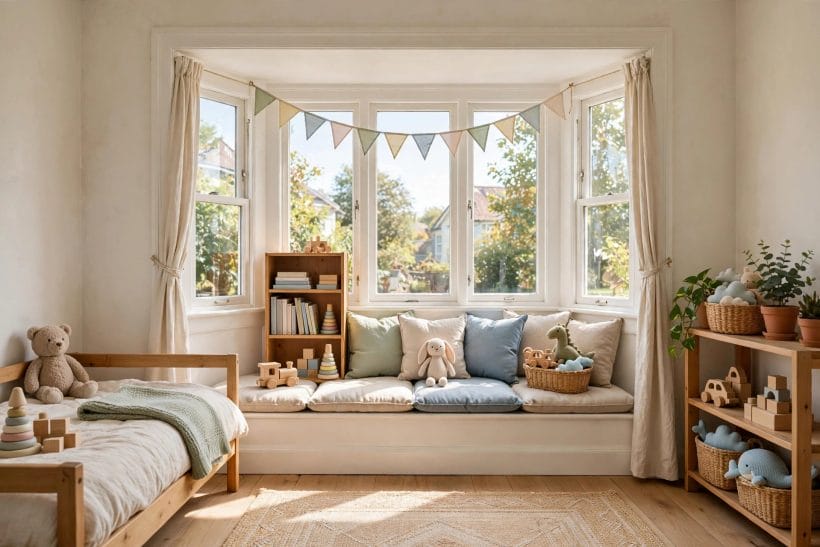
10. When to Ask a Professional: Structure and Weatherproofing
Some box bay questions belong to professionals, and knowing which ones is part of owning one well. Anything that touches the structure of the bay, its foundations, its roof, the wall it projects from, or the lintels that carry the wall above it, is work for a qualified builder or structural professional, not a weekend project. The same applies to weatherproofing: the joints where the bay meets the house, the roof of the bay, and the seals around its glass are the places where water finds its way in, and a leak at a bay junction can travel a long way before it shows.
Signs that a professional should look at a bay include damp patches on the inner faces or the wall beside it, draughts that a new seal does not cure, a roof that ponds water or drips at its edge, glass that mists between its panes, or any movement, cracking or sagging in the bay or the wall around it. None of these signs has a single household remedy, and each one is cheaper to assess early than to repair late. A surveyor or builder can tell you whether the cause is a seal, a flashing, a gutter or something structural, and that diagnosis is worth more than any general advice.
When work is needed, ask for the bay to be treated as part of the house, not as an isolated box. Its roof should drain with the house’s gutters, its walls should breathe and insulate in step with the house’s walls, and its glass should match the house’s glazing in performance. A bay repaired in isolation, with a roof that drains nowhere or a seal that traps moisture, can cause more trouble than it cures. A professional who looks at the junction, the roof and the wall together will give you a repair that lasts, and a written description of what was done that helps the next owner too.
For everything else, the dressing, the cushions, the plants, the storage, the bay is yours to enjoy and arrange as you please. The line is simple: decoration and furnishing are household work, while structure, roofing and weatherproofing are professional work. Keeping that line clear protects the house, protects the bay, and leaves you free to enjoy the seat, the light and the view without worrying about what holds them up.
Final Considerations
A box bay window is a modest architectural idea that pays back daily: a rectangle of glass that gives a room light from three directions, a seat that costs no floor, and a corner that can be a reading nook, a breakfast table or a quiet lookout as the household needs. Its plainness is its strength. It asks for little, a cushion, a clear sill, a dressing that opens fully, and it gives a room a focal point that changes with the day and the seasons.
If you are choosing how to use a bay you already have, start with the seat and live with it before changing anything else. If you are thinking about adding or altering one, talk to a professional first about structure and weatherproofing, and let the design follow from that advice rather than from a picture. And if you are simply admiring the form, in your own home or someone else’s, notice how the square corners, the flat faces and the level sill make a small projection feel like a room of its own. That feeling is the box bay’s real idea, and it is why the form has lasted.



0 Comments