

Yes, with conditions, and the conditions are the whole answer. When people ask can you live in a tiny house year round, they usually picture the hardest night of winter, but year-round living is really four different tests: a cold snap, a wet and airless month, a heatwave, and the ordinary paperwork of being allowed to stay. A tiny house that passes all four is a genuine four-season home. One that passes only the summer test is a fair-weather cabin, however charming it looks in July.
This guide takes the tests in the order you should take them, starting with legality, because insulation is wasted money on a home you may not keep on its site. After that it works through the envelope, heating, frozen water, moisture and ventilation, summer cooling, and the daily systems that must keep working in every month. Nothing here invents rules for your area: codes, zoning and site rules differ by place, so every legal point below is framed as what to check locally, with the officials who will actually decide.
Can You Live in a Tiny House Year Round? The Q&A Summary Table
| Question | Short answer | What it depends on |
|---|---|---|
| Are you allowed to live in one all year? | Only where your locality and site permit full-time occupancy | Zoning, the home’s classification, and the land or park’s own rules; check locally first |
| Will it stay warm in winter? | Yes, if insulation, air sealing and heating are sized together | Envelope quality, a correctly sized main heat source and a backup |
| Will the pipes freeze? | Not if water is kept inside the warm envelope and protected | Pipe routes, skirting, insulation, heat for the coldest nights and a drain-down plan |
| Will it overheat in summer? | Not if shade, ventilation and some cooling are planned | Orientation, window shading, airflow and a realistic cooling option |
| Is winter moisture a problem? | It is the main hidden risk, and it is manageable | Ventilation that runs daily, vapour control and drying wet gear properly |
| Can services cope all year? | Yes, with seasonal habits | Water supply and waste in freezes, fuel stored ahead, access kept clear |
| Who should not do it? | Anyone whose site, health or home fails a test above | An uninsulated home, an unlawful site or no backup heat in hard cold |
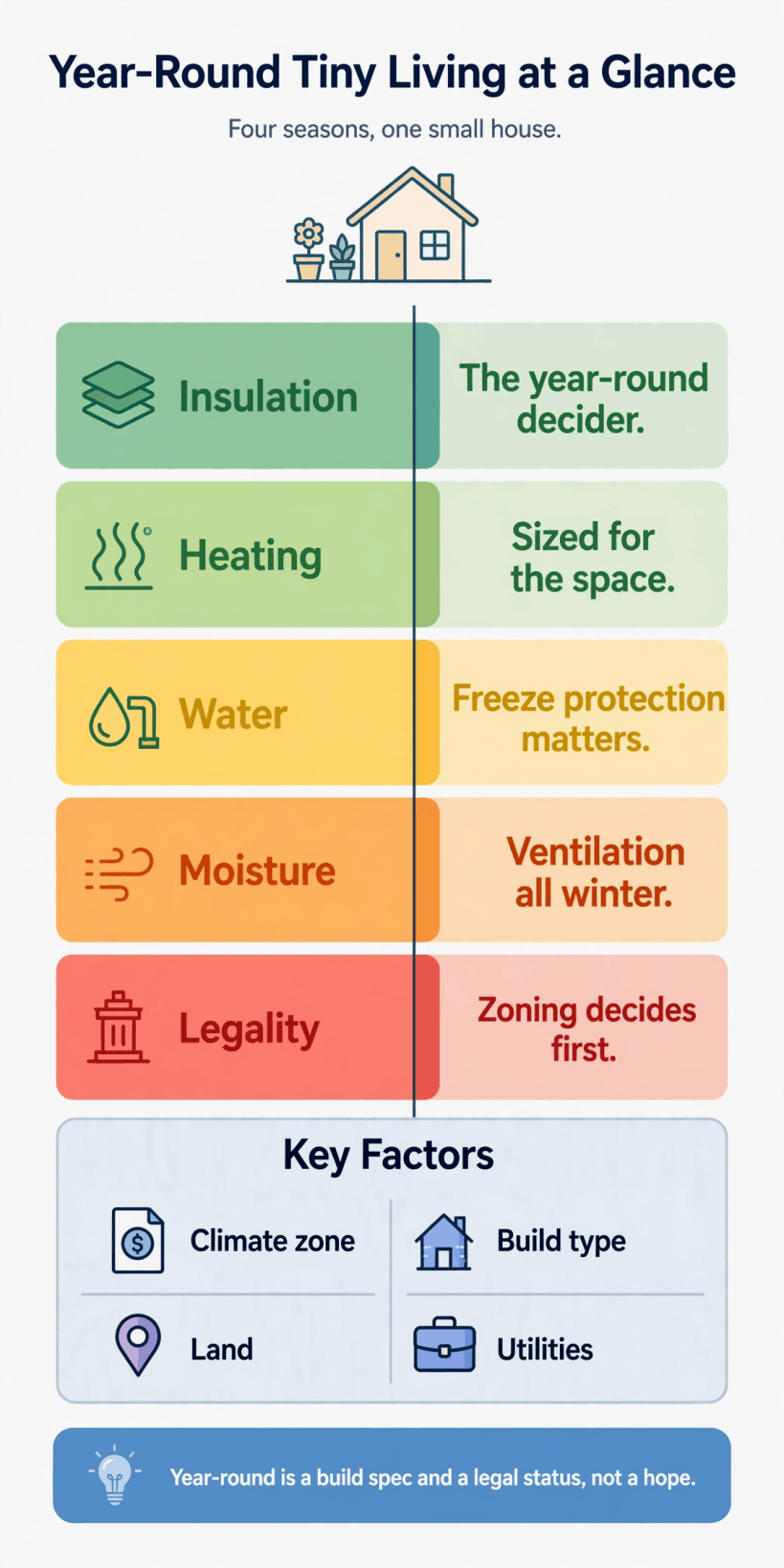
1. Legality and Zoning First: Are You Allowed to Stay All Year?
Start where the year-round question is actually decided: not in the insulation catalogue, but at your local planning or zoning office and in your site agreement. In many places the barrier is not the house but its classification and the land’s designated use. A home on wheels may be treated as a recreational vehicle, and recreational use is often time-limited by local rules or by a park’s licence, which can make summer living lawful and January living a breach. A home on a foundation is more often treated as a dwelling, with the building standards that implies. No article can give you your locality’s numbers, because there is no single set to give: minimum sizes, occupancy periods, utility requirements and permit routes are set locally and change.
So do the local work, in person, before spending on winter upgrades. The approach in zoning laws for tiny houses and how to talk to local officials is the right one: describe exactly what you propose, a home of this type, on this land, occupied all year, and ask what classification and permissions that needs. Follow it with the groundwork in how to prepare your land for a tiny house if the answer is yes. Keep every answer in writing, check whether a site or park allows twelve-month occupancy rather than a long season, and confirm how water, waste and a postal address are handled. A lawful, ordinary site you can stay on beats a beautiful, precarious one in every month of the year.
2. Insulation and the Envelope: The Winter Foundation
With permission settled, the envelope decides whether winter is comfortable or a campaign. A tiny volume loses heat through a lot of surface relative to its size, and its floor, suspended over cold air on a trailer or piers, is a surface a conventional house barely has. Continuous insulation in floor, walls and roof, careful air sealing at every junction and window, and no casual holes for pipes and cables are what turn heating from a struggle into a background hum. The materials compared in how to insulate a tiny house with spray foam, rockwool or sheep’s wool differ in cost, moisture behaviour and fit, but all of them fail in the gaps, so workmanship matters more than brand.
Pay particular attention to the places small homes skimp: the wheel arches and trailer steel that conduct cold straight inside, the door and its seals, single-skin corners where furniture hides condensation, and the loft roof where warm moist air arrives first. Thick curtains and a rug over a hard floor are not substitutes for insulation, but in a finished home they are its honest partners, cutting draught perception and making the same temperature feel warmer. Test the envelope on the first cold night with your hand and your nose: cold stripes on walls and a smell of still, damp air tell you where to work.
3. Heating Sized for the Coldest Night, With a Backup
Heating a tiny house is easy on an average winter day and genuinely demanding on the coldest night of the year, so size for that night, not the average. Too small and the system runs flat out while the floor stays cold and pipes approach risk; grossly oversized and a stove will roast the room in cycles while wasting fuel. The main options, their sizing logic and their running characters, are compared in how to heat a tiny house with propane, wood stoves, mini-splits and solar-air heaters, and fuel choice interacts with cost and storage in propane versus electric in tiny houses. In serious cold, treat a second, independent heat source as part of the design, not paranoia: if the main system fails at midnight in a freeze, the backup protects both the residents and the plumbing until morning.
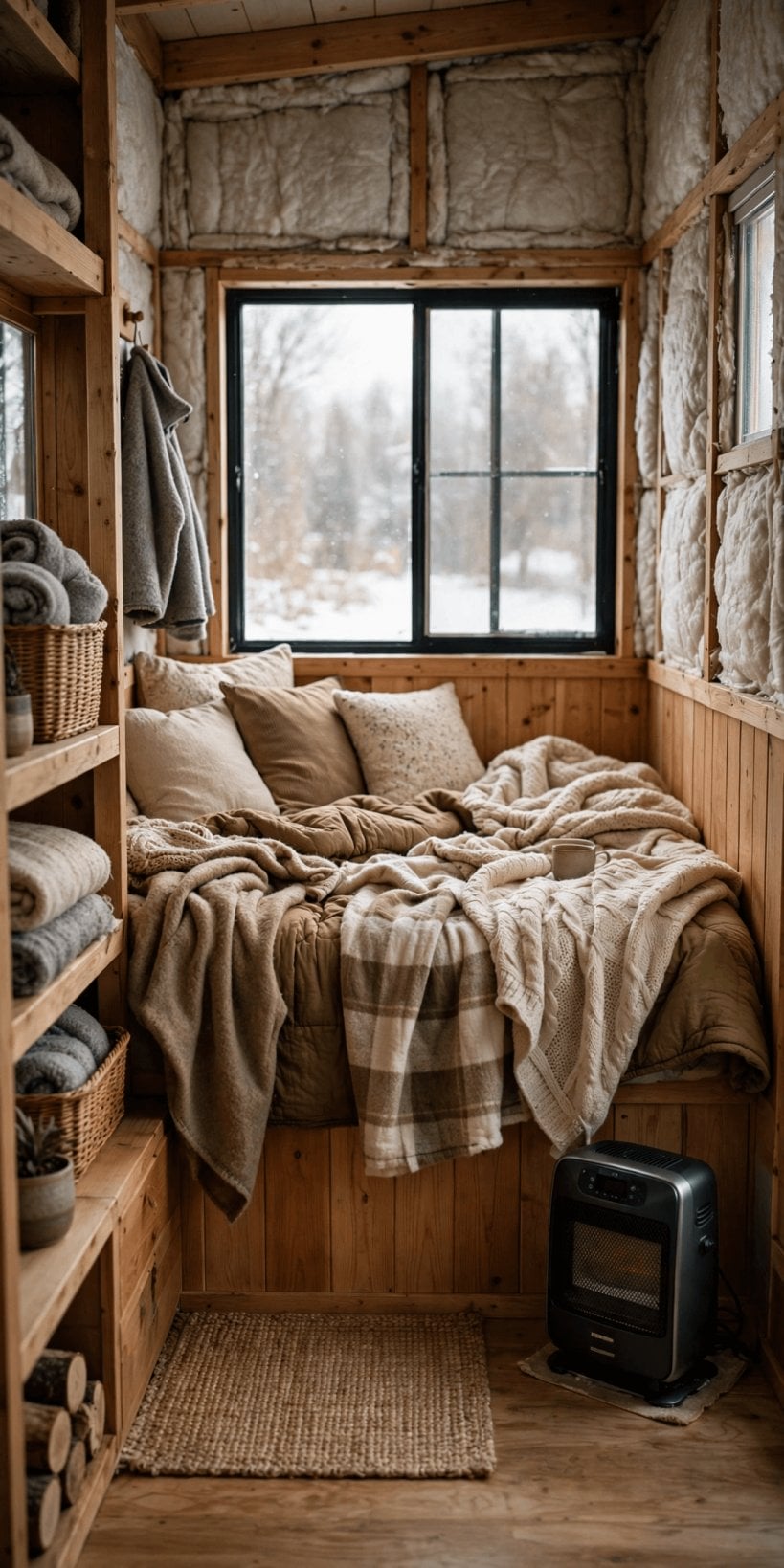
Distribute the heat you make. Warm air collects in a loft and leaves the floor, where people and pipes live, coldest, so a small fan, an open loft design and, where fitted, the gentle evenness described in underfloor heating in tiny houses, hydronic versus electric all earn their place. Keep combustibles, drying laundry and soft furnishings at the clearances your stove or heater specifies, in writing, from its own manual; in a small room, clearance discipline is not bureaucracy, it is the difference between a cosy home and a very small fire risk.
4. Freeze Protection: Keeping Water Liquid in January
More year-round attempts end with a burst pipe than with a cold bedroom, because water damage in a tiny home reaches everything quickly. Design so that as little plumbing as possible leaves the warm envelope: short internal runs, no pipes in exterior walls or unheated voids, and the supply entry and any external tap protected, insulated and, where your setup needs it, fitted with purpose-made heat tape installed to its instructions. Skirting around the base of a home on wheels or piers cuts the wind that strips heat from the floor and the pipes beneath it, which is why it appears in every serious cold-climate setup.
The lived experience in tiny house living in cold climates, managing humidity, drafts and frozen pipes adds the habits that hardware alone cannot: letting a tap drip is a folk remedy, not a strategy; knowing where your stopcock is, keeping the heating on low when you travel in a freeze, draining down fully if the home will sit empty and unheated, and insulating any hose or external run as if the coldest forecast night will definitely happen, because one night it will. Grey water needs the same thought: a waste pipe that freezes blocks the shower long before anything bursts, so falls, insulation and a route that drains completely are winter equipment, not details.
5. Winter Moisture and Ventilation: Breathing in a Small, Sealed Box
People, cooking, showers and drying clothes release a surprising amount of water into a very small volume of air, and in winter that moisture looks for the coldest surface and settles there as condensation, then mould. This, not cold itself, is the complaint that most often drives people out of tiny homes by February. The physics is unforgiving and the fix is ventilation that actually runs: an extractor in the wet zone vented outside, background fresh air that does not depend on willpower, and in many well-sealed homes a heat-recovery or energy-recovery ventilator that exchanges stale air without throwing the heat away, as explained in tiny house ventilation and why HRV and ERV systems prevent mould.
Daily habits share the work with the hardware. Lids on pans, a shower extractor left running after you leave the room, wet coats and boots dried in one ventilated spot rather than steamed through the whole home, and bedding aired instead of left against a cold wall all lower the load. Watch the early warnings: windows that are wet every morning, a musty note in the storage under the bed, black specks in a corner behind furniture. Each is the house reporting a moisture surplus while the repair is still a cloth, a fan and a habit, rather than a strip-out.
6. Summer: Shade, Airflow and Honest Cooling
A home engineered to hold heat in January will collect it in July, and small volumes change temperature fast in both directions. Year-round comfort therefore needs a summer plan with the same seriousness as the winter one: shade the glass that takes afternoon sun, ideally outside the pane with an awning, shutter or deciduous planting; open windows on opposite sides for cross-flow on still evenings; and use the stack effect a loft gives you, letting hot air out high and drawing cooler air in low. Light-coloured roofing and a ventilated roof build-up repay their cost in the first heatwave.
Where climate or health makes active cooling necessary, a small efficient unit sized for the tiny volume is neither extravagant nor difficult, but it must be in the plan, with its power draw, condensate drainage and outdoor unit position settled, rather than bought in a panic during a heatwave. Sleeping is the real summer test for most residents: a loft that was the warmest, cosiest place in winter can become the first place to overheat, so a summer sleeping option at floor level, or serious loft ventilation, belongs in an honest four-season layout.
7. Water, Waste, Power and Deliveries in Every Season
Year-round living is a logistics exercise as much as a building one. The systems surveyed in tiny house utilities for power, water and off-grid sewage each have a season that stresses them: water supplies and hoses in freezes, drainage in storm months, solar generation in the short dark weeks, batteries in the cold, and fuel deliveries on roads that weather can close. A four-season household plans backwards from the worst week of each: enough fuel stored ahead of winter, water arrangements that do not depend on a single exposed hose, waste emptying that remains possible and lawful in all months, and a power setup whose winter performance, not its summer best, matches the load of lights, pumps, fans and work.
Access is part of services. If a vehicle cannot reach the home in snow, mud or flood, then food, fuel and medical help cannot either, and an emptying or repair service certainly will not. Keep the route, the parking and the path as maintained as the house: gravel where wheels churn mud, a cleared and lit path, and house numbers a delivery driver or an ambulance can find at night in February. These are unglamorous sentences because year-round living is an unglamorous achievement, repeated daily.
8. The Exterior in Hard Weather: Skirting, Snow, Wind and Roofs
Outside, the seasons attack in turn. Skirting that protects pipes also keeps animals from nesting under the floor, and its materials and venting are compared in tiny house skirting options that protect pipes and improve insulation; fit it before the first winter, not after the first freeze. A simple pitched roof sheds snow and rain best, but know where sliding snow lands and keep doors, paths, flues and vents out of that line. In autumn, clear gutters and the ground drainage around the home, check roof fixings and seals before storms test them, and secure everything outdoors that wind can turn into a projectile or a sail.
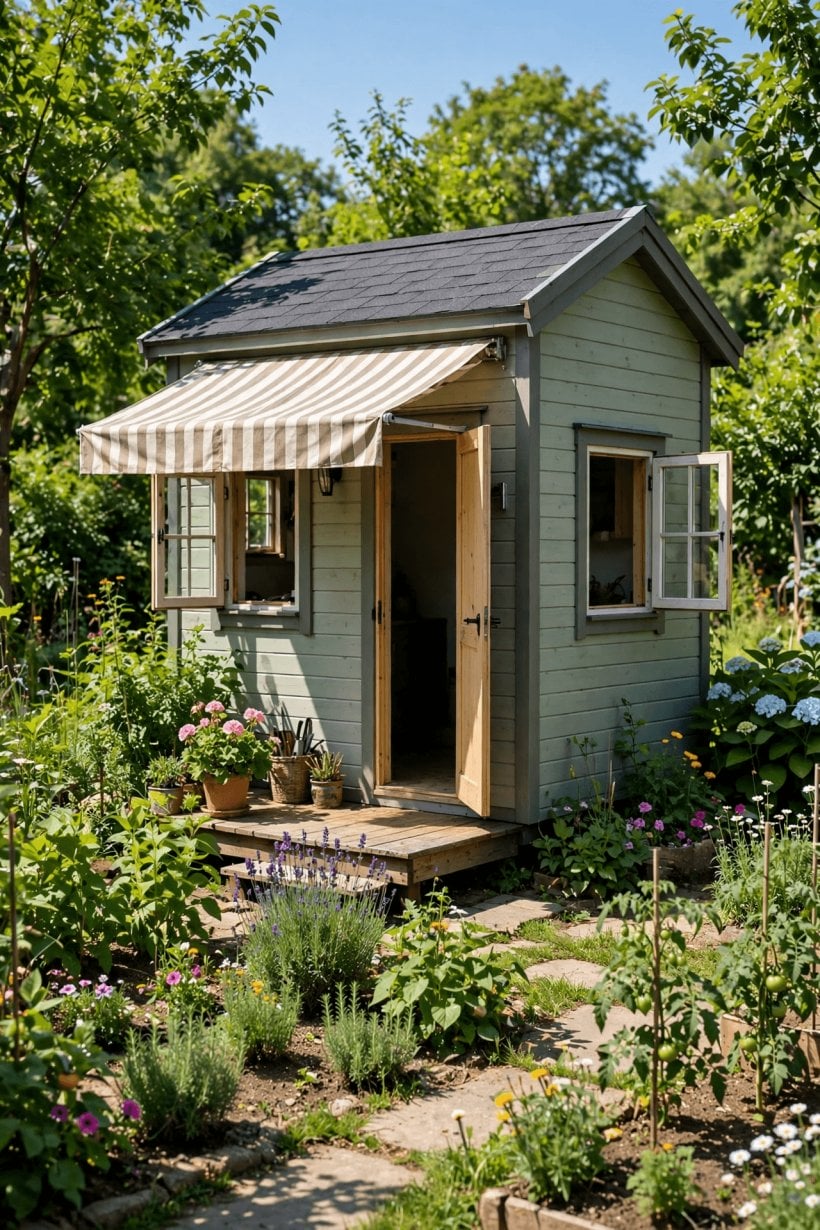
Anchoring and stability deserve a plain sentence: a home on wheels or blocks in an exposed place should be set up as its maker and your local guidance direct, level, supported and restrained as appropriate for local wind and ground conditions, and re-checked after ground movement, flood or an exceptional storm. Trees are shelter in summer and a hazard in a winter gale if a dead limb hangs over the roof, so managing the plot is part of maintaining the home, all year.
9. Daily Life Across Four Seasons: Clothes, Gear and Morale
The households that thrive all year are rarely the ones with the best equipment; they are the ones whose daily systems fit the seasons. Winter clothing, boots and outdoor gear are bulky, and a tiny home needs a deliberate place for them, a ventilated boot zone by the door, hooks that keep wet layers out of the living air, and storage for the off-season’s belongings so summer things are not competing with January coats. Laundry and drying deserve the same planning as heating, because a home that cannot dry clothes in a wet week becomes damp, cluttered and miserable in that order.
Morale is a system too. Short winter days in a small interior argue for good light, a chair that is genuinely comfortable, a window seat or view that connects you to the season rather than hiding from it, and a reason to go outside daily built into the routine, animals, a walk, a woodpile. Summer repays everything with the porch, the open doors and the garden, if the plot has them. Plan the year as a rhythm the home supports, work, rest, outdoors, storage, and four seasons stop being four problems and become the point of living somewhere small and deliberate.
10. The Honest Limits: When Year-Round Does Not Work
Close with the cases where the truthful answer is no, or not yet. A lightly built, uninsulated home sold for summer use will not become a winter home with a bigger heater; the condensation and heat loss will defeat the budget and the residents. A beautiful site with no lawful route to full-time occupancy is a holiday arrangement, and building a life on an informal understanding risks losing the home and the life at once. A household with health needs that depend on reliable warmth, space for equipment or carers, or step-free everything should test those needs against the specific home with professional advice, not enthusiasm.
None of that diminishes the yes cases; it protects them. Year-round tiny living works when each test in this guide is passed on evidence: permission in writing, an envelope you have felt on a cold night, heating with a backup, water that stayed liquid last January, air that stays dry, and a summer plan that lets you sleep. If a seller, a site or a video cannot help you verify those, the season you cannot verify is the one that will decide. Take the time, spend in the right order, and the home that results will not merely survive the year. It will enjoy it.
Final Considerations
So, yes: people live in tiny houses in every month, in cold places and hot ones, and they do it comfortably. They are not tougher than everyone else; they are better prepared in a specific order. Legality first, then insulation and air sealing, heating sized for the worst night with a backup behind it, water defended against frost, moisture given a daily way out, and a summer plan for shade and sleep. Work through that order for your place and your household, checking every local rule locally, and a tiny house stops being a fair-weather idea and becomes what its best residents say it is: a small, sufficient home for the whole turning year.


0 Comments