

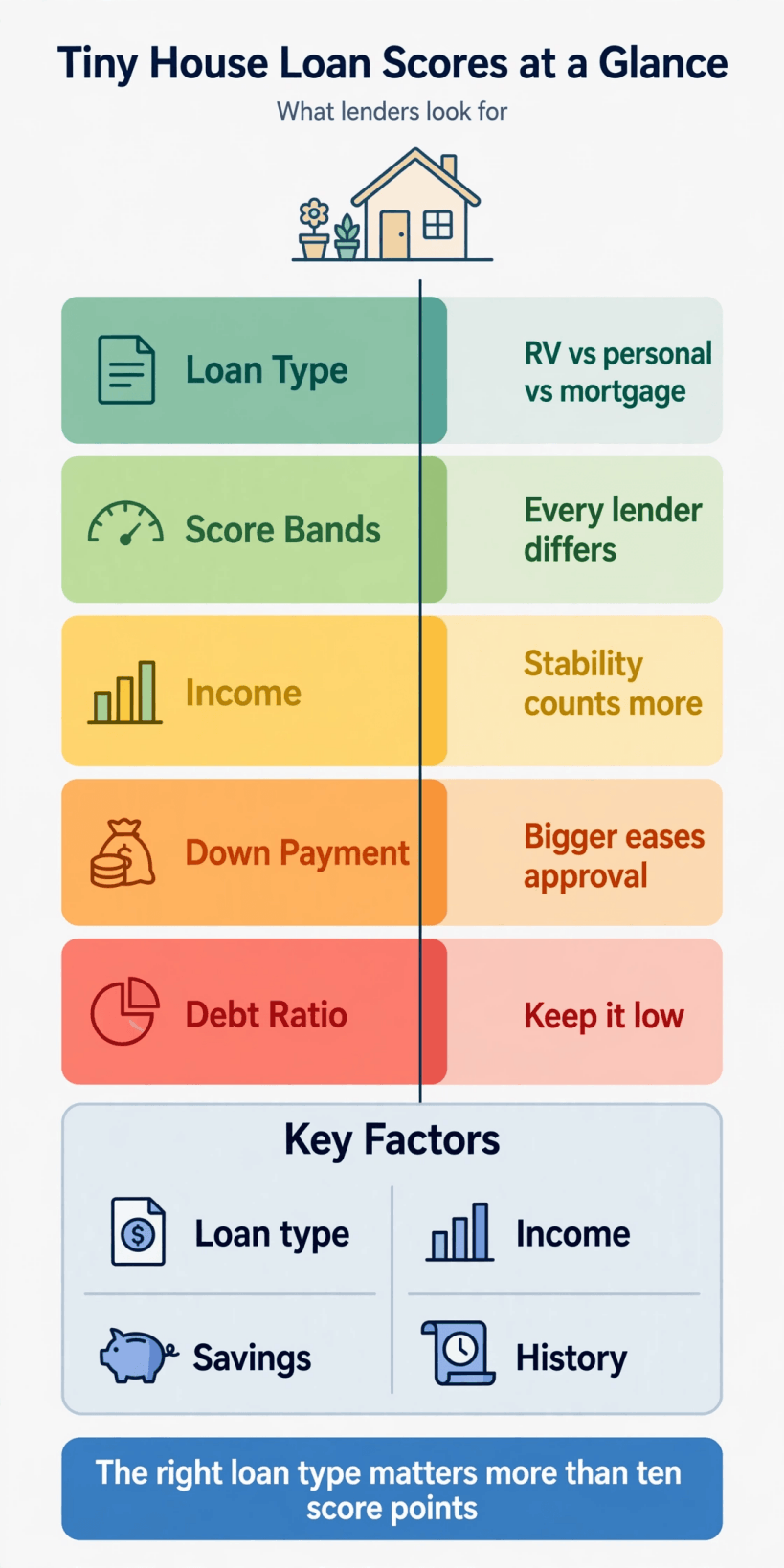
There is no single number that opens the door to a tiny house loan, and any website that promises you one universal cut-off is skipping the part that matters. When borrowers ask about a credit score tiny house loan decision, lenders are really judging a whole file: the type of loan you want, whether the home sits on wheels or a foundation, how steady your income looks, how much you can put down, and how much other debt you already carry. Your score is one important attribute in that file, but it is never the only one, and the same score can be treated very differently by two lenders looking at two different loan products.
The practical approach is to work backwards from the home and the loan, not forwards from a score you found online. Decide first whether you are financing a tiny house on wheels, a tiny house on a permanent foundation, or a shell you will finish yourself, because each route is assessed in a different way. Then look honestly at your score band, your income pattern, your savings, and your monthly commitments, and strengthen the weakest part of that picture before you apply. This guide walks through each attribute in turn, explains how lenders tend to weigh them, and shows you the order in which to fix things so an application lands on the strongest possible footing.
Quick Answers at a Glance
| Question | Short Answer |
|---|---|
| Is there one score that guarantees approval? | No. Every lender sets its own criteria, and approval also depends on loan type, income, down payment, and debt. |
| Does the loan type change what score matters? | Yes. RV-style, personal, and mortgage-style loans are assessed differently, so the same file can fare differently on each route. |
| Can a larger down payment help a weaker score? | Often it can help, because it lowers the amount borrowed and the lender’s exposure, though it never guarantees approval. |
| Does income stability matter? | Yes. Lenders like to see income that is regular, documented, and likely to continue, whatever the source. |
| What is the debt ratio? | The share of your monthly income already committed to repayments. Lower commitments usually leave a file looking stronger. |
| Should you improve your file before applying? | Usually yes. Correcting errors, reducing balances, and avoiding new credit applications can all strengthen how a file reads. |
| What else do lenders check? | Identification, the home itself, where it will sit, insurance, and in some cases certification or registration details. |
1. Start With the Loan Type, Not the Score
Most tiny house borrowing falls into three broad families, and each family reads your credit file through a different lens. An RV-style loan treats the home as a recreational vehicle, so the lender cares about the vehicle itself, its certification, and its resale value as well as about you. A personal loan is unsecured or lightly secured, so the lender leans much more heavily on your income, your score, and your existing commitments, because there is no substantial asset standing behind the borrowing. A mortgage-style loan for a tiny house on a foundation behaves most like conventional housing finance, with the land, the structure, and a longer paperwork trail all in play. Our overview of how to finance a tiny house, from loans to RV financing, maps these routes side by side.
Because the routes differ, asking what score you need before you know which route you are on is putting the question in the wrong order. A file that looks unremarkable for an unsecured personal loan might be perfectly workable for a smaller RV-style loan with a healthy down payment, and a file that struggles on wheels might succeed once the home is on a foundation with land behind it. Narrow the route first. Look at how and where the home will live, whether it will move again, and how long you plan to keep it. Those answers tell a lender which rulebook to open, and they tell you which parts of your file will carry the most weight when the application is read.
2. How Score Bands Usually Work — and Why No Band Is Universal
Credit scores are generally described in bands that run from lower to higher, and lenders tend to treat those bands as a quick summary of how you have handled borrowing in the past. A file in a higher band usually signals a long record of payments made on time and balances kept well under their limits, and it tends to be offered the widest choice of products and the most comfortable pricing. A file in a middle band is typically workable but may be steered towards smaller amounts, shorter terms, or a larger down payment. A file in a lower band often needs supporting strengths elsewhere, or time spent rebuilding, before a lender will say yes. That is the general shape of things, and it is deliberately described here without fixed numbers.
The reason no honest guide can hand you one number is that the bands themselves are not set by law and they are not shared across the industry. Each lender draws its own lines, weighs the score alongside other factors in its own way, and adjusts for the product on offer. One lender may be comfortable in a band where another is cautious, and the same lender may treat the same band differently for an unsecured loan than for a loan backed by the home. Treat any specific cut-off you read elsewhere as that writer’s example, not as a rule. Your job is to know roughly where your file sits, understand what pushes it up or down, and present the rest of your application so the overall picture is stronger than the score alone.
3. RV-Style Loans and What Lenders Look For
For a tiny house on wheels, the RV-style route is often the most natural fit, because the home is built on a trailer and can be certified and registered much like a recreational vehicle. On this route the lender looks at the home as an asset with a value that changes over time, so details about the builder, the build quality, and any certification the home carries can matter alongside your own file. Understanding what RVIA certification means for a tiny house helps you see why some homes are easier to finance this way than others. A professionally built, certified home is simply easier for a lender to value than an undocumented one-off build, and that ease shows up in how willingly they lend.

Your side of an RV-style application still matters a great deal. Expect to show identification, income evidence, and details of where the home will be kept, and expect questions about insurance, because a lender wants the asset protected for the life of the loan. The practical guide to how to register a tiny house as an RV is worth reading early, since registration and paperwork that are already in order make the whole conversation smoother. If your score sits in a middle or lower band, a certified home, tidy registration, and a meaningful down payment are the combination most likely to keep an RV-style application alive, even though none of them on their own can promise an approval.
4. Personal Loans: Speed, Smaller Amounts, and a Heavier Weight on Your File
A personal loan asks the lender to trust you rather than an asset, so your file carries almost all of the weight. These loans are often used for smaller amounts: a shell, a trailer and materials, a deposit, or the finishing costs on a build that is mostly funded another way. Because there is no home standing behind the borrowing in the same way, lenders tend to look harder at your score band, the stability of your income, and how much of that income is already spoken for. Terms also tend to be shorter than housing finance, which makes the monthly payment larger for the same amount borrowed, and that payment itself becomes part of the affordability picture the lender tests.
The honest trade-off is convenience against cost and scrutiny. A personal loan can be simpler to arrange and does not require the home to fit a certification or foundation rulebook, which is why some buyers use one for a modest build or a first stage. In exchange, you should expect pricing that reflects the extra risk the lender is taking, and an application that succeeds or fails largely on the strength of your own record. If you take this route, borrow the smallest amount that genuinely does the job, keep the term realistic rather than stretching for the lowest payment, and avoid stacking a personal loan on top of other new borrowing in the same season, because a file full of fresh commitments reads as stretched, however tidy each individual payment looks.
5. Mortgage-Style Loans for Tiny Houses on Foundations
When a tiny house sits on a permanent foundation on land you own, the conversation starts to resemble conventional housing finance. The lender can look at land and structure together, the home is treated as a dwelling rather than a vehicle, and the paperwork widens to match: valuations, title, local classification, and evidence that the home was built and connected properly. This route usually takes the longest to arrange, and it asks the most questions, but it can also support larger amounts over longer terms than the other routes, because the security behind the loan is the strongest of the three.
Your score still matters on this route, but it shares the stage with the property. A modest score band may be partly balanced by substantial equity in the land, a conservative amount borrowed against the value, and a home that is straightforward to value. Equally, an unusual structure, unclear classification, or land with access or utility problems can slow or sink an application that looks strong on paper. Before you assume this route is open, check how your area treats a small permanent dwelling, using our guide to zoning laws for tiny houses and talking to officials as a starting point, and be ready for the lender to want the same answers your local office gives.
6. Income Stability Often Matters as Much as the Score
Lenders are trying to answer a simple question: will this payment still be comfortable a year from now? A score tells them how you have handled credit in the past, but income evidence tells them whether the new payment fits your life today. Steady employment with a clear pay record is the easiest pattern to document, yet it is not the only acceptable one. Self-employed borrowers, seasonal workers, and people with several smaller income sources can and do borrow successfully; they simply tend to be asked for more evidence, such as a longer history, tax documents, or bank records that show the pattern repeating over time.
You can make this attribute work harder for you with preparation. Gather documents before you are asked, so the story of your income is consistent across payslips, bank statements, and any letters from employers or clients. If your income recently changed, be ready to explain why, in plain terms, and to show that the new level has held steady for a while. Avoid applying in the middle of a job change if you can possibly time it better, not because a change disqualifies you, but because a file mid-transition raises questions that a settled file does not. Remember too that lenders look at income against the whole cost of the project, not just the loan: site costs, connections, and moving the home all belong in the same honest budget you will find in our breakdown of the true cost of tiny houses, prefab versus DIY.
7. How a Larger Down Payment Changes the Conversation
A down payment works on a lender in two ways at once. First, it shrinks the amount you need to borrow, which lowers the payment and the total risk. Second, it demonstrates behaviour: savings built up over time suggest planning, and planning is exactly the quality a lender hopes to lend to. For a borrower whose score sits in a middle band, a larger down payment is often the single most practical lever available, because unlike a score it can be changed on a timetable you control, simply by delaying the purchase and saving for longer. It will not rescue a file with serious recent problems, and no honest guide should claim otherwise, but it changes the balance of the whole application.
There is a balance to strike. Emptying every account to maximise the down payment leaves you exposed to the costs that follow a purchase: delivery, siting, utility connections, insurance, and the small surprises every build produces. A lender may even view a borrower with a sensible down payment and a cash reserve as stronger than a borrower with a slightly larger down payment and nothing left. Work out the full cost of getting the home liveable where it will sit, using our guide to how to prepare your land for a tiny house, then decide what down payment you can offer while keeping a genuine reserve. That combination — meaningful money in, money still in hand — reads as mature, and mature files get better conversations.
8. Your Debt Ratio and Monthly Commitments
Alongside your score, a lender will look at how much of your monthly income already goes to repayments: cards, vehicle finance, other loans, and similar commitments. This share, often called a debt ratio or debt-to-income picture, is not judged against one universal percentage that applies everywhere; like score bands, it is assessed lender by lender and product by product. The underlying logic, though, is common sense. If most of your income is already committed before the new payment is added, the application looks fragile, because a small setback could break it. If your commitments are modest, the same income and the same score suddenly look considerably stronger.

This is an attribute you can improve without earning a cent more. Paying down a card balance reduces both a monthly commitment and, over time, the balance pressure that holds a score back. Closing out a small loan entirely removes a payment from the picture altogether, which can matter more to the ratio than spreading the same money thinly across several debts. What you should not do is shuffle debts around in the weeks before applying or open fresh credit to make old credit look smaller; experienced underwriters read patterns, and a burst of rearrangement invites questions. Steady, boring reduction over several months is the pattern that reads best, because it looks like a habit rather than a performance staged for the application.
9. Improving Your File Before You Apply
If your file is not where you want it to be, the cheapest loan improvement available is usually time spent fixing it before anyone pulls it. Start with accuracy: obtain your credit reports through the official channels available to you, read every line, and dispute anything that is wrong, duplicated, or not yours, because errors are more common than most people expect and an old mistake can drag a band down for years. Next, look at balances. Cards sitting close to their limits tend to weigh on a score even when every payment is on time, so bringing balances down steadily, and keeping them down, is one of the most reliable ways to help a file recover.
Then protect what you have built. Pay on time, every time, and set up automatic payments where you can so a busy week cannot undo months of care. Avoid applying for other credit while you are preparing, because each new application can leave a mark and a cluster of them reads as someone reaching for money. Keep older accounts in good standing rather than closing them impulsively, since a longer, calmer history generally reads better than a short, busy one. None of this is fast, and that is the point: lenders can tell the difference between a file that improved over six steady months and one that was tidied in a fortnight, and they price and approve accordingly.
10. Preparing a Strong Application, Step by Step
When you are ready to apply, treat the application as a small project with its own checklist. Decide the route first, RV-style, personal, or mortgage-style, and confirm the home genuinely fits it: certification and registration for wheels, classification and foundation details for land. Assemble your documents in one place — identification, income evidence, bank statements, details of existing commitments, and information about the home and where it will live. Add insurance to that list early rather than late, because most lenders will want the home insured from the start; our tiny house insurance guide for wheels versus foundation explains how the set-up changes what cover looks like.
Apply with intent rather than volume. Sending scattered applications to many lenders at once rarely improves your chances and can make a file look less settled each time it is searched. A better pattern is to ask direct questions first: which products fit this home, what evidence do you need, and how do you weigh a file like mine? The answers tell you where your application is most likely to be read sympathetically, and they may save you a formal refusal altogether. If an application is declined, ask politely what drove the decision. A specific answer — a balance, a document, a classification problem — is a gift, because it tells you exactly which attribute to strengthen before you try again.
Final Considerations
So, what score do you need? The honest answer this whole guide has been building towards is that you need a file, not a number: the right loan route for the home you are buying, a score band you understand and have done what you reasonably can to strengthen, income you can document, a down payment that lowers the risk without emptying your reserves, and monthly commitments that leave clear room for the new payment. Borrowers who assemble that combination are approved across a wide range of score bands every week, and borrowers who chase a magic number while neglecting the rest of the file are the ones who keep being surprised by refusals.
Take the time in the right order. Choose the route, check the home fits it, tidy and strengthen your file for a few steady months, save towards a down payment that keeps a reserve intact, and then apply once, properly, with your documents ready. That sequence will not guarantee any individual lender says yes — nothing can — but it guarantees you will be judged on the strongest version of your finances rather than the first draft of them, and for most tiny house buyers that difference is the whole game.


0 Comments