

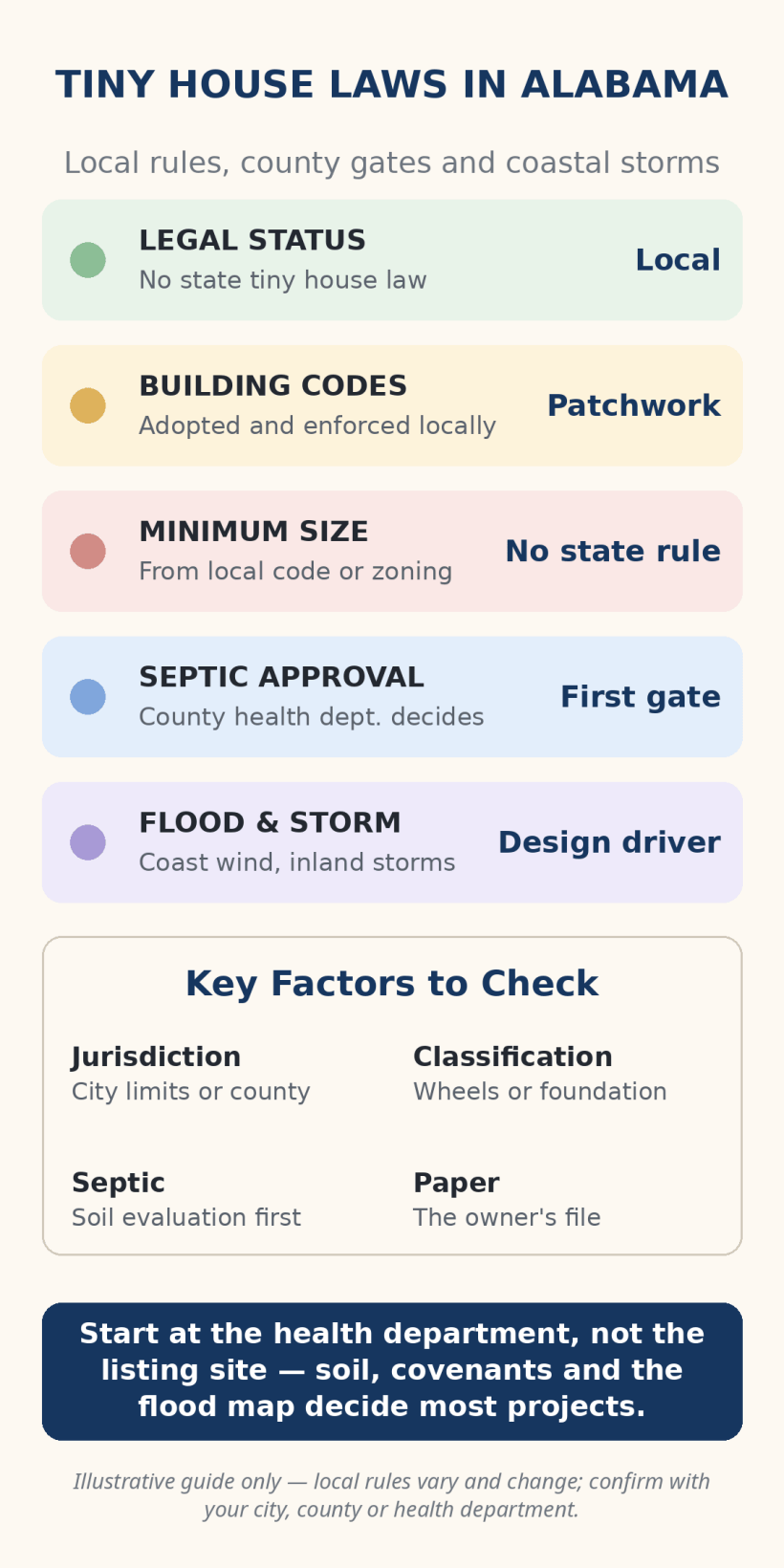
Alabama is the state this series saved for last, and it fits the pattern of its neighbours: there is no single Alabama tiny house law to obey or to dodge. What governs a tiny house here is a stack of local decisions — city zoning where a city has written it, county health department approval for the septic system almost everywhere, flood and wind rules along the Gulf Coast, and, across much of the rural state, a notable absence of anyone asking questions at all. Alabama rewards the same discipline as Mississippi and Georgia next door: classify the house honestly, find the office that actually regulates your parcel, and get the answer for your address rather than for the state in general.
This guide works through the full picture: how Alabama sorts wheeled houses from foundation houses, the patchwork of building codes, minimum sizes and where they come from, zoning inside and outside city limits, backyard cottages, permits and utilities, and the practical order to do the homework in. It completes the fifty-state set collected in tiny house laws by state, and it is written to be read alongside its neighbours — the rules change at the state line less often than they change at the city limit.
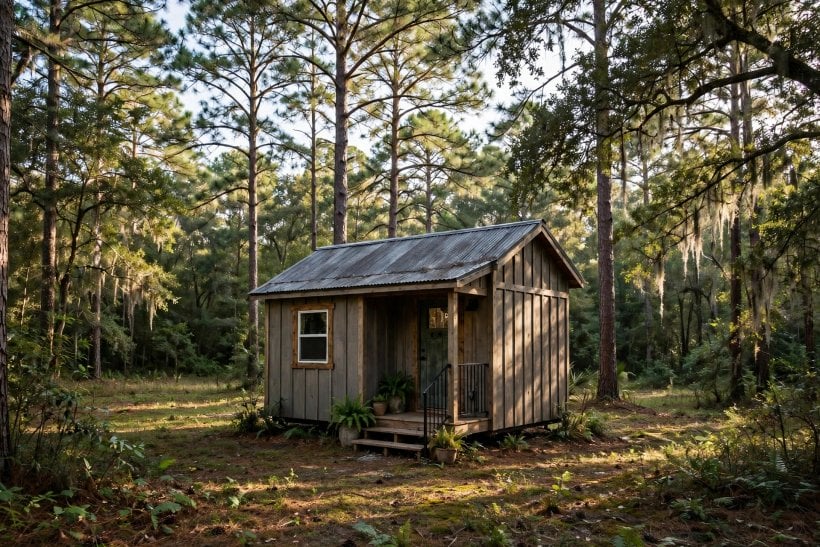
1. Tiny House Laws in Alabama at a Glance
The table below answers the questions Alabama readers ask first. Read the cautious answers as carefully as the open ones: in Alabama, permission is rarely the hard part — proving the parcel can take a house, a septic system and a storm usually is.
| Question | Alabama in brief |
|---|---|
| Are tiny houses legal in Alabama? | Generally yes. No state law bans or specifically licenses tiny houses; legality turns on local zoning where it exists, septic approval from the county health department, and flood rules where they apply. |
| Is there a statewide residential building code? | Not one enforced uniformly on houses across the state. Alabama leaves most residential code adoption and enforcement to cities and counties, so requirements vary sharply by address — some cities enforce full codes, many unincorporated areas enforce little or none. |
| Is a tiny house on wheels a house or an RV? | An RV or vehicle in practice. Full-time living in one belongs in RV parks, campgrounds and tiny-home communities that accept wheeled units; on private land its welcome depends on local rules and enforcement, which vary. |
| How small can a tiny house be? | Alabama sets no statewide minimum house size of its own. Where a minimum bites, it comes from a locally adopted building code’s habitability rules or a city zoning ordinance — check the jurisdiction, not the state. |
| What about septic and water? | The Alabama Department of Public Health oversees onsite wastewater, and county health departments handle the evaluations and approvals — for most rural tiny houses, this is the first real gate the project meets. |
| Do storms and floods change things? | Yes. The Gulf Coast builds under flood and wind exposure that inland counties never face, and tornado risk is a statewide design consideration. Mapped flood zones bring elevation and insurance requirements through local floodplain rules. |
| Where can I live in one full-time? | In a foundation tiny house on your own land where dwellings are allowed, on a conforming lot in a zoned city, in a manufactured-home community with a HUD-code unit, in a tiny-home community, or in an RV setting for a wheeled unit. |
Tiny house laws in Alabama at a glance — always confirm details with your city, county or health department before you buy.
Read the table the Alabama way: the state mostly steps back, and the county steps forward. The sections below spend their weight where Alabama projects are actually decided — the health department counter, the flood map, and the difference between a city address and a county one.
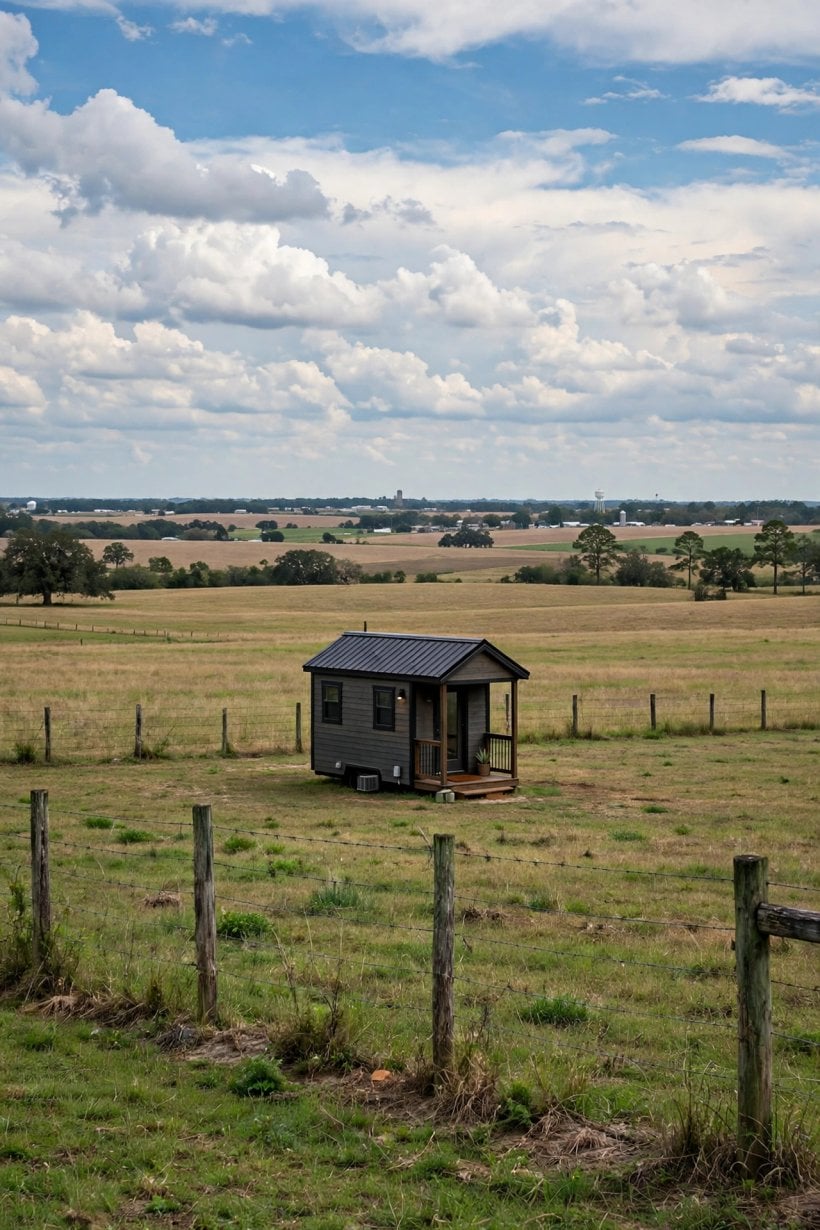
2. Legal Status: Tiny Houses on Wheels vs on a Foundation in Alabama
A foundation tiny house in Alabama is, in most of the state, simply a small house. Where a city enforces a building code, it is permitted and inspected like any other dwelling; where no local code is enforced, it is still real property — a dwelling on land — even if nobody stamped a drawing. Nothing in state law requires a house to be a particular size to be a house, so the foundation route is the legally plainest way to live tiny in Alabama, exactly as it is across this series.
A tiny house on wheels sits in vehicle territory, as everywhere. It is titled and registered rather than permitted as a dwelling, and its placement rights follow vehicle logic: RV parks, campgrounds and communities built for wheeled homes are its natural legal homes. Alabama’s rural culture softens the lived reality — wheeled units on family land are a common sight — but a tolerant county is not the same as a legal right, and inside city limits a wheeled unit used as a full-time residence can meet ordinances it would never meet out in the county. The general framing in zoning laws for tiny houses applies with full force here: ask the enforcing office before the house arrives, not after.
Manufactured homes are the third category, and Alabama regulates them through their own channel: factory-built homes follow the federal HUD code, and the state oversees how they are installed and set up. A manufactured tiny home is not a loophole around local placement rules — zoning and septic still decide where it may sit — but its paperwork trail is the most standardised of the three, which is why manufactured-home communities appear throughout this guide as a realistic full-time option.
Classification travels further than the permit counter. It decides how the home is taxed, what kind of loan will touch it, which insurers will quote it and what a buyer can finance when you sell. A foundation tiny house reads to every institution as a house; a wheeled unit reads as a vehicle with a vehicle’s financing and insurance markets; a HUD-code manufactured home reads as its own well-worn category. Alabama does not soften those distinctions, so choose the category with your lender’s and insurer’s likely answers in view — not after the build, when the category is welded or bolted in place.
3. Building Codes for Tiny Houses in Alabama
Alabama’s code landscape is local. Cities adopt building codes — typically an edition of the International Residential Code, sometimes with local amendments — and enforce them within their limits. Counties are a thinner story: some have permitting and inspection for parts of their territory, and many unincorporated areas have historically had no residential building inspection at all. The same physical house can therefore be a fully inspected dwelling inside a city and an uninspected one twenty minutes outside it, with no change in the house itself.
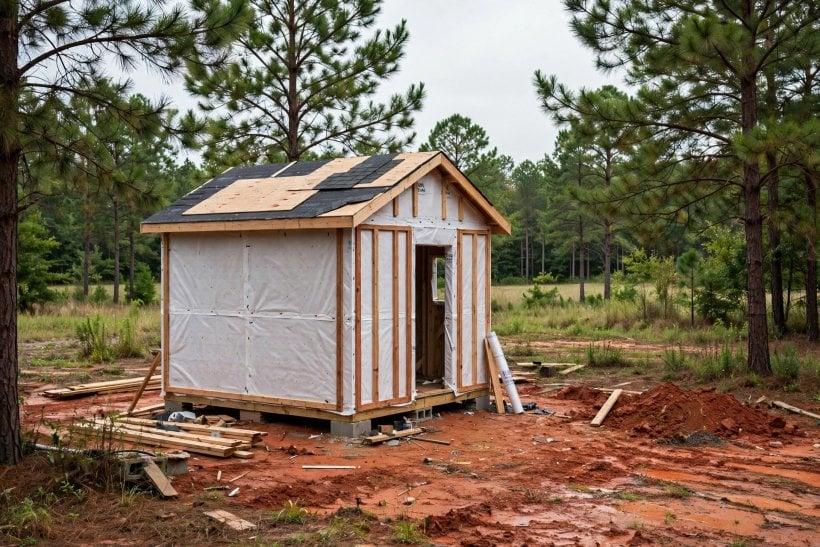
Two cautions follow. First, no inspection is not no standards: lenders, insurers and future buyers all read an unpermitted house through the code anyway, and the safest rural builds in Alabama are the ones built to a recognised code whether or not anyone checked. Second, national tiny-house provisions — the IRC’s tiny-house appendix, explained in IRC Appendix Q for tiny homes — only apply where a jurisdiction has adopted them; they are a conversation to have with your local building office, not a statewide Alabama entitlement. Electrical, plumbing and septic work carry their own licensing and approval layers regardless of how light the building-code layer is.
Utilities deserve their own sentence in an Alabama code conversation, because they are where the rural state quietly regulates hardest. Much of rural Alabama is served by electric cooperatives and county or municipal water systems, each with its own connection process, distance charges and timelines; a parcel can be entirely legal for a house and still be priced out of one by a long power run or an unavailable water tap. And above ground, Alabama’s storm climate writes an unwritten code of its own: roofing, tie-downs for manufactured and wheeled units, and a serious plan for tornado shelter are treated by insurers — and by sensible builders — as requirements whether or not a local ordinance lists them.
4. Minimum Size Requirements for Tiny Houses in Alabama
There is no Alabama state statute that sets a minimum size for a house, and no state rule that a dwelling must reach a particular square footage to be legal. Minimums arrive from below, not above: a city that has adopted a residential code inherits that code’s habitability floor — the room-size, ceiling-height and light-and-ventilation minimums that any dwelling must meet — and a city zoning ordinance can add its own minimum dwelling size or lot requirements on top. Subdivision covenants and homeowners association rules can and do set larger minimums privately, and in newer subdivisions they are frequently the binding limit.
The working method is the series’ standard one: ask three separate questions of three separate sources. The building office (if your jurisdiction has one) answers what the adopted code requires of the house. The zoning office answers what the district requires of the dwelling. The recorded covenants answer what the subdivision requires of you. A “no” from any one of the three is a no, and in Alabama the third is the one buyers most often forget to read.
5. Zoning and Placement Rules for Alabama Tiny Houses
Zoning in Alabama is primarily a municipal tool. Cities and towns zone the land inside their limits — residential districts, each with its allowed uses, lot sizes and setbacks — and many also exercise some authority in the areas just outside their boundaries. Outside incorporated places, much of Alabama has no zoning at all, though counties can regulate subdivisions and some exercise more land-use control than others, particularly in fast-growing and coastal areas. The honest summary is the one this whole series runs on: the absence of zoning is common in rural Alabama, but it is a fact to verify for your county and your parcel, never a statewide promise.
Placement follows the classification from Section 2. A foundation tiny house goes where dwellings go: residential districts, agricultural and rural land where a dwelling is an allowed use, and lots that meet whatever size and setback rules the jurisdiction applies. A wheeled unit goes where vehicles designed for living go — parks and communities — unless the local rules or a specific approval say otherwise. Before you buy, walk the parcel through how to prepare land for a tiny house: access, drainage, setbacks in practice and utility distances weed out more Alabama parcels than zoning does.
6. ADU Rules: Backyard Tiny Houses in Alabama
Alabama has no statewide rule that makes a backyard tiny house — an accessory dwelling unit — automatically allowed, and none that bans the idea either. ADUs live or die in city ordinances: some Alabama cities allow accessory dwellings under conditions, others restrict or prohibit them, and many smaller towns have never written the question down, which sends you to the zoning office for an interpretation rather than an answer from a code book. Lot size, parking, owner-occupancy conditions and whether the unit may be rented are the usual variables where ADUs are addressed.
The rural version of the same idea — a second small house on family land, for relatives or as a future main house — meets fewer written rules in unincorporated areas, but it still meets the health department: a second dwelling usually means a second wastewater solution, and the septic evaluation for the parcel decides how many homes the land can honestly carry. Treat the ADU question and the septic question as one question asked in two offices.
When you take the ADU question to a city office, take it in its working parts rather than as one big ask. Is an accessory dwelling a permitted use in this district at all? Must the owner live on the lot, and in which unit? Are size, height, parking or separate-entrance conditions attached? May it be rented, and to whom? Can it be sold separately from the main house — almost never, but ask. Five written answers to those questions are worth more than a friendly verbal yes, because the file, not the conversation, is what a future appraisal, complaint or resale will be judged against.
7. Where You Can Legally Live in a Tiny House in Alabama
The realistic full-time options, in the order most Alabama tiny residents use them:
- Your own rural land, foundation build. The classic Alabama route: unincorporated land, a small site-built house, health department septic approval, a well or county water, and power from the local utility or cooperative. The lightest-regulated and most durable option in the state.
- A conforming lot in a zoned city. A small house on an in-town lot, permitted under the city’s code and zoning — more process, more services, and full legal clarity at resale.
- A backyard ADU, where the city’s ordinance allows one — Section 6’s homework applies.
- A manufactured-home community, with a HUD-code unit that meets the community’s standards — the established infrastructure for small factory-built living.
- A tiny-home community. Alabama’s community scene is part of what the state’s tiny house community guide tracks; start with tiny house communities in Alabama for where organised options exist.
- An RV park or campground, for a wheeled unit — the straightforward legal home for a THOW, with stays governed by the park’s terms.
One more Alabama pattern deserves plain words, because it houses a large share of the state’s tiny homes: the family-land arrangement. A small house placed on a relative’s parcel — behind the main house, at the field’s edge, on a corner of the homeplace — is woven into how rural Alabama actually lives, and in unincorporated areas it often proceeds with nothing more formal than the health department’s septic approval. It works, until it meets the future: an estate settlement, a sale of the family land, a refinance, or a dispute, at which point an undocumented house on someone else’s parcel becomes everyone’s problem. A survey, a written agreement about the house’s footprint and access, and the septic paperwork in the file cost little at the start and are the difference between a family arrangement and a family heirloom of the wrong kind.
Compare the neighbouring pictures before you commit to a side of the state line: tiny house laws in Georgia, tiny house laws in Mississippi and tiny house laws in Tennessee each run the same local-first pattern with different local answers, and land prices near the borders make the comparison a practical one, not an academic one.
8. Permits, Inspections and Documentation in Alabama
Expect the permit stack to be assembled from parts rather than handed to you as a list. Inside a city: a building permit and staged inspections under the adopted code, zoning confirmation for the lot, and utility connections through city or county systems. Outside: possibly no building permit at all — and then the health department’s onsite wastewater process becomes the project’s spine. A site evaluation of the soil, a permit for the system matched to it, installation, and final approval before the system is covered and used: skip or shortcut that sequence and the house is unlawful in the way most likely to surface later, at resale or refinance.
Floodplain paperwork rides along where the map demands it: communities participating in the national flood programme administer elevation and siting rules in mapped zones, and coastal construction adds wind considerations that insurers will interrogate even where inspectors do not. Keep the file — evaluations, permits, approvals, photographs of work before it is covered. In a light-inspection state, the owner’s documentation is the house’s certificate, and Alabama buyers, lenders and insurers all price the file as much as the house.
Build the file to survive its hardest reader. Somewhere ahead of this house sits a buyer’s lender asking how the septic was approved, an insurer asking what the roof is fastened with, or a county official asking when the second dwelling appeared. A dated photograph of the septic field before it was covered, the health department’s approval letter, the survey showing the house inside its setbacks, and any city permit with its final sign-off answer all four readers at once. Alabama’s light-touch system runs on trust; the file is how a stranger gets to share it.
9. Notable City and County Examples in Alabama
Examples here are patterns, not rulings — verify each against the current ordinance before relying on it. The Gulf Coast counties (Mobile and Baldwin) are Alabama’s high-regulation shore: flood zones, wind exposure and fast growth have produced the state’s most complete local rulebooks, and an elevated, well-documented build is the norm rather than the exception. The larger cities — Birmingham, Huntsville, Montgomery, Auburn, Tuscaloosa and the growing suburbs around them — run recognisable city systems: adopted codes, zoning maps, permit counters, and ADU questions answered in writing somewhere in the ordinance. The rural counties of the Black Belt, the Tennessee Valley’s edges and the wiregrass are the state’s light-touch country, where the health department and the deed book outweigh the zoning map — but “rural” describes a tendency, not a guarantee, and growth corridors can change a county’s posture between one purchase and the next.
10. How to Go Tiny Legally in Alabama: Practical Steps
Step 1: Classify the house. Foundation dwelling, manufactured home, or wheeled unit — the category chooses the rulebook for everything after.
Step 2: Fix the address’s jurisdiction. Inside a city, outside, or in the fringe a city also reaches — write down which offices govern this exact parcel before asking anyone a general question.
Step 3: Read the private file. Deed restrictions, subdivision covenants and HOA rules, in full, before the public file seduces you: in Alabama’s subdivisions the covenant minimum is the limit that ends projects.
Step 4: Start at the health department. Soil evaluation and septic feasibility for the parcel, sized for the household you plan — the approval everything else quietly depends on.
Step 5: Price utilities and storm cover together. Power distance, water source, septic type and the wind/flood insurance quote in one spreadsheet before closing; cheap Alabama land is ambushed by long utility runs and coastal premiums exactly as it is next door.
Step 6: Build the paper file as you build the house. Permits where they exist, photographs of every concealed stage, the septic as-built, elevation paperwork where the flood map applies.
Step 7: Close the legalities. Final health department sign-off, address confirmed for emergency services, insurance bound with the documentation attached, any city permits closed out.
Final Considerations
Alabama closes this fifty-state series the way its neighbours opened it: the government mostly steps back, and the responsibility steps forward. The state offers genuinely light-touch rural counties, affordable land, health departments that answer the phone and cities with clear if conventional rulebooks — a workable landscape for tiny living by any honest measure. What it asks in return is that you do the diligence the missing inspectors would have done: septic proven, flood map read, covenants understood, storm exposure priced, and the paper file kept like it matters, because at resale it will be the only proof the house was ever legal.
Meet Alabama on those terms and it is one of the easier states in this index to go tiny in. Start at the health department, not the listing site — one parcel, its soil, its recorded restrictions and its flood map. Those four documents decide more Alabama tiny house projects than any ordinance ever written.


0 Comments