

Salt air, bright sun and a sea horizon ask more of a house’s outside than almost any other setting — and reward it with the most loved look in home design.
These seventy-five coastal exterior ideas cover colour palettes, siding and finishes, roofs, windows, porches and landscaping, plus the weather checks that keep a seaside house beautiful instead of battered.
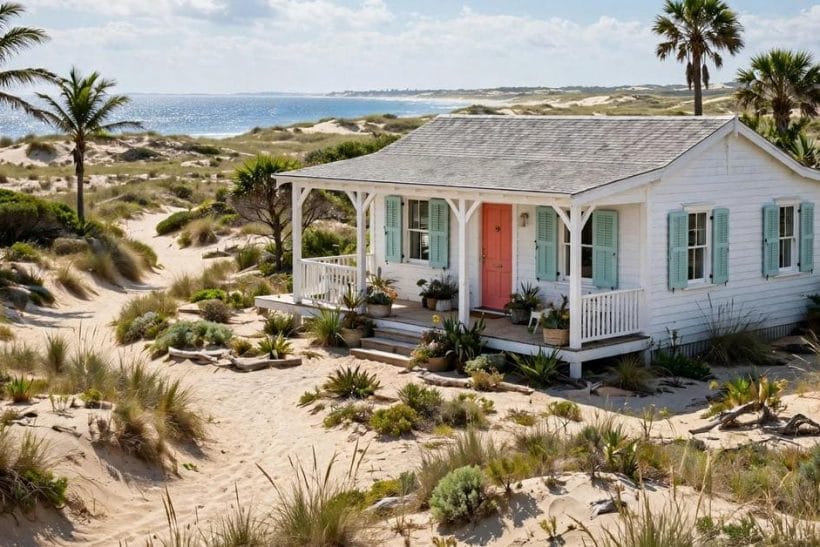
1. Coastal Exterior Home Ideas at a Glance
A coastal exterior is a palette and a materials list before it is a style. The palette comes from the shore itself — sand, shell, driftwood, sea and sky — and the materials are chosen to survive the shore’s weather: salt spray, driving rain, strong sun and wind that finds every loose edge. Choosing beach house exterior colors is therefore only half the brief; the other half is finishes and forms that hold those colours honestly for years. This post belongs to the wider exterior home ideas family and stays outside the house — the inside of the coastal story, its dining rooms and living rooms, is told separately.
| Question | Short answer |
|---|---|
| What colours define a coastal exterior? | Soft whites, sand and shell tones, sea blues and greens, weathered greys — tested in the site’s real light before committing |
| Which siding suits the coast? | Horizontal boards, shingles and board-and-batten all belong; the right one is the one detailed and maintained for salt and storm locally |
| What is the biggest coastal mistake? | Choosing colours and finishes for a calm showroom day, then meeting the first storm season unprepared |
| How do porches fit in? | As the coastal house’s outdoor room — shaded, railed and furnished for the view, on the sheltered side where the site allows |
| What drives exterior cost? | Surface area and height, preparation and repairs, finish quality, access for scaffolding, and how often the coastal climate demands renewal |
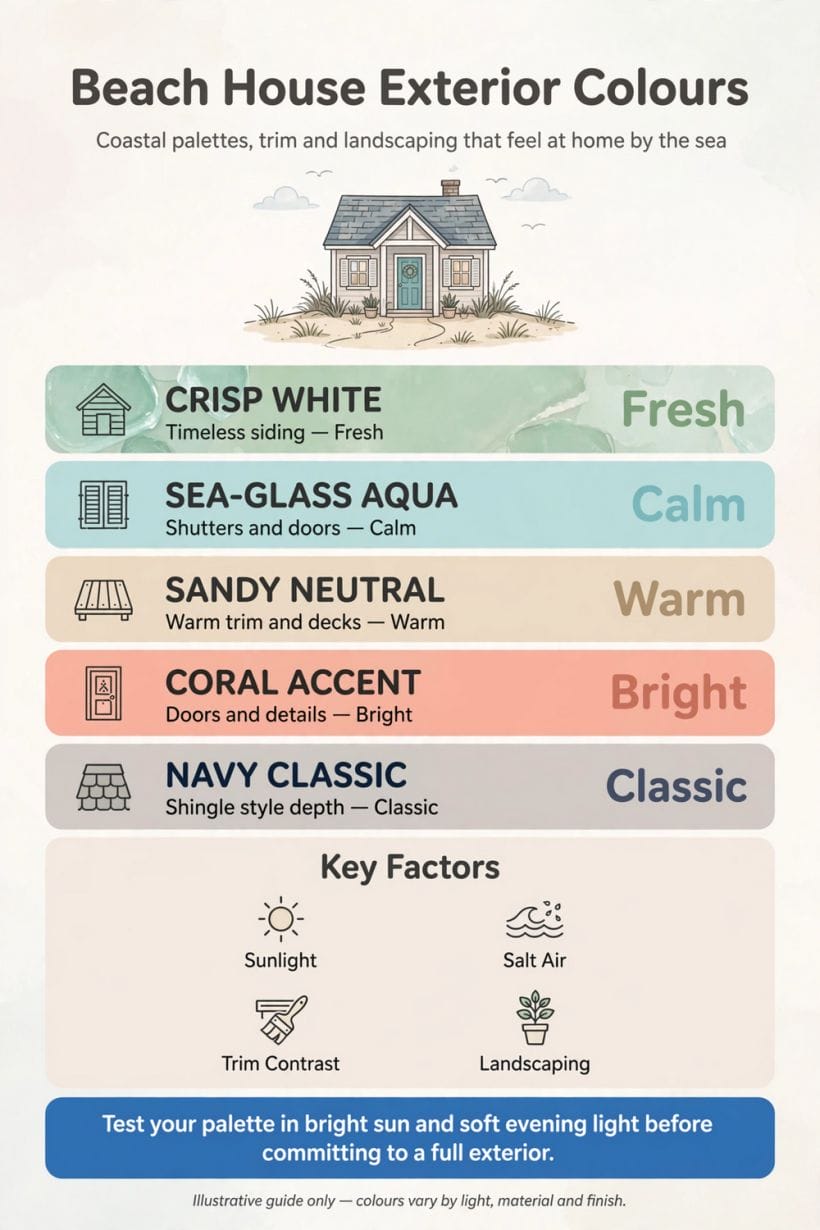
2. Coastal Colour Palettes
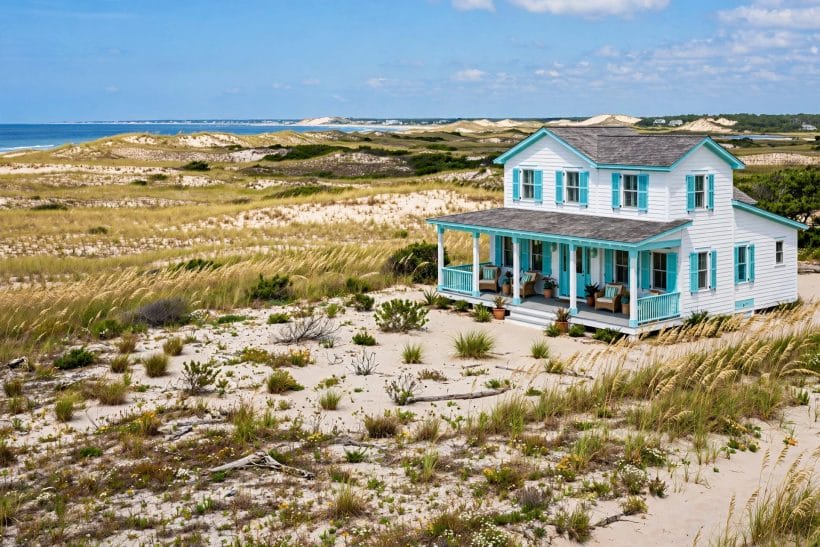
Coastal colour is borrowed colour: every durable palette on a seaside house can be found within a short walk of its front door. Work from the shore inward, and the house will always belong to its setting.
1. Crisp white siding with a pale blue door
The defining coastal scheme: white boards that bounce the sea light, and a door in the blue of shallow water.
2. Sand and shell tones for a sun-bleached calm
Warm off-whites, sand and palest shell pink warm a white scheme without leaving the shore’s palette. These tones forgive dust and salt film between washes better than brilliant white, and they flatter natural timber details.
3. Sea-glass green siding with white trim
A soft green-grey taken from sea glass suits houses among dunes and grasses, where pure white can glare. White trim keeps the outline crisp, and the green deepens beautifully in rain light and evening sun.
4. Weathered grey shingles, silvered by the sun
Cedar shingles left to weather — or finished to imitate it — give the grey of driftwood and old piers. It is the lowest-key coastal palette and the most forgiving of salt, sand and an irregular washing schedule.
5. Navy accents on a white house
Deep navy on shutters, doors or a gable end gives a white coastal house its yachting note.
6. A soft blue house with deeper blue trim
Blue on blue — pale siding, mid-blue trim, a deeper door — layers the sea’s own gradient up the facade. It is the scheme the dedicated survey of blue exterior home ideas explores in full, and the coast is its natural home.
7. Grey siding with white trim and a black door
The grey family is the coast’s second language: the treatment in gray exterior home ideas applies here with sea light added — cool greys against white trim, grounded by one black door, calm in every season.
8. Coral or soft terracotta as the single warm note
One warm accent — a door, a pair of shutters, a bench — against cool coastal colours gives the house its sunset. Ration it strictly: warmth is the spice of the coastal palette, never the meal.
9. Two-tone siding: pale below, deeper above
A deeper tone on the upper storey or gable and a pale one below grounds the house and shrinks its apparent height. On tall coastal houses it stops the facade reading as a cliff of one colour.
10. Testing colours at the shore, not the store
Coastal light is bluer and brighter than shop light, and it changes with the tide of cloud over water. Paint large boards, prop them against the house, and read them morning, noon and storm-grey before the order is placed.
3. Siding, Cladding and Wall Finishes
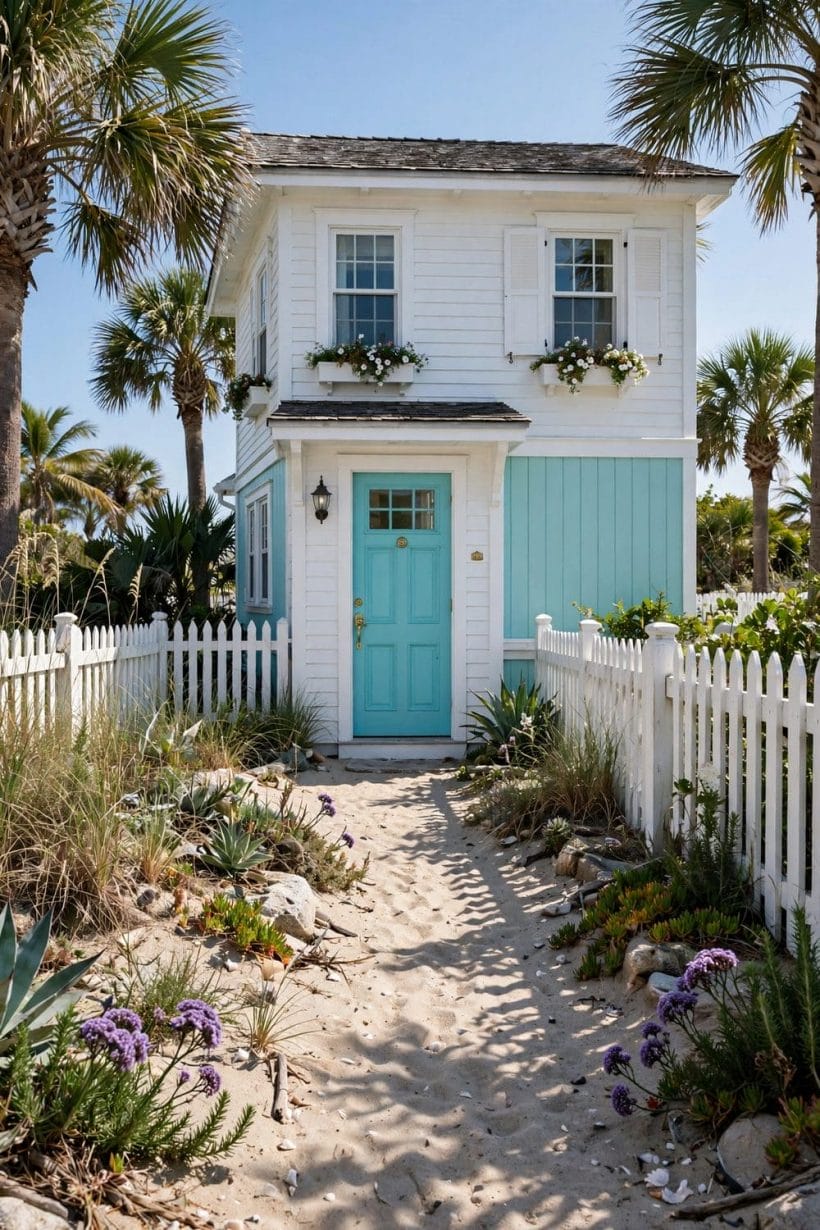
The wall finish is where coastal character and coastal survival meet. Boards, shingles and battens each shed water and take colour differently, and each asks its own maintenance — choose with both eyes open.
11. Horizontal lap siding, the coastal default
Overlapping horizontal boards are the shore’s vernacular: they shed rain, take paint beautifully and repair board by board after a storm. Their shadow lines give even a plain house its coastal rhythm.
12. Cedar shingles for texture and tradition
Shingle siding — in courses, sometimes patterned at the gable — brings the hand-made texture of older seaside towns. Left natural it silvers; stained, it holds a colour while keeping the texture that flat boards cannot give.
13. Board-and-batten for a taller, simpler read
Wide boards with narrow battens over the joints suit simple gabled forms and read smartly in white or grey. The vertical lines stretch a low house, and the system is kind to repair — one board at a time.
14. A stone or brick base grounding pale siding
A masonry skirt at the house’s foot — local stone where it belongs, brick where it does — protects the splash zone and anchors pale siding visually. It also gives driving rain and blown sand something tougher to meet.
15. Limewash and masonry finishes on solid walls
On rendered or masonry coastal houses, breathable mineral finishes in white and shell tones give the matte, soft look boards give timber houses. They age by mellowing rather than peeling, which suits a shore climate well.
16. Mixed siding: boards below, shingles in the gable
Combining finishes by zone — boards on the main walls, shingles in gables and bays — is the classic coastal composition. It breaks a tall facade into human pieces and lets each material do the job it does best.
17. Dark-stained timber accents against pale walls
A stained timber porch, screen or gable detail against pale siding supplies the driftwood note without darkening the whole house. Keep the stain system maintainable; coastal sun tests every finish it touches.
18. Corner boards and trim kept deliberately chunky
Generous corner boards, window casings and a clear water table line give coastal siding its tailored finish.
19. Ventilation and gaps behind the cladding
Behind every coastal wall finish there should be a drained, ventilated path for the moisture that gets in — because some always does. Detailing belongs to your builder and local practice; skipping it is how pretty walls rot quietly.
20. A finish chosen for its renewal, not just its first year
Ask of every finish how it is cleaned, recoated and repaired in year five, in salt air, at height. The coastal exterior that stays beautiful is the one whose maintenance was chosen as carefully as its colour.
4. Roofs, Gables and Coastal Silhouettes
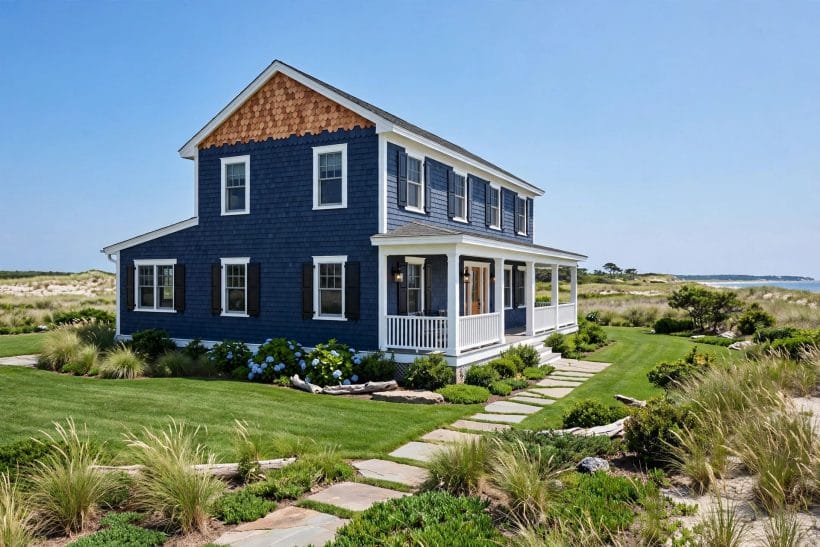
From the water and the road, a coastal house is mostly roof. Its pitch, material and silhouette decide whether the house hunkers into the shore or stands against it — and how it meets the wind.
21. A simple steep gable facing the sea
The classic coastal silhouette: one honest gable, deep enough to shed storm rain, plain enough to belong. A window in the gable gives the house its face and the attic its light.
22. Cross gables for a rambling seaside house
Intersecting gables let a house grow room by room toward the view, each wing sheltering the next. Keep the roofing material and trim consistent, or the ramble reads as accident rather than ease.
23. A hipped roof hunkering into the wind
Hips slope on every side, presenting no tall gable to the gale and sheltering the walls below. On exposed headlands the hipped coastal house looks — and behaves — like it intends to stay.
24. Standing-seam metal roofing in a sea tone
Metal roofs in soft grey, sea green or muted blue are the modern coastal answer: crisp lines, long service, and a surface storms struggle to lift when properly fixed.
25. Shingle roofing matched to shingle walls
Where walls and roof share the shingle material, the house reads as one weathered form — the celebrated shingle style. It asks skilled fixing and honest maintenance, and repays both with unmatched coastal character.
26. Deep eaves shading walls and windows
Generous overhangs throw rain clear of the siding, shade glass from high summer sun and give the silhouette its sheltered line. In storm country their undersides and fixings need the builder’s respect, not just the designer’s eye.
27. A widow’s walk or roof deck, railed and modest
The traditional railed platform at the roof’s peak belongs to maritime houses with a view to honour. Keep it small, railed to your local code and honestly maintained — salt attacks its fixings first.
28. Dormers that light the upper rooms
Shed and gable dormers bring headroom and sea views to roof-storey rooms, and their little roofs and cheeks repeat the house’s finishes in miniature. Cluster them rhythmically; scattered dormers unsettle a facade.
29. A cupola or lantern crowning the roof
One small cupola gives a coastal house its landmark and can ventilate the roof space as it charms. Scale it to the roof, not the ego — its charm is entirely in its proportion.
5. Windows, Shutters and Doors
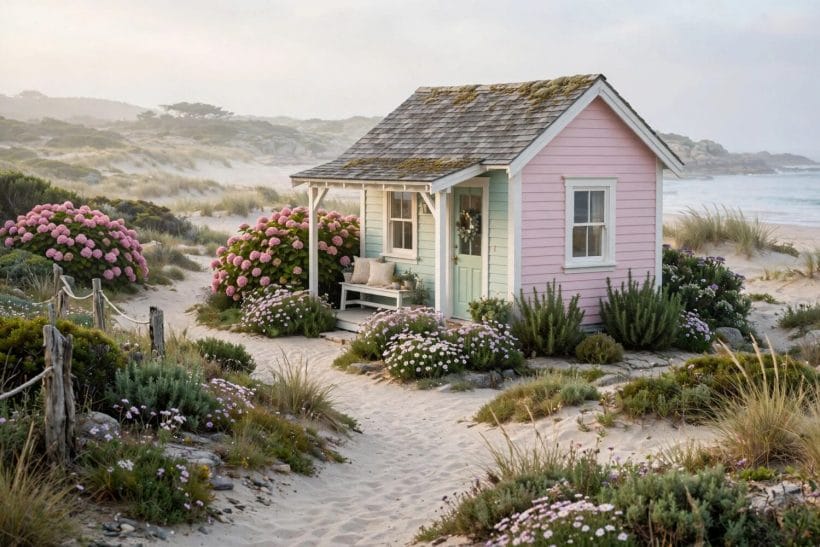
Openings are the coastal house’s eyes on the view and the storm’s favourite way in. Their style sets the facade’s expression; their specification — always to local storm and code requirements — sets its safety.
30. Tall windows taking the sea view whole
Where the view allows, give the sea-facing rooms tall, generous windows and keep their divisions simple. The house borrows the horizon as its largest picture, and the exterior gains the calm of few, big openings.
31. Multi-pane sashes for the traditional shore house
Divided lights suit older coastal forms and shingle walls: their grid rhymes with the siding’s texture.
32. Working shutters, sized to their windows
Shutters that could actually close over the glass — correctly sized, properly hinged — read as honest equipment; undersized fixed boards read as costume. In storm districts, rated protective systems are a specification matter for local professionals.
33. Shutters in the house’s one accent colour
If the palette has a single accent, the shutters are its natural home: sea blue, green or navy repeated window by window ties the facade together and lets the door echo it once.
34. A front door in a saturated sea colour
The door is where a pale coastal house spends its deepest colour — the saturated blue, green or even red of boats and buoys.
35. A Dutch door for the house that lives open
The split door — top half open to the breeze, bottom half closed to dogs and toddlers — is coastal practicality wearing charm. It suits kitchen and porch doors where the house’s life spills outside.
36. Screen doors that keep the breeze and lose the bugs
A well-made screen door, painted to match the trim, keeps sea air moving through the house on still evenings. Choose hardware that survives salt, and a closer that does not slam in the onshore wind.
37. Window boxes planted for salt and sun
Boxes under the sea-facing windows must hold plants that tolerate salt spray and bright reflection — ask local nurseries what thrives unprotected on your shore. The box itself, in the trim colour, becomes part of the architecture.
38. A porch door of glass, protected by the porch
Where a porch shelters it, a largely glazed door brings the view into the hall and light into the house’s middle. The porch roof is its storm protection; without shelter, specify the door for the full exposure.
6. Porches, Decks and Outdoor Rooms
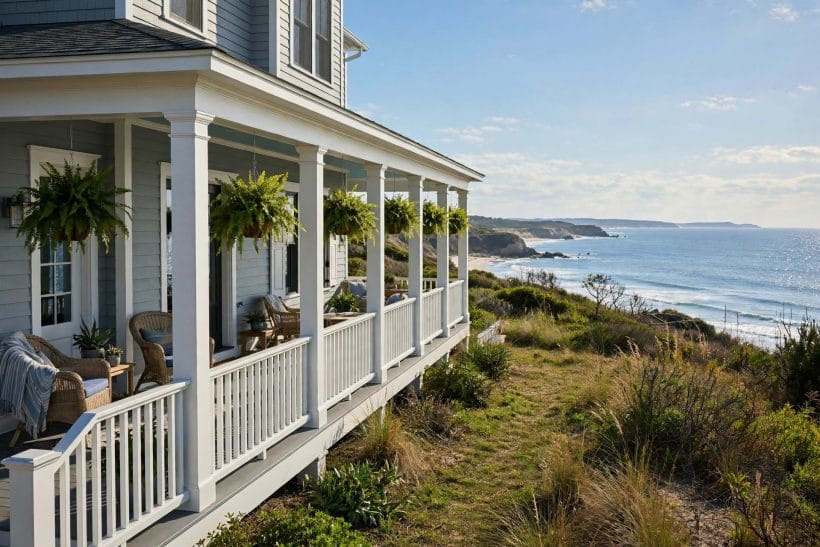
The porch is the coastal house’s signature room — neither in nor out, shaded, breezy and aimed at the view. Its exterior treatment ties the house to its ground and its ground to the shore.
39. A wraparound porch on the sheltered sides
Porches that turn the corner give the household a shaded seat for every hour and every wind.
40. A deep front porch with a ceiling in haint blue
The pale blue-green porch ceiling of southern coastal tradition is said to echo sky and water; whatever its folklore, it lifts the shade and flatters every colour below it. Pair it with white posts and a grey floor.
41. Porch posts and railings in crisp white
White porch structure against coloured siding — or against white siding with a coloured ceiling — is the coastal uniform. Keep balusters simple and the railing’s top rail wide enough for a mug; porches are used, not just viewed.
42. A screened porch for still, buggy evenings
Screening the porch’s sea side keeps the evening seat usable when insects own the garden.
43. A raised deck stepping down to the sand or lawn
Decks lift living space clear of wet ground and give the house its platform.
44. Outdoor showers rinsing the beach away
The enclosed outdoor shower — by the door the household actually uses, plumbed and drained properly — keeps sand in the garden where it belongs. Screen it with the house’s own siding so it reads as architecture, not apparatus.
45. A pergola shading the sun-trap terrace
Where the porch ends, a simple pergola continues the shade over the terrace the sun hammers.
46. Porch lighting in marine-style fittings
Bulkhead and lantern fittings made for outdoor — ideally marine-grade — service suit the porch’s style and survive its air. Warm light, shielded from the neighbours and the night sky, keeps the porch a room after dark.
47. The porch furnished as the house’s best room
Rockers, a swing, a table for breakfast: the coastal porch earns real furniture, weather-fit and stored kindly in winter. From the road, a furnished porch is the surest sign the house is loved — the detail the porch ideas collection develops at length.
7. Details: Trim, Hardware and House Numbers
Coastal exteriors are finished in their details — the metal, the numbers, the light by the door. Salt air audits every one of them, so choose each as if the sea will inspect it, because it will.
48. Marine-grade metals wherever hands touch
Handles, hinges, letterboxes and lights in metals and finishes rated for coastal exposure keep their looks while lesser fittings pit and stain the paintwork around them.
49. House numbers readable from the road
Clear, well-contrasted numbers in a simple face serve guests, deliveries and emergency services alike. Mount them lit or beside the door light, in the house’s accent metal — small, useful and quietly stylish.
50. A lantern by the door, matched at the garage
Repeating one fitting family at door, porch and garage ties the exterior’s punctuation together. Choose sealed units for the exposure and warm bulbs; the coast’s darkness deserves a welcoming, not glaring, light.
51. Gutters and rain chains that handle the downpour
Coastal rain arrives horizontally and in volume.
52. Shutters’ hardware in black against any colour
Black hinges and dogs (the stays that hold shutters open) give every shutter colour its crisp outline and hide their working nature in shadow. It is the traditional choice because it flatters them all.
53. A flagpole, a bell, one maritime gesture
One honest maritime detail — a house flag, a ship’s bell by the door, a rope handrail on the porch steps — charms; a deck-load of anchors and wheels tips into theme park.
54. Mailbox and gate in the house’s own language
The mailbox at the road is the house’s first sentence: paint it the door colour, post it sturdily, number it clearly. A gate that repeats the porch railing’s pattern completes the introduction before a visitor arrives.
55. Exposed fixings checked like rigging
Screws, bolts and brackets on coastal exteriors work like a boat’s rigging — they loosen, corrode and stain in the salt wind.
8. Landscaping and Setting
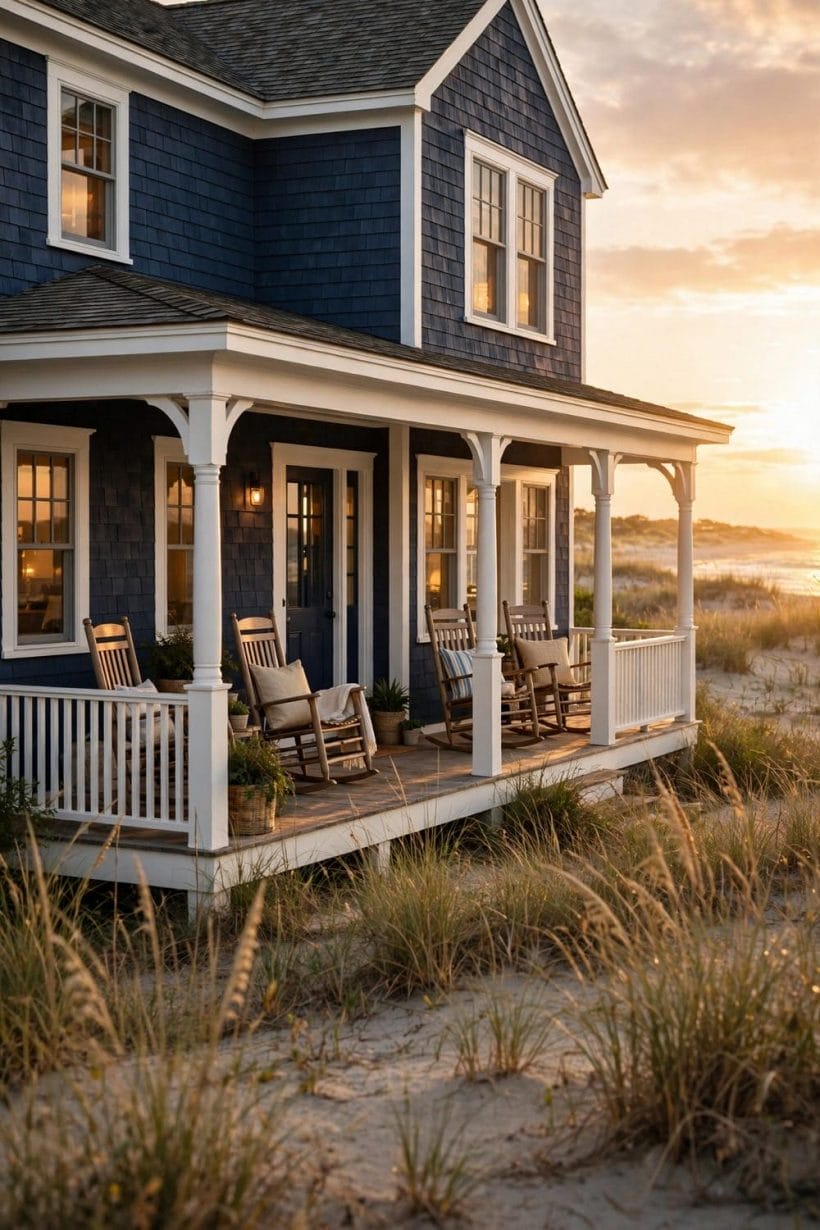
A coastal house sits in a landscape the sea edits daily: salt wind prunes, sand migrates, and only the plants that belong endure. Plant for the shore you have, and the setting will frame the house instead of fighting it.
56. Dune grasses as the house’s soft skirting
Ornamental and native dune grasses move with the wind the house must resist, and their motion makes still architecture feel alive. Planted in drifts against the walls, they soften the base line without hiding the house’s foot.
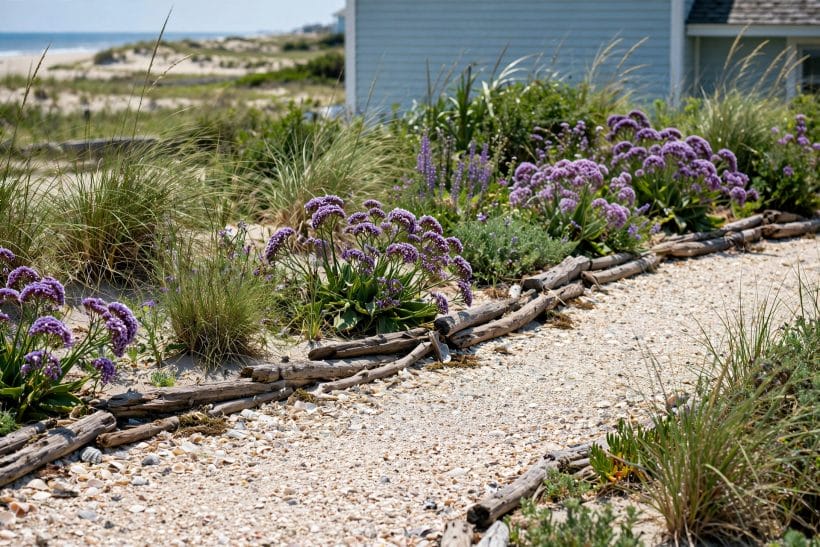
57. A shell or gravel path to the front door
Crushed shell and pale gravel paths belong to the shore palette, drain freely after storms and crunch pleasantly underfoot. Edge them firmly, or the garden and the path will negotiate their own boundary all summer.
58. Low planting that keeps the view open
Coastal gardens earn their view: keep planting below the windows’ sightlines on the sea side, and let taller shelter planting stand where it blocks wind, not horizon. The house’s best picture is the one it already owns.
59. A windbreak hedge on the weather side
A tough, salt-tolerant hedge or fence planting on the storm side buys calm for the whole garden — ask local growers what stands unprotected on your coast.
60. Weathered timber fences echoing the house
Fences and gates in silvered timber or the house’s trim colour continue the architecture into the plot. A fence that repeats the siding’s board rhythm makes even a large garden feel designed as one place.
61. Stone from the shore, used sparingly and legally
Local stone — gathered only where collection is permitted — edges beds and builds the low walls that suit coastal ground. Its colours are the palette’s source; a little of it ties house, path and shore into one story.
62. Lighting kept low, warm and seaward-dark
Garden lighting on the coast should guide feet, not compete with the moon on the water: low fittings, warm light, nothing glaring toward the beach. Wildlife and neighbours share the darkness; a considerate scheme honours both.
63. The indoor echo: coastal rooms behind coastal walls
The exterior promises what the interior should keep — the light palette and easy rooms explored in coastal dining room ideas show the same colours carried inside, so the house reads as one idea from road to table.
9. Salt, Storm, Sun and Small Coastal Homes
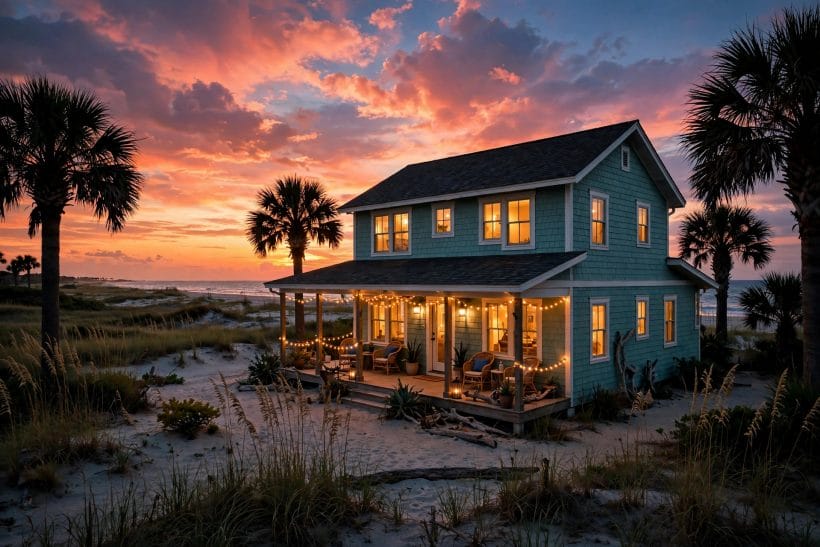
The last ideas face the coast’s terms directly: the weather that makes the setting glorious also tests every colour, fixing and finish. Design with the terms, maintain on their schedule, and adapt the whole approach to small houses and tiny coastal homes, where the same palette scales down beautifully — as the compact schemes in tiny house exterior ideas show.
64. A washing rhythm for salt film
Salt settles on glass, paint and metal invisibly and works constantly.
65. Storm shutters and fixings agreed before the season
Whatever protective system your district uses belongs in the exterior plan from the start: stored where it can be reached, fitted by the people who will fit it in a hurry, and rehearsed on a calm day.
66. Sun-side colours chosen a shade deeper
Strong coastal sun bleaches; a colour that looks right on the shaded side may fade unevenly on the sun side.
67. Ventilated details wherever timber meets timber
Decks, porches and board finishes last where air can dry them. Spacings, gaps and drip edges are unglamorous and decisive; a builder who talks about drying is a builder who understands the coast.
68. The small white cottage, perfectly plain
A tiny coastal cottage needs almost nothing beyond white boards, a coloured door and a cared-for roof — restraint is its whole style. Every addition must argue its way in against that beautiful simplicity.
69. A compact porch instead of a wide one
Small coastal houses gain more from a deep-enough porch on the sheltered side than from a shallow one wrapped around. One good outdoor room, furnished properly, beats three token platforms.
70. Colour carried onto the small house’s shed and fence
On a small plot, painting the shed, gate and fence in the house’s own palette makes the whole property read as one composed place — the cheapest sense of scale a tiny coastal home can buy, and a trick the plans in new home exterior design ideas for tiny houses use well.
71. A beach house that is mostly porch
Some small coastal houses are honestly a porch with rooms attached — and the exterior should admit it: the porch gets the best materials, the colour and the care, because it is where the house’s life is lived.
72. Rentals and second homes: durability as the style
A coastal house that stands empty between visits needs finishes that forgive neglect: simple palettes, robust fittings, planting that survives alone. Beauty that requires weekly attendance is a liability wearing a nice colour.
73. Recording every colour and finish in one house book
Paint names, finish systems, fitting models and the dates they were applied — kept in one book or file — turn every future repair from research into shopping. Coastal maintenance is frequent; records make it brief.
74. An annual storm-season walk-around
Once a year, before the rough season: roof edges, flashings, shutter fixings, porch structure, deck boards, gutters and every exposed fixing, checked and tightened. An hour with a ladder and a list is the coastal exterior’s real insurance.
75. Letting the house weather with dignity
The final coastal lesson: some silvering, softening and salt-kissed ageing is the setting’s signature, not failure. Maintain the house’s structure and safety without mercy, and let its surfaces grow into the shore that surrounds them.
10. Costs and Practical Details
Exterior costs are driven by scale and condition, not by the word coastal: the surface area and height of the walls, the preparation and repair the existing finish needs, the quality and system of the new finish, access for scaffolding on awkward or exposed elevations, and the renewal cycle the local climate imposes. Two identical houses can carry very different exterior budgets because one needs its boards repaired before paint and the other does not. The honest method is the surveyor’s and painter’s method: inspect every elevation, note repairs separately from finishes, and price preparation, materials and application as their own lines. Local quotes, from firms who know your shore’s weather, are the only figures worth planning around — this post deliberately offers none.
Practical sequencing matters as much as product choice. Roof and gutters first, so finished walls are not spoiled by later work; repairs and preparation second; finishes in the calm, dry window your climate offers; details and hardware last. Keep the records the earlier section advised, photograph each elevation before and after, and agree with your contractor exactly how storm damage discovered mid-job will be reported and priced. A coastal exterior is a maintenance commitment renewed every few years, and the households that budget for it as a rhythm — rather than dreading it as a surprise — are the ones whose houses still glow in the photographs a decade on.
Final Considerations
Begin at the shore: gather the palette from your own beach, dune or harbour, test it in the sea’s bright light, and choose finishes whose maintenance you will genuinely keep. Then give the house its porch, its honest shutters and its one coloured door. A coastal exterior is not a costume for a house — it is a house dressed for its weather, and dressed well, it will look like it belongs to the horizon it faces.



0 Comments