
Every rose grower starts the same way: one plant, one sunny corner, and a head full of questions the plant label does not answer.
This guide covers rose growing basics end to end — the main rose families, choosing and planting, watering, feeding and pruning, honest pest and disease care, roses for small gardens — and where gardeners share rose advice and learn from each other’s seasons.
1. Rose Growing Basics at a Glance
A rose is a long-lived garden shrub grown for its flowers, and rose growing basics are simpler than the rose’s grand reputation suggests: the right plant for the place, sun and air around it, soil fed and mulched, water at the roots, a confident annual prune, and problems met early and calmly. Everything else — the families, the fragrances, the shows — is enrichment on that foundation. This guide also answers the question behind many a search for rose advice: where growers swap experience. Gardeners share rose knowledge in local rose societies and garden clubs, at shows and nursery talks, and online in long-running gardening forums and community groups where years of questions and answers stay searchable. This guide names no single forum or site as the place; the value is in the accumulated experience of growers in climates like yours, wherever you find them, read with a sceptic’s pencil.
| Question | Short answer |
|---|---|
| What do roses need most? | Sun for much of the day, air moving gently around them, soil that holds moisture without drowning roots, and a yearly prune |
| Which rose should a beginner choose? | A shrub or landscape rose bred and sold for health and ease in your climate — ask local nurseries and societies what thrives unsprayed near you |
| When are roses planted? | Traditionally in the dormant season as bare-root plants, or from pots through much of the year where the ground can be worked and water given |
| What is the biggest beginner mistake? | Crowding roses into still, shaded air where disease thrives — space, sun and airflow prevent more problems than any treatment cures |
| Where do gardeners share rose advice? | Local rose societies, garden clubs and shows, nursery staff, and online gardening forums and groups — experience from your own climate is worth the most |
2. The Main Rose Families, in Plain Terms
Rose catalogues divide their plants into families, and the divisions are genuinely useful once they are translated out of catalogue language. The family tells you the plant’s habit — how big, how it flowers, what training it wants — which is everything a beginner needs to choose well.
Shrub roses: the garden’s backbone
Shrub roses are the general-purpose family: bushy, hardy, flowering over a long season, and available in sizes from ground-hugging to small-tree. For most beginners and most gardens, a healthy modern shrub rose is the right first plant and often the right tenth one too.
Climbing and rambling roses: roses for vertical space
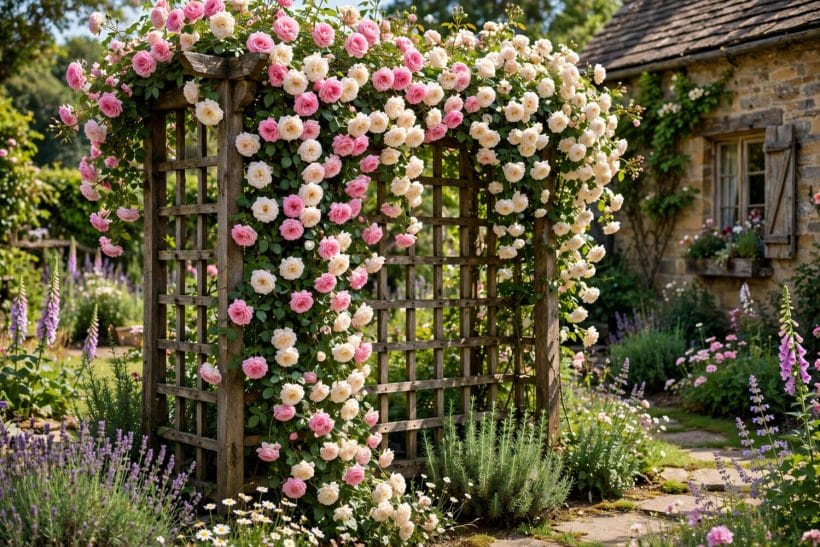
Climbers produce long stems that are trained — not self-clinging — onto walls, fences, arches and pergolas, while ramblers are their wilder cousins, usually flowering once in a great flush. Both need support and tying in, and both are covered in the training section below.
Hybrid teas and floribundas: the classic flower forms
Hybrid teas carry the classic single-stemmed exhibition flower; floribundas carry clusters of smaller blooms and flower generously for borders. Both are beautiful, and both traditionally ask a little more care against disease than the toughest modern shrubs — choose them with eyes open and local advice taken.
Ground-cover and miniature roses: the small-scale families
Ground-cover roses spread low and wide for banks and bed edges; miniatures scale the whole plant down for pots, troughs and the front of borders. Their care follows the same basics as their larger relatives, with watering watched more closely in containers.
Old garden roses: history with a fragrance
The older families — bred before the modern era — are loved for their scent, their soft colours and their once-or-twice flowering. Many are tougher than their romantic image suggests. A garden with room for one rose with a past gains a plant that teaches the family’s whole history.
3. Choosing Roses for Your Space and Climate
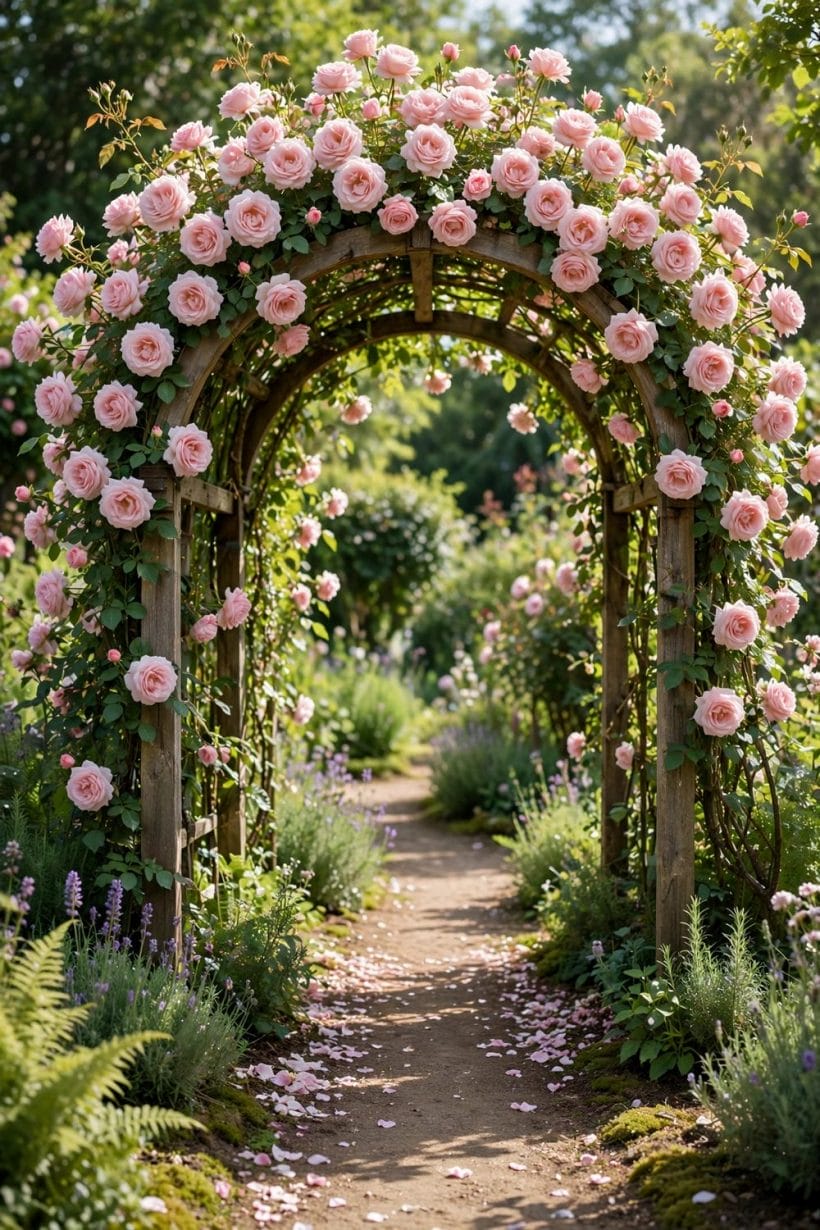
More rose disappointment comes from the choosing than from all later care combined. The checks in this section — climate, health, size and source — take an afternoon and repay it for the decades a rose can live.
Start with health, not with a photograph
A rose that stays healthy in your district without a spray programme is worth ten famous beauties that sicken every June. Local rose societies, good nurseries and experienced neighbours know which varieties thrive locally; their lists, gathered over seasons, are the most valuable rose document a beginner can own.
Match the mature size to the space
Roses are usually sold small and described modestly. Read the mature height and spread on the label as a promise, and plant for it: a rose crammed against a wall or its neighbour loses the airflow that keeps it healthy and the shape that makes it beautiful.
Buy from a reputable source, and inspect the plant
Whether bare-root in the dormant season or potted in leaf, buy from nurseries with a name to protect, and inspect what arrives: firm stems, healthy roots, no suspicious dieback. Variety names matter in roses — the same name should mean the same plant everywhere, which is one reason named, labelled stock from honest sources is worth its price.
Fragrance, colour and flowering habit: the honest trade-offs
The most fragrant roses, the longest-flowering roses and the most disease-resistant roses are rarely the same plant. Decide which quality your garden needs most — scent by the door, colour all summer, or ease above all — and let local growers confirm the shortlist before money moves.
4. Site, Soil and Planting
A rose planted well in the right place is half grown before it starts. The site’s sun and air, the soil’s preparation and the planting itself are the unglamorous work the whole plant’s life stands on.
Sun and air: the non-negotiables
Give roses the sunniest, most open site the garden offers — sun for much of the day — with room around each plant for air to move and dry the leaves after rain and dew. Avoid frost pockets where cold air pools, and the dry, root-robbed ground under large trees, where roses sulk however they are fed.
Preparing the soil
Roses are hungry, deep-rooting plants that repay generous soil preparation: dig the planting area deeply, work in plenty of well-rotted organic matter, and make sure drainage is honest — roses want moisture at their roots, never a sump. Heavy and light soils both improve with organic matter; the digging is done once, so do it properly. Give the beds firm paths you can work from in wet weeks without treading the soil — the path thinking in gravel patio ideas serves a rose bed as faithfully as any terrace.
Planting bare-root and potted roses
Bare-root roses, planted in the dormant season, go into a hole wide enough for their roots to spread, with the graft union — the knobbly joint where variety meets rootstock — set at the depth your region’s guidance advises. Potted roses plant much the same way, with the rootball teased and the hole backfilled and firmed. In both cases, water deeply at planting and keep watering while the plant establishes — the first season’s water is the plant’s foundation. The small-space planting discipline in container garden ideas applies the same care at pot scale.
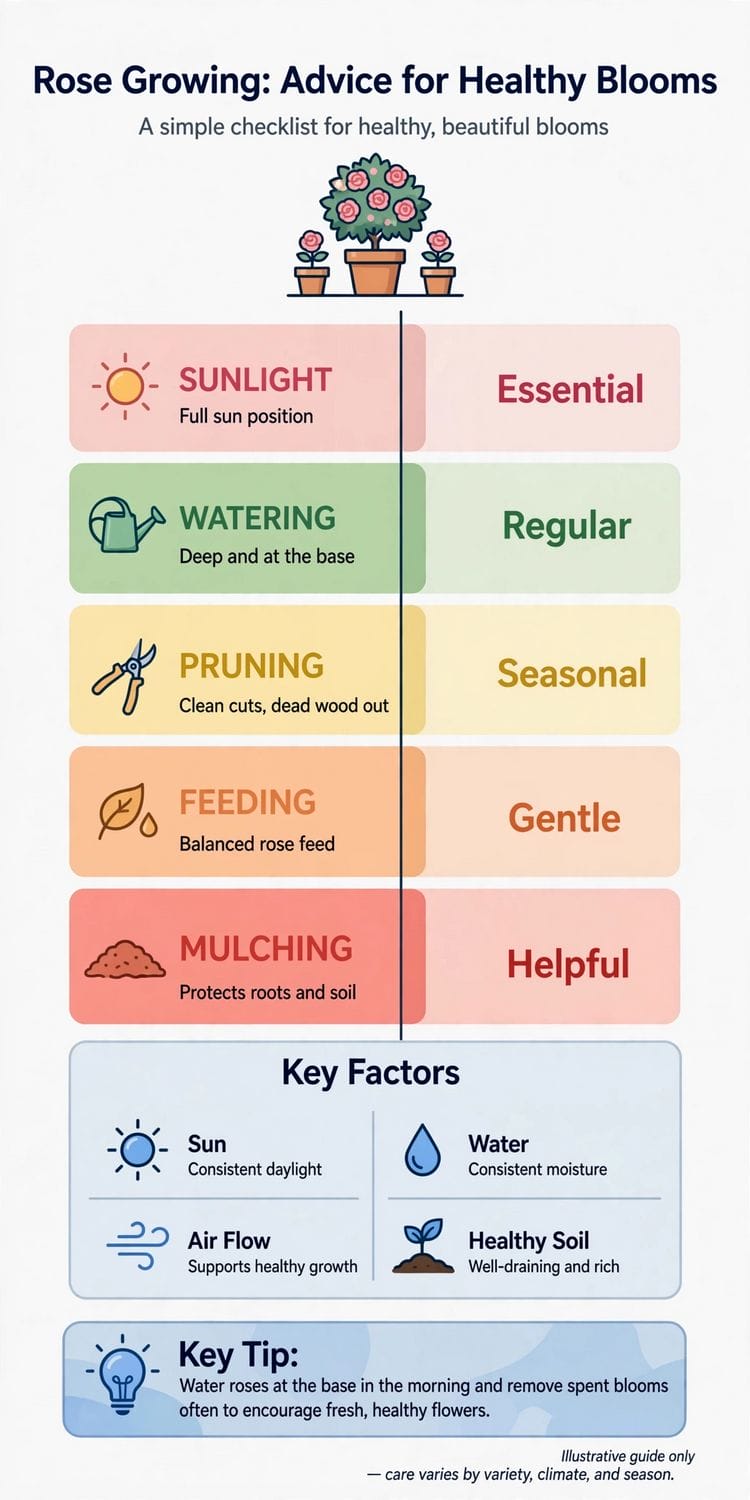
5. Watering, Feeding and Mulching
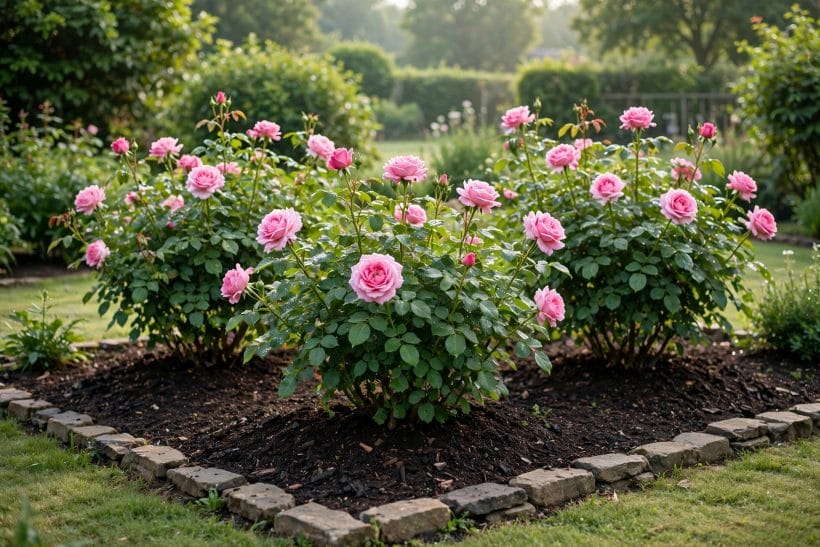
Established roses are tougher than their reputation, but the rhythm of water, food and mulch is what turns toughness into generous flowering. Each is simple; together they are the whole of routine rose care.
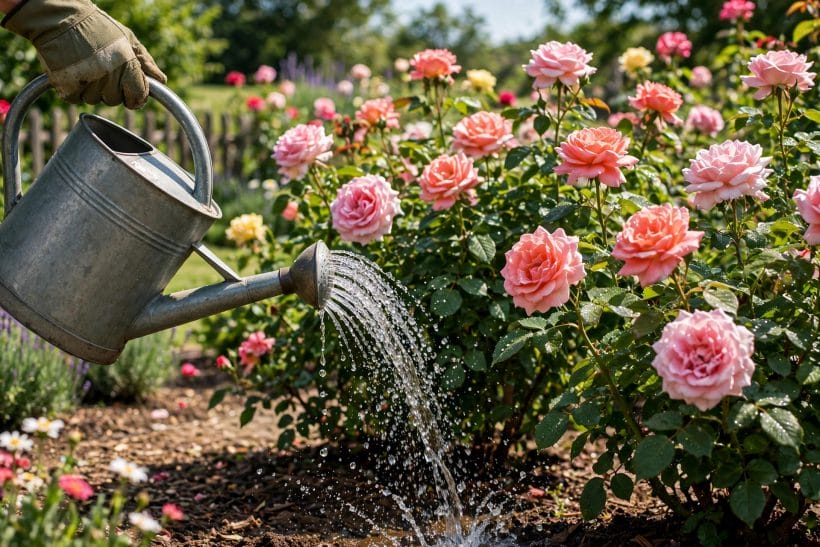
Watering deeply, at the base
Water roses deeply and less often rather than little and daily, so roots run down where the moisture lasts. Water at the base of the plant, in the morning where you can, keeping the foliage as dry as the weather allows — wet leaves in still air are disease’s invitation, which is why watering method matters as much as quantity.
Feeding in the plant’s own rhythm
Roses are fed as growth starts and again after the first great flush of flowers, using a rose or general garden fertiliser exactly as its label directs, or the well-rotted organic feeds traditional growers swear by. More is not better: overfed roses grow soft, sappy growth that pests and weather punish. The label, and local society guidance for your soil, govern quantities — this guide deliberately gives none.
Mulch: the rose grower’s quiet workhorse
A generous mulch of compost or well-rotted organic matter, renewed as it thins, keeps the soil’s moisture even, suppresses weeds, feeds the soil slowly and ends the mud-splash that carries disease spores onto lower leaves. Keep it off the stems themselves, and regard the spring mulching as the rose bed’s annual reset.
6. Pruning, Training and Deadheading
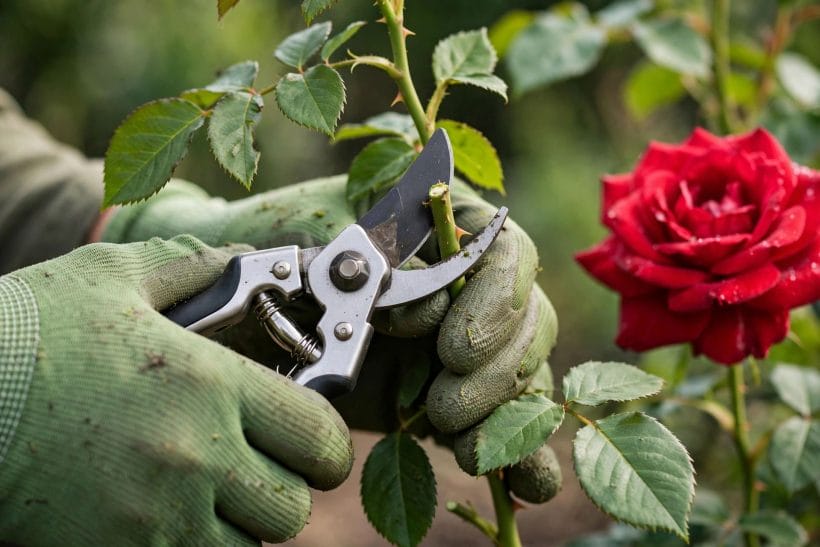
Pruning frightens beginners more than any other rose task, and it is mostly a matter of tidiness with a purpose: remove the dead, the weak and the crossing, open the plant’s centre to air, and shape it to its family. Roses forgive rough pruning far more readily than they forgive none.
The annual prune, in plain steps
Prune in the dormant-to-late-winter window your region’s guidance sets, with clean, sharp tools. Cut out dead, damaged and diseased wood entirely; remove weak and crossing stems; then shorten what remains to a shape that suits the family — shrub roses lightly and naturally, hybrid teas harder for exhibition blooms, climbers by the training rules below. Every cut is made to an outward-facing bud where direction matters. Local rose societies demonstrate pruning hands-on each season, and an hour watching an experienced pruner is worth a shelf of diagrams.
Training climbers and ramblers
Climbers and ramblers do not climb; they are tied. Fan their main stems as horizontally as the support allows — near-horizontal stems flower along their length rather than only at their tips — and tie with soft material that will not cut the bark as stems thicken. Spread the framework in the dormant season and add the season’s ties as growth extends.
Deadheading and the summer tidy
Removing spent flowers — deadheading — encourages repeat-flowering roses to bloom again and keeps the plant tidy; on once-flowering and hip-bearing roses, leave the last flowers to make their hips, which feed birds and decorate winter. Summer work is otherwise light: a crossing stem removed here, a sucker at the base dealt with there, the plant kept open to its air.
7. Pests, Diseases and Honest Prevention
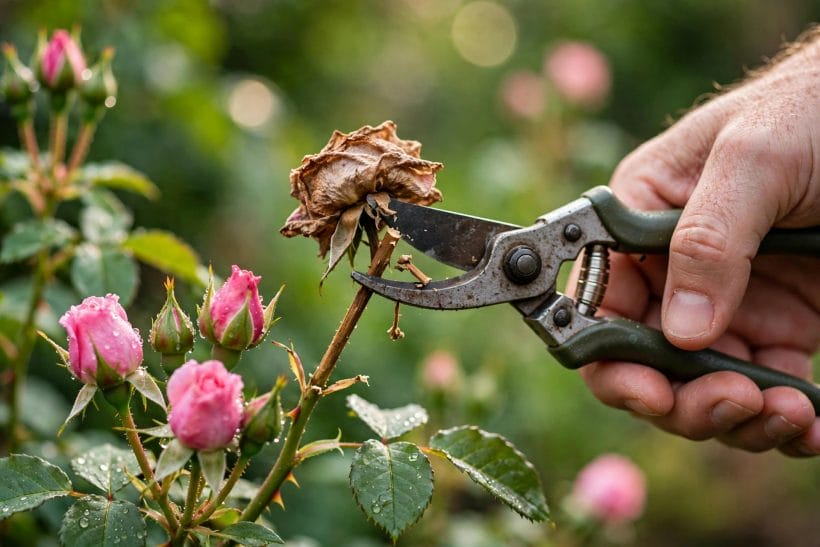
Roses have famous troubles — aphids, black spot, mildew, rust — and this guide treats them the way experienced growers do: prevention first, tolerance second, and any treatment chosen carefully, used exactly as its label directs, and never promised as a miracle. No product names appear here, deliberately: the right product, where one is needed at all, is the one your local regulations, labels and advisors approve for the problem in front of you.
Prevention is the real programme
Almost everything earlier in this guide is disease prevention in disguise: resistant varieties, sun and airflow, space between plants, watering at the base, mulched soil that stops spore splash, fallen leaves cleared from beneath the plants, and tools cleaned between a sick plant and a healthy one. A garden that does these things has few emergencies left to treat.
Aphids and the tolerance threshold
Aphids arrive on soft spring growth and are met first by patience and allies: ladybirds and other predators follow them quickly, and a modest presence does a healthy rose little harm. A firm jet of water dislodges colonies; where a plant is genuinely overwhelmed, local advice and labelled products are the honest escalation — in that order.
Fungal diseases met early and calmly
Black spot, mildew and rust spread by spores in wet, still conditions. Remove affected leaves as they appear — from the plant and the ground, into the bin rather than the compost — improve the air around the plant, and accept that a defoliated rose in a wet year usually leafs again and lives. Persistent problems are a signal to change the variety at the next planting, which is the experienced grower’s true remedy. The planting that shares its ground kindly — the spirit of a wildlife-friendly garden — also supports the predators and pollinators that keep rose pests in their place.
8. Roses in Small Gardens, Pots and Tiny Plots
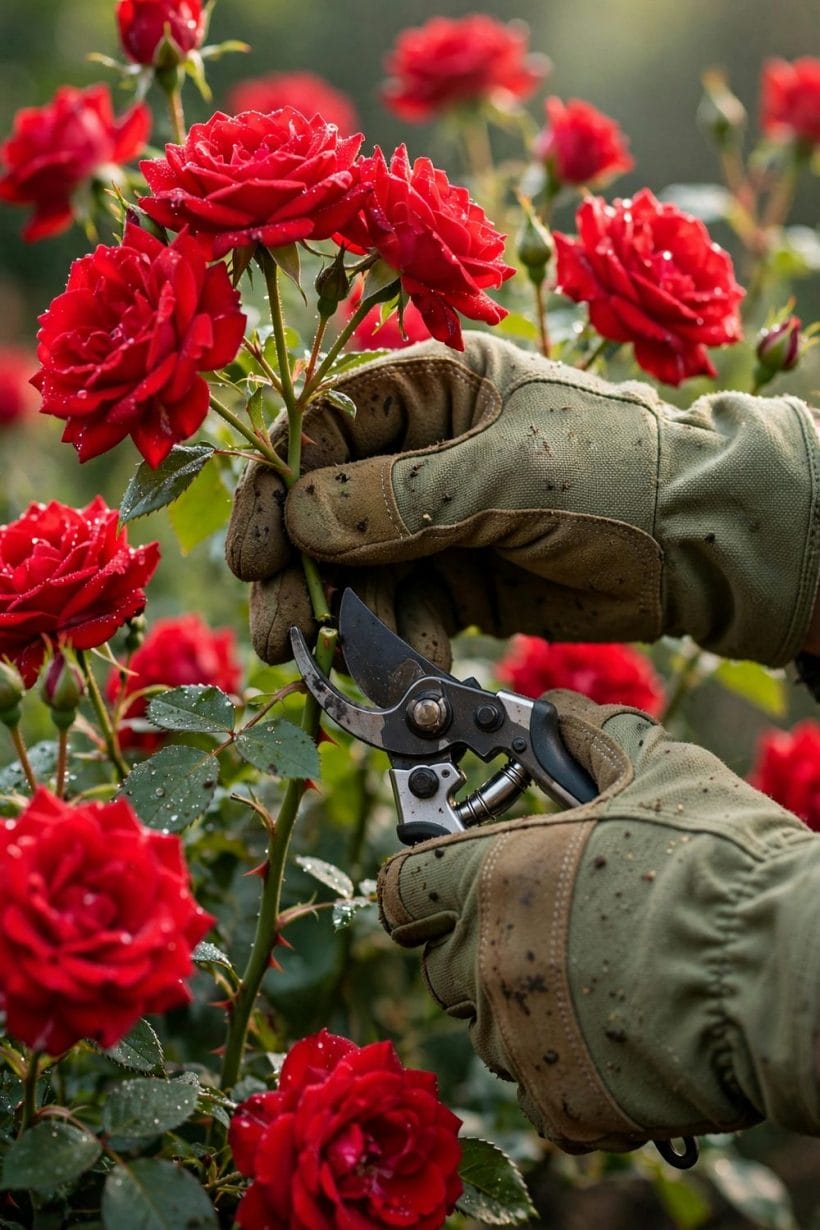
A rose garden is a gathering of roses, not a size of garden. Small spaces grow superb roses by choosing compact families, using vertical space and giving pots the extra water their freedom costs — the same discipline that governs the rest of a small plot’s planting around structures like those in garden shed ideas. Even the classic rose garden’s still pool scales down: a small pond at a bed’s end, of the kind the layouts in pond ideas plan, reflects the flowers and waters the garden’s wildlife in the same gesture.
Compact shrubs and patio roses for small beds
Modern breeding has filled the catalogues with roses bred for small gardens: compact shrubs and patio floribundas that flower generously at knee-to-waist height. Planted singly as specimens or in a small drift of one variety, they give a tiny plot a rose garden’s heart without its acreage.
A climber on the wall, the fence or the shed
Vertical space is the small garden’s spare land: one climber trained across a sunny fence or wall delivers a wall of flowers from a planting hole the size of a bucket. Choose a healthy, repeat-flowering climber, tie it in faithfully, and the smallest plot gains its rose moment every summer.
Roses in pots, done properly
Pots suit miniature, patio and even shrub roses where the pot is generous, the compost is soil-based and rich, and watering is faithful — pots dry far faster than beds, and a rose’s thirst in a hot week is daily. Feed potted roses through the season as their labels direct, repot or top-dress as they grow, and give them the sunniest standing the plot offers, as the layouts in tiny house garden ideas do for their whole planting.
9. Learning From Other Gardeners: Societies, Shows and Online Communities
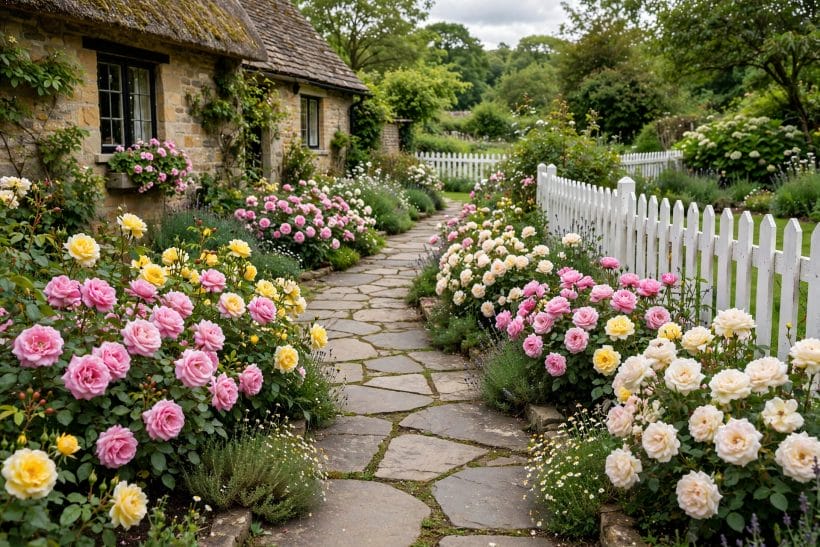
Roses are a sociable plant. No other garden flower has gathered so much shared knowledge around it, and the beginner who plugs into that knowledge — locally first — shortens their learning by years.
Local rose societies and garden clubs
Rose societies exist to share exactly what a beginner lacks: which varieties thrive locally, when to prune in this climate, whose garden to visit and what its owner learned the hard way. Their shows, talks and pruning demonstrations are an education for the price of a membership, and their members’ gardens are the truest catalogue a district can publish.
Online forums and community groups, read well
Online gardening communities — forums, groups and question-and-answer archives built by growers over many years — hold an unmatched record of real problems and real answers, searchable at midnight in the middle of a crisis. Read them the way experienced growers do: favour answers from climates like yours, prefer advice repeated by several growers over seasons, distrust any miracle cure, and remember that a photograph and a district are worth a page of description. What those communities cannot do is see your plant — so their advice informs your judgement rather than replacing it.
Nurseries, shows and open gardens
Good nursery staff, show benches and open gardens complete the education: the nursery sees the district’s problems weekly, the show displays the varieties at their best and names them honestly, and the open garden proves what thrives within a mile of your own gate. Take a notebook; rose knowledge is seasonal, and next spring is further away than it feels.
10. The Rose Year and Costs as Drivers
The rose year has a rhythm worth learning once: dormant-season planting and the annual prune as growth stirs; feeding and mulching as the leaves open; the first great flush of flowers; deadheading and the second feed; later flushes into autumn; hips and colour as the year closes; and the dormant tidying that sets up the next round. Exact timing belongs to your climate and your local society’s calendar — a guide for every district would be wrong for each of them — but the sequence itself is the same rose year everywhere roses rest in winter, and gentler, longer where they barely rest at all.
Costs are driven by choices rather than by roses themselves: the plants — named varieties from reputable nurseries cost more than anonymous bargains and are usually worth it — the soil preparation and mulch the first year, supports and ties for climbers, pots and compost where roses are container-grown, and the feeds and any treatments the household chooses to use. The honest saving is in the choosing: healthy varieties suited to the district, planted once in well-prepared soil, cost less across a decade than cheap plants replaced and remedied. Time is the other true cost — an hour at the annual prune, minutes a week in the flowering season — and most growers count it as the pleasure rather than the price. Begin with one or two plants, learn their year, and let the rose garden grow at the pace your knowledge does.
Final Considerations
Start with the site and the soil, choose health before beauty, and plant one good rose well rather than five hopefully. Then keep the rhythm — water at the roots, mulch in spring, prune with confidence, meet problems early — and spend time among other growers, in the society hall, at the show bench and in the accumulated wisdom of the gardening communities online. Roses repay exactly that: not fuss, but informed, regular, unhurried care, returned in flowers for decades.


0 Comments