
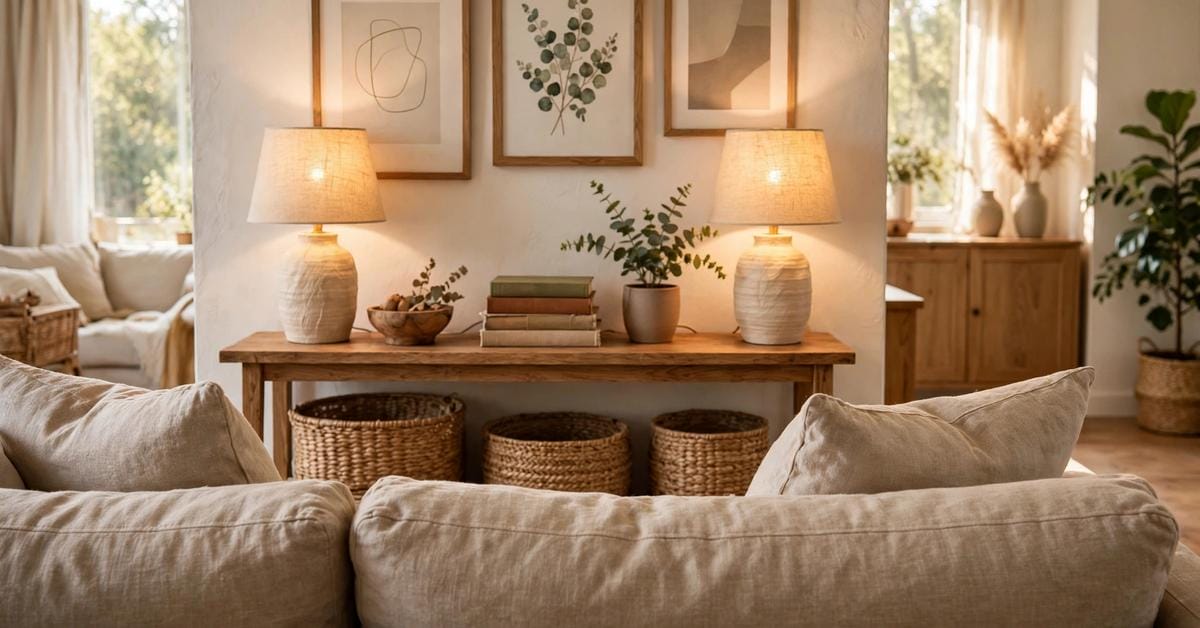
The back of a sofa is the most wasted surface in the house — a long, low, bare strip that open-plan rooms show to the world and nobody uses. A console table behind the couch turns it into the room’s hardest-working furniture: a landing strip, a lamp stand, a bookshelf and a line of storage, all in the depth of a single shelf.
These seventy-five ideas cover the console table behind the couch only: placing it, reading its proportions, choosing its style and material, styling its top, working its storage, lighting the wall above it and fitting it into small rooms — so the room’s back view works as hard as its front.
1. Console Table Behind the Couch Ideas at a Glance
A console behind a sofa is a narrow table doing several jobs at once: it finishes the sofa’s back, carries lamps a floating sofa cannot otherwise power, gives books and remotes a home, and draws a soft boundary behind the sitting zone. This post is the behind-sofa console only, within the wider world gathered by the living room ideas pillar — the media wall is treated in media wall living room ideas and the country register in French country living room ideas, both linked from the sections they belong to. Here, the table is chosen by proportion before style: length against the sofa, height against its back, depth against the walkway — the one piece whose measurements matter more than its looks.
| Question | Short answer |
|---|---|
| What is a console table behind a couch? | A long, narrow table placed directly behind the sofa — finishing its back, carrying lamps and objects, and adding reachable storage without touching the room’s walls |
| How long should it be? | Shorter than the sofa’s back so the sofa stays the frame; a table that runs close to the full length reads as one piece, a shorter one as an accent — both work when the choice is deliberate |
| How tall should it be? | At or just below the height of the sofa’s back, so its top becomes a shelf the seated eye reads as part of the sofa, not a shelf looming behind it |
| What goes on it? | Height at the ends and calm in the middle: a pair of lamps, stacked books, one plant, a tray — edited to a few groups rather than a crowd of small things |
| What does it cost? | Drivers only: the table’s material and length, whether it is bought, built or converted, lamps and wiring, and any baskets or drawers added below |
2. Placement and Layouts: Reading the Back of the Sofa
Placement is the whole game: the same table becomes a divider, a lamp shelf or an obstacle depending on where it stands. Read the room from the doorway first — the console is what the arriving eye meets.
1. Centred behind the sofa, the classic arrangement
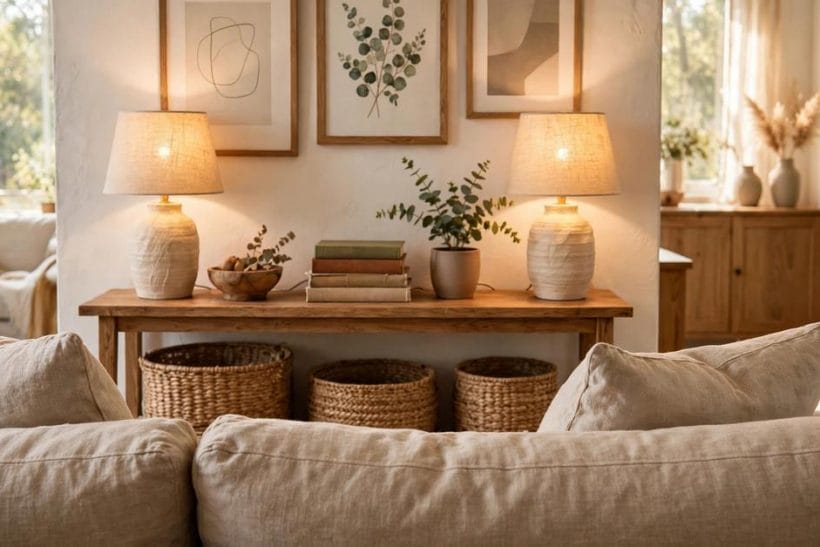
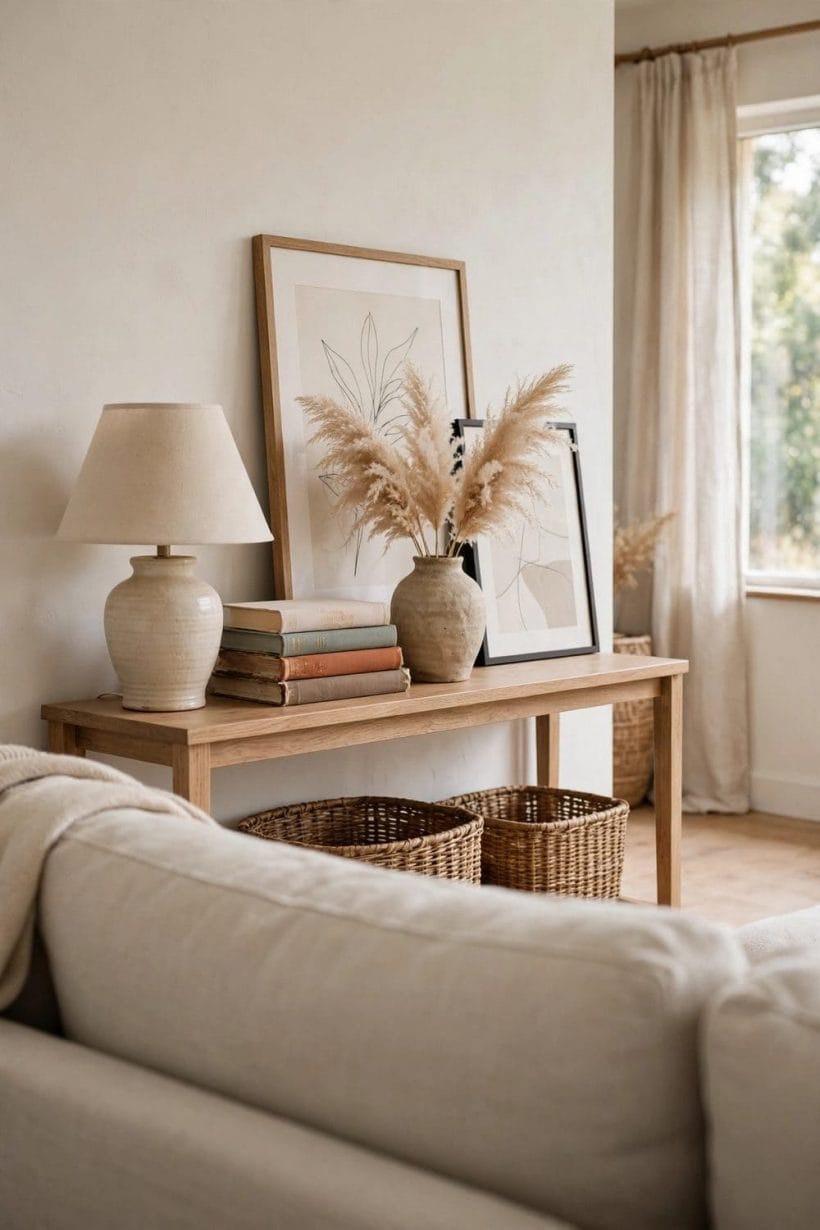
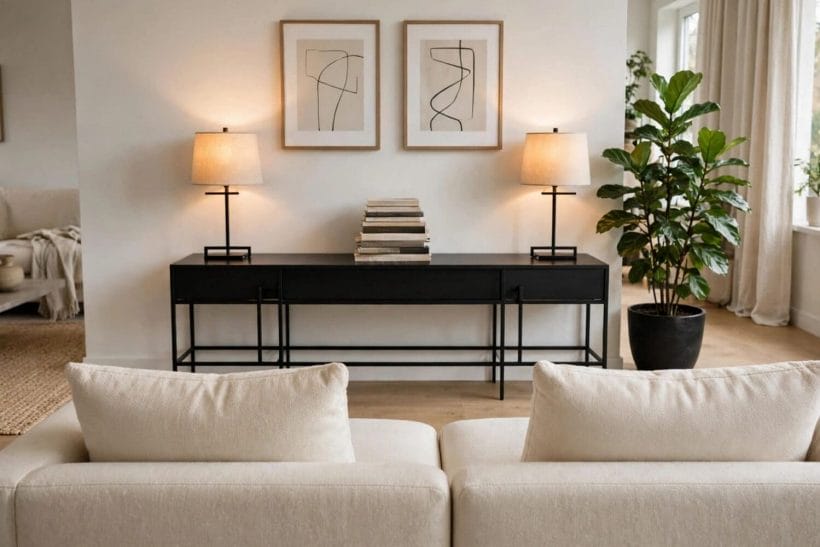
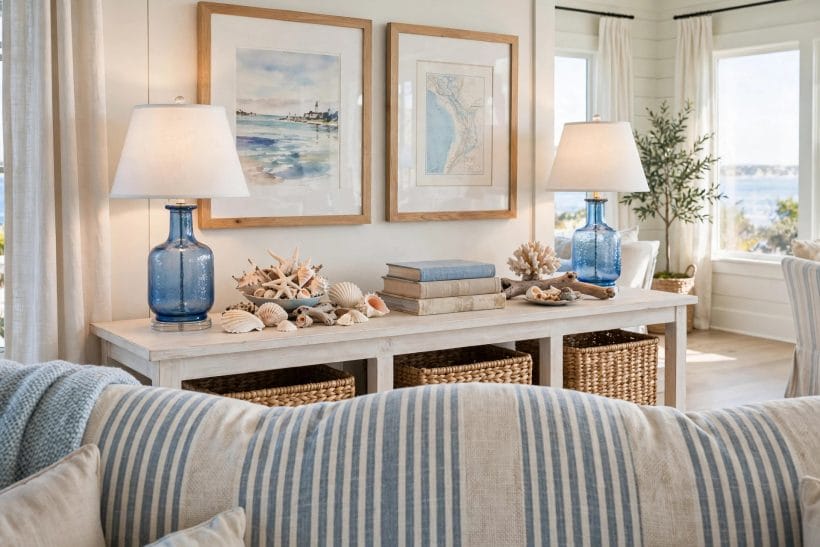
The gallery photograph’s layout: the table centred on the sofa’s back, lamps at either end, prints in a row above. Symmetry does the styling — the arrangement reads as one composed picture from anywhere in the room.
2. Floating the sofa with the console as its anchor
In an open-plan room the sofa floats with its back to the kitchen or hall, and the console anchors it — a finished shore for the floating island, and a piece of furniture that serves both zones.
3. The console as a room divider
Styled from both sides — a tray facing the sofa, a bowl facing the room beyond — the console draws the boundary between sitting and dining without a wall. Open-plan rooms live by such soft borders.
4. A small gap left behind the sofa
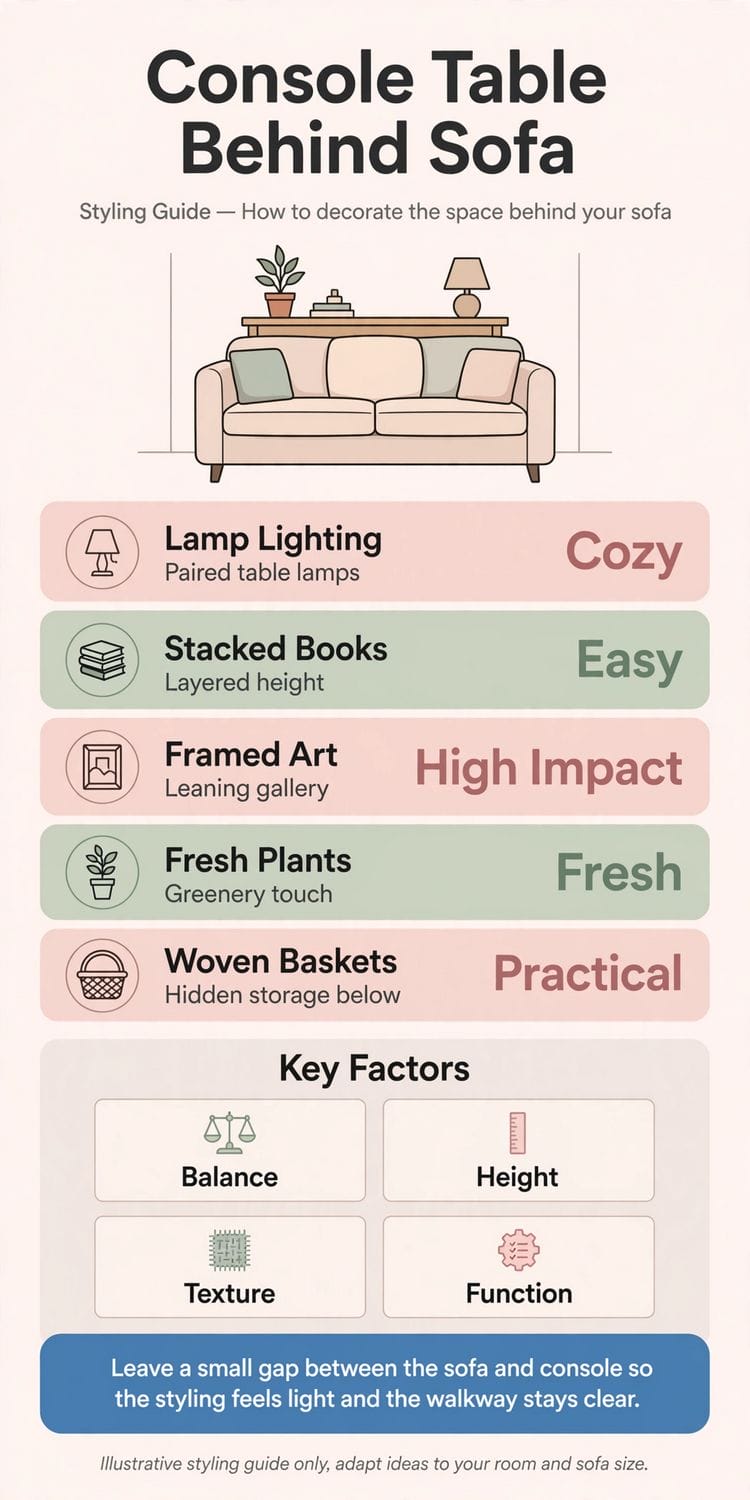
The infographic’s closing tip: leave a slight breathing gap between sofa and console rather than jamming them together. The styling reads lighter, dusting is possible, and the walkway stays honest.
5. Against the wall, sofa pulled forward
Where the sofa sits off the wall, the console fills the shadow gap behind it — catching the light, the lamps and the Sunday papers. A room gains a whole shelf by moving one sofa forward a hand’s breadth.
6. The walkway kept clear behind
If people pass behind the sofa, the console’s depth must be bought from the room, not the passage: choose the slimmest table that carries a lamp safely, and let nothing overhang the walking line. Flow first, styling second.
7. The L-shaped sofa with a console on its long back
A sectional’s long back is the largest bare surface in most modern rooms. A console along it breaks the upholstery’s horizon and gives the biggest piece a skyline of lamps and green.
8. Two short consoles instead of one long
Two matching short tables with a deliberate gap read as a pair of pedestals, and are easier to find and move than one very long table. The gap can hold a tall plant, making a feature of the join.
9. The console in the entry-facing position
When the sofa’s back greets the front door, the console becomes the hall table the house never had: a bowl for keys at its far end, a lamp for the evening arrival. First impressions are styled here.
3. Proportions and Scale: Length, Height and Depth
No figures are given here on purpose: sofas vary too much for borrowed numbers. What transfers is the reading — three relationships, judged by eye against your own sofa, that decide whether a console looks placed or parked.
10. Length judged against the sofa’s back
Hold the relationship, not a measurement: the table should end before the sofa does, so the sofa remains the frame and the table the picture. A console that outruns its sofa looks like it is carrying it.
11. The near-full-length console for a tailored look
Run the table close to the sofa’s full length and the pair reads as one designed unit — the choice for formal rooms. Allow the eye no awkward leftover inches of either piece.
12. The shorter console as an accent
A table well short of the sofa’s length centres itself like a picture over a mantel — a deliberate accent rather than a fitted piece, suiting small sofas and rooms where the console is one note among several.
13. Height at the sofa’s back
The kindest height puts the tabletop level with, or a whisper below, the sofa’s back. Lamps then rise from a shelf continuous with the sofa, and objects show without looming over seated heads.
14. The slightly lower console for a layered ledge
A table a little lower than the back turns its top into a ledge seen over the cushions — a place for a low bowl or a row of book spines colouring the room’s view of the sofa. The layering reads designed, not stored.
15. Why a too-tall console fails
Above the back line, a console peers over the sofa’s shoulder — objects silhouetted against seated heads, lamps glaring at neck height. If a tall piece is loved, give it a wall elsewhere; behind the sofa, humility wins.
16. Depth bought honestly from the room
Depth is the proportion that costs floor: every hand’s breadth is taken from the walkway or the room beyond. The slimmest console that stands steady is the right one — depth beyond that is storage bought at the room’s expense.
17. Depth for storage consoles
A console with drawers or a lower shelf earns a little more depth than a bare-legged table, because its volume is working. Judge it loaded, not empty — baskets below and books above are the true silhouette.
18. Testing with tape before buying
Mark the footprint with painter’s tape and live around it for a day — sit, pass, vacuum as usual. Proportion is learned by the body faster than the eye.
4. Styles: From Farmhouse Oak to Polished Chrome
Style comes after proportion, and follows the sofa’s own language: the console is its echo, in wood, metal or stone, speaking a register quieter than the seat it serves.
19. The farmhouse oak console
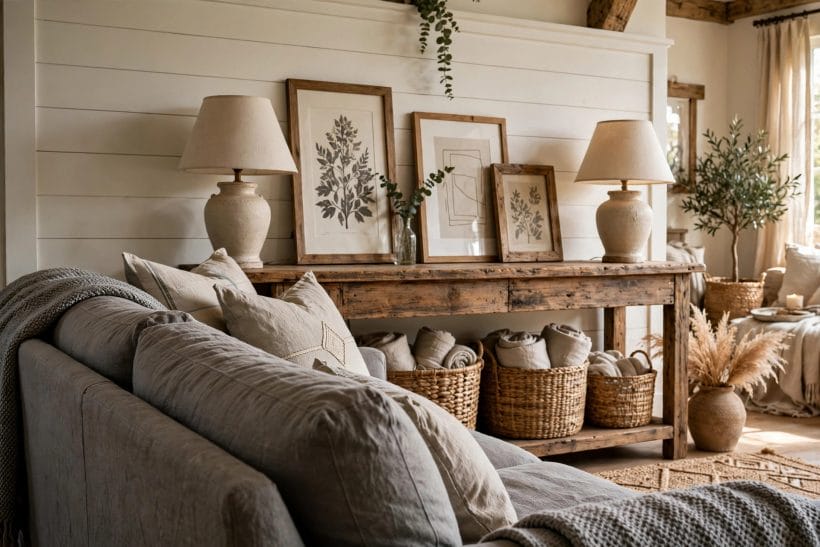
The feature photograph’s piece: honest oak, square legs, a top that takes lamps and baskets without ceremony. Farmhouse consoles forgive daily life and suit sofas in linen, cotton or worn leather.
20. The Scandinavian pale-wood console
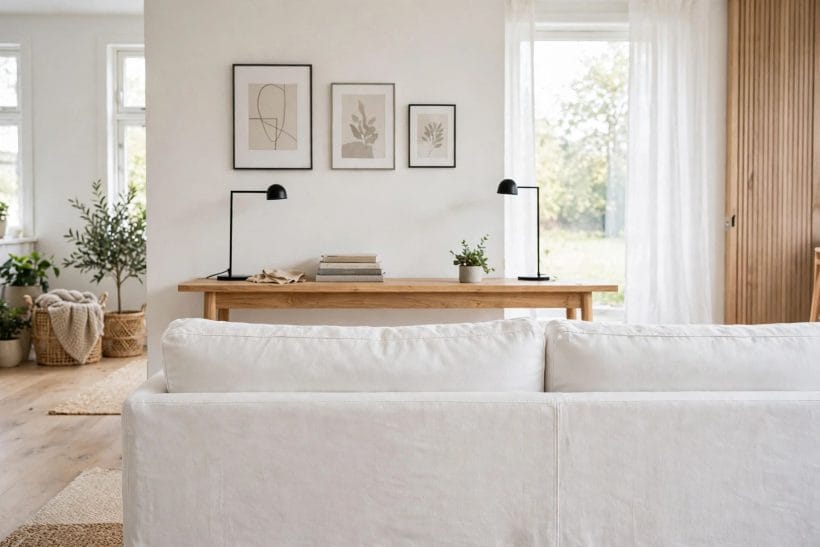
The gallery room’s register: pale timber, slim legs, an uncluttered top. Scandi consoles keep small rooms airy and pair with white and grey sofas and black lamp accents.
21. The traditional turned-leg console
Turned legs and a shaped apron bring furniture-making manners to the sofa’s back, suiting rolled-arm sofas and rooms with picture rails. The console as heirloom — bought once, styled forever.
22. The industrial metal-and-timber console
A blackened steel frame with a reclaimed-look top gives the arrangement edge and shrugs off walkway knocks. It suits leather sofas and loft rooms.
23. The modern slim metal console
Thin chrome or black metal, a glass or stone top, nothing wasted: the modern console disappears behind a contemporary sofa and lets its objects float — for rooms where the art is meant to be looked at.
24. The rattan and cane console
Woven cane and rattan bring holiday air and texture to the sofa’s back, lightening rooms that take themselves seriously. They pair with linen sofas, pale rugs and large plants.
25. The painted console in a colour
A console painted to match the wall melts into the architecture; painted in a contrast, it becomes the room’s punctuation. Either way, paint is the cheapest style decision in this post — and the most reversible.
26. The antique or vintage find
An old hall table, a narrow sideboard, a bench with a past: vintage pieces bring the patina new furniture imitates. Check steadiness and height against the sofa, and let the history do the styling.
27. Matching the console to the room, not the sofa
When sofa and room disagree — a modern sofa in a panelled room — let the console side with the room. A piece that belongs to the architecture settles the sofa in turn.
5. Materials and Finishes: What the Top Must Survive
A console top lives a harder life than a coffee table’s: drinks set down blindly by people facing the other way, lamp heat, plant water, keys. Material choice is a forecast of that life.
28. Solid oak, the forgiving default
Oak takes rings, knocks and re-sanding with grace, and its grain forgives the dust a behind-sofa shelf gathers between cleans. For most households it asks least and gives longest.
29. Walnut for depth and formality
Dark walnut behind a pale sofa gives the room its bass note — formal, warm, deliberate. It shows dust more honestly than oak: a flaw, or a housekeeping prompt, depending on the household.
30. Stone and marble tops
A stone top shrugs off cup rings and lamp heat and brings cool polish to the arrangement. Its weight demands a frame built for it — a commitment the legs must be told about in advance.
31. Glass tops for lightness
Glass keeps a small room’s sightlines open and lets a rug show through the arrangement. It also keeps every fingerprint and cable visible — choose it where styling is minimal and the cloth is handy.
32. Metal frames with slim profiles
A metal underframe carries a heavy top on slim legs, keeping the floor visible and the room’s air moving. Black or brass-toned finishes pair with almost any sofa fabric.
33. Woven and cane details
Cane webbing or a woven lower shelf adds the texture plain rooms lack and hides stored things behind a breathable screen. Storage that does not look like storage — the console’s party trick.
34. Painted finishes and easy renewal
A painted console can be re-painted when the room changes its mind — the only finish with a renewable future. Note the colour’s name; these pieces collect scuffs at ankle height and touch-ups are a fact of their life.
35. Raw and limed woods for pale rooms
Limed, whitewashed and raw-pine finishes keep timber’s texture while lifting its colour toward the pale end of the room. They suit the gallery photograph’s scheme and any sofa in white, stone or oatmeal.
36. Finishes that forgive a working household
Matte and satin finishes hide the micro-scratches of keys and plant pots that gloss displays like trophies. In a walkway position, forgiveness is the first virtue — shine can live on the lamps instead.
6. Styling the Top: Lamps, Books, Plants and Trays
The infographic’s five rows are the styling grammar: lamps, stacked books, framed art, fresh plants, woven baskets. Everything in this section is those five, arranged with restraint.
37. The pair of lamps, the anchor styling
The feature room’s whole secret: two matching lamps, one at each end, framing everything between them. After lamps, styling is just deciding what lives in the frame they make.
38. Stacked books for layered height
The infographic’s easy row: horizontal stacks build the middle heights between lamp and plant. Keep stacks low and few — a shelf, not a library sale.
39. One plant, honestly alive
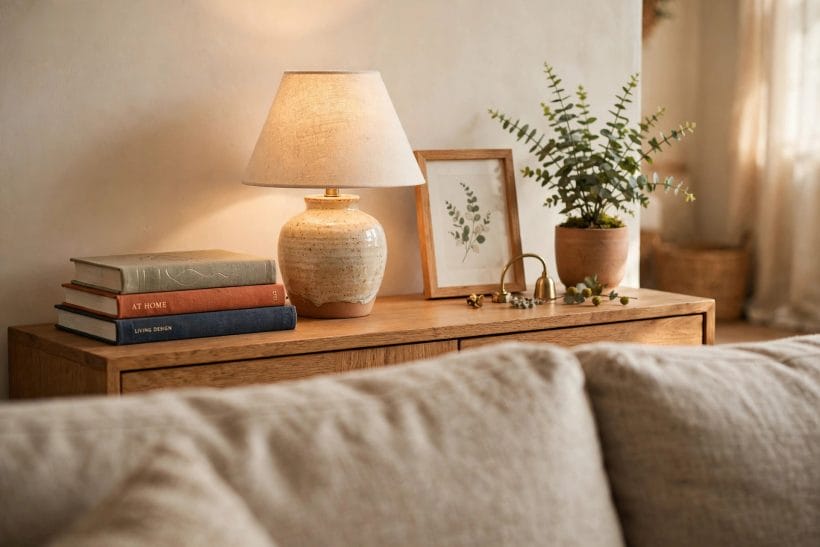
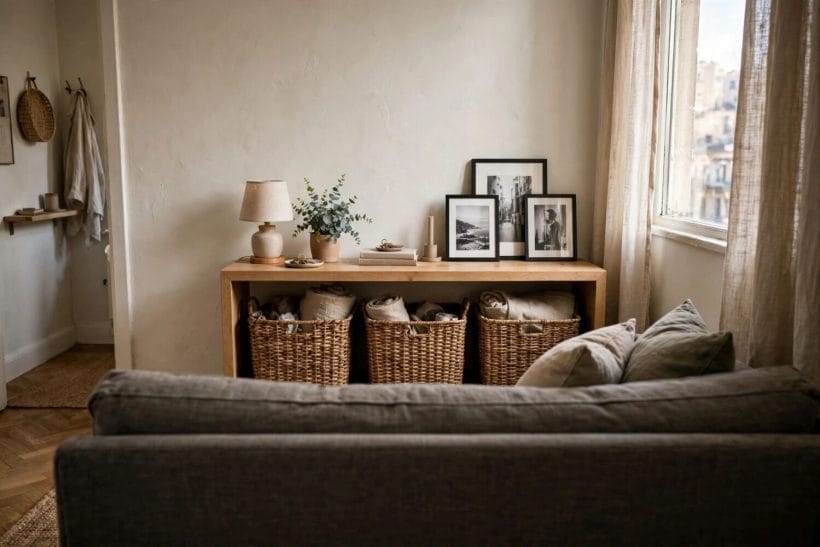
A single real plant — the feature room’s potted eucalyptus — brings green no object can imitate. Choose one whose needs match the light the position gets; a struggling plant styles nothing but guilt.
40. The tray that corrals the small things
Remotes, coasters, spectacles, the candle: a shallow tray gathers the small working objects into one deliberate group. Without it the top is a surface of strays; with it, the same objects read as a still life.
41. A bowl or basket as the landing strip
One generous bowl at the end nearest the door receives keys and pocket contents — the landing strip, beauty that earns its place every evening.
42. The rule of groups and odd numbers
Objects in loose groups of three — a stack, a plant, a small sculpture — please the eye more than a row or a scatter. Leave deliberate emptiness between groups; the gaps are part of the composition.
43. Height varied, never a skyline of equals
Lamps tall, books low, plant between: a varied silhouette keeps the top interesting from across the room. A row of objects all one height reads as a shop shelf — the most common styling mistake this piece attracts.
44. Seasonal swaps on a stable frame
Keep the lamps fixed; rotate the middle — spring stems, autumn branches, winter candles. The console becomes the room’s calendar, changed in minutes because its frame is never rethought.
45. Less than you think: the edited top
When a console looks wrong, the fix is almost always subtraction: remove one object a day until the top breathes. The feature and gallery rooms show the discipline — a handful of things, each with room to be seen.
7. Storage Consoles: Drawers, Shelves and Baskets Below
Below the styled top is the console’s second life: volume the room gets for free, in the one place storage never blocks a window, door or view.
46. Woven baskets on the floor run
The feature photograph’s trio of seagrass baskets: throws, cushions, toys and the knitting, each in its own basket — the floor run turned into a woven cupboard. The infographic’s practical row, and the easiest storage in this post.
47. A lower shelf for books and boxes
A stretcher shelf doubles capacity for the price of a plank: art books below, lidded boxes for the rest. From across the room the loaded shelf reads as a plinth — storage in the disguise of display.
48. Drawers for the small and the private
One or two shallow drawers swallow chargers, remotes and correspondence — the small clutter whose visibility makes tidy rooms feel untidy. Drawers are the difference between a styled console and a working one.
49. The console as a charging station
A drawer or basket with cables corralled inside turns the console into the household’s charging shelf — devices on top, wires hidden below, within arm’s reach of the sofa. Follow the devices’ own guidance, as with any charging spot.
50. Blanket and cushion overflow
The sofa’s own wardrobe — spare throws, winter cushions, the guest blanket — belongs within reach of the sofa, and the console’s under-run is that reach. The extras stay invisible until the evening turns cold, exactly when they are wanted.
51. Board games, toys and the evening clear-up
In family rooms the baskets become the five-minute tidy: games, toys and school things swept out of sight before guests or bedtime. Storage placed where the mess happens is storage that gets used.
52. The console-desk in a working corner
A console with a drawer and knee room doubles as a laptop perch for households short of a study — the chair borrowed from the dining set, the lamp already living here. Behind-sofa pieces earn their floor space twice over in small homes.
53. Open versus closed storage, chosen honestly
Open shelves display; drawers and baskets conceal. Households whose stored things are beautiful can choose open; everyone else should choose closed and enjoy the calm.
8. Lighting, Mirrors and Art Above the Console

The wall above a console is the room’s second picture rail: what hangs there is seen over the sofa, framed by the lamps and lit by them after dark. Treat wall and table as one composition.
54. A row of prints above, the gallery treatment
Both the feature and gallery rooms choose it: a level row of framed prints, their bottom edges breathing just above the lamps. A row suits a long console as a single large piece suits a short one.
55. One large artwork as the room’s headline
A single generous picture gives the sofa’s back the presence of a chimneypiece — the arrangement the whole room quietly orbits. Let it be the only large voice on that wall; the lamps are its footlights.
56. A mirror to borrow light and view
A mirror reflects the room’s best angle — a window, a garden, the picture wall opposite — and doubles the lamps’ glow after dark. In rooms that turn their backs to the light, it is this section’s hardest-working object.
57. Leaning art, the relaxed register
The infographic’s leaning gallery: frames rested on the console top against the wall, overlapping slightly, changed whenever the mood moves. It suits renters and anyone whose art outgrows its nails.
58. Table lamps as the room’s evening layer
Console lamps light the room at seated eye level — the flattering layer between glare and darkness. A floating sofa has no other route to lamplight; these lamps are evening infrastructure.
59. Plug points and cables planned, not discovered
Lamps need power where the table stands: check sockets before styling, and route cables along the back edge into a basket or cable tidy. An electrician adding a socket behind the sofa is money honestly spent.
60. Sconces and picture lights for the wall-led scheme
Where sockets are impossible, wall lights flanking the artwork light the composition from the wall itself, leaving the top free for objects. Fitted by an electrician, they make the back wall feel built-in.
61. Candles and the unplugged glow
A cluster of candles — real ones in hurricanes, never left burning unattended, or good flameless ones — gives the console a ceremony no switch provides. Keep them clear of cushions and throws.
62. The wall left deliberately bare
Sometimes the bravest styling is none: a beautiful console, two lamps, and empty wall above. Bare is a decision, not an omission — it suits sculptural lamps and rooms already rich in pictures. The small-room schemes gathered in small living room ideas use the same restraint.
9. Small Rooms and Apartments: The Slim Console at Work
Small rooms need the console most and forgive it least. The tiny-house schemes in tiny living room ideas and the decorating discipline of how to decorate a tiny living room start from the same truth: in a compact room, furniture must hold two jobs or hold none.
63. The slimmest useful console
In a small room the console’s depth is borrowed from the walkway, so buy the slimmest table that stands steady with a lamp on it. A narrow ledge still carries light, books and keys — the functions survive the diet.
64. The console replacing the hall table
Flats whose door opens into the living room have no hall to furnish; the sofa’s back becomes it. Bowl, lamp, mirror above: the whole entry sequence in the depth of a shelf.
65. The console replacing side tables
Where sofa ends have no room for side tables, the console serves the middle seats with drinks, books and lamplight — every seat a surface, no seat a table.
66. A shelf-ledge instead of a table
A wall-fixed ledge at sofa-back height gives the console’s surface without its legs — nothing to knock, and the floor’s run stays visible, which small rooms read as space.
67. The bench-console for flexible rooms
A long low bench behind the sofa works as console by day and extra seating when guests arrive. Flexible pieces are the small room’s aristocracy: two jobs, one footprint, no apology.
68. Light colours and legs that show the floor
In compact rooms choose pale finishes and open legs: the eye reads the floor continuing beneath as room still available. Heavy, dark pieces spend visual space the room does not have.
69. One console, three zones
In a studio, a console behind the sofa divides sleep from sitting, carries lamps for both, and holds the baskets that keep the flat’s clutter in one woven place — the hardest-working half-metre in the home.
70. Rental-friendly and fold-flat options
Folding and flat-pack consoles, and ledges fixed with the landlord’s blessing, give rented rooms the whole scheme without a permanent mark. The styling rules do not change; only the fixings do.
10. Costs, Care and Choosing Well
The last attributes are practical: where the money honestly goes, how the piece is kept kind in its awkward-to-reach position, and how to choose the one that will still please in five years.
71. Where the money goes: the table itself
The budget’s centre is the furniture itself — its material, length and making. A console is bought once and touched daily; it takes the largest share, and the lamps the second.
72. Bought, built or converted: three honest routes
Buy new for exact proportions; build for an awkward length no shop stocks; convert a hall table or narrow sideboard for character at a fraction of the cost. The room cannot tell which route the table arrived by.
73. The cost of light: lamps and wiring
Two lamps, their shades and, where needed, an electrician’s visit for a socket are the second cost — planned from the start, not discovered with the lamps already bought. The difference between a styled console and a lit one.
74. Baskets and drawers: small money, daily returns
Storage below is the cheapest part of the scheme and the most used — a few baskets transform the table from display to infrastructure. Spend here before spending on objects for the top.
75. Care in the awkward position, and choosing to keep
Behind-sofa pieces gather dust where nobody looks: a long-handled duster and a periodic pull-forward clean keep the arrangement kind. Choose proportions that suit the sofa you own, in a material your real life flatters.
Final Considerations
Before the tape measure comes out, stand where the room is entered and look at the sofa’s back: that bare horizon is the console’s whole argument. Then judge the three relationships in order — length, height, depth — with tape on the floor and a day of ordinary life walked around it. Get them right and almost any honest table becomes the right one.
A console behind the couch earns its place at both ends of the day: the lamp lit for the evening reader, the bowl receiving the morning’s keys, the baskets swallowing the room’s drift before guests arrive. Keep its splits clean — the living room’s world in its pillar, the media wall and country schemes in theirs — and let this post be the pure article: the sofa’s back, finished, the room’s quiet infrastructure.

0 Comments