

A French country living room is what happens when elegance stops trying: washed colour, honest timber, linen gone soft with use, and furniture that looks inherited rather than installed. Nothing matches, and everything belongs.
This survey works the French country style as its own lane within the living room ideas collection — palette, seating, tables, textiles, light, bones and daily life. It is the style lane only: the general living-room tour belongs to the pillar, and the neighbouring tempers are left to their own posts below.
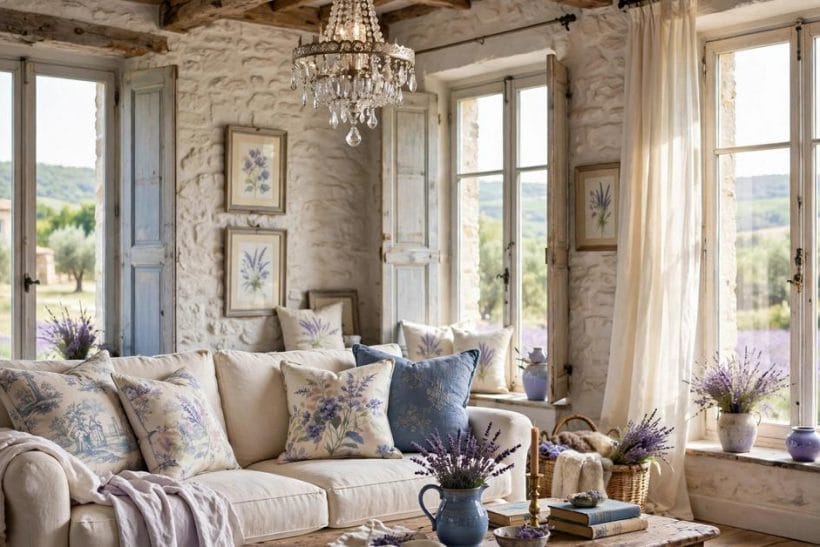
1. French Country Living Room Ideas at a Glance
The French country living room — the provincial style drawn from rural France’s farmhouses and modest manors — is a sitting room built on washed, sun-faded colour; natural materials with their texture left visible (limed and painted timber, stone, linen, wicker, iron); furniture of curved, comfortable provincial forms, often painted and gently distressed; patterns of toile, check, stripe and faded floral used sparingly; and an arrangement that privileges long, sociable comfort over display. Its governing attribute is patina: the style believes a room should look lived in by generations, and every decision — palette, fabric, finish — serves that belief.
| Question | Short answer |
|---|---|
| What separates French country from rustic and from traditional? | Temperature and manners. The rustic living room lane works heavier, darker and more rugged — logs, iron, hide. The traditional living room keeps formality, symmetry and polish. French country sits between and sunnier than both: curved and refined in its furniture, but faded, softened and deliberately imperfect in its finishes. If a room looks inherited from a cheerful grandmother in Provence, it is this lane. |
| What colours define the style? | A washed palette drawn from a summer landscape: warm whites and stone, faded blues and sage, lavender-grey, dusty rose, ochre and the pale gold of old wheat. Colours arrive as if sun and many washings had gentled them. Saturation is the enemy — any shade that looks new, bright or synthetic breaks the spell, however pretty it is alone. |
| Does French country need a farmhouse or beams to work? | No. The style is a palette, a set of materials and a furniture language, not an architectural sentence. Beams and stone floors amplify it beautifully, but a plain modern room dressed in washed colour, linen, limed timber and curved provincial pieces reads unmistakably French country. Architecture is the seasoning here, never the dish. |
| Is the style comfortable, or only picturesque? | Comfort is its founding claim — deep seats, soft natural fabrics, tables that welcome feet and feasts alike, light arranged for long evenings. A French country room that photographs well but sits badly has failed at its own first principle. Test every choice against an afternoon with a book and a winter evening with friends. |
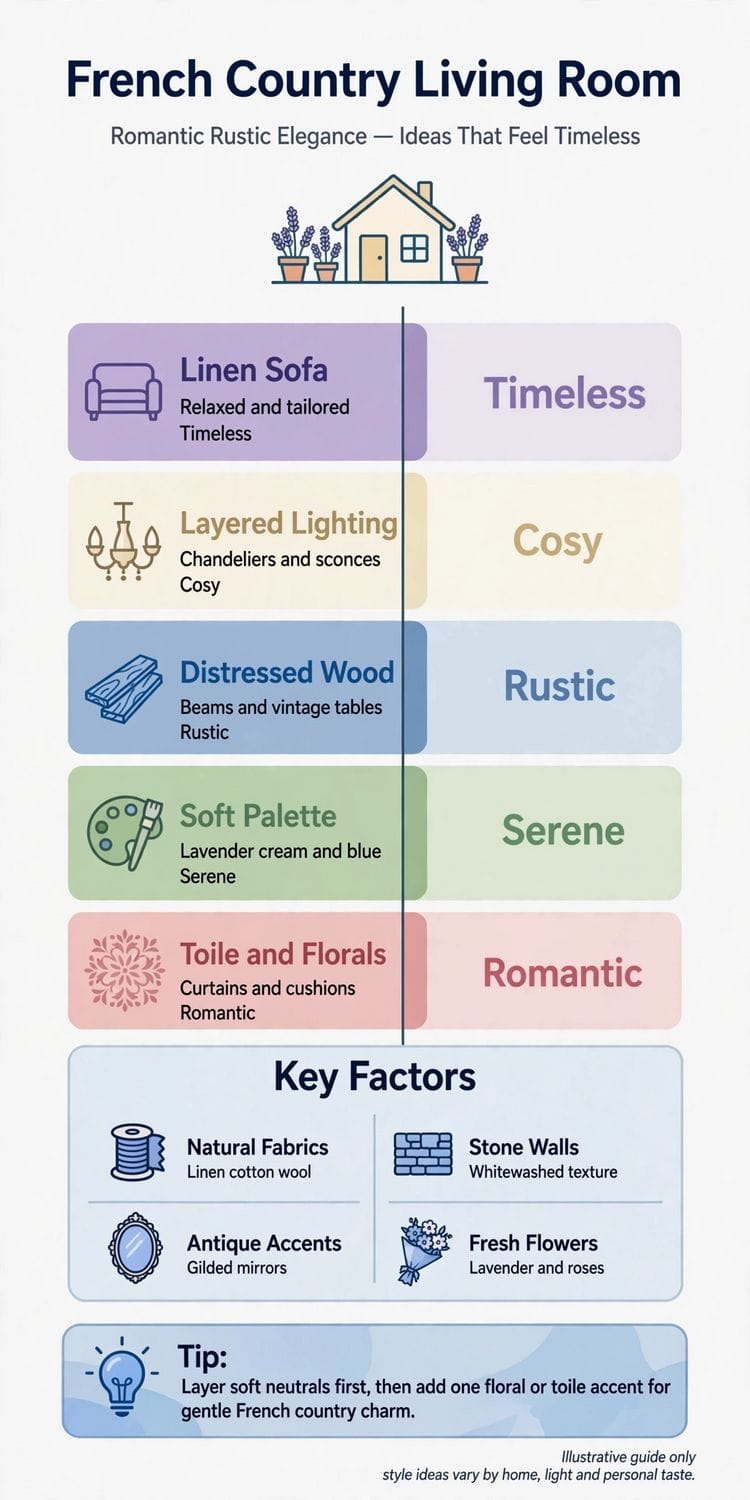
2. The Washed Palette and the Room’s Quiet Bones
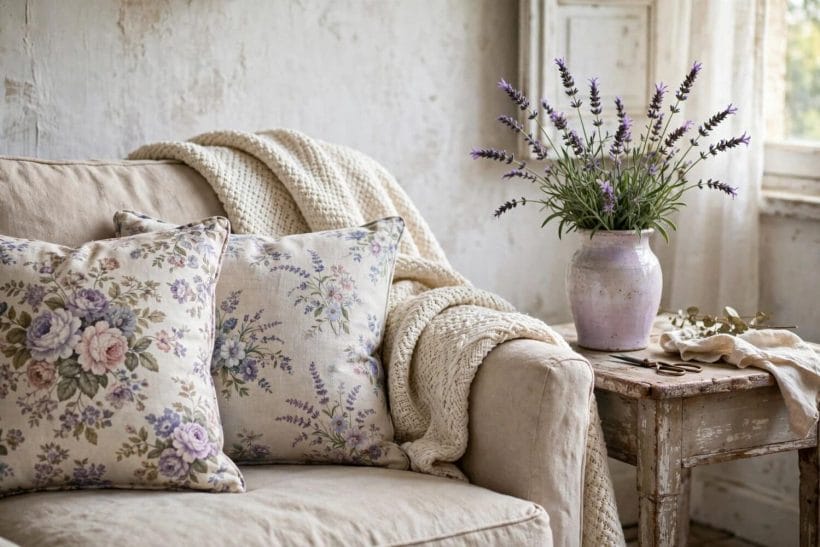
Colour and surface set the style’s temperature before any furniture arrives. This section lays that foundation — the groundwork the white living room ideas survey also begins from, warmed and faded here.
1. Wash the walls in warm white or stone
The style’s field is a warm, chalky pale — limewash-soft in feeling even when delivered by ordinary paint. Cool blue-whites freeze the palette; the right white has sun in it.
2. Let one faded colour lead
Choose a single washed hue — faded blue, sage, lavender-grey — for the room’s main textiles and let everything else orbit it.
3. Keep colour uneven, on purpose
A cushion more faded than its pair, a painted chair a tone apart from its neighbour — small inequalities are the style’s authenticity. Perfectly matched colour reads as a showroom set.
4. Lime or paint the timber pale
Limed oak, painted pine in cream or pale grey, waxed finishes that keep the grain’s ghost — the style’s wood is lightened by sun and use, never dark-polished. Heavy mahogany gloss belongs to the traditional lane.
5. Leave stone and plaster their texture
Where walls or hearths are stone or rough plaster, keep them matte, pale and unsealed-looking. The style trusts texture over pattern on its hard surfaces.
6. Choose floors that forgive
Wide boards, pale stone or terracotta in feeling, worn rugs over all of it — floors in this style are expected to carry dogs, boots, grandchildren and harvest suppers without complaint.
7. Age metal to iron, gilt and dull brass
Metals arrive blackened, burnished or softly gilded — never chrome-bright. Iron curtain poles, a gilt mirror gone cloudy, brass handles worn at their touch-points.
8. Let sunlight be a material
The palette assumes generous daylight and is designed to be faded further by it. Choose fabrics and finishes that improve under sun rather than perish — linen, cotton, painted timber — and accept the fading as the style working as intended.
9. Keep the ceiling plain and pale
Between beams or flat above them, the ceiling stays the room’s quietest surface — warm white, unadorned. The style puts its pattern at sitting height, in textiles and objects, and lets the overhead plane rest.
10. Borrow the landscape outside the window
Provence’s real palette is its countryside: lavender fields, cypress green, limestone, wheat.
11. Edit anything that looks new
Walk the room and find the object that still looks purchased yesterday — the too-crisp cushion, the glossy frame. Soften, swap or cover it.
3. Seating: Linen, Curves and the Long Sit
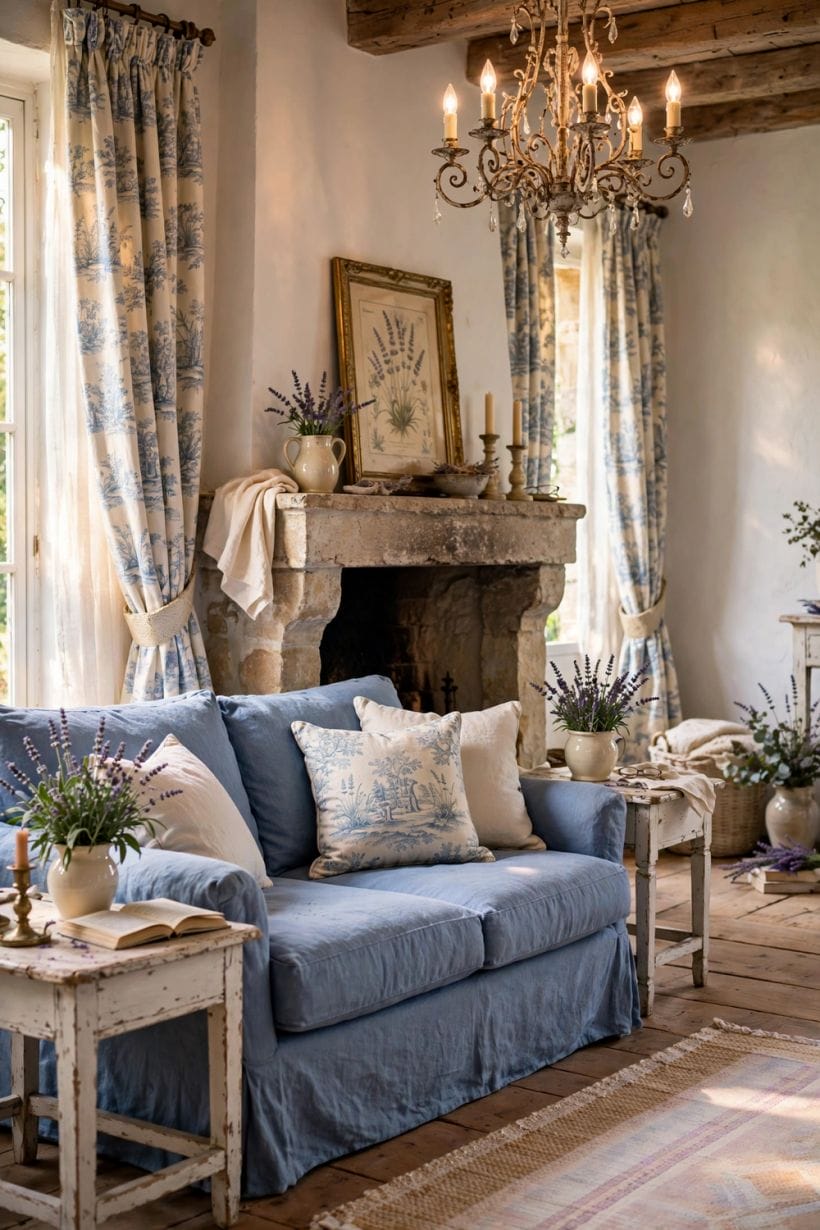
French country seating is furniture for lingering — deep, curved and upholstered in fabrics that forgive. Each piece below is judged by the afternoon test: could you sit in it for three hours, happily?
12. Choose a deep linen sofa as the room’s anchor
The central piece: generous, low-armed or rolled-armed, upholstered in natural linen the colour of unbleached cloth. Linen wrinkles, and the wrinkles are correct — they are the fabric behaving as itself.
13. Slipcover what life will test
Removable, washable slipcovers in pale linen or cotton are the style’s practical genius: dogs, children and red wine cease to be furniture emergencies.
14. Add a bergère or two
The style’s signature chair — an upholstered armchair with exposed, curved timber frame, often painted or limed — brings the manor house into the farmhouse. One makes an accent; a pair flanking a hearth makes a composition.
15. Mix the seating, never match it
A linen sofa, two different bergères, a wicker chair, a bench with a cushion — the assembled-over-time collection is the style’s seating plan. Matching three-piece suites are its one unforgivable purchase. Pieces should share palette and temper, and nothing else.
16. Bring in a chaise or daybed for the reader
A small chaise longue or a simple daybed with a faded cover claims the room’s best light and declares the household’s priorities: rest is a furnishing category.
17. Use wicker and cane without apology
Woven seats and cane backs bring the garden’s materials indoors, lightening rooms full of upholstery. A wicker chair by the window, cane panels on a cabinet — the texture is the style’s lace: humble, handmade in feeling, and exactly formal enough.
18. Cushion generously, in faded naturals
Cushions in linen, cotton ticking and washed floral — feather-filled, softly slumped, never karate-chopped into points. Their job is comfort first and colour second; a cushion too styled to lean on has forgotten its profession.
19. Keep a bench where a chair won’t fit
A painted bench along a wall or before the hearth seats extra guests, holds books and trays, and keeps the room’s circulation open.
20. Let one piece be genuinely old
A single antique — a chair with worn gilt, a farmhouse settle — authenticates everything newer around it, the way one old coin validates a collection. It need not be precious; it must be real.
21. Arrange for conversation, not for the television
Seats angled toward each other across a table, the hearth as one voice among several — the provincial room is composed for talk.
22. Test the sit before the style
Sit in every candidate chair with a book and ten unhurried minutes.
4. Tables, Storage and Painted Joinery
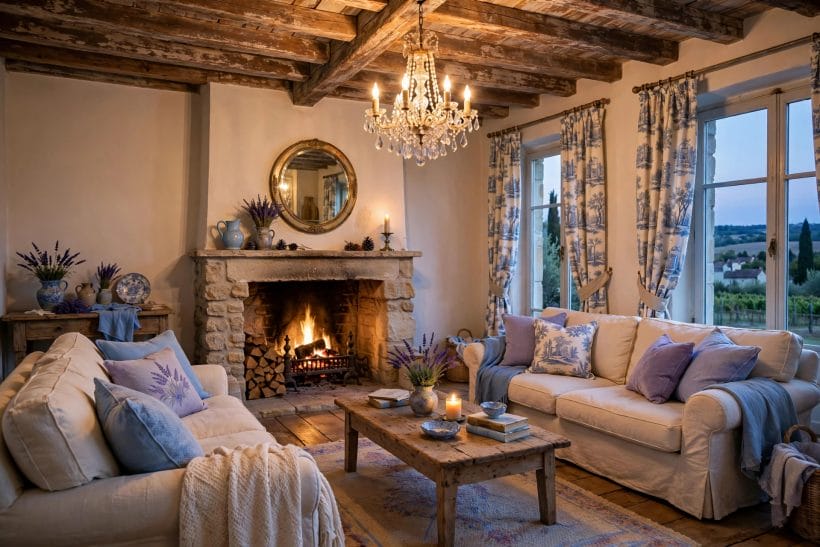
The style’s hard furniture is farmhouse carpentry with manor manners: big honest tables, armoires, and painted pieces that carry the room’s storage without a fitted unit in sight.
23. Centre the room on a farmhouse table when space allows
A long, scrubbed-pine or limed-oak table — big enough for projects, puzzles and impromptu suppers — is the provincial room’s second hearth. Living rooms that eat, work and gather around one great table need fewer, better pieces everywhere else.
24. Close storage in an armoire
The tall provincial cupboard hides televisions, blankets, games and the room’s whole untidy life behind panelled doors.
25. Paint the pieces that were never fine
Honest pine dressers, side tables and bookcases in washed cream, sage or pale blue gain the style’s softness from a coat of paint and a gentle distressing at their edges.
26. Distress with restraint
A little wear at corners and handles suggests a life; sanded-everywhere distressing suggests a factory. The difference is judgement, and the rule is simple: distress where hands and years would actually touch, nowhere else.
27. Use a painted bookcase for the library wall
Books belong in this style’s rooms in quantity, and a pale painted bookcase — or two mismatched ones levelled by a shared colour — gives them a home that keeps the room light.
28. Let a console carry the lamp layer
Behind the sofa or against the long wall, a narrow painted console holds the pair of lamps that light the room’s middle register, plus the books and branches that finish it.
29. Choose side tables with drawers
Small painted tables with a drawer each swallow remotes, coasters, spectacles and string — the debris that makes serene rooms look anxious. The style’s calm is substantially a storage achievement: everything has a drawer to be calm inside.
30. Bring the kitchen’s crocks and baskets in
Stoneware pitchers, woven baskets, wooden bowls — the farmhouse kitchen’s vessels double as the living room’s vases, log stores and magazine keepers.
31. Stand a dresser as the room’s sideboard
A painted farmhouse dresser — drawers below, open shelves above — holds books, crocks, plants and the household’s current projects in the living room as naturally as it once held plates in the kitchen.
32. Keep joinery curved where it can be
Cabriole legs, shaped aprons, arched door panels — the provincial line curves gently wherever structure permits. Straight, sharp, slab-sided furniture argues with the room’s whole vocabulary.
33. Let ironwork do the hardware
Blackened iron handles, hinges and latches on painted joinery give the pale furniture its punctuation. Keep them plain and forged in feeling. Bright chrome or polished brass hardware would strike the wrong century’s note on every door it touched.
5. Textiles and Pattern: Toile, Checks and Faded Flowers
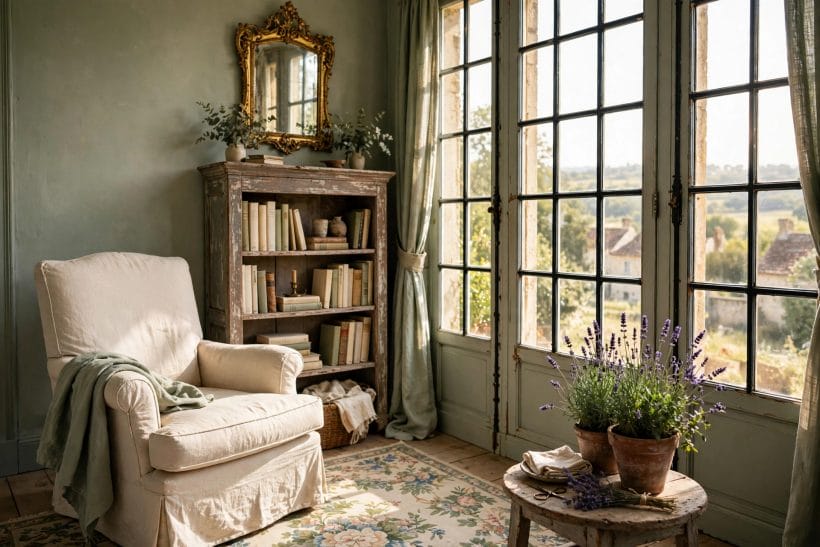
Pattern in this style is rationed like strong cheese — a little, of the best, carries the whole meal. These are the fabrics and the discipline that keeps them provincial rather than chintzy.
34. Spend toile once
Toile de Jouy — the pastoral printed cotton — is the style’s signature pattern, and one appearance is enough: the curtains, or one chair, or a cushion set. Walls, sofa and drapes in toile together build a theme room.
35. Ground the room in ticking and checks
Blue-and-white ticking stripes, faded gingham and simple woven checks are the working patterns — on cushions, a bench cover, a lampshade. They mix with everything, cost little, and carry the farmhouse note without scenery.
36. Use florals faded and small in scale
Washed rose prints and sprigged cottons belong on a cushion, a throw, perhaps a single chair — at the size flowers actually appear in a room, and faded as if by the same sun that lights them.
37. Layer linen in its natural shades
Flax, stone, washed white, pale grey — linen’s own undyed family layered across sofa, curtains and cushions gives the room depth without pattern. Texture does the work colour does in other styles.
38. Hang curtains long, loose and unlined-feeling
Full-length linen or cotton curtains, pooling a breath on the floor or breaking just at it, on plain iron poles. Pelments, swags and tie-backs in silk belong to the manor’s formal rooms.
39. Throw wool and cotton for the seasons
A faded quilt, a woven cotton throw, a wool blanket in the landscape colour for winter — textiles rotate with the year, and the room changes its temperature without changing its furniture.
40. Cover the floor with a worn-look rug
A faded oriental-pattern rug or a simple woven jute under the seating pulls the palette together and takes the household’s traffic without complaint.
41. Let lace appear only as an heirloom accent
A grandmother’s lace cloth over one table, a crocheted edge on a shelf — a single appearance of true lace carries the tradition more honestly than lace-effect prints everywhere. Like toile, it is a soloist.
42. Keep pattern off the walls here
In the neighbouring coastal living room lane the walls may carry stripe or board; in French country the walls stay plain and pale, and pattern lives on movable cloth. It is the discipline that keeps the room restful — and makes redecorating a matter of cushions, not ladders.
43. Sew or buy cushions with honest closures
Buttons, ties and zips hidden at the back; covers that come off for washing. The style’s textiles are working textiles, maintained like household linen for generations.
44. Let one textile be the room’s jewel
A length of antique linen, an embroidered cushion, a fragment of old toile framed or thrown over one chair — a single precious cloth lifts the working textiles around it.
6. Light and Hearth: The Evening Room
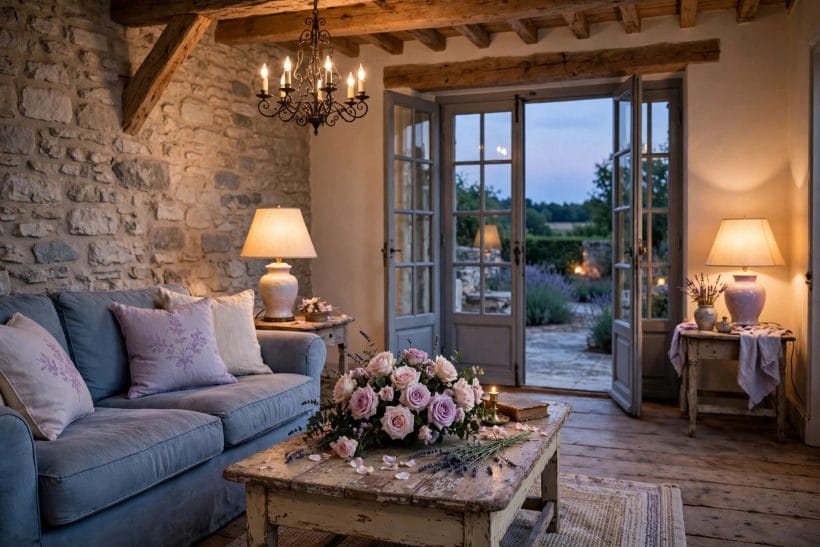
French country rooms are designed for dusk — lamplight, firelight and candlelight over a pale palette. This section composes the glow the family room ideas collection arranges for daily life, in a more romantic accent.
45. Light with lamps at sitting height
Pairs of lamps on consoles and side tables, their shades in linen or parchment-toned fabric, are the room’s true lighting system. Ceiling lights, where they exist, are for finding lost needles.
46. Hang one iron chandelier, simply
A blackened-iron chandelier — curved arms, candle-style bulbs, no crystal unless it is old and cloudy — gives the room its single piece of overhead theatre.
47. Give the hearth its provincial dress
A stone or plain plaster surround, a heavy timber beam for a mantel shelf, a basket of logs, iron fire tools worn bright at their handles.
48. Burn candles without occasion
Candles on the mantel, the table, in storm lanterns by the door — lit on ordinary Tuesdays. The style’s romance is a practice, not an event, and candlelight forgives every fade and wrinkle the room has earned.
49. Shade the windows with shutters or simple blinds
Interior shutters in painted timber, or plain linen blinds beneath the curtains, give the room its afternoon half-light — the siesta gloom in which pale palettes look their best. Blackout formality is unnecessary; the aim is filtered, dappled, adjustable daylight.
50. Keep bulbs warm and unanimous
Every lamp and candle-bulb in one warm colour temperature, so the room’s evening is a single climate of light.
51. Mirror with one gilt frame, aged
A single tall mirror in a softly gilded, slightly worn frame doubles the lamplight and the garden view, and is the style’s one permitted piece of grandeur. Hang it where it reflects light or greenery, never a television or a corridor.
52. Let the garden light the room by day
French doors or tall windows kept clear of heavy dressing pull the garden into the palette — green is the style’s favourite borrowed colour.
53. Wash the walls with daylight-friendly pale tones for dusk
The evening room begins at noon: pale walls in warm tones store the day’s brightness and return it softly after dark, which is why this palette needs so little artificial light to feel kind.
54. Put the television in its place
Inside the armoire, on a plain wall treated as a picture, or simply absent from the best room — decide once and completely. A screen tolerated apologetically will dominate apologetically.
55. End the day in lamplight only
The room’s final test: an ordinary evening with every ceiling light off.
7. The Bones: Beams, Shutters, Stone and Iron
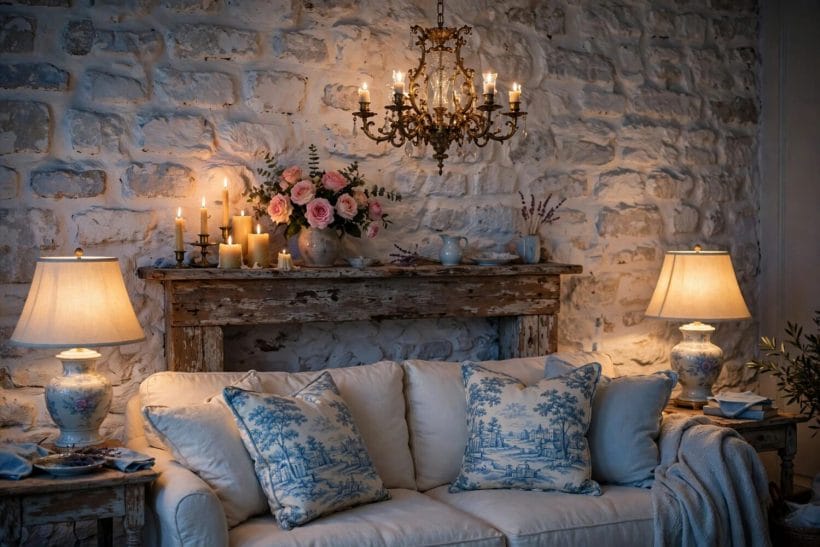
Where architecture offers the style its bones, take them gratefully; where it doesn’t, add only what can be added honestly. This section separates the two, in the spirit of the transitional living room survey’s respect for a room’s existing character.
56. Keep beams if the house gives them
Exposed beams — aged, scrubbed or painted pale — are the style’s favourite ceiling, giving the pale room its structure and shadow. Never cover them, rarely darken them.
57. Add beams only where they can be believed
A faux beam over a low modern ceiling convinces no one and lowers the room.
58. Open the fireplace if it is real
A working hearth, or one honestly retired with candles in its grate, anchors the style like nothing else. Blocked and papered-over fireplaces leave a room’s face without features.
59. Panel one wall in painted boards
Vertical painted boarding on the hearth wall or behind the bookcase gives a plain room the farmhouse layer without a full architectural campaign. Keep it matte, pale and simply jointed.
60. Dress windows tall and simply
Long windows deserve long curtains and nothing more architectural than a plain iron pole.
61. Lay a hearth of stone or brick, generously
A wide hearthstone extends the fireplace’s hospitality into the room — a place for baskets, boots and the cat. Keep its material honest and its surface unpolished.
62. Let doors be ledged, painted or old
A ledged timber door, or panelled doors painted into the palette, keep the room’s entrances in its own century.
63. Keep ironwork plain throughout
Hinges, latches, curtain poles, the chandelier, the fire tools — one family of blackened iron, plainly made. Iron is the style’s punctuation, and consistent punctuation is what lets the soft sentences of linen and faded colour be read.
64. Admit the garden at every opening
Climbers at the windows, a pot of lavender by the door, the garden’s green pressing close — the provincial house blurs its edges into its plot.
65. Repair rather than replace the old bones
A worn stair tread, a door that has settled, floorboards with a century in them — the style regards these as assets with paperwork. Repair with compatible materials by people who know old houses, and let the room keep its evidence.
8. Daily Life in the Style: Keeping It Human
The final ideas are housekeeping for the soul of the style — the habits that keep a French country room a home rather than a photograph of Provence.
66. Keep flowers loose and seasonal
A jug of whatever the garden or market offers — arranged by the hand, not the florist — on the table or mantel. Tight, formal arrangements argue with the room’s whole philosophy.
67. Let books and work stay visible
A novel face-down on the arm of a chair, knitting in its basket, the crossword on the table — the style displays life, not objects.
68. Feed people in this room
Soup on the farmhouse table, cheese after, coffee carried in from the kitchen — the provincial living room expects to feed its sitters.
69. Welcome the dog onto the rug
Not onto the best linen, perhaps, but into the room’s life entirely — a basket by the hearth, a blanket on the bench.
70. Let children build their forts
Blankets over chairs, cushions on the floor — the room survives and improves. French country furniture is sturdy, washable and unprecious by design, which makes it, quietly, the most child-compatible of all the elegant styles.
71. Change the room with the seasons only
Summer: covers lightened, rugs lifted from stone, shutters angled. Winter: the wool returns, candles multiply, the fire resumes.
72. Buy slowly, inherit gladly
Accept the hand-me-down, haunt the brocante and the house clearance, wait a year for the right armoire. The assembled-over-time room cannot be purchased in a weekend, and attempting it produces the style’s one false note.
73. Forgive the room its wrinkles
Linen creased, paint worn at the handle, a cushion that has kept the shape of its favourite sitter — these are the style’s honours list. The household that irons its slipcovers weekly has mistaken the farmhouse for a hotel.
74. Keep one corner entirely for pleasure
The reading chair, its lamp, its table, its throw — defended against storage, devices and duty. Every provincial house has such a seat, usually claimed by the same person for decades.
75. Judge the room by a winter evening
The style’s examination: rain outside, fire lit, lamps warm, something in a pot, people talking.
9. Checks and Mistakes: Before the First Purchase or the First Stone
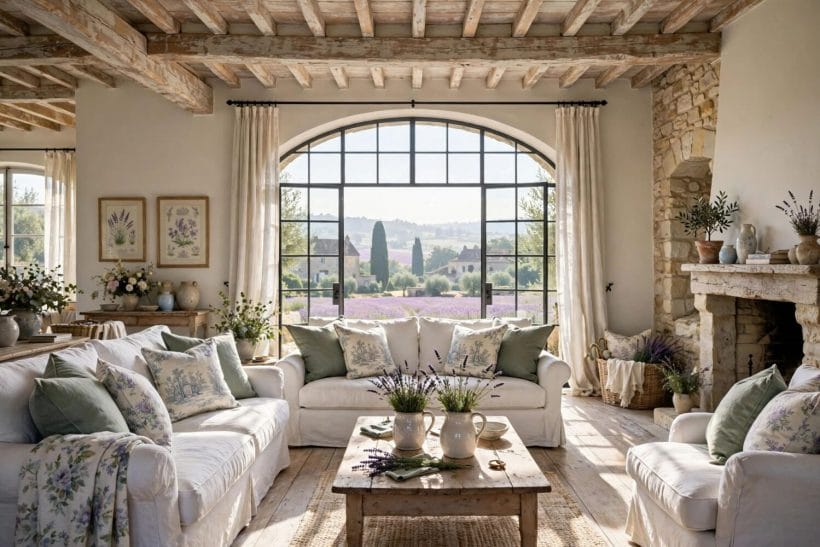
Before buying for a French country room, run the style’s checks. Is the palette washed — could every colour pass for sun-faded? Is the timber pale, limed or painted rather than dark-polished? Are the textiles natural, washable and mostly plain, with pattern rationed to one or two appearances? Does the seating mix rather than match? And does every piece pass the afternoon test of genuine comfort? A room that passes those five will read as provincial whatever house it sits in; a room that fails two is merely a room with some French-looking objects in it.
The mistakes are fond and consistent. Matching suites bought as a set. Distressing applied everywhere with a sander’s enthusiasm. Toile on every surface. Colours chosen at full strength because the faded versions looked timid on a swatch — they are supposed to look timid on a swatch. And the cruellest: a room so perfectly styled that the household begins apologising to it. This style exists to be lived in; a French country room its family is afraid of has failed at the only thing it was ever for.
One boundary deserves keeping: finishes and furniture are the owner’s free territory, but fires, flues and any structural beam work belong to qualified trades under local rules. Keep the romance in the textiles, where it is safe, and the chimneys in professional hands, where they belong.
10. Costs and Pulling It Together
Costs in this style reward patience over budget. The expensive route — antique armoires, genuine bergères, old stone — is real, but the style’s centre of gravity is modest: painted second-hand furniture, washable natural textiles, one good linen sofa, ironwork and time. Its true currency is the year spent finding the right piece rather than the sum spent on the wrong one quickly. What cannot be economised is the palette discipline; faded colours chosen wrong are merely dull ones, and dullness is the one failure the style cannot charm its way out of.
Pull the room together in this order: washed palette on the walls, pale timber and forgiving floors, the linen sofa and mixed seating, the farmhouse table and painted storage, textiles with pattern rationed, lamps and hearth for the evening, and finally a life lived visibly in it. The French country living room succeeds when a guest cannot tell which pieces are old, which are new, and which were painted last spring — and does not care, because the room has already fed them, seated them softly, and lit them kindly.
Final Considerations
Of all the living-room styles in this collection, the French country room makes the largest promise with the softest voice: that a home can be elegant and entirely unpretentious at once — that beauty, in a house, is mostly the visible evidence of care repeated over years. Its faded palette is not a lack of colour but a memory of summers; its worn paint is not damage but handwriting.
Build it slowly, in its own lane — the traditional room keeps its formality elsewhere, the rustic room its ruggedness, and this post has kept to the washed, curved, linen-soft province between them. Within that lane, let the standard be hospitality itself: a room that seats deeply, lights kindly, washes easily and forgives everything. A living room cannot do more for the people inside it, in any style, in any century.

0 Comments