

A farmhouse family room has to do two jobs at once: look warm and welcoming, and survive daily life with children, pets, muddy boots and movie nights. These 75 ideas are grouped so you can plan the layout first, then colours, furniture, storage and the practical details that keep the room easy to live in.
Work through the sections in order, or jump to the one your room needs most. Every idea is chosen for real family use, not just for photographs.
1. At a Glance: The Farmhouse Formula That Actually Works
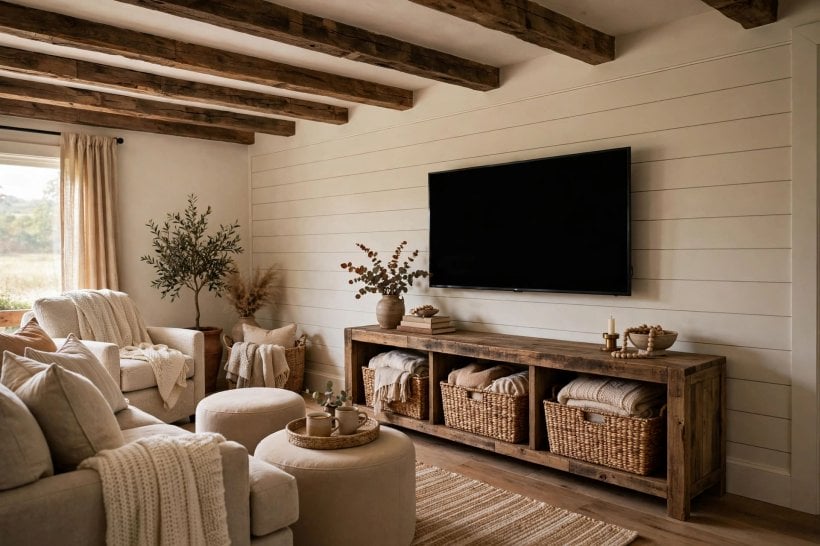
The rooms that succeed share a simple formula: a calm, warm base, natural textures doing the heavy lifting, furniture arranged for conversation rather than for the television alone, and storage close to where clutter is born. A farmhouse family room is not a theme park of signs and distressed props. It is a practical room with soft edges, honest materials and enough seating for everyone to land at the end of the day. In a small home that formula matters even more, because the family room is rarely only a family room; it is also the playroom, the guest room, the office corner and the route to everywhere else.
| Element | Reliable choice | Why it works |
|---|---|---|
| Layout | Seating grouped around one focal point | Keeps conversation easy and walkways clear |
| Base colours | Warm white, cream, soft sage, muted clay | Light, forgiving and easy to accessorise |
| Key materials | Timber, linen, wool, leather, painted wood | Texture replaces clutter as the decoration |
| Storage | Baskets, benches, closed cabinets | Clutter disappears in under a minute |
| Spend first on | Sofa comfort and washable textiles | The pieces touched every day earn the budget |
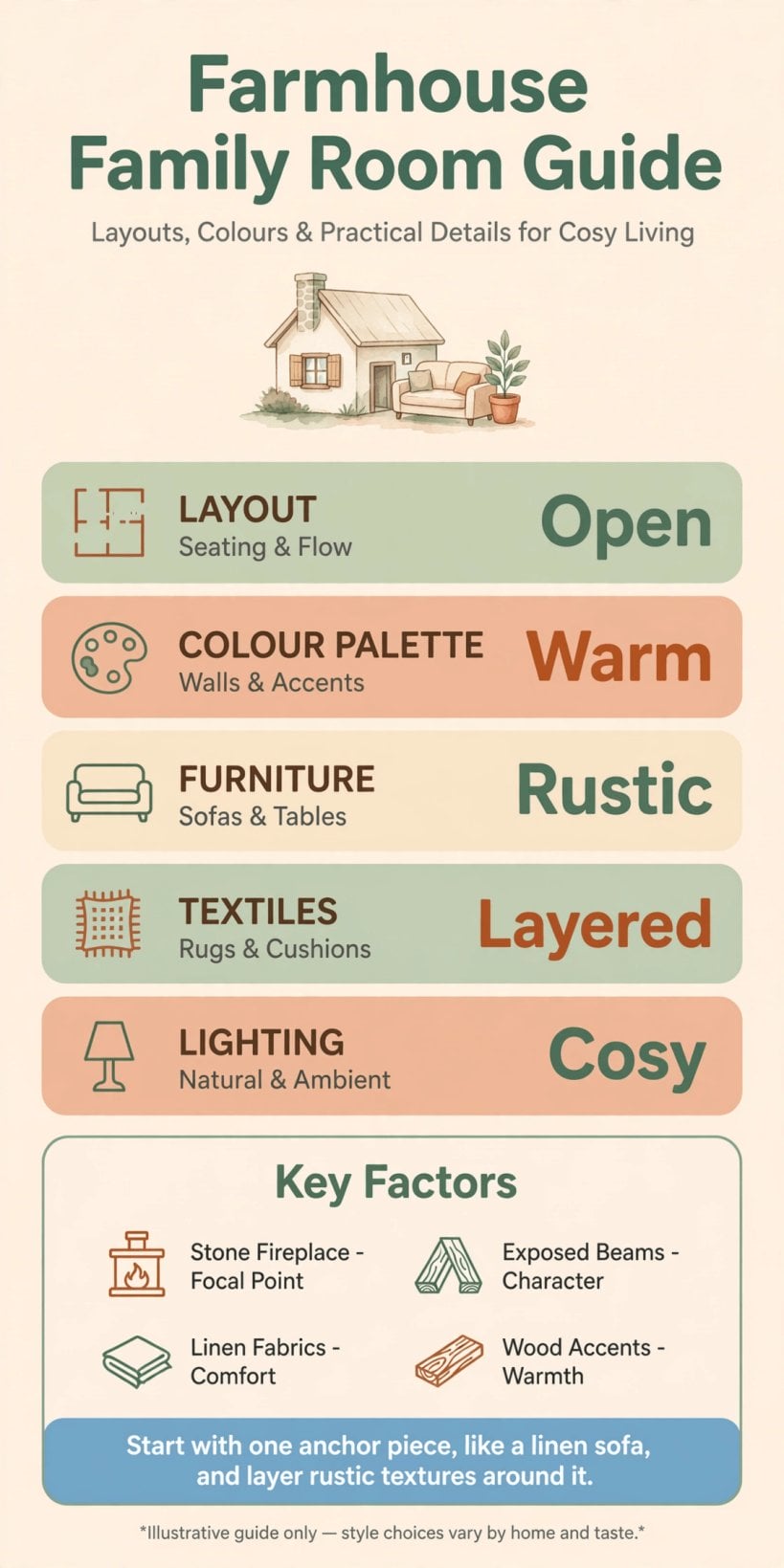
The whole plan on one page: layout first, then colour, texture, storage and the family-proof finishing touches.
Use the table as your shopping filter. If a purchase does not help the layout, the palette, the texture or the storage, it is probably decoration the room does not need. Farmhouse style rewards restraint: fewer, larger, better-loved pieces beat a crowd of small themed ornaments every time, and the room will feel calmer for it on the busiest evenings.
2. Layouts First: Ideas 1 to 8
Ideas 1 to 8 are layout moves. 1) Face the two main seats toward each other with the focal point between them. 2) Keep a clear walkway behind or beside the sofa instead of pushing everything to the walls. 3) Anchor the seating on one rug large enough for the front legs of every seat. 4) In a long room, split the space into a watching zone and a reading or play zone. 5) Use a low coffee table or upholstered ottoman so sightlines stay open. 6) Angle one chair to soften a boxy room. 7) Leave the window wall light so daylight is never blocked by tall furniture. 8) In an open-plan space, use the back of the sofa and a console table as the room divider.
These moves cost little or nothing, and they decide how the room feels before a single cushion is bought. Small homes benefit most, which is why the zoning thinking pairs well with these tiny house living room ideas: define the room with furniture placement, not walls. Measure honestly, tape the footprint of a new sofa on the floor, and walk the routes you use every day, from door to kitchen to stairs, before committing to any arrangement.
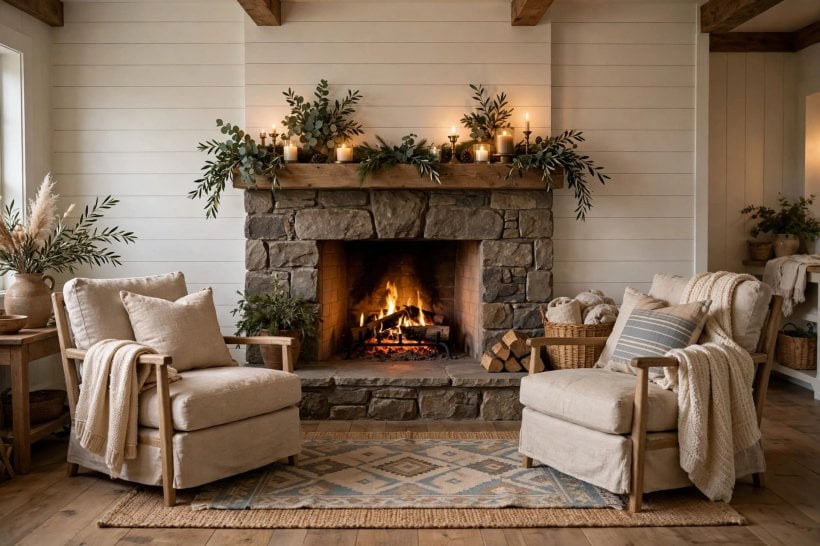
If the layout works with the furniture you already own, you have saved the largest part of the budget for the pieces in section 4 that genuinely wear out.
3. Colours and Light: Ideas 9 to 16
Ideas 9 to 16 are colour decisions. 9) Start with a warm white or cream on walls so winter light stays kind. 10) Add sage or eucalyptus on one element, such as a cabinet or the lower wall. 11) Use clay, rust or muted terracotta as the warm accent in cushions and throws. 12) Ground the scheme with one dark note, in iron, aged bronze or a deep stained timber. 13) Keep ceilings bright to lift low rooms. 14) Repeat your accent colour three times, no more, so it looks chosen. 15) Let natural wood count as a colour in its own right. 16) Test paint beside the window and opposite it, because farmhouse colours shift a lot between the two.
Colour in this style is about weather and landscape rather than fashion: stone, straw, leaf, earth and sky on a cloudy day. That is why it sits so comfortably next to the softer schemes in these tiny house bedroom ideas when the same home needs both rooms to feel related. Keep the palette in photographs of your actual room, on your actual screen, before buying; phone images lie less than memory does.
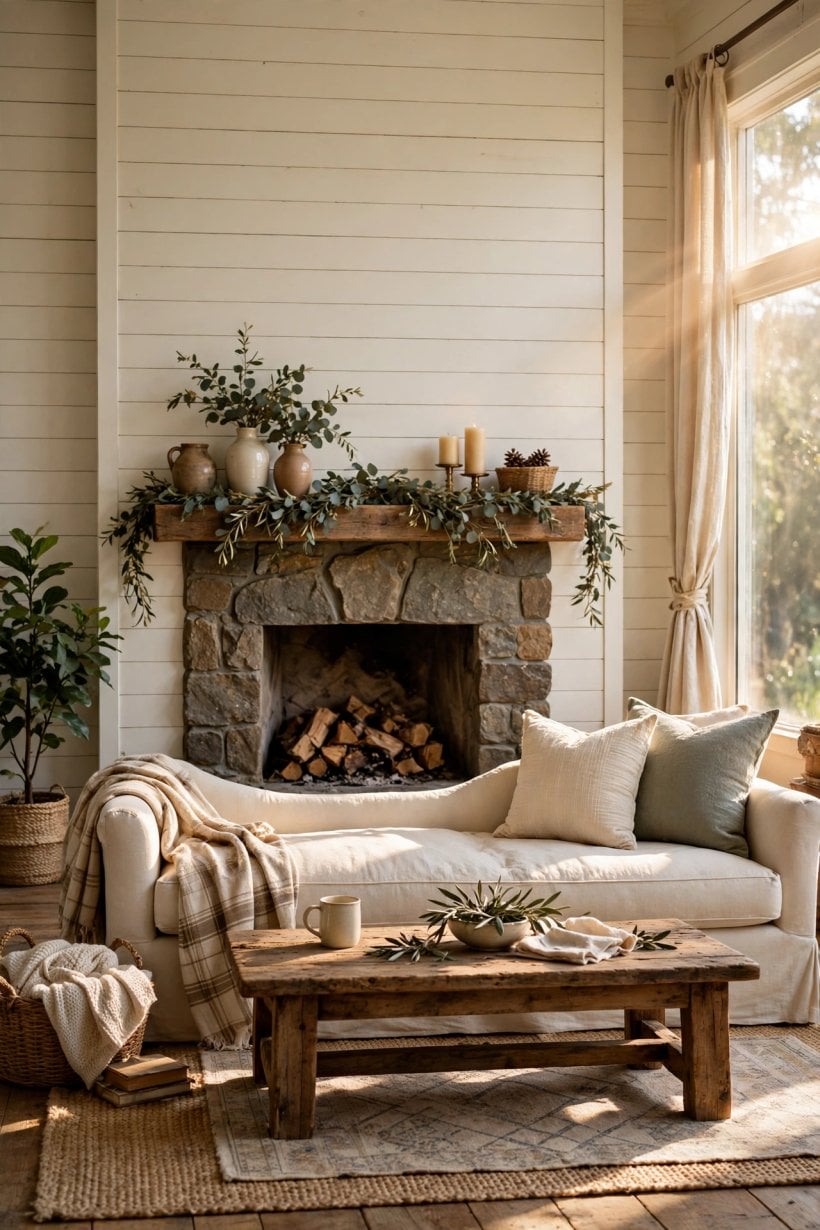
North-facing rooms should lean warmer in every choice. South-facing rooms can afford cooler greys and crisper whites without turning chilly.
4. Seating and Main Furniture: Ideas 17 to 24
Ideas 17 to 24 cover the big pieces. 17) Choose the deepest, most comfortable sofa the room can honestly fit. 18) Add one chair with arms for reading and older guests. 19) Pick a coffee table with a lower shelf so books and remotes have a home. 20) Use a storage ottoman as spare seating and a toy vault in one. 21) A painted sideboard hides games, chargers and paperwork better than any basket. 22) Nesting side tables flex for drinks, laptops and jigsaws. 23) A washable slipcover extends a sofa’s life by years. 24) Keep one piece of genuinely old furniture if you can; its wear is the style’s soul.
Buy comfort before looks in this category, because nobody admires a beautiful sofa they avoid sitting on. Sit on floor models, check cushion fillings, and ask how covers come off for washing. Households planning the whole home at once will find the same buy-once logic in this tiny barn house interior feature, where hard-working furniture carries conversions with big, open rooms.
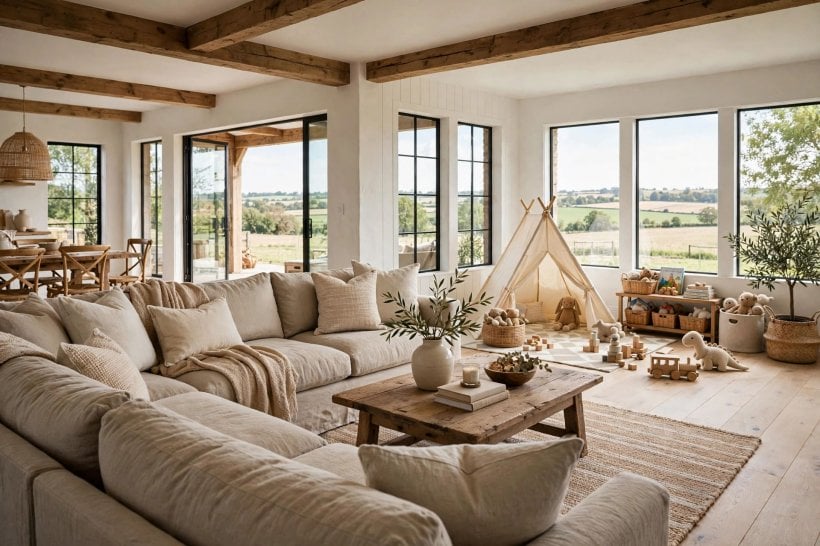
Match leg heights and wood tones loosely rather than exactly. A room where everything matches perfectly reads as a shop display, not a family home.
5. Textiles and Soft Layers: Ideas 25 to 32
Ideas 25 to 32 are the soft layers. 25) A wool or wool-look rug for warmth underfoot. 26) Linen-look curtains hung high and wide to fake taller windows. 27) Two cushion fabrics only, one plain and one patterned, repeated. 28) A chunky throw on the sofa arm nearest the draughtiest door. 29) Washable cushion covers in the same palette, swapped for a seasonal refresh. 30) A quilt or woven blanket folded on the spare chair. 31) Seat pads on hard chairs so homework and board games last longer. 32) Layer one natural fibre, such as jute, underfoot in summer and store it in winter if your climate is wet.
Textiles are where a small budget changes the room fastest, and where family life sho
One last thought on getting the balance right. The farmhouse look is sometimes mistaken for a shopping list, as if enough painted signs, faux-rustic finishes and themed cushions could add up to the feeling people are actually chasing. They cannot. The feeling comes from use: a sofa that has hosted a thousand evenings, a table marked by homework and celebrations, blankets that are folded because they were used that morning. So build the room slowly and let your household finish the styling. Choose the practical version whenever a choice appears, washable over delicate, lidded over open, sturdy over clever, and spend your money where hands and eyes land every day. If the room ends up a little less symmetrical than the pictures that inspired it, that is not a failure of the plan. That is the plan working. A family room should carry the evidence of the family, and the warmth everyone associates with this style is really just the look of a room that is loved, used and looked after in that order, week after week, year after year.
ws first. Choose fabrics that forgive: tight weaves, mid-tone patterns that hide marks, and covers that zip off. The layered, personal approach in this colourful tiny house interior shows how far textiles alone can carry a room’s character while the furniture stays simple and hard-wearing underneath.
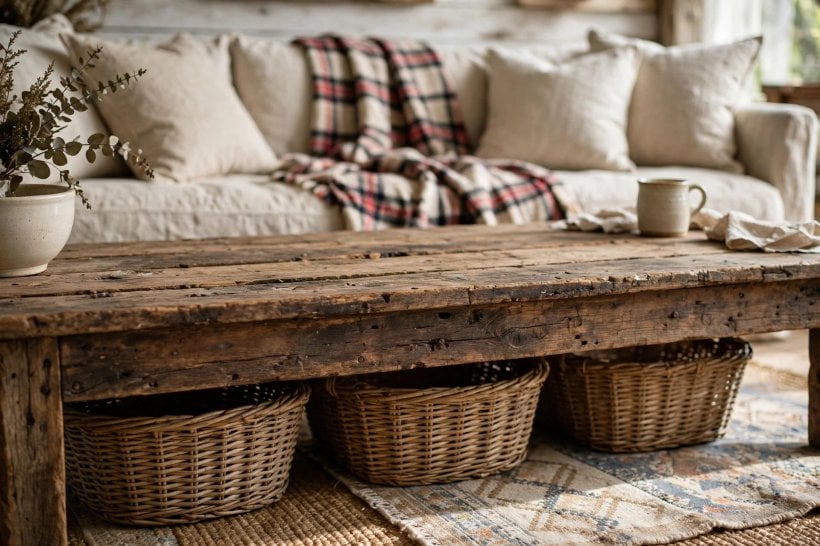
Keep a lidded basket for the textiles not in use. Rotating two sets of covers makes the room feel refreshed twice a year for almost no money.
6. Storage That Hides Real Life: Ideas 33 to 40
Ideas 33 to 40 tackle storage. 33) One closed cabinet for the things you never want on show. 34) Baskets with lids, sized to the shelves they live on. 35) A bench with storage inside for shoes and bags at the room’s edge. 36) Low book storage children can reach and tidy themselves. 37) A charging drawer or box so cables stop colonising the sofa table. 38) Board games in one lidded crate, rotated monthly. 39) A tray that corrals remotes, coasters and reading glasses. 40) One empty shelf, deliberately, so the room never looks full to bursting.
Storage fails when it lives far from the mess. Put the toy basket where toys land, the shoe bench where shoes come off, and the paper tray where post arrives. In compact homes the same principle drives good tiny house bathroom ideas: small, closed, close to hand. Audit storage twice a year and evict what nobody used; farmhouse rooms look generous because they are edited, not because they are large.
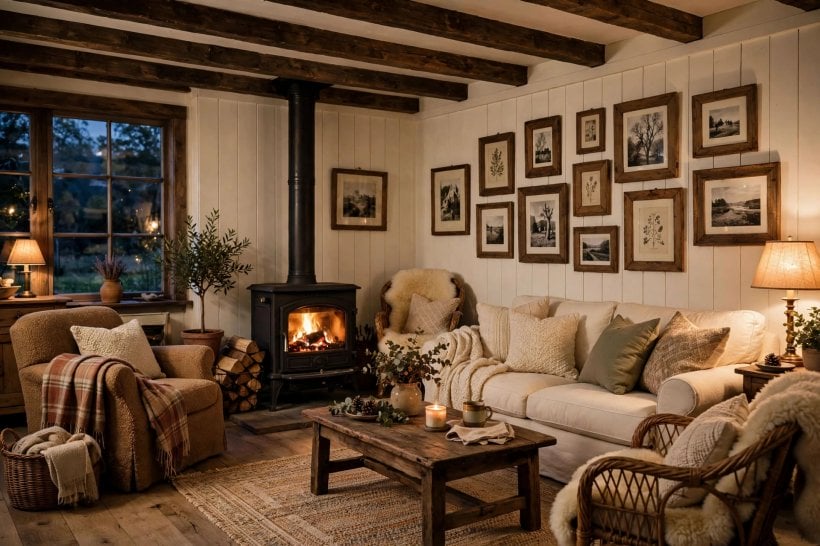
If a tidy-up takes longer than five minutes, the system is wrong, not the family. Simplify until five minutes is enough.
7. Lighting and Decor: Ideas 41 to 48
Ideas 41 to 48 are light and decoration. 41) Three light sources at three heights: ceiling, table and floor or wall. 42) Warm bulbs everywhere for evening softness. 43) A reading lamp with its own switch beside the best chair. 44) One oversized piece of art or a mirror instead of many small frames. 45) Family photographs in a loose grid with matching frames. 46) A plant or two for life and height, in baskets or clay pots. 47) Candles or lanterns grouped on a tray for winter evenings. 48) Decorative objects in odd numbers, edited hard.
Lighting does more for atmosphere than any ornament. Dim, layered light hides a multitude of daytime sins and makes the cheapest sofa look inviting. Decor should tell the family’s story rather than the style’s: the bowl from a holiday, the picture a child drew, the clock that actually works. Rooms styled for real people, like those planned in bedroom interior design for tiny houses, age gracefully because their objects mean something to the household.
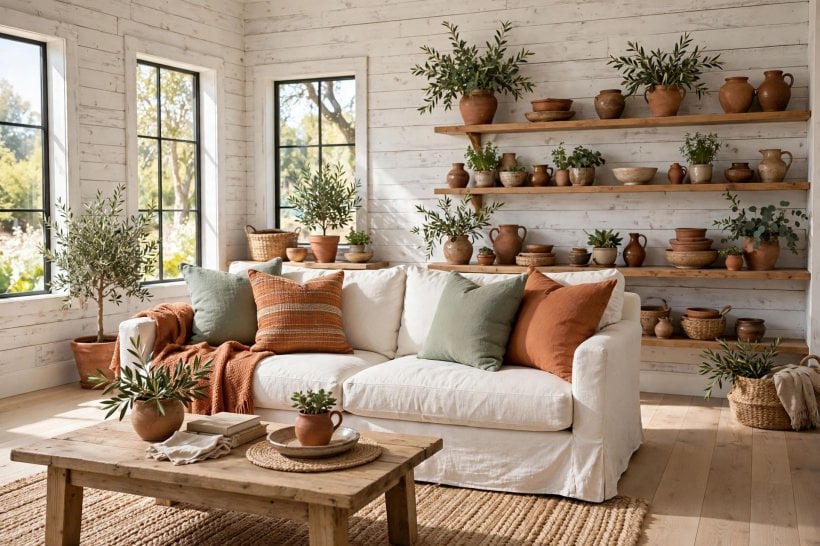
Before buying decor, move what you own from other rooms. Shopping your own house is the oldest farmhouse habit there is.
8. Family-Proof Practical Details: Ideas 49 to 56
Ideas 49 to 56 are the practical details. 49) Rounded corners on the coffee table while children are small. 50) A washable rug or rug tiles in the play zone. 51) Stain-resistant fabric or a darker patterned seat where snacks happen. 52) Coasters that live on the table, not in a drawer. 53) A small side table at each main seat so drinks stop migrating to the floor. 54) Cable clips behind the media unit. 55) Felt pads under every leg to protect floors and temper noise. 56) A mud-season mat and boot tray by the door the family actually uses.
None of these ideas will be pinned or praised, and all of them will be appreciated daily. Practicality is the difference between a room that photographs well once and a farmhouse family room that still looks good in year three. Build the habits into the furniture, a tray here, a hook there, a basket within reach, and tidiness stops depending on anyone’s willpower at the end of a long day.
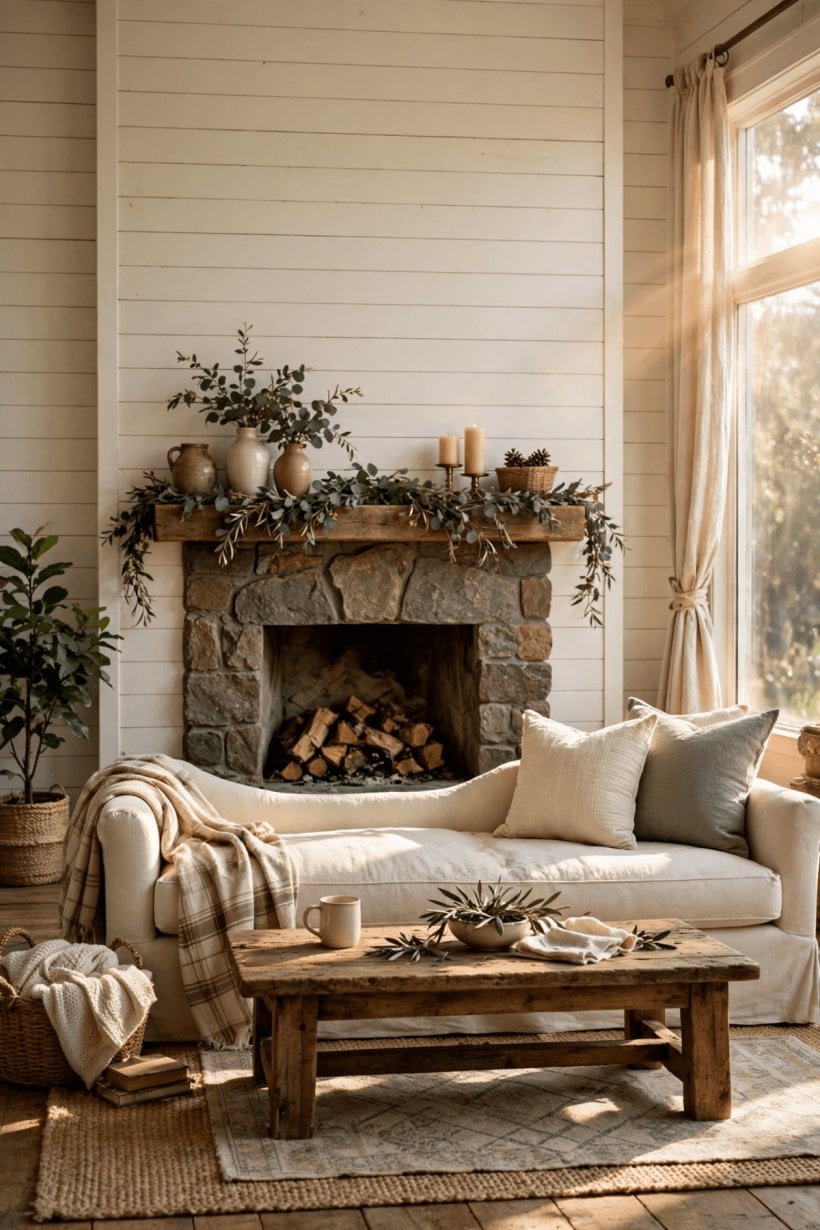
Review this list after a month of living with the room. The details your household actually uses are the ones worth spending on again.
9. Small Rooms and Tight Corners: Ideas 57 to 64
Ideas 57 to 64 shrink the formula for small spaces. 57) A two-seat sofa and two light chairs beat one huge sectional. 58) Leggy furniture that shows the floor makes the room breathe. 59) A round coffee table keeps shins and walkways safe. 60) Wall shelves above sofa height for books and plants. 61) One multifunctional piece per wall, no more. 62) Pale walls with the colour carried in textiles you can change. 63) A mirror opposite the window to borrow its light. 64) Doors kept clear of furniture so the room’s full footprint stays usable, a detail the doorway planning in small-space living room planning also rewards.
Small farmhouse rooms fail by excess, not by size. Every idea above removes visual weight while keeping function, which is exactly the trade a compact room needs. Resist miniature versions of big-room furniture; choose full-size comfort in fewer pieces instead, and the room will feel generous rather than doll-like.
Measure doorways and stairs before ordering anything. The best sofa in the world is useless if it cannot reach the room.
10. Costs and a Simple Plan: Ideas 65 to 75
Ideas 65 to 75 are about money and sequence, the last eleven. 65) Spend first on the sofa, because cost per sit is what counts. 66) Save on side tables, lamps and baskets, which turn up second-hand constantly. 67) Paint before replacing; a painted cabinet can gain years. 68) Buy the rug after the furniture, sized to the final layout. 69) Phase the plan: layout now, textiles next season, decor last. 70) Keep a small contingency for the unglamorous fixes, sockets, pads, hooks, that make the plan work. 71) Choose one hero purchase a year rather than many small ones. 72) Sell or donate what the room replaces, and let that fund the next step. 73) Maintain as you go; re-covering one cushion beats re-buying a set. 74) Photograph the room each season to see it with fresh eyes. 75) Stop when the room works for your family, not when it matches a picture.
Exact prices vary too much by region and timing to quote honestly, so plan in proportions instead: roughly half the budget on seating, a quarter on textiles and the rug, and the rest on storage, light and finishing details. Households sequencing a whole home, as in this guide to building your own tiny house, use the same staged approach: structure first, comfort second, decoration last of all.
Final Considerations
A farmhouse family room is not finished when it looks right in a photograph. It is finished when everyone in the household has a seat they love, the clutter has somewhere to go in under five minutes, and the room forgives the way your family actually lives. Start with layout, let colour and texture follow, and add the practical details that protect your investment. Built that way, the room will keep earning its place at the centre of the home.

0 Comments