

Vertical blinds are practical, landlord-friendly and almost nobody’s idea of beautiful. The usual fix — hang curtains over them — runs straight into the question as asked: the blinds stick out from the wall, their vanes swing in a wide arc, and a standard curtain rod fitted the ordinary way leaves the curtains scraping, catching and bulging over the whole mechanism.
The short answer is that you do not hang the curtains from the blinds, or level with them: you hang them in front of them, on a rod or track whose brackets project far enough to clear the headrail and the vanes’ full swing, mounted high and wide so the curtains frame the window instead of fighting it. This guide works through every honest route to that result — drilled, ceiling-mounted, no-drill and clip-on — in general terms, because windows, walls and blinds vary and the right measurements are always your window’s own. None of the routes needs the blinds removed, replaced or argued with — the blind stays, does its job, and disappears behind fabric.

1. Curtains Over Blinds at a Glance
The central problem is clearance: a vertical blind occupies a band of space in front of the window — the headrail’s depth, plus the room the vanes need to tilt and traverse — and anything hung within that band will collide with it. Every successful method in this guide is a way of putting the curtain’s hanging line in front of that band. The layered result belongs to the same family as the tiny house curtain ideas approach to small-window dressing, and the privacy logic echoes the glass door covering ideas survey: a hard-working layer behind, a soft layer in front, each doing what it does best. Nothing in the method is exotic; every route here is ordinary hardware used at an unusual distance from the glass.
| Question | Short answer |
|---|---|
| Why do curtains catch on vertical blinds? | The blind’s vanes swing into the space a standard rod leaves |
| What is the core fix? | A rod or track mounted proud of the headrail and the vanes’ swing |
| Can it be done without drilling? | Yes — tension, adhesive, magnetic and clip-on routes exist, with limits |
| Do the blinds still work afterwards? | Yes, if clearance is honest — the layers operate independently |
2. Why Blinds Stick Out: The Clearance Problem
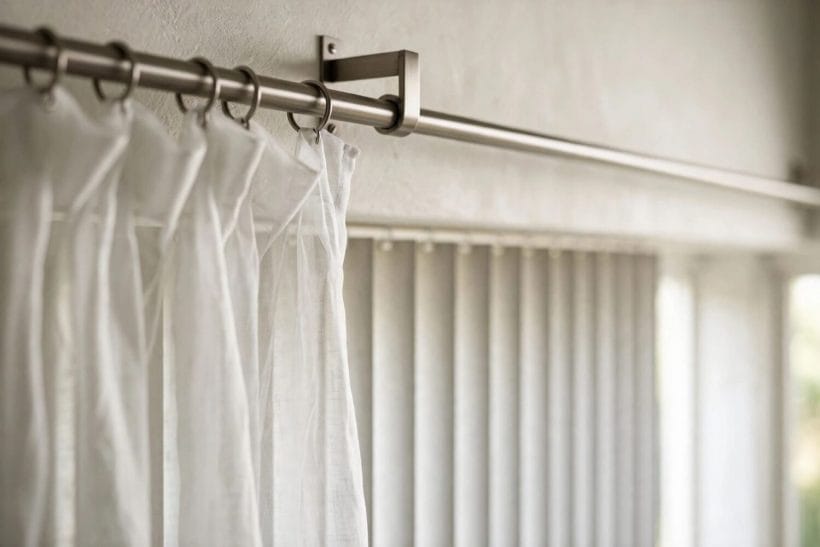
Before any hardware, understand the geometry you are up against. These four points describe the blind’s occupied space — the invisible box your curtains must hang in front of.
1. The headrail’s projection
A vertical blind’s headrail is a chunky track mounted at the top of the window or on the wall above it, and it projects into the room by its own depth plus its brackets. Measure that projection first; it is the minimum your curtain hardware must beat.
2. The vanes’ swing arc
The hanging vanes tilt open and closed, and a tilting vane sweeps a wider arc than its resting width suggests. Curtains hung to clear the rail but not the swing will still brush the vanes every time the blind adjusts — allow for the arc, not the rest position.
3. The traversing stack
Drawn open, the vanes bunch at one or both sides, occupying a thick stack exactly where a curtain panel wants to hang. Plan where the stack parks and where your open curtains will sit, so the two are not competing for the same handspan of wall.
4. Controls, cords and wands
Chains, cords and tilt wands hang in the same zone and tangle enthusiastically with curtain hems. Note where they fall before choosing panel lengths and tieback positions — the neatest installation is the one whose controls remain reachable and untangled.
3. The Standard Fix: A Rod That Sits Clear

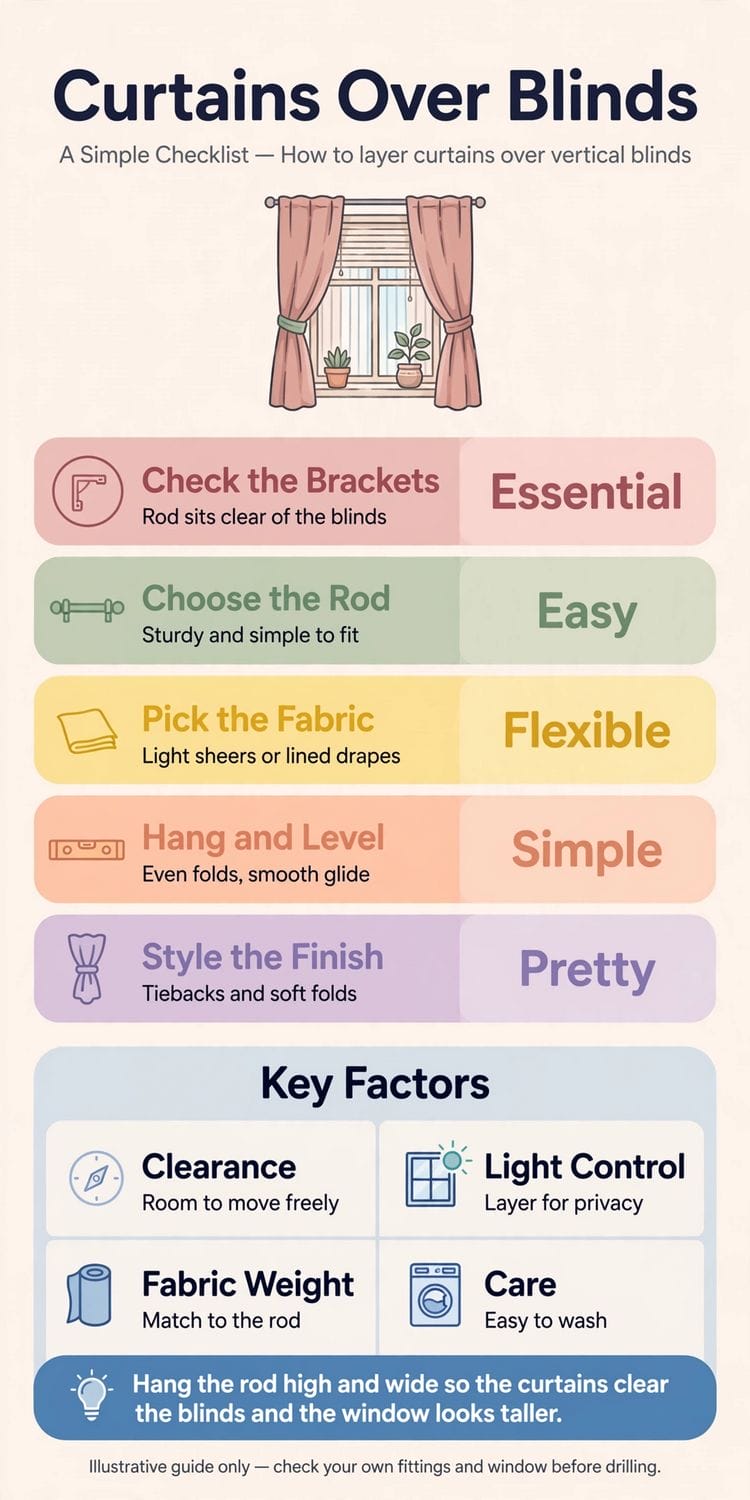
The most common solution is an ordinary curtain rod on longer, projecting brackets — fitted to the wall above and beyond the blind rather than to the window frame. Four decisions make it work.
5. Extended brackets, honestly projected
Choose brackets whose projection clears the headrail plus the vanes’ swing with room to spare — the curtain should hang freely, touching nothing, even when the blinds tilt fully. If standard brackets fall short, longer-return brackets exist for exactly this layering job.
6. High and wide, as a rule
Mount the rod above the headrail and wider than the window, so open curtains stack back onto the wall and clear the glass and the blind stack. The window looks larger, the ceiling taller, and the mechanics all fit inside the frame the curtains create.
7. Into structure, not hope
Curtains on extended brackets lever harder on their fixings than ordinary ones. Find studs or use fixings honestly rated for the wall type and the load — a rod that pulls out takes plaster, paint and the whole layered effect with it.
8. A rod with returns or a wrap-around end
Rods that return to the wall at the ends close the side gap where light and sightlines leak past the layered window. The finish looks built-in, and the curtains’ outer edges sit against the wall instead of floating in profile view.
4. Ceiling-Mounted Tracks and Rods

Where wall space above the window is short — or the look wanted is the hotel wall-of-curtain — the fixing moves to the ceiling. Four variations.
9. The ceiling track in front of the blind
A ceiling-mounted track set a comfortable distance in front of the headrail carries curtains on gliders that slide silently past the blind’s whole mechanism. It is the cleanest solution where the ceiling is sound and the window wall is awkward.
10. A ceiling-fixed rod on drop brackets
Where a track’s look is too minimal, rods can hang from ceiling brackets at the same cleared distance. The geometry is identical to the track’s; only the furniture changes.
11. The full-width curtain wall
Running the track wall to wall turns a window with blinds into a fabric wall that opens in the middle. It is the strongest disguise of all — behind closed curtains, nobody guesses blinds exist — and a favourite in bedrooms for its blackout manners.
12. Recessed and pelmet-concealed tracks
A pelmet or valance fitted over a ceiling track hides the hardware line entirely, so the curtains appear from behind a finished architectural edge. It is the most built-in of the ceiling options and the one that asks the most carpentry.
5. No-Drill and Low-Impact Options
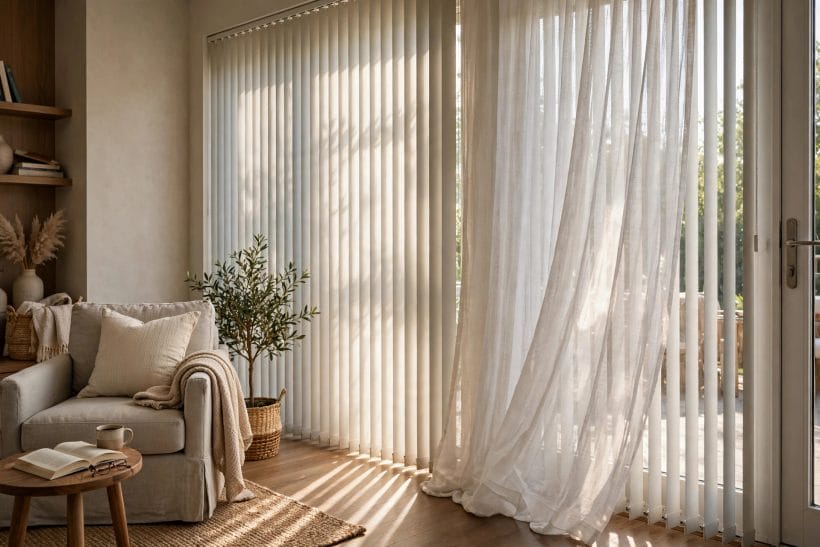
Renters and the drill-shy are not out of options — but every no-drill method trades load capacity for kindness to walls. Four routes, with their honest limits.
13. Tension rods inside a deep reveal
Where the window sits in a deep reveal, a spring tension rod across the reveal’s front edge can carry a light sheer in front of the blind. It suits sheers only — heavy lined curtains will walk a tension rod down the wall, usually at night, always eventually.
14. Adhesive and hook-based hangers
Heavy-duty adhesive hooks and brackets can carry very light curtains on smooth walls. Treat their ratings sceptically, keep the fabric featherweight, and expect to re-stick occasionally — this is a garnish solution, not a foundation.
15. Magnetic solutions on metal frames
On steel window frames and doors, magnetic rods and holders grip without a mark. They are genuinely useful for a light panel over a door’s blind, and genuinely useless on timber or uPVC — know your frame before ordering.
16. Freestanding and furniture-borne tricks
In furnished rooms, a tall bookcase pair or a folding screen standing either side can carry a swag or a pole between them, dressing the window zone without touching the wall. It is staging rather than installation — and sometimes staging is exactly what a rental needs.
6. Clip-On, Clamp and Over-the-Headrail Tricks
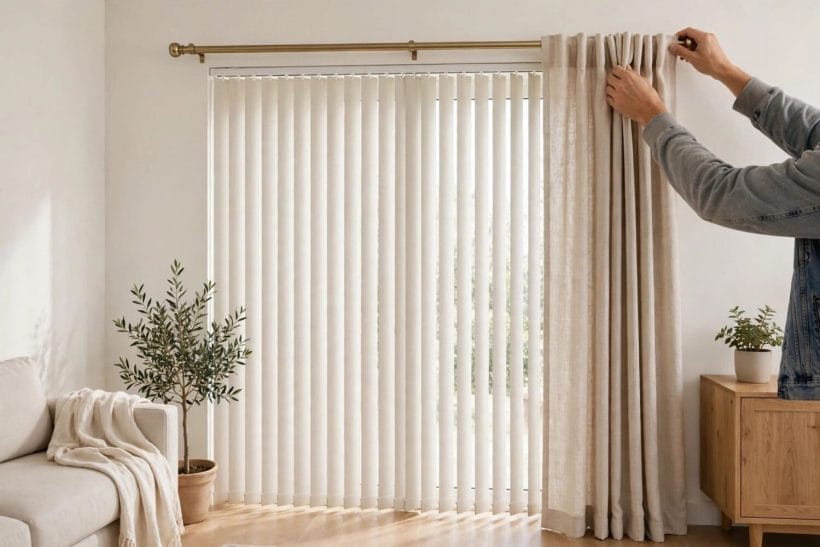
The lightest-touch family: hardware that borrows the blind’s own structure or the curtain’s own heading to fake a layered look without new fixings at all.
17. Valances hung from the headrail
Many vertical blinds accept a valance clipped to the headrail to hide it. A soft fabric valance fitted the same way gives the window a dressed top while the vanes keep working below — the smallest possible curtain intervention.
18. Cafe panels on a slim rod below the rail
A short cafe-style panel at the window’s lower half, on a slim rod fitted to the frame, adds privacy and softness where it is wanted most while the blind above handles the light. The two layers divide the window’s jobs between them.
19. Clip rings on a slim front rod
Where a slender rod can be fitted just clear of the vanes — on the frame’s face with shallow brackets — clip rings make hanging and removing fabric effortless. Keep the fabric light; slim rods and shallow brackets are a team with a weight limit.
20. The swag-over solution
Draping a length of fabric as a swag over two hooks or the rod ends, with the blinds behind doing the real work, gives instant softness for a guest room or a photograph. It is decoration, honestly labelled — and sometimes decoration is the actual brief.
7. Fabric, Fullness and Length

Hardware decides whether it works; fabric decides whether it looks good. These four choices connect the layered window to the room — the same eye for proportion the wider interior design ideas collection applies at room scale.
21. Sheers for softness, lined for substance
A sheer layer over blinds mainly softens and flatters; a lined curtain adds privacy, darkness and insulation the blind cannot. Choose by the job the blind is failing at, not by habit.
22. Fullness that clears the mechanism
Generous fullness looks luxurious but eats clearance: deep folds project toward the room and toward the blind. Behind the hanging line, folds fall where they will — allow the fabric’s own depth in your clearance planning, not just the rod’s position.
23. Length: sill, below-sill or floor
Floor-length panels give the grandest disguise and hide the blind’s bottom rail entirely; sill-length keeps things neat where radiators, desks or pets argue with drapes. Match the length to the room’s furniture, not to a photograph.
24. Colour against the vane colour
Blinds are usually white or cream, and they will show between and behind your curtains. A curtain colour that sits comfortably against that pale ground — rather than pretending the blinds are not there — makes the layering read intentional.
8. Making It Look Built-In
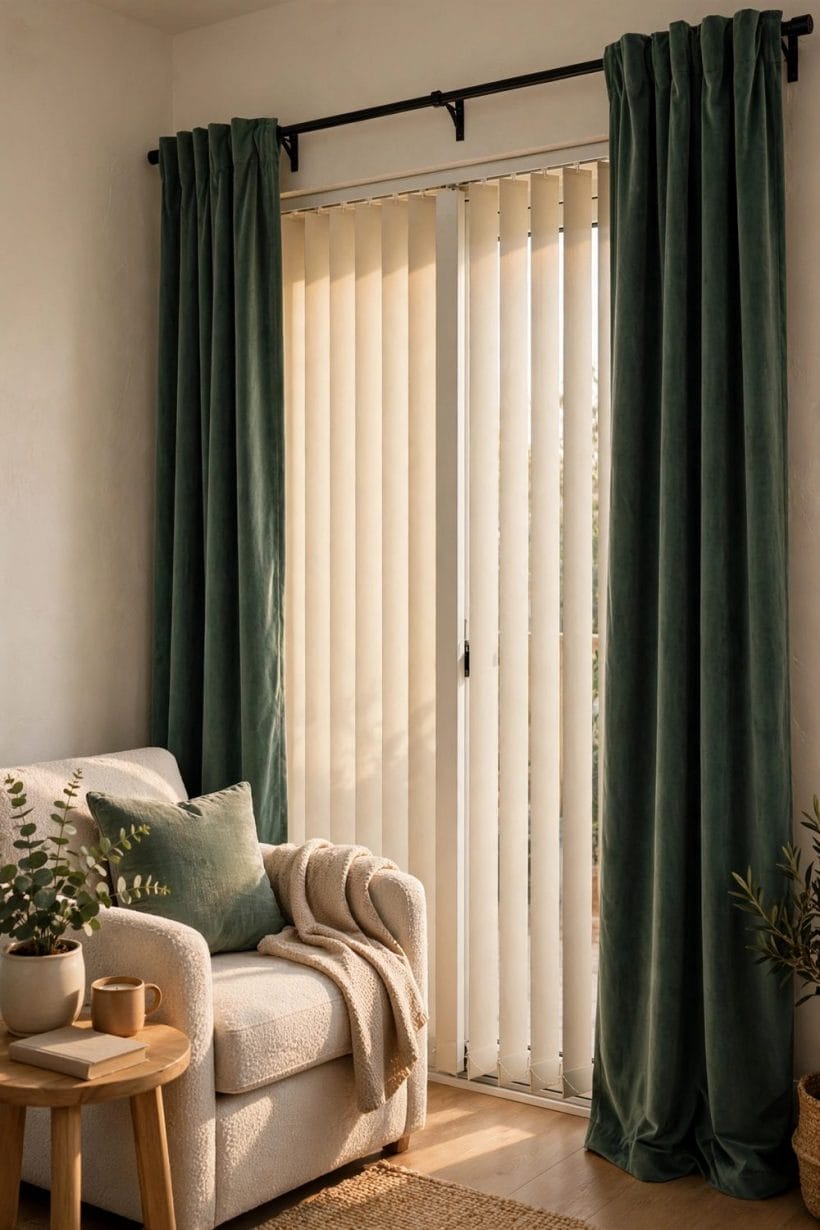
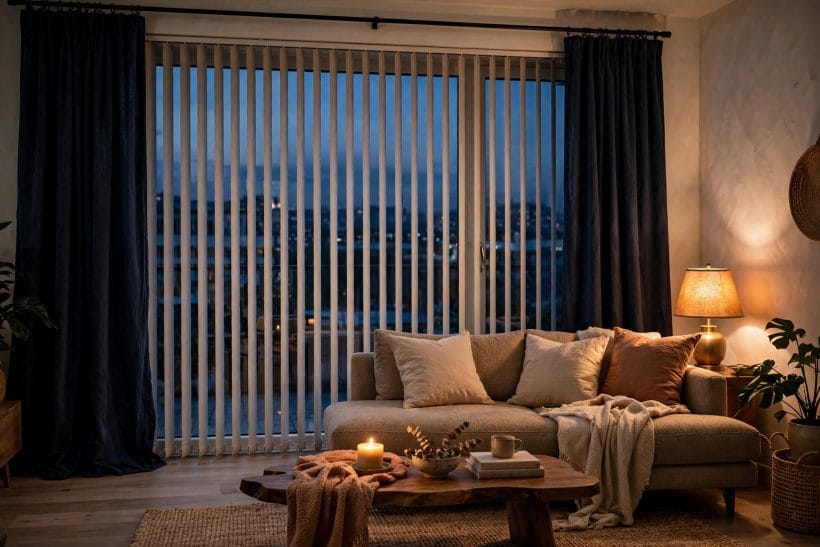
The difference between “curtains hung over blinds” and “a layered window treatment” is finishing. Four touches that complete the disguise — most visible in a living room, as the living room ideas survey’s window treatments show at their best. The discipline scales down, too: small living room windows depend on it entirely, because in a small room the window is half the wall.
25. A pelmet or cornice over the whole assembly
One upholstered or painted pelmet spanning rod and headrail unifies the layers into a single designed object. It hides every mechanism at the top, where the eye checks first, and lets the fabric below be the whole story.
26. Tiebacks placed to miss the stack
Tiebacks should hold open curtains where the blind’s drawn stack is not — plan both positions together. A curtain tied back into a bunch of vanes looks like an accident; one tied beside it looks like a design.
27. Matched side panels, working centre
A classic composition: stationary side panels for the dressed look, with the blinds alone handling daily light. The curtains never move, never foul the mechanism, and the window always looks finished.
28. Steam, hem and hang
Whatever the method, curtains that are steamed, evenly hemmed and hung to dry in their folds read as a treatment; curtains straight from the packet read as a workaround. The finishing hour is the cheapest upgrade in this whole guide.
9. Common Mistakes and Quick Fixes
The rod fitted to the frame, inside the blind’s band. The commonest failure: brackets screwed where a rod would normally go, leaving curtains draped over the headrail like a tea towel. The fix is always projection — move the hanging line forward, by longer brackets, a wall position higher up, or a ceiling track.
Clearing the rail but not the swing. Curtains that hang beautifully while the blinds are open, then snag and tilt the vanes when they close. Test the full tilt and traverse with the curtains hung before calling the job done; a small extra projection at fitting stage prevents a daily irritation.
Panels too narrow, stacking onto the glass. Skimpy panels that cannot clear the window when open leave fabric bunched over the blind stack and the light. Width is not extravagance here — it is clearance in another form.
Fixings that flex. Extended brackets multiply leverage; a rod that sags a little sags the curtains onto the vanes a lot. If the wall is weak, the ceiling track stops being the fancy option and becomes the sound one.
Forgetting the bottom of the window. All the planning happens at the top — rails, brackets, clearance — while the blind’s bottom bar and the curtain’s hem wage their own quiet war at the sill. Decide the hem’s length against the bar’s position, and the layered window behaves at both ends.
10. When to Replace the Blinds Instead
Sometimes the honest answer to the question is that the blinds are the problem: a broken headrail, warped vanes, a mechanism that no longer tilts or traverses. Layering curtains over a failing blind preserves the failure in soft focus. Where the blind is at end of life, replacing it — with a slimmer blind, a roller, or curtains alone on a properly fitted rod — can cost less effort than engineering around it.
There is a middle case worth naming: blinds that work perfectly but belong to a window you are re-dressing entirely. If the room is getting new curtains anyway, weigh the honest options side by side — longer brackets, a ceiling track, or a fresh blind — and let the window’s architecture, not habit, choose between them.
There is also the landlord case: in a rental, the blinds may be the landlord’s, fixed and not yours to work around elaborately. The no-drill and clip-on routes in this guide exist precisely for that house — dress the window, keep the deposit, and take the curtains with you when you go.
Final Considerations
Hanging curtains over vertical blinds that stick out is not a fight with the blinds; it is a change of line. Put the curtain’s hanging line in front of the headrail and the vanes’ swing — on long brackets, on the wall above, or on the ceiling — and the two layers stop colliding and start cooperating: the blind for light and privacy mechanics, the curtain for softness, colour and calm. The question that arrived as a complaint about hardware ends, as most window questions do, as a decision about where a line is drawn.
Measure your own window’s projection, choose the route your walls and tenure allow, and finish it like a treatment rather than a workaround. The blinds will still be there behind the fabric — working perfectly, and, for the first time, not the first thing anyone notices.




0 Comments