

Do tiny houses pay property tax? Usually yes — but how much, to whom, and under what classification varies enormously. A foundation tiny house is typically taxed like any small home; a tiny house on wheels might face personal property tax, vehicle registration fees, or (in some places) nothing at all. This guide explains the rules, the state-by-state patterns, and how to figure out your actual obligation.
Note: tax rules change and vary by county, not just state. Verify with your local tax assessor — this guide explains the frameworks, not your specific bill.
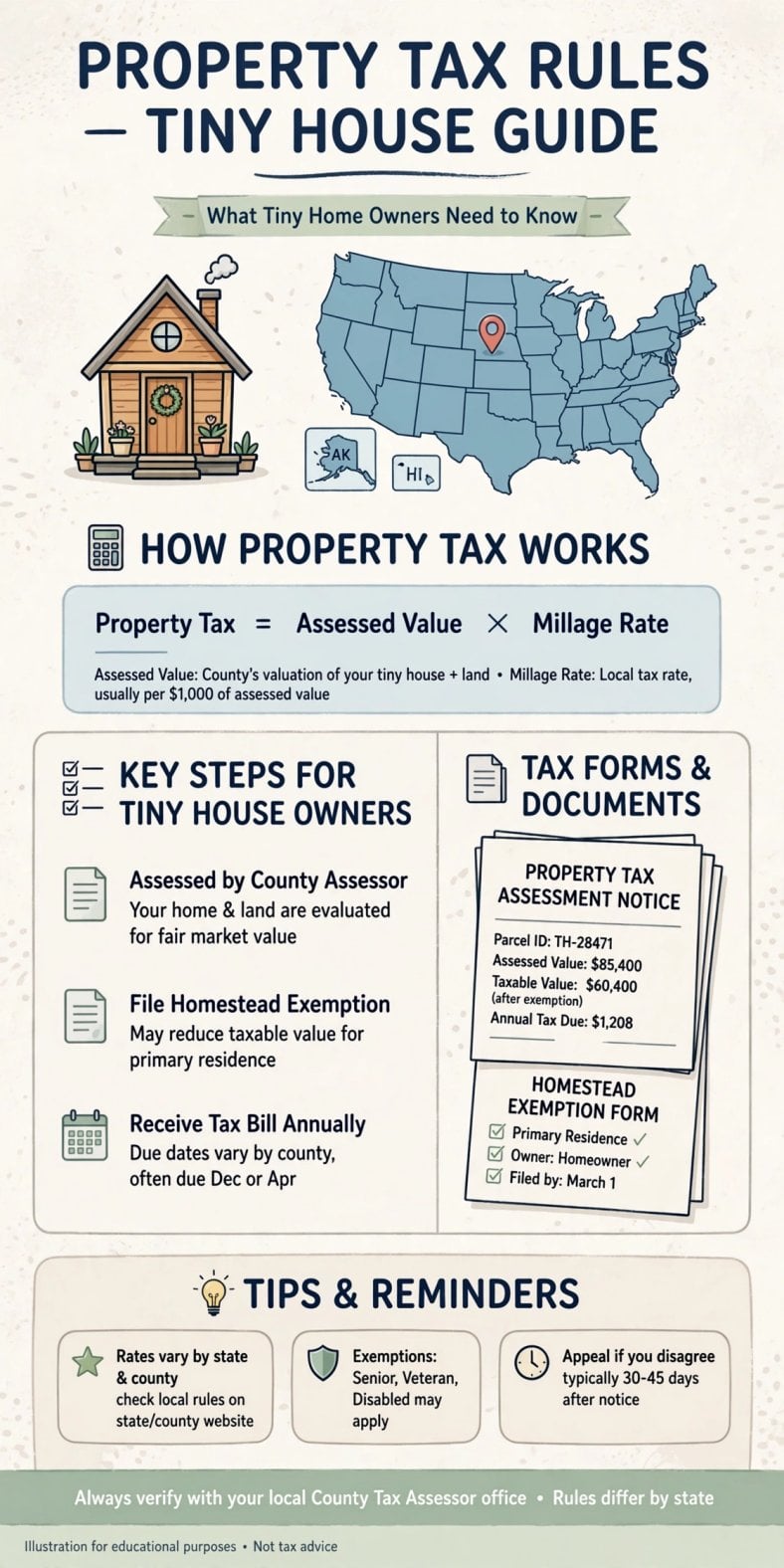
The Short Answer
Foundation tiny houses: Almost always subject to real property tax, like any house — assessed on the land and structure.
Tiny houses on wheels: Often subject to personal property tax or vehicle/RV registration fees instead — sometimes less, sometimes comparable, rarely zero.
The myth: “Tiny houses don’t pay property tax” is false as a general rule. Some specific situations escape taxation, but they’re exceptions, not the norm.
Real Property Tax vs. Personal Property Tax
Real property tax: Tax on land and permanently attached structures. This is the classic “property tax” — assessed annually, based on appraised value, funding schools and local services.
Personal property tax: Tax on movable property — vehicles, equipment, and in many states, tiny houses on wheels. Often lower rates, different assessment methods.
Why it matters: Classification determines which tax applies, who’s owed, how it’s assessed, and what exemptions exist. Get the classification right first.
Foundation Tiny Houses: Standard Taxation
How they’re assessed: Like any residential property — the assessor values the land and the structure, applies the local tax rate, and sends a bill.
Typical amounts: A $100,000 tiny house on a $50,000 lot at a 1% effective rate = $1,500/year. Actual rates range from ~0.3% (Hawaii) to ~2.5% (New Jersey) of assessed value.
The tiny house advantage: Lower value = lower tax. A $150,000 tiny house property pays a fraction of what a $500,000 conventional home pays in the same jurisdiction.
Tiny Houses on Wheels: The Patchwork
Personal property tax states: Many states tax THOWs as personal property — annual tax based on depreciated value, similar to vehicle tax. Rates and methods vary widely.
RV registration states: Some states treat certified THOWs as RVs — annual registration fees ($50–$500+) instead of property tax.
The gray zone: Some THOWs fall between categories — too house-like for RV treatment, too mobile for real property tax. Local assessors decide, inconsistently.
State Patterns: The Northeast
General pattern: High property tax states (New Jersey, Connecticut, New Hampshire) apply their standard regimes — foundation tiny houses face meaningful bills, though proportional to their lower values.
THOW treatment: Varies by state and municipality — expect personal property tax or registration requirements. Verify with the town assessor, not just state guidance.
State Patterns: The South
General pattern: Lower property tax rates overall (Alabama, Louisiana, South Carolina among the lowest effective rates). Foundation tiny houses here often have very modest tax bills.
Homestead exemptions: Many Southern states offer generous homestead exemptions that can substantially reduce or nearly eliminate tax on low-value tiny house properties.
THOW treatment: Mixed — some states have clear personal property frameworks; others handle THOWs ad hoc at the county level.
State Patterns: The Midwest
General pattern: Moderate-to-high property taxes (Illinois, Wisconsin, Michigan on the higher end). Agricultural and rural classifications can significantly reduce land tax portions.
Rural advantage: Tiny houses on rural or agricultural land often benefit from use-value assessment — the land is taxed on agricultural value, not development value.
State Patterns: The West
California (Prop 13): Property tax capped at ~1% of assessed value with limited annual increases. Foundation tiny houses benefit from the same protections — buy, and your tax base is largely locked.
No-income-tax states: Texas, Nevada, Washington, and others lean harder on property tax — but tiny houses’ low values keep bills manageable.
Oregon and others: Some Western states have specific frameworks for alternative dwellings — check for tiny-house-specific provisions.
How Assessments Actually Work
The assessor’s job: Determine market value (or a defined fraction of it) for your property, then apply exemptions and the tax rate.
For tiny houses: Assessors may struggle with valuation — thin comparable sales for tiny houses specifically. This can cut both ways (under- or over-assessment).
Appealing: If your assessment seems wrong, appeal — most jurisdictions have a formal process. Bring comparable sales, documentation of condition, and (for THOWs) depreciation schedules.
Exemptions That Help Tiny House Owners
Homestead exemptions: Available in most states for primary residences — reduce taxable value by a fixed amount ($25,000–$100,000+ depending on state). File for it; it’s not always automatic.
Senior exemptions: Additional reductions for older homeowners in many states — relevant for tiny houses as retirement housing.
Veteran/disability exemptions: Disabled veterans often qualify for partial or full property tax exemption — potentially eliminating the bill entirely.
Agricultural use: Land in agricultural use is assessed at use value — if your tiny house sits on working land, investigate this classification.
What If You Don’t Pay
Real property: Unpaid property tax leads to tax liens and eventually tax foreclosure — the government can sell your property to recover the debt. This is not theoretical.
Personal property: Unpaid personal property tax can lead to liens, registration blocks, and collection actions — varying by state.
The bottom line: Property tax isn’t optional. Budget for it from day one — it’s one of the permanent carrying costs of tiny house ownership.
Minimizing Your Property Tax Legally
Choose jurisdiction wisely: Effective tax rates vary 8x between the highest and lowest states. Location is the biggest lever.
File all exemptions: Homestead, senior, veteran, agricultural — claim everything you qualify for. Unclaimed exemptions are the most common overpayment cause.
Appeal bad assessments: Assessors make mistakes, especially on unusual properties. Annual review and appeal when warranted.
Consider classification: In some jurisdictions, THOW vs. foundation classification significantly changes the tax bill — understand both before committing to a build type.
Worked Examples
Foundation tiny house, Texas: $80,000 house + $40,000 lot = $120,000 assessed. At 1.8% effective rate: $2,160/year. Homestead exemption ($100,000 school exemption in Texas) could cut this substantially.
THOW, personal property state: $70,000 house depreciated to $50,000 assessed value. At 1% personal property rate: $500/year — plus vehicle registration.
Foundation tiny house, Alabama: $100,000 total assessed at 0.4% effective rate: $400/year. Homestead exemption may reduce further. Among the lowest bills in the country.
Special Assessments and Fees
Beyond the base rate: Many jurisdictions add special assessments — for roads, sewers, schools bonds, fire districts. These apply to tiny houses like any property.
Mello-Roos and CFDs: In California and similar states, newer developments may carry special district taxes adding $1,000–$5,000+/year regardless of house size. Investigate before buying in new developments.
HOA fees: Tiny house communities often have HOA or lot fees ($100–$500/month) that function like private taxation — budget them alongside property tax.
Tax Sales and Redemptions
How tax sales work: Chronically unpaid property tax leads to tax lien sales or tax deed sales — investors pay your tax debt and gain claims on your property.
Redemption periods: Most states give owners a redemption window (6 months to 3 years) to repay the debt plus interest and reclaim the property.
The lesson: Property tax delinquency is a slow-motion foreclosure. If you’re struggling, contact the tax office about payment plans before it reaches sale stage.
Renting Out Your Tiny House: Tax Implications
Income tax: Rental income is taxable — report it. Short-term rentals (Airbnb) have additional rules and often trigger local lodging taxes.
Property tax changes: Converting a primary residence to a rental may end homestead exemptions — increasing the property tax bill. Check before converting.
Depreciation: Rental properties can be depreciated for tax purposes — a significant deduction. Consult a tax professional; the rules reward documentation.
Moving States: Tax Reassessment
Foundation houses: Selling and buying in a new state means new assessments at current values — in rising markets, your tax bill may jump even for a similar house.
THOWs: Moving the house means new registration and new personal property tax jurisdiction. Some states prorate; others charge full annual amounts.
Prop 13 portability: California’s Prop 19 allows certain homeowners (55+, disabled, disaster victims) to transfer their tax base to a new home — potentially valuable for tiny house movers.
Working With Your Assessor
Be proactive: Contact the assessor’s office when you build, buy, or move a tiny house — don’t wait for them to find you. Voluntary compliance beats discovered non-compliance.
Document everything: Build costs, purchase price, depreciation schedules, certifications. Assessors work from evidence — provide it.
Ask about classifications: “How do you classify tiny houses on wheels? What exemptions am I eligible for? When are assessments updated?” Assessors answer these questions daily — ask.
Property Tax and Income Tax Deductions
SALT deduction: State and local taxes (including property tax) are deductible on federal returns up to $10,000/year — if you itemize. Most tiny house owners won’t exceed the standard deduction, making this moot.
When it matters: If you own additional property or have high state income tax, the SALT cap may bind — and tiny house property tax competes for the same $10,000.
Record-keeping: Keep property tax receipts regardless. They substantiate basis, support appeals, and matter if your situation changes.
The Long-Term View: Tax as Location Cost
Annualize it: A $1,500/year property tax bill is $125/month in permanent housing cost — compare it directly against rent or mortgage alternatives.
Inflation behavior: Property taxes generally rise with property values and local budgets — typically 2–4% annually. Model this in long-term plans.
The tiny house edge: Lower values mean lower taxes forever. Over 30 years, the cumulative property tax savings of a tiny house versus a conventional home can exceed $50,000–$100,000 in high-tax states.
Common Myths Debunked
“Tiny houses are tax-free”: False. Most tiny houses incur real property tax, personal property tax, or registration fees. The bills are smaller — not zero.
“Wheels mean no tax”: False. Wheels change the tax category, not the tax obligation. Personal property tax and registration fees apply in most states.
“Under a certain size there’s no tax”: Mostly false. A few jurisdictions have minimum-value thresholds, but they’re low and inconsistent — don’t plan around them.
“Off-grid means off-tax”: False. Tax follows ownership and classification, not utility connections. The assessor doesn’t care about your solar panels.
Frequently Asked Questions
Do tiny houses pay property tax?
Usually yes. Foundation tiny houses are typically subject to standard real property tax. Tiny houses on wheels often face personal property tax or RV registration fees instead. Truly tax-free situations are rare exceptions — verify with your local assessor.
How much is property tax on a tiny house?
It depends on value, location, and classification. A $150,000 tiny house property at a 1% effective rate = $1,500/year. Rates range from ~0.3% to ~2.5% across states, and exemptions can reduce the bill substantially.
Do tiny houses on wheels pay property tax?
Often they pay personal property tax or vehicle/RV registration fees rather than real property tax — but this varies by state and county. Some jurisdictions haven’t clearly classified THOWs, creating gray zones. Check with your local assessor.
Can I avoid property tax with a tiny house?
There’s no reliable legal way to avoid all property-related taxation. Strategies that minimize it — low-tax jurisdictions, exemptions, favorable classification — are legitimate; schemes to evade it are not, and the penalties exceed any savings.
Do I pay property tax if I rent the land under my tiny house?
You typically don’t pay real property tax on land you don’t own (the landowner does — and bakes it into your rent). But you may still owe personal property tax on the house itself, depending on your state. Clarify this in your land agreement.
Final Considerations
Tiny houses usually pay property tax — just less of it than conventional houses, because there’s less value to tax. The exact obligation depends on foundation vs. wheels, your state and county, and which exemptions you claim. Don’t rely on myths or forum anecdotes; call your local tax assessor with your specific situation and get the answer in writing. Then budget for it permanently — property tax is one of the few truly inescapable costs of homeownership, tiny or otherwise. The good news: on a tiny house, it’s one of the smallest bills you’ll have.