

There is a quiet irony in tiny house finance: the cheapest money available to most tiny house buyers is not a tiny house loan at all — it is the equity sitting in the conventional house they already own. A home equity line of credit lets a homeowner borrow against that equity at rates closer to mortgage pricing than to chattel or personal-loan pricing, draw only what a build actually needs, and repay flexibly. For the right buyer, a tiny house HELOC — home equity used deliberately — can fund land, site work, and the build itself for thousands less in interest than any loan secured by the tiny house.
The word to hold onto is “deliberately.” A HELOC is secured by your main home, which means the risk profile is unlike any other product in this guide series: default does not cost you the tiny house — it can cost you the big one. This article covers how a HELOC works mechanically, the equity and eligibility maths in full, a step-by-step application path, what the money can and cannot sensibly pay for, the risks in plain language, and how it stacks up against the alternatives. Example figures are illustrative, computed from typical current ranges; your lender’s terms — especially the rate cap and the draw rules — are the ones that matter, so read them before you fall in love with the idea.
1. What a HELOC Actually Is
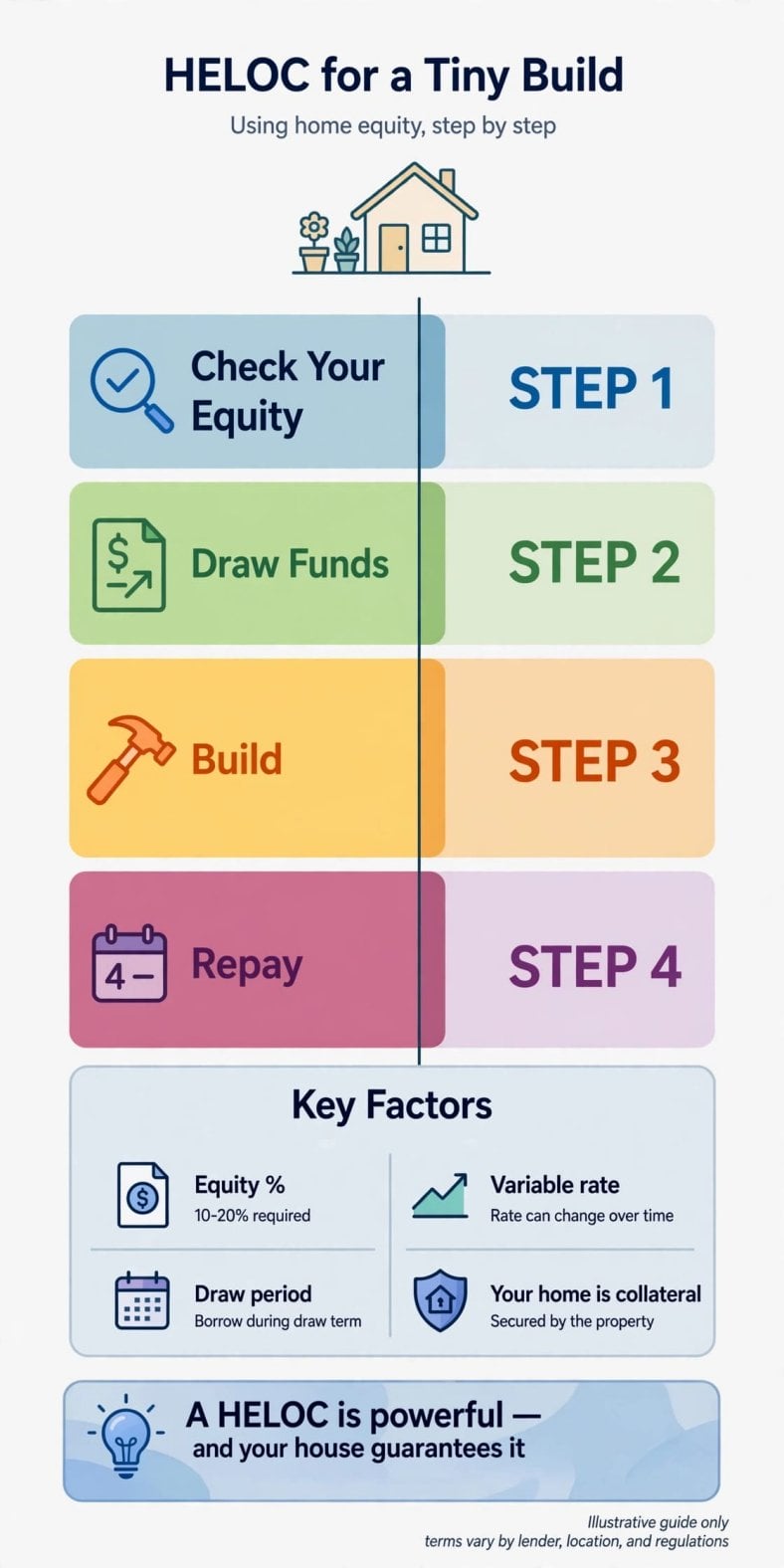
A HELOC is a revolving credit line secured by your existing home, structured in two phases. During the draw period — commonly 10 years — you may borrow, repay, and borrow again up to your limit, much like a credit card with a deed attached; minimum payments during this phase are usually interest-only on the drawn balance. During the repayment period — commonly 15 to 20 years — the line closes to new draws and the remaining balance amortizes like a loan. The rate is almost always variable, tied to the prime rate plus a lender margin: in recent cycles, qualifying borrowers have commonly seen rates roughly in the 8 to 10.5 percent range, moving with the market rather than fixed at signing. For a tiny house project, the HELOC’s defining trait is that the lender neither knows nor cares what the tiny house is: there is no certification requirement, no appraisal of the tiny home, no titling question. The tiny house is simply what you spend the draws on — which is precisely why a tiny house HELOC — home equity route succeeds where direct tiny house loans fail for DIY and unconventional builds.
Position it correctly against the rest of the market using our pillar guide to how to finance a tiny house: chattel, RV, and personal loans are underwritten on the tiny house and your credit; a HELOC is underwritten on your main home and your equity. Different collateral, different rules, different failure mode — the sections below keep returning to that trade.
2. The Equity Maths: How Much Line You Can Actually Get
Lenders cap HELOCs by combined loan-to-value (CLTV) — your first mortgage balance plus the new line, divided by the home’s appraised value. Caps commonly fall between 80 and 90 percent. Worked example: your home appraises at $420,000 and your mortgage balance is $260,000, so you hold $160,000 of equity. At an 85 percent CLTV cap, total secured debt may reach $357,000; minus the $260,000 mortgage, your maximum line is about $97,000 — enough, in most markets, for land plus a mid-range build, or the full cost of a quality tiny home with site work. Notice what the cap protects: the lender keeps a 15 percent equity cushion beneath you, and so should you. Borrowing to the cap consumes the cushion that absorbs a price dip; prudent tiny house borrowers self-limit to using 60 to 75 percent of their calculated maximum and leave a reserve. Closing costs on HELOCs are comparatively light — often $0 to a few hundred dollars in fees, sometimes an appraisal fee of a few hundred — with one trap covered in Section 7: many lenders waive closing costs only if the line stays open for a minimum period, commonly three years.
3. Eligibility: What the Lender Actually Checks
Because the collateral is a mainstream house, eligibility is mainstream too. Credit score: most lenders want 680 or higher for their best pricing, with some approving into the mid-600s at higher margins. Income and employment: documented, stable, and sufficient that your debt-to-income ratio — including the HELOC payment calculated at a stressed, fully drawn, amortizing figure, not the friendly interest-only number — stays within the lender’s limit, commonly around 43 percent. Appraisal: the main home is valued (full appraisal or automated valuation), which is where the $420,000 in our example comes from — no appraisal exists for the tiny house at all. Property conditions: the home must be insurable, titled cleanly, and typically your primary residence or a well-documented second home at tighter caps. If you plan to leave the main home and live in the tiny house full-time — as a backyard ADU host, or by selling later — raise that plan with the lender before closing, because occupancy representations in loan documents are not fine print to improvise around. Remember that the main home must stay properly insured throughout; our tiny house insurance guide for wheels versus foundation covers the tiny home’s own cover, which the HELOC lender does not arrange for you.
4. Step by Step: From Application to Funded Build
Step 1 — Size the project honestly. Total the real budget: land, site work, the home, delivery, permits, and a 10 to 15 percent contingency, checked against the full cost picture in our breakdown of the true cost of tiny houses. Step 2 — Compute your CLTV ceiling at 80, 85, and 90 percent and choose a target line below the maximum. Step 3 — Collect two or three HELOC quotes, comparing margin over prime, lifetime and periodic rate caps, draw-period minimum-payment rules, annual fees, early-closure cost recapture, and any fixed-rate lock option. Step 4 — Apply and appraise (typically two to six weeks to close). Step 5 — Sequence the draws to the project: land closing first, then site-work milestones, then builder progress payments — drawing late and in stages keeps interest-only costs low while money is not yet needed. Step 6 — Overpay from day one: treat the interest-only minimum as a floor, not a payment, and model your exit using our mortgage calculator for tiny houses so the repayment-period figure never arrives as a surprise.
5. Using One Line for Land + Build: Sequencing That Works
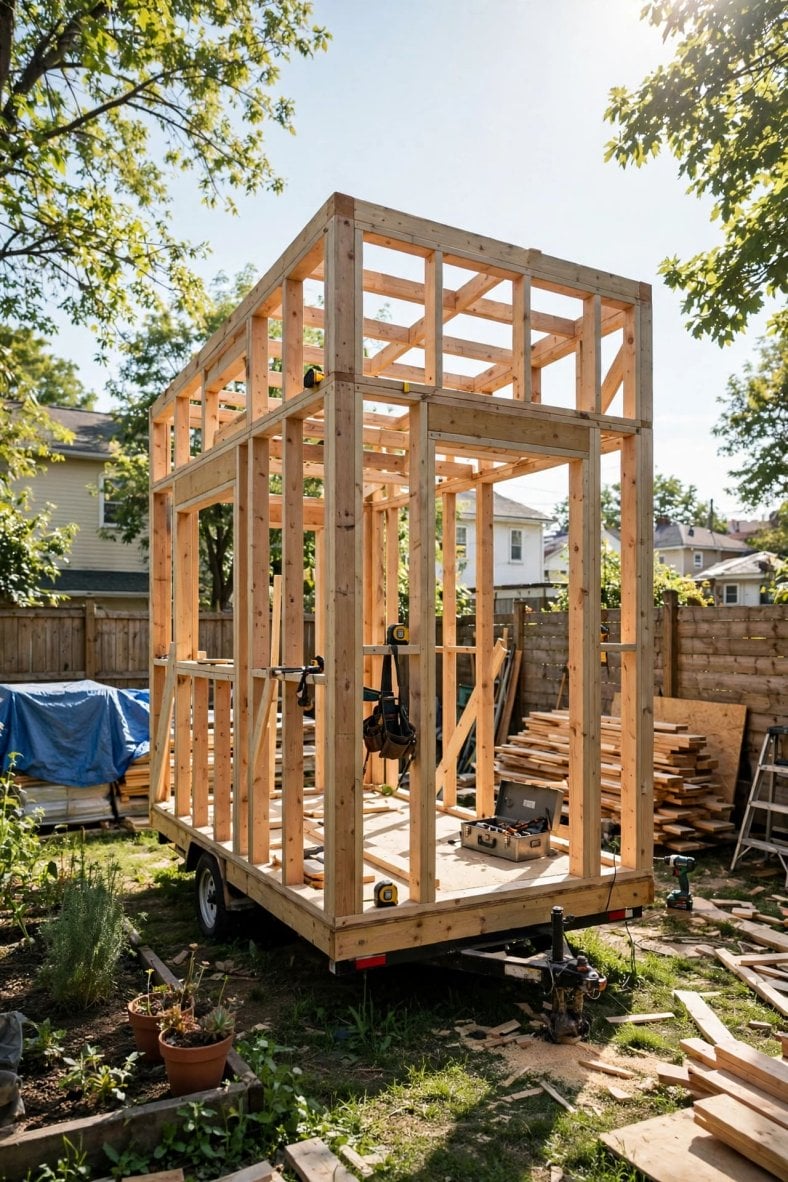
The HELOC’s most underappreciated advantage is that it can fund the two purchases tiny house lending usually splits apart: the land and the home. Buyers routinely draw for the lot purchase (researching the parcel first with our guide to where to buy tiny house lots), then draw in stages for the site work — survey, septic or sewer connection, water, power, driveway — following the sequence in our walkthrough of how to prepare your land for a tiny house, and finally for the home itself, whether a builder’s progress draws or the delivery balance on a finished unit. Two disciplines make this work. First, phase the draws to invoices, not to optimism: every dollar drawn starts accruing interest immediately, so a $20,000 draw taken three months early at 9 percent costs roughly $450 of pure patience. Second, keep the wheels-versus-foundation decision conscious: a HELOC can fund either, but money spent on a wheels home buys a depreciating asset with home-secured debt, while money spent on a foundation build on your own lot creates a second real property — Section 7 returns to why that distinction matters for risk.
6. Draw and Repayment Mechanics — and the Variable-Rate Trap
Access is deliberately easy: checks, a card, or online transfers, often with a minimum draw amount. That ease is the product’s danger in slow motion. Your minimum payment during the draw period is typically interest only — on $60,000 drawn at 8.9 percent, about $445 a month that reduces your balance by exactly zero. When the draw period ends, the same $60,000 amortized over 20 years at 9 percent costs about $540 a month, every month, for two decades — and if rates have risen in the meantime, more. Three numbers in your loan documents control your future: the margin over prime (your true price), the lifetime cap (the worst case — often startlingly high, 18 percent or more on some lines), and any periodic adjustment cap. Some lenders offer a fixed-rate lock feature that lets you carve a drawn balance into a fixed-rate sub-loan; for a build whose final cost is known at completion, locking the bulk of the balance at that point is one of the soundest moves in this entire guide. A HELOC is cheapest when it is treated as a bridge and repaid aggressively, and most expensive when it is treated as permanent money at a teaser of a minimum payment.
7. The Risks, Stated Plainly
Your main home is the collateral. Miss payments on chattel or RV debt and you can lose the tiny house; miss HELOC payments and the foreclosure is on the home you live in — with your family’s housing, not a lifestyle asset, on the table. Every other risk is a footnote to that one, and it disqualifies the product entirely for borrowers whose income is unstable or whose tiny house plan is speculative. Rate risk: a variable rate that starts at 8.9 percent can be 11 percent before your draw period ends; stress-test your budget at the cap-adjusted figure, not the start figure. Freeze risk: lenders may reduce or freeze lines when home values fall or credit profiles change, including mid-project — keep a contingency that does not live inside the line itself. Depreciation mismatch: securing a loan with an appreciating asset (your home) to buy a depreciating one (a wheels tiny house) inverts sound collateral logic; it can still be right for a genuine housing need, but size the draw to the tiny home’s resale value trajectory, not its purchase price. Early-closure recapture: close the line inside the lender’s minimum window and waived closing costs — sometimes $500 to $2,000 — come back onto your bill. Behavioural risk: a replenishing line quietly funds the truck, the deck, and the holiday. Ring-fence it: one project, one ledger, no exceptions.

8. HELOC vs the Alternatives
| Option | Collateral | Rate style | Best at | Watch out |
|---|---|---|---|---|
| HELOC | Main home | Variable, prime + margin | Staged land + build funding | Home at risk; rate rises; repayment shock |
| Home equity loan | Main home | Fixed, lump sum | One known total cost | Interest on full sum from day one |
| Cash-out refinance | Main home | Fixed mortgage rate | Large projects, low first-mortgage rate available | Resets your whole mortgage; closing costs |
| Chattel / RV loan | Tiny house | Fixed, higher | No risk to main home; certified builds | Depreciation; shorter terms |
| Construction loan | New property | Short-term, converts to mortgage | Foundation builds on owned land | Inspections, draws, codes required |
| Savings / staged cash build | None | Zero interest | Zero debt risk | Time; inflation on materials |
The fixed-rate home equity loan deserves a special note for tiny house buyers: if your project cost is a single known number (a turnkey foundation build, for instance), its lump sum at a fixed rate trades the HELOC’s staging flexibility for total payment certainty — for many borrowers the better sleep. And whatever product you choose, note that certification still matters for the tiny home itself at resale and insurance time, even when the lender ignored it; our explainer on what RVIA certification is and why your tiny house needs it covers the downstream effects.
9. Verdict: Who Should, and Who Should Not
Strong fit: a homeowner with substantial equity, stable documented income, a project with phased costs (land, then site work, then build), and the discipline to overpay during the draw period and consider locking the final balance. For this buyer the HELOC is frequently the cheapest and most flexible route in all of tiny house finance. Possible fit: the ADU builder adding a tiny home in their own backyard for family or rental — the project enhances the very property securing the loan, which aligns collateral and investment unusually well. Poor fit: buyers whose equity is their only financial cushion, buyers funding a speculative or soon-to-be-flipped tiny house, anyone whose budget only works at the interest-only minimum payment, and anyone planning to sell or leave the main home soon (repayment and recapture clauses will sour the maths). If you fall in the poor-fit column, the chattel and RV routes in Section 8 keep the risk on the tiny house — where, for most buyers, it honestly belongs.
Final Considerations
Judge a HELOC the way a lender judges you: by the worst realistic case, not the brochure case. Model the line fully drawn, at a rate two points higher than today’s, entering repayment on schedule, and confirm the payment is unremarkable inside your real budget. Then use the product the way it rewards: draw in stages against invoices, overpay every month you can, and lock or repay the balance down once the build is done. Equity took you years to accumulate; spent carefully on a tiny house — land beneath it, roof over you, housing costs cut for a decade — it is one of the most productive uses a line of credit can have. Spent casually, it is a mortgage on a depreciating lifestyle purchase. The difference is not the product. It is the plan.