

Financing a tiny house starts with an identity problem, not a price problem. A conventional home loan assumes a fixed house on owned land, a tiny house on wheels is a movable structure that may be titled, certified, parked, or permanently installed depending on how you live in it, and each of those identities points to a completely different kind of credit. That is why comparing tiny house loan lenders head to head only makes sense once you sort them by type: the eight options below are not eight versions of the same product, they are eight different answers to the question of what your tiny house legally is.
This guide walks through each lender type in the order most buyers meet them, explains what each one lends against, what it asks from you, and where the honest trade-offs sit. Nothing here promises an approval, a rate, or a specific product, because none of that can be known until a real lender looks at your real house, income, and parking plan. What you can control is arriving at that conversation with the right classification, the right paperwork, and a realistic shortlist instead of applying everywhere and hoping.
At a Glance: The Eight Options Side by Side
| Option | Lender type | What secures the loan | Best suited to | Main trade-off |
|---|---|---|---|---|
| 1 | RV-style loan | The certified tiny house on wheels itself | Certified THOWs used as recreational or part-time homes | Use and parking restrictions may apply |
| 2 | Personal loan | Nothing; your income and credit history | Smaller budgets, used houses, fast timelines | Shorter terms and higher cost of credit |
| 3 | Mortgage-style loan | A tiny house permanently installed on land | Foundation-built tiny homes on owned land | Slowest process, strictest property rules |
| 4 | Credit union loan | Varies; often the house or your deposit relationship | Members who want a human conversation about an unusual home | Membership rules and smaller lending capacity |
| 5 | Builder or manufacturer finance | The house under construction, through the builder | New builds bought directly from a builder | Less room to compare terms independently |
| 6 | Chattel loan | The movable home, not the land under it | Homes placed on leased or family land | Fewer protections than a mortgage |
| 7 | Home-equity borrowing | Another property you already own | Homeowners funding a tiny house as a second unit | Puts the main property at risk |
| 8 | Online marketplace loan | Usually unsecured, matched to partner lenders | Comparing several offers with one application | Terms depend entirely on the matched lender |
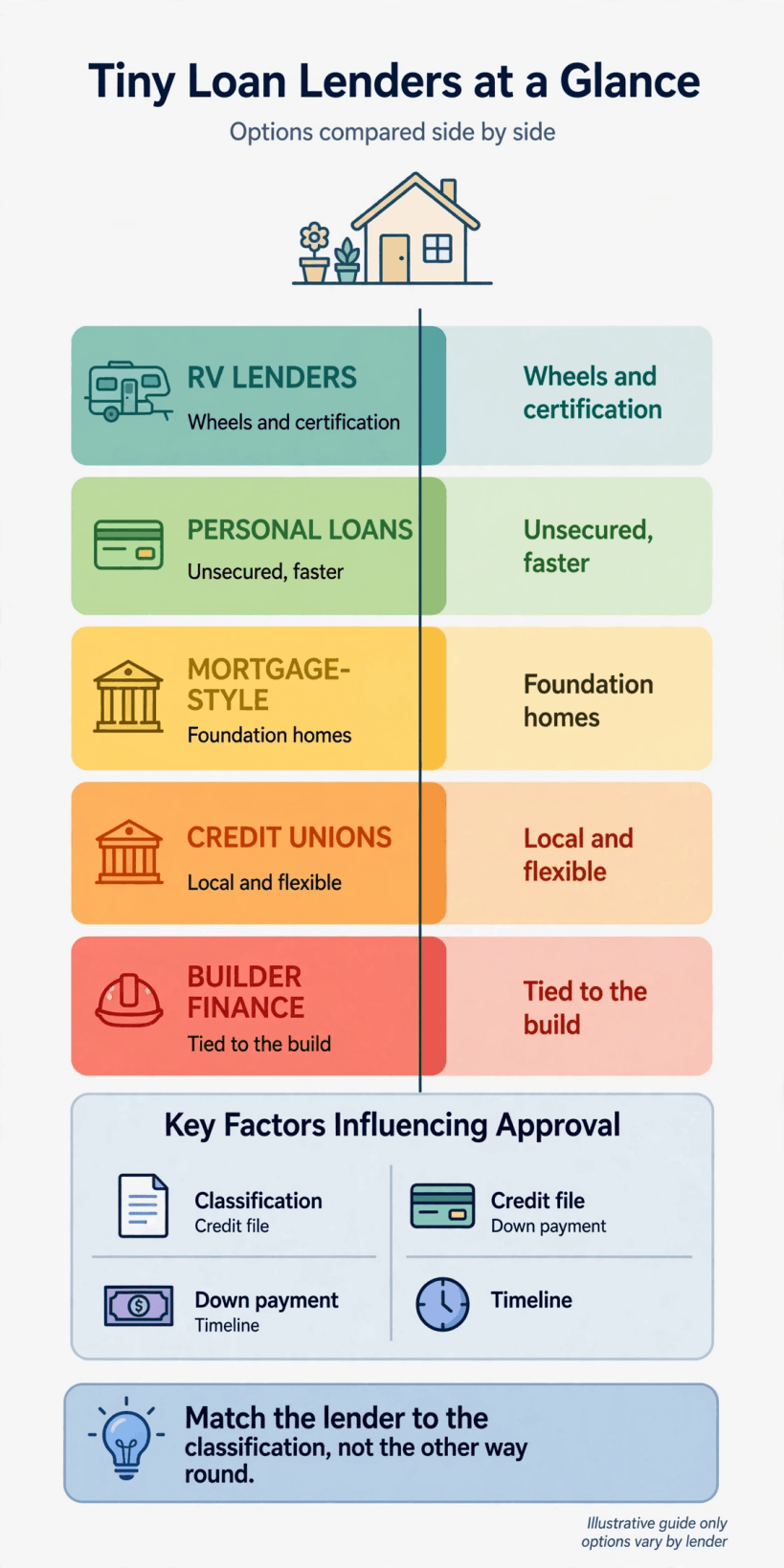
1. How Classification Decides Which Loans Even Exist
Before any lender discusses money, it classifies your house. A tiny house on wheels may be treated as a recreational vehicle if it carries the right certification, as personal property if it is simply a movable structure, or as real property once it is permanently affixed to land you own. Each classification unlocks a different shelf of loan products and closes others, which is why two buyers with identical incomes can be offered completely different options for houses that look almost the same.
Ask classification questions first: Is the house certified to a recognized standard? Will it sit on a foundation or stay on its trailer? Do you own the land, lease it, or park in a community? Your answers form the lender’s decision tree. Our explainer on the IRC Appendix Q rules for tiny homes shows how building-code recognition feeds into this, and it is worth reading before you apply anywhere, because a house built to a recognized code is simply easier for a lender to understand, value, and insure.
2. RV-Style Loans: When Certification Opens the Door
If your tiny house on wheels is certified as a recreational vehicle, some lenders can finance it through their RV lending channel. The appeal is structural: the lender already knows how to title, value, and repossess a movable dwelling, so the paperwork follows a familiar path. The house itself is the collateral, the term is set around its expected life as a vehicle, and the process is usually faster than anything involving land.
The trade-offs live in the conditions. RV-channel lending may limit how the house can be used, where it can be parked, or whether it can be your full-time residence, and those limits vary by lender and policy rather than by any universal rule. Read the use clauses as carefully as the payment terms. The trailer under the house matters here too, so review our tiny house trailer buying guide before you buy, because a properly rated, documented trailer supports both certification and valuation.
3. Personal Loans: Fast, Unsecured, and Demanding
A personal loan ignores the house almost entirely. The lender evaluates you: your income stability, existing debts, and repayment history. Because nothing secures the loan, approval can be quick and the money can fund a used tiny house, a shell, or a self-build that no property-based lender would touch. For smaller budgets and simple purchases between private parties, this is often the most straightforward route available.
Unsecured also means the lender carries more risk, and that risk is priced in. Expect shorter repayment windows and a higher overall cost of credit than a secured product, and expect the amount offered to be capped by your income rather than by the value of the house. Run the total repayment, not just the monthly figure, before signing. Knowing the realistic weight and specification of what you are buying helps you borrow the right amount, and our guide on how to calculate the weight of a tiny house is a useful reality check when a seller’s description sounds optimistic.

4. Mortgage-Style Loans: When a Tiny House Counts as a Real Home
At the other end of the spectrum, a tiny house that is permanently installed on a foundation, on land you own, connected to utilities, and built to the locally adopted residential code can sometimes be financed much like any small house. This is the slowest and most documented route: appraisal, title work, inspections, and property standards all apply, because the lender is financing real estate, not a vehicle.
The reward for that patience is the most mortgage-like structure: the loan is secured by house and land together, which generally supports longer terms and a clearer resale path. The constraint is eligibility. Many tiny houses on wheels will never qualify, no matter how well built, because wheels and a trailer frame contradict the permanence this channel requires. If this is your goal, plan it from the start with the land work in our guide on how to prepare land for a tiny house, since zoning, foundations, and utility connections are decided long before a lender gets involved.
5. Credit Unions: Relationship Lending for Unusual Homes
Credit unions are member-owned, locally focused lenders, and that structure sometimes makes them the most flexible audience for an unusual home. A loan officer who can walk your file through a smaller decision process may consider a certified tiny house, a park placement, or a member’s long deposit history in ways a large automated lender will not. Some credit unions offer RV, personal, or small real-estate products that can be adapted to a tiny house purchase.
The honest limits are scale and consistency. Membership eligibility rules apply, lending capacity is smaller, and one branch’s enthusiasm is not a policy you can rely on until it is in writing. Treat a credit union conversation as exactly that: a conversation. Bring your classification documents, your parking plan, and your insurance thinking, and ask what product, if any, they would actually use for your house, then get the answer in the form of a real pre-approval rather than encouragement.
6. Builder and Manufacturer Financing: One Contract, Hidden Trade-Offs
Many tiny house builders either arrange financing through partner lenders or refer buyers to channels they work with regularly. The convenience is real: the builder knows which certifications their houses carry, the lender knows the builder’s product, and the build contract and the loan timeline can be coordinated so deposit, progress, and delivery milestones line up instead of colliding.
Convenience, however, is not the same as value. A builder’s channel is one option, not a market comparison, and the terms you are offered deserve the same scrutiny as any other quote: total cost, term, what happens if delivery slips, and what the warranty does and does not cover. Ask whether you may use your own lender instead, and compare both paths before committing. Delivery is part of the finance picture too, because transport is a real cost at the end of a build, as our tiny house moving guide explains in detail.
7. Chattel, Home-Equity, and Marketplace Loans: The Remaining Three Options
Three further options complete the eight. A chattel loan is secured by a movable home but not by land, a structure long used for manufactured housing placed on leased or family land. It can fit a tiny house that will live on a rented lot or a relative’s parcel, but it usually carries fewer consumer protections and different titling than a mortgage, so the contract deserves slow reading.
Home-equity borrowing takes the opposite approach: it ignores the tiny house and borrows against a property you already own. It can be practical for a homeowner adding a backyard tiny unit, but it converts an unsecured dream into a debt secured by your main home, which should give anyone pause. Online marketplace loans, finally, match one application to several partner lenders, usually on an unsecured personal-loan basis. They are useful for comparison, provided you remember the marketplace is an introducer, and the real terms belong to whichever lender you are matched with.
8. The Paperwork Every Lender Type Asks For
Whatever the channel, the file looks similar. Expect proof of income and employment, a record of existing debts, identification, and a credit history review. On the house side, expect to document what the house is: builder details, certification paperwork where it exists, the trailer’s identification and rating, photographs, and a bill of sale or build contract. On the living side, expect questions about where the house will be parked or installed and how it will be insured, because a lender financing a movable asset cares deeply about where that asset sleeps.
Build this file before you apply anywhere. A complete packet makes a small lender confident, makes a large lender’s automated process smoother, and lets you answer follow-up questions in hours instead of weeks. Keep digital copies of everything, name the files clearly, and keep the parking and insurance answers consistent across every application, since contradictions between applications are an easy and avoidable reason for delays.

9. Total Cost Thinking: Term, Fees, Insurance, and Parking
The loan payment is only one line in the real monthly cost of a borrowed tiny house. Add insurance for a movable or small dwelling, which works differently from standard homeowners cover, as our guide on how to keep your tiny house safe discusses from the protection side. Add the cost of the place the house will live: a community lot, a rented parking spot, or land payments of your own.
Placement is not a background detail; lenders and insurers both price risk around it. The differences between communities and parks, covered in our comparison of tiny house communities vs RV parks, affect lot fees, rules, and how permanent your setup is allowed to be. When you compare two loan offers, compare them on total cost over the full term, including fees and the insurance each lender requires, not on the monthly payment alone, because a longer term can make an expensive loan look deceptively gentle.
10. How to Apply in the Right Order Without Burning Your Credit
Sequence protects you. First, classify the house and gather the paperwork file. Second, talk to the lender types that fit that classification, starting with relationship options such as your own bank or credit union and the builder’s channel if you are buying new. Third, collect written quotes within a short window so the comparison is honest, and ask each lender the same questions about term, total cost, use restrictions, insurance requirements, and what happens if you move the house.
Resist applying everywhere at once before you know your classification, because a pile of mismatched applications wastes time and can complicate your credit profile. Your running costs matter to underwriters too, so understand your likely utility setup using our tiny house utilities guide and budget it alongside the payment. A borrower who can explain the house, the parking, the insurance, and the monthly totals in one calm page is, frankly, the borrower every one of these lender types prefers to work with.
Verdict: Who Should Pick Which Loan Type
Pick the RV-style loan if your house is a certified tiny house on wheels and your use fits the lender’s conditions. Pick a personal loan if your budget is modest, your timeline is short, or the house is used or self-built and you accept a higher cost for simplicity. Pick the mortgage-style route if your tiny house will be a permanent, code-built home on your own land and you can tolerate a slower process. Pick a credit union if relationships and local flexibility matter and you qualify for membership. Pick builder finance for coordination, but only after comparing it against one independent quote. Consider chattel lending for homes on leased or family land, home-equity borrowing only with clear eyes about the risk to your main property, and marketplace loans as a comparison tool rather than an answer in themselves.
Final Considerations
There is no single best way to finance a tiny house, only a best match between a house’s legal identity, a place to put it, and a borrower’s real budget. Classify first, document everything, compare total costs in writing, and let the lender types above compete for the version of tiny living you are actually planning. Do that, and the financing becomes what it should be: a solvable logistics problem on the way to a smaller, calmer home, rather than the obstacle that stopped the project.


0 Comments