

Shopping among tiny house insurance companies is confusing for a reason that has nothing to do with price. A tiny house does not fit the categories insurers normally sell. It may be a vehicle, a dwelling, a cabin, a park home, or a certified recreational unit, sometimes all in the same conversation, and each classification opens a different set of policies while quietly closing others. Two owners with identical homes can be quoted completely different products, at completely different terms, simply because one home sits on a foundation on owned land and the other sits on wheels in a rented park. Classification decides everything, and it is decided before anyone talks about cover.
So this comparison names no insurers and quotes no prices, deliberately, because neither would survive contact with your classification anyway. Instead, the seven providers promised in the title are compared here as seven provider and policy routes: specialist insurers, specialist brokers, mainstream insurers, RV-style policies, dwelling-style policies, park or site schemes, and generalist local agents. Each route is judged head-to-head on the same ground: what it covers well, what it commonly excludes, who it genuinely suits, and what to verify in writing. Find your classification first, compare the routes in the table, then read the exclusions section before you read any quote.
| Option type | What it suits | What to verify |
|---|---|---|
| Specialist insurer, direct | Owners who want a policy designed for tiny homes from the start | Which classifications they accept, wheels, foundation, or both |
| Specialist broker | Unusual homes, self-builds, and owners refused elsewhere | How many insurers the broker can actually place you with |
| Mainstream insurer | Foundation homes and owners bundling with other policies | Full-time living, size limits, and construction conditions in writing |
| RV-style policy | Certified homes on wheels that travel or sit in parks | Whether full-time occupancy is covered or excluded |
| Dwelling-style policy | Homes on foundations treated as small houses | Building standards evidence and how outbuildings and decks count |
| Park or site scheme | Residents of parks where a group arrangement is offered | What the scheme covers versus what remains your responsibility |
| Generalist local agent | Owners who value a human who will search several markets | The agent’s actual experience with non-standard homes |
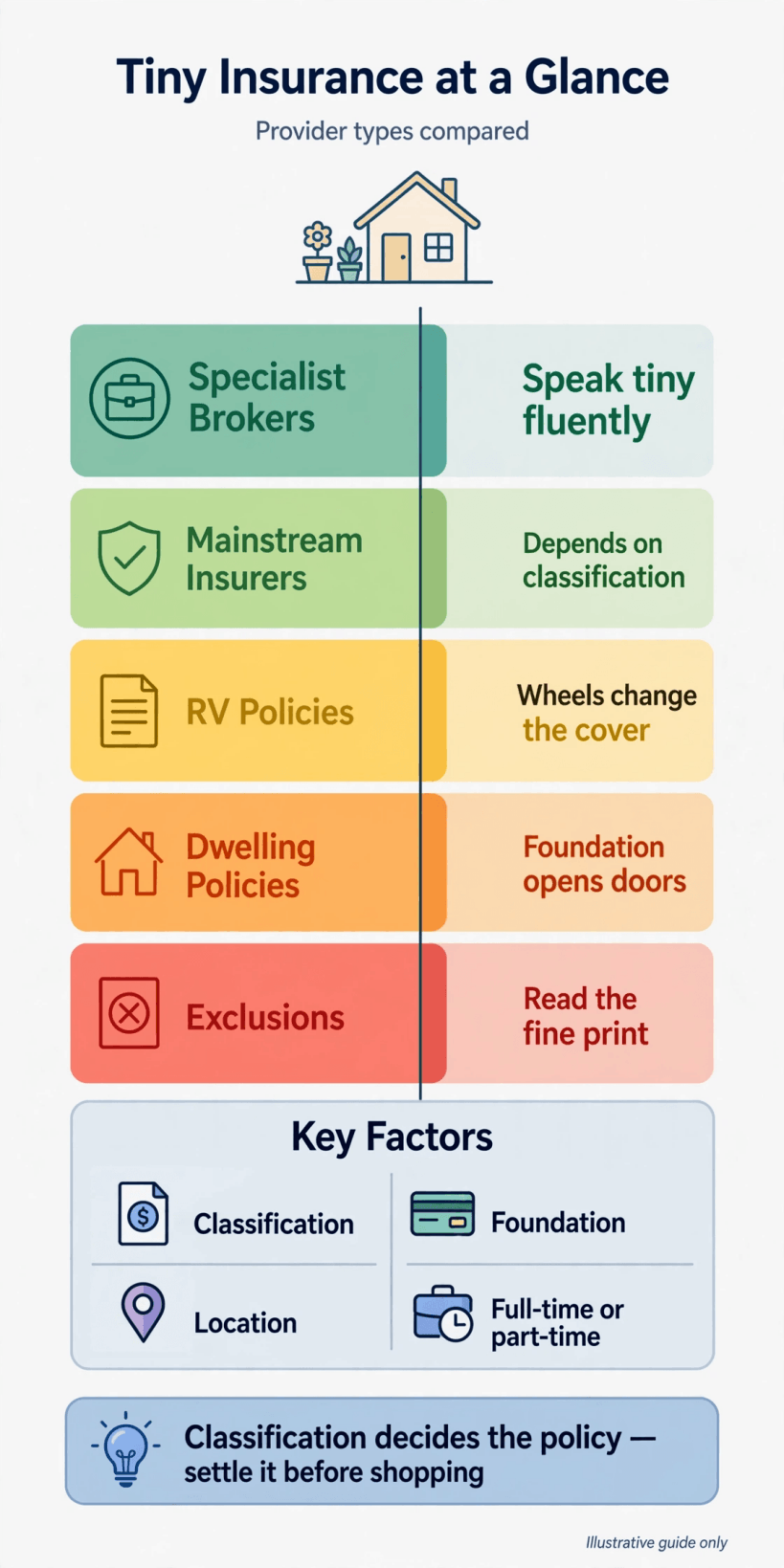
1. Classification First: RV, Dwelling, or Something In Between
Every route in this comparison hangs on one question: what is your home, in the eyes of an insurer? A tiny house on wheels may be classed with recreational vehicles, especially where it carries a recognised certification. A tiny house on a foundation, connected to services and used as a main residence, may be classed as a dwelling. Between those poles sit park homes, cabins, annexes, and self-builds that match neither template neatly, and those in-between homes are where insurance conversations go wrong, because a policy sold under the wrong classification can fail exactly when it is claimed on.
Start by reading our tiny house insurance guide for homes on wheels versus a foundation, which walks through the classification problem in depth, and, if your home carries certification, our explanation of what RVIA certification means for a tiny house and what it does and does not prove. Gather the facts every route will ask for: dimensions, construction, foundation or chassis, where the home sits, who owns the land, how the home is heated, and whether you live in it full time. Answer identically everywhere. Classification is not a label you shop for; it is a description you must be able to evidence.
2. Specialist Brokers: Deep Knowledge, a Narrow Shelf
A specialist broker does not insure you directly. They place your home with insurers whose products fit non-standard risks, and their value is knowledge: they know which underwriters will look at a self-build, which will accept a wood stove, which insist on certification, and which will quietly decline anything under a certain size. For owners of unusual homes, that knowledge can be the difference between a real policy and a month of refusals. A good specialist will also translate, explaining why a question is being asked and what an exclusion means for your actual life in the home.
The honest trade-off is the size of the shelf. A broker can only offer the insurers they deal with, and specialist markets are small, so the choice placed in front of you may be a choice of two or three, presented well. Fees and commissions are part of this route’s economics, which is normal, but you are entitled to understand how the broker is paid and whether the recommendation is the best fit or the only fit. Ask directly how many markets were approached for your home, and what the answers were. A broker who answers that question plainly is demonstrating exactly the expertise you are paying for.
3. Mainstream Insurers: Convenience and Bundling, With Conditions
The mainstream route is the household-name insurer you may already use for a car or a previous home. Its attractions are real: one account, familiar claims systems, the possibility of bundling, and, for tiny homes on foundations that resemble small conventional houses, a dwelling policy that fits without special pleading. Some mainstream insurers have also developed specific positions on tiny and non-standard homes, which can make them a straightforward answer for straightforward homes. Convenience, however, is where the strengths end and the conditions begin.
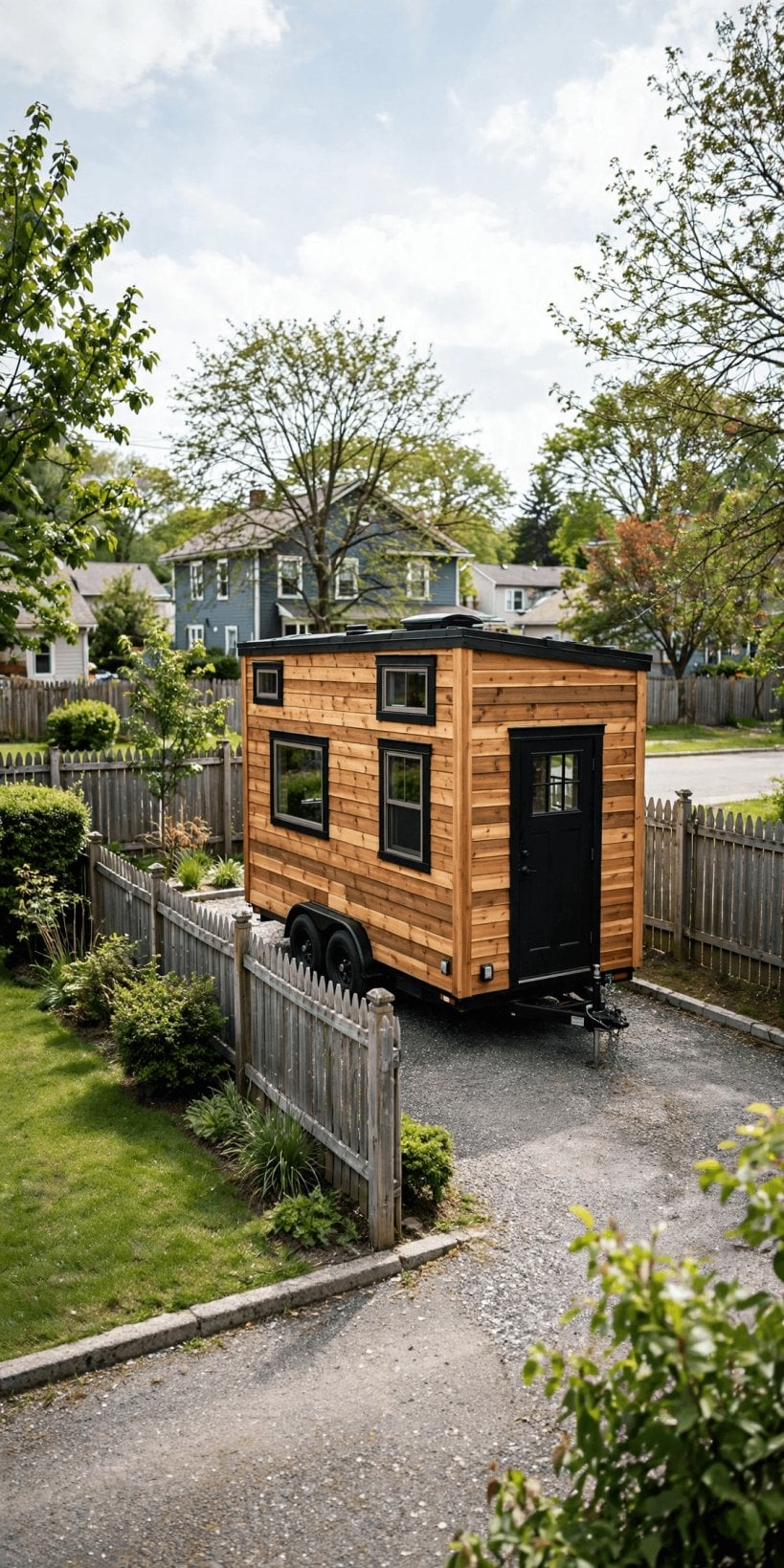
Mainstream products are built around standard assumptions, and tiny homes break several: minimum sizes, standard construction, permanent siting, approved heating, and occupancy patterns. A quote generated quickly online may embed assumptions your home does not meet, and a policy bought on wrong assumptions is cover in name only. Use the mainstream route with your classification documents in hand, get acceptance of the specific facts in writing, and read the conditions about heating appliances, unoccupancy periods, and letting. If the mainstream answer is yes, in writing, on the real facts, it can be excellent value. If it is a fast yes with no questions asked, be careful.
4. RV-Style Policies: Built for Wheels and Travel
An RV-style policy treats the tiny house as what its chassis says it is: a vehicle-like unit designed to move. That brings genuine strengths for homes on wheels. Transit and towing-related risks sit naturally inside this kind of policy, park siting is familiar territory, and contents, awnings, and the realities of a home that relocates are understood rather than explained from scratch. For a certified tiny house that travels regularly or lives in parks as the rules of those parks intend, the RV route often asks the fewest strange questions and understands the home’s daily life best.
Its limits appear at the boundary between recreation and residence. Many vehicle-style policies are written around occasional or seasonal use, and full-time living can be excluded, limited, or priced as a special case. A home parked indefinitely, skirted, plumbed in, and lived in all year starts to behave like a dwelling wearing a vehicle policy, and claims can turn on that gap. If you live in your wheeled home full time, the occupancy wording is the whole policy for you. Read it, ask about it specifically, and keep the answer with your documents.
5. Dwelling-Style Policies: Built for Foundations and Permanence
A dwelling-style policy treats the tiny house as a small house, and for homes on foundations that is the most natural fit in this comparison. Buildings cover, contents, liability, and the usual homeowner protections map onto daily life without translation. Lenders, where a loan exists, are also most comfortable with this classification, and a permanent home on owned land, sited and serviced like any other house, can often be insured much like one, sometimes by the same mainstream and specialist routes that handle non-standard conventional homes.
The route’s demands are evidence and permanence. Expect questions about construction standards, foundations, services, and how the home was sited, where the groundwork described in how to prepare land for a tiny house becomes part of your insurance file as well as your build file. Wheels removed or retained, decks and outbuildings counted or excluded, and the home’s status if you later move it, all belong in the conversation now, not at renewal. A dwelling policy is strong, stable cover for a home that stays put, and a poor costume for a home that still travels twice a year.
6. The Other Routes: Specialist Insurers Direct, Park Schemes, and Generalist Agents
Three routes remain, each narrower than the big four and each the right answer for somebody. A specialist insurer approached directly offers products designed for tiny and non-standard homes, without a broker in between; that can mean tidy, purpose-written wording, provided your home fits their stated appetite. A park or site scheme arranges cover for residents collectively; it can be convenient and well-priced for standard park situations, but you must separate what the scheme covers, sometimes only the structure in its park context, from liability, contents, and away-from-park risks that may remain yours to arrange.
The generalist local agent is the oldest route of all: a human broker without a tiny-house specialism who searches the markets they know. Their quality varies with their curiosity. A good generalist who finds your home interesting will learn the market on your behalf and may already insure the local cabins, park homes, and annexes. A disinterested one will offer the nearest standard product and move on. Judge this route by the questions the agent asks you. Detailed, classification-first questions are the sign of a route worth taking; a fast quote with none is a warning, whichever of the seven routes produced it.
7. What Every Policy Should Cover: Structure, Contents, Liability, Transit
Strip away the routes and every tiny-home policy is some combination of four covers, and a fair comparison checks each one separately. Structure cover is the home itself, valued honestly at what rebuilding or replacing it would actually cost, including, for self-builds, the labour reality a like-for-like figure may hide. Contents cover is everything that would fall out if you tipped the home up: in a tiny house that is a high value in a small space, often including expensive systems and equipment, so inventory it properly rather than guessing a round number.
Liability cover protects you if someone is hurt or something of theirs is damaged in connection with your home, a risk that grows the moment guests stay, neighbours live close, or a park places homes side by side. Transit cover is the specialist of the four: the home in motion is at its most vulnerable and least conventional-home-like, and wheeled homes should confirm exactly which movements, by whom, and how often, are covered. The systems inside the home matter to underwriters too, and the overview in tiny house utilities: power, water and off-grid sewage is a useful checklist of what to disclose about how your home actually works.
8. Exclusions to Read Twice: Full-Time Living, Stoves, Letting, Vacancy
Exclusions are where tiny-home policies are won and lost, and four deserve to be read twice. Full-time living is the first: a policy priced for recreational or occasional use may exclude or limit the main-residence life you actually live, and no discount is worth a claim refused on occupancy. Unoccupancy is its twin. Homes left empty beyond a stated period, for travel, work, or winter, can lose cover unless the insurer is told and conditions such as draining down or maintaining heat are met, so the winter routines in tiny house living in cold climates belong in your insurance thinking too.

Heating appliances are the third, and wood stoves lead it: a stove not disclosed, not installed to its stated clearances, or not documented can give an insurer grounds to refuse the very fire claim the policy exists for, which is why the installation standards in how to heat a tiny house with propane, wood and electric options should be matched by an insurer conversation on record. Letting is the fourth: guests who pay, even occasionally, change the risk and usually the policy. If there is any chance your home earns money, disclose it before the first booking, not after the first incident.
9. Compare Quotes Fairly: Same Home, Same Cover, Same Honest Answers
Quotes from different routes are only comparable when they describe the same risk. Give every provider the same facts, the same rebuild value, the same contents total, the same occupancy story, and the same heating and siting details, and ask for the same four covers itemised. A cheaper quote that quietly drops transit, halves the contents, assumes occasional use, or raises the excess beyond what you could actually pay is not cheaper cover; it is less cover wearing a smaller number. Lay the quotes side by side on classification, covers, exclusions, excess, and conditions, in that order, and let price speak last.
Value the paper trail as part of the product. Insurers and brokers who confirm acceptance of your specific facts in writing, list your stove, your full-time living, your park siting, or your foundation type on the documents, are selling you certainty as well as cover. That habit of total-cost, whole-picture thinking is the same one we apply to the purchase itself in the true cost of tiny houses, prefab versus DIY. The right question is never which quote is cheapest. It is which quote would still be standing, unchanged, on the worst day of the policy year.
10. Claims, Renewals, and Keeping the File Current
Insurance is a relationship with a file, and the file should be boring, complete, and current. Keep the policy, the classification evidence, build or purchase records, installation certificates for heating and major systems, photographs of the home inside and out, and your inventory with receipts where they exist, together in one place, with a copy outside the home it insures. If a claim ever comes, that file turns a stressful week into a process: what the home is, what it contains, what it cost, and what cover was agreed are all answerable in an afternoon rather than argued from memory.
Renewals are not administration; they are a re-underwriting of a home that may have changed. A new stove, a moved home, a foundation added, a season of letting, a home office installed: each is a fact the insurer should hear about when it happens, not discover later. Review the exclusions annually against your actual life, because lives drift faster than policies do. Owners who treat renewal as a five-minute accuracy check keep the cover they think they have, which, as this whole comparison has argued, is the only cover worth buying.
The Verdict: Who Should Pick Which
Pick the specialist broker if your home is unusual, self-built, refused elsewhere, or hard to describe, because their market knowledge is the product and it is aimed exactly at you. Pick a specialist insurer direct if your home fits a stated tiny-house appetite neatly and you want purpose-written wording without an intermediary. Pick the mainstream route if your home is a foundation dwelling that genuinely resembles a small conventional house, and the acceptance of its specific facts is confirmed in writing, because convenience plus certainty is a strong combination.
Pick the RV-style policy if your home is certified, wheeled, and mobile in its real life, travelling or living in parks as those parks intend, with the full-time occupancy wording read and satisfied. Pick the dwelling-style policy if your home is permanent, founded, and serviced, and you want homeowner-shaped cover for a homeowner-shaped life. Pick a park scheme if you live in a participating park and have separated, in writing, what it covers from what you must arrange yourself. And pick the generalist agent only if their questions prove they understand classification, because in this market the quality of the questions is the quality of the cover. If two routes both fit, choose the one whose exclusions you understand best, not the one whose premium is smallest.
Final Considerations
The seven routes in this comparison are not a league table, because they are not selling the same product to the same home. Classification decides which routes are open to you, the four covers decide what you are actually buying, and the exclusions decide whether it will pay. Work in that order, insist on your real facts being accepted in writing, and treat any quote that arrives without questions about wheels, foundations, heating, and occupancy as a quote for a different home than yours.
Finally, buy the policy before you need it, disclose before you are asked, and update the file before life drifts away from it. Insurance for a tiny house is entirely obtainable, across all seven routes, for owners who approach it as a classification exercise rather than a shopping exercise. Get the classification right and the rest of the conversation, with whichever provider type you choose, becomes surprisingly ordinary, which is exactly what insurance is supposed to feel like.


0 Comments