
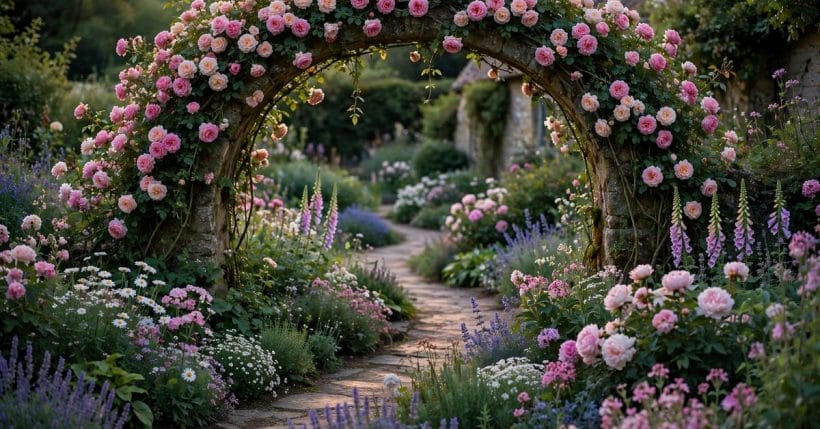
There are gardens you walk through, and gardens you wander into as if you had stepped through a gate in a story. The second kind rarely depends on size or grandeur. It depends on enclosure, on a path that curves out of sight, on scent drifting from somewhere you cannot quite see, and on the feeling that something lovely is waiting just around the next bend. A fairytale garden is built from those small, deliberate moments rather than from any single grand gesture.
This guide gathers fourteen such gardens, each one a complete idea you can borrow in whole or in part. Some suit a generous plot and some suit a small corner behind a house, but all of them share the same ingredients: a sense of arrival, a path worth following, planting in soft layers, and at least one quiet place to sit. Tree work and anything structural belongs with a qualified professional throughout; everything else here is about choosing, planting and arranging with patience.
1. What Makes a Garden Feel Like a Fairy Tale
Before the fourteen gardens, it helps to name what they have in common, because the same handful of qualities turns up in every one of them. The first is enclosure. A storybook garden feels like a room outdoors, held by hedges, walls softened with climbers, fences, or simply by planting tall enough to shut out the street. You enter it rather than merely looking at it, and that threshold matters more than anything planted inside.
The second quality is a journey. A straight path to a visible destination is practical, but a path that bends, narrows, or passes under an arch invites you to keep walking. The garden reveals itself in stages, and each stage holds something worth pausing for: a seat, a scented shrub, a patch of light through leaves, or a view framed by branches. The third quality is softness. Edges blur where planting spills over paths, where climbers loosen the line of a wall, and where flowers and foliage mix rather than standing in stiff rows.
The last qualities are scent, sound and a place to sit. Scented planting near a path or seat, the sound of water or birdsong, and a bench or chair positioned for a view rather than for passing traffic all slow a visitor down. A garden that asks you to linger will feel like a storybook garden even when it is modest, while a large garden with nowhere to sit and nothing to smell can feel like little more than a lawn. Keep those tests in mind as you read: enclosure, a journey, softness, scent and a seat. For the small-plot version of this approach, the guide to tiny house garden ideas shows how enclosure, a path and a seat can work in a compact footprint.
2. Arched Entries and Gateways
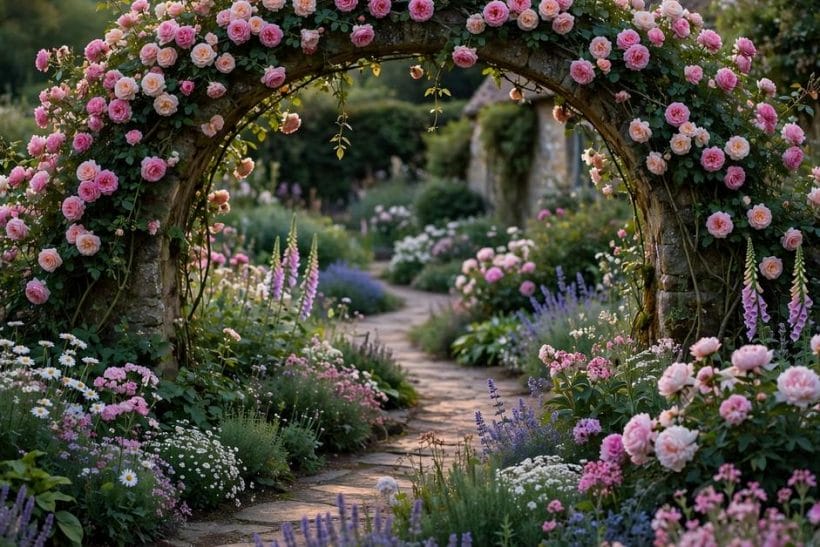
An arch or a gateway does more work than almost any other single feature in a storybook garden. It marks the moment of arrival, frames the view beyond, and gives climbers something to climb. The two gardens in this section both begin with that threshold, and both are worth considering before anything else, because once the entry is right, the rest of the garden tends to follow.
1. A Rose-Covered Arch Walk
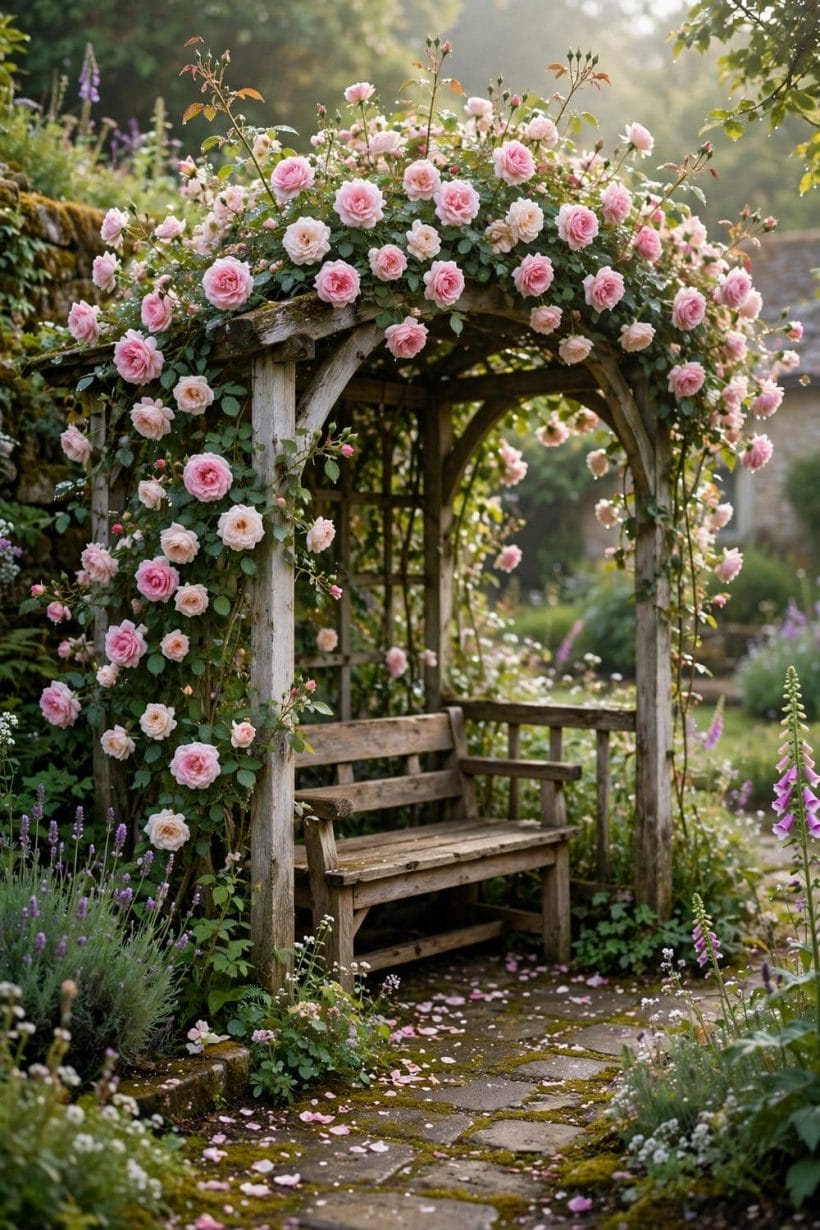
A single arch smothered in roses is the classic storybook entry, and it earns its reputation. The arch should sit where it genuinely leads somewhere, over a path into a seating area or a second garden room, rather than standing alone in open lawn where it frames nothing. Roses grown over an arch need tying in as they grow and pruning to keep the path clear, so choose a position you can reach comfortably from both sides. Scent matters here as much as colour: a fragrant rose over a walkway greets every visitor twice, on the way in and on the way out.
Under the arch, keep the planting low and simple so the arch itself stays the star. Pale gravel or stone underfoot, a few low herbs or soft perennials at the feet of the roses, and nothing tall enough to crowd the opening will do. The arch walk also sets the garden’s colour story, since the rose colour chosen here will echo in borders further along the path. Pick a shade you love rather than one you think a storybook garden ought to have, because you will be walking under it every day.
2. A Hedge Tunnel to a Hidden Gate
Where a rose arch is open and floral, a hedge tunnel is green, shaded and secretive. Two rows of hedging, clipped into an arching passage or left to meet loosely overhead, create a short walk in cool shade that ends at a gate. The gate itself can be simple timber, painted or left natural, and it works best when it opens onto something different from what came before: a sunny seating corner after shade, or a flower-filled space after green seclusion. The contrast is what makes the arrival feel like a discovery.
A hedge tunnel asks for patience and regular clipping, and it suits a garden where the hedge can be reached for trimming without a struggle. A simple timber gate, painted or left natural, suits the tunnel best, since the planting, not the gate, is the feature. Keep the tunnel floor clear and firm underfoot, and resist filling it with ornaments; the tunnel is the feature, and anything else inside it only interrupts the walk.
3. Winding Paths and Quiet Corners
If arches provide arrival, paths provide the story. A storybook garden rarely shows itself all at once. It leads you on, hides its corners, and rewards slow walking. The two gardens here are both built around that idea, and both work even in a small plot, where a short curving path can feel longer than a straight one twice its length.
3. A Curving Stone Path
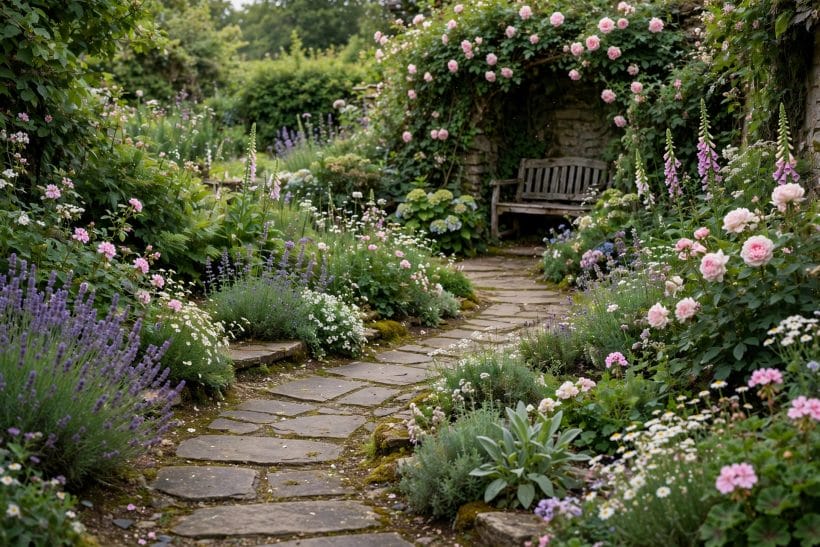
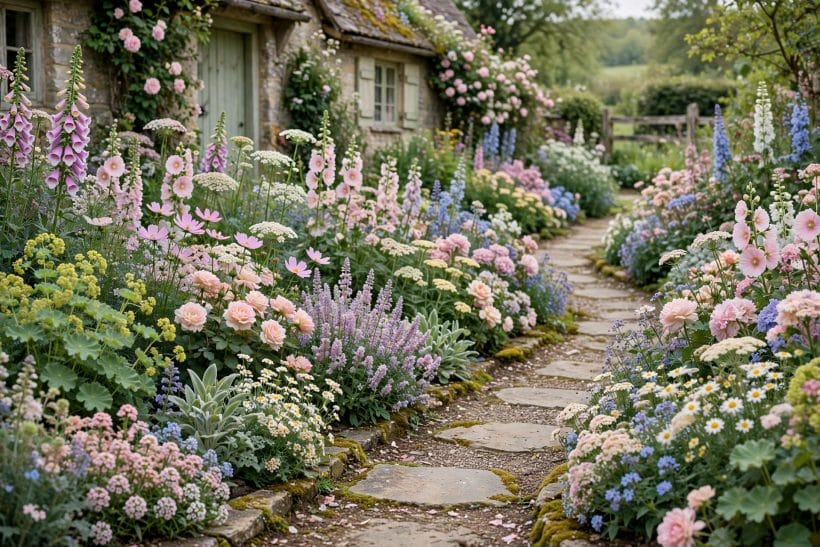
A path that curves gently through planting, disappearing behind a shrub and reappearing further on, turns even a short walk into a small journey. Natural stone, set with soft joints where low planting can creep between the slabs, suits this best, because the path then looks as if it has always been there. Edge the path loosely rather than with a hard, straight border, and let foliage spill over the edges in places so the line of the path softens.
Along the path, plant in drifts rather than in single specimens, so each bend offers a change of colour, texture or scent. A fragrant shrub where the path narrows, a patch of shade where it turns, and a glimpse of a seat or an ornament ahead will each pull a walker forward. Keep the surface even and clear of loose growth underfoot, since a storybook path should invite wandering, not tripping, and make sure the route stays usable in wet weather.
4. A Seat Tucked Out of Sight
Every storybook garden needs at least one seat that is not visible from the house or the gate. The pleasure of such a seat is finding it: a bench at the end of a path, a chair under a tree, or a small seating nook wrapped in planting, positioned so the sitter looks back over the garden rather than out at the street. The seat itself can be plain timber or stone; comfort and a good view matter more than ornament.
Plant around the seat for enclosure without gloom. A shrub or two at the back, something scented within arm’s reach, and overhead cover from a tree or an arbour will make the spot feel sheltered. Leave room to get in and out easily, and place the seat where it catches a pleasant part of the day’s light, whether morning sun for breakfast or evening shade for a quiet hour. A hidden seat that is never used has missed its point, so put it where you will genuinely go.
4. Climbers and Green Walls
Climbers are the storybook gardener’s fastest route to atmosphere. They soften hard edges, turn a plain wall into a backdrop, and give a garden its vertical layer, which is the layer most often missing in a flat, newly planted plot. The two gardens in this section use climbers differently, but both depend on giving the plants a sound support and room to grow.
5. An Arbour Wrapped in Climbers
An arbour is a small open structure, often little more than posts and a top frame, that supports climbing plants and shelters a seat beneath. Wrapped in fragrant climbers, it becomes a room of its own: shaded in summer, scented when the climbers flower, and a natural pause on a walk through the garden. The frame itself should be sturdy and well fixed, since a mature climber is heavy, and any structural work or fixing into walls belongs with a qualified professional.
Choose climbers for more than one season where you can, mixing an early flowerer with a later one, and keep the entrance to the arbour clear so the seat beneath stays inviting rather than overgrown. Prune to keep the interior of the arbour open and the path to it clear, and the arbour will stay a pleasure rather than becoming a thicket.
6. A Softened Garden Wall
A bare wall can make a garden feel enclosed in the wrong way, like a yard rather than a room. Climbers change that entirely. Trained across a wall on wires or a trellis, they break up the flat surface, add colour through the seasons, and give birds and pollinators somewhere to shelter. The effect is strongest when the planting is allowed to loosen at the edges, with foliage spilling over the top of the wall or softening its corners.
Before planting against any wall, check the wall’s condition and keep climbers away from gutters, roofs and any damaged pointing, since growth in the wrong place can cause trouble over time. Self-clinging climbers suit sound masonry, while twining kinds need wires or a trellis to grip. Underplant the base of the wall with shade-tolerant perennials so the wall planting reads as one layered composition rather than a single flat screen.
5. Water, Light and Reflection
Water brings a storybook garden to life in a way nothing else quite manages. It reflects the sky, doubles the planting, draws birds, and adds a sound that makes even a small garden feel like a retreat. The two gardens here use water at a modest scale, and both are designed to be enjoyed from a seat nearby rather than admired from a distance.
7. A Still Pool with Water Plants
A small, still pool, edged with stone and planted with water plants, can be the calm centre of a storybook garden. The water’s surface reflects trees and sky, and the planting around the edge, from soft grasses to moisture-loving perennials, blurs the line between water and garden. Site the pool where it catches light for part of the day, since still water in deep shade can look dark rather than reflective, and keep a clear, safe edge that is easy to tend.
Water and electrics need care: any pump, lighting or powered feature should be installed and checked by a qualified professional, and the pool should be planned with children and pets in mind. The guide to backyard landscaping places a pool like this in the wider setting of a whole garden, with planting and paths around it. Keep the pool’s surroundings simple, with a seat or a flat stone nearby for watching, and let the reflections do the decorating.
8. A Stone Basin and Birdsong Corner
Where a pool is too much, a stone basin offers water at its simplest: a shallow vessel, filled by hand or by rain, set among planting where birds can drink and bathe. Birds visiting daily bring movement and song to a corner that might otherwise be still, and a basin needs little more than a level base, regular fresh water, and planting around it that gives birds cover nearby without hiding the basin itself.
Place the basin where it can be seen from a seat or a window, since much of its pleasure is watching. A few flat stones at the edge give birds a footing, and low planting around the base keeps the basin looking settled rather than stranded on open ground. In cold weather the water may freeze, and in hot weather it may need topping up, so treat the basin as a small daily ritual rather than a fit-and-forget feature.

6. Woodland Shade and Ferns
Not every storybook garden is sunny. Some of the most atmospheric are shaded, green and quiet, built from ferns, foliage and filtered light rather than from flowers. Shade gardens suit the cooler, damper corners of a plot that sun-loving planting would struggle in, and they reward a gardener who loves texture and green in all its shades.
9. A Fern-Filled Shady Glade
A glade of ferns under trees, or in the shade of a wall, feels ancient in the best sense: cool, green and still. Ferns of different heights and leaf shapes, planted in drifts with other shade-loving foliage, create a layered floor that looks after itself once established, provided the soil stays moist enough for the kinds chosen. A simple path of stone or bark through the glade, and perhaps a single mossy stone or a plain bench, is all the furnishing it needs.
Shade planting depends on matching plants to the shade you actually have, since dry shade under trees is a very different home from damp shade beside a wall. Observe the spot through a season before planting heavily, and improve the soil with organic matter where it is thin. Tree work above a glade, including any pruning of overhanging branches, belongs with a qualified arborist, and the glade below will be all the better for the light that careful professional work lets through.
10. A Woodland Edge of Layered Planting
A woodland edge copies the way planting layers itself at the edge of a wood: tall trees or large shrubs at the back, medium shrubs in front of them, and low perennials and ground cover at the feet of all of it. The result reads as natural rather than arranged, and it gives a garden depth that a single row of shrubs never achieves. This garden suits a boundary or a long edge of a plot, where the layering can run for a satisfying length.
Build the layers gradually, starting with the woody backbone and adding the lower layers over time, and leave gaps where a path or a view can pass through. The woodland edge also suits wildlife, offering shelter at several heights, and it tends to need less fussy attention than a formal border, since its charm lies in fullness rather than precision. Cut back only to keep paths clear and to remove anything dead or damaged, and let the layers settle into one another.

7. Flowers, Scent and Colour
Flowers are what most people picture first when they imagine a storybook garden, but the gardens that linger in memory use flowers as part of a larger composition, not as the whole of it. Colour is layered, scent is placed where walkers will meet it, and the planting is allowed to look abundant rather than regimented. The two gardens here both celebrate flowers, in two different moods.
11. A Cottage Flower Border in Layers
The cottage border is the abundant, romantic border: tall flowers at the back, medium ones in the middle, and low edging plants at the front, all mingling rather than standing in lines. The planting looks generous because it is generous, with self-seeding kinds allowed to find their own places between the planted ones. Colour can be a soft mix or a restrained palette of two or three shades, but the feeling should be of plenty, not of a display bed.
A cottage border needs room to billow, so give it depth rather than a thin strip, and stake or support the tallest kinds discreetly before they flop. Cut back spent flowers through the season where that encourages a second flush, and accept that a cottage border at its best looks slightly wild; tidiness is not its virtue.
12. An Evening Scent Corner
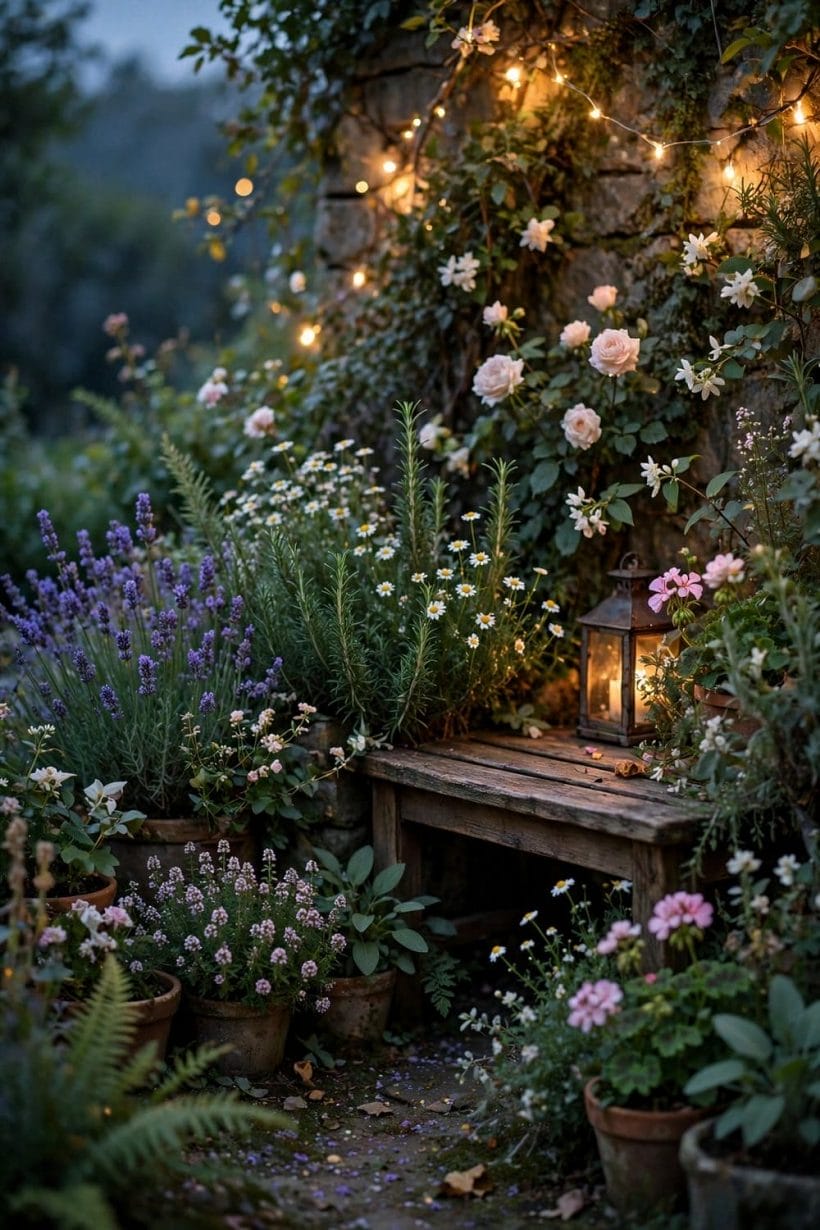
An evening scent corner is planted for the hours when the garden is most often enjoyed after work: fragrant shrubs and flowers that release their scent as the air cools, arranged around a seat or beside a path used in the evening. Pale flowers show up well in fading light, which is why white and pale shades are often chosen here, and the corner works best when it is sheltered enough for scent to linger rather than blowing away.
Choose scented kinds you genuinely enjoy, since a scent corner is a personal thing, and plant them close enough to the seat to be appreciated without leaning. A few scented plants well placed will do more than a whole border of them scattered thinly. The guide to herb garden layouts is a useful companion here, since many scented herbs suit exactly this kind of sheltered corner. Keep the corner’s maintenance light, since an evening garden should be a place to unwind, and a corner that demands heavy work at the end of the day will not be sat in for long.
8. Small Structures and Gentle Whimsy
Whimsy is the quality that tips a pretty garden into a storybook one, and it is best applied with a light hand. One charming structure or a few handmade details, placed where they surprise rather than dominate, will do far more than a garden full of ornaments competing for attention. The last two gardens in the fourteen both rest on that restraint.
13. A Storybook Garden Shed
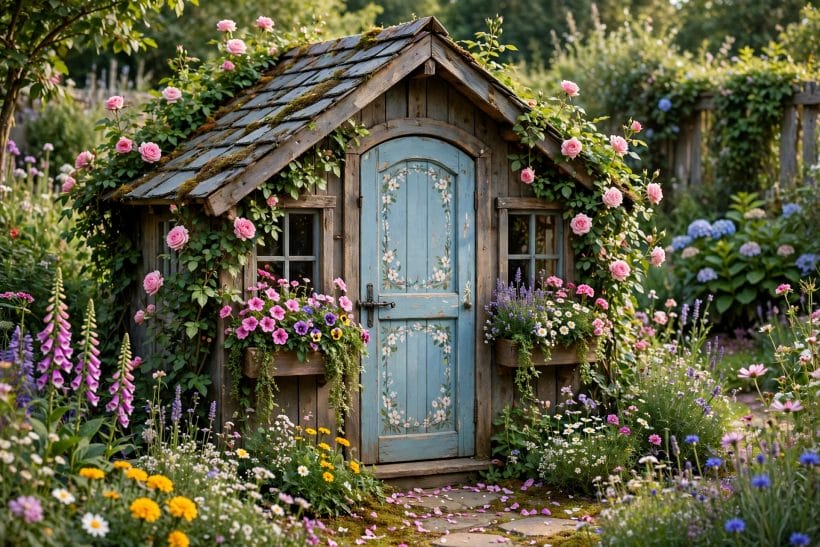
A shed with a pitched roof, a painted door, climbers at its corners and window boxes can become a garden’s cottage in miniature. It still needs to work as a shed, storing tools and pots, but a little care in its finish, a colour that suits the garden, a small porch roof or a climbing plant at the door, turns a utilitarian box into a feature worth walking toward. Keep the structure sound and weatherproof first, since a pretty shed that leaks is no pleasure.
Any shed that needs a base, a roof repair or an electrical supply should be built or altered by someone qualified for that work, and the shed should sit where it can be reached easily in all weathers. Plant around it softly rather than hiding it entirely, and give it a path and a small apron of stone or gravel at the door. The guide to garden shed ideas covers shed forms and finishes in greater detail. A shed that looks like a cottage and works like a shed is the storybook ideal in practical form.
14. Mossy Stone and Handmade Details
The fourteenth garden is the smallest in scale and perhaps the easiest to begin: a corner dressed with mossy stone, a handmade birdhouse, a simple wooden sign, or a few stones arranged as a tiny rock feature among planting. Details like these give a garden a human touch and a sense of having been cared for by hand, and they are best made or chosen slowly, one at a time, rather than bought in a single haul.
Place handmade details where they will be found rather than displayed: beside a path, at the foot of a tree, or near a seat, where a walker pauses and notices them. Keep them weatherproof and in keeping with the garden’s materials, stone with stone, timber with timber, and avoid anything that needs constant repair. One well-placed detail can become a garden’s signature, the thing visitors remember and ask about long after the visit.
9. Planting Through the Seasons
A storybook garden should not peak for a fortnight and then fade. The gardens above work best when their planting is planned across the year, so that each season hands the garden to the next without a gap. Spring bulbs and early blossom, summer flowers and scent, autumn colour and seed heads, and winter structure from evergreens, bark and the shapes of bare branches all have a part to play, and a garden with all four seasons in mind feels alive whenever it is visited.
Planning for the seasons is mostly a matter of noting what is missing. Walk the garden in each season and ask what it lacks: colour in winter, scent in autumn, shade in high summer, or structure when the flowers are gone. Then fill only that gap, rather than replanting wholesale. Containers can help where soil or drainage needs improving, and the guide to container garden ideas covers planting in pots and planters in detail. Over time, a garden planned this way grows more interesting rather than merely bigger, and the gardener’s work shifts from rescue to gentle steering.
10. Keeping a Storybook Garden Manageable
The romance of a storybook garden can hide a practical truth: abundant planting needs regular attention, and a garden that outgrows its gardener stops feeling like a storybook and starts feeling like a burden. The answer is not to plant less, but to plant and arrange in a way that matches the time available. Paths that stay clear, beds with edges that are easy to mow or trim against, and planting chosen for the soil and light already present will all cut the work down without cutting the charm.
A few habits keep the garden in hand: a regular walk to deadhead, tie in climbers and clear paths; a seasonal pass to cut back anything dead or overgrown; and a willingness to remove a plant that is struggling in the wrong place rather than nursing it indefinitely. Larger jobs, including tree work, structural repairs and anything involving water or electrics, belong with qualified professionals, and asking for help with those is part of good gardening, not a failure of it. The guide to tiny backyard ideas places these ideas in the wider setting of a whole backyard, where a storybook corner can sit happily alongside lawn, seating and everyday outdoor living. A manageable garden is one that is still a pleasure in its third year, not only in its first summer.
Final Considerations
Fourteen gardens is a generous list, and no one needs to build all of them. The wisest way to use it is to pick the two or three that fit your plot, your light and your patience, and to build those well, leaving the rest as ideas for later years. A single rose arch and a hidden seat, done properly, will give more storybook feeling than a whole garden of half-finished features, and a garden that grows gradually tends to look as if it has always been there.
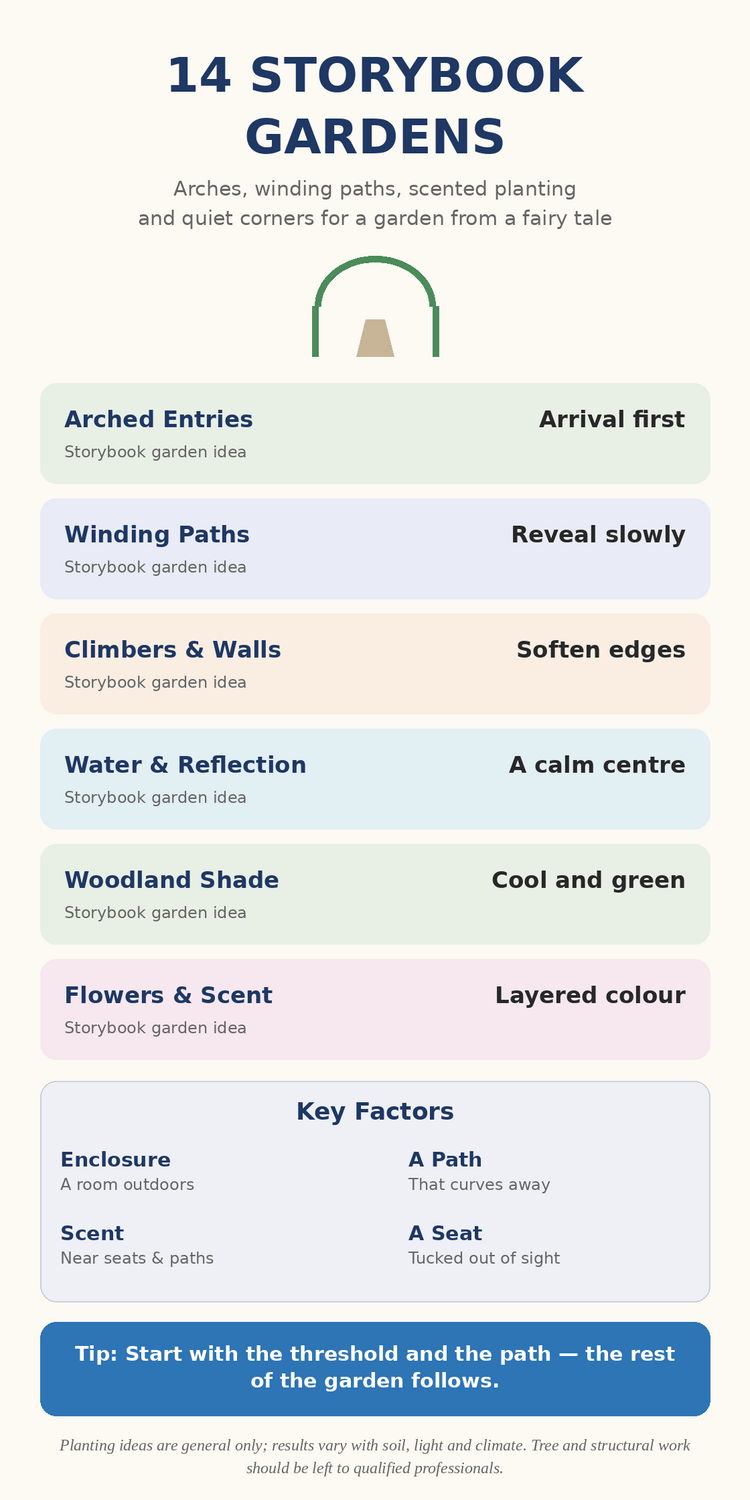
Start with the threshold and the path, since those two decisions shape everything else, then add the planting in layers and let it settle before adding more. Choose plants for the conditions you have rather than the conditions you wish you had, keep scented planting near seats and paths, and give every feature a reason to be where it is. A fairytale garden, at its heart, is not a collection of ornaments or a particular style of planting; it is a garden that invites you to walk slowly, to sit quietly, and to come back tomorrow to see what has changed. For the wider setting, the guide to backyard landscaping shows how a storybook corner can sit within a whole garden plan.
When the garden is established, its pleasures become small and daily: the first scent on a summer evening, the arch in flower, the birds at the basin, the seat in shade on a hot afternoon. Those are the moments the fourteen gardens above are built to provide, and they are worth more than any single showpiece. Build slowly, tend regularly, and let the garden tell its own story in its own time.





0 Comments