
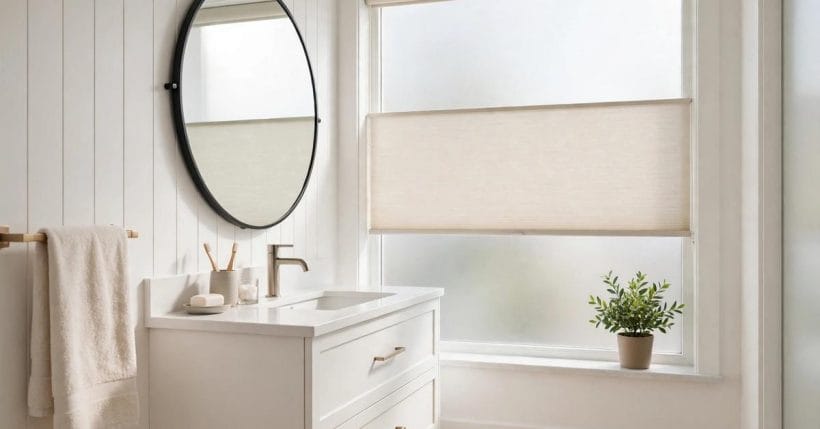
A bathroom window has a harder job than a window anywhere else in the house. It has to let daylight in, keep the room private, stand up to steam, and still be easy to open, clean and live with every day. Get the balance wrong and the room feels either exposed or gloomy, and a treatment that suits a bedroom can warp, spot or mildew in a bathroom. This guide looks at bathroom window treatments on their own terms, so you can choose by privacy, light and moisture first, and by looks second.
The good news is that there is no single right answer. A frosted pane, a roller blind, a sheer curtain, a set of shutters or a layered pair can all work well, provided the choice matches the window, the room and the way you use it. What follows is a practical walk through those choices, with notes on small bathrooms, high windows and the spots where a treatment has to work hardest.
1. At a Glance: Six Treatments Compared
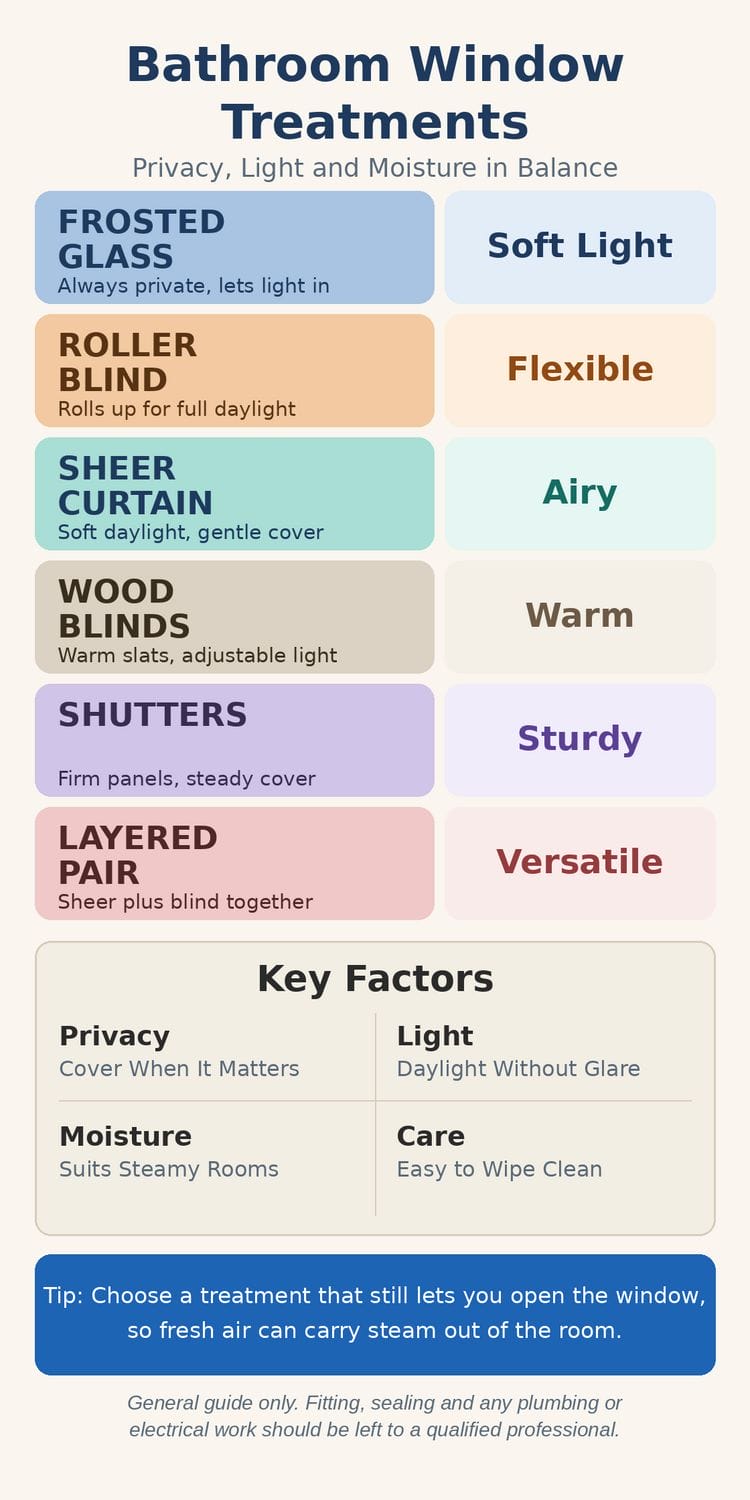
Start with the shape of the choice. Each treatment below trades privacy, light and moisture tolerance a little differently, and the table gives the short version before the detail that follows.
| Treatment | What it does | Feel |
|---|---|---|
| Frosted Glass | Always private, lets light in | Soft Light |
| Roller Blind | Rolls up for full daylight | Flexible |
| Sheer Curtain | Soft daylight, gentle cover | Airy |
| Wood Blinds | Warm slats, adjustable light | Warm |
| Shutters | Firm panels, steady cover | Sturdy |
| Layered Pair | Sheer plus blind together | Versatile |
Read the table as a starting point, not a verdict. A treatment that looks best on paper can still be the wrong fit if it blocks the window handle, hangs where it stays damp, or cannot be reached for cleaning. Fitting, sealing and any work near plumbing or wiring should be left to a qualified professional, and the rest of this guide assumes that framing throughout.
2. Privacy First: What the Room Actually Needs
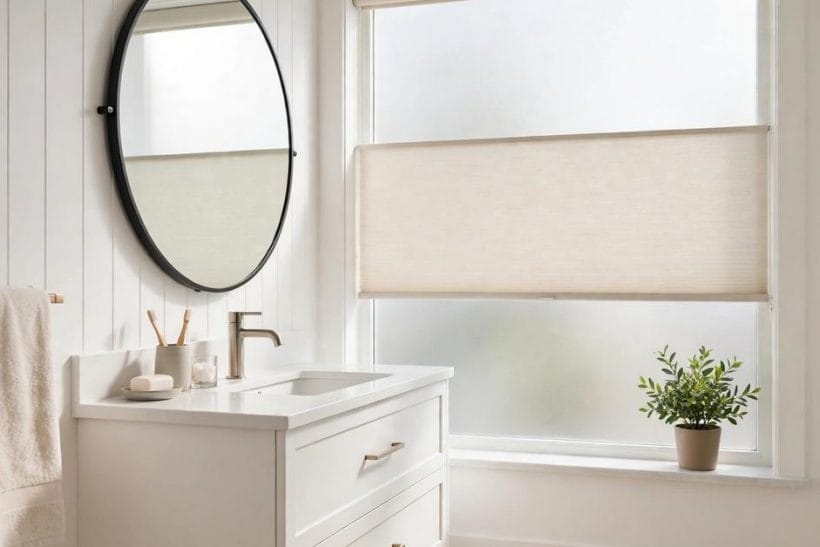
Privacy is the first test for any bathroom window, and it depends on where the window sits. A window that faces a garden wall needs far less cover than one that faces a neighbour’s window, a path or a street. Stand outside, if you can, and look back at the glass at different times of day, because a treatment that looks private in bright daylight can turn see-through at night when the bathroom light is on and the outside is dark.
Frosted glass and obscured glass solve the problem at the pane itself, which is why they suit windows that are overlooked all day. A blind or a curtain, by contrast, gives you a choice: closed for full privacy, open for a clear view. That choice matters most in a bathroom used by more than one person, or in a room where the window sits beside the mirror and is in view during the morning routine.
Think about the lower half of the window first, since that is where privacy usually matters, and about the top half second, since that is where daylight comes from. Treatments that cover only the lower half, or that open from the top down, can give you both at once. If you are planning a wider refresh, the ideas in our tiny bathroom ideas show how a window treatment sits alongside the rest of a small room, rather than as an afterthought.
3. Light: Keeping the Room Bright Without Glare
Daylight is one of the best things a bathroom can have. It makes a small room feel larger, flatters the mirror, and means the room does not depend on electric light all day. The trick is to soften that light rather than block it, especially on a window that faces the sun for part of the day.
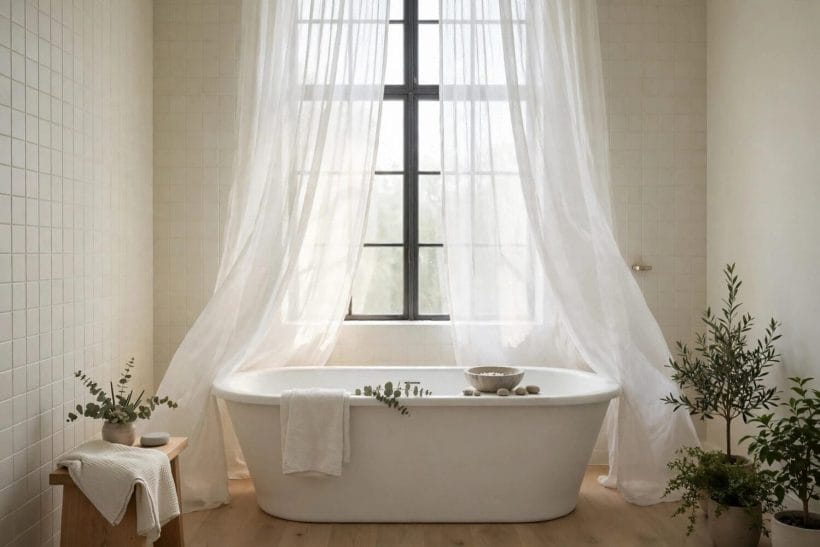
Sheers, light-filtering blinds and frosted glass all spread daylight around the room instead of shutting it out. Slatted blinds and shutters give finer control, because you can tilt the slats to bounce light toward the ceiling while keeping the view screened. A dark, heavy treatment over a bathroom window, on the other hand, can make the room feel closed in, and it can leave the mirror in shadow at exactly the time you need it.
Consider the direction the window faces and the time you use the room most. A morning bathroom benefits from a treatment that can be opened fully for bright light, while a room used mainly in the evening may need a treatment that looks calm under electric light. Our tiny house interior lighting ideas cover how daylight and electric light can work together, so the window treatment is part of the lighting plan rather than fighting it.
4. Moisture and Steam: The Bathroom Difference
Steam is what separates a bathroom window treatment from every other window treatment in the house. Hot showers fill the room with damp air, and that air settles on glass, fabric and slats alike. A treatment that stays damp will spot, smell or wear out sooner, and one that traps steam against the frame can make the frame itself suffer over time.
Materials that wipe clean and dry quickly have a clear advantage here. Smooth blinds, coated shutters and glass treatments cope better with steam than heavy, unlined fabric, which can hold moisture long after the shower has ended. Wherever the treatment sits, it should still let the window open, so steam has a way out and fresh air has a way in. A treatment that blocks the handle, or that has to be fully removed before the window can open, is working against the room.
Ventilation matters more than any single material choice. Open the window after a shower when you can, and keep the treatment clear of the sill where water can pool. If the window frame, the seal or the wall around it shows damp, swelling or mould, ask a qualified professional to look at it before choosing a new treatment, since a fresh blind will not fix a sealing or ventilation problem underneath.
5. Roller Blinds and Shades: Simple, Flexible Cover
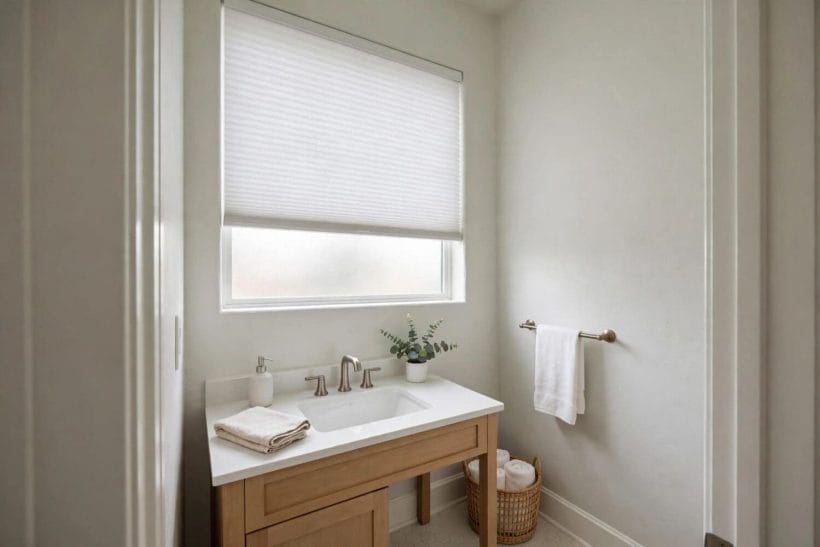
Roller blinds are the workhorse of the bathroom window. They roll up out of sight for full daylight and an open view, and roll down for privacy in a single movement. That simplicity is a real advantage in a small room, where a treatment that folds, stacks or swings can eat into precious space around the mirror or the bath.
Light-filtering roller blinds soften daylight while keeping the room bright, while blackout-style rollers give full privacy at night. Cellular shades, with their honeycomb folds, add a softer look and a little insulation feel, and versions that open from the top down are worth considering, since they let daylight in at the top while keeping the lower half covered. Whichever style you choose, look for a finish that wipes clean, and for an operating cord or control that is safe and easy to reach, with cord safety fitted as the maker directs.
Roller blinds suit almost any bathroom window shape, including narrow and tall windows, and they pair well with frosted glass, where the blind becomes the night-time layer and the glass does the daytime work. Keep the blind clear of the bath edge and the shower spray, and let it dry fully after steamy use before rolling it away damp.
6. Curtains and Sheers: Softness That Needs Care
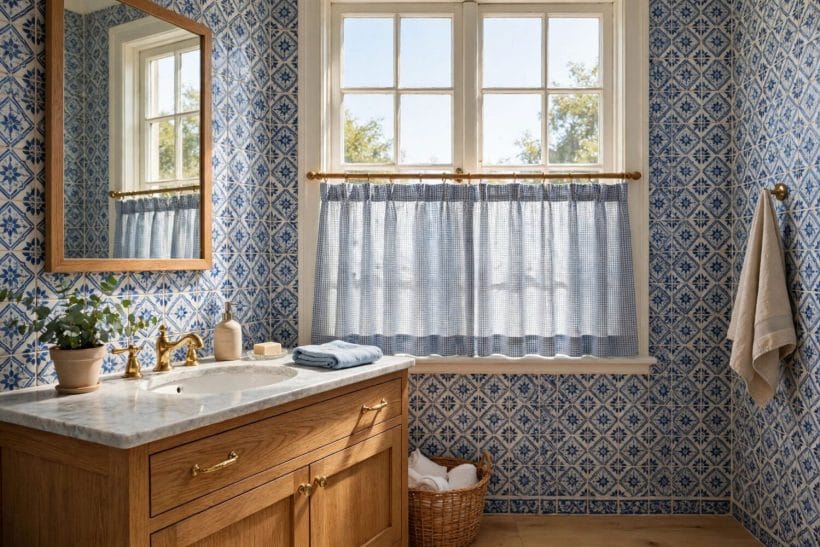
Curtains bring a softness that hard treatments cannot match, and in a bathroom that softness can turn a plain room into a calm one. Sheer curtains filter daylight beautifully and give gentle daytime privacy, while a heavier curtain gives full cover at night. A cafe curtain, which covers only the lower half of the window, is a neat compromise, keeping the view and the daylight above while screening the part of the room that needs it.
The trade-off is moisture. Fabric holds steam, so bathroom curtains need to be washable, hung where they can dry, and kept clear of splashes from the bath or basin. Short curtains that end above the sill dry faster and stay cleaner than full-length curtains that brush a damp floor or a wet bath edge. If you love the look of curtains elsewhere in the house, our tiny house curtain ideas show the same soft approach in drier rooms, which helps to show where bathroom curtains need extra care.
For a deeper look at sheer fabrics on their own, the companion guide to blinds and shades covers what to check before you buy any window cover, from fit and fabric to safe operation. In the bathroom, the same checks apply, with moisture and washability added to the top of the list.
7. Wood Blinds and Shutters: Warmth With Control
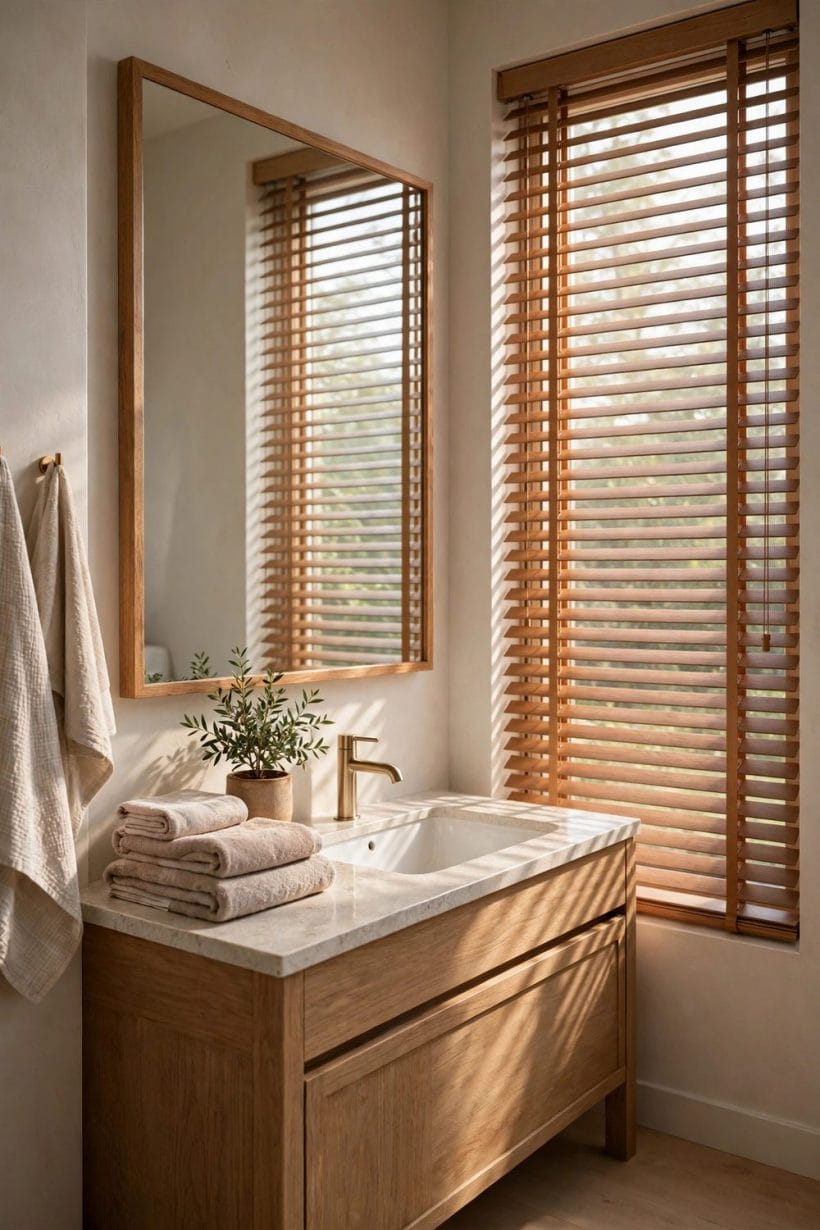
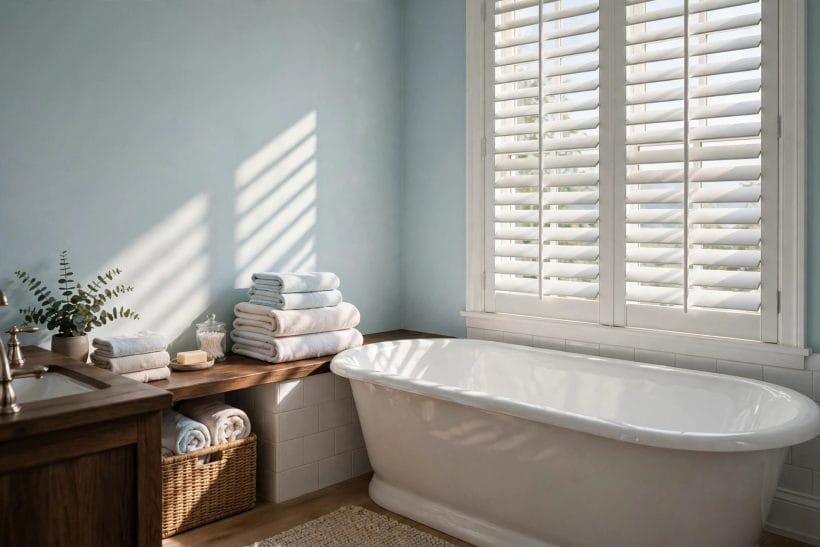
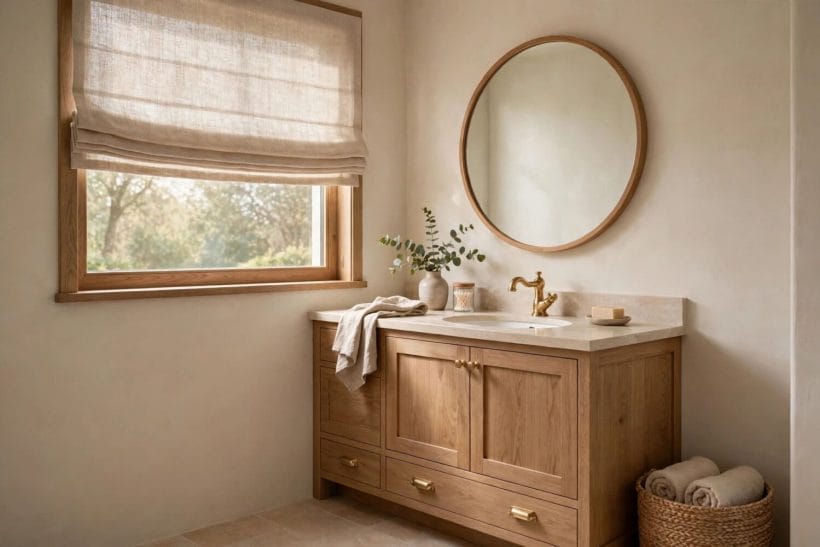
Wood blinds and shutters give a bathroom window a warm, crafted feel, and their slats give the finest light control of any treatment here. Tilt the slats open for daylight, tilt them closed for privacy, and the room changes character without anything being raised or lowered. Shutters, with their firm panels, feel especially steady and tidy, and they suit windows that are a feature of the room rather than a background detail.
Real timber needs care in a steamy room, so look for blinds and shutters made or finished for humid rooms, and keep them wiped and dry. Faux-wood and coated versions offer a similar look with less worry about moisture, which can make them the calmer choice for a busy family bathroom. Either way, slats collect dust and steam marks, so choose a style you are happy to wipe down, and check that the slats can be reached easily when the window is behind the bath or above a high sill.
Shutters and wood blinds pair well with plain walls and pale tiles, where their warmth stops the room feeling cold. They also work well in a bathroom with a strong style of its own, since the treatment becomes part of the room’s character rather than a purely practical cover.
8. Frosted Glass and Films: Privacy Built Into the Pane
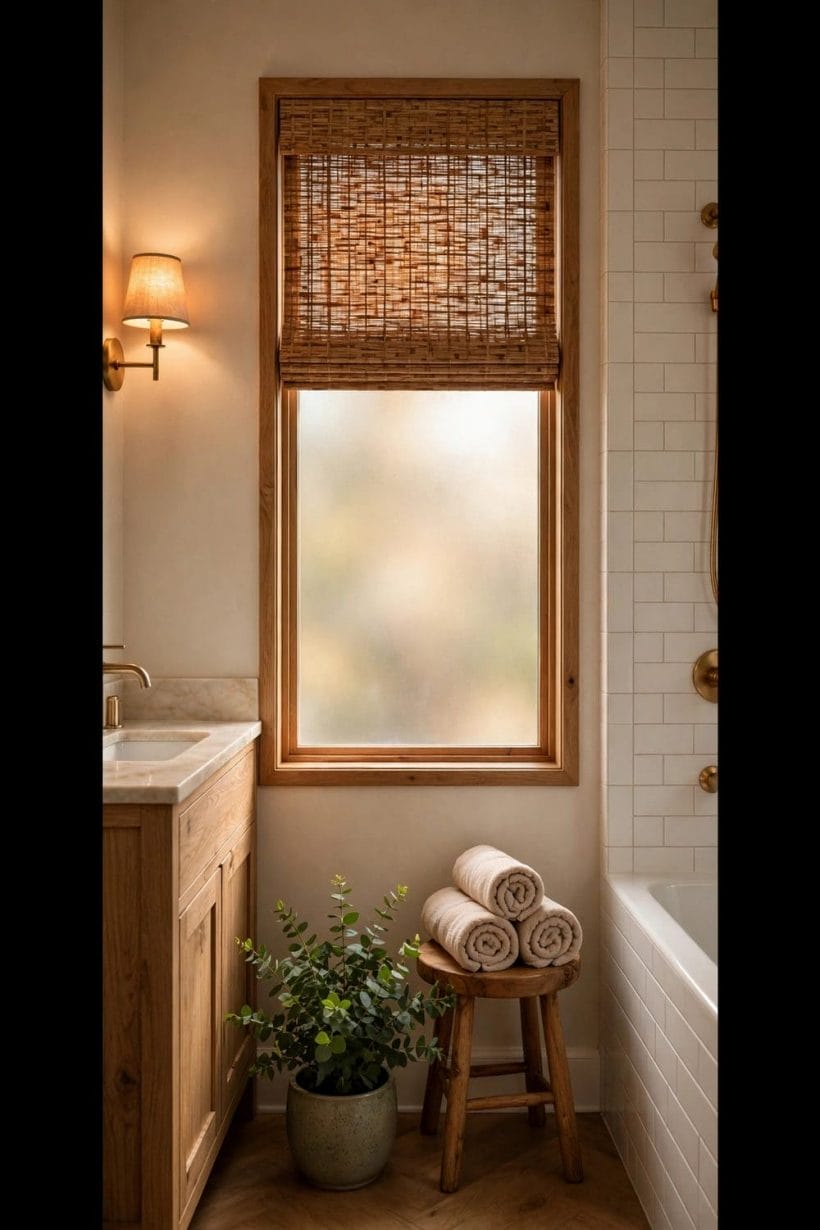
Frosted glass gives privacy without any moving parts at all. The glass itself obscures the view while letting daylight through, so the room stays bright even with nothing else on the window. That makes it a strong choice for windows that are overlooked, for high windows that are hard to reach, and for bathrooms where a blind or curtain would always be in the way.
Applied films can give a similar effect on existing glass, and patterned or textured films can add a decorative touch. Films need a clean, smooth pane and careful fitting, so if the glass is old, damaged or awkward to reach, ask a professional fitter rather than forcing a film onto a pane that will not take it well. Frosted glass and film still benefit from a second layer at night, since a brightly lit bathroom can show shapes through obscured glass after dark, and a simple roller blind covers that case neatly.
This is also the treatment to think about first when the window sits inside a wet zone. Our guide to a window in the shower looks at placement, light and privacy for that demanding spot, and it shows why a treatment that lives in constant spray needs different thinking from one on a dry wall. For most bathroom windows, though, frosted glass is the quiet, low-maintenance starting point, with other treatments layered on top as needed.
9. Layering Two Treatments: The Best of Both
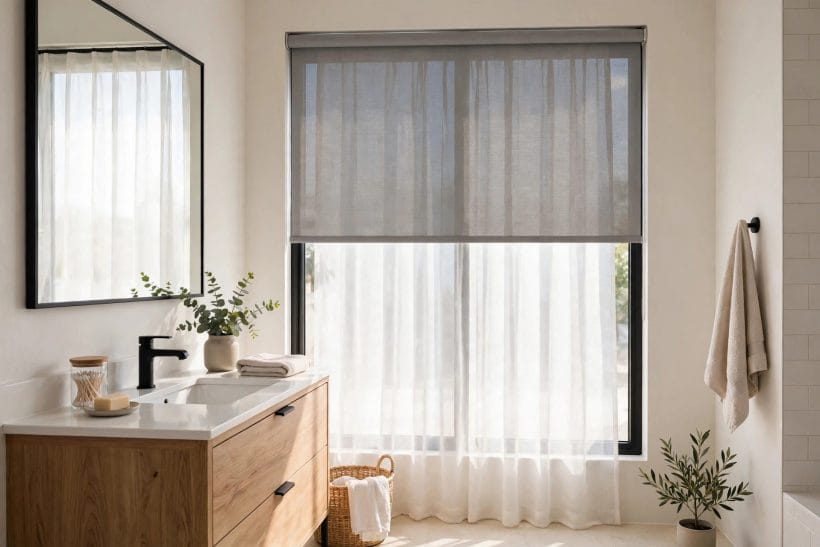
Layering is how you get daylight, privacy and night-time cover from a single window. A sheer panel behind a roller blind, for example, gives soft daylight by day and full privacy at night, while frosted glass plus a blind gives privacy all day and full cover after dark. The layers do different jobs, so neither one has to do everything alone.
Layering works best when the two treatments are simple and the window can still open. A sheer that hangs clear of the handle, plus a blind that rolls clear of the sheer, is a practical pair, while two heavy treatments fighting for the same space will frustrate daily use. Keep the inner layer light and washable, and the outer layer easy to wipe, so steam and splashes do not trap moisture between them.
Think of layering as a way to solve a specific problem, not as decoration for its own sake. If the window is overlooked only at night, a single blind may be enough. If it is overlooked all day and you still want daylight, a sheer plus a blind earns its place. And if the room is small, a layered pair on one window can still feel calm, provided both layers are pale, simple and easy to operate.
10. Small Bathrooms, High Windows and Tricky Spots
Small bathrooms reward treatments that take up no floor space and no wall space beyond the window itself. A roller blind, a cellular shade or frosted glass fits inside the reveal and leaves the mirror, the basin and the bath clear. Avoid treatments that swing out into the room, or that need a wide stack of fabric beside a narrow window, since they will crowd the very space you are trying to keep open.
High windows are a different problem. They are often there precisely to give privacy while letting light in, and they may be hard to reach for daily adjustment. For those windows, a treatment that can stay in one position, such as frosted glass or a fixed light-filtering blind, often makes more sense than one that needs daily handling. If the window does need to open for steam, make sure the control is reachable, and ask a professional about safe operation rather than stretching or climbing to reach it.
Windows beside a bath, above a basin or near a door need the same practical test: can the treatment be operated without leaning over water, can it be cleaned without moving furniture, and does it stay dry? If the answer to any of those is no, a simpler treatment in a better position will serve the room better. Our tiny house interior design ideas and tiny house floor plans show how window, mirror and basin positions are planned together, which is the same thinking, applied to the bathroom window.
Final Considerations
Choosing among bathroom window treatments comes down to three questions, asked in order. How private does this window need to be, and when? How much daylight do you want to keep? And how will the treatment cope with steam, splashes and cleaning? Answer those honestly, and the right treatment usually reveals itself, whether it is a simple roller blind, a pair of shutters, frosted glass, or a layered pair.
Keep the choice simple, keep the window openable, and keep fitting and sealing work with a qualified professional. A treatment that is easy to use, easy to clean and matched to the moisture of the room will look better for longer than a grander choice that fights the room every day. Done well, a bathroom window treatment does its work quietly: daylight in, privacy kept, steam on its way out, and a room that feels calm from the first light of the morning to the last light of the night.



0 Comments