

A garden begins at its gate — before the first flower, before the lawn. Get the gate right and the garden has already made its promise.
Seventy-seven gorgeous garden gates follow, counted honestly from their source: timber and iron, cottage and formal, arched and planted, the small working gates, and the keeping that lets a gate swing true for decades.

1. Garden Gate at a Glance
The central entity is the garden gate: the pedestrian leaf — timber, iron, steel or aluminium, single or paired — that forms a garden’s entrance through its fence, hedge or wall. Its attributes are construction (ledges, braces, frames and posts), material and finish, style from cottage to contemporary, the hardware that is its true machinery, and the keeping that twice-yearly attention provides. The count is honest: the source survey numbers seventy-seven gates, and seventy-seven are presented here, in seven families of eleven. This post owns the garden-scale gate: the all-materials gate field is the gate ideas pillar’s, and driveway-scale wrought iron is its own post’s lane, linked where it belongs. All structural, safety and electrical points are stated generally, deferring to local rules and professional installation throughout.
| Question | Short answer |
|---|---|
| Why seventy-seven gates? | Because the source survey counts seventy-seven — the number is carried honestly, in seven families of eleven, rather than rounded to a tidier figure. |
| What decides a gate’s lifespan? | Its posts and hinges, not its leaf: sound posts set true, hardware sized for the weight, and ten minutes’ keeping twice a year. |
| Timber or metal? | Timber for warmth, privacy and the cottage register; metal for slimness, see-through grace and security — both kept by their finishes. |
| What is the commonest failure? | The sagging leaf: a brace run the wrong way, a post moved, a hinge worn — diagnosed early, it is an adjustment; late, a re-hanging. |
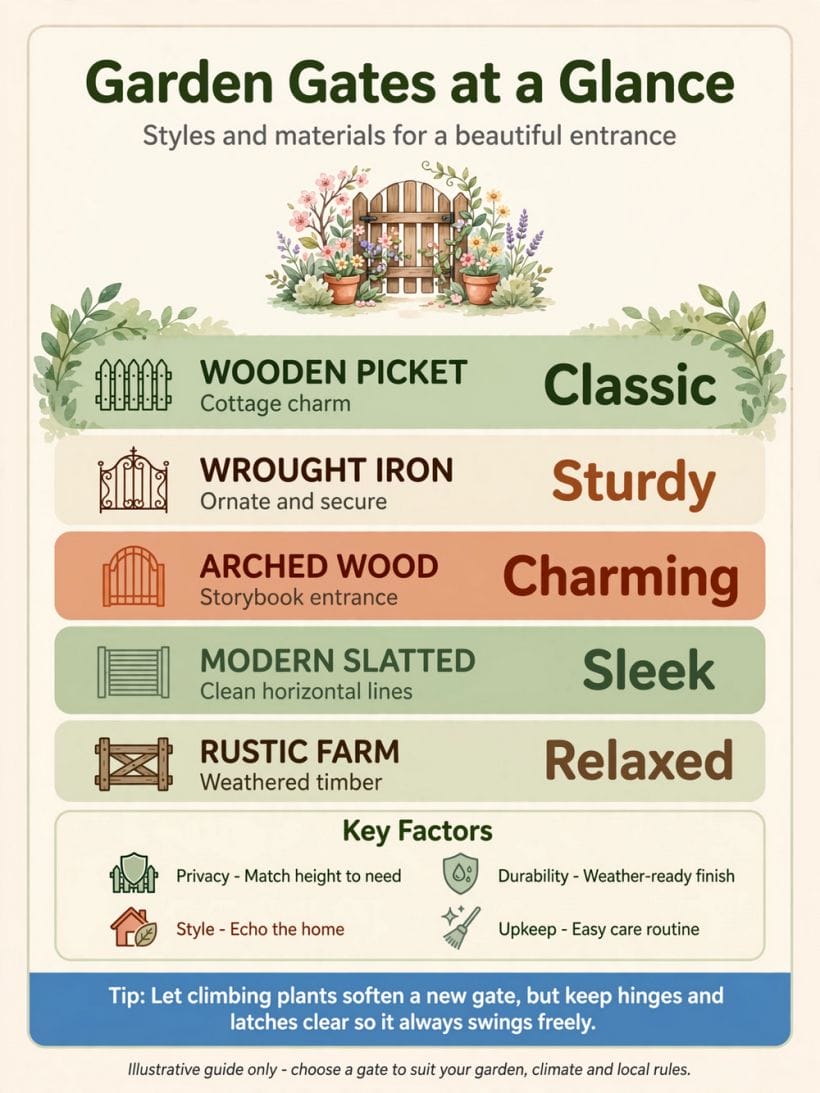
2. Timber Garden Gates: Ledged, Framed and Boarded
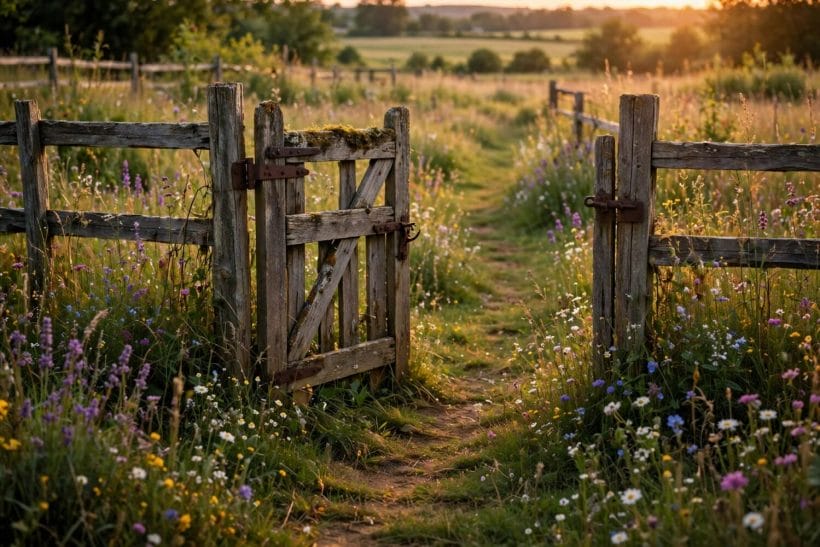
Timber is the garden gate’s first material, and the wider gate field — every material, every scale — belongs to the gate ideas pillar. This section stays on wooden gates: how they are built, why they move, and the forms a century of gardens has settled on.
1. The ledged-and-braced gate
Horizontal ledges and a diagonal brace on a boarded face: the farm gate’s construction, honest and repairable. The brace’s direction does the work — hung correctly it carries the gate’s weight to the hinge post instead of letting the leaf sag.
2. The framed, ledged and braced gate
A full frame around the ledges stiffens the ledged gate into the cottage garden’s classic: stronger, squarer, and the version that survives decades of swinging.
3. Vertical-board gates that match the fence
Boards run vertically, in the fence’s own rhythm, so the gate nearly disappears into its line — the quiet choice where the boundary, not the entrance, is the feature. A handle and a shadow gap are all that announce it.
4. Horizontal-board contemporary timber gates
Wide horizontal boards in a hardwood or stained softwood give timber a modern register: calm lines, a spa-like calm, and a gate that suits new gardens and clean architecture.
5. The five-bar field gate in a garden setting
The five-bar gate brings the field into larger gardens and smallholdings: wide, welcoming to barrows and mowers, and unmistakably rural.
6. Cedar gates that silver with age
Cedar arrives warm and red-toned and silvers to a soft grey if left unoiled — a deliberate, beautiful ageing that suits naturalistic planting. Oiled, it keeps its warmth instead. Either way it is the lightweight, stable timber gates are loved for.
7. Oak gates for the long term
An oak gate is a generational purchase: dense, strong and slow to weather, darkening and checking characterfully. It asks for posts and ironmongery of equal seriousness, and repays them by outlasting every fence it will ever hang in.
8. Painted timber gates in garden colours
Paint is timber’s renewable dress: sage, cream, charcoal or the front door’s own colour, refreshed in an afternoon.
9. The wicket gate: small, low and charming
The wicket — a small, low gate in a fence or hedge — guards paths, cottage fronts and the entrances to garden rooms.
10. Double timber gates for the wide entrance
Where a garden entrance is wide — a drive, a courtyard, a working yard — paired timber leaves meet in the middle with a drop bolt and a shared stance.
11. The reclaimed-timber gate
A gate built from reclaimed boards carries its history in nail holes and weathering, at home in cottage, rustic and ecological gardens. Sound timber only, checked board by board — reclaimed is a look, never an excuse for rot at the hinges.
3. Iron and Metal Garden Gates
Metal gates trade timber’s warmth for slimness, see-through grace and security — and the driveway-scale, wrought-iron survey in full is the wrought iron gates post’s own lane. This section stays at garden scale: the pedestrian leaf in iron, steel and aluminium.
12. The classic wrought-iron garden gate
Bars, a scroll or two, spear or ball finials: the iron garden gate of the traditional front garden, see-through enough to show the planting, definite enough to mark the threshold.
13. Estate-style railings gates
A gate in the estate-railing manner — plain vertical bars, a gentle top line, no ornament — suits long boundaries and park-like gardens. It is the least showy metal gate and often the most elegant, because its proportions do all the work.
14. Contemporary slatted metal gates
Horizontal or vertical slats in powder-coated steel or aluminium give the modern garden a gate of lines and shadows: private without being blank, light without being flimsy. Colours run to charcoal, black and the greens that disappear into planting.
15. Aluminium gates that never need painting
Aluminium’s gift is indifference: no rust, no repainting, a light leaf that small posts can carry. For coastal gardens and low-maintenance households it is the pragmatic metal, in designs that imitate timber boarding or stand as clean modern slats.
16. The mesh-panel security gate
A framed mesh gate — weldmesh or expanded metal in a steel frame — is the working garden’s honest security: for allotments, utility areas, dog runs and the vegetable garden’s defence against rabbits and deer.
17. Iron gates with a timber infill
A metal frame filled with timber boards marries the two materials’ virtues: the frame’s stiffness and security, the boards’ privacy and warmth.
18. The scrollwork statement gate
Hand-worked scrolls, leaves and tendrils make a gate into the garden’s signature — the one piece visitors photograph. Scrollwork belongs on the garden’s main entrance, executed by a smith whose work will outlast fashion; everywhere else, restraint keeps it special.
19. Galvanised farm-style metal gates
The galvanised field gate — tube-framed, mesh-filled — serves the garden’s working edges: the compost corner, the wood store, the chicken run. Its zinc finish shrugs off weather, and its honesty suits any garden that also grows food.
20. The low iron gate at the cottage path
A low iron gate at the head of a cottage path, in a low fence or a hedge gap, is the threshold in miniature: knee-height, light, and purely ceremonial in the best way.
21. Metal gates painted in colour
Metal need not be black: deep green disappears into hedges, cream suits cottage ironwork, and a bold colour — the front door’s red, a gardener’s blue — makes the gate the garden’s exclamation.
22. The automated pedestrian gate, stated generally
Small gates can be automated — access control, closers, latches that answer a code — and any such system is specialist work under local rules, with safety for children and visitors designed in by its installer.
4. Cottage and Country Gate Styles

The cottage gate is a welcome before it is a barrier: low, planted around, and made of the garden’s own materials. This section stays on the country register — the styles that suit roses, hedges, lanes and the unhurried end of the garden world.
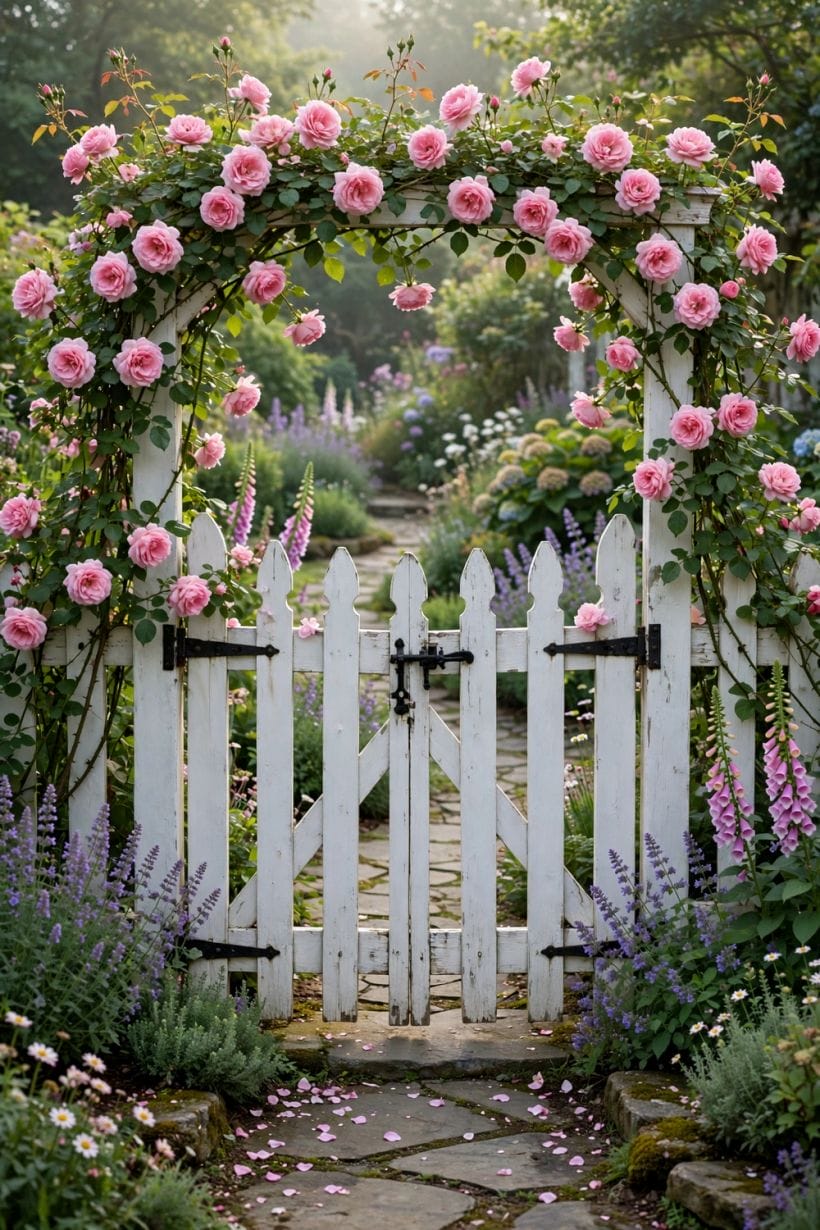
23. The rose-round-the-gate cottage entrance
A cottage gate with roses trained around its posts and across a small arch is the style’s postcard: the gate half-hidden in bloom, the path beyond it.
24. The picket gate in a picket fence
A short picket gate, its tops pointed, scalloped or flat in the fence’s own pattern, is the cottage front garden’s native entrance. Painted white it is the classic; in sage or cream it is the softer modern cottage version.
25. The hazel hurdle gate
A woven hazel hurdle hung as a gate brings the hedgerow craft into the garden: light, textured and entirely at home among native planting.
26. The split-chestnut rustic gate
Cleft chestnut — split, not sawn, following the grain — makes gates of wonderful irregular rightness for rustic and woodland gardens. No two rails match; the gate looks grown rather than manufactured, and its strength follows the timber’s own fibres.
27. The lychgate-inspired garden entrance
A small roofed gate, echoing the churchyard lychgate, gives a country garden entrance a moment of shelter and ceremony: a place to pause, set down shopping, wait out a shower. It suits larger cottage gardens and houses with a lane to honour.
28. The hedge-gap gate
Where a hedge is the boundary, the gate is a simple leaf set into a trimmed gap — timber or iron, deliberately plain, because the hedge is the architecture.
29. The dry-stone-wall gate
In stone country, a gate hung between stone wall ends — on posts pocketed into the wall by a waller’s craft — is the boundary’s native form.
30. The orchard gate
A wide, plain timber gate into an orchard or fruit garden: built for barrows and ladders, handsome in its plainness, and usually left standing open through the picking season.
31. The white-painted arched cottage gate
An arched top softens a painted timber gate into the cottage garden’s friendliest shape — the arch echoes cottage windows and rose arches, and in white paint against a hedge it is the entrance children draw when they draw a garden.
32. The garden-room gate: between one room and the next
Inside the garden, gates between its rooms — from lawn to flowers, flowers to vegetables — create the sequence that makes a garden feel larger.
33. The lane gate with a letterbox and a bell
A country gate at a lane often carries the house’s public furniture: a letterbox, a bell or knocker, the house name in carved or painted letters.
5. Modern and Formal Gate Styles
At the other register stand the formal and the modern: gates as architecture — measured, symmetrical, minimal — for gardens and houses whose lines are drawn straight. This section stays on those considered entrances, where proportion is the ornament.
34. The symmetrical formal pair
Matched leaves, matched planters, a path on axis: the formal entrance composes the gate as the garden’s frontispiece. Everything is doubled and aligned, which makes execution unforgiving — the style has nowhere to hide a post out of true.
35. The tall privacy gate in horizontal boarding
A tall gate in tight horizontal boards gives a modern house a private, spa-calm entrance: a warm timber wall that opens.
36. The frameless-look steel gate
Slim steel framing with the fixings hidden gives a gate of pure lines: it reads as a drawing of a gate, which is the modern style’s ambition. Such gates are fabricated precisely and finished in powder-coat; their elegance is manufacturing, honestly come by.
37. The gate as a slatted screen
Extending the gate’s slats into matching screen panels on both sides turns an entrance into a composition — the boundary becomes a designed elevation, with the gate leaf identified by its handle and its shadow gap alone. It suits new-build gardens especially well.
38. The black-on-black contemporary entrance
Gate, fence, posts and planting scheme in blacks and dark greens: the contemporary entrance as a study in tone. Dark planting — purple-leaf shrubs, black-stemmed grasses — completes a register that looks designed in every season and photographs like architecture.
39. The Japanese-inspired garden gate
A simple, perfectly made timber gate — plain posts, a modest lintel, a bamboo or slatted panel — in the Japanese garden manner makes the entrance a moment of transition and calm.
40. The courthouse-formal iron gate
Iron gates in the formal manner — taller bars, a crested top line, finials with heraldic restraint — suit Georgian, colonial and classical houses.
41. The minimalist single-slat gate
One material, one repeated element, no visible mechanism: the minimalist gate reduces the entrance to a rhythm of slats and light.
42. The bronze-toned statement entrance
Warm metallic finishes — bronze and brass tones in coated metal — give a formal entrance a glow that black cannot: the gate as jewellery on the house.
43. The gate in the garden wall: masonry-framed entrances
A gate set in a rendered or stone garden wall — the leaf framed by masonry piers with caps or copings — is the Mediterranean and classical entrance: weight around, lightness in the leaf.
44. Lighting the formal entrance
Formal entrances finish their composition with light: a lantern on each pier, a soft wash down the path, the house number lit. Outdoor electrical work belongs to qualified electricians under local rules; designed well, the lit entrance is the house’s evening portrait.
6. Arched Gates and Gates with Trellis and Pergola Tops
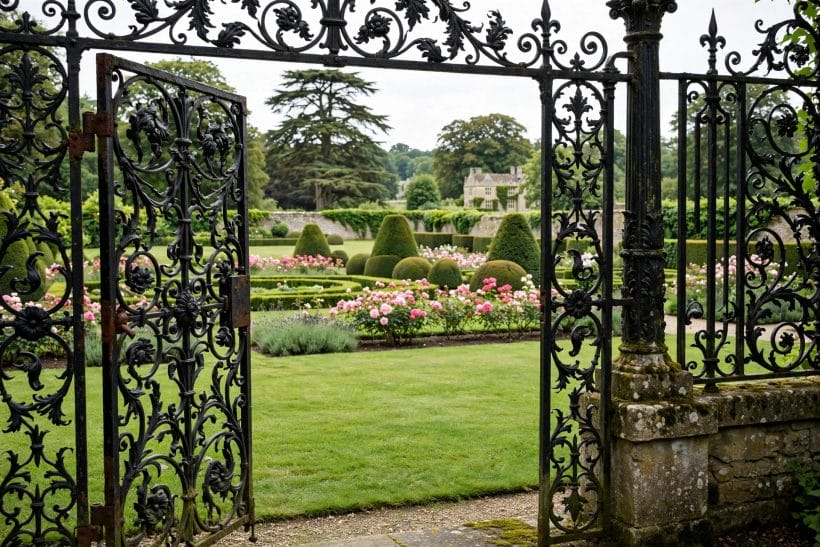
Some gates carry their garden upward: an arch, a trellis panel, a small pergola overhead, so the entrance is planted as well as built. These connect to the walkway ideas survey’s paths beyond; this section stays on the gate and its green roof.
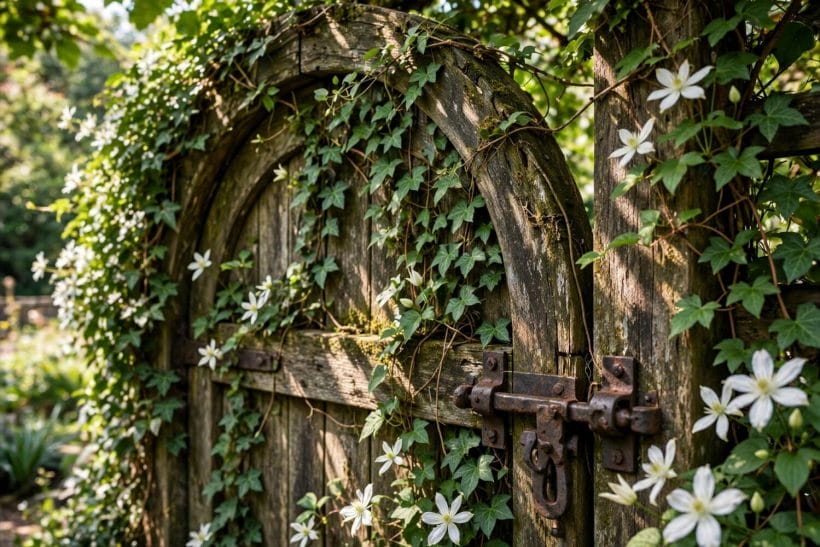
45. The simple timber arch over a gate
Two posts and a curved or pitched top, spanning the gate, give climbers a home and the entrance a silhouette.
46. The rose arch gate
Roses over an entrance arch are the garden’s most loved cliché because they earn it: scent at head height, bloom at the threshold, and a gate experienced with more than eyes.
47. The pergola-top gate
A short pergola — a few rafters over the path at the gate — makes the entrance a room of dappled shade, especially with a vine overhead.
48. The trellis-panel gate
A gate whose upper half is trellis keeps the leaf light, lets planting weave the boundary, and gives a see-through welcome at eye level over a solid, private base.
49. The moon gate in a garden wall
A circular moon gate — in a wall or a hedge — is the most theatrical entrance a garden can hold: a framed picture of the room beyond, stepped through like a threshold in a story.
50. The clematis gate: light structure, heavy bloom
Clematis asks only for wires or a light trellis over a gate to smother it in bloom in its season — the cheapest of the planted entrances and among the most joyful.
51. The evergreen arch: yew and hornbeam over gates
Clipped evergreen trained over an entrance arch gives the planted gate a winter presence the roses cannot: a green doorway in the bare months.
52. The jasmine summer gate
Jasmine over a gate perfumes the evening entrance in summer — the gate you smell before you see.
53. The wisteria pergola entrance, with patience
Wisteria over a pergola gate is a decade’s promise: overwhelming spring bloom, summer shade, winter tracery.
54. The hop and bean seasonal screen gate
Fast annual climbers — hops, runner beans, sweet peas — over a gate’s light frame give the kitchen garden a seasonal entrance: green and flowering by midsummer, cleared in an hour in autumn.
55. Keeping planted gates working
Every planted gate shares one discipline: the planting must never be allowed to defeat the gate.
7. Small Gates: Side Passages, Kitchen Gardens and Gates in Fences
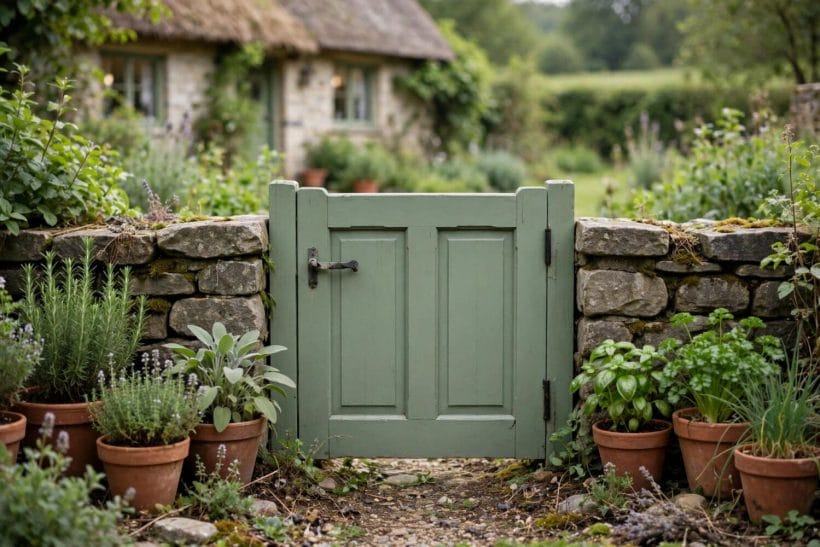
Most gates in most gardens are small ones: the side passage, the vegetable plot, the gap in the hedge. The planting and paths around them belong to the front yard landscaping ideas field in front and the backyard fence survey at the boundary; this section stays on the little leaves themselves.
56. The side-passage gate
The side gate guards the house’s working route — bins, bikes, the boiler’s access — and is usually the most-used gate of all.
57. The kitchen-garden gate
The vegetable garden’s gate has one historic job: keeping rabbits, deer and the household’s own dog away from dinner.
58. The compost-corner gate
Even the compost corner earns a small gate or hurdle: it tidies the garden’s engine room, keeps dogs from investigating, and makes the working area feel kept rather than abandoned. Utility gates are where reclaimed timber and honest mesh belong.
59. The gate in a hedge: the hidden door
A gate concealed in a hedge — its leaf faced with mesh that planting grows through, or simply painted hedge-green — is the secret-garden entrance, beloved of children and romantics.
60. The gate in a fence: matched and shadow-gapped
A gate built flush in a fence, boards continuous, hinges concealed, identified only by a shadow gap and a handle, is the tidy modern boundary’s favourite trick.
61. The low gate at the top of steps
Where a path climbs, a low gate at the steps’ head serves households with small children and visiting dogs: a pause point, not a fortification.
62. The pool and pond safety gate, stated generally
Where a garden holds a pool or deep pond, its gate is a safety device before it is anything else: self-closing and self-latching as local rules require, opening away from the water, and kept working.
63. The dog gate in the garden’s middle
A low internal gate — across a path, a terrace edge, a deck’s steps — manages dogs between the garden’s zones without shutting doors or shouting.
64. The allotment gate
An allotment gate is a noticeboard, a lock and a welcome in one: plot number, a hook for the communal key, room for a trug to pass.
65. The bin-store gate
The modern garden’s least glamorous and most-seen gate fronts the bin store: matched to the fence, ventilated, opening wide enough for collection day.
66. The gate that is mostly a view
Some small gates exist to be looked through: a barred or open-framed leaf in a wall or hedge that frames the borrowed landscape beyond — a field, a church spire, the neighbour’s glorious tree.
8. Colour, Finish and the Keeping of Gates
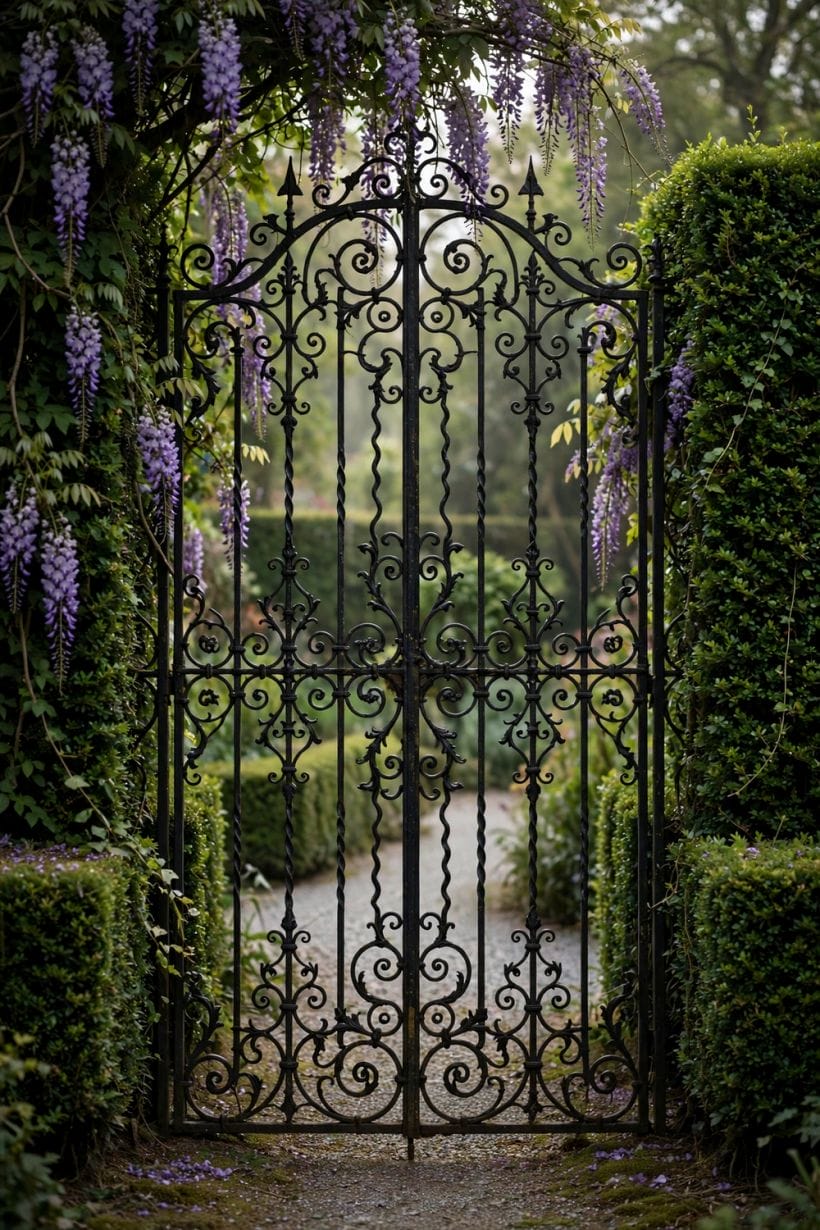
A gate is the most-touched, most-weathered piece of joinery or ironwork in the garden, and its keeping decides whether it greets or apologises. This closing survey section stays on finishes, hardware and the habits that keep seventy-seven gates’ worth of entrances swinging true.
67. Paint systems on timber: the renewable finish
A painted timber gate’s system — preparation, primer, undercoat and topcoat, honestly applied — is its lifespan: kept up in short cycles, the timber beneath never suffers.
68. Oils and stains on hardwood gates
Hardwood gates kept in oil or stain show their grain and are fed rather than coated: the finish renews without stripping, and the colour deepens with the years.
69. Powder-coating and galvanising on metal
Metal gates are kept by their coatings: galvanising’s zinc, powder-coating’s coloured skin. Chips and scratches are touched in promptly, because rust begins at the breach — attention stated generally, as every coating system has its maker’s own repair method.
70. Hinges: the gate’s true machinery
A gate is its hinges: sized for the leaf’s weight, fixed into sound post timber or masonry, and oiled in their season.
71. Latches, bolts and the satisfying close
The latch is the part of the gate every hand meets: it should close with a sound that satisfies, open with gloves on, and suit the gate’s duty — a thumb latch for the cottage, a lockable bolt for the side passage, a self-latch where safety rules the design.
72. Posts: where gates really fail
Gates fail at their posts — rot at the ground line in timber, movement in poor footings — long before their leaves fail.
73. The sagging gate and its remedies
A sagging leaf — toe dragging, latch missing — is diagnosed before it is forced: brace direction in timber, hinge wear in metal, post movement beneath both.
74. Autumn and spring: the gate’s two services
Twice a year the gate earns ten minutes: leaves cleared from its swing, bottom rail checked, hinges oiled, coatings inspected, planting cut back from its arc.
75. Children, visitors and the friendly gate
A garden gate should be operable by the people it serves: a latch a child can reach where children should pass, a weight an elderly visitor can swing, a close that announces itself.
76. Replacing a gate well
When a gate’s time comes, its replacement inherits the opening, the posts if they are sound, and the garden’s habits.
77. The gate as the garden’s handshake
Stand at any gate in this survey and the whole argument is in your hand: the weight, the close, the view it frames.
9. Checks and Mistakes: Before the First Purchase or the First Fitting

Before the first purchase, walk the entrance as a stranger: approach it, open it, pass through with your hands full — a bag, a barrow, a child’s hand in yours — and note where the swing lands, where the latch sits, and what the opened gate reveals. That walk decides more than any catalogue: gate width, swing direction, and whether the entrance wants ceremony or discretion.
Check the boundary’s truth next: the posts’ ground, the fence or hedge the gate must marry, and the levels of the path on both sides. A gate hung between failing posts fails with them; a leaf that clears the path in summer may ground on frost-heaved paving in winter. Sound posts, set by a competent builder where the work is structural, are the purchase beneath every other purchase.
Check the duties the gate must serve — security, children, dogs, deer, the wheelie bin’s weekly journey — and let the duties choose the latch, the height and the self-closing habit, with any safety-related installation, around pools and ponds especially, done to local rules and professional standards. Then check the keeping honestly: painted timber wants its cycles, oiled hardwood its feedings, and a household should buy the finish it will actually maintain.
The mistakes repeat across garden gates: the leaf hung on posts too slight for it; the brace run the wrong way so the gate sags by its second season; planting allowed to swallow the swing until the gate opens halfway; a beautiful latch fitted where gloves, children or the postman cannot work it; and the front gate styled while the side gate — the one used daily — is left to rot. Each is avoidable, and each avoidance is visible every day.
10. Costs and Pulling It Together
Costs among garden gates, stated generally and without invented figures, arrange themselves by making: a simple ledged timber gate or a hurdle costs least and is within a competent maker’s short work; framed hardwood, smith-made iron and fabricated contemporary gates cost most, priced by the craft in them; and posts, hardware and hanging — the parts nobody photographs — are the spend that decides whether any of it still works in a decade. Automation and lighting add their professional costs where they are wanted. The economy that never pays is the cheap gate on cheap posts: it is bought twice.
Gather the seventy-seven into one picture: an entrance is a threshold, a machine and a welcome in a single leaf — timber or iron, cottage or formal, planted or plain — and its success is measured in decades of true swinging. The rest of the gate field, from driveway leaves to the boundary entire, is surveyed across this site’s home design ideas collection; this post’s seventy-seven stand at the garden’s edge, and they are complete.
Final Considerations
A garden gate is a small thing asked to do a great deal: to mark a beginning, to work in all weathers, to be beautiful in the hand and the eye for decades. Choose its material for the garden it serves, hang it on posts that deserve it, plant around it without imprisoning it, and keep it with ten minutes twice a year — and the gate will repay you every single day, in the simple pleasure of arriving home.



0 Comments