

The front yard is the only garden most people will ever see of your house — the view from the pavement, the walk to the door, the photograph in the estate agent’s window. It works two shifts: public face by day, homecoming by evening. And in most houses it is a strip of tired lawn doing neither job well.
These 75 front yard landscaping ideas treat the space between street and door as a designed garden in its own right: composed from the kerb, planted in layers, and kind to the people who arrive through it daily. The welcome it leads to continues at front porch ideas; this post owns the ground before the door.
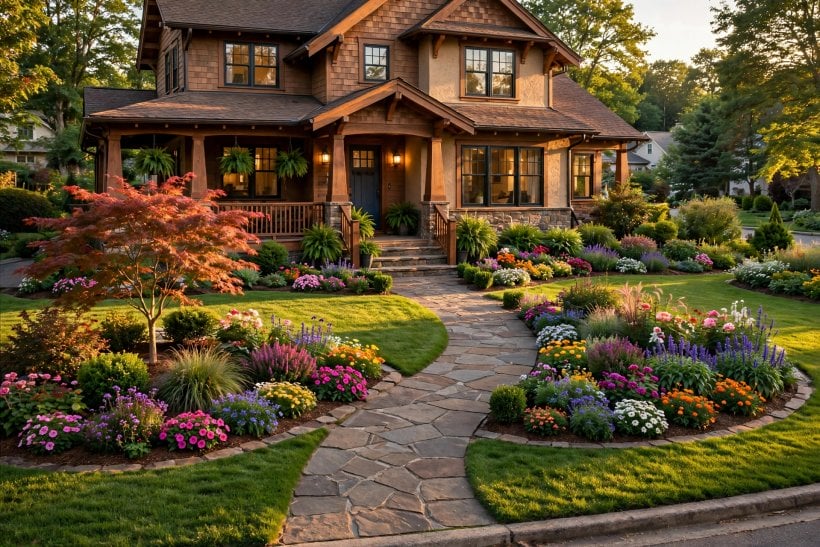
1. Front Yard Landscaping Ideas at a Glance
The central entity is the front yard: the ground between the house’s face and the street, whose job is to present the house, route its visitors and frame its architecture. Its attributes are the street composition, the path and drive, foundation planting, the lawn’s role, trees and vertical structure, and the boundary treatment. Every front yard is judged from two directions — by the street looking in, and by the household coming home — and the good ones are designed from both.
| What is curb appeal, in practical terms? | The street’s verdict on the house, delivered in seconds: tidy edges, layered planting, a clear route to a visible door, and nothing apologising. It is composition and maintenance, not expense. |
| How much of a front yard should be lawn? | Only as much as earns its mowing: a clean green panel can set off planting beautifully, but lawn as the default surface — rather than a chosen one — is how front yards become forgettable. |
| What should a front yard never contain? | Anything stored: bins on parade, the project car, the waiting skip. The front yard is the house’s portrait; whatever stands in it joins the portrait. |
| What is the front yard’s most common failure? | Being planted from the house outward — a row of shrubs against the wall and lawn to the kerb — instead of composed from the street, where every passer-by actually reads it. |
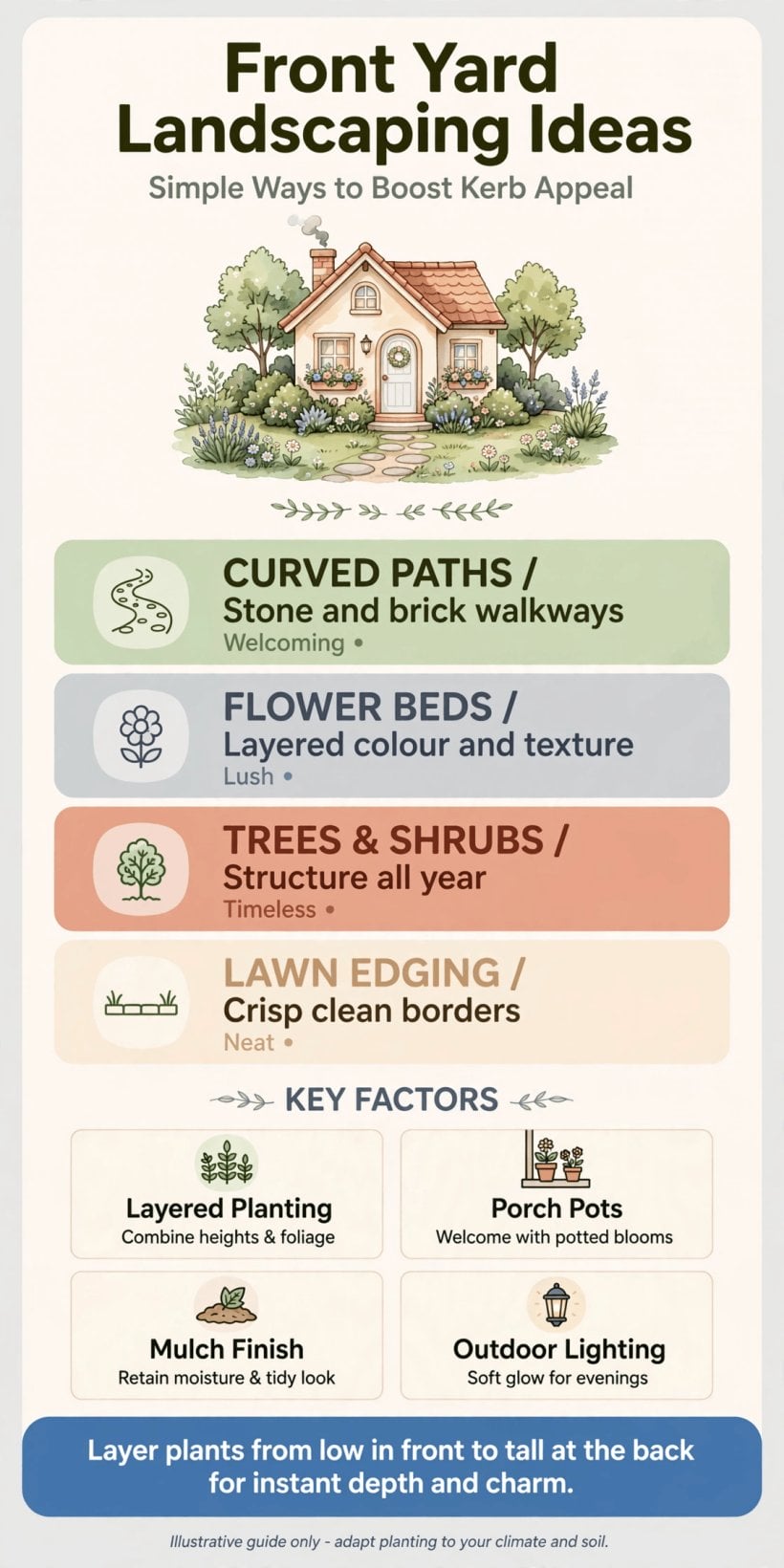
2. The Street View: Reading Your Own House
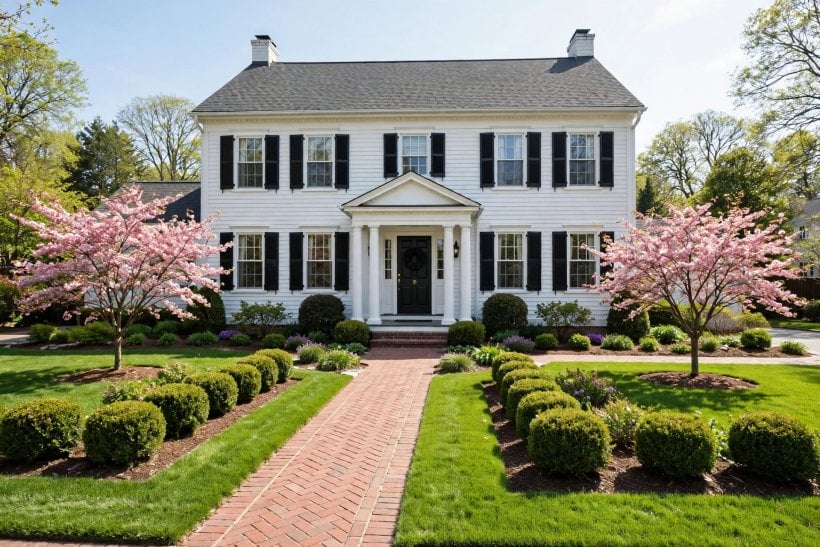
Design begins across the road. The front yard’s audience stands on the opposite pavement, and its composition — masses, gaps, the door’s visibility — is decided from there. This section teaches the street-side reading that the rock-and-gravel treatments at front yard rock landscaping for curb appeal also start from.
1. Cross the Street and Look Back
Stand where the neighbours stand and read the house whole: what dominates, what disappears, where the eye lands. Half of all front-yard mistakes are invisible from the garden side and obvious from the pavement.
2. Photograph the House From the Kerb, in Every Season
A phone photograph flattens flattery: gaps, lopsided planting and the bin’s starring role all confess. Shoot the same view four times a year and plant for the worst photograph, not the best day.
3. Make the Front Door the Composition’s Destination
Every line in the front yard — path, planting edges, the drive’s border — should conduct the eye to the door. A front garden where the door cannot be found has failed its only wayfinding duty.
4. Balance the Planting Masses Across the Facade
One heavy shrub at the left corner and lawn to the right reads as an error, not asymmetry. Compose the planting as masses with answering weights — not twins, but a conversation across the door.
5. Frame the House, Do Not Wrap It
Planting should stand at the corners and edges like a frame around a picture, leaving the facade’s centre open to be read. A house gift-wrapped in shrubs hides the architecture it means to flatter.
6. Respect the House’s Own Style
Cottage planting flatters a cottage; a formal house wants clipped shapes and straight lines. The front yard that argues with its house’s architecture loses — the building is bigger and it was there first.
7. Plan the View From Inside, Too
The front windows look out on this garden all day. A composition that is all facade — flat against the street — gives the household a view of backs and bins. Plant in depth so both audiences get a garden.
8. Keep the House Number and Door Readable at Dusk
Visitors, deliveries and ambulances all read the front yard at night. A lit number, a lit door and a path edge that can be followed in the dark are landscaping, whatever the brochures say.
9. Edit Ruthlessly: One Idea per Front Yard
The cottage border, the gravel desert garden, the formal parterre: each is a fine thesis. Together they are noise. Choose the yard’s single idea and let every plant serve it.
10. Notice What the Neighbours’ Yards Teach
The street is a free trial garden: the shrubs thriving three doors down will thrive here, in this soil and this light. Borrow the street’s proven palette before importing experiments.
11. Leave the Street Tree Its Majesty
Where a street tree stands on the verge, design beneath it rather than against it: shade planting, a mulch ring, nothing competing. The tree is the front yard’s largest asset and it belongs to everybody.
3. Paths, Driveways and the Route to the Door
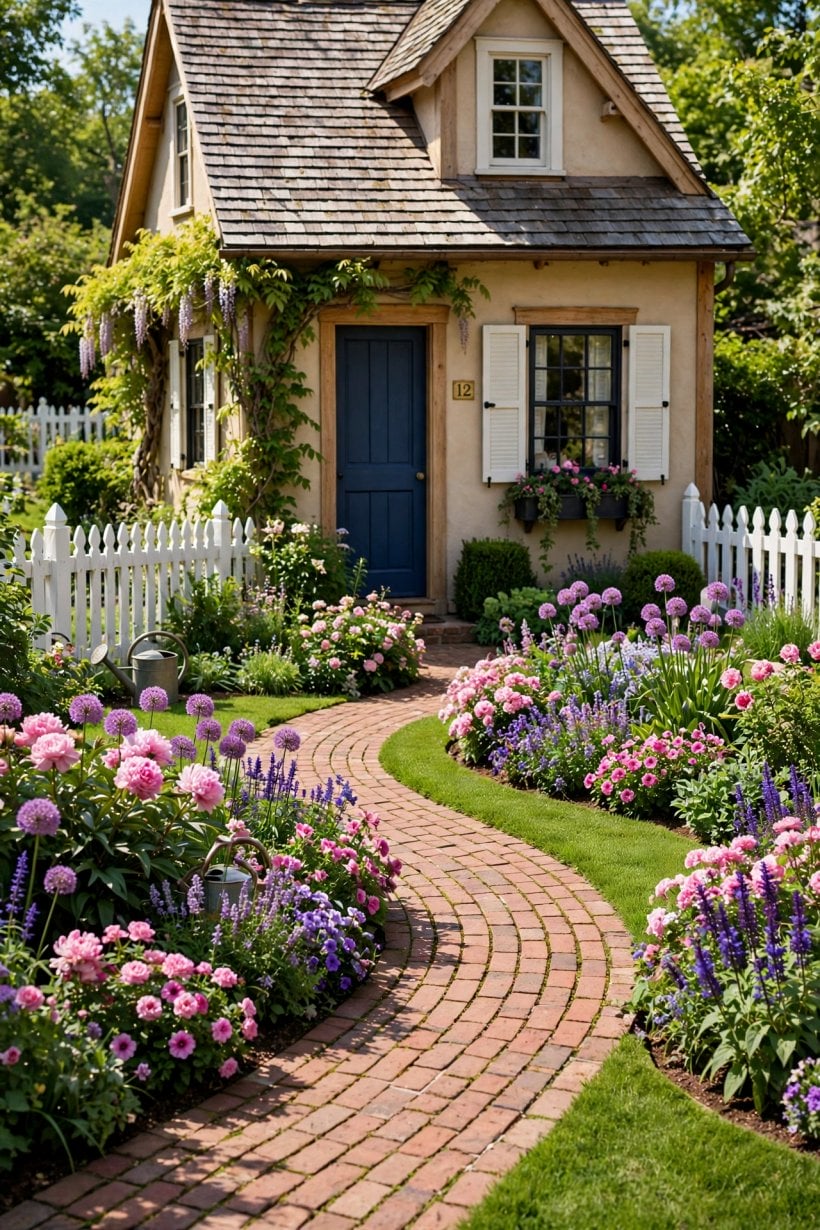
Movement is the front yard’s skeleton. Path and drive occupy its largest hard surfaces, set its lines and decide how every arrival — guest, postman, child on a bicycle — experiences the house. This section routes them like a designer, not like a leftover.
12. Give the Path a Width for Two
A front path walked by couples, by a parent with a child, by anyone carrying anything, should pass two people without a sideways shuffle. Narrow paths are the suburbs’ most common daily irritation.
13. Let the Path Curve Only Where It Earns It
A gentle curve to a hidden door is charm; a wiggle across a six-metre lawn is indecision poured in concrete. Straight serves short distances and formal houses; curves must be justified by what they reveal.
14. Edge the Path So the Planting Stays Honest
A defined edge — brick, stone, steel — keeps beds from swallowing the route and makes the whole yard read maintained even mid-season. The edge is the cheapest curb appeal in this entire post.
15. Treat the Driveway as a Floor, Not a Car Park Sign
The drive is often half the visible yard. Its material and borders are landscaping: gravel with a stone edge, pavers with planting pockets, or a green strip down the centre all return it to the garden.
16. Soften the Drive’s Edges With Low Planting
A ribbon of low planting or a row of setts between drive and lawn dissolves the hardest boundary in the yard. Cars need the width; the eye needs the seam hidden.
17. Light the Route at Ankle Height
Path lighting belongs low: guiding, not glaring. Fixtures that light the walking surface and the step edges make arrivals safe and leave the garden’s night drama to the house’s lit windows.
18. Build a Step-Free Route Wherever Possible
Prams, wheelchairs, delivery trolleys and tired knees all use the front path. A gentle, step-free line from kerb to door is future-proofing disguised as kindness, and it looks like confidence.
19. Give the Post and Parcels a Landing
A flat, dry, obvious place by the door for deliveries — and a letterbox that does not require a duel — are front-yard infrastructure. Design them in, or they will improvise themselves badly.
20. Keep the Bin Journey Short and Invisible
Bins must travel from store to kerb weekly. Route that journey along the drive’s edge on a surface that survives it, and store the bins behind planting or a screen — present in function, absent in the portrait.
21. Mark the Door’s Approach With a Pair
Two pots, two small evergreens, two lights flanking the door: the oldest arrival device in domestic architecture. The pair tells the eye “entrance” faster than any sign, path or porch.
22. Let the Path Material Echo the House
Brick paths for brick houses, stone for stone, gravel for the informal: the route reads as part of the building’s world. One respectful material repeated beats three clever ones competing.
4. Planting Beds Against the House
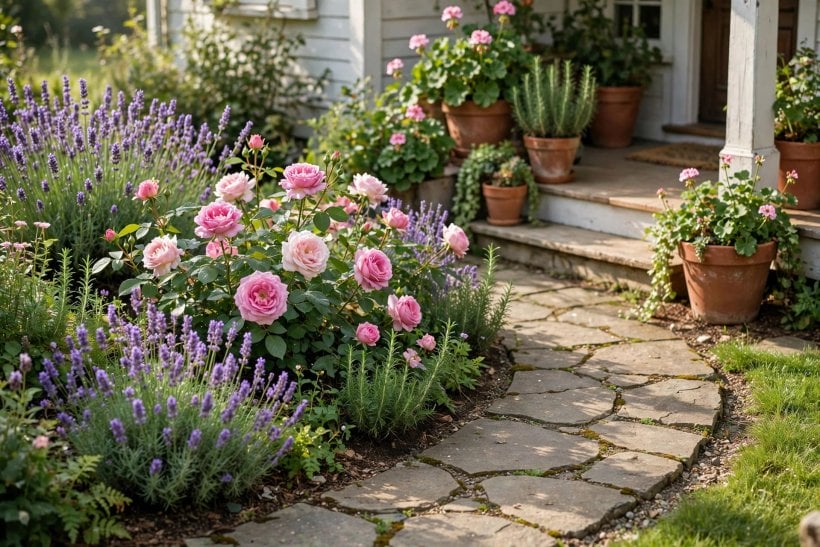
The foundation bed is where front yards are won or lost: the band of planting between wall and lawn that should mediate between architecture and garden. Built in layers and given real depth, it turns the house’s hardest junction into its softest asset. The broader planting philosophy continues at backyard landscaping ideas; the front demands extra discipline because the audience is the public.
23. Give Foundation Beds Real Depth
The skimpy half-metre strip against the wall is the front yard’s original sin: nothing thrives, everything looks apologetic. A bed deep enough for three layers — shrub, perennial, ground cover — changes the whole facade.
24. Plant in Three Layers, Always
Structure shrubs at the back, flowering perennials in the middle, ground cover spilling at the edge. The layer cake is the whole technique of the composed bed, and it works at every budget.
25. Anchor the Corners With Evergreen Structure
The house’s corners take the eye’s full stop. An evergreen shrub at each corner — clipped or naturally shapely — holds the composition in January, when everything else has retired.
26. Keep Tall Planting Off the Windows
Shrubs that eat windows darken rooms and read as neglect from the street. Choose mature heights honestly: the label’s final size, not the pot’s current one, is the number the bed is designed around.
27. Repeat a Short Plant List Across the Front
Three shrubs, two perennials, one ground cover, repeated: repetition is what makes a bed read as designed rather than collected. The street reads pattern instantly; it reads variety as clutter.
28. Mulch Like You Mean It
A deep, clean mulch is the bed’s tailored suit: it suppresses weeds, holds moisture and gives planting its finished ground. Bare soil in a front bed is undone work, visible from across the street.
29. Face the Bed’s Edge With Something Permanent
Stone, brick or steel edging gives the bed a line that survives the seasons of growth and dieback. A bed whose edge breathes in and out through the year can never look deliberate.
30. Plant for the Second Year, Judge in the Third
New beds always look sparse; overplanting to fix the first summer guarantees the third year’s crowding. Space for maturity, mulch the gaps, and let time do the filling it does so well.
31. Include One Flowering Moment per Season
Spring bulbs, summer perennials, autumn colour, winter berries or bark: a front bed that performs in sequence keeps the house’s portrait fresh all year, and gives the street a reason to slow down.
32. Keep Water Honest at the Wall
Beds against the house must not pond water at the foundations. Grade the soil away from the wall, keep mulch off the render’s damp line, and let the driest strip by the wall hold the toughest plants.
33. Let One Specimen Earn Its Solo
A single beautiful small tree or sculptural shrub in the bed — a Japanese maple, a multi-stem amelanchier — gives the composition its soloist. One is artistry; five are a nursery display.
5. The Lawn Question: Keep, Shrink or Replace
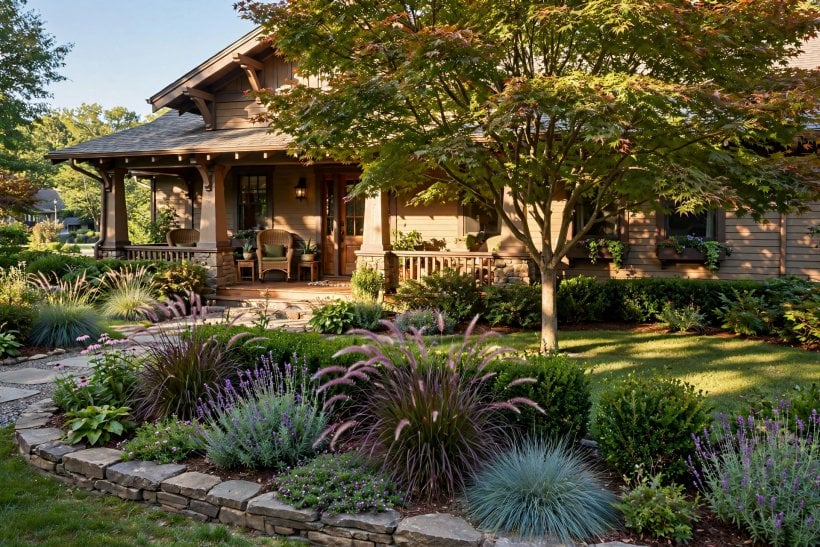
Lawn is the front yard’s default setting, and defaults deserve cross-examination. A front lawn is never played on, rarely sat on, and exists mostly to be looked at and mown — which makes it a design choice to justify, like any other. The tiny-plot version of this argument runs through tiny house landscaping ideas as well.
34. Keep a Small Lawn Perfect Rather Than a Large One Tired
A modest, crisp green panel sets planting off like a mount sets a picture. Halve the lawn and double its care, and the whole yard’s perceived maintenance rises while the mowing falls.
35. Shrink the Lawn to a Shape With Intent
An oval, a rectangle, a clean curve echoing the bed opposite: a lawn with a deliberate geometry reads as a design element. A lawn shaped like the leftover between other things reads as exactly that.
36. Replace Lawn With a Gravel Garden Where Water Is Dear
Gravel, drought-wise planting and stone: the dry front garden needs no irrigation, no mowing and looks intentional in the hottest month, when lawns are confessing. Choose plants that love the conditions rather than endure them.
37. Plant a Flowering Meadow Strip Where the Street Allows
A managed meadow band — even a metre deep along the fence — feeds pollinators and gives the yard a season of movement. Keep a mown edge against the path so the wildness reads as chosen.
38. Use Ground Covers Where Feet Never Go
Under trees, on banks, in the awkward triangles: creeping ground covers do lawn’s visual job without its mowing. The rule is traffic — ground cover anywhere feet do not regularly fall.
39. Let the Front Lawn Retire in Deep Shade
Grass under a dense canopy will always be a rumour. Mulched shade planting or a stone-and-fern composition replaces the struggle with a woodland floor that suits the light it actually gets.
40. Edge Whatever Replaces the Lawn Twice as Carefully
The smaller or stranger the lawn treatment, the more its edges matter. A crisp boundary is what separates “designed gravel garden” from “the grass died” in the street’s judgement.
41. Consider the View From the Front Window
The household looks down on the front garden daily. Patterns invisible from the kerb — the bed’s rhythm, the lawn’s shape — are composed for this audience. Design the plan view, not just the elevation.
42. Keep a Path Across Whatever Replaces Grass
Postmen and meter readers will cross the yard on the desire line regardless. Give the gravel or the meadow a stepping-stone route before their boots draw one for you.
43. Phase the Lawn’s Retreat Over Seasons
Convert a section each year — the shadiest, the driest, the least loved — and the front yard transforms without a single overwhelming project. Lawns can retire gradually, with dignity.
44. Count the Mowing Honestly Before Keeping It All
Price the lawn in hours per year, water and machinery. Most households discover it is a subscription they never chose.
6. Trees, Shrubs and the Vertical Layer
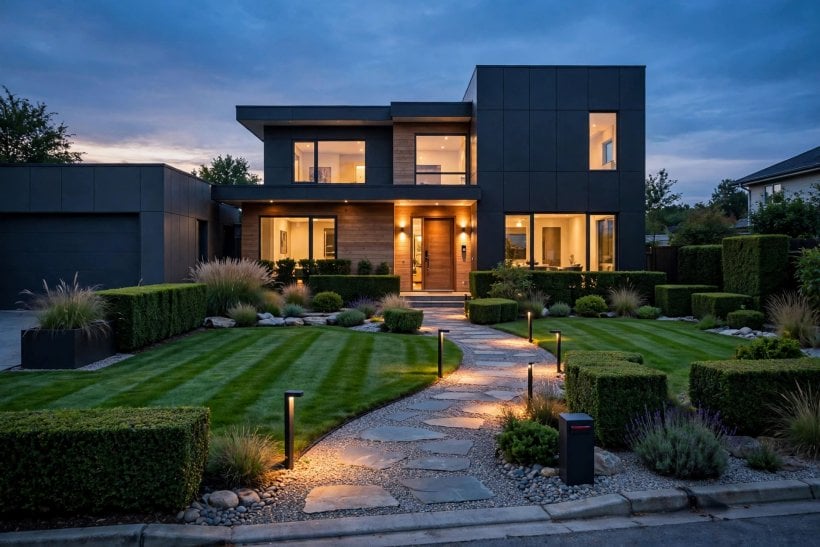
A front yard of only low planting is a garden lying down. Trees and tall shrubs give it posture, shade the windows, cool the wall and make the house look settled into its ground — the single strongest signal that a home is established rather than newly occupied. The architectural side of that settled look is covered at new home exterior design ideas.
45. Plant One Small Tree as the Yard’s Landmark
Amelanchier, crab apple, small maple, multi-stem birch: one well-chosen small tree does more for a front yard than any ten shrubs. It gives blossom, shade, autumn colour and winter bones in a single purchase.
46. Site the Tree to Frame, Not Hide, the House
Off to one corner, a third of the way across the facade: the classic portrait position. Centred on the house, a growing tree eventually becomes the view; offset, it stays the frame.
47. Mind the Mature Size Like a Contract
The sapling is adorable; the thirty-year tree is the fact. Check the species’ honest final height and spread against the house, the wires and the neighbour’s light before the spade commits anyone.
48. Use Fastigiate Forms Where Space Is Narrow
Columnar trees give the vertical layer in a strip of ground — beside drives, in side passages of the front, against gables. Height without the land claim is the small yard’s arboreal answer.
49. Layer Shrubs by Height From Wall to Kerb
Tallest at the house, stepping down to the street: the front bed in section should look like a hillside, not a cliff. The gradient lets every plant be seen and gives the composition its depth.
50. Choose Shrubs That Earn Two Seasons Minimum
Blossom and berry, flower and autumn fire, scent and structure: front-yard shrubs are on public duty all year and should hold at least two acts. One-season wonders belong in the back, among friends.
51. Clip Evergreens Where the Style Is Formal
Box, yew and their kin, clipped twice a year, give a formal front its architecture. Unclipped, the same plants read as neglect — formality is a maintenance promise, so promise only what the calendar holds.
52. Let One Loose, Flowering Shrub Soften the Geometry
Against clipped structure, a single billowing shrub — a rose, a hydrangea — supplies the romance. The contrast of the tailored and the wild is the oldest front-garden music there is.
53. Keep Tree Roots and Foundations in Honest Conversation
Distance, species and soil decide whether roots and houses coexist. Plant thirsty giants well away from foundations, choose modest species near the walls, and the two structures will age together peacefully.
54. Underplant the Tree With Its Own Small World
A ring of bulbs, shade perennials and mulch beneath the canopy finishes the tree as a composition and suppresses the grass battle beneath it. The tree gets a garden; the garden gets a centre.
55. Prune for the Sightline, Not Just the Tree
Lift the canopy to keep the door visible and the house number readable; clear the pavement’s headroom as an act of citizenship. Street-side pruning is where private gardening meets public manners.
7. Borders, Fences and the Garden’s Edge
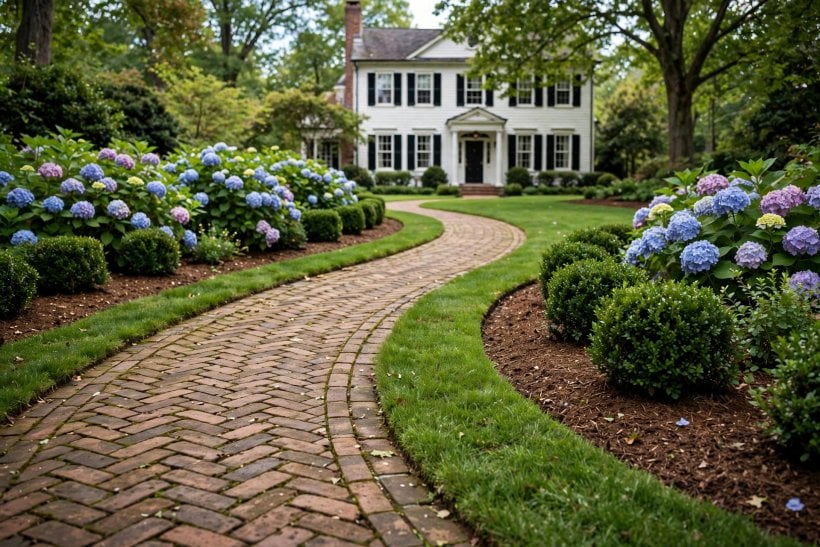
The boundary is the front yard’s handshake with the street: it declares where public ends and home begins, and its treatment — open, hedged, fenced or walled — sets the whole property’s temperament. The porch it protects is furnished at porch ideas; this section draws the line it stands behind.
56. Decide Open or Enclosed, and Commit
The open front yard is generous and communal; the enclosed one is private and composed. Half-measures — a broken hedge, a fence missing its gate — read as indecision. Choose the street’s character and keep it.
57. Plant a Low Hedge as the Living Border
A clipped hedge at knee to waist height marks the boundary, frames the garden and gives the street something green to look at. It is the friendliest wall ever built, and it improves for thirty years.
58. Keep Front Fences Low and Permeable to Light
Where fences are wanted, pickets and open rails keep the garden visible and the street friendly. A tall solid barrier at the front turns the house into a compound and the yard into a rumour.
59. Soften Any Fence With Planting on Both Sides
A fence with climbers on the garden side and a planting strip on the street side becomes the street’s asset instead of its eyesore. The verge planting is a gift to every passer-by, daily.
60. Give the Gate the Door’s Importance
The front gate is opened more often than the front door by the people who matter most — the household. Its latch, swing and material deserve door-grade attention; a gate that fights back is a daily insult.
61. Use a Wall Where the House Already Speaks Stone or Brick
A low wall in the house’s own material is the most permanent and formal boundary — and the most expensive. Where budget or style forbids, a hedge in the same formal spirit does the job at a gardener’s price.
62. Mark the Boundary With Planting Alone in Open Streets
Where the street’s custom is open lawns, a change of planting — a bed, a row of grasses — can declare the border without building one. Neighbourliness sometimes means matching the street’s openness.
63. Keep Visibility Splits Clear at the Drive
Whatever the boundary, the driver’s view out must stay open: low planting near the drive’s mouth, nothing tall at the kerb corner. Curb appeal never justifies a blind exit.
64. Light the Boundary Lightly
A single light at the gate or the number post marks the property’s threshold after dark. More than that belongs to airports. The boundary’s night job is orientation, not display.
65. Maintain the Street Side Like It Is Yours — It Is
The verge, the pavement edge, the hedge’s street face: the public reads the house by its public surfaces. Ten minutes outside the fence does more for the portrait than an hour inside it.
8. Small Front Yards, Slopes and Tiny Houses
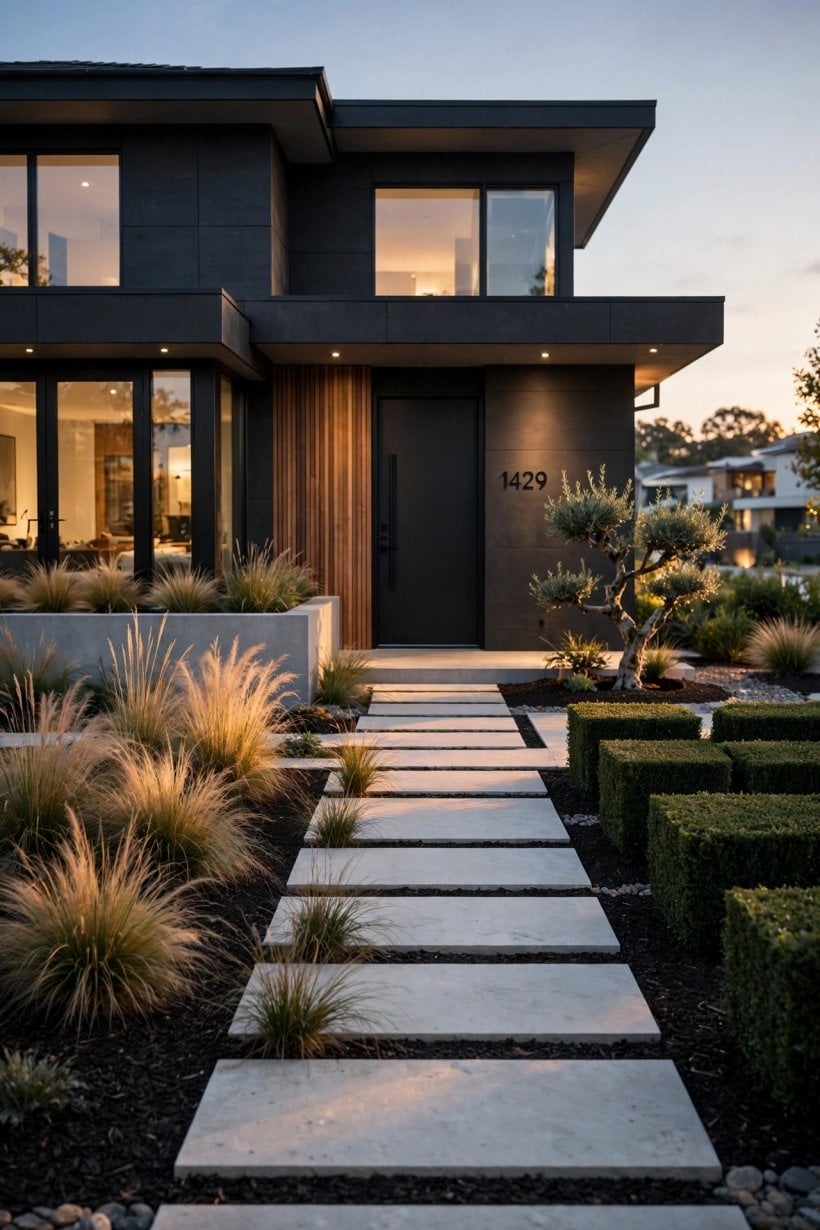
The small front yard has no room for the average — every plant must be a decision. Slopes add gravity to the argument, and tiny houses compress the whole composition into a few metres where the yard is also the approach, the garden and the view. The pergola that can crown the smallest plot is built at pergola ideas.
66. Give a Tiny Front Yard One Tree, One Bed, One Path
The minimum viable composition, done beautifully, beats a crowded miniature of a big garden. Restraint at small scale reads as confidence; the street can smell a crammed yard at twenty paces.
67. Terrace a Slope Into Planting Shelves
A sloping front yard wants level ground in steps: low retaining edges, beds like shelves, the path in honest steps. Terraces turn the slope from apology into structure.
68. Plant a Bank With Things That Hold It
On banks, choose root-deep ground covers and shrubs that knit the soil — the planting is engineering here, erosion control wearing flowers. Loose mulch on a steep bank is a landslide in instalments.
69. Let a Tiny House’s Yard Borrow the Wild
Where a tiny house sits in landscape, the front yard can grade gently from composed near the door to meadow at the boundary — the house reads as settled into nature rather than parked upon it.
70. Use Containers Where the Ground Is Paved or Rented
Pots at the door pair, a container border along the path: the fully paved front yard can still be a garden, and a rented one can be a garden that moves house with its owners.
71. Paint the Door to Do the Yard’s Colour Work
In the smallest front yards, the door is the largest colour surface available. A considered door colour — with the number and hardware to match — carries the portrait while planting stays green and calm.
72. Keep Sight Lines Open in Shared and Corner Plots
Corner houses hold two front yards and two audiences. Keep planting low at the corner itself: the composition must serve two streets without hiding either one’s traffic from the other.
73. Store Nothing in a Small Front Yard — Ever
Small yards have no background: everything in them is foreground. Bikes, bins and tools need a side route, a screen or a store — the tiny front yard’s discipline is absolute because its stage is.
74. Choose Slow Plants Where Access Is Awkward
Sloped, narrow or terraced beds are hard to reach for pruning. Slow-growing, self-shaping plants in the awkward zones keep the maintenance honest and the composition stable between visits.
75. Make the Homecoming the Design Brief
Whatever the yard’s size, judge it at the moment of arriving home, tired, in the rain, in the dark. If the path is clear, the door is lit, the planting is kind and nothing needs apologising for — the front yard is finished, whatever the street thinks.
9. Checks and Mistakes: Before the First Spadeful
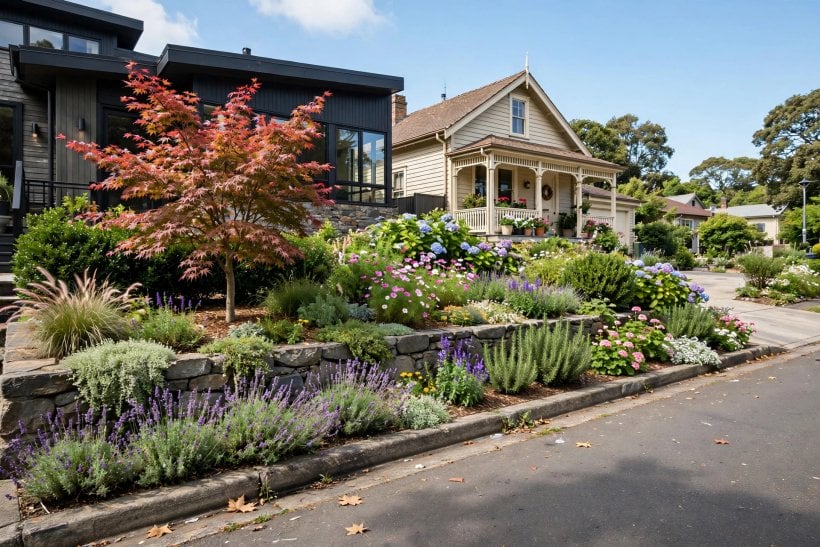
The front yard’s classic mistakes are committed from inside the house looking out: the shrub row planted against the wall because the wall was there; the lawn kept from habit; the tree centred like a flagpole; the bins given the best parking in the portrait. And above all, the yard designed in one heroic weekend and maintained never. Run the checks from across the street. Can the door be found? Is there one clear idea? Does every plant’s mature size fit its post? A front yard that passes those questions will look loved from the kerb for decades — which is, in the end, the entire job.
10. Costs and Pulling It Together
Front-yard money divides into hard landscaping, plants and patience. Paths, edging and boundaries are the capital works — buy them once and well. Plants are cheaper than their reputations when bought small and given time; mulch and edges are the cheapest transformation in the garden. Spend first on the route to the door and the bed’s structure, let planting mature into its spaces. Pull it together from the street inward — compose the portrait, route the arrival, layer the beds, settle the lawn’s honest size — and the house will present itself exactly as it deserves to be met.
Final Considerations
A front yard is a promise made in public: that this house is cared for, that arrivals are expected, that the life inside has overflowed pleasantly into the open. It asks for less than any other garden — a clear path, layered planting, edges kept with pride — and returns more per hour spent on it than any room indoors. Design it from the pavement, keep it from the heart, and the walk from kerb to door becomes what it always could have been: the best introduction a home can give.


0 Comments