

A gate is the only part of a boundary that moves, speaks and shakes hands — the fence stands still for decades, but the gate is greeted, latched and judged twice a day.
These 75 gate ideas cover the garden gate, the driveway gate and the honest side gate in one order: the threshold defined, the three territories walked, then materials, hardware and the planting and light the gate lives among.
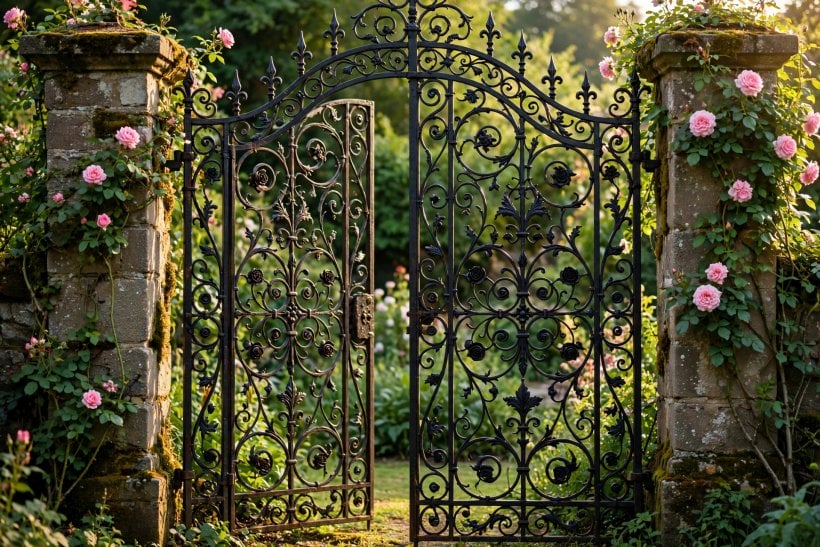
1. Gate Ideas at a Glance
The central entity is the gate: the movable panel in a plot’s boundary, defined by its attributes — the threshold it marks, the territory it serves (garden, driveway or side passage), its material and finish, its posts and hardware, and the planting, light and routine around it. A gate is judged three ways at once: as security, as welcome, and as a machine that must swing true in February wind with a bag in each hand.
| Question | Short answer |
|---|---|
| Garden, driveway or side gate first? | Decide the territory first: garden gates are hand-latched ceremonies, driveway gates are wide working machines, side gates are security with a bin run attached. |
| Swing or sliding for a driveway? | Swing where the drive is level and its arc stays clear; slide where slope, wind or parking steal the swing’s room. |
| Which material lasts best? | The one whose upkeep the household will keep: timber for repairability, galvanised steel for strength, aluminium for lightness, composite for low care. |
| What fails first on most gates? | The posts and hinges, not the panel — a gate is only ever as good as what it hangs on. |
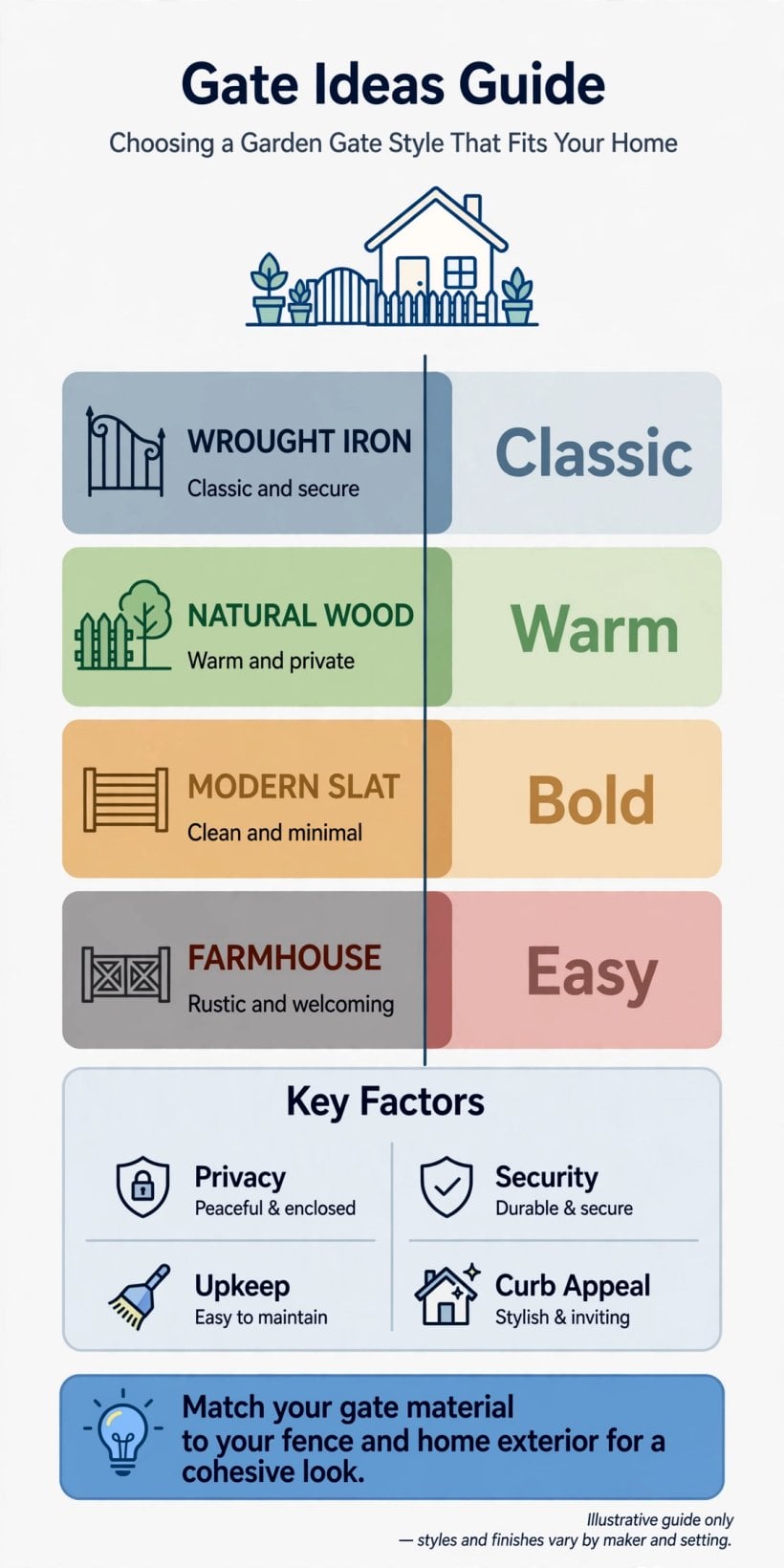
2. The Gate Defined: Threshold, Security and Welcome
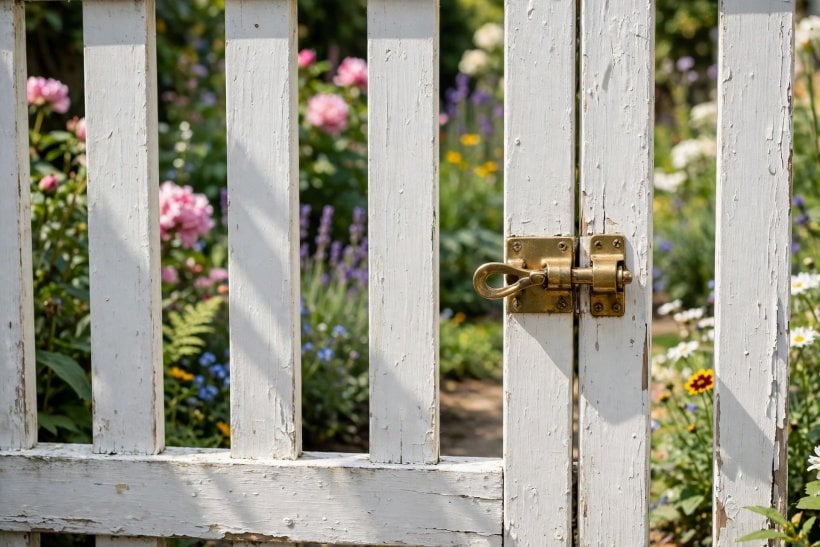
The gate is the boundary made movable: where the exterior home ideas survey treats the whole street face, this post stays on the one panel that opens. A good gate does three jobs at once — it marks the threshold, it controls who and what passes, and it welcomes the right people warmly while it does so.
1. Start With the Gate as a Threshold, Not a Fence Panel
A gate is crossed, looked at and touched daily; a fence is only seen.
2. Decide What the Gate Must Actually Control
Dogs, toddlers, deer, delivery drivers, privacy, wind: every gate has a real job list.
3. Match the Gate’s Weight of Welcome to the House
A five-bar field gate welcomes a cottage; a tall close-boarded gate suits a private modern house.
4. Give Every Boundary One Principal Gate
One main entrance gate, clearly the entrance, organises visitors, post and deliveries better than three equal openings. Secondary gates for bins, meters and gardens can stay quiet and narrow behind it.
5. Let the Gate Complete the Boundary’s Line
A gate should read as the fence or hedge continued, in the same material family and height, with its own emphasis. A gate that argues with its fence makes the whole boundary look assembled from leftovers.
6. Plan the Swing Before Anything Is Built
Inward or outward, left or right, clear of parked cars, bins, planting and the path’s traffic: the swing is the gate’s daily choreography.
7. Respect the Gate Post as the Real Structure
Gates hang on posts, and posts decide whether a gate sings or sags.
8. Keep the Gate’s Proportions Honest to Its Width
A wide gate needs the bracing, thickness and hardware of a wide gate; a narrow one can be light and fine.
9. Think of the Gate and Its Path as One Sentence
The gate lands on a path, and the pair should be designed together: gate width to path width, gate style to path material.
10. Let Children and Dogs Test the Design on Paper
Small hands find latches, small bodies find gaps, dogs find both faster. If the household includes either, their abilities belong in the first sketch, not in the first escape report.
11. Remember a Gate Is Judged Twice Daily, Forever
Arrival and departure, in rain and dark, with shopping and moods: the gate is handled more than any door except the front door itself.
3. Garden Gates: Timber, Iron and the Cottage Threshold
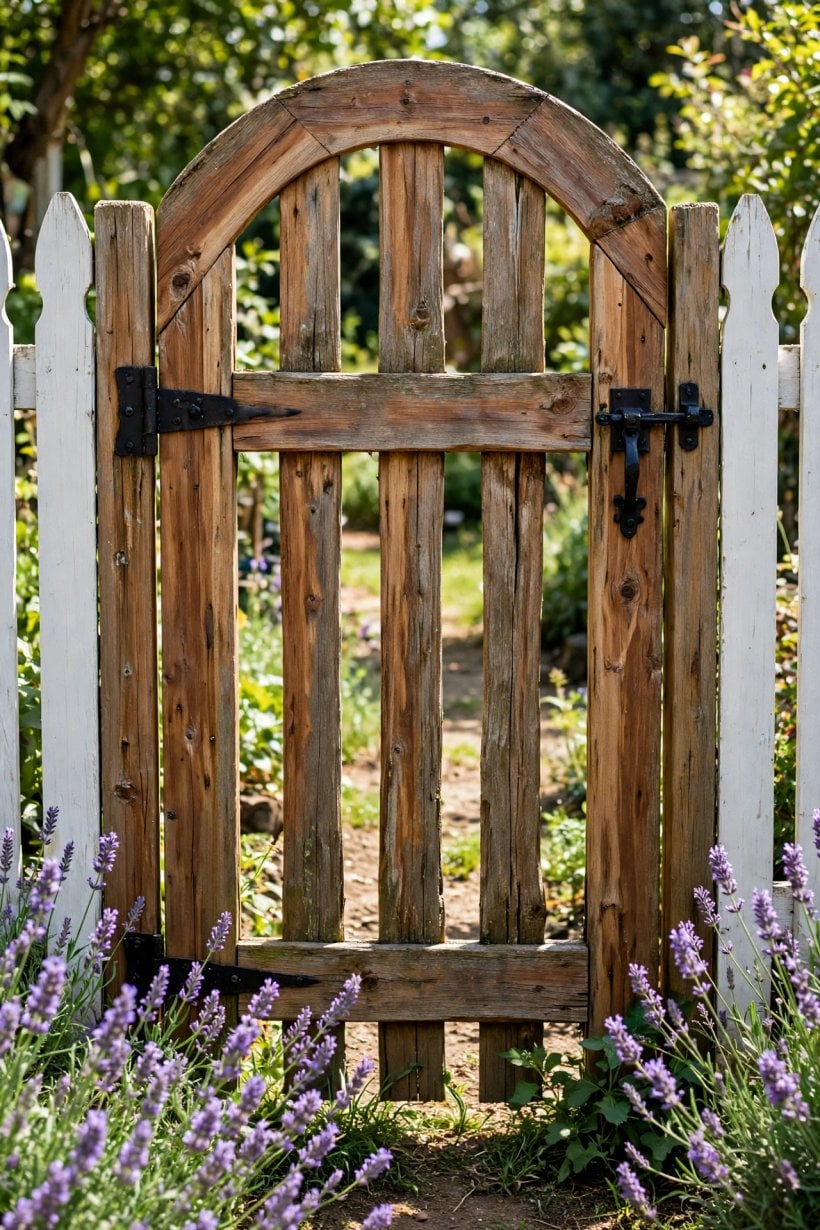
The garden gate is the gate in its purest form: human-sized, hand-latched, opening onto planting. These ideas keep to the garden — the drive and the side passage get their own sections — and to the plot’s front boundary, where the front yard landscaping ideas survey sets the wider scene the gate punctuates.
12. Hang a Classic Timber Picket Gate Where the Garden Is Cottage at Heart
Vertical pales with a gentle top line, painted or left silvered, are the garden gate’s mother tongue. Picket gates suit boundaries you can see over and gardens that want their flowers visible from the lane.
13. Use a Ledged-and-Braced Timber Gate for Honest Farmhouse Character
Boards, ledges and a diagonal brace, all on show: the construction is the decoration. Built from durable timber and hung on strap hinges, it is the gate most home workshops can genuinely make well.
14. Let an Arched-Top Gate Soften a Straight Boundary
A shallow arch across the gate’s top echoes garden curves and takes the severity out of a long straight fence. The arch costs little at build time and pays in softness every day after.
15. Frame the Gate With an Arch or Pergola Where Roses Want Height
A simple timber arch over the gate gives climbers their scaffold and the entrance its theatre. Keep the structure stout and the planting trained clear of the swing, or the romance becomes a weekly pruning negotiation.
16. Choose Wrought-Style Iron Where Views Must Pass
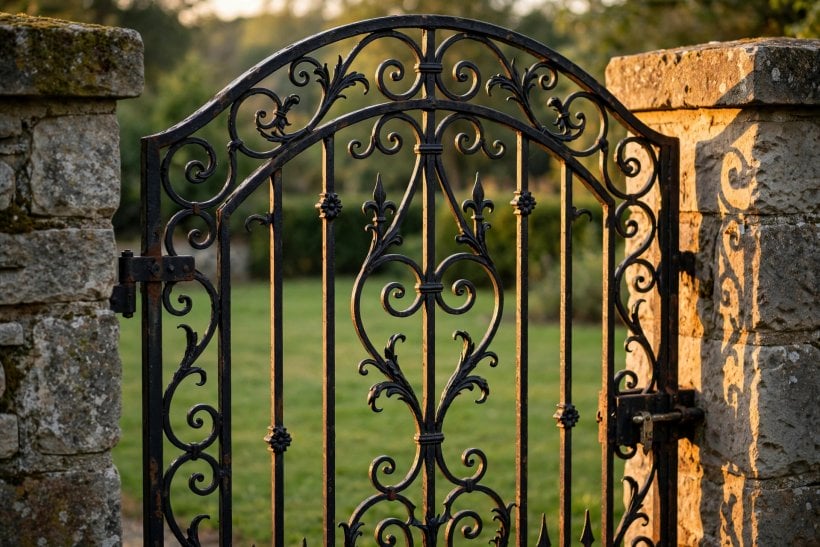
Iron garden gates guard without hiding: the garden stays visible, the boundary stays real. Slim bars, a spear or ball finial kept modest, and black paint renewed patiently are the whole recipe.
17. Paint the Garden Gate a Colour Borrowed From the Planting
Deep green that disappears into the hedge, or a deliberate flower colour — cornflower, oxblood, chalk blue — repeated in pots by the door. A painted gate is the cheapest personality a front garden can buy.
18. Set a Low Gate Where the Boundary Is a Courtesy
Front gardens on friendly streets often need only a waist-high gate: it keeps dogs in and toddlers honest while the conversation over it continues. Low gates fail only when asked to do a tall gate’s job.
19. Use a Hazel or Willow Woven Gate for the Grown, Not Built, Garden
Woven hurdles as gates suit gardens that prefer craft to manufacture. They are light, repairable and short-lived by design — a renewable gate for households who enjoy remaking things.
20. Give the Gate a Forecourt of Honest Ground
Gravel, stone or brick immediately inside the gate takes the mud season’s punishment and gives arrivals a clean landing. The patch of ground at a gate works harder than any other square metre of the garden.
21. Hang the Gate to Close Gently Against a Stop
A gate that meets a stop with a soft thud, caught by its latch every time, feels crafted; one that rattles past its frame feels broken even when new.
22. Let the Garden Gate Carry the House Number or Name
A small, well-made plaque or painted number on the gate itself solves the where-is-it hunt for every visitor and delivery. Legible from the street, in the gate’s own style, it is wayfinding as craft.
4. Driveway Gates: Swing, Slide and the Working Entrance
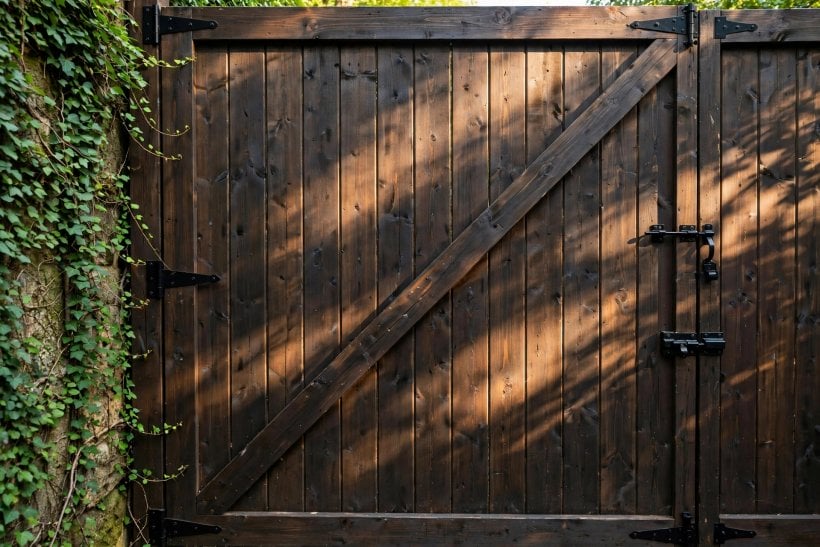
The driveway gate is a machine wearing a gate’s clothes: wide, heavy, opened in weather, often automated. The design groundwork is shared with the driveway ideas post, which owns the drive’s surface and layout; this section owns only the moving panel at its head.
23. Choose Swing Gates Where the Drive Is Level and the Swing Is Free
A pair of swing gates is the classic driveway answer: simple, handsome, repairable. It needs a level arc of clear drive behind it — snow, slope and parked cars all vote against swings they obstruct.
24. Slide the Gate Where Space, Slope or Wind Forbid the Swing
A sliding gate travels along the boundary instead of across the drive, shrugging off slope and stealing no parking. It needs a straight run of fence to retire along, kept clear of planting and bins forever.
25. Split Wide Openings Into a Pair, Not One Heroic Leaf
Two moderate leaves hang easier, automate cheaper and fail gentler than one enormous panel. The meeting in the middle is also the design’s natural centre — dress it with the best hardware on the boundary.
26. Build Driveway Gates in Steel-Framed Timber for Warmth Without Sag
A steel frame wearing timber boards gives the driveway gate its classic alliance: the frame holds the geometry, the timber gives the face. Pure timber at driveway widths is a promise diagonal braces eventually break.
27. Use Aluminium Where Weight and Upkeep Must Stay Low
Aluminium driveway gates open lightly, ignore rust and hold modern slatted designs crisply. They suit automated setups particularly, where every kilogram is a motor’s daily workload.
28. Keep Vertical Slats for the Contemporary Drive
Close vertical slats in charcoal, black or timber-effect finishes are the modern driveway gate’s uniform: private, calm, and kind to both minimalist and traditional houses behind them.
29. Let a Five-Bar Gate Serve the Rural and Semi-Rural Drive
Galvanised or timber five-bar gates belong where drives meet fields and lanes. They read as countryside honesty, keep stock and dogs honestly, and never pretend the house behind them is a townhouse.
30. Automate for the Household That Opens in Rain, Not for Show
Automation earns its cost on the wet Tuesday, the late return, the school run — not in the demonstration. Households that walk their drive happily may spend the same money better on the gate itself.
31. Plan the Pedestrian Answer Beside Every Driveway Gate
Visitors on foot should not have to operate the vehicle gate: a side pedestrian gate, an intercom-released latch, or a simple wicket within one leaf. Decide it early; retrofitting welcome is awkward.
32. Give Automated Gates Their Manual Manners
Power fails, remotes die, guests arrive unannounced. A manual release the household can actually operate, explained and practised once, is part of an automated gate’s design, not an admission of defeat.
33. Light the Driveway Gate Like the Entrance It Is
A lit gate is found at night, operated safely and photographed by every security camera kindly. Borrow the lighting from the drive’s own scheme — the driveway post covers the surface lighting this gate depends on.
5. Side Gates, Service Gates and the Honest Back Doors of the Plot
Not every gate performs at the front. The side gate guards the passage, the bins, the oil tank and the dog’s ambitions — the plot’s working entrances, designed with the same care as the gravel path and DIY walkway routes they usually open onto.
34. Make the Side Gate Tall, Plain and Serious
The side passage is the burglar’s favourite route and the household’s bin run.
35. Fit a Bolt and a Lock That Work From Both Sides
Side gates imprison their own households weekly: a bolt operable only from inside, a key left indoors. Hardware chosen for the bin run at night, in rain, carrying rubbish, passes the real test.
36. Use a Narrow Iron Gate Where the Passage Needs Air and Light
Where privacy allows, an iron side gate keeps the passage bright and lets breezes through while still barring the way. It suits side returns overlooked by neighbours, where security is shared and visible.
37. Give the Garden’s Working Gate Width for Barrows and Mowers
The back or side gate that serves the garden must pass a loaded wheelbarrow and the mower without theatre. Measure the widest regular passenger and add grace; gates are cheaper than lifted barrows.
38. Hang a Gate in the Garden’s Middle Where Rooms of Green Divide
Internal garden gates — between lawn and vegetable plot, garden and orchard — let one garden hold several moods and keep dogs from the digging. Low, light and characterful is the register here.
39. Use a Moon-Gate Opening or Round-Topped Gate for a Garden Moment
A circular or generously arched garden gate makes a framed view of what lies beyond: the oldest theatre trick in garden design, still working. Keep it to one per garden; theatre rations itself.
40. Gate the Vegetable Plot Against Its True Enemies
Rabbits, deer and the household’s own dog decide the vegetable gate: close mesh below, height where deer browse, a latch that closes itself behind arms full of produce.
41. Let the Bin Store and the Gate Be Designed as One Object
A gate that is also the bin store’s door, or stands immediately beside it in matching material, tidies the plot’s least loved corner into invisibility. The collection-day route should never cross the welcome route.
42. Screen the Service Gate With Planting, Not Apology
A trellis panel and one patient climber turn the utility gate into a green door. Planting hides hardware honestly here, provided the swing and the lock stay reachable.
43. Keep a Self-Closer on Gates That Guard Water, Roads or Animals
Where a gate protects against a pond, a lane or livestock, a spring or weighted closer removes human memory from the safety system. Choose closers that shut firmly without slamming fingers’ worth of force.
44. Number the Working Gates in the Household’s Mind
Front, side, garden, field: a household that names its gates maintains them. The working gates fail quietly — a dropped latch, a rotted foot — until the day they are needed urgently.
6. Materials and Finishes: Timber, Steel, Aluminium and Composite
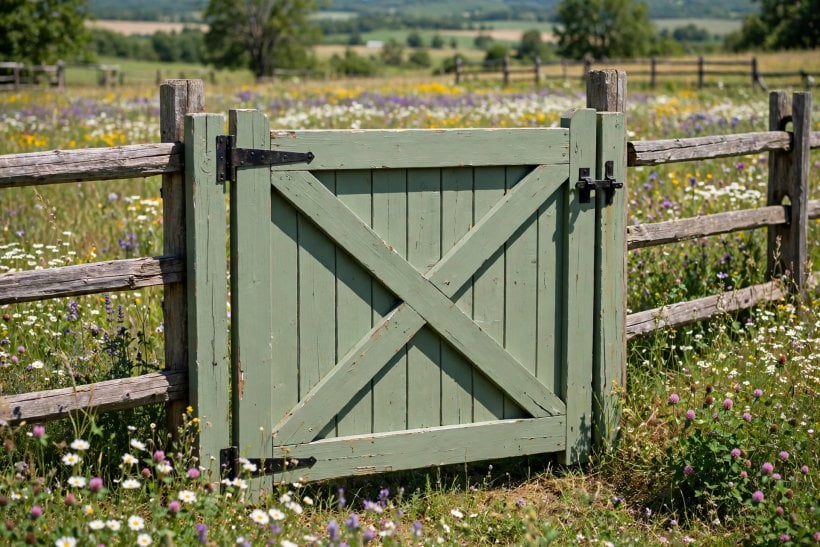
Material is the gate’s character and its maintenance contract in one decision. The wider material palette of the plot’s hard landscaping is surveyed in the backyard landscaping ideas post; here the choice is narrowed to what hangs, swings and weathers on hinges.
45. Choose Timber Where Warmth and Repairability Lead
Timber gates can be mended, re-hung, re-painted and re-imagined by ordinary hands — the repairable gate. Durable species or well-treated softwood, detailed to shed water, repay their modest upkeep for decades.
46. Detail Timber Gates to Shed Water, Not Hold It
Capped top rails, chamfered tops, gaps that drain and end grain sealed: timber rots where water sits, not where rain passes. The best timber gate design is mostly a plumbing drawing for rainfall.
47. Use Steel Where Slim Strength and Security Lead
Steel gates carry wide spans in slim sections, take serious locks, and hold crisp modern or traditional bar designs. Their upkeep is paint discipline: chips touched in before rust gets its paragraph written.
48. Galvanise and Powder-Coat Steel for a Quiet Life
Hot-dip galvanising under a powder coat is steel’s long-life alliance, pushing repaint cycles far apart. It costs more at purchase and less at every year after — the honest arithmetic of exterior metalwork.
49. Pick Aluminium for Light Weight and Zero Rust
Aluminium gates suit long spans, automation and coastal air, and modern slatted styles in particular. They dent where steel shrugs, so busy drives with bikes and bins should weigh the trade honestly.
50. Consider Composite Boards Where Timber’s Look Must Come Without Timber’s Upkeep
Composite slats in steel frames mimic timber calmly and ask only washing. In shade and damp they can grow surface algae like any material — low maintenance is not no maintenance, whatever the brochure’s mood.
51. Let Ironwork Stay Traditional Where the House Is Period
Hand-forged character — scrolls kept restrained, spearheads modest — suits period boundaries in a way no catalogue modern gate can. Commission from makers with local gates standing that can be visited and pushed.
52. Mix Materials Deliberately: Frame One, Face Another
Steel frame with timber boards, aluminium frame with composite slats: the mixed gate puts each material on its best duty. Two materials chosen on purpose read as design; three read as indecision.
53. Match the Finish to the Boundary’s Other Metalwork
Gate, hinges, house numbers, the lantern by the door: one metal family and finish across the plot’s entrance reads as care. The gate is where the family’s finishes meet the street, so it chairs the meeting.
54. Plan the Finish’s Renewal Before Choosing It
Paint wants renewing, oil wants refreshing, powder coat wants only washing until it doesn’t. Choose the finish whose maintenance rhythm the household will genuinely keep — the gate will advertise whichever choice was made.
55. Buy Hardware-Grade Fixings, Always Stainless or Galvanised Outside
The gate’s screws and bolts live outdoors under load. Cheap fixings bleed rust down good timber and seize before their first adjustment; the savings are imaginary and the stains are permanent.
7. Hardware, Hinges, Locks and Automation: The Gate’s Moving Parts
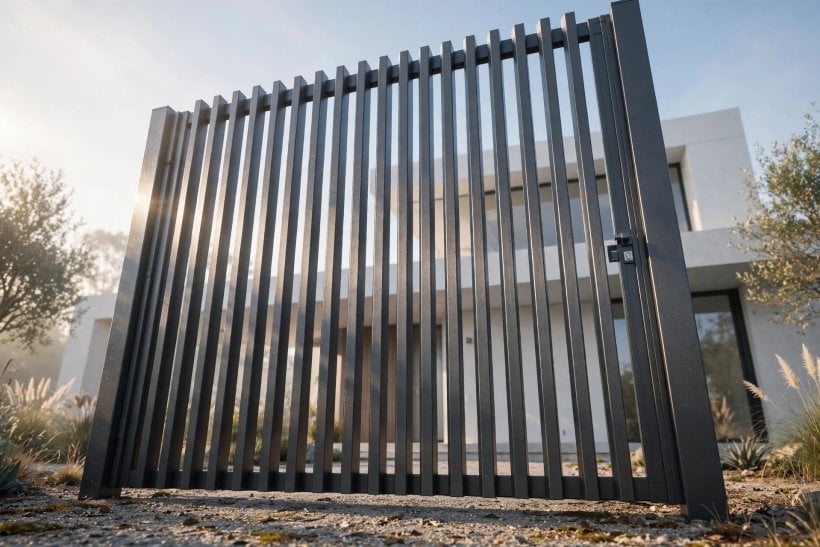
A gate is mostly its hardware experienced daily: the hang, the catch, the lock, the closer. This section is the moving-parts survey; the planting and lighting that complete the entrance follow, and the plot’s wider projects — sheds, stores and working corners — are gathered in the garden shed ideas post for households mid-makeover.
56. Hang Gates on Hinges Sized With Margin, Not Optimism
Hinges carry the gate’s whole weight at its worst leverage, in wind, forever.
57. Use Adjustable Hinges Where Posts or Seasons Move
Timber posts breathe with the seasons and ground shifts slowly; adjustable hinges let the gate be re-trued in minutes instead of re-hung in a weekend. On any gate wider than a person’s stride, they are kindness itself.
58. Choose the Latch the Hand Learns Once
Thumb latches, lever handles, ring latches: the best gate latch is operable one-handed, gloved, carrying shopping, in the dark. Test candidates with a bag in the hand and the argument settles itself.
59. Lock the Gates That Guard, Key the Gates That Matter
A latch keeps a gate shut; a lock keeps it guarded.
60. Fit a Self-Closing Spring Where Memory Is the Weak Point
Gates that must always be shut — pools, roads, animals, toddlers — should not depend on anyone remembering. Springs and rising hinges close the gate as a property of physics, not of virtue.
61. Automate With Safety Sensors Treated as Non-Negotiable
Automated gates are machines with a vehicle’s power: photocells, safety edges and correct force settings, installed and checked by competent hands, are the design — the remote control is merely its interface.
62. Give Driveway Automation a Pedestrian Logic
Intercom, keypad, or a separate pedestrian gate: visitors, post and the household on foot all need a way through that is not the full vehicle ceremony. Design it before the motor is ordered.
63. Keep Manual Gates’ Closers Gentle
A closer that slams teaches children to fear the gate and loosens every fixing monthly.
64. Oil, Tighten and Inspect on a Season’s Rhythm
Ten minutes twice a year — hinges oiled, screws checked, latch aligned, timber ends inspected — keeps a gate in its first decade indefinitely. Gates die of neglect in small instalments, all of them preventable.
65. Let the Gate’s Sound Be Designed, Not Endured
Creaks, rattles and the latch’s clatter are the gate’s voice, heard by the household and the neighbours daily. Felt pads, true alignment and sound fixings compose that voice into something nearer music.
8. Planting, Light and Living With the Gate
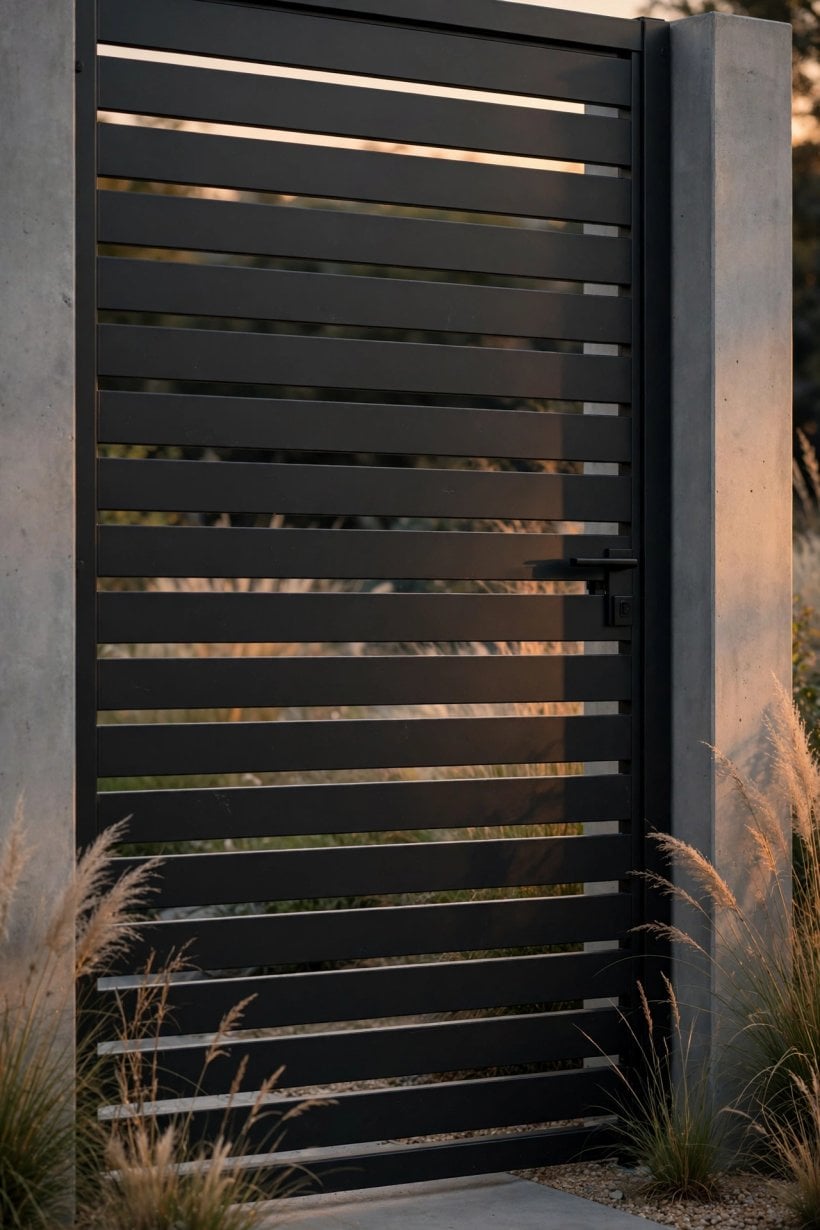
The finished gate lives in planting, weather and routine. These last ideas dress the threshold and keep it working — the curb-facing planting framework is the front yard rock landscaping post’s territory, linked here where gate and garden meet the street.
66. Plant the Gateposts, But Never the Swing
Climbers on the posts and arch dress the gate beautifully; planting in the swing’s arc is a slow war the gate always loses untidily.
67. Use Scent at the Gate, Where Hands and Coats Brush Past
A rosemary, lavender or scented rose at the gate perfumes every arrival without a single device. Scent is the gate’s invisible welcome, and it costs one plant and one season’s patience.
68. Keep One Evergreen Anchor at the Entrance in Winter
When the garden sleeps, a single evergreen form at the gate — a clipped ball, a conifer in a pot — keeps the entrance composed. Winter is when gates are most looked at, the planting having retired.
69. Light the Latch, Not Just the Scene
Entrance lighting usually flatters the house and abandons the gate. A modest light where the hand meets the latch, warm and glare-free, is the most used light on the plot after dark.
70. Sweep the Gate’s Threshold as Part of the Entrance’s Routine
Leaves, grit and ice collect where gates swing and paths land. A clear threshold keeps the swing free, the footing sure and the entrance’s welcome credible in every month.
71. Re-Tension, Re-Level and Re-Paint Before Small Faults Teach Big Ones
A gate dropped by a finger’s width is telling its household something cheap to hear. Attend early and the gate stays a pleasure; ignore it and the frame, posts and hardware all learn the fault together.
72. Dress the Gate for the Seasons Lightly
A wreath in winter, a hanging basket in summer: the gate takes small celebrations gracefully, provided fixings never wound the timber or foul the swing. The entrance that changes slightly is an entrance that is looked after.
73. Watch How Guests Use the Gate, and Believe Them
Visitors hesitate where the latch hides, push where the gate actually pulls, and park across swings that look like drive. Their behaviour is free consultancy: adjust signs, handles and planting to the gate people think they see.
74. Keep the Dog’s View in Mind at Dog Height
A gap at the bottom, a see-through panel at nose height: gates are experienced by dogs at their own altitude, usually with strong opinions. Design the lower third for its most motivated user.
75. Remember the Gate Outlives Its Fashions
Posts set well and a sound gate will serve through several of the household’s taste eras. Choose the enduring version of the current wish — the gate repainted is a weekend; the gate replaced is a project.
9. Checks and Mistakes: Before the First Pour or Purchase

Check the posts, the ground and the swing before the panel is chosen, because gates fail from the ground up: post depth and foundations suited to the soil, the swing’s arc walked and cleared, and drainage arranged so the gate’s feet never stand in water. The prettiest panel in this post cannot rescue a post that was set hopefully.
Check the hardware against the gate’s true weight and width, with margin, and the security against the territory: side gates locked properly, automated gates given their safety sensors and manual release, and every latch tested one-handed in the mind before it is bought. Gates are used too often to be forgiven daily annoyances.
The common mistakes are all refusals of this post’s order: panel bought before posts, swing never walked, automation without a pedestrian answer, planting in the arc, and finishes chosen for the showroom rather than the household’s real maintenance rhythm. Each is avoided by deciding territory, structure and hardware before appearance.
10. Costs and Pulling It Together
Costs stay qualitative, as honest gate-keeping must: a ledged timber garden gate is the economical end, its materials modest and its making within a competent workshop’s reach, while wide automated driveway gates in steel-framed timber or aluminium are the expensive end, where posts, groundwork, motors and safety systems are the true price and the panel almost an afterthought. Spend first on posts and hardware; they are touched at every passage, long after finishes fade.
Pull it together in the order this post kept: territory, threshold, material, hardware, then planting and light. Followed in that sequence, these seventy-five ideas become one boundary that opens like a welcome and closes like a promise.
Final Considerations
The gate is the plot’s handshake, offered twice daily for decades. Build it on honest posts, hang it on generous hardware, dress it lightly and keep its small promises — a true swing, a kind latch, a clear arc — and the boundary it serves will feel less like a wall and more like a welcome with good judgement.

0 Comments