

A good gate announces itself by sound: a soft, certain click, iron meeting iron, that says the house behind it is kept.
Seventy-five modern wrought iron gates follow: their frames and scrolls, driveway and garden leaves, entrances, boundaries, finishes, and the automation and keeping that let iron outlive its maker — security stated generally, throughout.
1. Iron Gate at a Glance
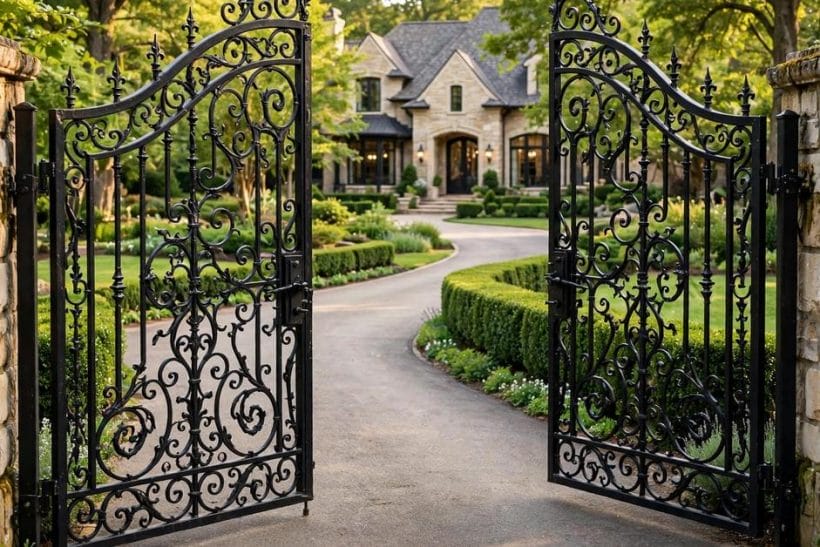
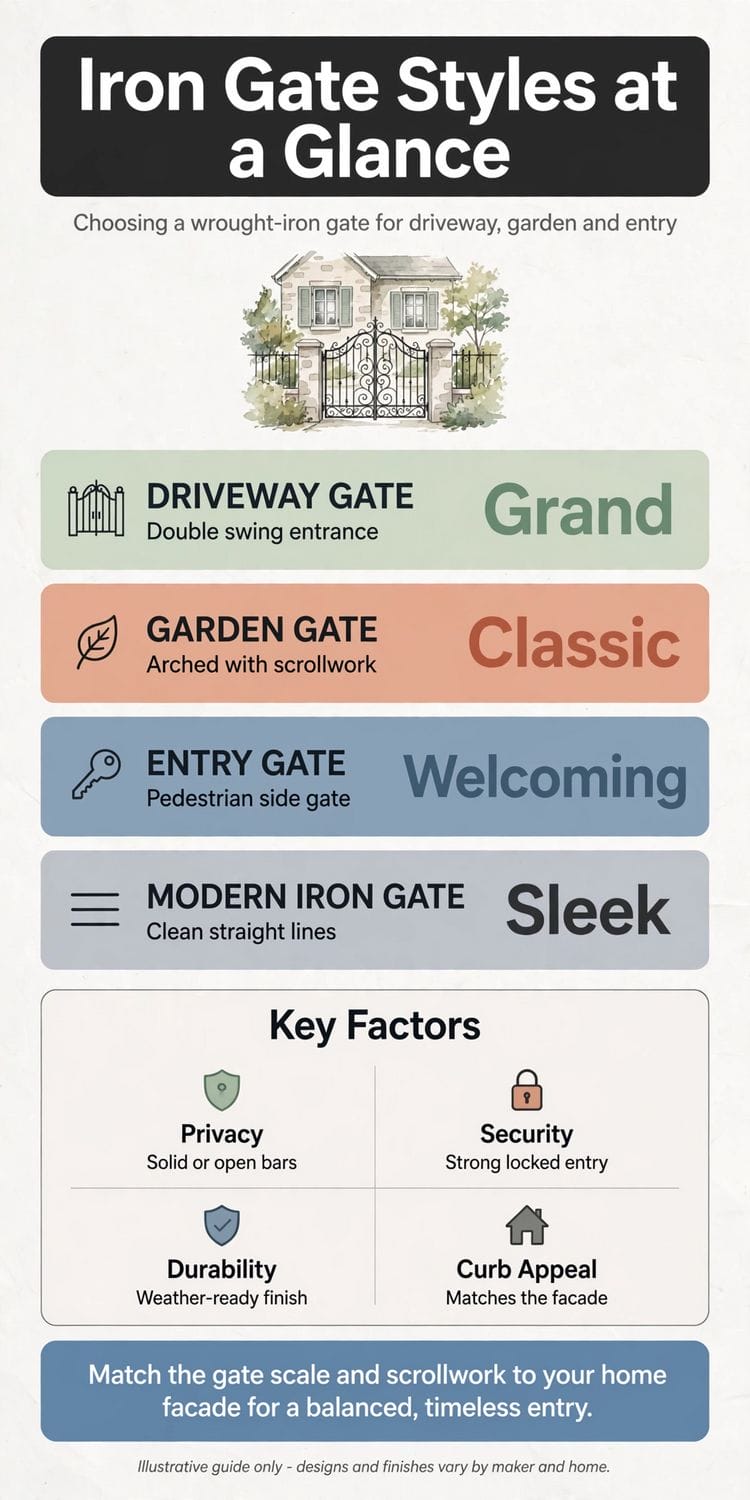
The central entity is the wrought iron gate: a leaf or pair of leaves framed and barred in worked iron — traditionally forged, today often fabricated to forged designs — hung on posts or masonry piers at a driveway, garden or pedestrian entrance. Its attributes are a frame that cannot sag, a pattern that balances security with welcome, a finish that defends the metal, and hardware from hinges to openers sized honestly to the leaf. This post owns the modern wrought-iron material lane: the general gate field belongs to the gate ideas pillar, and fence lines are a sibling’s survey, linked where they meet the leaf. All structural, security and automation points are stated generally, as specialist work under local rules.
| Question | Short answer |
|---|---|
| What separates a good iron gate? | Its frame and hanging: braced, balanced and true long before its scrolls are admired. |
| Swing or sliding for a driveway? | Swing where the arc stays clear and level; sliding where slope or space forbids the swing — an installer’s judgement on site. |
| What finish lasts outdoors? | A properly prepared coated finish, in one colour across gate and boundary, maintained by early touch-ins and an annual hour. |
| Can an iron gate be automated? | Yes — by qualified installers as a regulated system with safety devices and manual release, never as an improvisation. |
2. The Gate Itself: Frames, Bars, Scrolls and Spears
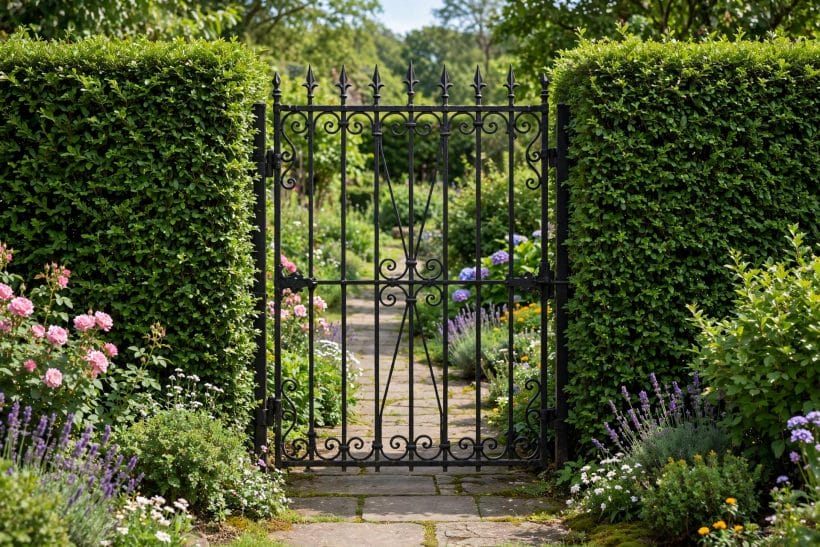
An iron gate is blacksmith work at architectural scale: a frame that must not sag, bars that must not bend, and ornament that must survive weather. The whole gate field is surveyed by the gate ideas pillar; this post stays on wrought iron itself — its construction, its patterns and the details that separate a forged gate from a flimsy imitation.
1. The frame that carries everything
Every good iron gate begins as a honest rectangular frame, braced so its own weight cannot pull it out of square.
2. Vertical bars, closely and calmly set
The classic field of upright bars, evenly spaced, is iron’s most enduring pattern: secure in character, transparent to the garden, and calm against any house style. Even spacing is harder than it looks — irregular bars betray hurried making instantly.
3. Scrolls that earn their place
Forged scrolls — the C and S curves of the smith’s tradition — belong at the gate’s centre and corners, where the eye lands.
4. Spear finials along the top rail
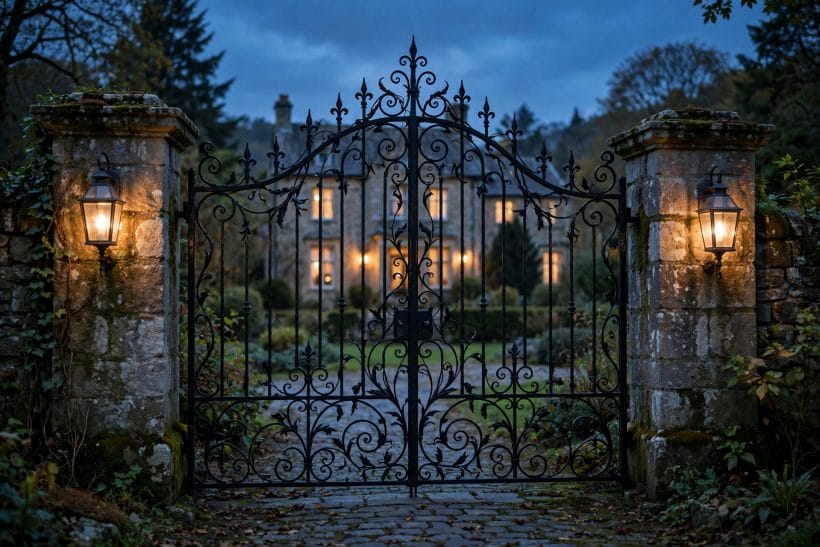
Pointed finials finish the top rail with iron’s traditional silhouette and a clear, honest message about climbing. Finial styles run from simple spikes to fleur-de-lis forms; consistency along the rail matters more than the pattern chosen.
5. The arched top gate
A gentle arch across the gate’s head softens iron’s severity and suits garden entrances and older houses beautifully.
6. Flat-top gates for modern houses
A level top rail, square bars and an absence of scrollwork give iron its contemporary register. Modern wrought iron succeeds by proportion and finish rather than ornament: the straighter the design, the more exact the making must be.
7. Circles and motifs in the field
A forged circle, a family initial, a simple geometric medallion at the gate’s centre gives a pair of leaves their focal point.
8. Solid lower panels with open bars above
A gate panelled solid at its base and barred above balances privacy at ground level with openness at eye level. The panel also shields the garden from street splash and gives dogs and small children an honest visual boundary.
9. Mesh-backed iron for full screening
Fine mesh fixed behind an iron frame screens sight almost completely while keeping the gate’s forged face. Mesh-backed gates suit side passages and service entries where the garden wants privacy more than it wants a view.
10. Double leaves that meet true
A pair of gate leaves must meet at the centre without a step, a gap or a sag — the test every visitor unconsciously performs.
11. The blacksmith’s hammered texture
Hand-worked iron carries a faint hammered life in its surface that flat manufactured bar never quite imitates.
3. Driveway Gates: Swing, Sliding and the Entrance Composition
The driveway gate is the house’s front door at street scale. Its opening ground — the drive itself — belongs to the driveway ideas survey; this section stays on the iron leaves, their swing or slide, and the posts and piers that present them to the road.
12. The classic pair of swing leaves
Two leaves swinging inward from masonry or iron piers remain the ceremonial entrance: symmetrical, welcoming, unmistakably an arrival. Swing gates need their arc kept clear — of cars, of planting, of snow — a discipline the design should assume, not discover.
13. Single-leaf swing gates for narrow drives
One wide leaf serves narrower entrances where a pair would look fussy. A single leaf carries more weight on its hinges and post, so its frame and bracing step up a register — the post, honestly built, is half the gate.
14. Sliding iron gates on a ground track
Where the drive slopes or space behind the piers is tight, a sliding gate travels sideways along its track and asks nothing of the driveway’s surface.
15. Cantilever gates that float the opening
A cantilever gate slides without a ground track, carried on rollers at one side — kind to block paving and snowy climates alike.
16. Piers in brick or stone, caps in iron’s black
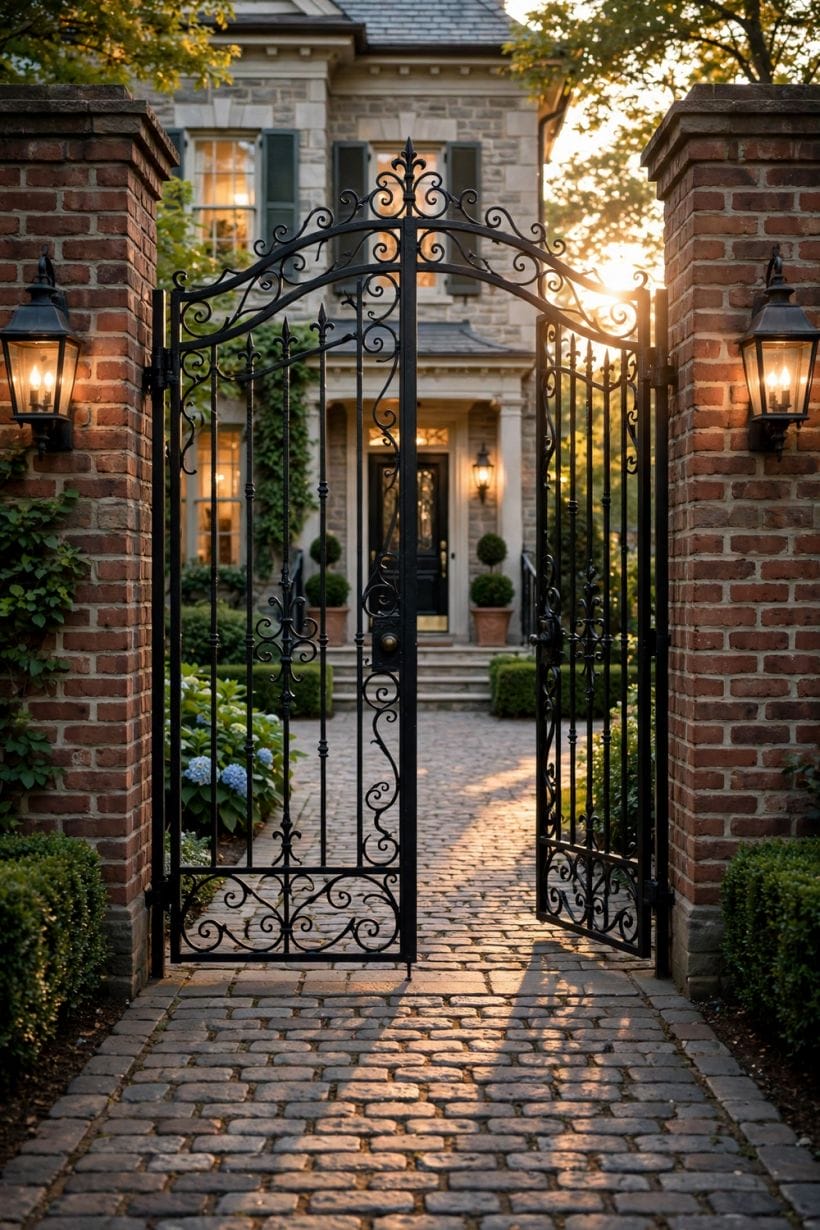
Masonry piers give wide iron gates their architecture and their hinge strength, capped and lit to finish the entrance.
17. Iron posts for the lighter entrance
All-iron entrances, leaves hung on steel posts, suit modern houses and narrower plots where masonry would overwhelm. Posts must be set deep and true by their installer; a leaning post writes the gate’s whole future in its first winter.
18. The gate centred on the house’s axis
Composing the entrance on the same axis as the front door and the drive gives the arrival its processional calm. Even modest iron gates gain ceremony from alignment — the cheapest grandeur in entrance design.
19. A pedestrian leaf beside the driveway pair
A small matching gate for people on foot, beside the great leaves, saves opening the driveway for every arrival home. Matched in pattern and finish, the pair-plus-one composition is the complete, grown-up entrance.
20. See-through leaves that show the garden
Open-barred driveway gates display the garden and the house beyond — a confident, welcoming security of presence rather than concealment. Where the plot is beautiful, transparency is the design; the bars simply set its frame.
21. Panelled leaves for the private entrance
Solid or mostly solid iron leaves close the view entirely, for houses that want the street kept at the gate.
22. Lanterns on the piers
A lantern on each pier finishes the entrance and lights the keypad, the latch and the visitor’s face. Entrance lighting is electrical work for a qualified installer, planned with the gate rather than trailed after it.
4. Garden and Side Gates: Iron at Walking Scale
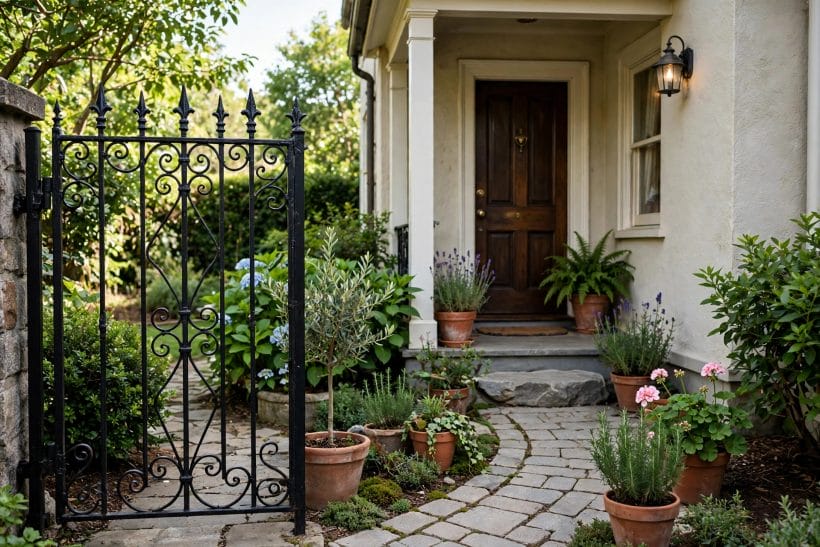
At garden scale iron comes down to walking pace: a leaf one person opens with one hand, into the green. This section keeps to the garden and side-passage gates — their proportions, their planting, and the small ceremonies of passing through them daily.
23. The single garden leaf, simply barred
A plain barred leaf in a garden opening is iron’s most honest form: light, transparent, and clearly made. In the garden, simplicity lets the planting perform; the gate’s job is to close with a click and disappear.
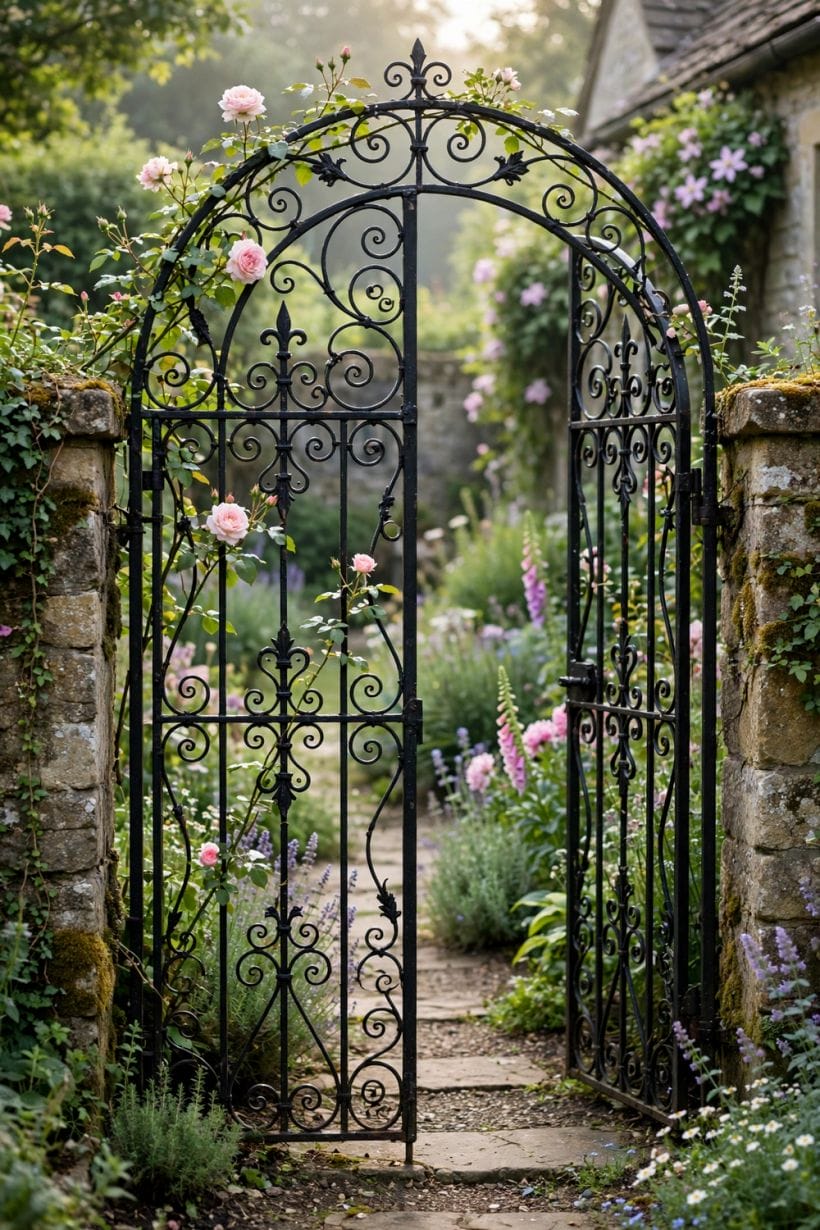
24. An arched garden gate under a rose
The arched leaf beneath a climbing rose is the cottage garden’s emblem — iron giving the rose its structure and the rose forgiving the iron its hardness.
25. Scroll-topped gates for the herb garden
A lighter gate with a scrolled crest suits the kitchen and herb garden, where the mood is craft rather than ceremony. Garden gates at working entrances earn wider openings and latches that yield to a gardener’s elbow or hip.
26. The side-passage gate that means it
The passage between house and boundary is the plot’s honest weak point, and its gate should be the survey’s most serious small gate: full height, sound frame, proper latch and lock — security stated plainly, as a matter of good household order.
27. Gates in the fence line, matched to the fence
An iron gate set in a timber or hedge boundary should repeat the boundary’s height and rhythm so the opening reads designed. A gate that interrupts its fence apologetically will look temporary for the whole of its long life.
28. The gate to the vegetable plot
Productive gardens want gates that keep out the household’s own animals and welcome the gardener carrying crates: wide, simple, self-closing. Self-closing hinges on working gates are a small mercy performed a thousand times.
29. Pool and play-area garden gates
Where a garden holds water or small children, its gates join the household’s safety system — self-closing, self-latching, and kept to the local rules that govern such enclosures.
30. A gate in a low garden wall
Low walls with an iron leaf make the gentlest divisions between garden rooms: terrace from lawn, lawn from orchard. At low heights the gate is all silhouette, so its pattern deserves the care usually saved for the front entrance.
31. The wicket gate within a larger leaf
A small person-sized door cut into a wide garden or yard gate — the wicket — saves moving the great leaf for daily comings and goings. Wickets are traditional in farm and stable gates and work just as kindly in gardens.
32. Iron gates painted garden green
Black is iron’s classic, but a deep green leaf disappears into planting and lets flowers take the gate’s portrait. Painted garden gates ask the same rust discipline as black ones; the colour is a mood, not a maintenance holiday.
33. The gate that frames a view
Position a garden gate on the axis of a path, a bench or a borrowed view, and the open leaf becomes a picture frame.
5. Front Entrances: Pedestrian Gates, Porches and Street Presence
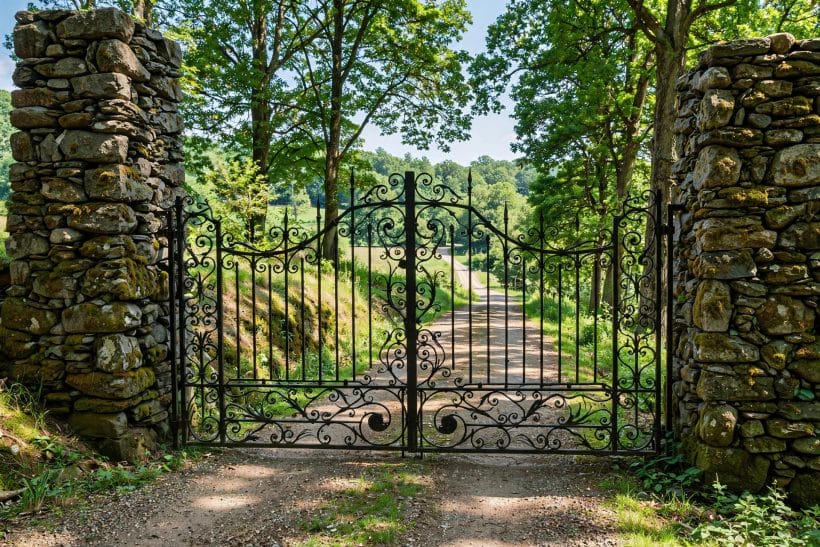
Most houses meet their visitors at a pedestrian gate, not a driveway. This section composes that first threshold — with the front door ideas at the path’s end and the planting of the front yard landscaping ideas survey around it — while the iron leaf itself holds the street line.
34. The waist-high front gate of the cottage street
A low iron gate at a cottage garden’s front is pure welcome: boundary declared, view shared, latch lifted by every caller.
35. Full-height pedestrian gates for town houses
Urban fronts ask taller leaves, closer bars and a latch with a lock — the town gate as the house’s street door.
36. A gate matched to the porch ironwork
Where the porch or veranda carries iron railings, a gate repeating their pattern ties street to door in one material story. Matched ironwork across gate, railing and lantern brackets is the quiet signature of a composed front.
37. House numbers worked into the gate
A number forged or cut into the gate’s centre panel solves the visitor’s search and the postman’s at one stroke. Numbers belong where a lantern or the street’s light finds them — legibility is the courtesy, the ironwork its frame.
38. The letterbox in or beside the gate
A box mounted at the gate — in the leaf’s panel or on its pier — keeps callers at the boundary and the path private.
39. Twin pedestrian leaves for the wide front path
Grand front paths earn a pair of small leaves rather than one wide one: symmetry again, and a leaf weight the hinges enjoy. Paired pedestrian gates compose beautifully with a centred door and a straight, planted path.
40. The gate and the low front wall
A low brick or stone wall with an iron leaf at the path is the classic suburban front, and its proportions are unforgiving: wall, gate and house must agree on height and material, or the front reads as three separate decisions.
41. Iron gates with timber doors behind them
Some fronts pair an outer iron gate with the timber front door as two thresholds — street iron, house timber — giving a shallow porch or passage between. The pairing suits deep-set doors and gives callers a graduated arrival.
42. A bell or knocker at the gate
Where the gate stands far from the door, a bell at the leaf saves the visitor’s uncertainty and the household’s missed callers. Small, weatherproof and in the gate’s own finish, it is the entrance’s finishing courtesy.
43. Gates that welcome the delivery age
A front gate today must also admit parcels, prams and bicycles gracefully: clear width, an honest latch operable with full hands, and a path the gate’s swing does not block. Design for the arrivals the house actually receives.
44. The gate left open, composed
Front gates in quiet streets live open as often as closed; compose the open leaf against its wall or hedge so the entrance looks deliberate either way.
6. Iron with Fences, Walls and Hedges
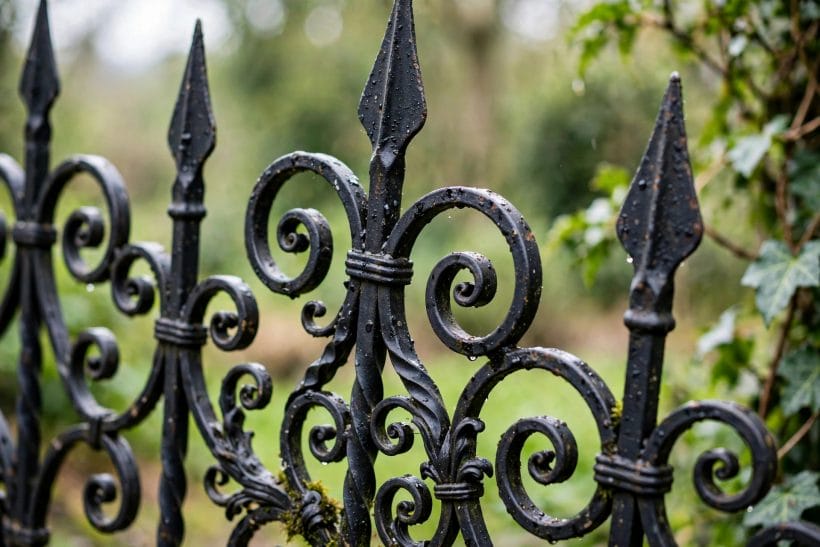
No gate stands alone: it is one bay in a boundary. This section pairs iron with its neighbours — including the fence lines whose own survey is the backyard fence post — so the leaf, the fence and the planting read as one decision from the street.
45. Iron gate in an iron fence: the continuous line
Where fence and gate share the same barred pattern, the boundary reads as one forged work with an opening in it.
46. Iron leaves between masonry piers in a hedge
A hedge boundary with masonry piers and an iron gate gives the green wall a stone-and-iron doorway: softness everywhere, ceremony at the entrance. The hedge must be cut back from the swing as a standing garden discipline.
47. The gate in a brick wall, arched over
A brick boundary wall can carry its opening as an arch, with the iron leaf shaped to the curve — the most architectural entrance in this section.
48. Iron gate, timber fence: the honest contrast
Black iron against warm timber fencing is a partnership of opposites that suits modern and rustic houses alike. Keep the gate’s pattern simple against timber’s grain; two busy materials at one boundary argue.
49. Stone wall ends as gate posts
Where a dry or mortared stone wall forms the boundary, its ends can be built up as the gate’s posts, tying leaf to wall without new materials.
50. Iron railings on a low wall, gate to match
The town-house classic: low wall, iron railings above, gate repeating the railings’ bars and finials. The whole front becomes one iron composition with the gate as its moving part — replace or restore all of it in one finish, always.
51. A gate where the fence changes material
At the corner where timber fencing meets a masonry wall, an iron gate mediates handsomely — black suits both neighbours. Corner gates take wind from two directions and deserve the survey’s sturdiest hanging.
52. See-through iron beside a solid fence
Pairing an open-barred gate with a private, solid fence gives the entrance a window: the house shows its face at the gate while keeping the garden’s privacy elsewhere. The contrast must look chosen — same height line, same finish discipline.
53. The gate and the hedge tunnel
Tall hedges can be trained over a gate as a green arch, with the iron leaf beneath — the secret-garden entrance at suburban scale.
54. Matching the gate’s bars to railing bars nearby
Where railings guard a terrace, steps or a balcony within sight of the gate, repeating their bar spacing and finial on the leaf ties the plot’s ironwork into one family.
55. Boundary gates at the plot’s far end
The back gate to a lane, field or neighbour deserves iron’s honesty too: simpler, sturdier, and locked with the same seriousness as the front. Boundaries fail at their least-regarded opening; the far gate is where regard pays.
7. Finishes, Colour and the Blacksmith’s Details
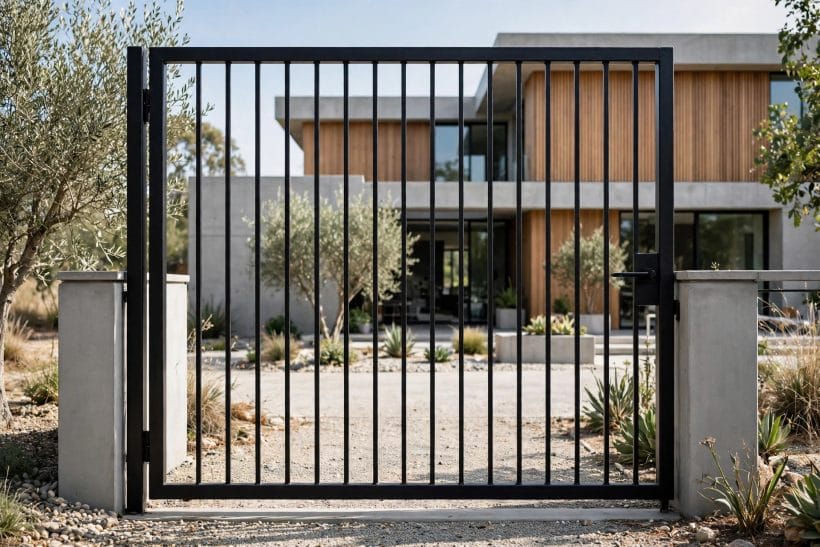
Iron’s finish is its weather defence and its whole complexion. This section covers the colours, coatings and small hardware choices that decide whether a gate looks better in its tenth year than its first — the gate pillar’s material questions answered here for iron alone.
56. Classic black, satin not gloss
A satin or soft-matte black is iron’s most forgiving and most architectural finish, sitting calmly against brick, stone, timber and planting. High gloss shows every hammer mark and every future touch-up; satin shows the gate.
57. Galvanised and coated: the long-life route
Protective zinc coating beneath the colour coat is the widely used defence for gates that must live outdoors with minimal attention — a specification to discuss with the maker in general terms, since environments differ and coastal air asks more of any finish.
58. Deep green and heritage colours
Dark green, deep blue and oxblood finishes give iron a period or garden character black cannot. Heritage colours suit older houses and planted boundaries, and they share black’s discipline: one colour, everywhere, maintained as one surface.
59. White iron for the coastal cottage
White-painted iron gates belong to seaside and Mediterranean fronts, bright against blue doors and green shutters. White shows rust weep earliest — its keepers accept a closer maintenance rhythm as the price of the picture.
60. Bare and waxed iron, honestly kept
Some gates keep a natural, oiled or waxed metal finish for the forge’s own colour. It is the connoisseur’s choice and the most demanding: the finish is renewed as a ritual, and the gate’s owner enjoys the ritual.
61. Hinges as visible craft
Strap hinges, barrel hinges and traditional pintles each give the leaf a different character — and they are seen every day. Choose hinges rated honestly for the leaf’s weight by the maker, and let their finish match the gate exactly.
62. Latches that close with a sound
A gate latch should close with a soft, certain click operable by one hand and a shopping bag. Ring latches, thumb latches and lever handles each suit a register; the test is performed at the gate, in weather, with gloves considered.
63. Locks integrated, not appended
A lock built into the gate’s frame or a neat boxed housing keeps security from looking like an afterthought chained on later. Security hardware is chosen with professional advice for the property; design’s job is to make it look inevitable.
64. Drop bolts and centre stops for pairs
A pair of leaves is finished by its meeting hardware: drop bolts into the ground and a centre stop that receives the leaves truly. These small parts decide whether the closed pair reads as one gate or two acquaintances.
65. The maker’s mark
Good smiths sign their work — a small plate, a stamped initial, a scroll detail repeated as signature.
8. Automation, Safety and Keeping Iron Sound
The final section is the working one: opening a heavy leaf without effort, keeping children and cars safe around it, and the maintenance rhythm that lets iron outlive its maker. Every mechanism and safety point here is stated generally — automation and powered gates are specialist, regulated work for qualified installers under local rules.
66. Hand-opened, well-balanced leaves
A gate hung true opens with a fingertip and stays where it is left; no automation redeems a badly hung leaf.
67. Above-ground openers on the leaf
The familiar arm-type openers mount visibly on the gate and post, are straightforward for installers to service, and suit most swing leaves. Their look is mechanical; compose them low and in the gate’s finish where the maker allows.
68. Underground openers for the clean line
Openers buried at the hinge line keep the gate’s face entirely forged and formal. They ask more of drainage and installation — a specialist’s groundwork — and repay formal entrances where no machinery may show.
69. Sliding-gate motors and safety edges
Powered sliding gates carry their motor at the track’s end, with safety edges and sensors specified by the installer to the rules that govern powered gates. This survey’s standing line: powered gates are professional systems, never improvisations.
70. Keypads, fobs and phone access
Modern entrances open by code, fob, intercom or phone — conveniences to be specified with the installer alongside a manual release for power cuts. The visitor’s experience still matters: a caller should reach a human voice, not a puzzle.
71. Safety for children, pets and cars
Powered and heavy manual gates alike deserve the household’s safety respect: clear sightlines, no climbing invitation in the bar pattern near play areas, and mechanisms maintained to their maker’s schedule. Local rules for powered gates exist precisely here, and they govern.
72. The annual hour: iron’s whole maintenance
Once a year, wash the gate, walk its bars, touch in any chip to bare metal promptly, oil the hinges and check the latch’s close.
73. Rust spots treated early and simply
A rust freckle at a chip or weld is a blemish; left seasons, it becomes a repair.
74. Hinges, posts and the lean check
Stand back yearly and sight along the gate: a beginning lean or a dropping leaf is a post or hinge asking early attention.
75. Repainting the whole, in its season
When the finish finally tires, a full clean, preparation and repaint restores the gate as one surface — piecemeal patches across a whole gate show as a map of its years.
9. Checks and Mistakes: Before the First Purchase or the First Fitting
Stand at the street and judge the gate as a visitor does: does it hang true, close with one sound, and match its boundary’s height and mood? Most gate disappointments are visible in that thirty-second audit — a sagging leaf, a latch that fights, a pattern fighting its fence.
Let the maker or installer set posts and levels before the leaves are forged to final size. Iron is unforgiving of approximate openings; the survey’s repeated professional note — posts, piers, tracks and power are installers’ work under local rules — is what lets the smith’s work fit first time.
The recurring mistakes: ornament ordered before structure, a pair hung on one post’s optimism, automation added to a badly balanced leaf, finishes mixed across gate and fence, and maintenance deferred until rust writes the schedule. Every good example above is simply one of these avoided.
For powered gates especially, treat safety as specification, not accessory: sensors, edges, manual release and a maintenance contract with the installer belong in the first conversation — a point this post states generally and every property must settle specifically with its professionals.
10. Costs and Pulling It Together
Costs gather where the craft is: the forging and finishing of the leaves, posts or masonry piers, hinges and latching hardware, groundworks for tracks or underground openers, and — where chosen — the automation system and its electrical supply, all stated generally here. A hand-made gate is priced as the smith’s work it is; the honest comparison is against the decades a sound iron gate serves, repainted occasionally, where lesser gates are replaced outright.
Pull the entrance together from the boundary inward: settle the fence, wall or hedge line, the posts or piers, the leaves’ pattern and finish, then the hardware and any automation. The rooms and fronts around the gate live in the site’s wider home design ideas collection; at the boundary itself, the iron gate is the decision every other element decorates.
Final Considerations
An iron gate is the hardest-working piece of craft a house owns: weather-beaten daily, swung thousands of times, and still expected to make the homecoming feel like an arrival. Chosen for its frame before its scrolls, hung by professionals, finished as one surface with its boundary and kept with one faithful hour a year, a wrought iron gate does something no other fitting quite manages — it turns a boundary into a welcome, in iron, for a lifetime.



0 Comments