

For many tiny house owners, the dream feature is a six-foot wall of glass that opens the living space, floods it with light and dissolves the line between inside and out. The nightmare version arrives at highway speed: that same 150-pound pane rides on rollers through what towing does to a house — a 60 MPH earthquake. This guide is the travel protocol that lets you keep the dream and skip the nightmare.
1. The Wall of Glass at a Glance
Sliding glass doors are beautiful, but on a Tiny House on Wheels they are high-maintenance travel companions. The reason is mechanical: a residential slider is a heavy sash resting on rollers inside a frame that expects to sit perfectly still, and a towed house offers it anything but stillness. The whole guide that follows is organised around that mismatch. Three risks do the damage — the sash’s own momentum, the sash leaving its track, and the frame twisting around glass that cannot twist with it. Three protocols answer them: block the track, stop the vertical lift, and strap the door into its seals. Around those sit the buying specs that make a new door road-worthy and the pre-flight checklist that makes an existing one travel-ready. The table gathers the whole system in one place; the sections after it take each row apart.
| Attribute | Detail |
|---|---|
| The Dream | A 6-foot wall of glass: light, space and indoor-outdoor flow |
| The Weight | A 150-pound sheet of glass riding on rollers |
| The Highway Reality | Towing is a 60 MPH earthquake for a door built to sit still |
| Risk One | The battering ram: braking momentum snaps the small handle latch |
| Risk Two | Jumping the track: bumps lift the sash up and out of the bottom rail |
| Risk Three | Frame distortion: trailer flex racks the square frame into a parallelogram |
| Protocol One | Block the track with a 2×4 or hardwood dowel cut to a perfect, play-free fit |
| Protocol Two | Stop vertical lift: pan-head screws every 12 inches, plus travel shims |
| Protocol Three | A padded ratchet strap on D-rings holds a rear door against wind suction |
| The Buying Specs | Tempered glass, a DP50 or higher rating, and interlocking stiles |
| The Screen | Removed and stowed inside for every move — 2 minutes to reinstall |
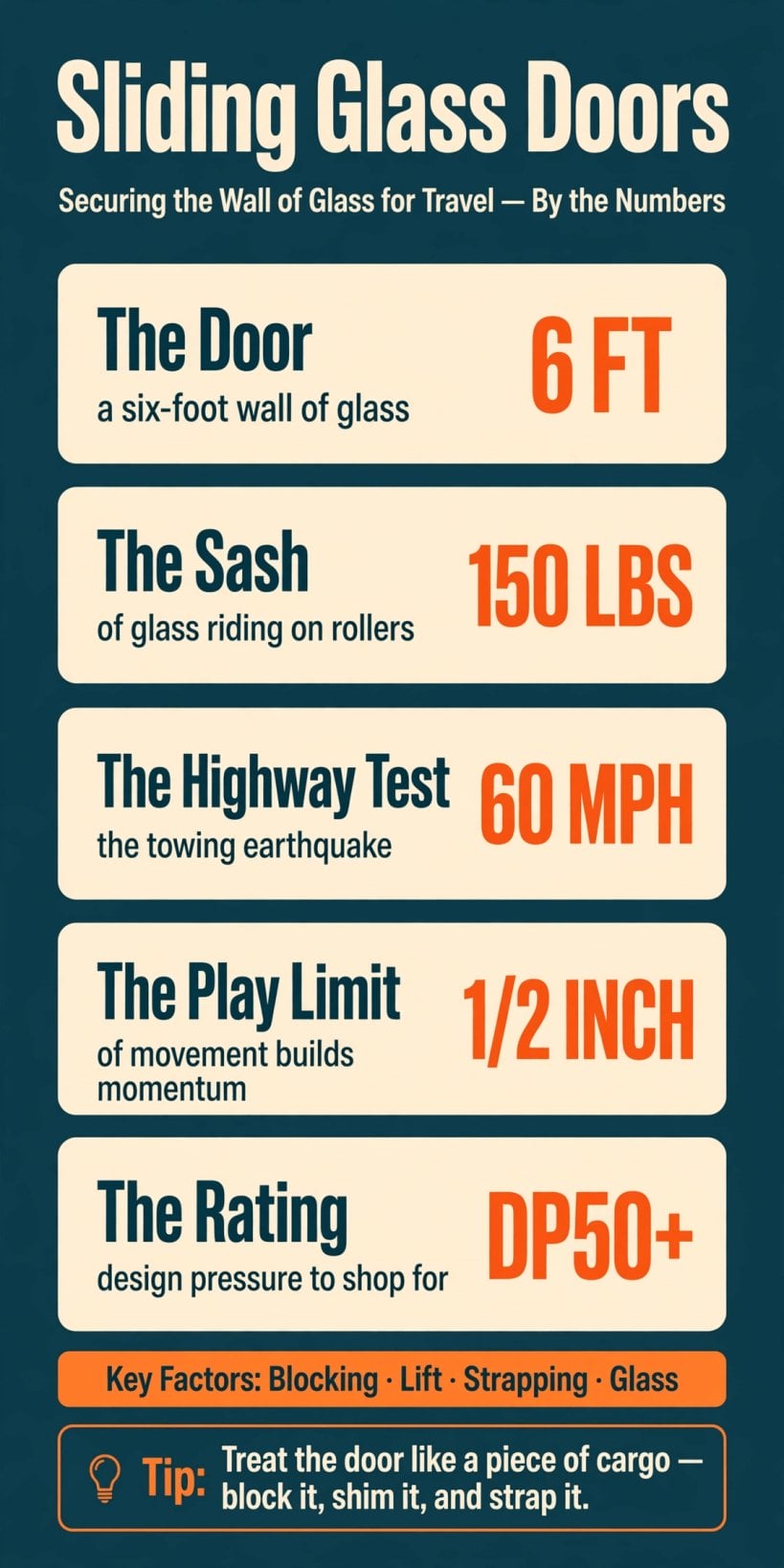
Six feet of glass, 150 pounds on rollers, a 60 MPH earthquake and a half-inch of forbidden play — the travel protocol on one card.
2. The Dream and the Danger: A Door Built to Sit Still
Start with why the door is there at all, because the dream is legitimate. A 6-foot slider opens up the space in a way no window can: it floods the room with light and creates the coveted indoor-outdoor flow, turning a small living area and a deck into one continuous room. In a house measured in dozens of square feet, a wall that opens is not a luxury detail — it is the largest single living-space feature the build can have.

The danger is that the feature was designed for a different life. Standard residential sliders are designed to sit still — level, plumb, undisturbed, opened and closed by hand a few times a day. Put one on a trailer and every assumption inverts. The heavy sliding sash rides on rollers, free to move along its track by design; the frame is anchored to a structure that flexes; and the whole assembly is subjected to a 60 MPH earthquake every time the house tows. On the road, that sash acts like a battering ram and the frame can twist until the glass shatters. None of this argues against the door. It argues for treating the door the way every other opening in a moving house has to be treated — the same road-first judgement applied to awning vs. sliding windows, where the mechanism, not the look, decides what survives the highway.
3. Risk One: The Battering Ram
The first risk is horizontal, and it is powered by the door itself. The latch on a standard slider is tiny — a small locking hook in the handle, designed to keep a closed door closed against a hand pulling on it, not against physics. Under heavy braking or acceleration, the momentum of the heavy sliding door loads that hook with the full travelling weight of the sash. A hook sized for a latch’s job meets a battering ram’s job, and it can snap.
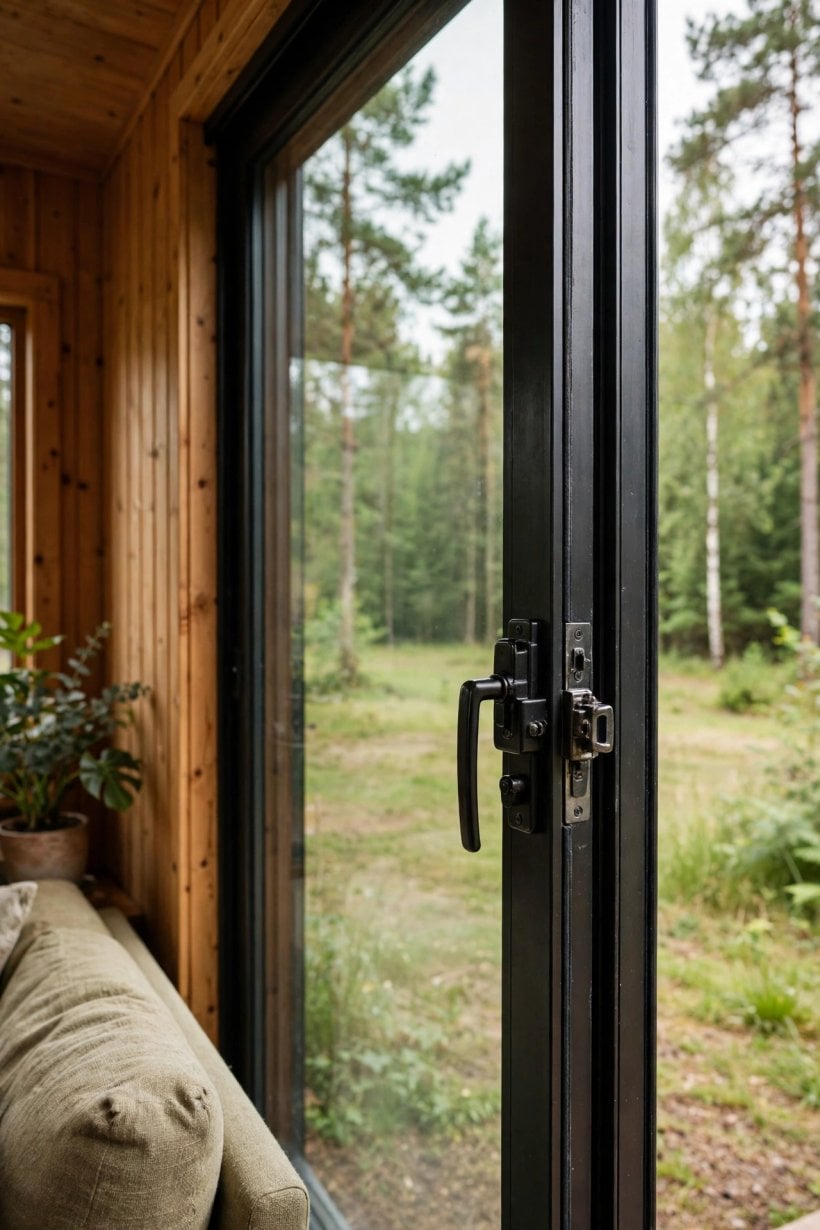
What follows is worse than the break itself. A sash released at speed does not simply slide open and stop; it slams back and forth along the track, gathering force at each end of its travel, hammering the frame it rides in. The original names the outcomes plainly: the slamming shatters the glass or the frame. Notice the compounding: the failure begins with the smallest part of the assembly, the hook, and ends with the largest, the pane. The road supplies the momentum; the door supplies the mass; the latch is asked to mediate between them, and it is the wrong size for the negotiation. Everything in the first protocol exists because this risk cannot be latched away — it has to be blocked.
4. Risk Two: Jumping the Track
The second risk is vertical, and it is the one that surprises people, because a sliding sash feels captive in its frame. It is not. The sash rests on rollers in the bottom track, and gravity — nothing else — is what keeps it seated there. Road bumps push the door up: every pothole, expansion joint and gravel washboard unloads the rollers for an instant, and in that instant the sash is a 150-pound pane hovering over its rail.
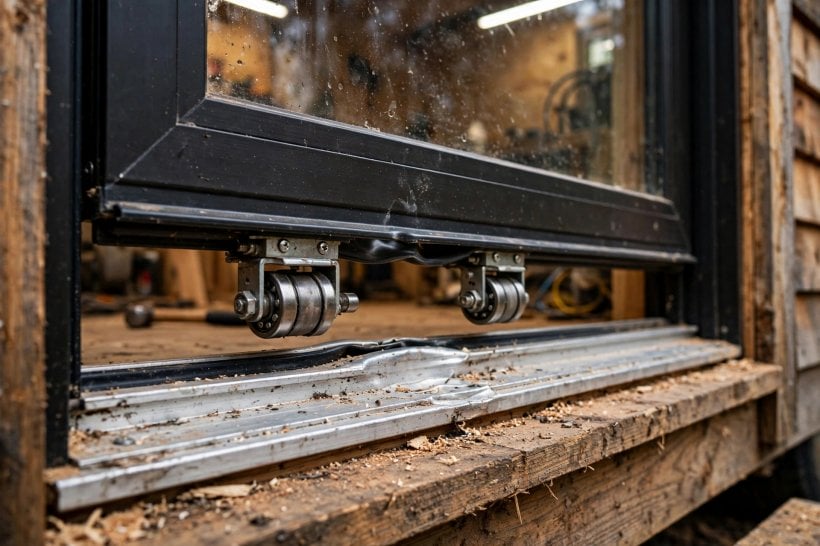
If the lift is enough, the door jumps out of the bottom track entirely. A sash that has left its rail does not hang neatly in the opening waiting to be reseated; it swings free, held by nothing, and destroys itself against the frame, the floor and its own fixed panel. Read the two risks together and the pattern is the guide in miniature: the door is free to move in exactly the two directions the road moves it. Horizontally it can run along the track and gather momentum; vertically it can leave the track altogether. A parked house never loads either axis. A towed house loads both, constantly, for hours. That is why the protocols come in matched pairs — one against the run, one against the bounce — and why a travel routine that only locks the handle has answered neither.
5. Risk Three: Frame Distortion
The third risk belongs not to the door but to the house around it. A trailer flexes as it travels — over crowned roads, into driveways, across the twist of uneven ground — and everything built square on it is asked to flex with it. The door frame is the largest rigid rectangle in the wall, and flex does to it what it does to any rectangle whose corners are pushed unevenly: the square door frame becomes a parallelogram.
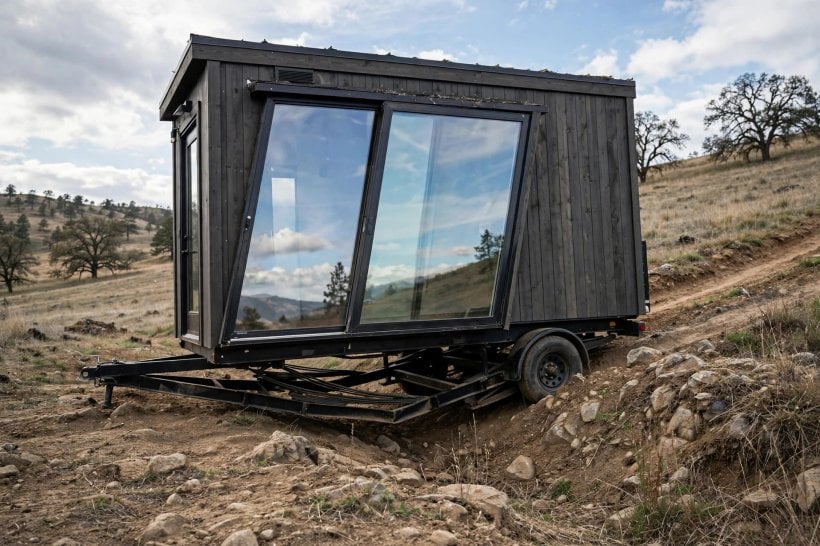
Glass sits at the centre of that geometry lesson, and glass has one property that decides the outcome: it doesn’t bend; it breaks. A wooden wall can rack a few millimetres and rack back without complaint. A frame can twist and, within limits, survive it. The pane inside the frame has no such tolerance — when the opening changes shape, the glass is asked to change shape with it, and it answers by shattering. This risk also explains why the other two protocols matter beyond their own sections: a sash blocked tight and pinned down moves with its frame instead of being thrown against it, so the whole assembly rides the flex as one unit. Left loose, the door meets the twist a beat late, at speed, with its own momentum added. Securing the door is, in the end, a way of making the biggest piece of glass in the house travel as part of the structure rather than as cargo loose inside it.
6. Protocol One: Blocking the Track — the Charlie Bar
The first protocol answers the battering ram, and its premise is blunt: you cannot rely on the small locking hook in the handle. You must mechanically block the door from moving. The tool is the oldest one in the sliding-door world — a block in the track, the bar sometimes called a Charlie Bar — sized to the individual door rather than bought off a shelf.
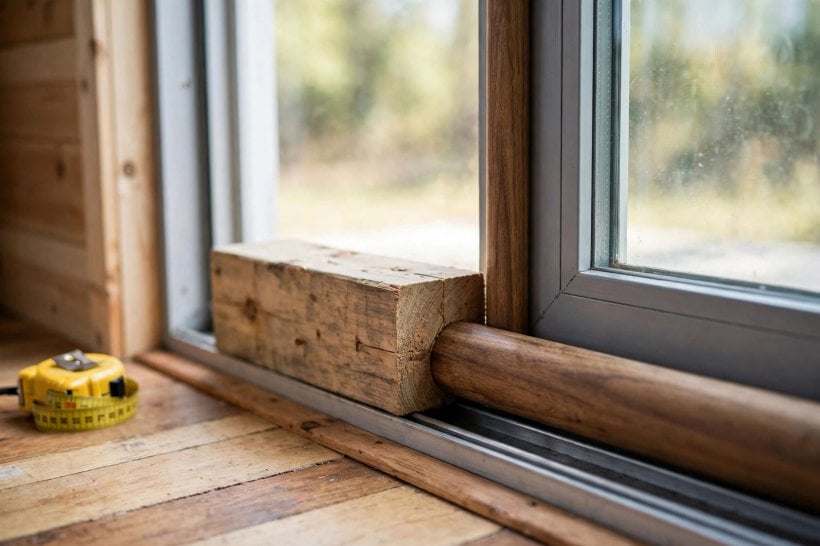
The method is measurement, not hardware. Measure the bottom track, where the door slides, and cut a 2×4 or a thick hardwood dowel to fit that gap perfectly. The fit standard is absolute: it should be a tight squeeze, with zero “play” or wiggle room. The reason is the physics of §3 in miniature — if the door can move even 1/2 inch, it can build up momentum, and a sash that arrives at the end of a half-inch run is already a small battering ram. A block with no gap to cross gives the sash no run at all; the momentum never forms. Place the block in the bottom track, and for extra security place a second one in the top track if it is accessible, so the sash is caged at both rails. It is the same cut-to-fit discipline that secures loose gear elsewhere on the trailer — the dowel-in-a-track logic of the DIY tongue boxes travel routine — wood measured to the gap, wedged tight, doing a job no latch was sized for.
7. Protocol Two: Preventing Vertical Lift
The second protocol answers the bounce, and the original flags it as the step most DIYers miss — because a blocked door feels finished, while its vertical freedom sits unexamined overhead. Preventing vertical lift works in two layers: a permanent hardware layer that caps how far the sash can rise, and a per-trip layer that pins it down before departure.
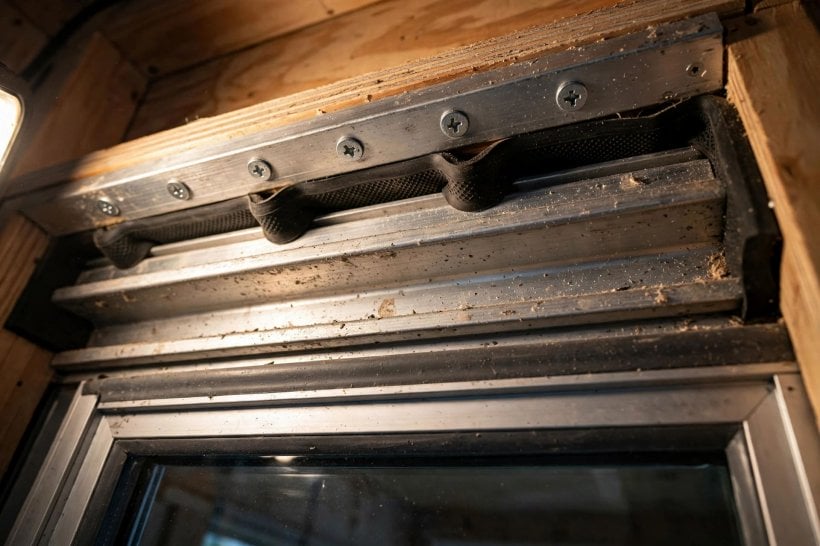
The permanent layer is the Spacer Screw Method. Open the door and look inside the top track: install pan-head screws into the header of the track every 12 inches, adjusting the depth so the screw heads sit just above the door frame. The geometry is elegant — the door can still slide past them in normal use, because the heads clear the frame’s travel, but if the sash bounces up, it hits the screw heads and stays in the track. The screws convert the open space above the sash, the space the bounce needs, into a ceiling the sash cannot pass. The per-trip layer is simpler: before driving, wedge dense rubber shims or wood wedges into the top gap above the sliding sash to pin it down against the rollers. Shims remove the bounce rather than catching it — the sash starts the journey already held down, with no gap to rise into. Screws for the sash that lifts anyway, shims so it never starts: between the two, the vertical axis of §4 is closed.
8. Protocol Three: The Compression Strap
The third protocol answers a force the first two do not touch: air. If your sliding door is on the rear of the tiny house, it rides in the slipstream’s wake, where the suction force from the wind can actually pull the door outward — away from its seals, against its stops, working at the sash for every mile of the tow. A door blocked against sliding and pinned against bouncing can still be worried outward by suction, rattling against its stop and straining the very frame joints the flex is already testing.
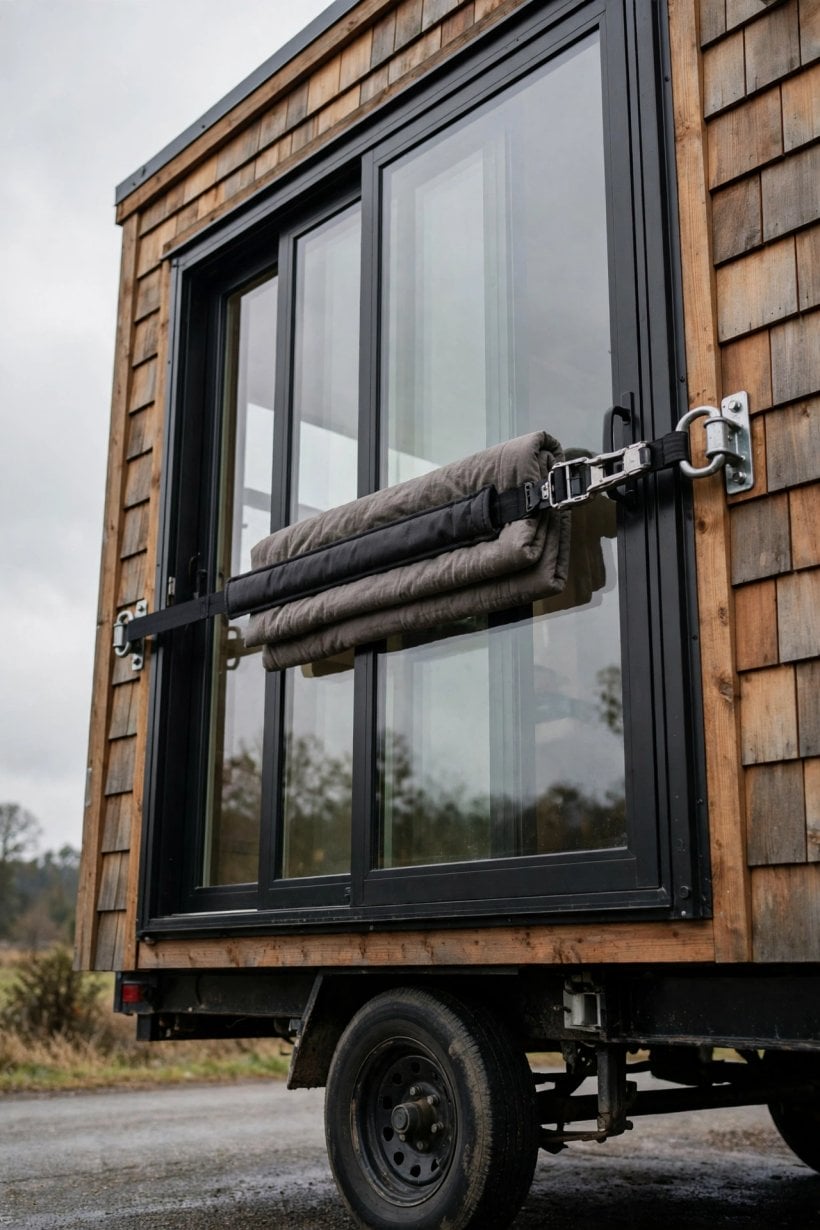
The answer is a compression strap. Install heavy-duty D-rings on the wall studs on either side of the door frame — anchored to structure, not to trim — and run a ratchet strap across the face of the glass, padded with a moving blanket where it meets the pane. Tightened down, the strap holds the door firmly into its frame seals, compressing it home along its whole height. It prevents both failures the suction threatens: the door cannot rattle against the stop, because it is already pressed past it into the seals, and it cannot be sucked outward, because the strap’s line is anchored to the studs the wind cannot move. The logic is the same one that latches every other large flat surface on a moving house — a roof hatch installation is draw-latched for exactly this reason — because on the highway, wind does not push on a house so much as it pulls at everything flat enough to grab.
9. Buying Right: Tempered Glass, DP50 and Interlocking Stiles
The protocols secure a door you already own. If you are buying a new slider, the original gives three specifications to shop for, and each one answers a risk from the first half of this guide. Together they separate a door that was merely built for a wall from a door that can survive being a wall on wheels.

First, tempered glass — mandatory, not optional. Just like the windows, door glass must be tempered safety glass: the pane that breaks into dull cubes instead of shards, under the same rule set out in selecting windows for road safety. On the largest pane in the house, the failure mode matters most, because §5’s scenario — glass asked to bend — ends either in cubes or in blades. Second, the DP rating: look for a door with a high Design Pressure rating, DP50 or higher. The rating is the manufacturer’s own statement that the frame is reinforced to withstand higher wind loads and structural stress — precisely the loads §§5 and 8 describe. Third, interlocking stiles: better doors have “interlocking” vertical rails where the sliding door meets the fixed door, so the two panels lock into each other along their meeting edge. That creates a much stronger structural connection than doors that just butt up against each other, turning the closed pair into something closer to a single wall — a wall that, after dark, is also the house’s largest security surface, which is what the placement rules in the exterior lighting for security guide are written around.
10. The Screen Door and the Pre-Flight Checklist
One component does not get a protocol, because it does not survive travel at all: the sliding screen door, the flimsiest part of the whole assembly. The original’s verdict is unsentimental — it will almost certainly fall off or get shredded by the wind during travel. The fix is not reinforcement but removal. Take the screen door off the track and store it inside the house, on the bed or the floor, whenever you move. It takes 2 minutes to reinstall at the other end, and it saves you from buying a new one every trip. Some parts of a travelling house are secured; this one is simply carried.
Everything else in this guide compresses, before departure, into the original’s pre-flight checklist — five lines that map one-to-one onto the protocols. The block answers the battering ram; the latch is checked even though it is never trusted alone; the shims answer the bounce; the screen is already inside; and the soft furnishings are secured so they cannot spend the journey rubbing against the glass they hang beside. Run it the way you run the rest of the departure routine — the same walk-around discipline that readies systems like folding deck designs for the road — because a checklist item skipped is a protocol undone.
- Track Block installed (tight fit).
- Handle Latch locked.
- Top Shims inserted (no vertical bounce).
- Screen Door removed and stowed.
- Curtains/Blinds secured (so they don’t scratch the glass).
Final Considerations
Sliding glass doors ask more of their owners than any other single feature in a tiny house, and they repay more: no window opens a small room to the world the way a six-foot wall of glass does. The price of keeping that view is a change of category. A residential slider is a fixture; on a trailer it is freight — a 150-pound pane that must be blocked against its own momentum, pinned against the bounce, strapped against the suction and checked, item by item, before every departure. Treat the door like a piece of cargo and it arrives as a door, ready to open onto the next campsite. Treat it like a fixture and the highway will reclassify it for you, somewhere around the first hard brake or the first washboard mile. File the belief that the biggest pane in the house can travel on the smallest latch under the other tiny house myths: on a house that moves, the glass you secure is the glass you keep.



0 Comments