

Rain starts over a big house and the drill is simple: close the windows and let the HVAC handle the air. A tiny house has no such luxury, because its air runs out fast — and if every drizzle seals the house up tight, the moisture from cooking, showering and breathing has nowhere to go but into the walls. The windows have to keep breathing in bad weather.
1. Awning and Sliding Windows at a Glance
The Awning vs. Sliding Windows debate is really a debate about what a tiny house window is for. A sliding window — a glider — is the budget default: simple, stocked at big-box stores, and flush with the wall. An awning window is hinged at the top and cranks outward from the bottom, and that one mechanical difference cascades through everything a house on wheels cares about: whether the window can stay open in rain, how its seal behaves at highway speed, whether it rattles, and how hard it is to force from outside. The table gathers the whole contest in one place; the sections after it take each row apart.
| Attribute | Detail |
|---|---|
| The Question | Which operable window keeps a tiny house ventilated when the weather turns |
| The Contenders | Top-hinged, crank-out awning units against side-sliding gliders |
| The Rain Test | An awning can stay cracked open 2–4 inches in a rainstorm; a slider must be shut |
| The Slider’s Seal | A brush seal — a fuzzy strip — across the clearance gap in the sliding track |
| The Awning’s Seal | A rubber compression gasket the crank and lock pull the sash tight against |
| The Highway Test | At 60 MPH, wind drives dust and water through brush seals; a compression seal gets tighter |
| The Rattle | Track clearance lets a sliding sash rattle in transit and wear its locking mechanism |
| Security | Awning hardware is internal, the sash locked into the frame at multiple points on better models |
| The Cost Shape | Sliders are cheaper and easier to find; awning units are often more expensive |
| The Verdict | Awnings for the kitchen, bathroom and lofts; sliders acceptable for a big living-room window |
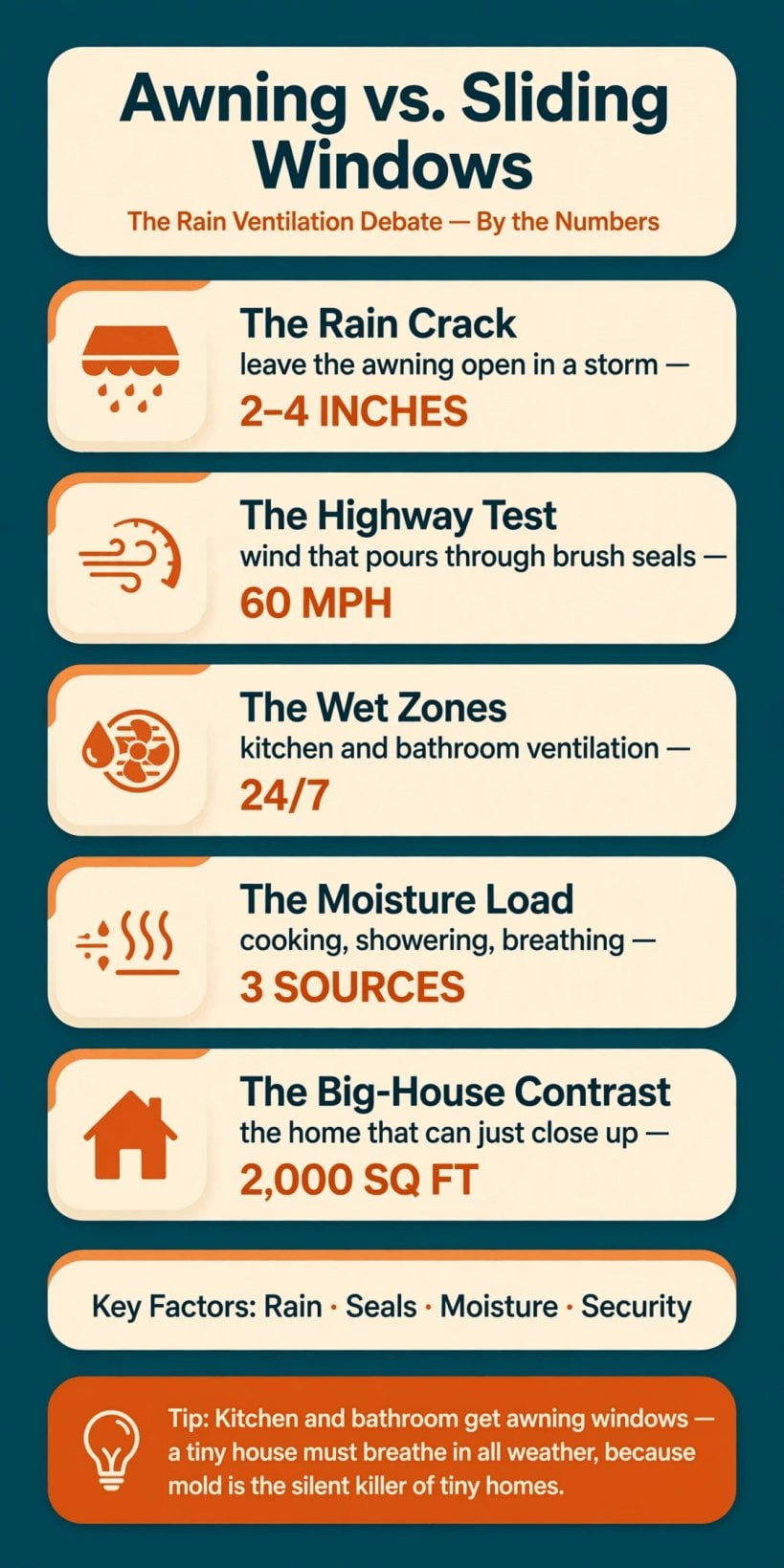
A 2–4 inch rain crack, a 60 MPH highway test and ventilation around the clock — the window debate on one card.
2. Why a Tiny House Cannot Just Close Up
Start with the problem the window choice has to solve, because it is not the problem a conventional house has. In a standard 2,000-square-foot home, rain is a non-event for indoor air: you close the windows and let the HVAC handle the air, and the sheer volume of the house dilutes whatever moisture the day produces. A tiny house holds a fraction of that air, and it produces moisture at a household rate — cooking, showering and breathing all load the same small volume, and the load builds up incredibly fast.
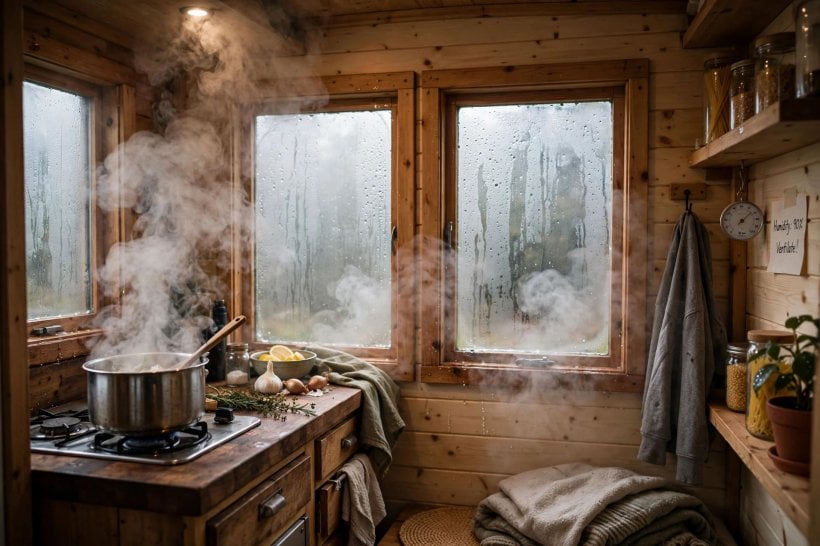
Seal that volume up tight every time it drizzles and the moisture has to go somewhere: it condenses on the coldest surfaces and, given time, grows mold. That is why ventilation in a tiny house is not a comfort feature but a moisture-management system, and why the window question cannot be separated from the load it has to carry — the same load the dehumidifier sizing calculator works out when windows alone cannot keep pace. You need to be able to ventilate even when the weather is bad. Everything else in this contest follows from that single requirement: the winner is the window that can stay open in the rain.
3. The Sliding Window: The Budget Default
The sliding window — the glider — is where most budget-conscious builders start, and the reasons are honest ones. The mechanism is as simple as a window gets: one sash slides sideways in a track, with no crank, no hinge and nothing to wind. Units are readily available at big-box stores in standard sizes, so a slider can be bought off the shelf on build day rather than ordered and waited on. And because the sash travels inside its own frame, nothing sticks out past the wall — the closed window is flat against the house, with no part of it projecting into the weather or the slipstream.

Those virtues are real, and on a stationary house they are usually enough — a glider on a house that never moves and rarely needs venting in the rain is a perfectly reasonable window. The case against the slider is specific to the tiny house’s life: small air volume, frequent rain ventilation, and hours of highway travel in between stays. The next two sections take the failures in turn — the first happens when it rains, the second when it rolls.
4. Slider Problem One: Rain Means Closed
The slider’s first failure is geometric. The opening it makes is vertical: slide the sash aside and you have opened a tall slot in the wall, with nothing above it to shed water. The moment rain starts falling, a slider must be shut — because even a light wind-blown mist will soak your window sill and floor. There is no cracked-open setting that works; a partly open slider in rain is just a smaller slot for the weather to come through.
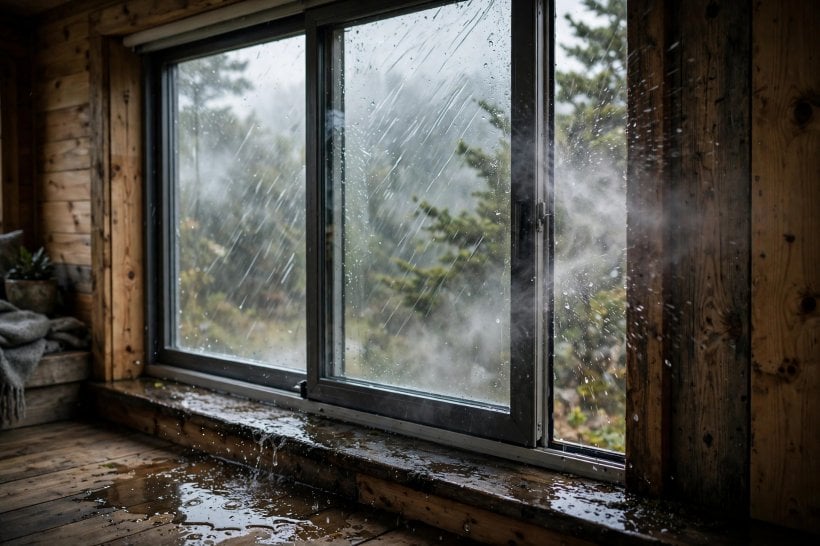
Now set that against the requirement of §2. The moments a tiny house most needs to vent are wet moments — a shower steaming up the bathroom, a pasta pot boiling in the kitchen — and rainy weather is exactly when cooking and showering still happen. A window that must close when it rains forces the choice the tiny house cannot afford: vent and let the storm in, or stay dry and let the moisture build. The house’s first line of defence is upstream — removable gutter systems throw roof water clear of the walls before it ever reaches a window — but the rain that arrives as wind-blown mist lands on the glass itself, and at that point only the window’s own geometry decides whether the house can breathe.
5. Slider Problem Two: The Leaky Track and the Rattle
The second failure is built into how a slider works. To slide, a window sash needs clearance in the track — the sash cannot be a tight fit, or it would not move. That gap is usually sealed with a brush seal, the fuzzy strip that lines the track and brushes against the sash as it passes. On a stationary house the arrangement is adequate. At 60 MPH down the highway, it is not: wind drives dust and water right through these brush seals, because a brush is a filter the sash can slide past, not a barrier pressure can bear on.
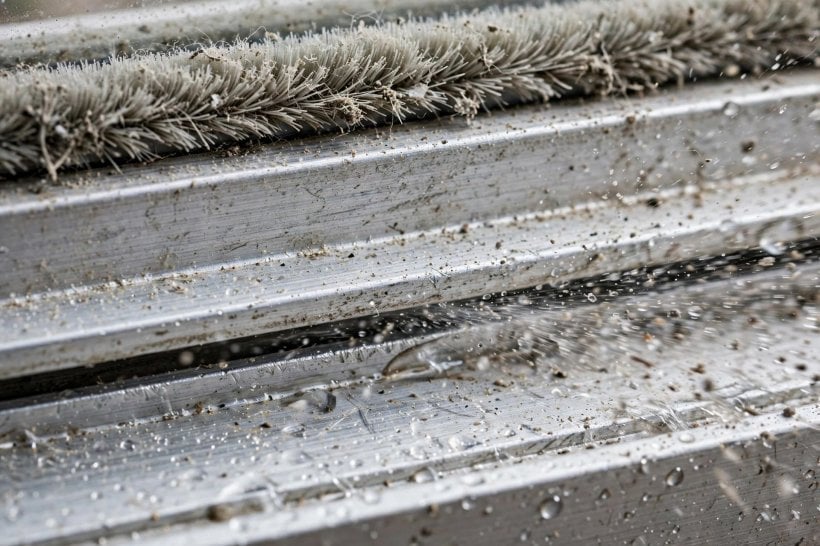
The same clearance produces the third complaint: the rattle. With room to move in its track, the sash shakes during transport — annoying in itself, and worse over time, because the vibration can eventually damage the locking mechanism the window’s security depends on. Notice the pattern: both failures come from the clearance the mechanism cannot live without. It is the same class of problem the glazing itself faces on the road, where selecting windows for road safety treats every pane as vehicle glazing rather than house glazing — a window on wheels is travel hardware, and it has to be judged by what the highway does to it, not by what a parked wall asks of it.
6. The Awning Window: Hinged at the Top
The awning window answers with a different mechanism. It is hinged at the top, and it cranks outward from the bottom: turn the crank and the bottom edge of the sash swings out and up, leaving the pane sloping over the opening like the awning it is named for. There is no track, no sideways travel and no clearance gap for the sash to slide in — the sash moves on a hinge, and when it comes home it comes home against a seal, which is the subject of §8.
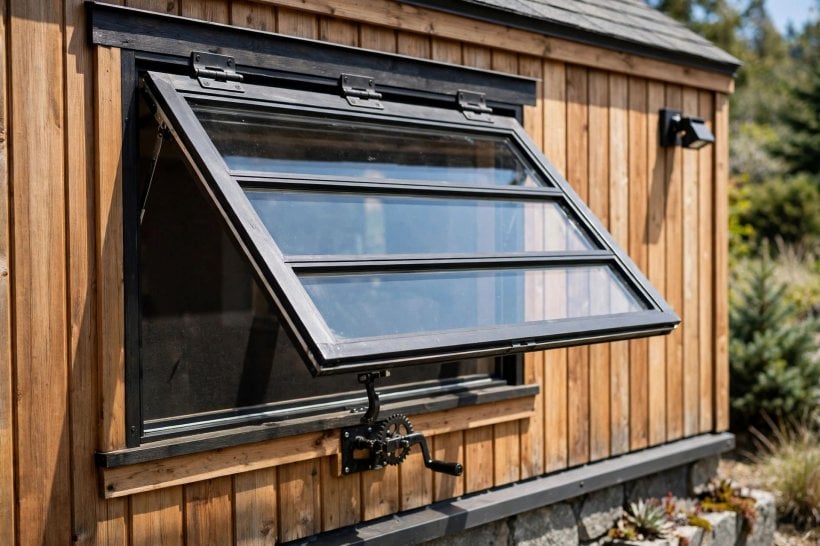
The original’s verdict on this mechanism is blunt: the simple mechanical difference makes the awning superior for tiny homes in almost every way. Almost — the cost section of this guide will qualify it, because awning units are often more expensive, and §10 will keep one room in the house for the slider. But the three advantages that follow are each direct consequences of the hinge: the glass itself becomes the roof over the opening, the closed sash compresses a gasket instead of brushing past a strip, and the hardware that holds it shut lives inside the frame. Take them in turn.
7. The Umbrella Effect: Ventilation in the Rain
The killer feature is the one the hinge makes possible. Because the glass slopes outward like a roof, you can leave awning windows cracked open 2–4 inches during a rainstorm. Water hits the glass and runs off the bottom edge, away from the opening — the pane sheds the rain the way a roof sheds it, off its face and clear of the wall. Underneath that sloped glass, the opening stays dry, and fresh air can still rise and enter from the bottom.
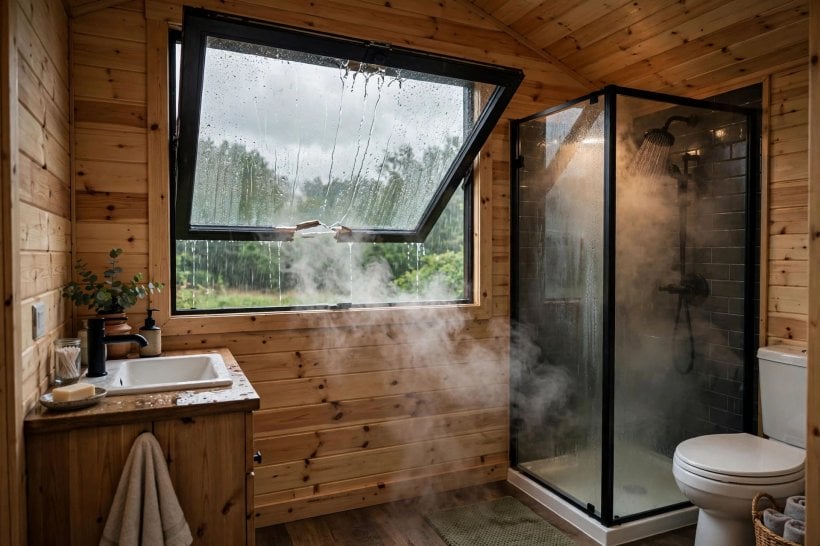
The result is the exact capability §2 demanded: you can keep venting moisture from your shower or pasta pot without letting the storm inside. The wet rooms of the house stop having to choose between steam and rain, because the window gives them both at once — exhaust out, weather off. It is the same all-weather ventilation thinking that governs the rest of the openings in a small house: the cooling strategy in our tiny home summer prep guide assumes windows that can move air whenever the house needs it, and a roof hatch installation answers to the same rule overhead. An opening that only works in fair weather is half an opening.
8. The Compression Seal: Built for the Highway
Where the slider seals with a brush, the awning window seals with compression. Its seal is a rubber gasket, and the mechanism works on it directly: when you crank the window shut and lock it, the mechanism pulls the sash tightly against the rubber gasket, squeezing the seal closed around the whole perimeter of the frame. There is no track clearance to forgive, because the sash does not travel in the frame — it lands on the gasket and is drawn into it.
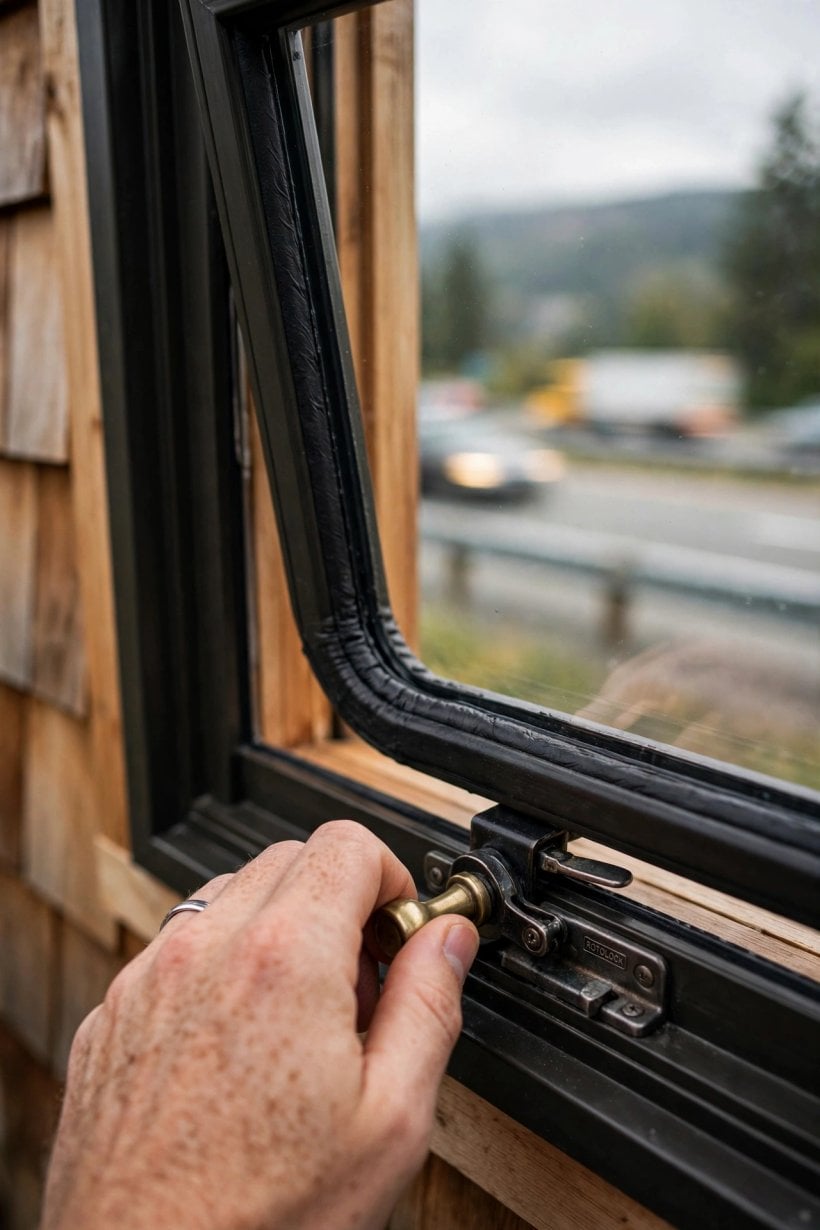
The benefit runs opposite to the slider’s failure. The harder the wind blows — or the faster you tow — the tighter the seal gets, because wind pressure on the sloped sash presses it further into the gasket rather than hunting for a gap to pour through. That makes awning units virtually airtight and waterproof during highway travel: the 60 MPH test that defeats the brush seal is the test the compression seal is built by. A window’s seal is one layer of a sealed envelope, and it belongs to the same discipline as the barrier behind the siding — the comparison in the Tyvek vs. ZIP System air-barrier battle is about exactly this: assemblies that are sealed by compression and tape hold; assemblies that rely on loose contact leak.
9. Security: Locked Into the Frame
The third advantage is the quietest. Awning windows are notoriously difficult to pry open from the outside, for two structural reasons. The hardware is internal — the crank, the hinges and the locking mechanism all live inside the house, where a pry bar cannot reach them. And the sash is locked into the frame at multiple points on better models, so there is no single latch to defeat and no loose corner to start from; the same mechanism that pulls the sash into its gasket holds it there against force as well as weather.
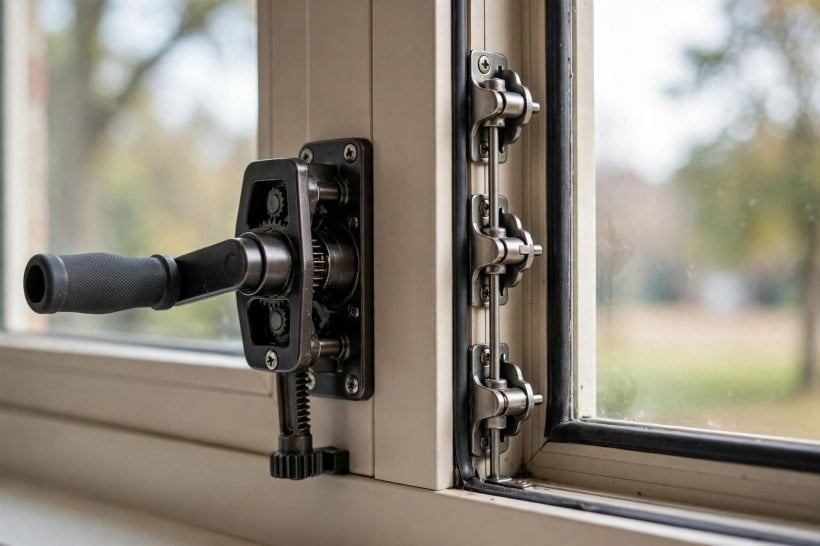
For a tiny house, this is not a marginal concern. The house parks in laybys, trailheads and driveways; it is left unattended in places a conventional house never sits, and its windows are at arm’s height from the ground. A window that resists prying because of how it is built — rather than because of an accessory lock added to it — carries its security in its mechanism. It is the third leg of the awning’s case: the hinge sheds the rain, the gasket defeats the highway, and the locked sash defeats the crowbar.
10. Where Each Window Belongs: The Room-by-Room Verdict
None of this makes the slider useless, because awning windows are often more expensive, and a tiny house budget is a zero-sum thing. The original’s answer is to mix and match — put each window where its strengths matter. The kitchen and bathroom are non-negotiable: these are high-moisture zones where you need ventilation 24/7, regardless of weather, so they must use awning windows. A slider in a bathroom is a window that closes exactly when the shower runs.
Sleeping lofts get the strong recommendation. You generate a lot of moisture breathing at night, and it gathers in the smallest, warmest air in the house — waking up to a stuffy loft because you had to close the window due to rain is miserable, and it is the nightly version of the §2 problem. The living room is where the slider survives: if you need a massive picture window that opens, a large slider is often cheaper and easier to find than a massive awning window, and the room’s moisture load is the lowest in the house. One exception stands outside the verdict entirely: if you are building a stationary cabin in the desert, buy whatever is cheapest — the rain and the highway are what make this a contest at all. And the windows are one layer of the wet-weather wall: the rain screen installation behind the siding handles the water the windows never see.
Final Considerations
For a Tiny House on Wheels that will see rain, highway winds and high moisture loads, the Awning vs. Sliding Windows contest has a functional winner. The awning window lets the house breathe in all weather conditions — open in the rain under its own glass roof, sealed tighter the faster it tows, locked into its frame at several points — and breathing in all weather is what protects the interior from the silent killer of tiny homes: mold. The slider keeps its place where its weaknesses do not bite: the big living-room picture window, the tight budget, the stationary build. Choose per room, not per house — file the idea that one window type must win everywhere under the other tiny house myths — and the debate settles itself: awnings wherever moisture is made, sliders only where air is easy.




1 Comment