

Some architectural words name a style; clerestory names a solution. It is the band of windows set high in a wall, just under the roof, that lights the middle of a room no ordinary window can reach — a device older than the Gothic cathedral, at work today in everything from passive-solar houses to tiny cabins, and still widely confused with its neighbours.
This article explains the feature itself: what it is and is not, where it comes from, how its light and air behave, the forms it takes, where it earns its keep, and its honest drawbacks. Detailed window treatments belong to a later post in this plan; here the subject stays at the level of the feature, defined properly and whole.
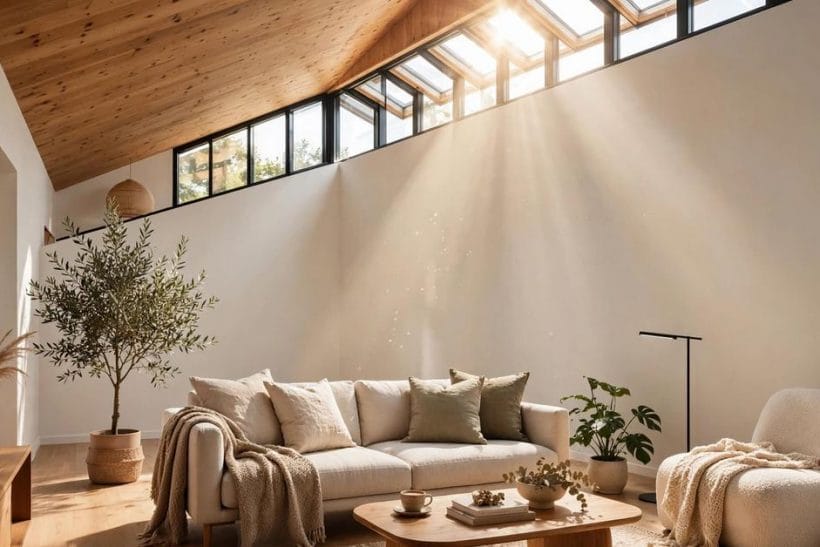
1. Clerestory at a Glance
The central entity is the clerestory: a band of windows set high in a wall, above eye level and beneath the roof, whose defining attributes are position (the wall’s upper register, carried on a raised step in the roof), function (throwing daylight deep into a plan and, where its panes open, venting the warm air that gathers at the ceiling), and form (split pitches, stepped sheds and monitor roofs, in fixed, opening or louvred glass). This article treats the subject as the generic definition of the feature — the level at which every later, narrower treatment in this plan will differentiate itself. The wider home it belongs to is gathered in this site’s home design ideas collection, and the neighbouring ceiling, light and shading fields are linked where their lanes begin. All structural, planning and ventilation points are stated generally, as professional work under local practice.
| Question | Short answer |
|---|---|
| What is a clerestory, in one sentence? | A band of windows set high in a wall, just under the roof, that throws daylight deep into a room and can vent its warmest air. |
| How is it different from a skylight? | A skylight lies in the roof’s own slope; a clerestory is vertical glass in a raised wall step, so it lights and vents without lying open to the sky. |
| Does a clerestory need a high ceiling? | It needs height in the wall more than in the room — the band sits above eye level, so tall or raised sections of roof are where it lives. |
| Can one be added to an existing house? | Yes, but it is roof work — survey, drawings, permissions and warranted junctions — most often absorbed into an extension or a roof rebuild. |
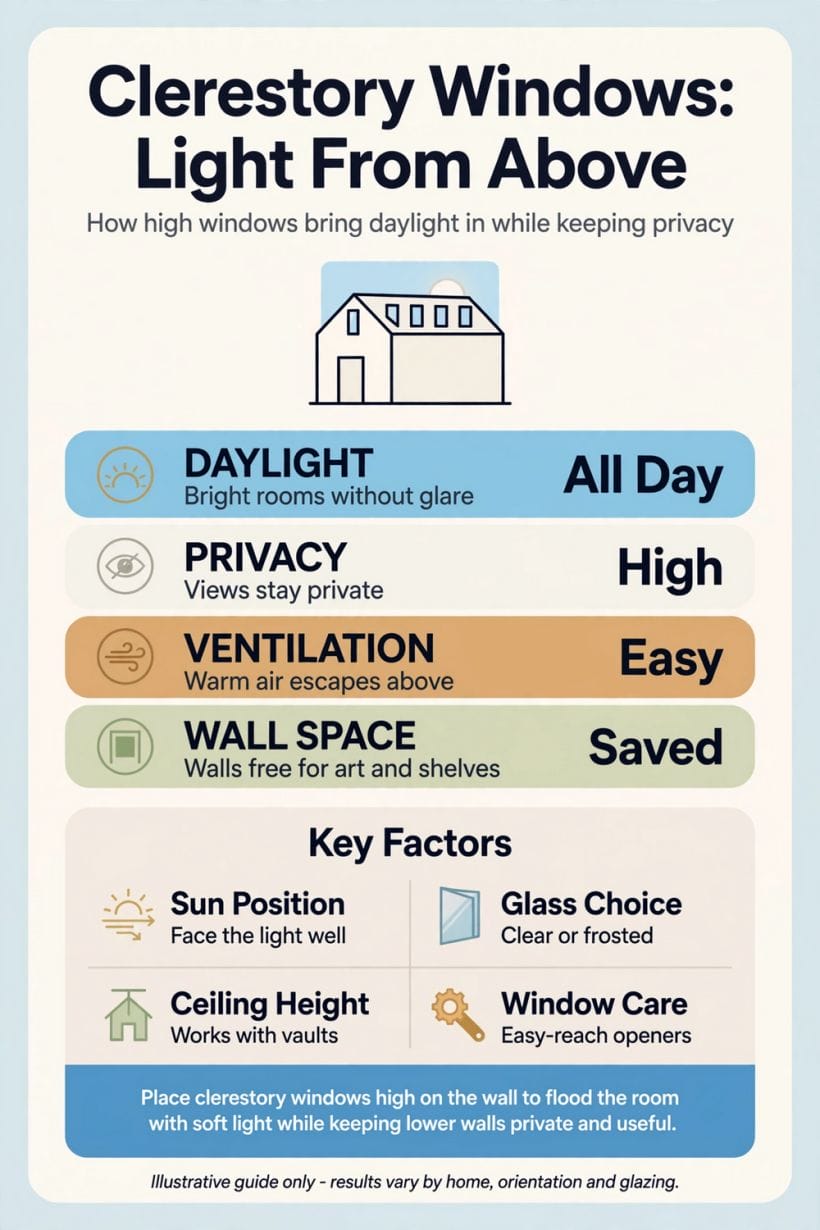
2. What a Clerestory Is: The Definition and the Anatomy
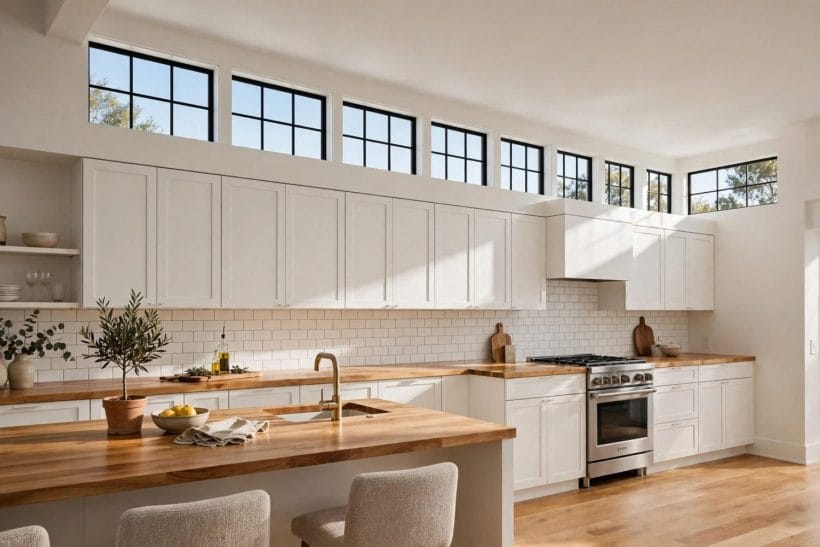
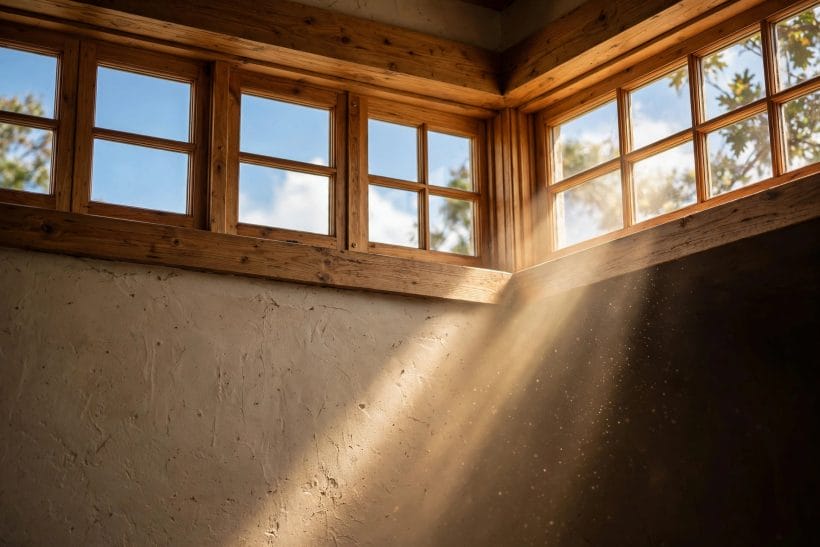
A clerestory — pronounced with the stress on the first syllable, and spelled exactly as oddly as it sounds — is a band of windows set high in a wall, above the eye level of the room it serves and usually just under the roof. The word comes to architecture from the church: the clear storey, the glazed upper level of a great nave, lifted above the aisle roofs to throw light into the middle of the building. The domestic version keeps the principle and drops the scale.
The anatomy: sill, head and the roof above
A clerestory has a high sill — the bottom of the glass begins well above head height — and a head that meets the roof structure, which is why the feature is as much a roof decision as a window decision. The raised strip of roof that carries it, whether a split pitch, a stepped shed roof or a small monitor roof, is what you actually see from the street: the house appears to have lifted the lid along one side to let the light in.
What it is not: skylight, transom and high window
Three neighbours cause confusion. A skylight lies in the plane of the roof itself; a clerestory is vertical, in a wall. A transom is the small pane above a door or another window, inside the same frame’s family. And an ordinary high window in a tall wall — a stairwell slit, say — is just a window placed high; a clerestory is a system: a continuous or repeated band, working with the roof form, lighting the depth of a room rather than a spot. The ceilings that share these tall rooms are their own field, gathered in this site’s ceiling design ideas survey; the clerestory’s subject is the glass band itself.
Fixed glass, opening glass, and the band as a whole
Clerestory panes may be fixed, opening, or a mixture — fixed where only light is wanted, opening where the band also ventilates, as a later section covers. Louvred and vented variants exist for hot climates and industrial buildings. What unifies them is position: the band sits in the wall’s upper register, above the reach of furniture, sightlines and the ordinary window’s jobs of view and access.
3. A Short History: Temples, Churches and Engine Sheds
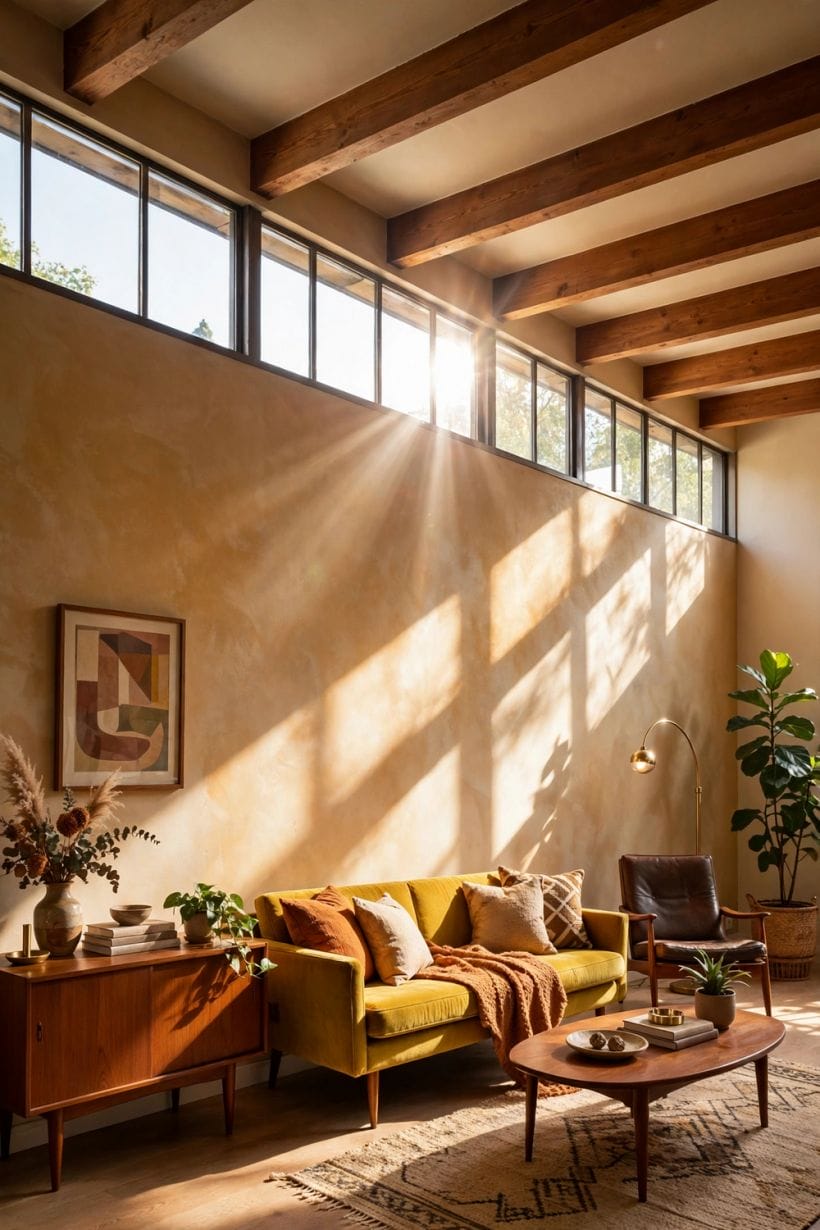
The clerestory is one of the oldest lighting devices in building, and its history explains its virtues: it was invented wherever people needed light deep inside a large roofed space, long before glass was cheap or electric light existed, and it has been rediscovered by every era that built big rooms.
Ancient halls and the Gothic answer
Egyptian temple halls raised their central roofs above the side aisles and lit the nave through the difference — the clerestory in embryo. Roman basilicas used the same section, and the Gothic churches perfected it: a glazed upper storey floating above the aisle roof, flooding the nave’s centre with a light that seemed, to the people below, to arrive from nowhere visible. The section — high centre, low sides, glass in the step — has never been improved as a way to light a deep plan.
Sheds, factories and the industrial band
Industry adopted the clerestory for entirely practical reasons: great workshops and weaving sheds needed even light across deep floors, and the raised monitor roof with glazed sides delivered it, along with ventilation at the building’s hottest point. The sawtooth and monitor roofs of the industrial age are clerestories wearing overalls, and their honesty is why the feature still reads as modern.
The modern house takes it up
Twentieth-century house architects — the modernists first, and the passive-solar designers after them — brought the band home: a strip of high glass to light a deep open plan, to bounce sun off a ceiling in winter, to vent a house’s rising heat in summer. In the tiny-house and small-home world the same trick lights lofts and deep little plans. The feature this article defines is that one device, at every scale from cathedral to cabin.
4. How the Light Behaves: Thrown Deep, Bounced and Glare-Free
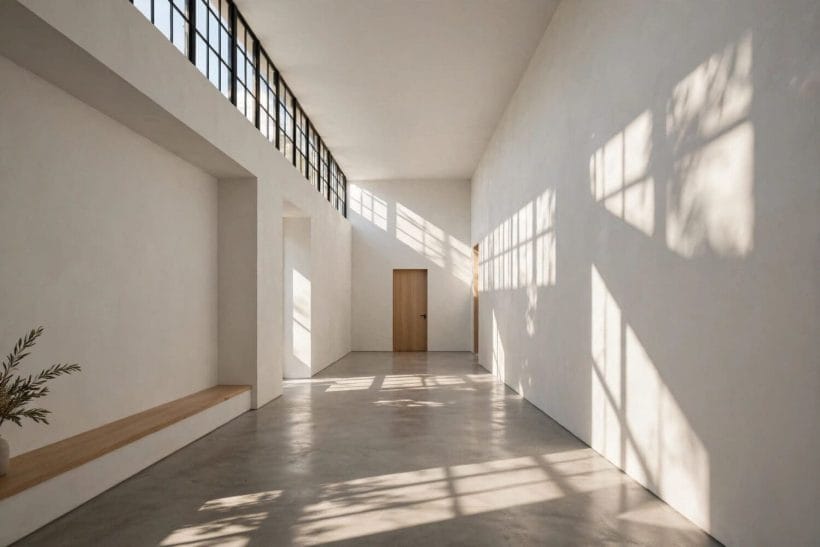
The clerestory’s whole purpose is a particular quality of light, and understanding it explains every design decision that follows. Light from a high band behaves differently from light through an ordinary window, and mostly better — provided the band is placed with the sun’s habits in mind.
Depth: light that reaches the middle of the room
An ordinary window lights the floor near itself and leaves the room’s depth in gloom; a high band throws its light across and down, reaching the middle and far side of a deep room, especially where a pale ceiling or a high pale wall catches it and bounces it onward. This is why the device suits deep plans, extensions built onto the shadowed side of a house, and rooms whose only external wall is committed to doors, kitchens or privacy.
Glare: the band above the sightline
Because the glass sits above eye level, its brightness stays out of the direct view of people sitting and standing below — the room is lit without the lit window being stared into. Screens, sofas and desks can sit under a clerestory without their users squinting, which is precisely the failure of the big low picture window at the sunny end of a room. The tall living rooms where the band pairs with a raised ceiling are this site’s vaulted ceiling living room ideas field; the light logic is shared.
Which side: the soft side and the sunny side behave differently
A band on the side of the house away from the sun’s main path gives the classic clerestory light: even, shadowless, all-day. A band facing the sun gives drama and, unmanaged, trouble — shafts of direct sun that move across the room and heat that arrives with them. Traditional practice shades the sunny band with the roof’s own overhang, sized by a designer to the latitude, so the glass admits the low winter sun and is shaded from the high summer one. The principle is general; the angles are a professional’s calculation for the specific site.
5. Air and Warmth: The Ventilation Half of the Idea

Half the clerestory’s value rises with the warm air. Hot air collects at the top of a room, exactly where the band sits, so a clerestory that opens is a chimney with a view — and in summer, in the right arrangement, it ventilates a house with no machinery at all.
The stack effect, stated plainly
Warm air rises and escapes through high openings; cooler air is drawn in low to replace it. Give a house low openings on its shaded side and opening clerestory panes above, and the building breathes in a slow, silent stack. The effect is general physics, stated in every ventilation textbook; making it work in a specific house — sizing openings, placing them, automating panes that sit far above reach — is design work for the professionals who will warrant it.
Heat at the ceiling, and the winter account
The same height that vents in summer stratifies in winter: warmth pools at the ceiling of a tall room while the occupants sit in the cool below. Clerestory houses answer with ceiling fans, with the band’s glass specified and shaded properly, and with heating designed for the volume rather than the floor area. None of this is an argument against the feature; it is the honest account of it, and it belongs in any decision to build high glass into a home.
Opening panes you cannot reach
A band above head height opens by mechanism — winding gear, chains, or electric actuators, often tied to rain sensors and the house’s other systems. The mechanism is part of the feature’s cost and upkeep, and the fixed-versus-opening decision should be made room by room: light-only bands can be fixed and cheaper; the band above a kitchen or a deep living room usually earns its openers.
6. Where Clerestories Work: Rooms and Buildings
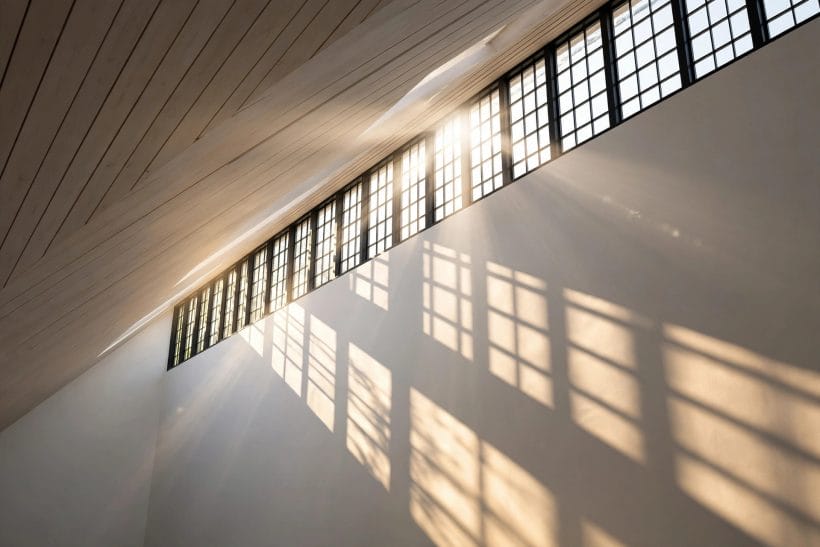
The feature earns its complexity in specific situations, and naming them is the quickest way to judge whether a house — existing or planned — is a clerestory candidate at all.
Extensions and deep plans that have run out of wall
The classic domestic case is the rear extension: a deep new room built against the house, whose far end is the old external wall and whose middle would otherwise darken. A raised strip along the extension’s roof, glazed on the house side, pours light into exactly the dead zone. Whole deep open plans use the same geometry at larger scale — the band is how a big room avoids becoming a well-lit rim around a gloomy centre.
Borrowed light for inner rooms
Bathrooms, halls and kitchens buried in the middle of a plan can borrow light through a clerestory from the tall space beside them — glass high in the shared wall, privacy intact, daylight delivered. It is the polite version of the internal window, and in small homes it can be the difference between a room that needs the light on all day and one that does not.
Small houses, lofts and the tiny end of the field
At the small end of building, the band is a favourite of tiny-house and loft design: high glass over a sleeping loft, a raised central strip lighting a deep little plan, privacy kept in tight plots where low windows would stare at neighbours. This site’s published clerestory window tiny house layouts post works that end of the field in detail; this article stays at the feature level it owns.
7. The Forms It Takes: Roofs, Bands and Window Types
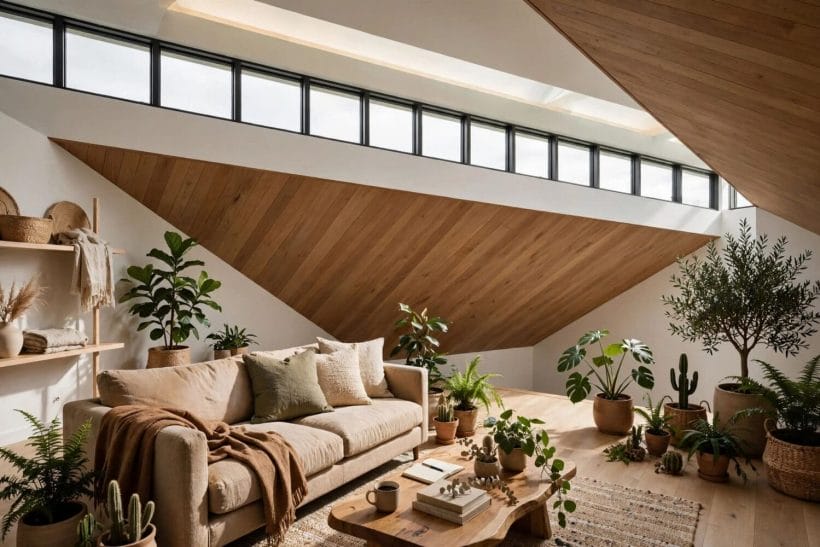
From the street, a clerestory reads as a roof event; from inside, as a band of light. The forms are few, and each has its temperament. The whole-house survey of the raised-ceiling family — the generic treatment of vaulted and lifted roofs — is this site’s vaulted ceiling ideas post; what follows is the glazed band’s own taxonomy.
The split pitch and the stepped shed
The commonest domestic forms raise one roof plane above another: two slopes at different heights with glass in the step between them, or a main roof and a lower lean-to with the band in the riser. Both put the glass on the step’s vertical face, sheltered by the upper roof’s overhang — the form that makes the shading trick of the light section possible.
The monitor roof and the continuous band
The monitor — a small raised roof running along the ridge, glazed on both sides — is the industrial form brought home, lighting the centre of a plan from directly above its spine. At the modest end, the band may be no more than a continuous strip of windows directly under the eaves of a single-slope roof: the simplest clerestory, and the easiest to add where a roof is being rebuilt anyway.
Glass types: fixed, opening, louvred
Within any form, the band’s panes divide into fixed lights, opening casements or top-hung vents, and louvred sections in the climates that favour them. Deep frames and mullions give the band its rhythm; the pattern of the divisions is the feature’s main decorative decision, and the quiet, regular rhythm almost always ages better than the busy one.
8. Privacy, Glare and the Honest Drawbacks
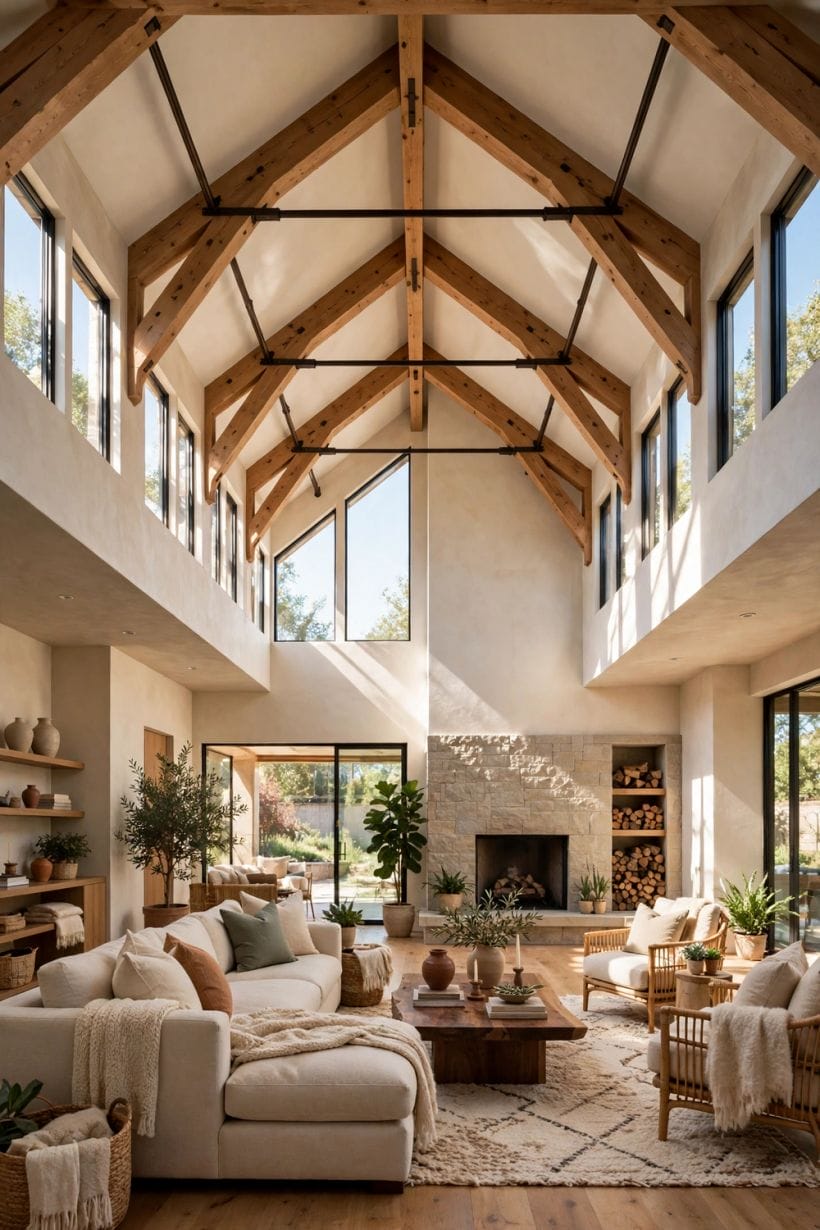
A definition article owes its subject the drawbacks as plainly as the virtues. The clerestory’s are real, and they cluster in three places: building complexity, control of sun, and the care of glass you cannot reach.
Complexity and cost sit in the roof, not the glass
The band itself is ordinary windows; the expense and the risk sit in the roof step that carries it — extra structure, extra flashing, extra junctions where water must be persuaded to leave. This is designed, surveyed and warranted work, not an improvisation, and its cost belongs in the same conversation as any roof alteration. Houses whose roofs are being rebuilt anyway absorb a band most cheaply, which is why so many clerestories arrive with extensions and loft conversions.
Shading high glass, and cleaning it
Sun control for a high band — external overhangs first, then blinds and shades made for inaccessible glass, on poles, cords or motors — must be planned with the band, not discovered after the first summer; this site’s window treatments survey covers the shading family in its own right. Cleaning is the other honest chore: high glass is cleaned from ladders, platforms or by the professionals with poles, and a design that forgets access will wear its grime as a permanent feature.
Where the feature does not belong
Not every room wants its light from above: rooms for sleeping in the day, rooms for screens and projection, and small rooms with adequate ordinary windows all gain little. And a band added to a shallow, already bright room is decoration wearing engineering’s clothes. The clerestory is a tool for depth, height and borrowed light; where none of those is lacking, the honest answer is a good ordinary window.
9. Adding One, or Reading One in a House You Buy
The article closes with the two practical encounters most readers will have with the feature: putting one into a house, and understanding one that is already there.
Adding: survey, structure and the professional team
Adding a clerestory means altering a roof, which means structure, weatherproofing and, commonly, the local planning and building rules that govern roof alterations and overlooking. The route is a survey of the existing roof, a designer’s drawings, the necessary permissions, and builders who will warrant the junctions. Nothing in that list is optional garnish; the band is only ever as good as the step that carries it, and the step is professional work from first sketch to final flashing.
Buying: what to check in an existing clerestory
In a house that already has one, read the band as a surveyor would: the junctions and flashings for staining or past leaks, the opening mechanisms for movement, the glass for failed seals fogging between panes, and the rooms below for the shading answer — is there one, and does it work at the sunny hour? A well-kept clerestory is a house’s glory; a neglected one is a roof junction with a history, and the difference shows in exactly those places.
The feature’s one-sentence verdict
If the plan is deep, the ceiling can rise, and the light has nowhere else to come from, the clerestory is not an ornament but the answer — the oldest answer architecture has — and it will go on being rediscovered for as long as people build rooms deeper than a window can light.
10. Costs and Pulling It Together
The clerestory’s costs arrange themselves honestly: the glass is the least of it, being ordinary window units in a row; the money lives in the roof step — structure, flashing, access and the mechanisms of panes placed out of reach — and in the shading that a sunny band requires. Against that stands the return no other device quite replicates: daylight in the depth of a plan and ventilation at its crown, bought once and collected daily. Any specific project deserves a designer’s and a builder’s own figures; this article’s claim is only about where the costs and the value sit.
Pull the feature together and it is a single idea wearing many roofs: lift the glass above the sightline, and light goes deeper, glare goes away, air finds its exit, and privacy stops being the price of daylight. Temples, churches, engine sheds and modern houses all arrived at the same band of high windows because the problem — a room deeper than its windows — has only ever had the one elegant answer.
Final Considerations
Read a house for its clerestory and you read its intelligence: someone, at some point, refused to accept a dark middle to the plan and lifted the roof a little to let the light in properly. The feature asks more of a building than an ordinary window does, and pays more back, for longer, than almost any other single gesture in domestic architecture.
The detailed treatments of clerestory windows — their styles, dressings and room-by-room uses — belong to a later post; this definition stands as the ground they will build on. The wider house around the feature stands in this site’s exterior home ideas survey and its home design ideas collection; this article’s band of high glass stands within it, lit from above and used daily.



0 Comments