
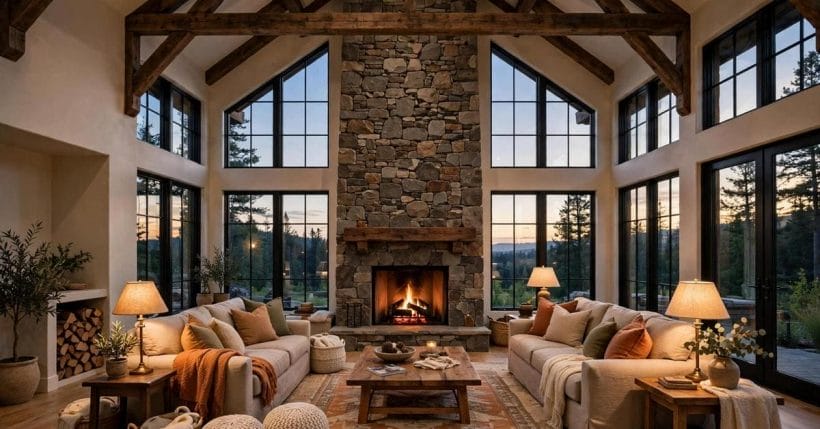
A great room can swallow an ordinary fireplace whole. Tall walls, long sightlines and open floor space ask for a fire that holds its own without shouting, a hearth that gathers the room instead of decorating one corner of it.
This guide looks at great room fireplaces through scale alone: how the fire sits in a large room, where it belongs on the wall, and how seating, light and soft dressing make a big room feel close.
Related Guide: 10 Rustic Great Room Ideas: Beams, Stone Fireplaces and Cosy Seating
1. Reading the Scale of the Room
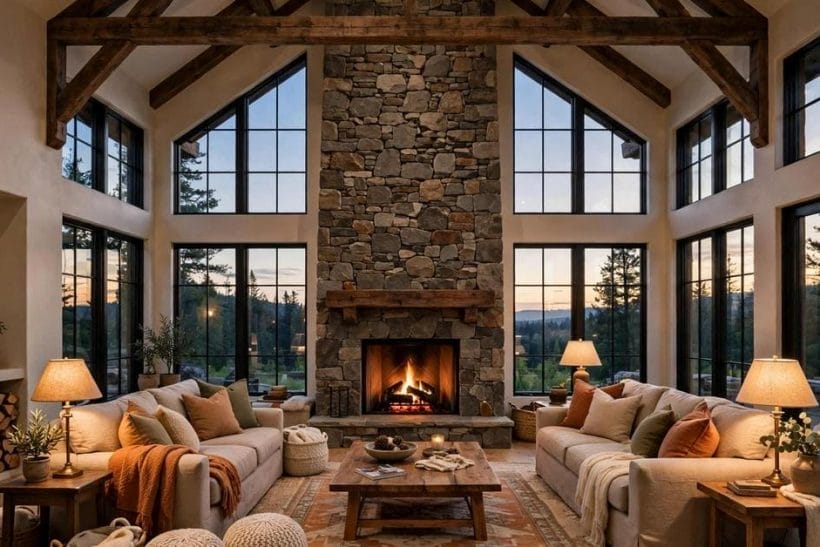
A great room is not simply a large living room. It is a room with height as well as floor area, often open to a kitchen or dining space, with windows that run tall and sightlines that cross the whole house. A fireplace in such a room has two jobs at once: it must be visible and welcoming from the far side of the room, and it must still feel intimate to the people sitting nearest to it. Getting that balance right is the whole art of the subject.
| At a Glance | This Room |
|---|---|
| First question | How tall and wide the room truly feels |
| Fireplace place | Centred on the main wall, in clear view |
| Seating | Grouped close enough for conversation |
| Materials | Stone, brick, timber or plaster, honestly used |
| Finishing touch | Soft light, throws and greenery |
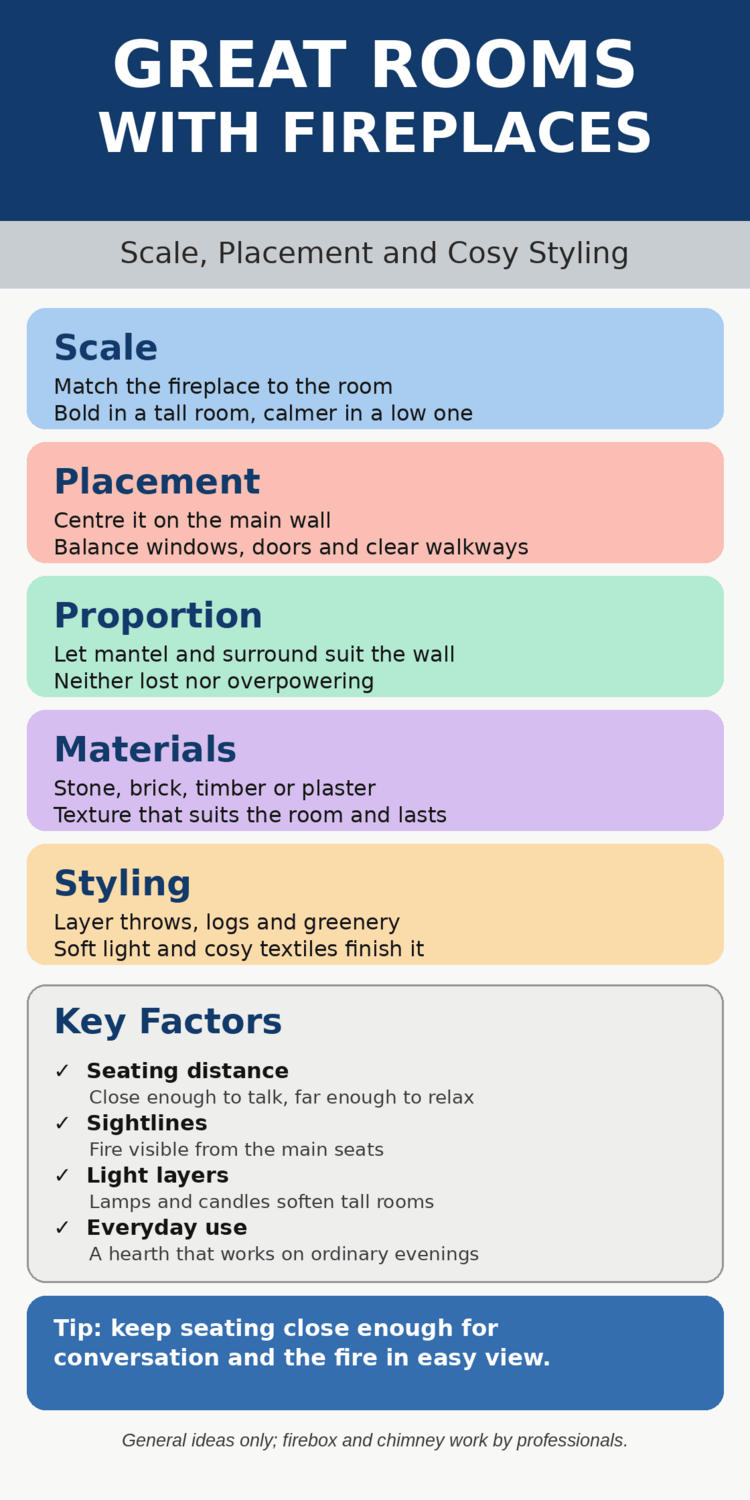
Start by standing at the far end of the room and looking toward the fireplace wall. If the fire reads as a small dark opening lost in a large wall, the room will feel colder than it is, however warm the fire itself may be. If the surround climbs so high and wide that it dominates every view, the room will feel like an antechamber to the fireplace rather than a place to live. The pleasing middle is a fireplace that anchors the wall without owning it, with breathing room on either side and a clear relationship to the ceiling above.
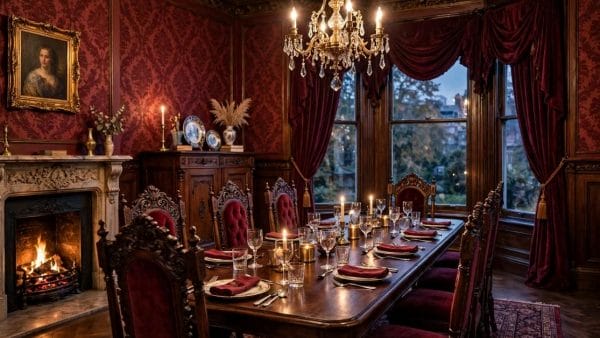
Scale is also about what stands near the fire. A pair of low armchairs, a rug that gathers the seating group, and a mantel dressed with restraint all help the eye judge the size of the fireplace correctly. Rooms that feel grand rather than empty almost always have this middle layer of furniture and texture between the vast wall and the small flame. Compare the feeling with small living room ideas, where every piece must earn a tight footprint, and the difference scale makes becomes obvious: a great room forgives generous furniture, but it still needs that furniture to gather around something.
2. Placing the Fireplace on the Main Wall
Placement comes before decoration. In most great rooms the fireplace belongs on the wall that the room naturally faces, the wall seen first from the entrance and from the main seating group. A fireplace tucked on a side wall, or competing with a wall of glass, will always feel like an afterthought, however handsome its surround may be. Walk the room’s natural paths first: the way in from the hall, the way through to the kitchen, the view from the stairs if the room is open above. The fireplace wall should sit where those paths do not cross the seating group, so nobody must walk between the chairs and the fire to reach another part of the house.
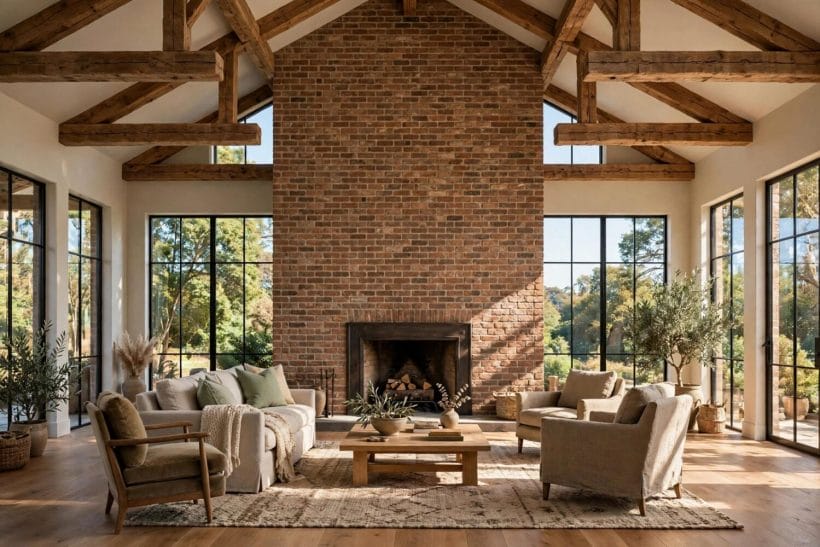
Balance matters as much as centrality. A tall fireplace wall with windows on both sides feels settled, because light frames the fire rather than fighting it. A fireplace beside a single large window can work beautifully too, provided the seating does not end up staring into glare on one side and shadow on the other. Think of the wall as a composition: fire at the centre, something calm on either side, and nothing that forces the eye to choose between two rivals. The wider survey of home design ideas shows the same principle at house scale, where one clear focal wall per room keeps the whole plan legible.
Corner placements deserve a special note. A fireplace angled into a corner can suit a room where the main wall is already given over to glass or to an open kitchen, and it can make an awkward corner the warmest seat in the house. But a corner fire asks for seating arranged on the diagonal too, and that arrangement can waste the middle of a large room if it is not planned with care. In a truly great room, a centred wall placement is usually the calmer, more generous choice.
3. Proportion: Fireplace, Wall and Ceiling Together
Proportion is the quiet cousin of scale. Scale asks whether the fireplace is big enough for the room; proportion asks whether its parts agree with each other and with the wall. A tall, narrow firebox on a very wide wall looks pinched. A broad, low opening beneath a soaring ceiling looks stranded. The happiest great-room fireplaces have a surround whose height and width echo the wall it sits on, so the eye travels up from hearth to mantel to ceiling without a jolt.
The mantel is the hinge of this relationship. A mantel set too high above the firebox disconnects the flame from the display above it, while a mantel crowded down onto the opening makes the whole composition feel compressed. In a tall room, a mantel with a little more presence than a cottage mantel would carry is usually right, because it must hold its own against the height of the wall. Keep the dressing above the mantel simple and tall rather than wide and busy: a mirror, a single large picture, or a pair of tall candlesticks will suit the vertical line of the wall better than a scattered row of small objects.
Ceiling detail changes the equation as well. Beams, a vault, or a coffered ceiling all add horizontal lines that the fireplace must sit comfortably beneath. A surround that climbs into the beams looks accidental; a surround that stops well short of them, with a calm stretch of wall above, looks considered. The contrast with tiny house designs is instructive: where a small home must compress every line, a great room can afford generous pauses of plain wall, and those pauses are what let the fireplace breathe.
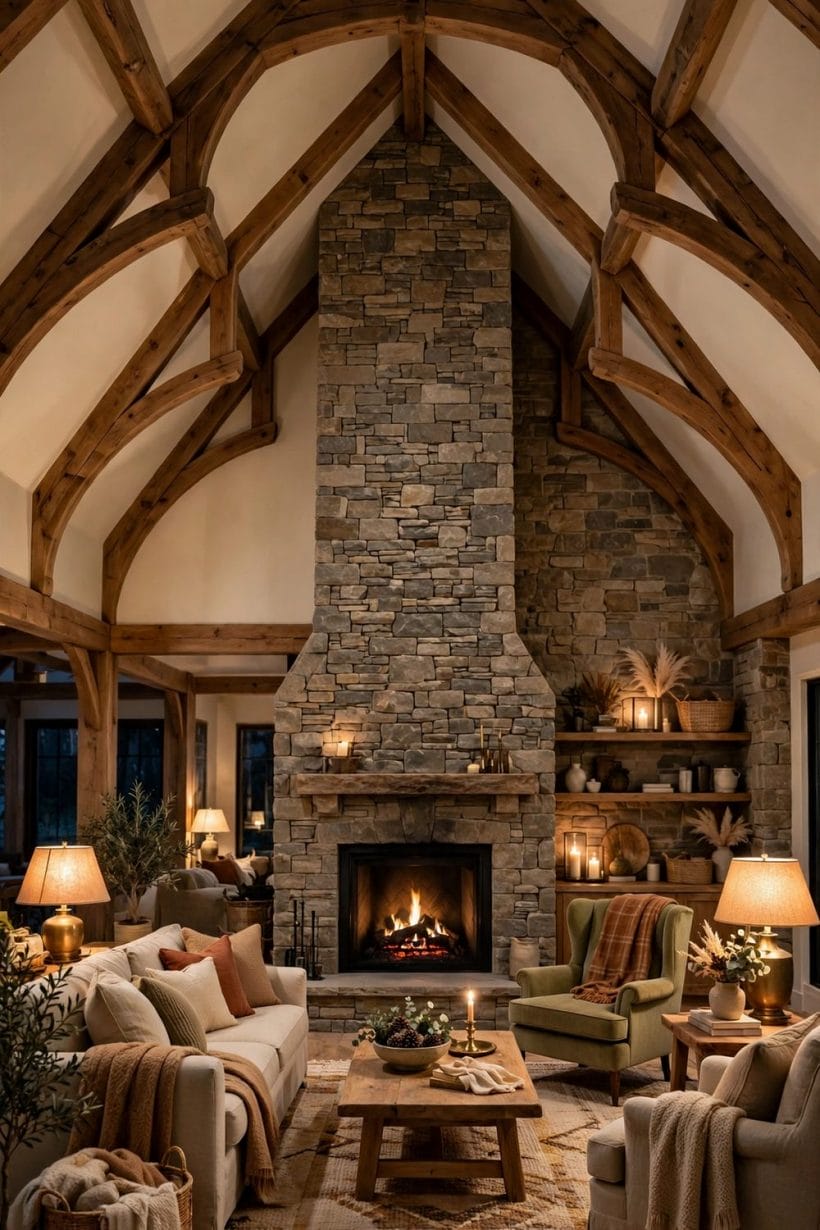
4. Seating the Room Around the Fire
A great room fails when its seating drifts. Sofas pushed against distant walls, chairs marooned in the middle of the floor, and a rug too small to gather anything all leave the fireplace performing to an empty room. The remedy is to build a room within the room: a seating group close enough that people can talk without raising their voices, with the fire in easy view from every seat. The rest of the floor can then belong to circulation, to a reading chair by the window, or to the open passage into the kitchen, without the room feeling empty.
Two facing sofas, or a sofa facing a pair of armchairs, is the classic great-room arrangement for a reason. It gives the fire an audience on both sides and gives conversation a natural shape. An L-shaped arrangement suits rooms where the fireplace shares its wall with the television or where the main view is through glass rather than toward the hearth; in that case, angle the chairs so the fire is still in the corner of the eye, not behind the sitter. Whatever the shape, keep a clear path around the group so guests can join it without stepping over feet or skirting a coffee table.
Rugs do more work here than they are credited with. A rug that reaches beneath the front legs of every seat in the group ties the arrangement together and marks the boundary between the fireside circle and the rest of the room. A rug that floats in the middle, touching nothing, only emphasises how far apart the seats are. The same grouping logic guides tiny house floor plans, where every seat must belong to a group, and it scales up directly: a great room is simply a plan with more air between its groups.
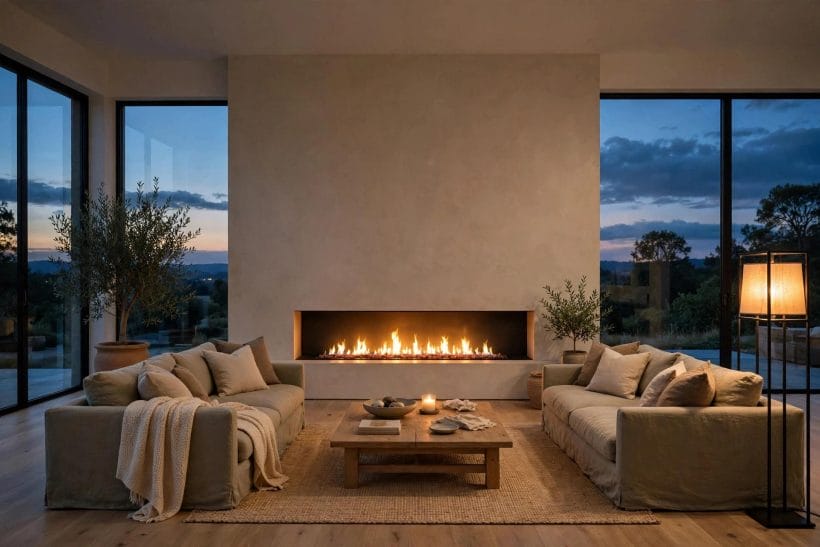
5. Materials That Suit a Large Room
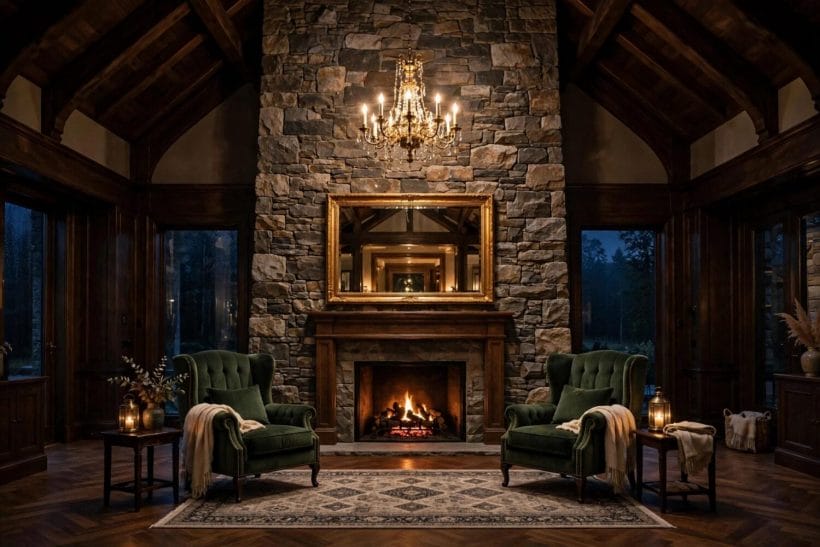
Materials behave differently at great-room scale. A texture that looks rich in a small room can look thin when it must cover a tall wall, while a bold material that would overwhelm a small space can be exactly right here. Stone is the natural great-room material: its weight and variation hold a tall wall, and its irregular surface catches firelight beautifully. Brick brings warmth and a handmade rhythm that suits rooms with timber ceilings and deep window reveals. Plaster, smoothly finished, gives a calm modern wall that lets the flame itself be the texture. Timber, used as beams or as a mantel, softens stone and brick and stops a tall wall from feeling cold.
Mixing materials needs restraint. Two materials in conversation, such as stone with a timber mantel, or brick with plaster above, usually read as intentional. Three or four competing surfaces on one wall read as indecision, and the eye cannot settle. Let one material lead and the other support it, and carry the supporting material elsewhere in the room, in a beam, a door frame or a floor, so the fireplace feels part of the house rather than pasted onto it.
Colour follows the same rule. Natural stone and brick carry their own colour, and they sit most happily against walls in warm whites, soft greys or muted earth tones that do not compete with them. A painted surround in a single calm colour can be equally successful, especially in a bright room where the fireplace should recede a little and let the windows lead. Whatever the palette, test it in firelight as well as daylight: a colour that looks crisp at noon can turn cold or muddy in the evening glow, and the evening is when the fireplace matters most.
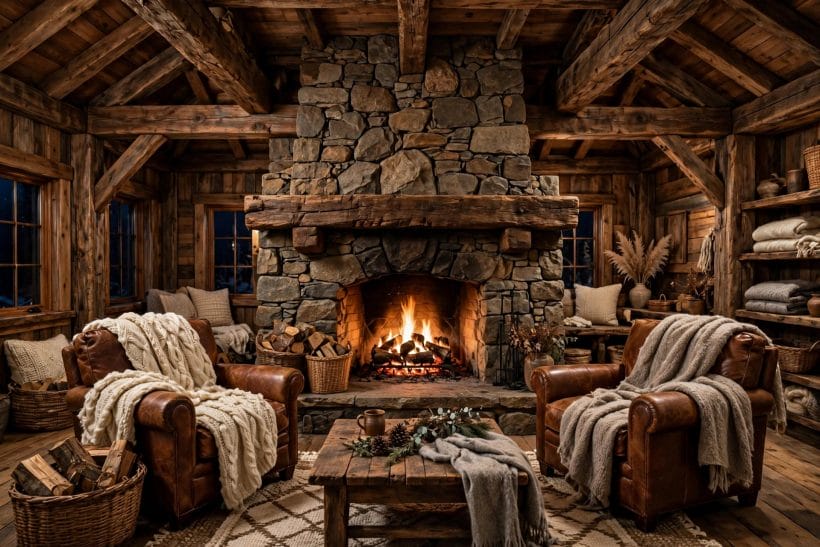
6. Mantels in a Tall Room
The mantel is where the architecture of the fireplace meets the life of the household, and in a tall room it must work harder than elsewhere. It frames the fire, carries the dressing of the seasons, and gives the eye a horizontal resting place on a vertical wall. A mantel that is too slight for its wall looks like a ledge hung in the wrong place; a mantel with real depth and presence anchors the whole composition and invites the room to gather beneath it.
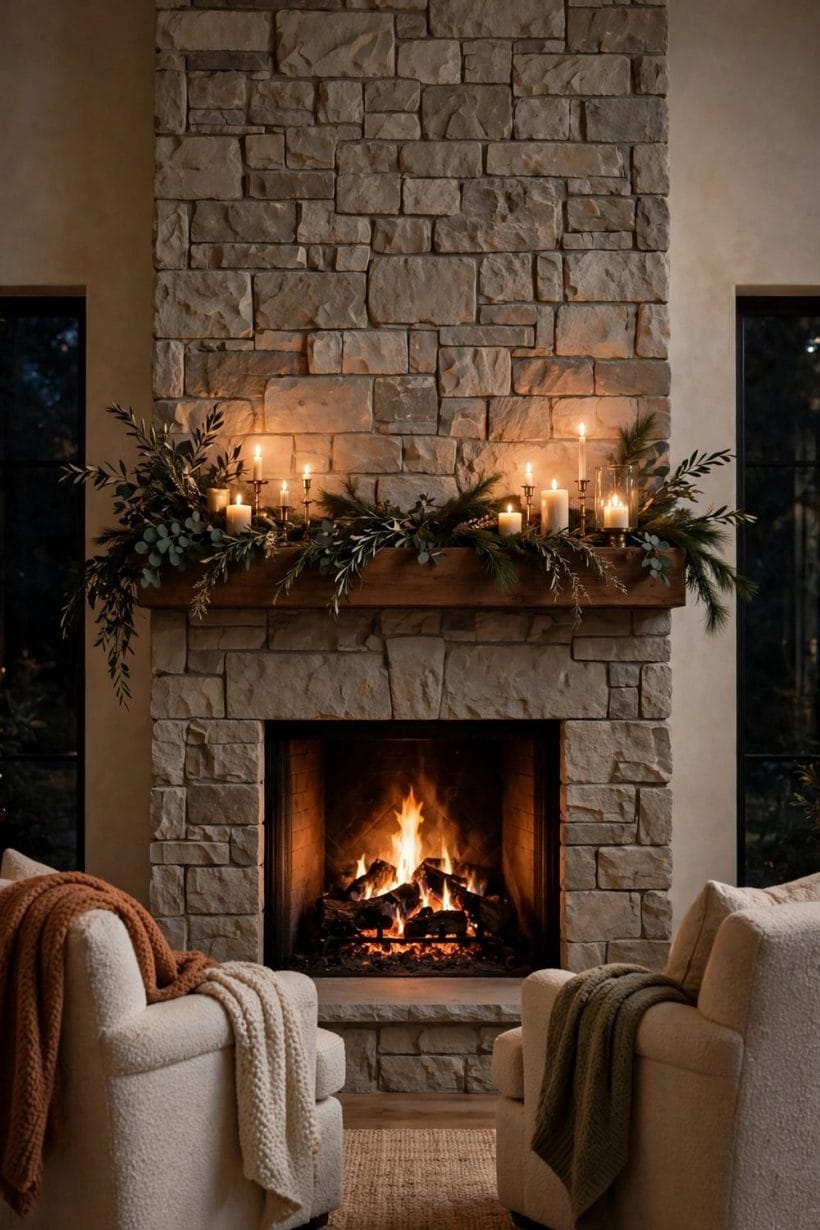
Dressing a great-room mantel is an exercise in restraint. Tall rooms tempt their owners to fill every inch, but a mantel crowded with small objects reads as clutter from the far side of the room, where most of the mantel will actually be seen. Choose fewer, larger pieces: a tall mirror or picture, a pair of candlesticks, a vase of branches that echoes the height of the wall. Leave breathing room between pieces so each one can be read from across the room. Seasonal dressing, a garland in winter, fresh greenery in spring, follows the same rule: one generous gesture beats a dozen small ones.
Practical notes belong here too. Anything placed on a mantel must be able to live with warmth rising from below, so keep delicate finishes, candles in soft holders and anything that could dry out or warp well clear of the heat, and never hang anything flammable close above the opening. The mantel should also be easy to dust and refresh, because a mantel that is hard to reach will stay dressed in last season’s arrangement long past its welcome. A mantel that is beautiful and practical will be re-dressed with pleasure, and that pleasure shows in the room.
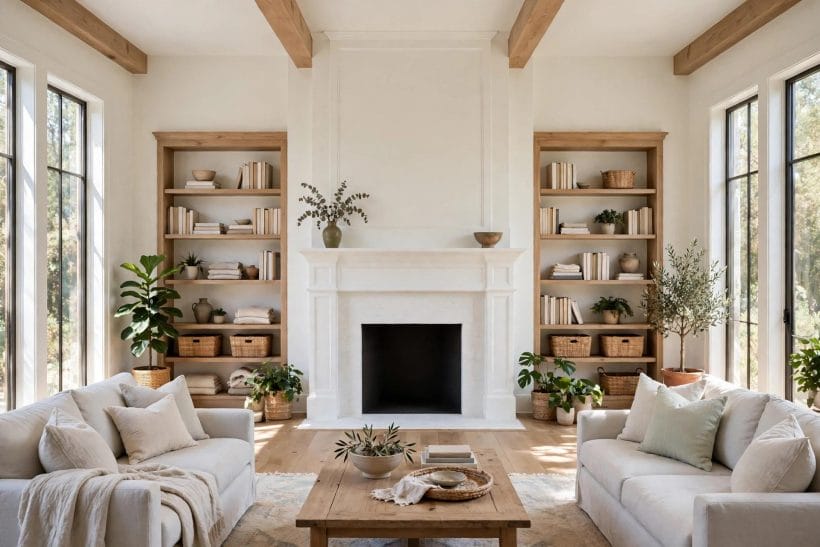
7. Light, Windows and Evening Glow
Great rooms live by their windows, and the fireplace must share the room with them gracefully. Tall glass brings daylight deep into the room and gives the fireplace a rival for attention during the day; that rivalry is healthy, because a room with two sources of delight never feels one-note. The challenge comes at dusk, when the windows go dark and the fireplace must take over as the room’s light. Rooms that manage this transition well have layered light ready: table lamps and floor lamps that can be switched on before the daylight fades, so the room never passes through a gloomy interval between day and firelight.
Warm light is the key. Cool, bright overhead light flattens a great room and makes the fire look small, while warm lamps at seating height make faces, timber and stone glow and let the fire be the brightest warm point in the room. Place lamps where people sit rather than where the ceiling dictates, and keep at least one lamp near the fireplace group so the fireside circle has its own gentle light even when the fire is unlit. Candles on the mantel and on side tables add a flickering layer that echoes the flame without competing with it.
In an open plan, light from neighbouring spaces joins the firelight. The kitchen’s under-cabinet glow, the dining table’s pendant, the hall lamp left burning, all soften the edges of the great room and keep it from feeling like a stage set. The same layering idea appears in small kitchen ideas, where a single warm lamp changes a working corner into a welcoming one, and it works at great-room scale too: light should gather where people gather, and the fireplace group is the first place it should gather.
8. Making a Large Room Feel Cosy
Cosiness in a great room is not about shrinking the room; it is about giving the body reasons to relax within it. Soft textiles do the heaviest work: throws over chair arms, cushions that invite leaning back, a rug underfoot that is pleasant in bare feet. These are not decorations but signals, and a room full of them tells a visitor within seconds that this is a room for lingering. Keep the textiles in the seating group generous and touchable, and keep their colours in conversation with the fireplace materials so the group reads as one place.
Sound and scent complete the effect. A great room with hard floors and tall walls can echo, and an echo makes a room feel empty even when it is full of furniture. Rugs, curtains, upholstered seats and even a basket of logs by the hearth all soften sound, and the faint scent of timber or greenery from the mantel dressing adds a warmth that the eye alone cannot provide. None of this needs to be elaborate: a room that sounds soft and smells faintly of home will feel cosy long before anyone has consciously noticed why.
The fireplace itself is the strongest cosiness signal of all, and it works best when it is used often rather than saved for occasions. A fire lit on an ordinary evening, with supper on knees and a book in hand, teaches the household that the great room is an everyday room, not a formal one. Rooms that are lived in daily accumulate the small signs of life, a basket of logs, a well-worn throw, a chair pulled a little closer to the fire, that no amount of styling can fake.
9. Open Plans: Fireplace Between Living, Dining and Kitchen
Many great rooms are open to the dining table on one side and the kitchen on the other, and the fireplace must hold the living end of that plan without walling it off. The trick is to let the fireplace anchor its own zone while keeping sightlines open across the whole space. A rug, a sofa with its back to the dining table, or a pair of chairs turned toward the fire all mark the living zone gently, without a wall or a screen. The dining table then becomes a second gathering place in the same room, and the kitchen beyond it a third, each with its own light and its own reason to linger.
This openness asks for coordination rather than matching. The dining chairs need not match the living room sofas, and the kitchen finishes need not repeat the fireplace stone, but the three zones should share a temperature of colour and a level of formality so the room reads as one house rather than three rooms that happen to share a ceiling. A warm timber that appears in the mantel, the dining table and a kitchen counter will tie the plan together more quietly and more successfully than any attempt to make everything identical. The same neighbourly logic runs through kitchen ideas and tiny dining room ideas, where rooms that sit side by side are planned to flatter each other.
One caution belongs to open plans: the fireplace’s smoke and warmth behave differently when the room has no doors, and draughts from a kitchen window or an exterior door can pull at the fire. If the fire ever behaves oddly, smoking back or burning unevenly, that is a matter for a professional to look at, not a puzzle to solve by adjusting the room. Firebox and chimney work always belongs to qualified professionals, and any change to the fireplace itself should wait for their advice.
10. Through the Seasons: Dressing the Hearth
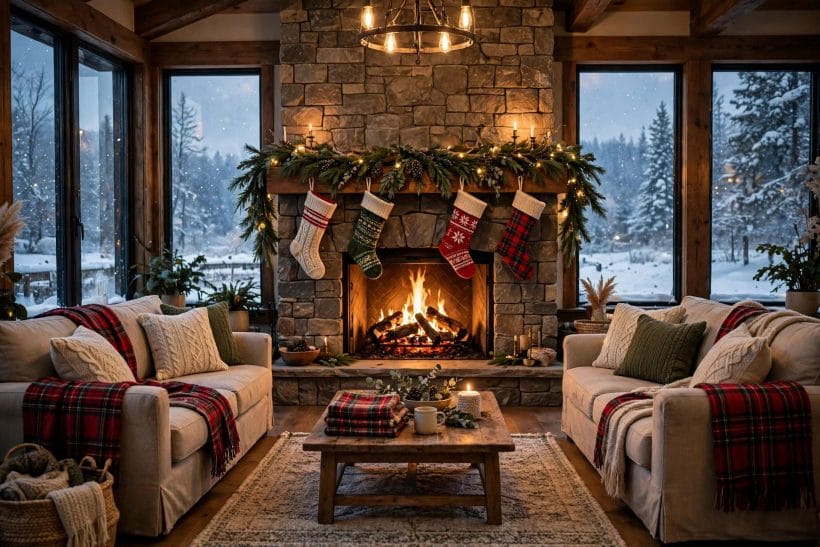
A great-room fireplace earns its keep all year, not only in winter. In the cold months it is the centre of the house, dressed with greenery and candles, with logs stacked nearby and throws close at hand. In spring and summer it becomes a quieter presence: the fire unlit, the mantel dressed with fresh branches or a vase of flowers, the hearth swept and calm. A fireplace that is dressed for the season it is in looks cared for, while a fireplace left in winter dress through summer looks forgotten, however grand its surround may be.
Seasonal dressing is also the easiest way to refresh a great room without touching its architecture. A change of mantel dressing, a different set of cushions in the fireside chairs, a lighter rug for summer and a deeper one for winter, all shift the feeling of the room at little cost and no disruption. Keep the changes simple and generous, in the spirit of the mantel rule: one clear gesture per season, not a collection of small novelties. The room will feel renewed each time, and the fireplace will remain its anchor through every change.
Between seasons, give the hearth itself a little care. A swept hearth, a clean firebox, and a mantel free of dust show respect for the room’s centrepiece, and they make the next fire more pleasurable to light. If anything about the firebox, the chimney or the surround looks damaged or worn, leave it to a professional rather than attempting a repair. The broader survey of home design ideas returns to the same point across every room: the best-dressed house is the one whose structure is looked after first, and whose decoration follows.
Final Considerations
Great room fireplaces succeed on judgement rather than expense. Read the room’s true scale before choosing anything, place the fire where the room naturally faces, keep its proportions honest against wall and ceiling, and gather the seating close enough that conversation never has to compete with the size of the room. Choose materials that can carry a tall wall, dress the mantel with restraint, layer warm light for the evening, and let the hearth change with the seasons. A great room built this way will feel grand when guests arrive and cosy when they have gone, and the fireplace will be the reason for both.
One final caution is worth repeating. Everything in this guide concerns arrangement, proportion and dressing, the visible and reversible choices any householder can make. Anything inside the firebox, up the chimney, or behind the surround is professional work, and it should be treated as such. Get the visible choices right, leave the hidden work to qualified hands, and the great room will reward you every evening.


0 Comments