

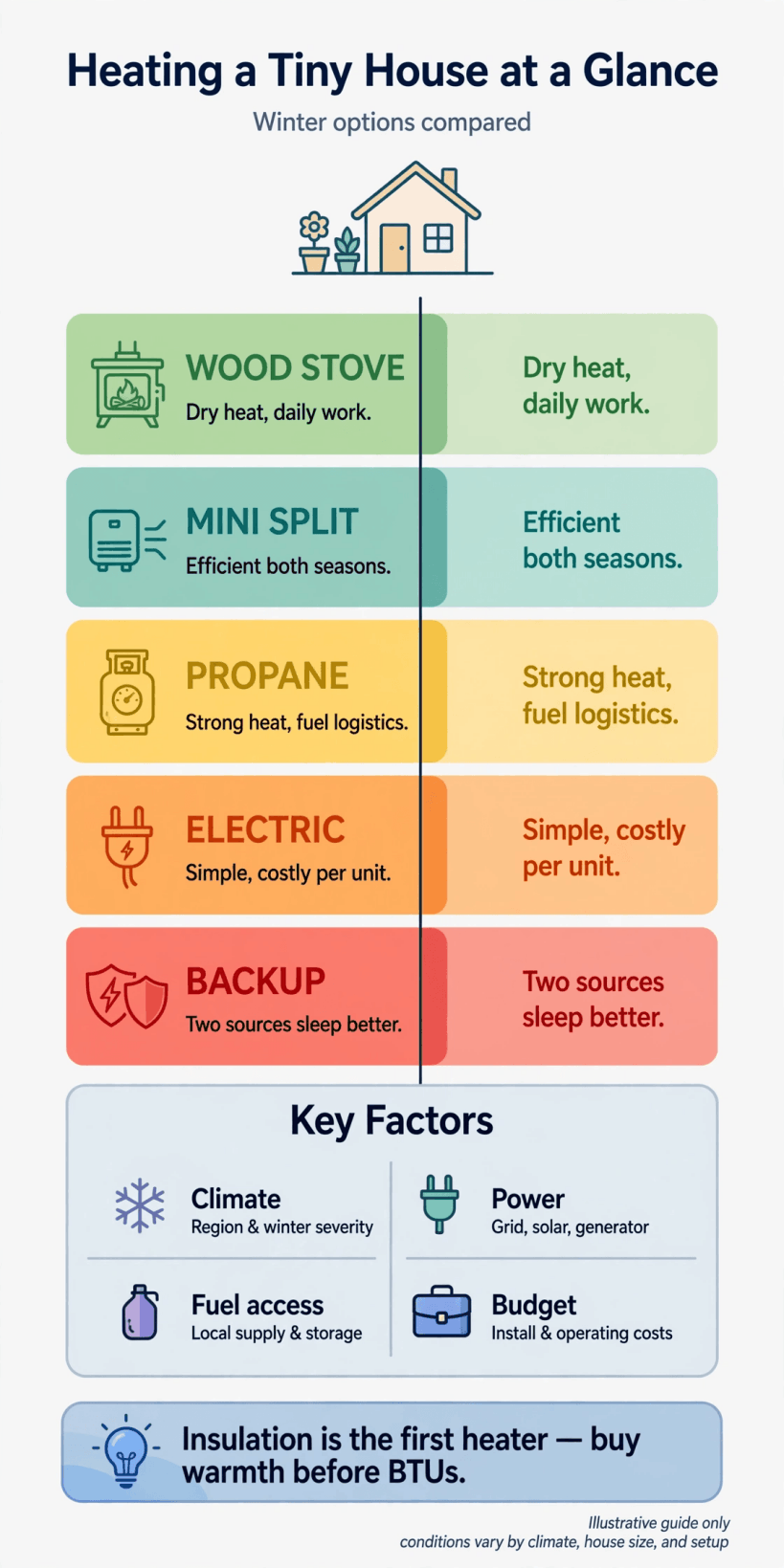
Heating a small home well is less about buying the strongest heater you can find and more about understanding how to heat tiny house winter living actually works: a very small volume of air, wrapped in a thin shell, often parked somewhere the wind has a clear run at it. Get it right and a tiny house is one of the easiest dwellings in the world to keep warm, because there is so little space to heat. Get it wrong and the same smallness turns against you, with a home that swings from stuffy to freezing, grows condensation on every cold surface, and burns through fuel or electricity far faster than its size suggests it should.
This guide works through heating in the order the house experiences it. Insulation and air sealing come first, because they decide how much heat you need at all. Then each heat source on its own merits: wood, heat pump, propane and electric, with their honest costs in money, effort, space and attention. After that come the supporting systems that winter exposes, floor warmth, backup heat for the coldest nights and the failure you did not plan for, and the moisture and safety principles that run underneath every choice. By the end you should be able to match a heating plan to your climate, your power supply and the way you actually live, rather than copying whatever heater happened to be in the last tiny house video you watched.
Heating a Tiny House in Winter: Quick Answers
| Question | Answer |
|---|---|
| What should you fix before choosing a heater? | Insulation and air sealing. A well-wrapped small house needs surprisingly little heat; a leaky one defeats any heater you install. |
| What is the most hands-on heating option? | A small wood stove. It gives dry, powerful heat independent of the grid, in exchange for fuel storage, daily work and careful clearances. |
| What heats and cools in one system? | A mini-split heat pump, which moves heat instead of making it, and reverses in summer. It needs reliable electricity and loses its edge in the deepest cold. |
| Where does propane fit? | As a strong, stored-fuel option for furnaces and wall heaters, useful where electricity is limited, provided ventilation and carbon monoxide safety are handled properly. |
| Is plain electric heating enough? | On a good hookup, often yes for a small, well-insulated house. Off grid, resistance heat is usually too hungry to be the main plan. |
| Do you need a backup heat source? | In genuinely cold places, yes. One source always fails, runs out or meets weather beyond it, and a tiny house has very little thermal slack when it does. |
1. Insulation and Air Sealing First: Heat Less, Need Less
Every heating decision gets easier after this one. A tiny house has a lot of surface area for its volume, walls, roof and floor all losing heat at once, and in a house on wheels the floor is a cold surface exposed to moving air underneath, not a slab resting on the ground. Insulating all six sides properly, sealing the gaps where air leaks in and out, and paying attention to the trailer zone and pipe runs underneath does more for winter comfort than any heater upgrade. Owners who do this work often find the house needs a modest heat source run gently, rather than a powerful one run hard.
Work through the shell methodically before you shop for appliances: continuous insulation where you can manage it, careful sealing around windows, doors, wheel arches and service penetrations, and skirting or an enclosed under-floor zone to calm the air beneath the house. The full material comparison lives in how to insulate a tiny house, and it is worth reading before a single heater is chosen, because the insulation standard you achieve sets the size, running cost and even the type of every heat source that follows. Heat the house you have insulated, not the one you wish you had built.
2. Sizing Heat for a Small Volume: Why Tiny Houses Swing Hot and Cold
A tiny house heats up fast and cools down fast, for the same reason: there is very little air and material inside to buffer change. A heater sized by instinct, the way you might size one for a conventional room, will overshoot, cooking the loft while the floor stays cool, then switch off and let the temperature slide until it fires again. Comfort in a small volume comes from a heat source that can run low and steady, or cycle gently, matched to the modest load of a well-insulated small space rather than chosen for brute strength.
Placement shapes comfort as much as size. Heat rises, so a sleeping loft collects the warmth the ground floor generates, which is pleasant at bedtime and stifling by midnight in an over-heated house. A small fan moving air gently, a heat source sited low and central where its warmth can spread, and doors or curtains used to zone the space all help even things out. These are the everyday realities behind tiny house living in cold climates: the winners are rarely the people with the biggest heater. They are the people who thought about air movement, zoning and steady low heat before the first frost arrived.
3. Wood Stove Heating: Dry Heat, Real Work
The small wood stove is the romantic favourite, and unusually, the romance survives contact with reality, with conditions. Wood heat is dry heat, which is a genuine virtue in a small house fighting condensation all winter. It works when the power is out, it asks nothing of your electrical system, and it turns the daily rhythm of the house towards the fire in a way many owners come to love. A tiny stove also suits a tiny load: small spaces need small, frequent fires rather than a raging one, and a well-run stove ticking over steadily is a very comfortable way to live.
The work and the constraints are equally real. Fuel must be sourced, stored dry and carried in, ash must go out, and the stove needs feeding on its schedule, not yours, including last thing at night and first thing in the morning. Clearances to combustible surfaces, a proper hearth, a correctly routed flue and the weight of stove plus fuel all have to be designed in, following the stove maker’s requirements and your local rules, and insurance and park rules may have their own view of solid fuel in a small dwelling. Choose wood with your eyes open: it is a lifestyle as much as a heating system, and it rewards people who enjoy that lifestyle daily, in February, in the rain.
4. Mini-Split Heat Pumps: Heating and Cooling in One System
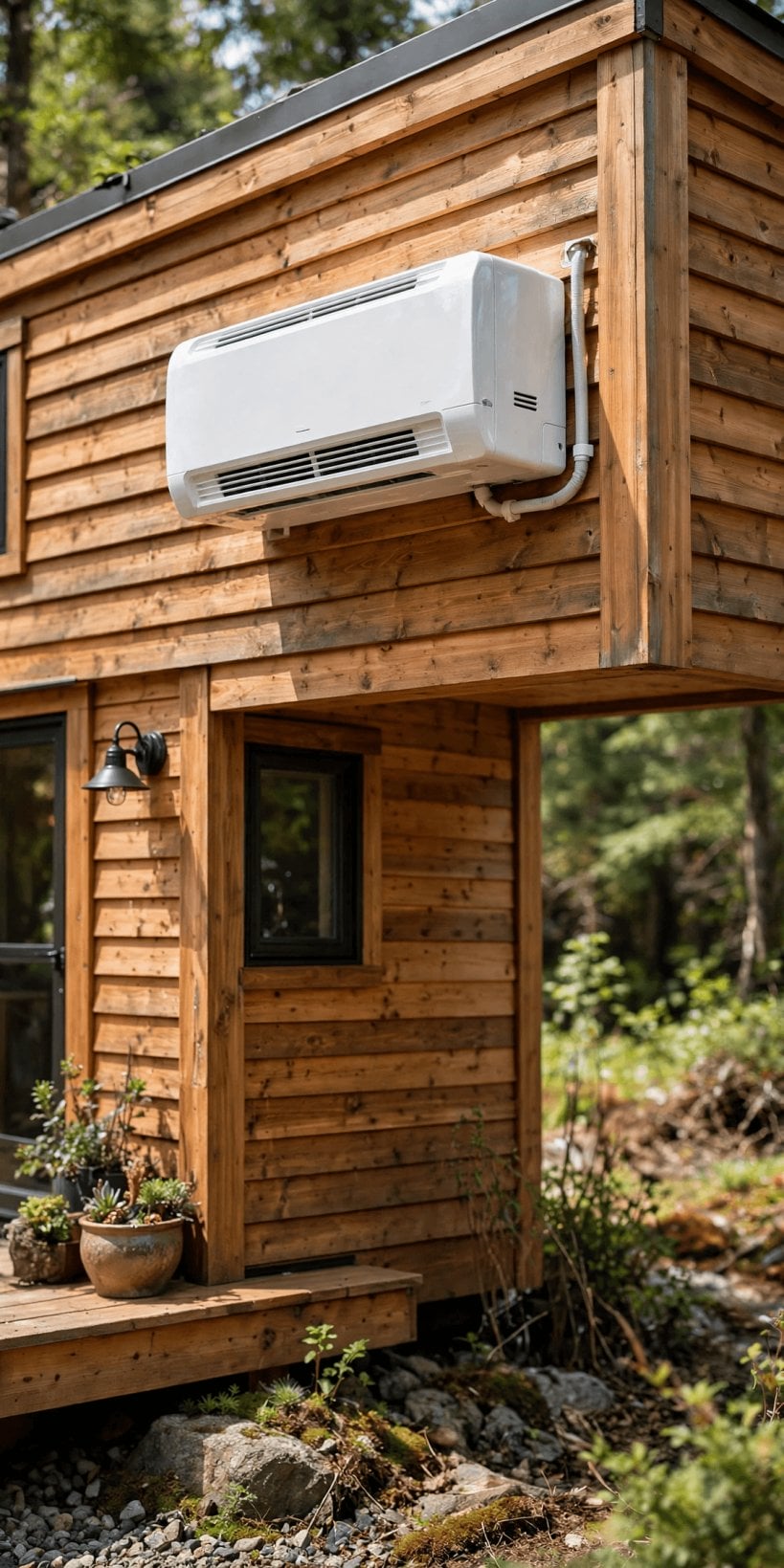
A mini-split heat pump takes a different approach: instead of making heat by burning or resistance, it moves heat from the outside air into the house, which it can do very efficiently in mild and moderate cold, while also providing cooling and dehumidifying in summer from the same unit. For a tiny house on a reliable electrical supply, that two-seasons-in-one-box quality is hard to beat, and the indoor unit mounts high on a wall, using no floor space at all. Run gently and steadily, a heat pump suits the small, steady load of a well-insulated tiny house beautifully.
Its limits appear at the edges. Moving heat gets harder as the outside temperature falls, so in the coldest weather the unit works harder for less, and some other source may need to share the load on the worst nights. It is wholly dependent on electricity, in quantity, which rules it out as the sole plan for many off-grid houses. Installation is also a specialist job involving refrigerant lines and an outdoor unit that needs its own clear, drained spot beside the house. The practicalities are covered in installing a mini-split in a tiny house; read it for the siting and drainage details, because a heat pump whose outdoor unit sits in a snowdrift or whose condensate freezes in its drain is a heater that quits mid-winter.
5. Propane Heating: Furnaces and Wall Heaters
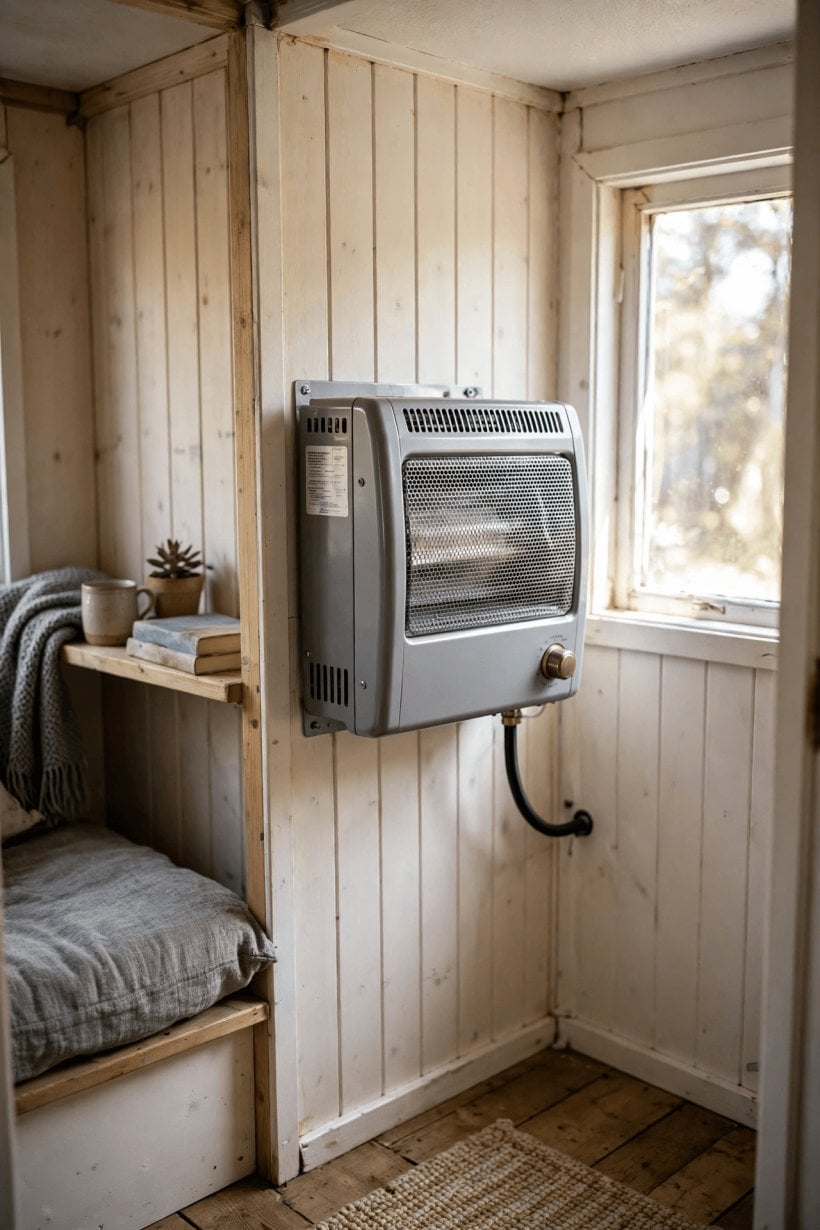
Propane earns its place by storing a lot of heating potential in a tank outside the house and delivering it on demand, independent of how strong your electrical supply is. In tiny houses it typically appears as a small furnace with ducted or directed warm air, or as a wall-mounted heater, vented designs being the serious choice because they send their combustion gases outside rather than adding them, and their water vapour, to your indoor air. For houses off grid or on modest hookups in cold regions, propane often carries the main heating load while electricity is saved for everything else.
Treat the fuel system with respect. Tanks, regulators and lines need correct sizing, protection and leak checking, and the supply is a logistics rhythm of refills or exchanges that gets more interesting in deep winter and remote spots. Storage and siting follow local rules, and any fuel-burning appliance in a small sealed volume makes carbon monoxide awareness non-negotiable, with a working alarm and proper ventilation as baseline habits, not extras. The wider fuel-versus-electric picture, including how tank capacity shapes the routine, is laid out in propane vs electric in tiny houses, and it is the right companion read before committing the design to either camp.
6. Electric Resistance Heat: Simple, Hungry, Useful in Its Place
Resistance heating, the panel heater, the small fan heater, the heated floor mat, is the simplest heat there is: plug it in and electricity becomes warmth with no flue, no fuel and no maintenance. In a small, well-insulated house parked on a generous hookup, that simplicity can be the whole answer, with a modest heater holding the temperature comfortably and nothing to service, store or vent. It is also the easiest backup and the easiest top-up for a cold corner or a bathroom.
Its weakness is appetite. Resistance heat converts your supply into warmth one-for-one with no leverage, and it does it for as long as winter lasts, so on a limited hookup it crowds out everything else electrical, and off grid it can drain a battery system with discouraging speed on a single cold night. Electric heat is therefore a question of supply before it is a question of heaters. Add up your whole electrical life honestly, the way you would for any service in tiny house utilities: power, water and off-grid sewage, and let the numbers tell you whether resistance heat is your main plan, your supporting act, or a luxury for hookups only.
7. Floor Warmth and Point Heat: Heating People, Not Just Air
Some of the best winter comfort in a tiny house comes from heating the person and the surface rather than the whole volume of air. Warmth underfoot transforms a small house on a cold morning, because the floor is the surface you are always in contact with and, in a house on wheels, the one most exposed to cold air beneath. In-floor approaches, whether hydronic or electric, spread gentle, silent heat exactly where it is felt, and they pair well with the low, steady philosophy of the earlier sections. The options and their demands are compared in underfloor heating in tiny houses.
Point heat follows the same logic at smaller scale: a heated throw on the sofa, warmth directed at the desk or the reading chair, the bathroom given a quick boost before a shower rather than the whole house held hotter all day. In a dwelling this size, zoning is almost free comfort, because the zones are a few steps apart and a curtain or door genuinely divides them. Think in layers: shell first, background heat low and steady, then warmth aimed at where life actually happens. That layered approach is what makes a small heating system feel generous instead of barely adequate.
8. Backup Heating: The Second Source That Saves a Cold Snap
Plan for the night the main system does not run, because in a long winter that night always exists. Fuel runs out the day the delivery cannot reach you. Power fails in the storm that made it coldest. A heat pump meets the week its efficiency falls off a cliff, a stove flue needs attention, a part is on order. A conventional house coasts through a day of this on stored warmth in its mass and volume. A tiny house, with neither, heads towards cold pipes and a miserable night within hours, which is why a second, independent heat source is not pessimism. It is the design.
Independence is the key word. A backup that shares the main system’s fuel, power supply or weakness is a spare, not a backup. Good pairings cross energy types: the grid-powered main heat with a stored-fuel backup, the wood stove with an electric panel for the nights you are away, propane carrying the load with resistance heat behind it on a hookup. Size the backup to protect the house and keep the occupied zone liveable, pipes unfrozen and people safe, rather than to reproduce full comfort. Then test it before winter, maintain it like you mean it, and store its fuel or connections ready. Backups discovered to be broken in January are just decorations.
9. Moisture, Ventilation and Safety While Heating
Heating and moisture are one subject in a tiny house, not two. People, cooking, showers and any unvented combustion all release water vapour into a very small volume, and warm indoor air meeting cold walls, windows and the underside of the roof gives that vapour somewhere to condense. A winter of it means mould in corners, damp bedding against cold walls and a house that feels chilly even when the thermometer says otherwise, because damp air and damp fabric steal warmth. The ventilation habits in tiny house ventilation and mold prevention are therefore heating advice too: extract at the source, ventilate deliberately even on cold days, and keep air moving around cold surfaces.
Safety principles run alongside, and they are principles rather than optional extras. Fuel-burning appliances need their maker-specified clearances, sound flues and venting, and a working carbon monoxide alarm in the living space. Portable heaters need stable positions away from fabrics and a household rule that they are never the unattended plan. The plumbing deserves a thought as well: skirting and protecting the under-floor zone, as in tiny house skirting options for pipes and insulation, keeps supply pipes alive through the cold snap your heating plan is busy surviving. None of this is complicated. It is a checklist, run every autumn, in a house with no spare volume for mistakes.
10. Putting It Together: A Heating Plan by Climate and Power Supply
Assemble the plan from your constraints outward. Start with climate honesty: a mild coastal winter and a continental deep-freeze are different problems that happen to share a name, and gear chosen for one is wrong for the other. Then your supply: a strong hookup makes the heat pump or simple electric heat easy answers with a modest backup; limited electricity pushes propane or wood to the front with electricity in support; serious off-grid living usually means wood or propane as the backbone, ruthless insulation, and electric heat treated as a rare treat.
Finally, your temperament, because heating systems are daily relationships in a house this size. The wood stove asks for work and gives ritual. The heat pump asks for a good installation and gives push-button calm. Propane asks for logistics and gives independence from the electrical supply. There is no universal winner, which is why the broader comparison in how to heat a tiny house is worth your time alongside this guide. Choose for the winter you actually get, the power you actually have and the life you actually want to live, and the house will feel less heated than simply, reliably warm.
Final Considerations
A tiny house in winter is a solvable problem, and the solution is a system, not a product: a tight, well-insulated shell that needs little heat, a main source matched to your climate and supply, warmth aimed at people and floors rather than wasted on empty air, an independent backup for the inevitable failure, and moisture and safety treated as part of heating rather than somebody else’s chapter. Build that system in that order and winter becomes one of the pleasures of small living: a compact, warm, dry house ticking along gently while the weather does its worst outside, and a heating bill sized to the small home you actually chose.


0 Comments