

Yes, you can have laundry at home in a tiny house, and for many owners a washer dryer tiny house setup is what turns a clever small dwelling into a home that works week after week. Clothes, bedding and towels do not stop needing washing because the floor plan shrank, and relying on a trip into town for every load gets old quickly, especially in winter, in wet weather, or when you are parked a long way from the nearest laundromat. The honest answer is not a simple yes, though. A laundry appliance asks for four things a tiny house has in short supply: floor space, electrical capacity, water and drainage, and a way to get rid of warm, moist air. Give it those four things in the design stage and in-home laundry is entirely realistic. Try to squeeze it in as an afterthought and it will fight you every wash day.
This guide works through the decision in the order your house will experience it. First, the types of machine that genuinely fit small spaces, and how vented and ventless drying change what the house needs. Then the unglamorous systems work that decides success or failure: circuits and load, supply and drainage, lint and moisture, noise and vibration. Finally, it covers the alternative that suits more tiny households than you might expect, which is a deliberate laundromat rhythm with no machine at all. None of these routes is the right one in the abstract. The right one is the one that matches your power supply, your parking situation, how many people you wash for, and how much of your precious storage you are willing to trade for clean clothes on demand.
Washer Dryer in a Tiny House: Quick Answers
| Question | Answer |
|---|---|
| Can a tiny house have a washer and dryer at all? | Yes, provided the plan reserves space, power, water, drainage and moisture control for it from the start rather than treating it as a later add-on. |
| Which machine type fits best in the least space? | A single combo unit, because it washes and dries in one drum under one counter. Separate compact machines and stackable pairs need more room but wash and dry at the same time. |
| Vented or ventless drying? | Ventless suits most tiny houses because it needs no duct through the wall, but it releases moisture management work to the room. Vented drying moves moist air outside and needs a planned duct route. |
| What power does laundry need? | Enough dedicated capacity for the machine plus everything else running at that moment. On a small supply or off grid, laundry becomes a scheduled, one-big-load-at-a-time activity. |
| What about water and drainage? | The machine needs a reliable supply, a drain that can take the full discharge without backing up, and leak protection, because a small leak in a small house reaches everything quickly. |
| What if no machine fits? | A planned laundromat rhythm, with an airer at home for small items, is a legitimate choice that returns floor space and removes a whole set of plumbing and power demands. |
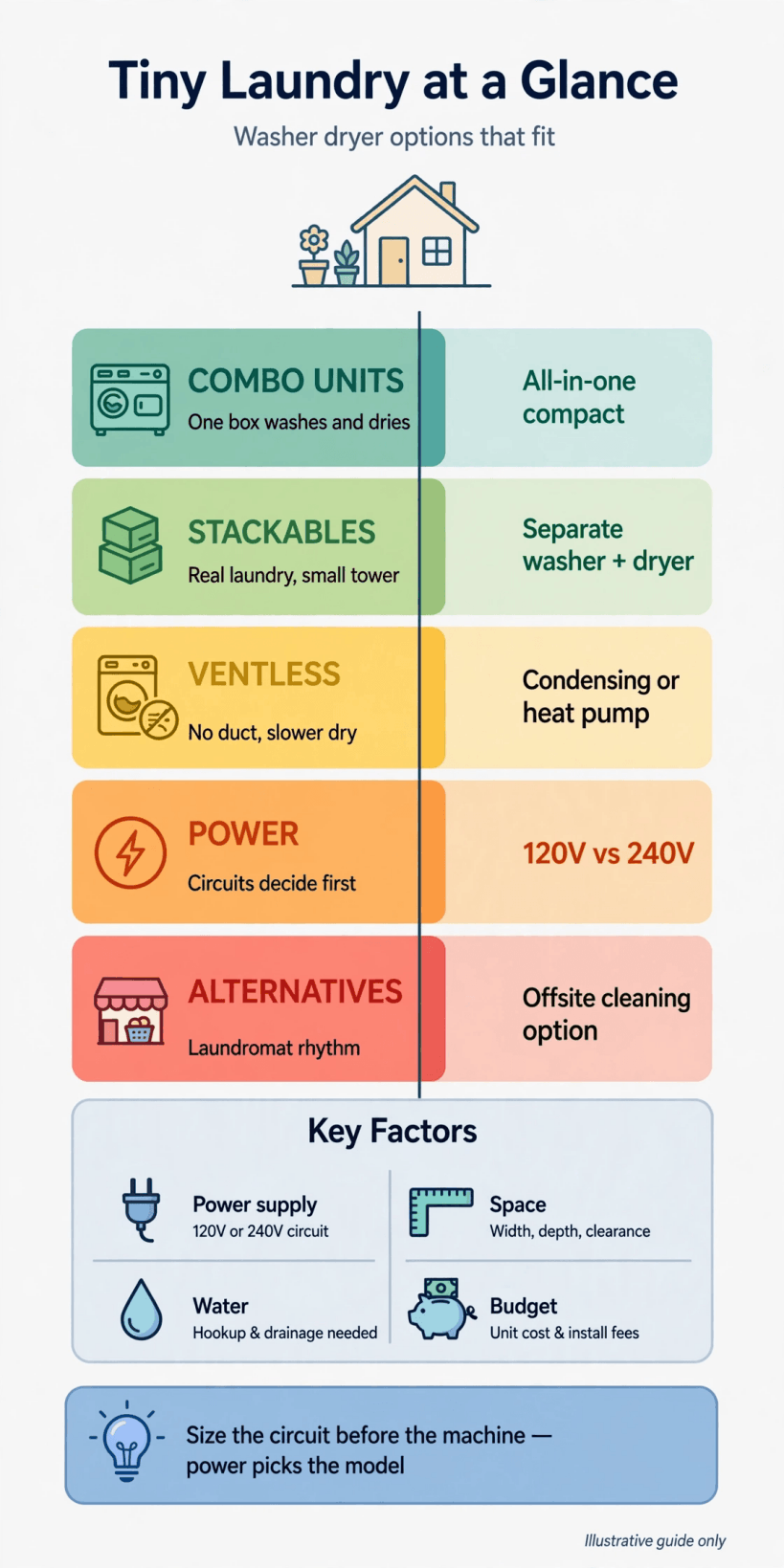
1. Washer Dryer in a Tiny House: Start With the Space You Can Actually Give Up
Space is the first attribute, because every other decision hangs off it. A laundry appliance does not just occupy its own footprint. It needs clearance to open its door, room to load and unload without performing yoga, access to its hoses and filter for maintenance, and ideally a laundry basket’s worth of sorting space somewhere nearby. In a tiny house, that footprint competes directly with the kitchen, the bathroom, clothing storage and the water heater, so measure in three dimensions and be honest about what the cupboard you are eyeing currently holds. Equipment that only fits if you remove everything you own has not really fitted.
Think about where the weight sits, too, especially in a house on wheels. A machine full of water and wet clothes is a concentrated, shifting load, and it belongs low, over or near the axle line where the structure expects weight, not high in a loft or cantilevered at the far end. This is the same whole-house thinking that shapes compact kitchen appliances for tiny houses: in a small dwelling, every appliance is a space decision, a weight decision and a power decision at once, and the houses that work are the ones where those decisions were made together, on paper, before anything was bought.
2. Combo Units: One Machine That Washes and Dries
The combo unit is the layout’s favourite because it does both jobs in a single drum, in the footprint of one appliance, often under a counter. You load it, set a wash-and-dry programme, and come back to clean, dry clothes without moving a wet load between machines. For one or two people with modest laundry, in a house where a single kitchen-sized cabinet is all the laundry room there will ever be, that simplicity is hard to beat, and because most combos dry without a vent, the installation avoids cutting a duct through the wall.
The trade-offs are real and worth stating plainly. A combo handles smaller loads than separate machines, and because washing and drying happen in sequence in the same drum, a full cycle takes a long time. A household generating laundry faster than one slow drum can clear it will find the machine running constantly, and a breakdown takes out both functions at once. Combos suit couples and solo dwellers with steady, modest loads and the patience to run the machine as a background rhythm of daily life. They suit a family producing mountains of bedding and children’s clothes far less well, unless the plan also includes the laundromat for the big weekly clear-out.
3. Stackable and Compact Separate Machines: When Two Boxes Beat One
Separate machines, either compact models side by side where width allows or a stackable pair using vertical space, solve the combo’s two weaknesses. Washing and drying can run at the same time, loads can be larger, and if one machine fails the other still works. A stack in a tall cupboard near the bathroom is a classic tiny layout, using the one dimension small houses sometimes have spare, which is height, and keeping all the wet trades in one zone of the plan.
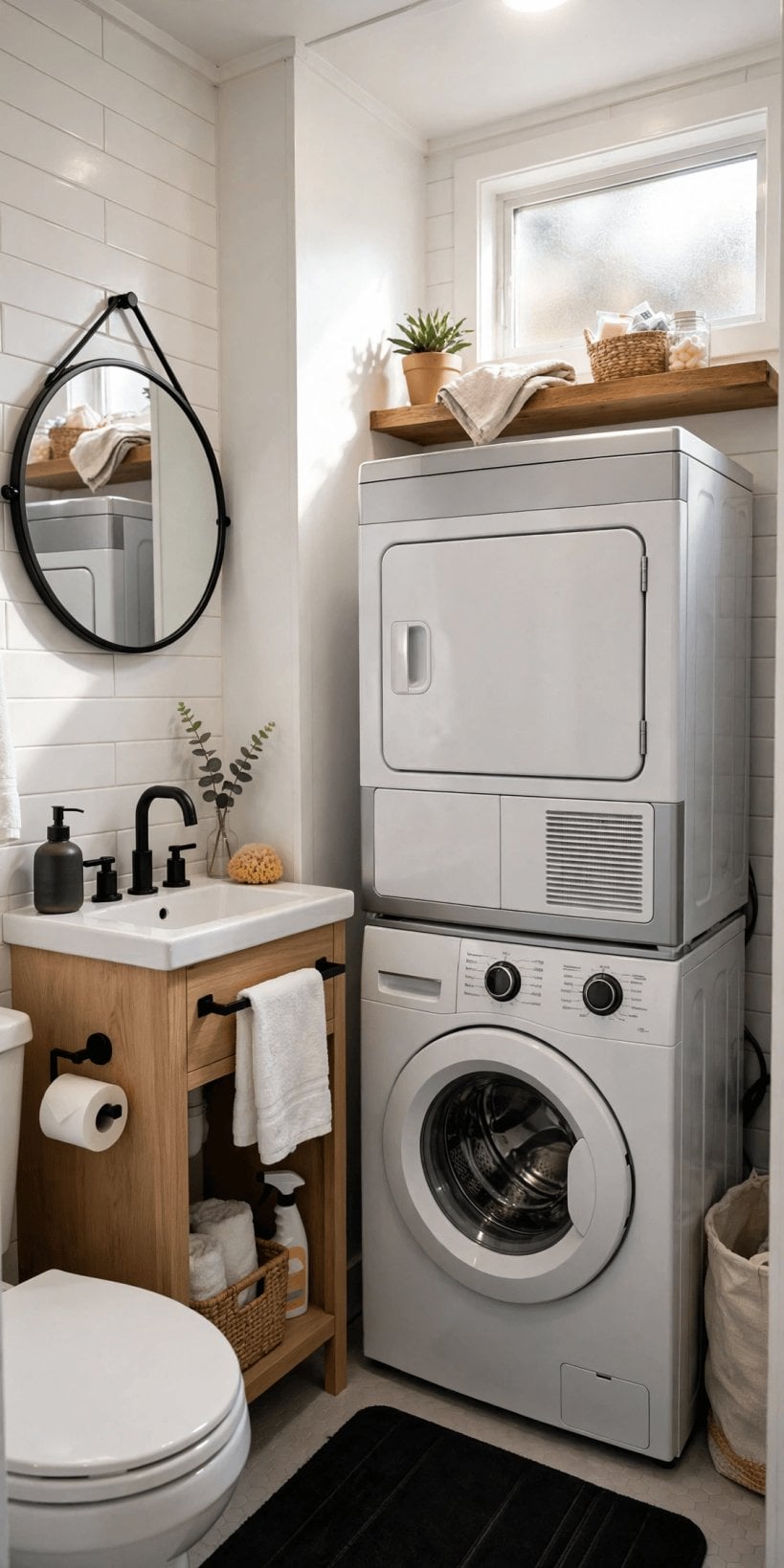
The costs are footprint, weight and complexity. Two machines mean two sets of connections, more total weight for a house on wheels to carry, and a stack that must be secured so it cannot walk or topple when the house moves or the spin cycle gets enthusiastic. Access matters as well: the upper machine’s controls and drum must be reachable for the shortest person in the household, and both machines need to come out for repair without dismantling the bathroom. If you are planning this zone from scratch, design it alongside the rest of the wet room using the principles in tiny house plumbing layout and drain-waste-vent design, because laundry, shower and toilet sharing one well-planned plumbing wall is far cheaper and more reliable than three separate improvisations.
4. Ventless Drying: Condenser and Heat Pump Approaches
Drying is where tiny laundry gets interesting, because wet clothes have to give up their water somewhere. Ventless machines keep that moisture inside the system. Condenser designs collect much of it as water you empty or drain away, while heat pump designs dry at lower temperatures, treat fabrics gently and use the drying process more efficiently, in a larger, heavier and more complex machine. Either way, there is no duct to route, no hole in the wall, and no stream of warm air being thrown outside, which is why ventless drying dominates small-space laundry.
Vented drying, where the plan allows it, has its own honest advantages: it is mechanically simple and it physically removes moist air from the house. But the duct needs a short, smooth route to the outside, and in a tiny house that route competes with structure, insulation and other services. Whichever type you choose, respect what the machine does to the room. Drying releases heat into a very small volume, which is welcome in January and much less welcome in July, and no drying system is perfectly sealed, so the ventilation habits in the next sections are not optional extras. They are part of how the machine works in the house.
5. Power First: Circuits, Load and Off-Grid Limits
Before you fall in love with any machine, do the power audit, because laundry is one of the heaviest loads a tiny house carries. Washing uses bursts of power for the motor and, in many programmes, for heating water. Drying is the real demand, sustained heat over a long period. The question is never just whether the machine’s rating fits your supply on paper. It is what else will be running at the same time: heating or cooling, cooking, the water heater, someone drying their hair. In a house on a modest hookup, laundry becomes a deliberate, one-big-load-at-a-time activity, scheduled rather than spontaneous.
Off grid, the discipline is stricter still, and it connects laundry to the whole energy picture covered in tiny house utilities: power, water and off-grid sewage. Every wash is water you hauled or pumped and energy you generated and stored, so off-grid households wash fuller loads, less often, and time drying for when the system has energy to spare, or lean on line drying for much of the year. Portable power has limits here too: the systems discussed in off-grid power stations for tiny houses are excellent for lights, devices and small loads, but sustained electric drying is exactly the kind of heavy, hungry job that exposes the gap between a house system and a portable one. Have the circuit work done or checked by a qualified electrician, and treat the machine’s stated requirements as the starting point, not a suggestion.
6. Water Supply, Drainage and Leak Protection
A washing machine is a controlled flood that happens on schedule, so its plumbing deserves respect. It needs a supply that can fill it without starving the rest of the house, shut-off valves you can actually reach when something goes wrong, and a drain sized and vented to swallow the full discharge when the pump empties the drum. A drain that copes with a sink may not cope with a machine emptying itself at speed, and a backup in a tiny house is not a minor event. Grey water handling also matters more off grid, where laundry water is a significant share of everything your system must absorb or dispose of responsibly.
Leak protection is the unglamorous detail that separates a good installation from a story you tell ruefully later. Hoses age, connections work loose under vibration, and in a small house a slow leak reaches flooring, framing and stored belongings very quickly because there is nowhere else for it to go. A drain pan under the machine, braided or otherwise robust hoses replaced on a schedule rather than after a failure, a water alarm, and subfloor materials chosen with the wet zone in mind are all cheap insurance. The same defensive thinking applies under the house, where tiny house skirting options for pipes and insulation protect the supply and drainage runs below the floor from cold and damage.
7. Venting, Lint, Moisture and Indoor Air
Every load of laundry moves water out of fabric and into your house’s air and surfaces unless the system captures it completely, and in a tiny volume that moisture arrives fast. Warm, damp air meeting cold windows, wall corners and the underside of a loft produces condensation, and condensation held against timber and fabric produces mould. This is why laundry cannot be separated from the house’s wider moisture strategy, the subject of tiny house ventilation and mold prevention. Run extraction while the machine dries, open a window when weather allows, wipe condensation before it becomes a habitat, and never let a ventless dryer turn the whole house into its condenser box by keeping every opening sealed.
Lint is the quieter problem. It escapes around doors and filters, settles on surfaces, and in a small home there is very little ‘away’ for it to settle in. Clean the machine’s filters on the schedule the manufacturer sets, keep the laundry zone easy to wipe down, and treat lint build-up in any ducted run as a genuine maintenance item rather than housekeeping fussiness. None of this is difficult. It is simply a rhythm, like everything else in a tiny house: small tasks done regularly, because the house has no spare volume to absorb neglect.
8. Noise, Vibration and Living Next to Your Laundry
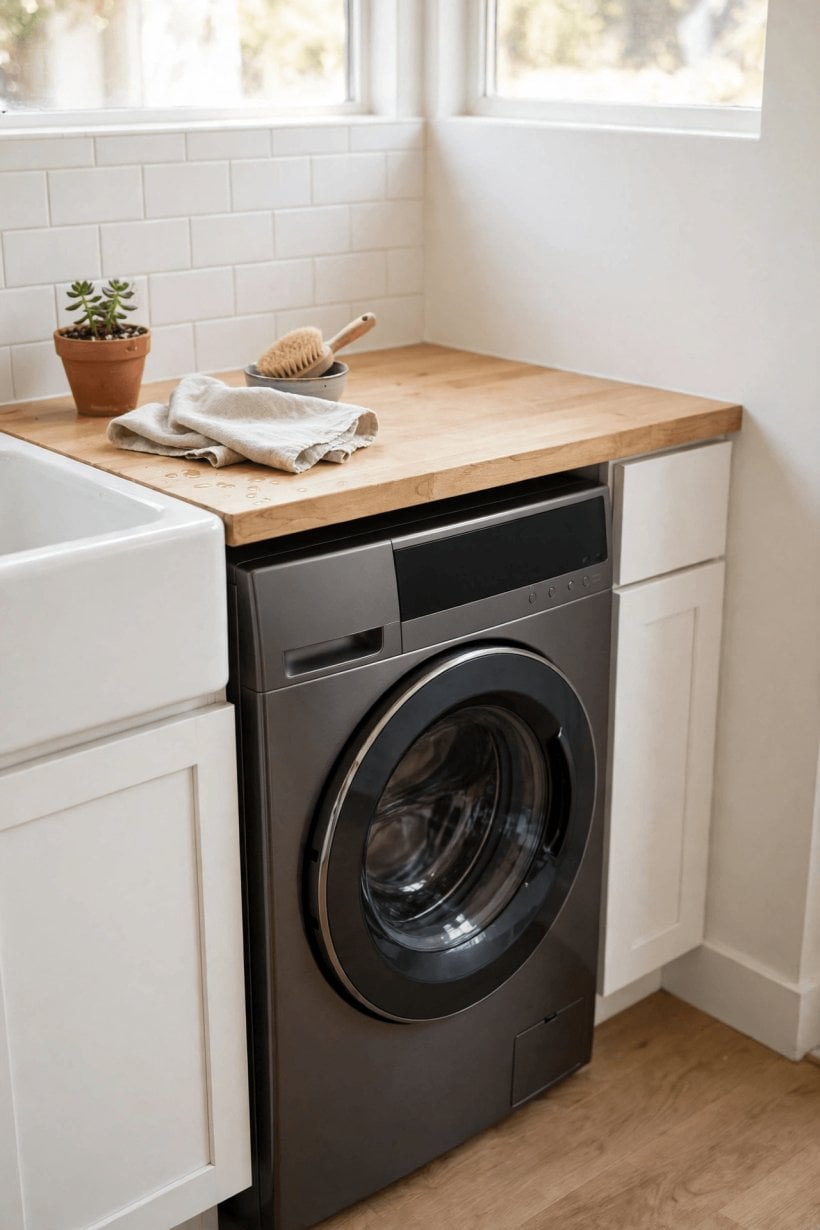
In a conventional house the laundry hides in a utility room. In a tiny house it spins a few steps from your bed, your desk and your sofa, and an unbalanced load on a spin cycle will announce itself to all three. Vibration travels through lightweight floors with enthusiasm, so siting matters: a machine on a solid, level base, as low and as structurally supported as possible, behaves far better than one perched on a flexible floor span. Anti-vibration pads help, correct levelling helps more, and loading the drum sensibly, neither a single heavy item nor an overstuffed tangle, helps most of all.
Plan your routine around the noise as well. Many tiny households run the wash while they are out walking or working elsewhere, or during the active part of the day, and let the slow ventless dry finish whenever it finishes, rather than lying awake listening to a spin cycle through a thin partition. Door and cupboard choices play a part too: a laundry cupboard that closes properly contains both noise and visual clutter, and turns the machine back into furniture when the wash is done. Small house, small tolerances, small habits adjusted. That is the whole game.
9. The Laundromat Rhythm: When No Machine Is the Right Machine
Now the alternative that deserves more respect than it gets. Plenty of tiny households, including people whose houses could technically fit a machine, choose not to have one, and run laundry as a weekly rhythm instead: one trip, several machines at once, everything washed and dried in a couple of hours, home to storage that is not hiding an appliance. The laundromat route returns the whole cupboard to clothes or food storage, removes a heavy appliance’s weight from a house on wheels, and deletes an entire category of plumbing, drainage, power and moisture problems from the design.
The trade-offs are the mirror image of the machine’s benefits. You travel, you pay per wash forever, you depend on opening hours and on a facility existing where you park, and bedding day requires planning rather than impulse. A hybrid softens most of this: no machine, but a simple airer or line at home for the small, constant stream of cloths, underwear and gym kit, plus the weekly laundromat run for the bulk. Judge this option by your actual geography and routine, not by pride. For a house parked long-term in a town, it may be the smartest laundry plan of all. For a house far from services, it is not a plan at all, which is why the geography comes first.
10. A Simple Decision Path: Matching Laundry to How You Live
Pull the attributes together in order. First, geography: if you are parked long-term near laundry services and short on space, the laundromat rhythm is a serious candidate, not a failure. Second, people and volume: solo dwellers and couples generate combo-sized laundry; larger households push towards separate machines or the hybrid. Third, power: a generous hookup supports in-home drying in any form; a small supply makes laundry a scheduled activity; serious off-grid living pushes you towards ventless efficiency, line drying and fuller, rarer loads. Fourth, water and drainage: if the plumbing plan cannot give the machine a proper drain and leak protection, the design is not ready for a machine yet.
Run that sequence honestly and the answer usually names itself. The households who struggle are rarely the ones who chose the ‘wrong’ machine. They are the ones who chose the machine before answering the space, power and water questions, and spent years negotiating with the consequences. Decide in the house’s order, systems first and appliance second, and laundry becomes what it should be: a solved background task in a house that works, covered by the same practical thinking as how to heat a tiny house and every other service the house depends on.
Final Considerations
Yes, a tiny house can have a washer and dryer, in combo form, as compact separates, or not at all, and each of those is the right answer for somebody. The machine is the easy part. The house around it, its space, structure, power, water, drainage and air, is what decides whether laundry day feels like a quiet background convenience or a weekly wrestling match. Plan the systems first, choose the simplest machine that fits the plan, protect the house against the water and moisture the process inevitably involves, and keep the laundromat in mind as a legitimate design choice rather than a defeat. Do that, and clean clothes become one more thing your small house simply handles.


0 Comments