

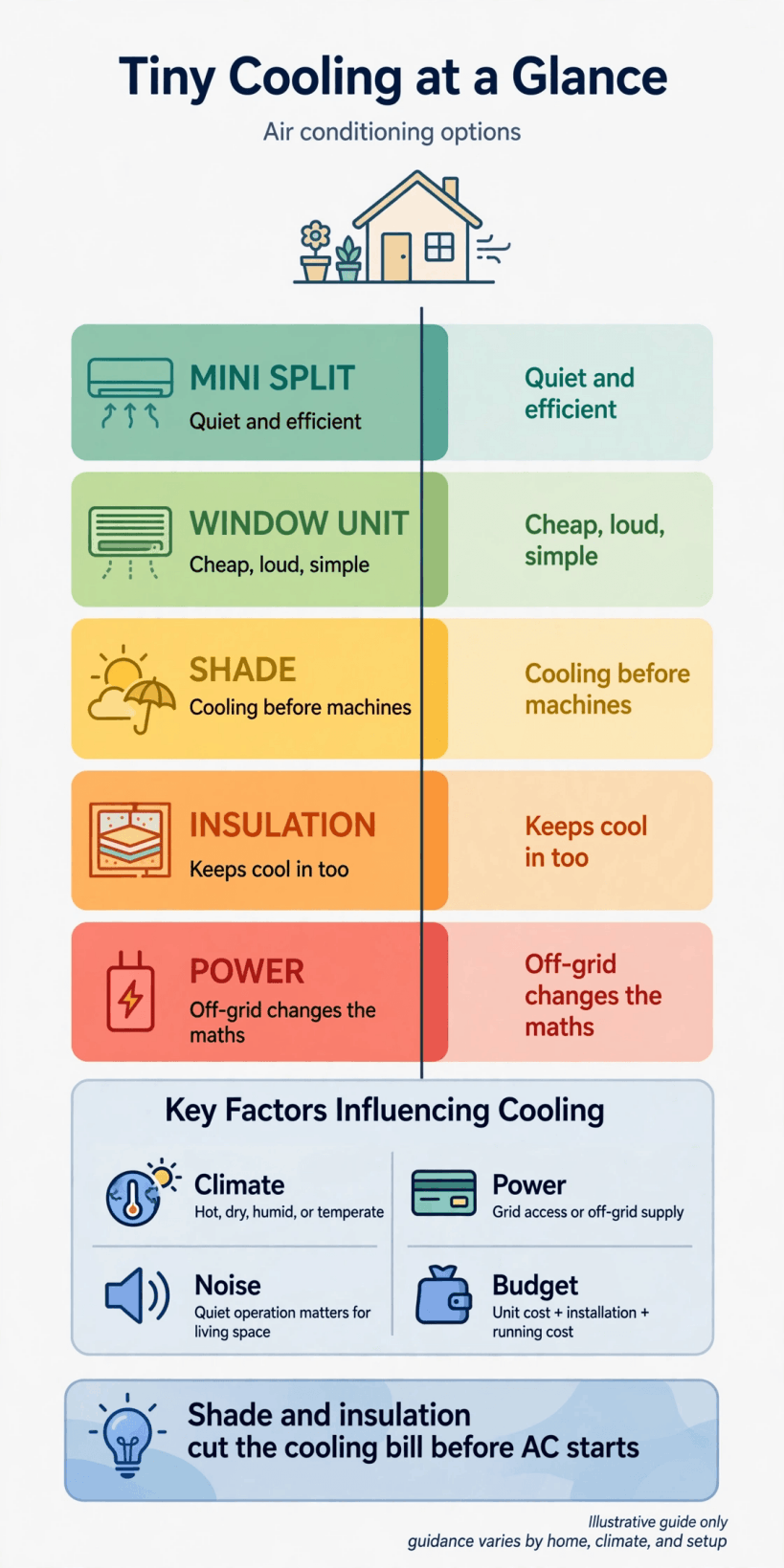
Yes. Tiny houses can and do have air conditioning, and in a hot climate it stops being a luxury surprisingly fast. A small home heats up like a parked car when the sun works on its roof and walls, and because there is so little air inside, the temperature climbs in minutes rather than hours. Good tiny house air conditioning is therefore not really about the unit. It is about a sequence: keep heat out with shade and insulation, remove what gets in with the smallest efficient machine that fits your power supply, and use moving air and cool nights to do as much of the work as possible for free.
This guide follows that sequence in order. First, the passive defences that decide how much cooling you need at all, and how cooling loads behave in a very small volume. Then the machines themselves, mini-splits, window and portable units, with their honest trade-offs in cost, space, noise and power. After that come ventilation and night flushing, fans, and the humidity that quietly decides whether a cooled tiny house feels comfortable or clammy. The off-grid section treats energy qualitatively and truthfully: cooling is one of the heaviest loads a small system can carry, and any plan that ignores that will fail in the first heatwave. Finish with a plan matched to your climate and parking, and summer becomes manageable instead of miserable.
Air Conditioning in a Tiny House: Quick Answers
| Question | Answer |
|---|---|
| Do tiny houses have air conditioning? | Yes. Many do, most often a mini-split, a window unit or a portable unit, sized small because the space is small. |
| What matters more than the unit? | Shade and insulation. A house that keeps heat out needs far less cooling, on far less power, than a house relying on a machine to fight the sun all day. |
| What is the best all-round machine? | A mini-split for most permanent setups: efficient, quiet, wall-mounted, and it heats in winter too. Window and portable units cost less upfront and suit temporary or rented situations. |
| Can you cool off grid? | Sometimes, carefully. Cooling is energy-hungry, so off-grid comfort depends on shading, modest expectations, efficient machines and running the hardest cooling when your system has energy to spare. |
| What free cooling exists? | Night flushing: opening the house to cool night air and closing it up before the day heats, plus fans that make a given temperature feel noticeably cooler. |
| What do people forget? | Condensate drainage, humidity, and the outdoor half of the system, which needs shade, airflow and a drained place to sit. |
1. Shade and Insulation First: Stop Heat Before You Remove It
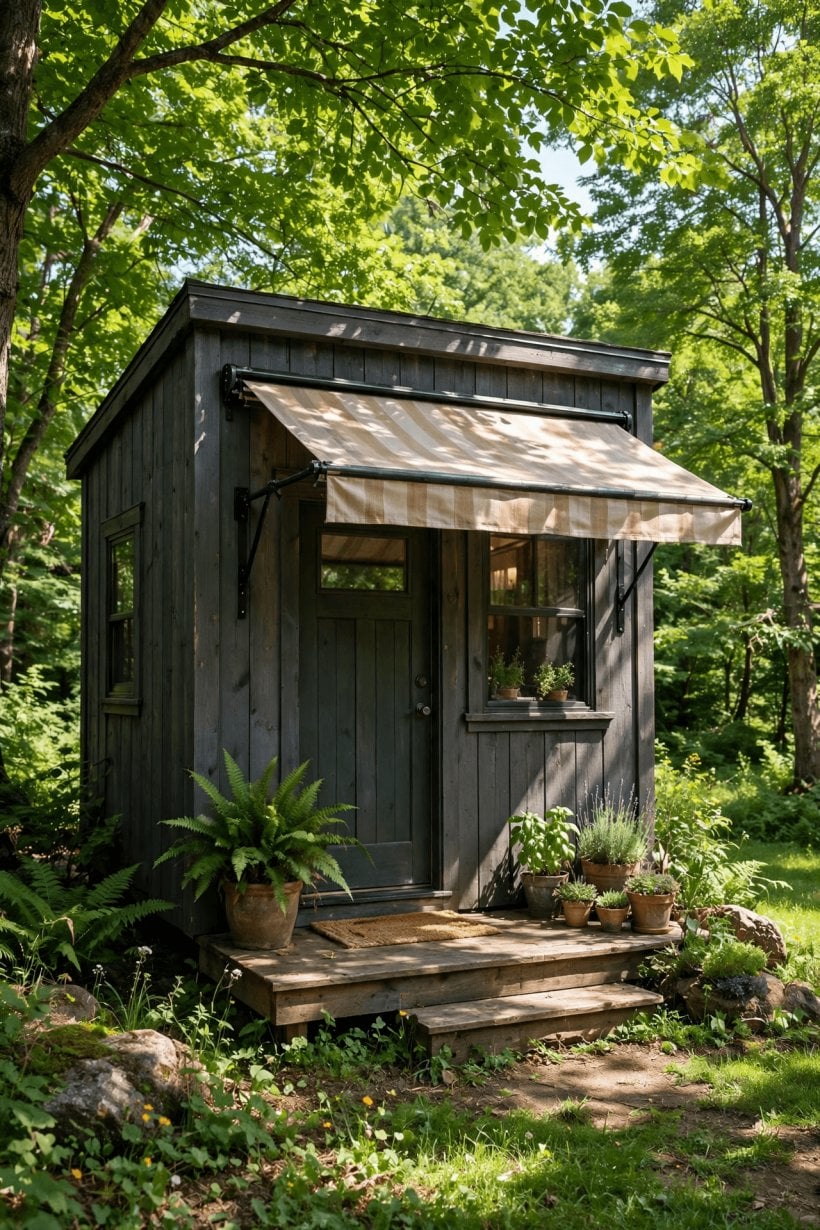
Every bit of heat you keep out is heat no machine has to remove, on power you then do not have to supply. Start where the house is parked: orientation that keeps the long walls and big windows out of the harshest afternoon sun, shade from trees or a simple awning or shade structure, and a parking spot chosen with summer in mind, not just winter. Where you can choose the site, the thinking in how to prepare land for a tiny house applies with the seasons reversed: the plot itself is part of the cooling system.
Then the shell. Roof and wall insulation slow the day’s heat on its way in, light-coloured exterior surfaces reflect rather than absorb, and window coverings earn their keep on the sunny side, where a blind closed before the sun arrives beats a bigger air conditioner running after it. Sealing matters here just as it does in winter, because hot humid air leaking in is load the machine must handle. The material choices are the same ones in how to insulate a tiny house, doing double duty across the year: the wrap that keeps January’s heat in keeps July’s heat out, and it is the cheapest cooling capacity you will ever buy.
2. How Cooling Loads Behave in a Very Small Space
A tiny house is a small thermal problem with fast mood swings. Little air volume means the temperature responds quickly to everything: sun on the roof, cooking, a couple of guests, the machine switching on. That speed cuts both ways. Cooling a small space takes a small machine, which is the good news everyone quotes, but it also means comfort can collapse within the hour if the defences fail on a serious afternoon, and an oversized unit will blast cold air, switch off, and leave the humidity behind, cycling all day without ever feeling right.
Think of the load as having layers you can peel in order. Solar gain through roof and glass is the biggest and the most preventable. Internal gains from cooking, showers and bodies are next, and in a space this size a hot oven genuinely is a heating appliance in summer, which is why tiny households shift cooking outdoors or to the cooler ends of the day. Air leakage and humidity ride along with both. A cooling plan that names these layers, and assigns each one a defence, will outperform a plan that consists of a single appliance and optimism.
3. Mini-Split Cooling: The Two-Season Workhorse
For a permanently sited tiny house with a solid electrical supply, the mini-split is the machine most owners converge on, for reasons that compound. It cools efficiently by moving heat rather than fighting it, it mounts high on the wall and uses no floor or window space, it runs quietly enough to sleep beside, it removes humidity as part of normal operation, and the same unit heats in winter, so one installation covers both hostile seasons. In a small, well-insulated volume it can usually run at a gentle fraction of its capacity, sipping rather than gulping power once the house is down to temperature.
The compromises are installation and dependency. A mini-split is a fitted system, indoor unit, outdoor unit, refrigerant lines and a condensate drain, and it wants professional installation and a sensible outdoor spot with airflow and drainage. It is wholly electric, so its summer appetite has to be counted in the house’s whole energy picture. The siting, line routing and drain details are exactly the subject of installing a mini-split in a tiny house, and they matter: most mini-split misery in small homes is drainage and placement misery, not machine failure.
4. Window and Portable Units: Cheaper, Flexible, Compromised
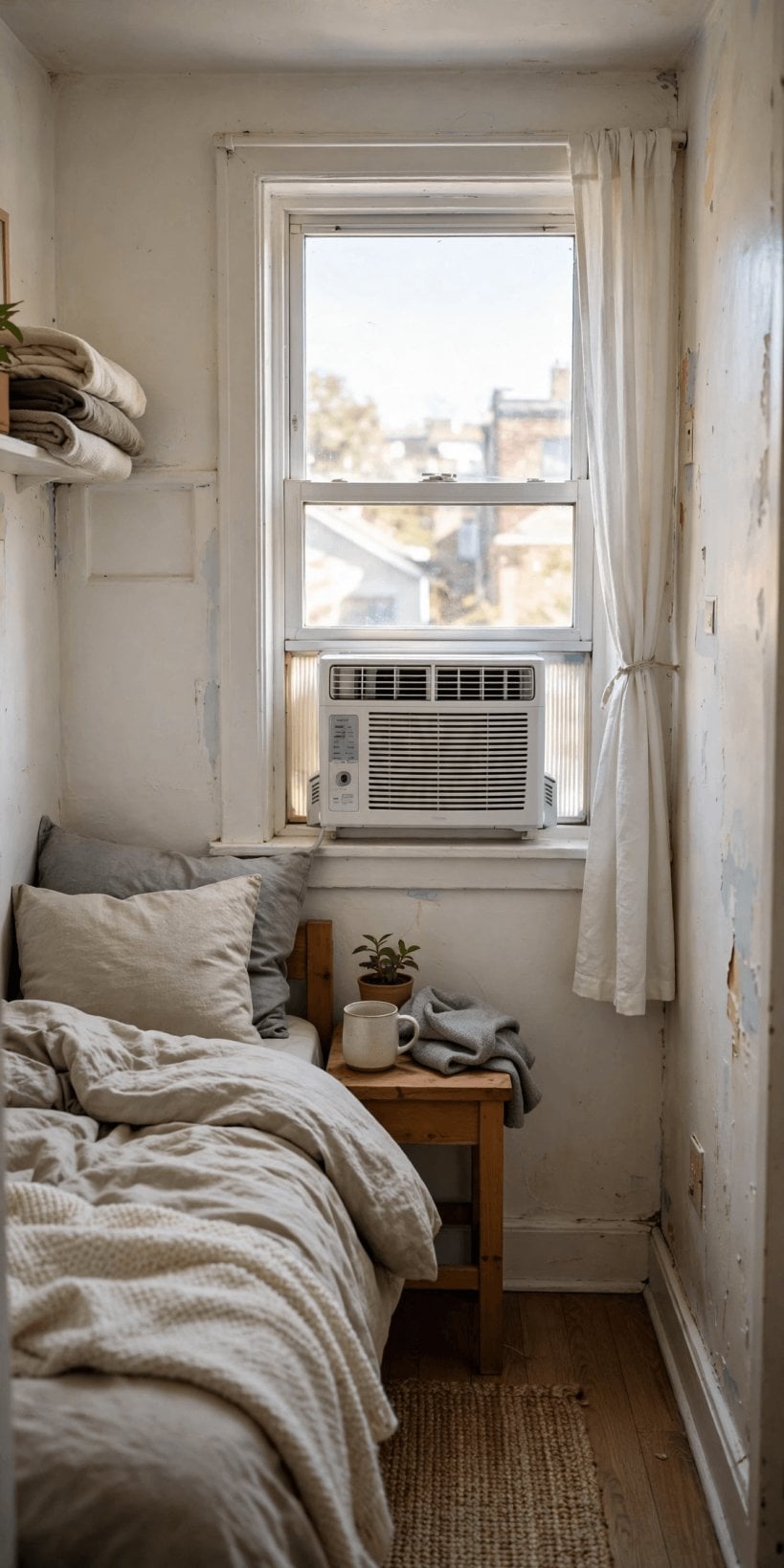
Window units are the honest budget answer: inexpensive, widely available, simple to understand, and genuinely effective at cooling a small volume. For a tiny house they bring particular frictions. A window in a small home is precious, for light, ventilation and emergency escape, and giving one up all summer hurts more than it would in a big house. The installation must be sealed and supported properly, the unit is louder than a mini-split because the whole machine lives in the room with you, and the window’s security and weather sealing need thought, especially in a house that moves.
Portable units on castors solve the window problem by occupying floor space instead, which in a tiny house is its own currency, and they exhaust hot air through a hose that itself radiates heat back into the room, which is why portables work harder for the cooling they deliver. Both types still earn their place: a rented or temporary parking situation, a first summer while the permanent system is saved for, a mild climate where cooling is needed for a handful of weeks. Judge them as what they are, useful compromises with known costs, not failed mini-splits.
5. Ventilation and Night Flushing: Free Cooling When Nights Cooperate
Where nights cool down, and in many climates they do even after fierce days, the house itself can be the cooling system. Night flushing means opening windows and vents wide once the outside air drops below the inside temperature, letting the flow carry the day’s stored heat out of the structure, then closing everything early, blinds down, before the day rebuilds it. The house’s fabric and contents cool overnight and absorb the next day’s heat more slowly, and the machine, if you have one, starts from a far better position.
The mechanics are simple and the details decide whether it works. Air needs a path, in low and out high, because warm air rises and will leave through a high opening if you give it one. Insect screens make the strategy liveable, secure openings make it sleepable, and a small fan assisting the exhaust on still nights keeps the flush moving when the breeze will not. This is the summer face of the same air management covered in tiny house ventilation and mold prevention: a tiny house breathes deliberately or not at all, and deliberate breathing is free temperature control for much of the year.
6. Fans and Air Movement: Making Warm Feel Cooler
Fans do not cool a room. They cool people, by moving air across skin, and in a tiny house that distinction is an opportunity, because the people occupy so much of the volume that cooling them is most of the job. A ceiling fan in the main space, a small fan aimed at the sleeping loft, moving air at the desk: these use a trickle of power compared with any compressor, and they raise the temperature at which the house feels comfortable, which means the air conditioning, if fitted, runs less and later in the day.
Placement is the craft. The loft, where heat collects and people sleep, is the first place that deserves moving air in any tiny house summer plan. Airflow across the bed on a warm night is often the whole difference between sleeping and lying awake, with no refrigeration involved at all. Build fans into the plan from the start, wired and sited rather than improvised with trailing leads in July, and treat them as a system alongside the passive defences: shade stops the heat, the flush removes it overnight, fans make what remains comfortable, and the machine handles only what is left.
7. Humidity: The Half of Comfort Nobody Sees
Ask someone why a room feels oppressive and they will blame temperature, but humidity is usually the silent partner. Warm air laden with moisture from cooking, showers and breathing feels hotter than the thermometer claims, sticks to skin, and in a tiny volume the moisture sources are always a few steps from where you sleep. Air conditioning earns much of its comfort not by cooling but by wringing water out of the air as it works, which is one reason a correctly sized unit running steadily feels better than an oversized one blasting in short bursts: steady running is steady drying.
Manage moisture at its sources as well. Lids on pans, extraction during and after showers and cooking, wet towels and laundry dried outside the living volume on humid days, and ventilation judged by how the house feels and what the windows tell you on a cool morning. In persistently humid climates, accept that dehumidification is a season-long task, not a side effect, and size expectations accordingly. A tiny house that is cool and dry feels spacious. A tiny house that is cool and damp feels like a cave with good appliances.
8. Off-Grid Cooling: Power Maths Without the Fantasy
Now the honest section. Cooling is moving heat uphill, and it is one of the most energy-demanding things a home does, sustained over the hottest hours of the day. Off grid, that demand meets a system that generates and stores a finite amount of energy, and the arithmetic, kept qualitative because every system differs, is unforgiving: hours of compressor cooling can consume what lights, devices, water pumping and cooking need for far longer. This is the same reality check that applies to any heavy load in tiny house utilities: power, water and off-grid sewage, and portable power in particular has limits here, as the discussion of off-grid power stations for tiny houses makes plain.
Successful off-grid cooling is therefore mostly not about the machine. It is a shaded, well-wrapped house that barely heats up, night flushing that resets it daily, fans for the occupants, and a modest, efficient unit run strategically, hardest when the sun is feeding the system directly, eased off as the day fades, with expectations set to comfortable rather than chilly. Houses parked in genuinely hot, humid, shadeless places on small systems have a harder truth to face: siting and season may have to change, because physics does not negotiate. Plan cooling into the energy design from the start, and it works within its limits. Bolt it on afterwards and the first heatwave conducts the audit for you.
9. Condensate, Drainage and Caring for the Unit
Cooling wet air produces water, continuously, and that water has to go somewhere planned. Every air conditioner in a tiny house is also a small plumbing appliance: a condensate drain that must fall, stay clear and discharge somewhere that does not rot the wall, feed mould or pool against the house. Blocked or badly routed drains are the unglamorous cause of a large share of cooling complaints, announcing themselves as drips, smells and stained finishes in a house where everything is within arm’s reach of everything else.
Care is otherwise light but real. Filters clog and quietly strangle airflow and efficiency, so clean them on the maker’s schedule. The outdoor unit needs its airflow unobstructed and its fins reasonably clean, and in a house on wheels it needs securing and protection that survives travel. Weather sealing around any through-wall or window installation matters doubly in a small envelope, the same discipline as sealing and weatherproofing tiny house sill plates applies at every penetration: water and air both find the gaps you leave. Ten minutes of maintenance a month is the whole price. Skip it for a season and the machine will collect the debt itself.
10. A Cooling Plan by Climate and Parking Situation
Assemble the answer from your facts. Climate first: dry heat with cool nights is a passive problem, solvable largely with shade, a tight shell, night flushing and fans, with a small unit for the worst afternoons. Hot and humid around the clock is a machine problem, where the mini-split on a good supply earns its keep and dehumidification is a headline feature, not a footnote. Parking second: permanent land lets you plant shade, site an outdoor unit properly and even shape the ground around the house; rented or temporary spots push you towards portable defences, awnings, window units and routines that travel with you.
Power last, because it arbitrates between the options the climate suggests: a strong hookup makes the two-season mini-split the calm default, a modest supply adds discipline about what else runs at peak heat, and off-grid living returns you to the passive-first plan with mechanical cooling as a rationed extra. Notice how this mirrors the heating logic in how to heat a tiny house: shell first, systems second, machines last, in both hostile seasons. A house designed that way is not chasing comfort with appliances. It is keeping comfort with its structure, and letting small machines tidy up the remainder.
Final Considerations
Do tiny houses have air conditioning? The ones that need it, yes, and the successful installations share a pattern that has very little to do with the badge on the unit. The house is shaded and wrapped so the cooling load stays small. The machine is the smallest honest tool for the remaining load, a mini-split where permanence and power allow, a simpler unit where flexibility matters more. Air and water are managed on purpose, at night, through fans, and out of the condensate drain. And the energy behind it all was counted before the first hot day arrived. Build the plan in that order and a tiny house in summer stops being a solar oven with furniture, and becomes what it should be: a small, cool, dry refuge from the season.


0 Comments