
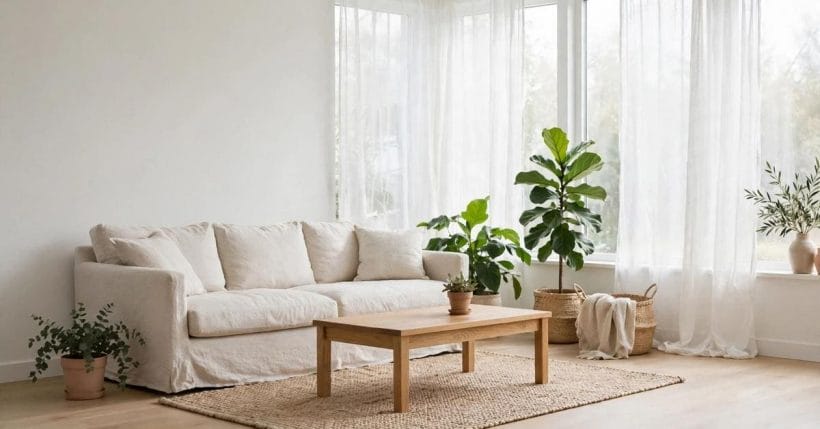
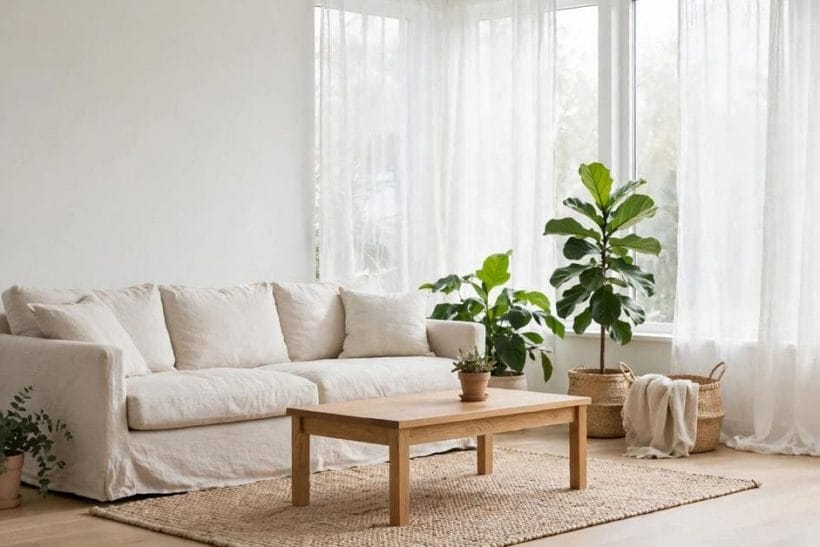
A living room with white walls can feel bright, calm and generous, even when the room itself is modest in size. White does not shout for attention. It steps back, lets daylight travel further into the room, and gives furniture, textiles and plants a quiet background against which their shapes and colours can be read clearly. That is the whole appeal of white walls ideas for a living room: not emptiness, but a calm frame that makes everything placed inside it look considered.
This guide stays inside one room. It is about the living room only: how it is laid out, which sofa suits it, which colours sit happily against white, and how its lighting is layered from morning to evening. It does not re-teach the bedroom angle, which belongs to its own post. Everything here is general advice for shaping your own room. No single product is recommended, no maker is named, and no measurement or shade code is given, because a room guide should help you recognise what works and why, not hand you a shopping list. For a sense of how living rooms sit within whole homes, see these tiny house interiors, where every room has to earn its place.
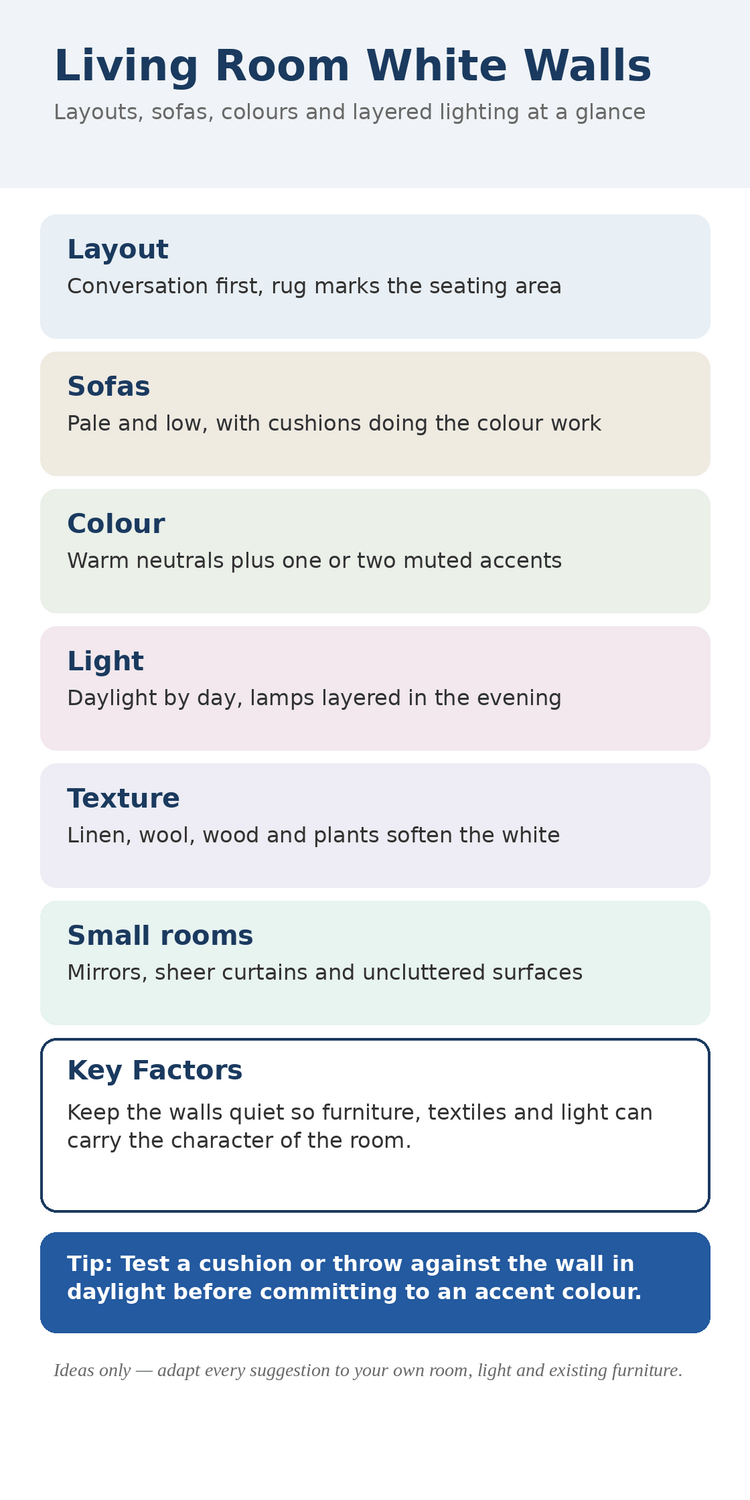
| Item | What it is |
|---|---|
| Why White Walls Work in a Living Room | White walls work first through light. |
| Start With the Layout: Conversation First | The layout of a white-walled living room begins with a simple question: where do people sit, and can they talk to each other comfortably. |
| Choosing Your White: Warm, Bright and Soft | Not every white looks the same on a wall, and choosing among them is worth a little patience. |
| The Sofa: Pale, Low and Easy to Live With | The sofa is the largest single object in most living rooms, so against white walls it sets the tone for everything else. |
| Colour Against White: Accents That Earn Their Place | Colour against white walls works best when it is deliberate rather than abundant. |
| Layered Lighting: Daylight, Lamps and Evening Glow | Layered lighting is the phrase designers use for a simple idea: a living room should not rely on a single overhead light. |
| Small Living Rooms: Making White Work Harder | In a small living room, white walls are not a luxury but a practical choice. |
| Texture and Warmth: Rugs, Throws and Natural Materials | If white walls are the quiet background, texture is what stops the room from feeling flat. |
| Walls as a Backdrop: Art, Shelves and Plants | White walls make an ideal backdrop for art, precisely because they do not compete with it. |
| Keeping It Honest: What Not to Force | The most common mistake with white walls is trying to make the room look like a photograph rather than a home. |
1. Why White Walls Work in a Living Room
White walls work first through light. Daylight entering a living room bounces softly from a pale wall instead of being absorbed by a dark one, so the room feels brighter for longer through the day and the corners feel less heavy. In the evening the same quality helps lamplight, which spreads as a gentle glow rather than pooling harshly in one spot. The effect is not about making a room look larger by trickery. It is about letting the light that is already there do more of the work.
White also works through calm. A living room holds a great deal of visual information: seating, tables, books, plants, pictures and the everyday objects of family life. Against a strong wall colour, all of that can start to compete for attention, and the room can feel busy even when it is tidy. Against white, the same objects settle. The eye finds the sofa first, then the rug, then the picture, rather than taking everything in at once. That sense of order is restful, and restfulness is what most people want from the room where they spend their evenings.
There is a third reason, quieter than the other two. White is forgiving when tastes change. A cushion colour can be swapped, a throw can be folded away, a picture can move to another wall, and the room still holds together, because the background has not committed the room to any one accent. That flexibility matters in a room that is used daily and rearranged over the years. White walls do not demand a single style. They welcome several, one after another, as the household changes.
2. Start With the Layout: Conversation First
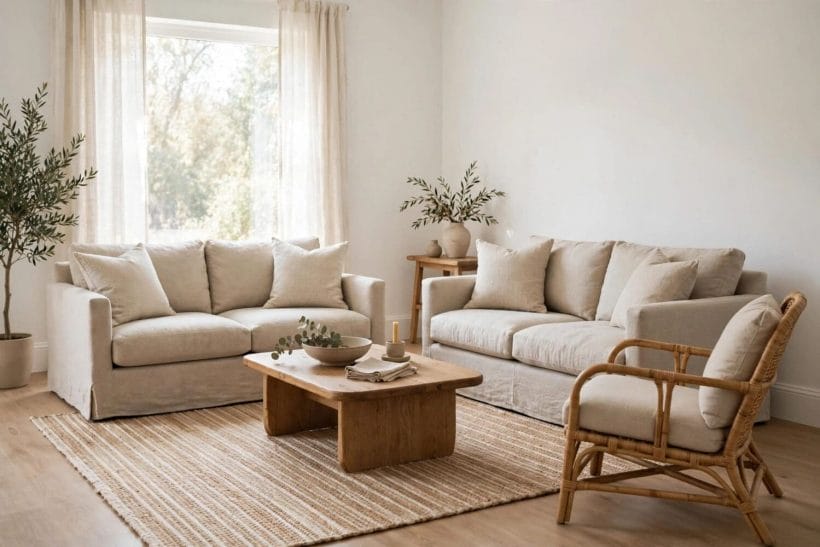
The layout of a white-walled living room begins with a simple question: where do people sit, and can they talk to each other comfortably. A rug usually marks the answer. Place the rug first, then arrange seating around it so that chairs and sofas face one another rather than lining up against the walls like an audience. When seating faces inward, the room feels like a place for gathering. When it faces outward, the room feels like a corridor with furniture in it. The rug gives the conversation area a boundary, even in an open-plan space.
Leave room to move around the seating group. People should be able to reach a chair, carry a cup across the room and open a door without squeezing past furniture or stepping over a rug edge. That breathing space matters more against white walls than against dark ones, because white shows the shape of the room so plainly. A cramped arrangement reads as cramped immediately. A layout with clear paths reads as calm, even when the furniture itself is generous. Think of the empty floor as part of the design, not as space wasted.
Anchor the layout with one clear focal point, and let the white walls do the rest. The focal point might be a window with a view, a fireplace, a large picture or simply the seating group itself gathered around a coffee table. Everything else can then sit a little quieter. For more ideas on shaping a compact seating area, see these tiny living room ideas, where layout decisions matter even more because there is less room to hide a mistake. The principle is the same at any size: decide where conversation happens, then build the room around it.
3. Choosing Your White: Warm, Bright and Soft
Not every white looks the same on a wall, and choosing among them is worth a little patience. A warm white carries a gentle hint of cream and suits rooms with wooden floors, woven rugs and soft natural light. A bright white feels crisper and suits rooms with plenty of daylight and clean-lined furniture. A soft white sits between the two, neither creamy nor stark, and suits rooms where you want brightness without a cold feeling. None of these is better in the abstract. Each one changes with the light in your room, the colour of your floor and the direction your windows face.
The surest way to choose is to live with a sample on the wall for a few days before committing. Paint a generous patch, not a postage stamp, and look at it in morning light, in afternoon light and under lamplight in the evening. Notice how it sits beside your sofa fabric, your rug and your wood tones. A white that looks perfect in a shop can feel chilly beside pale oak or muddy beside grey upholstery, and only the wall itself will tell you. This is also why this guide gives no shade codes: the right white is the one that behaves well in your light, not a name on a chart.
Keep the finish in mind as well as the shade. A flat, matte finish softens a wall and hides small imperfections, which suits a relaxed living room. A finish with a gentle sheen reflects a little more light and wipes more easily, which suits a wall near a doorway or behind a sofa where hands and heads brush past. The difference is subtle to the eye and real to the hand. Choose the finish for how the wall will be lived with, not only for how it looks on the day it is painted.
4. The Sofa: Pale, Low and Easy to Live With
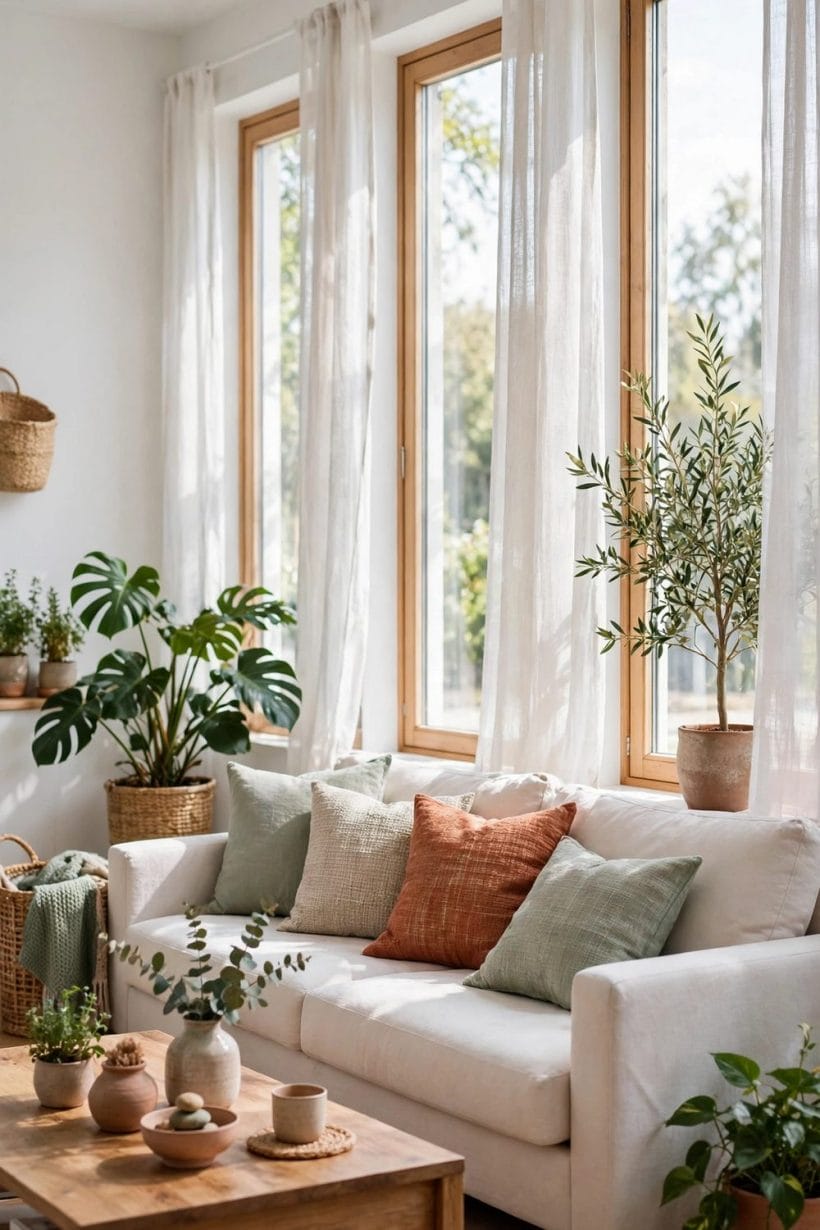
The sofa is the largest single object in most living rooms, so against white walls it sets the tone for everything else. A pale sofa in linen or a similar natural fabric keeps the room feeling light and lets the walls and the seating read as one calm composition. A low sofa, with cushions that sit close to the frame, keeps sightlines open across the room, so windows and pictures stay visible and the room feels connected rather than divided by furniture. Comfort matters more than silhouette: a sofa should invite a long sit, not merely photograph well.
Cushions are where a pale sofa earns its keep. Because the sofa itself stays quiet, cushions can carry colour, pattern and texture without overwhelming the room. A few cushions in muted tones, changed with the seasons or simply when the mood changes, can refresh the whole room without touching the walls. Keep the number restrained and the colours related to each other, so the sofa looks gathered rather than cluttered. A throw draped over one arm adds softness and warmth, and it is there to be used, not merely displayed.
Practicality deserves the same attention as looks. A pale sofa in a living room will meet everyday life: cups of tea, muddy paws, children with books and visitors with coats. Choose a fabric you can care for without anxiety, and keep the shape simple enough that cushions can be plumped and covers can be tended. A sofa that you are afraid to sit on has failed, however beautiful it looks against white. For rooms where seating must work harder in less space, see these small living room ideas, which show how a well-chosen sofa can anchor a compact room.
5. Colour Against White: Accents That Earn Their Place
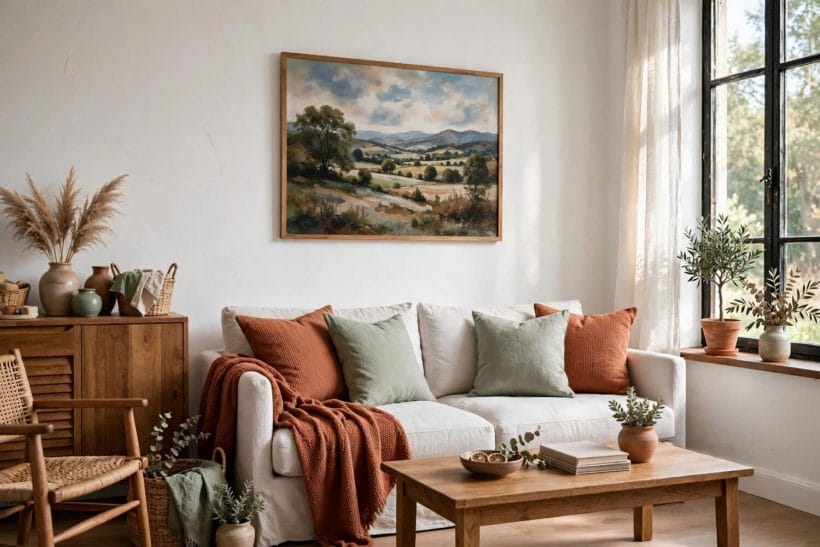
Colour against white walls works best when it is deliberate rather than abundant. Choose one or two accent colours and let them repeat in small doses: a cushion, a throw, a picture, a vase. Repetition is what makes an accent feel intentional. A single red cushion in an otherwise neutral room can look like an accident. The same tone appearing on a cushion, a book spine and a plant pot reads as a decision. White gives you that freedom, because the background stays out of the way while the accents do their quiet work.
Warm neutrals are the easiest companions for white: soft beige, warm grey, muted clay, sage green and gentle terracotta all sit comfortably against a pale wall without competing with it. These are colours found in wood, stone, wool and leaves, and they bring a natural warmth that stops white from feeling cold. Stronger colours can work too, but they need a lighter touch: a deep green picture frame, a navy cushion or a rust throw will hold its own against white, provided it is not asked to cover too much ground. Let the bold tone be a note, not a chorus.
The same pairing instinct appears elsewhere in the home. A related post on a white wall with grey trim in a bedroom shows how one restrained pairing can carry a whole room, and the lesson transfers directly: pick the pairing, repeat it sparingly, and let the white do the rest. See that white wall grey trim bedroom pairing for how grey and white can sit together calmly. In the living room, the equivalent might be white with warm wood, white with sage, or white with clay. The pairing matters less than the restraint with which it is used.
6. Layered Lighting: Daylight, Lamps and Evening Glow
Layered lighting is the phrase designers use for a simple idea: a living room should not rely on a single overhead light. Daylight is the first layer, and white walls make the most of it, bouncing it softly around the room. Sheer curtains help here, softening direct sun without blocking it, so the room stays bright but never glaring. If a window faces a view worth keeping, keep the dressing light and let the daylight itself be the decoration for much of the day.
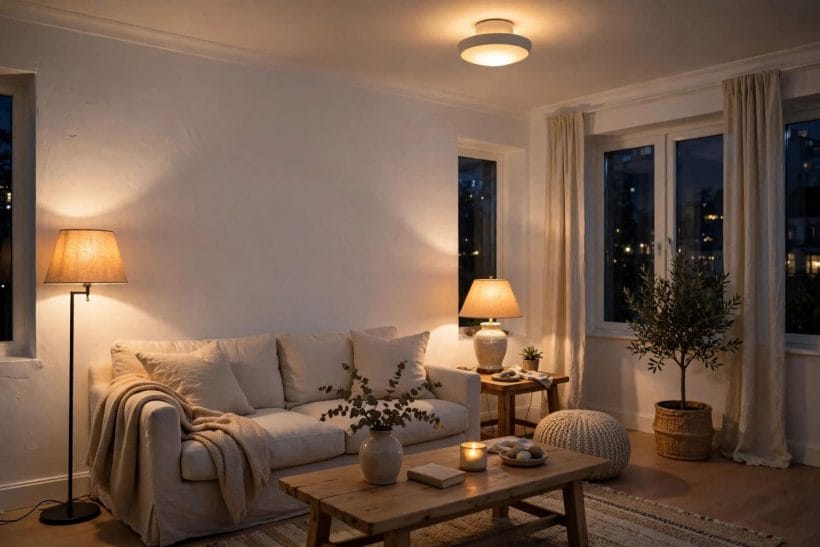
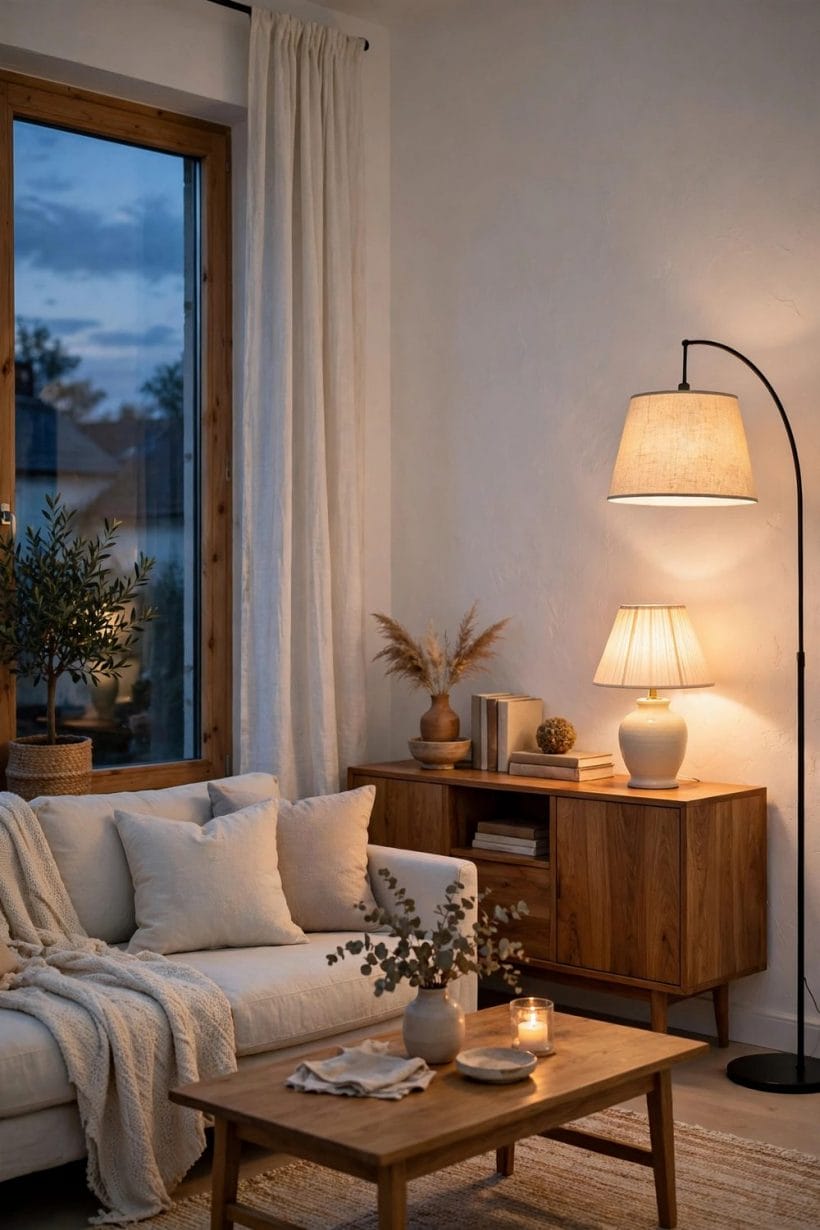
Lamps are the second layer, and they are what make a white-walled room feel welcoming after dark. A floor lamp beside the sofa gives reading light. A table lamp on a side table gives a pool of warmth at sitting height. A small lamp on a shelf or sideboard gives a gentle glow in a corner that would otherwise fall dark. Each lamp should be on its own switch or dimmer where possible, so the room can be lit for conversation, for reading or for quiet evening rest, rather than lit one way for everything.
The third layer is the softest of all: the glow that comes from candles on a coffee table, a fire where one exists, or simply the spill of light from an adjoining room. This layer is not about seeing clearly. It is about atmosphere, and white walls repay it generously, catching a warm glow and spreading it. Avoid the temptation to flood a white room with bright overhead light in the evening. White already reflects plenty. What it needs after dark is warmth and variety, not volume. For broader inspiration on shaping light in a home, see these interior design ideas, where lighting is treated as part of the room rather than an afterthought.
7. Small Living Rooms: Making White Work Harder
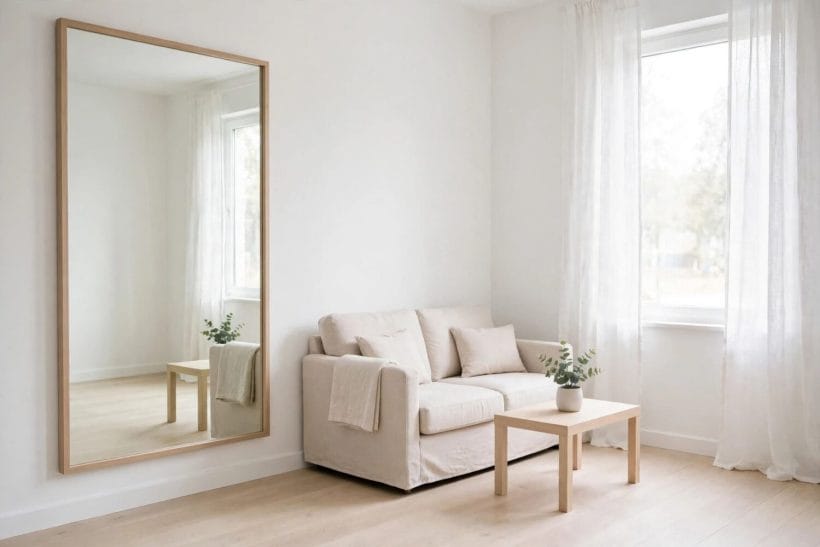
In a small living room, white walls are not a luxury but a practical choice. They keep the boundaries of the room light, so the walls recede rather than advance, and the room feels less enclosed. That effect is helped by keeping large furniture pale as well: a pale sofa, a light rug and pale curtains continue the same quiet tone from wall to floor, so the eye travels without stopping at a dark block. The room does not become larger, but it feels less crowded, and that feeling is what matters day to day.
Mirrors earn their place in a small white room. A large mirror on one wall reflects both light and the room itself, doubling the sense of space without adding a single object to the floor. Place it where it reflects a window or a pleasant view, not a blank wall or a cluttered corner, or it will simply double the clutter. Sheer curtains help in the same way, letting daylight in while keeping the window dressing light. Heavy curtains in a small room can undo much of what white walls achieve, by adding visual weight exactly where lightness is needed.
Storage is the quiet partner of white walls in a small room. White shows clutter plainly, so a room without a home for books, remotes and everyday objects will look untidy quickly, however beautiful its walls. Closed storage, a sideboard with doors, baskets that hide their contents and shelves kept to a few chosen objects all help the white stay calm. For ideas on giving everything a place, see these tiny house storage ideas, where storage is designed into small rooms from the start rather than added as an afterthought.
8. Texture and Warmth: Rugs, Throws and Natural Materials
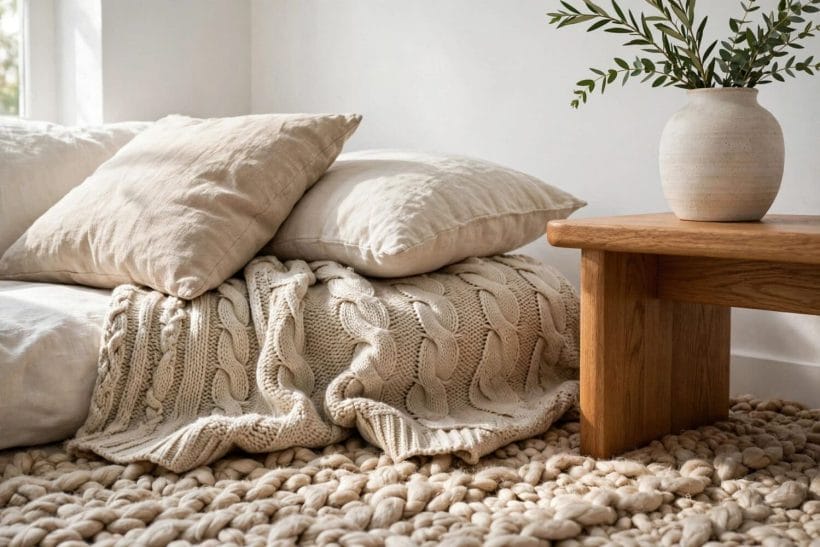
If white walls are the quiet background, texture is what stops the room from feeling flat. A woven rug underfoot, linen cushions on the sofa, a knitted throw over an arm, a wooden coffee table with a visible grain, a ceramic vase with green stems: each of these adds something for the hand and the eye that colour alone cannot give. In a room with little strong colour, texture becomes the main source of richness, and it rewards attention. Run a hand over the rug. Notice how the throw folds. These small pleasures are the point.
Natural materials suit white walls particularly well, because they bring warmth without bringing visual noise. Wood in a warm tone, wool in a soft neutral, cotton and linen in pale shades, stone and ceramic in muted finishes: all of these sit comfortably against white and age gracefully with use. A room built from such materials feels lived in from the start, rather than staged. It also forgives everyday wear, since a scratch on wood or a softened cushion reads as character rather than damage.
Plants are texture too, and they are the easiest way to bring life against white. Green leaves read vividly against a pale wall, and a plant in a corner softens the meeting of two walls in a way no picture can. Choose plants you can care for in the light your room actually receives, and place them where they will be seen and tended rather than forgotten. A healthy plant in a plain pot will do more for a white-walled room than a struggling plant in a decorative one. Let the plant be part of the room, not a decoration added to it.
9. Walls as a Backdrop: Art, Shelves and Plants
White walls make an ideal backdrop for art, precisely because they do not compete with it. A large picture can hold a wall on its own, and its colours will read more clearly against white than against any patterned or coloured background. Hang pictures at a height where they can be enjoyed from a seated position, not only from standing, since a living room is mostly experienced from the sofa. A single generous picture often serves a room better than a crowd of small ones, which can start to feel like clutter against so much calm.
Shelves need the same restraint. A shelf against a white wall displays its contents plainly, so a few chosen objects, books standing upright, a vase, a small plant, will read as a collection, while a shelf crammed edge to edge will read as storage spilling into view. Leave empty space on the shelf. The emptiness is not waste. It is what lets each object be seen. If a shelf starts to fill by accident, that is a sign that the room needs a closed cupboard somewhere else, not another shelf.
Wall panelling, picture rails and simple mouldings can add quiet structure to a white wall without adding colour. A panelled section behind a sofa, a rail that divides a wall gracefully, or a simple frame of moulding around a picture wall all give the eye something to follow while keeping the palette pale. These details work best when they are painted the same white as the wall, so the interest comes from shadow and shape rather than contrast. The wall stays white, but it stops being plain.
10. Keeping It Honest: What Not to Force
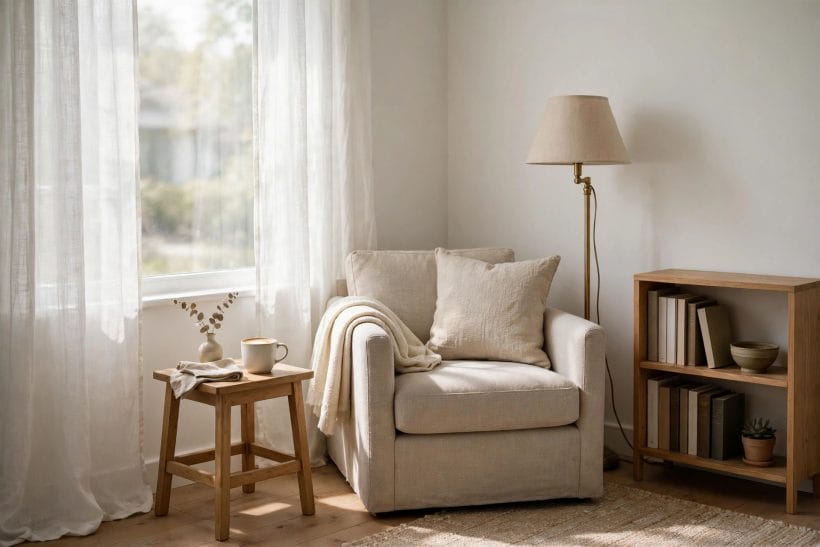
The most common mistake with white walls is trying to make the room look like a photograph rather than a home. A living room that is kept too perfect, where nothing may be touched and every cushion must sit at an angle, stops being restful. White walls should serve the life lived in the room, not police it. Let the sofa be sat on, let books pile on the coffee table, let a throw stay where it was left after an evening read. A room that shows gentle signs of use feels welcoming. A room that shows none feels like a waiting room.
Another mistake is adding too much to compensate for the whiteness. If a room feels cold, the answer is rarely more decoration. It is usually warmth in the right place: a rug underfoot, a lamp at sitting height, a wooden table, a plant by the window. Add one warm element at a time and live with it for a few days before adding another. White rooms reward patience. Each addition shows clearly, so each one should earn its place rather than merely filling a gap.
Finally, do not force a white-walled living room to be something it is not. A room with little natural light will not become bright simply because its walls are white, and a room with dark floors and heavy furniture will not become airy by paint alone. Work with what the room gives you: its light, its proportions, its existing furniture. White walls are a beginning, not a cure. Used honestly, with attention to layout, texture and light, they give a living room a calm frame within which everyday life can look its best.
Final Considerations
A living room with white walls succeeds when its parts work quietly together: a layout built for conversation, a sofa that invites a long sit, one or two accent colours repeated with restraint, lighting layered from daylight to lamplight, and textures that warm the room without cluttering it. None of these ideas demands a particular style or a particular purchase. They are habits of arrangement, and they can be applied gradually, one change at a time, as the room evolves.
Begin where the room asks for help. If evenings feel harsh, start with lamps. If the room feels cold, start with a rug and a throw. If it feels busy, start by clearing a shelf and letting the white breathe. Small changes show clearly against white, so each one teaches you something about what the room needs next. That is the real pleasure of white walls ideas in a living room: the room itself becomes easy to read, and easy to improve, step by step.
For the bedroom version of this idea, with the same white-wall thinking applied to restful styling and storage walls, see the companion post on white walls bedroom ideas. The two rooms share a palette but not a job: the living room gathers people, the bedroom rests them, and each deserves its own treatment. Keep this room for gathering, keep its white calm, and let its furniture, textiles and light do the talking.



0 Comments