

Marble is the bathroom material that never leaves — it only waits, patiently, for each generation to rediscover its veining and call the discovery new.
This survey stays inside the material lane: seventy-five marble bathrooms read stone by stone — formats, layouts, showers, vanities, pairings and small-room versions — with the wider bathroom map linked to its pillar and the neighbouring tile, modern and master lanes linked, not absorbed.
1. Marble Bathroom at a Glance
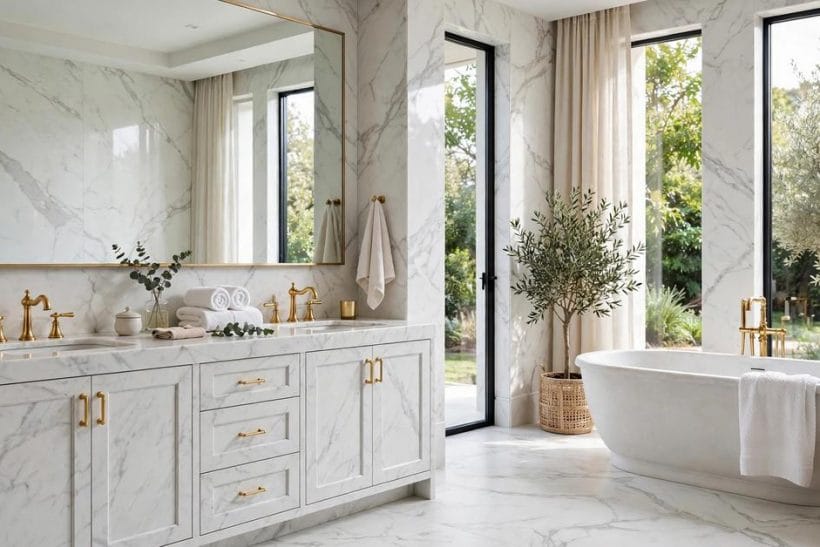
A marble bathroom is a bathroom whose defining material is marble — real stone tile or slab, or marble-look porcelain chosen in its place: its attributes are the stone’s veining and finish, the formats it is cut into, where in the room it is laid, and the sealing and cleaning discipline it asks in return. This post owns the marble material lane only: the room as a whole belongs to the bathroom ideas pillar, the wider tile-material survey to ceramic tile bathroom, the modern register to modern bathroom ideas and the master layout to master bathroom ideas — each linked here as its lane’s owner and none re-taught. Read what follows as a stone-first catalogue: every example is judged on its material honesty, its placement and its care realism, so a reader planning one marble wall, one shower or one whole room can lift a single idea whole.
| Question | Short answer |
|---|---|
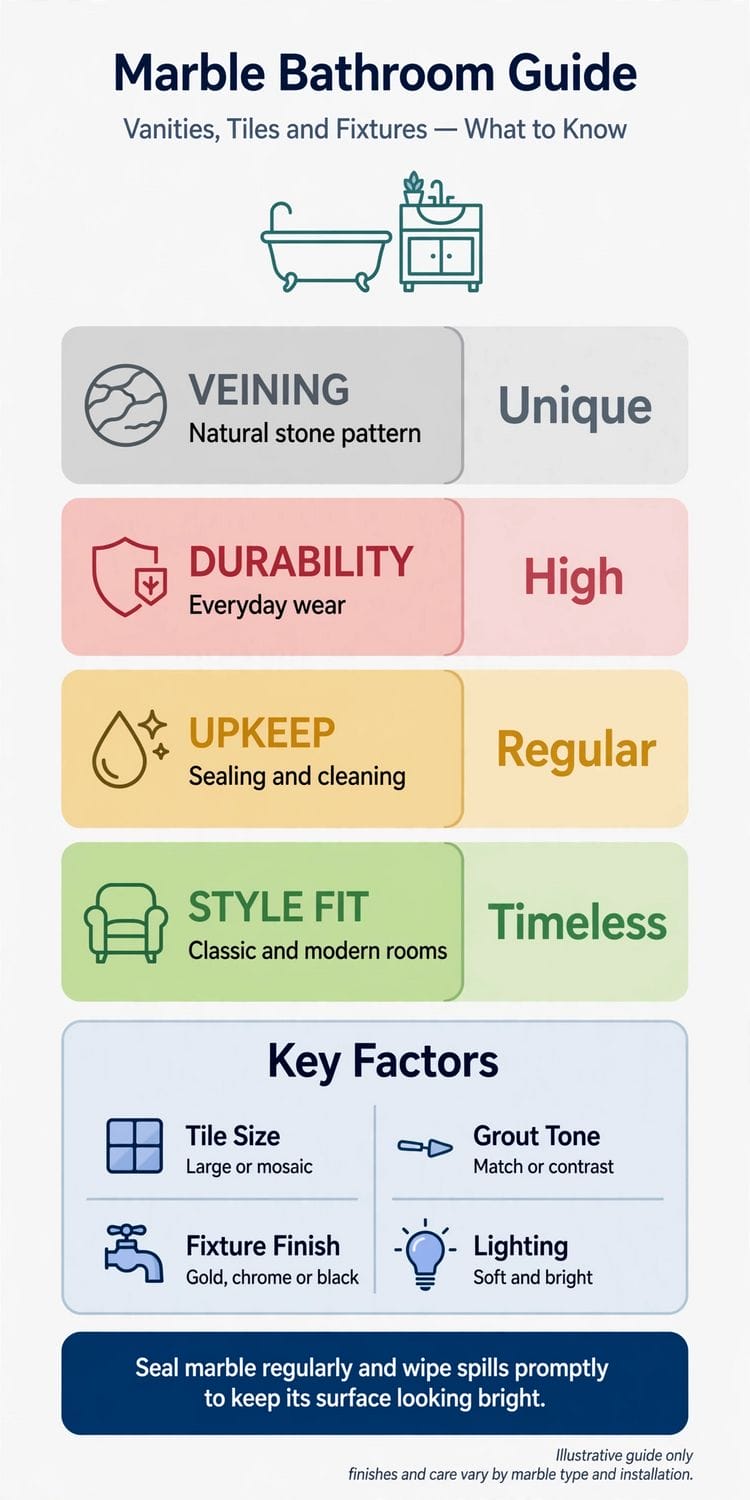
| Is real marble practical in a bathroom? | Yes, with its discipline accepted: sealing maintained, acidic and abrasive cleaners kept away, spills wiped as they happen. Households unwilling to keep that small routine should choose marble-look porcelain honestly — it is the practical twin, not a failure. |
| Where does marble earn its place most? | On the surfaces the eye and hand meet most: the vanity top and splashback, the shower’s main wall, a pale floor in a small room. One well-placed stone surface usually outperforms a whole room of imitation. |
| Which finish is safest underfoot? | Honed or tumbled finishes, and small mosaic formats whose grout lines add grip. Polished marble belongs on walls and dry zones. Underfoot choices are stated generally here; a tiler advises on the individual floor and its setting. |
| Does marble suit a small bathroom? | Emphatically — pale marble returns light, large formats calm small volumes, and one material carried through makes a tiny room read as a single considered object. The small-room section of this survey is devoted to exactly that case. |
2. The Marble Itself: Stone, Tile and the Honest Substitutes
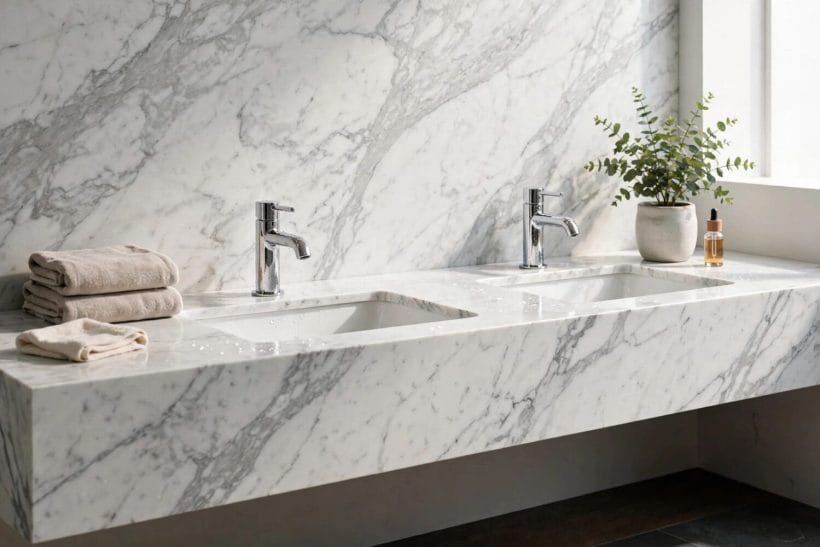
Marble in a bathroom is a material decision before it is a style one: real stone, porcelain that prints the stone, and the formats each arrives in behave differently under water, soap and time. The tile-material survey as a whole belongs to the ceramic tile bathroom lane; this section stays on marble and its immediate family, and lets the formats set up everything that follows.
1. Real marble tile, honestly chosen
Genuine marble tile brings depth no print quite matches — veining that continues through the stone’s body and a coolness underfoot.
2. Marble-look porcelain tile
Porcelain printed with marble’s veining gives the photograph without the sealing diary: harder, denser and kinder to family bathrooms.
3. Large-format marble slabs on walls
Big tiles or slab panels mean fewer grout lines and a calmer wall, letting long veins run uninterrupted.
4. Carrara-style white and grey
The classic register: white ground, soft grey veining, a cool and architectural calm. It pairs with chrome and pale timber, and it is the marble most small bathrooms borrow light from.
5. Calacatta-style bold veining
Wider, more dramatic veins on a brighter white ground make the stone the room’s artwork. Use it where the wall is large enough for the pattern to breathe — a shower wall or a full splashback.
6. Dark marble for contrast
Deep green, charcoal and near-black marbles turn a pale bathroom dramatic used sparingly: a vanity top, a niche back, a floor border. Whole rooms in dark marble belong to grand houses and brave lighting plans.
7. Honed marble underfoot
A honed, matte finish grips better than polished stone and hides water marks more forgivingly.
8. Polished marble where it stays dry
Polish belongs on walls and vanity zones away from the shower floor’s traffic: there its reflection doubles candlelight and lamplight, and its slipperiness never meets a wet foot.
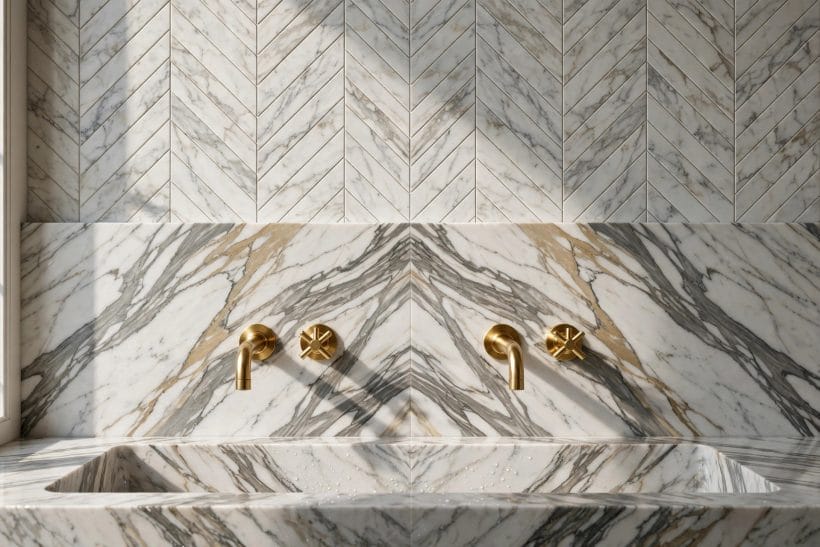
9. Marble mosaics and small formats
Small tiles on mesh sheets wrap curves, shower floors and niches that big formats cannot; the extra grout is also extra grip, which is why mosaics are the traditional shower-floor answer.
10. Tumbled and aged marble
Softened edges and a chalky surface give marble a lived-in, country register that forgives the odd mark. It suits farmhouse and cottage bathrooms where perfection would look like a showroom.
11. Marble with a border or inlay
A plain marble field framed by a darker border or a mosaic strip gains architecture without pattern overload — the traditional way to make a simple layout look designed.
3. Layouts: Where the Marble Goes in the Room
Layout decides how much marble a room actually needs. A full stone envelope, a single feature wall and a floor-only treatment are three different budgets wearing the same material, and this section separates them so the photographs that follow can be read as plans, not just pictures.
12. The full marble envelope
Walls and floor in one stone make the room feel carved rather than decorated — the hotel register. It asks for restraint everywhere else: plain fittings, quiet textiles, and light that does not fight the veining.
13. One feature wall of marble
A single stone wall behind the bath or vanity, with quieter surfaces elsewhere, concentrates the cost and the drama in one view. This is the layout most real bathrooms in this survey actually use.
14. Marble floor, plain walls
The floor carries the stone and the walls step back in plaster, paint or plain tile. The room gains marble’s cool pattern underfoot and keeps its walls easy to repaint as tastes move.
15. Marble walls, warm floor
Stone on the walls with timber or timber-look flooring underfoot balances marble’s coolness — a pairing returned to in the materials section, and a favourite of bathrooms that felt too cold in early sketches.
16. The wet-room marble layout
In a fully tiled wet room, marble-look porcelain usually does the heavy lifting for practicality, with real stone reserved for the vanity wall. Drainage and falls are the tiler’s and plumber’s professional work, stated generally here.
17. Marble around a freestanding bath
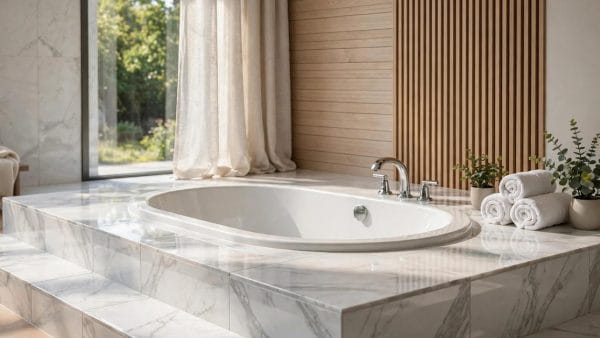
A stone floor or a low stone upstand beneath a sculptural bath turns the tub into the room’s centrepiece; keep the marble’s pattern quiet so the bath’s silhouette stays the event.
18. The double-vanity marble wall
A full-height marble splashback behind twin basins reads as one carved panel. It is the master-bathroom register — and the master layout as a whole belongs to the master bathroom ideas lane, glanced at here only for its stone.
19. Marble in the water closet corner
A small separate WC gains dignity from a marble floor and one stone wall — proof that the material flatters the smallest room in the house as faithfully as the largest.
20. Half-height marble wainscot
Stone carried to dado height with painted plaster above is the traditional compromise: splash zones in marble, breathing room above, and a ledge line that organises mirrors and shelves.
21. Marble thresholds and trims
Even a bathroom that cannot run to stone walls can carry marble at its edges — thresholds, window sills, shelf ledges — small true notes of the material at every touchpoint.
22. The ensuite marble capsule
A compact ensuite wrapped in pale marble-look tile reads as a single jewel-box volume; the small-space section returns to this layout with the tiny-house versions.
4. The Shower in Marble: Walls, Floors and Niches
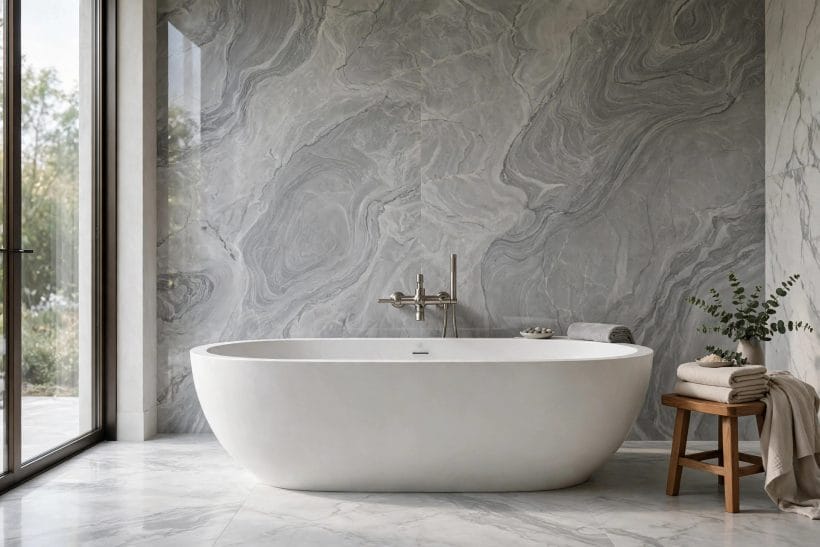
The shower is where marble is tested hardest — constant water, soap, shampoo and heat — and where its photographs are most persuasive. This section works through the enclosure surface by surface; shower layouts in general belong to the bathroom pillar linked at this post’s glance, and the open-entry shower is the doorless shower ideas lane’s subject, linked here and not absorbed.
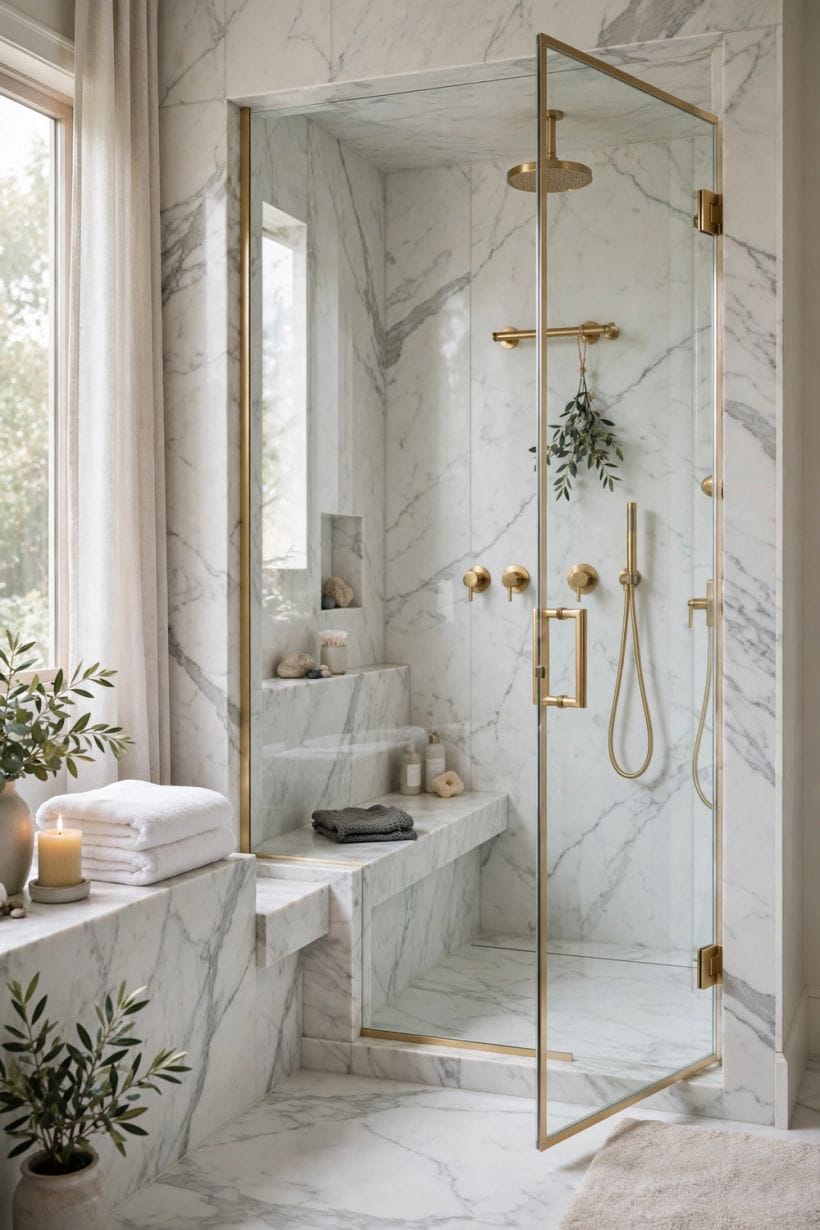
23. Full-marble shower walls
Stone on all three walls with the veining matched across corners is the luxury photograph. It needs sealing kept up and cleaning kept gentle — the care section of this survey treats that discipline in full.
24. Marble shower with a plain surround
One marble wall inside the enclosure and plain tile on the returns keeps the stone where the eye lands and the budget where it can bear. A pragmatic layout that photographs far richer than it costs.
25. Mosaic marble shower floor
Small marble pieces give the grip a wet floor needs and let the tiler form the falls to the drain. The traditional choice, and still the one most shower builders reach for first.
26. The marble bench seat
A stone bench inside a generous shower adds the spa register and a practical seat in one. Its top should be a single solid piece where possible, detailed by the installer to shed water.
27. Marble niches and recesses
A niche lined in the wall’s marble — or in a contrasting dark stone — turns shampoo storage into architecture. Keep bottles edited; the niche photographs its contents as faithfully as its stone.
28. Book-matched marble panels
Two slabs mirrored so their veins form a butterfly pattern make a shower wall into a picture. It is a specialist installation and a specialist price, shown here as the survey’s summit, not its standard.
29. Marble with black fittings
Matte black taps and frames against white marble give the graphic, modern register — the pairing the modern bathroom ideas lane also favours, though its room as a whole is a separate treatment.
30. Marble with chrome and glass
Polished chrome and frameless glass keep a marble shower light and traditional; nothing competes with the stone, and the enclosure nearly disappears.
31. The curbless marble entry
A level entry with the marble-look floor running through reads seamless and generous. Falls, drainage and waterproofing here are professional work under local rules, and this survey states them only in that general frame.
32. Marble half-wall and glass above
A solid marble half-wall gives privacy and a shelf line, with glass above for light — a layout that suits shared family bathrooms and guest ensuites alike.
33. Sealed, cared for, realistic
Every shower photograph in this section assumes the unglamorous truth: marble in daily water wants sealing maintained and acidic cleaners kept away. The stone rewards the routine; it punishes the neglect. Both halves are the idea.
5. Vanities, Basins and the Splash Zone
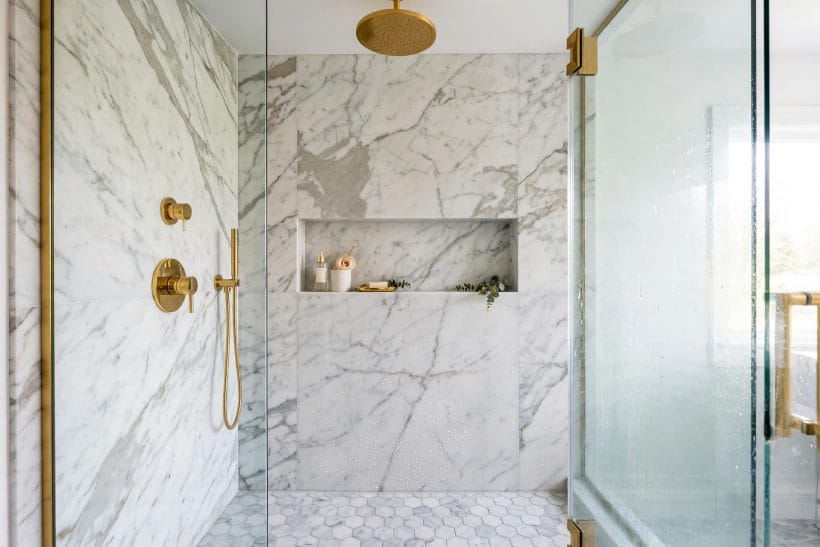
The vanity is where marble meets the day’s rituals — toothpaste, razors, hot hair tools — and where its tolerance is tested in small, daily ways. This section covers tops, basins and splashbacks, and the honest housekeeping each arrangement implies.
34. The one-piece marble vanity top
A stone top with an integrated or undermounted basin gives the cleanest line and the fewest dirt traps. Water rings and toothpaste are wiped as they happen; that small habit is the top’s whole care regime.
35. Vessel basins on a marble slab
A bowl basin sitting on a stone slab makes sculpture of the washstand. The slab takes the splashes, so its sealing matters; the bowl’s height must suit the shortest user, checked before anything is fixed.
36. The marble splashback panel
A stone upstand or full panel behind the basins protects the wall and carries the veining up to the mirror — the single most photographed vanity arrangement in this survey.
37. Twin basins in one stone field
Two basins set into one long marble top read calm and hotel-like. The middle stretch becomes shared counter, which households either love or negotiate; the stone is neutral in the dispute.
38. A marble shelf instead of a top
In a small bathroom, a stone shelf with a wall-hung basin beneath gives marble’s presence without a full vanity unit — the renter-adjacent, budget-honest version of the look.
39. Dark marble vanity, pale room
A deep green or charcoal stone top anchors an otherwise white bathroom and hides the day’s small marks better than pale stone does. The contrast is the design; everything else can stay quiet.
40. Marble and painted cabinetry
Painted vanity units — sage, ink, soft black — ground the stone and let the top stay pale. The paint carries the colour commitment, which is cheaper to change than the marble ever will be.
41. Marble and timber vanities
Warm wood under cool stone is the pairing that stops marble feeling like a hotel corridor; the materials section develops it, and this arrangement is its most useful place.
42. The wall-hung basin with marble behind
No unit at all: a basin on a marble-clad wall, with storage elsewhere. The floor stays clear and cleanable, and the stone panel becomes the room’s whole vanity statement.
43. Mirrors framed by the stone
Where the splashback runs full height, mirrors sit on the marble itself — a layered, architectural look that wants simple mirror shapes so the veining remains the pattern.
44. The guest-bathroom marble moment
A small cloakroom basin on a marble offcut gives guests the material’s pleasure in miniature. Offcuts from larger jobs are the honest route to this photograph, and stone yards are the place to ask.
6. Pairings: What Marble Lives With
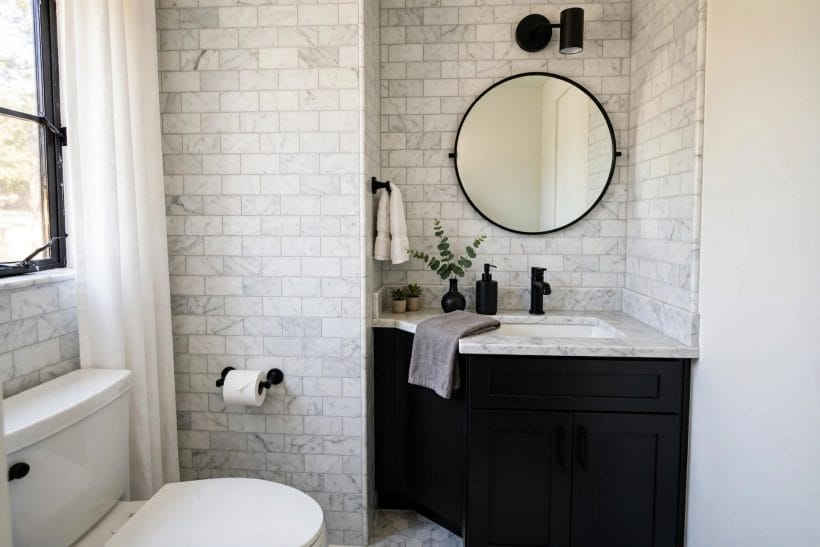
Marble never appears alone: metals, timber, paint and textiles decide whether it reads cool or warm, formal or friendly. This section is the pairing grammar for the whole survey, drawn tightly so the room-style lanes linked from the glance keep their own depth.
45. Marble with brass and bronze
Warm unlacquered metals take marble’s chill away and age alongside it — both materials patina, and the room improves with use. The classic pairing for traditional and transitional bathrooms alike.
46. Marble with chrome
Chrome keeps marble crisp, cool and architectural — the pairing of hotels and modern-classic rooms. It asks for the room’s warmth to come from textiles and timber instead.
47. Marble with matte black
Black fittings draw marble’s grey veins into a deliberate graphic scheme. Use it where the light is good; in a dim room the contrast can turn stark rather than smart.
48. Marble with oak and walnut
Timber is marble’s oldest partner: oak lightens the scheme towards Scandinavian calm, walnut deepens it towards the library register. Either way, the wood supplies the temperature the stone withholds.
49. Marble with painted walls
Above a marble wainscot or beside a stone floor, painted plaster in a soft colour lets a bathroom change mood for the price of a tin — the flexible half of a permanent material.
50. Marble with patterned tile elsewhere
If a floor or a niche carries pattern, let the marble be the plain partner, and the reverse. Stone and busy tile competing is the pairing mistake this survey sees most; one star per room is the rule.
51. Marble with linen and waffle cotton
Natural textiles soften marble’s formality at the touchpoints — towels, blinds, a bath mat with texture. The room’s hardness is all in its surfaces; its softness must be imported deliberately.
52. Marble with plants
Green is marble’s living contrast: a fern on the vanity, a trailing plant on the shower’s dry ledge. Choose plants that forgive bathroom humidity and keep them clear of the stone’s sealed faces when watering.
53. Marble with warm lighting
Warm-toned light flatters white marble towards cream in the evening; cold light sharpens it towards blue-grey. Judge the stone under the bathroom’s actual evening bulbs before committing, exactly as a paint colour is judged.
54. Marble with dark grout — or pale
Grout is a pairing decision in disguise: pale grout keeps marble fields seamless and calm, dark grout grids them into pattern. The same tile photographs as two different bathrooms depending on this one quiet choice.
55. Marble with colour, used once
A single coloured note — a deep green vanity, a rust towel, a blue glass vase — gives cool marble something to be calm against.
7. Small Bathrooms, Ensuites and Tiny Versions
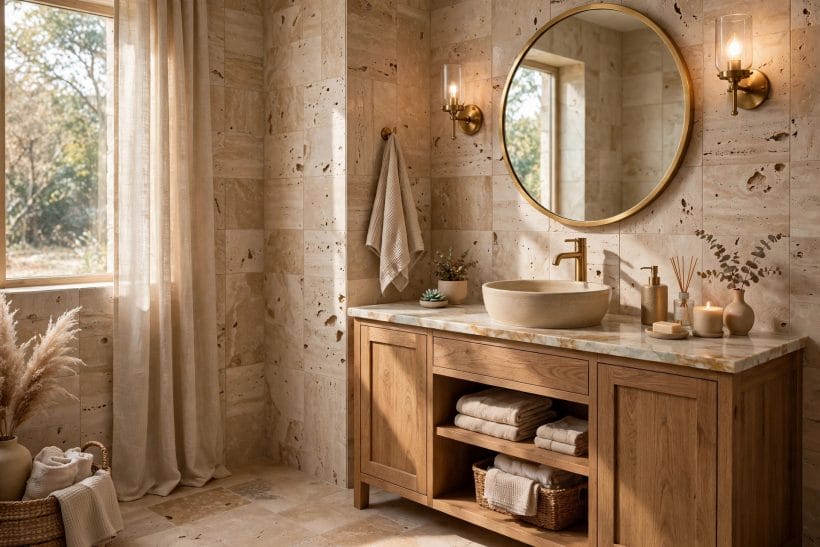
Small rooms are marble’s surprising stronghold: pale stone returns light, large formats reduce visual clutter, and one material carried through a tiny volume makes it read as a single calm object. The site’s wider small-room discipline runs through the bathroom ideas pillar; here it is applied to stone alone.
56. Pale marble to borrow light
In a windowless ensuite, pale marble and marble-look surfaces bounce what light there is from wall to wall. Glossier finishes borrow more light and ask more care; the balance is the room’s own decision.
57. Large tiles in a small room
Fewer grout lines mean a calmer small room — the counterintuitive truth that big formats suit tiny bathrooms. Keep the veining’s scale in proportion, and let one wall carry the drama.
58. The marble-clad shower niche wall
In a compact shower room, stone on the one wall the eye meets at the door upgrades the whole volume for a fraction of a full envelope’s material.
59. A marble shelf as the only stone
One true marble shelf above a plain basin gives a small bathroom its single luxurious note — honest, affordable, and enough. Small rooms reward one real thing over five imitations.
60. Wall-hung everything on marble-look tile
A tiny ensuite in marble-look porcelain with wall-hung fittings maximises clear floor and minimises cleaning corners — the tiny-house bathroom’s working formula, borrowed gladly by small flats.
61. Marble floor, mirror wall
Stone underfoot and a full mirror above the basin double a small room’s apparent depth. It is an old hotel trick and it survives because it works every single time.
62. The corner basin on a stone ledge
Corner fittings in a tight plan gain dignity from a shaped marble ledge beneath them; the stone offcut makes the compromise look chosen rather than forced.
63. Monochrome marble in the tiny ensuite
One pale stone, one metal, white textiles: a small room in a single register reads serene rather than sparse, and marble’s veining supplies all the pattern the volume can hold.
64. Marble-look in rentals and first homes
Where budgets or landlords rule out stone, marble-look porcelain and even quality vinyl give the register honestly — labelled as what they are, chosen for their own merits, and photographed here without apology.
65. The downstairs cloakroom jewel
The smallest room becomes the house’s marble showcase precisely because it is small: a stone floor, a stone splashback and one good mirror, and guests remember the little room longest.
8. Character Marble: Colour, Age and the Rooms That Break the Rules
The last ten step outside the white-and-grey canon: coloured stones, salvaged pieces, bathrooms where marble plays a supporting role, and the heritage rooms where its age is the point. None of them breaks the care discipline — character is not an exemption from sealing.
66. Green marble, the deep register
Verde marbles bring the forest into the bathroom: dramatic, forgiving of marks, and happiest with brass and warm light. A single wall or vanity is usually enough of its richness.
67. Pink and rose marble
Rose-toned stone flatters skin and lamplight and pairs with cream rather than stark white. It is the romantic register, and in small doses — a top, a niche — it charms without sweetening.
68. Salvaged marble, honestly reused
Old washstand tops, hearth pieces and threshold stones carry a century’s soft wear no new slab can fake. Reuse asks a stone yard’s help with cutting and edges, and rewards it with provenance.
69. Marble mixed with terrazzo
Terrazzo’s chips are marble’s extended family; the two together — stone walls, terrazzo floor — give pattern at two scales that harmonise because they share a geology.
70. The marble bath surround in a heritage room
In a period bathroom, a marble bath panel and stone floor honour the house’s own era; keep modern fittings quiet and let the room’s age lead the styling.
71. Marble as the only luxury
A plain, even humble bathroom with one marble element — a top, a sill, a shelf — demonstrates the material’s economy of effect: marble does not need company to register.
72. Book-matched marble behind a bath
The mirrored-vein treatment moved to the bath wall: the room’s single picture, framed by plain surfaces on every other side. Drama rationed is drama kept.
73. Marble with black and white checkerboard
The classic checkerboard floor is often marble itself — the traditional bathroom floor that predates every trend in this survey and will outlast them, cleaned and sealed like any other stone.
74. Outdoor-adjacent and garden bathrooms
Stone suits the semi-outdoor bathroom — a garden shower room or a bath court — where its coolness is a pleasure and its weathering is part of the design brief.
75. The marble that stays
The closing idea is a discipline rather than a photograph: marble chosen once, in the room’s own light, at a scale the household will actually maintain, outlasts every trend cycle this survey could catalogue — the stone is patient, and rewards households that are too.
9. Checks and Mistakes: Before the First Purchase or the First Stone
Check the stone before it is bought, in the light it will live in: marble’s colour shifts between the yard, the showroom and a north-facing bathroom, and a sample carried home is worth more than any photograph — including the seventy-five in this survey. Check the finish against its place, too: polished stone proposed for a wet floor is the classic marble mistake, and it is made at the ordering desk, not on site.
Keep the care rules in front of every layout. Real marble is sealed, cleaned with gentle, stone-safe products, and kept away from vinegar, lemon and abrasive scourers; etching and staining are chemistry, not bad luck. Waterproofing, drainage falls and the fixing of heavy stone are professional work under local rules, stated generally here — the individual room, its substrate and its plumbing decide the details, and a tiler and plumber, not a survey, carry that responsibility.
The commonest design mistake is competition: marble, patterned tile, busy wallpaper and ornate fittings all starring at once, so the stone’s own veining — the reason it was chosen — is lost in the noise. The second is scale: veining too large for a small wall, or mosaics proposed where a calm slab was needed. The third is forgetting the grout, which can grid a seamless stone field into a spreadsheet or settle it into calm, depending on one quiet colour choice.
10. Costs and Pulling It Together
Costs need no invented figures: marble’s economics are a ladder the reader can price locally — marble-look porcelain at the foot, real tile in the middle, slab and book-matched work at the top — with installation, sealing and care riding on every rung. The honest comparison is never stone against stone alone; it is the material plus its fitting plus its upkeep, over the years the household expects to keep it, against the plainer surface it replaces.
Pull the survey together as one sentence: choose the stone in the room’s own light, place it where eyes and hands actually meet it, pair it with one warm partner, and accept its small care discipline as the rent on its beauty — and a marble bathroom will outlast every trend that passes through the rooms around it. The wider map gathers under home design ideas, where the bathroom pillar and its material lanes all sit in one place.
Final Considerations
Marble’s long history in bathrooms is not an accident of fashion: it is cool where bathrooms are warm, calm where they are busy, and honest about its age in a way that printed surfaces never quite manage.
So begin with one surface, chosen slowly — a vanity top, a shower wall, a small room’s floor — and live with real stone before extending it. Marble rewards the household that commits to it properly far more than the one that covers every wall at once, and the first surface, well kept, is the argument for all the rest.

0 Comments