

Deciding between a brand-new build and a second-hand tiny home is the first fork in the road for most buyers, and new vs used tiny house buying is rarely the simple price comparison it looks like from the listings. A new tiny house arrives with a warranty, a known history and a layout chosen for your life, but it asks you to wait through a build queue and pay for every upgrade. A used tiny house can be parked on your land within weeks and often costs noticeably less up front, yet every system inside it carries the previous owner’s habits, maintenance record and shortcuts. Neither route is automatically smarter. The right answer depends on how much risk you can inspect, how much time you can wait, and how closely the home in front of you matches the way you actually live.
This guide walks through the comparison the way an experienced buyer would: side by side, system by system. We will weigh the sticker price against the hidden costs behind it, look at where condition risk really hides in a small home, and explain what a builder warranty does and does not cover. You will also find a hands-on inspection checklist you can take to any used viewing, plus honest notes on custom fit, move-in speed, financing and resale. By the end, you should know which questions to ask of any listing — and which answers should make you walk away.
New vs Used Tiny House Buying at a Glance
The table below sums up the head-to-head differences. Use it as a quick filter, then read the sections that match your biggest worry — for most buyers that is condition risk and the true cost of repairs in the first year.
| Criterion | New Tiny House | Used Tiny House |
|---|---|---|
| Upfront price | Higher; you pay for new materials, labour and builder margin | Lower; the first owner absorbs the steepest depreciation |
| Condition risk | Low and predictable; everything starts unworn | Variable; wear, water damage and DIY shortcuts may be hidden |
| Warranty cover | Builder and appliance warranties usually included | Often expired or non-transferable; bought as seen |
| Custom fit | Layout, finishes and systems chosen by you | Fixed; you adapt to the previous owner’s choices |
| Move-in speed | Weeks to months of build and delivery time | Often days to a few weeks once payment clears |
| Inspection burden | Snagging list and handover checks | Full top-to-toe inspection essential before you commit |
| Financing and insurance | Easier to document value and specifications | Valuation and history can be harder to prove |
| First-year costs | Mostly planned extras and furnishing | Budget for repairs and replacements from day one |
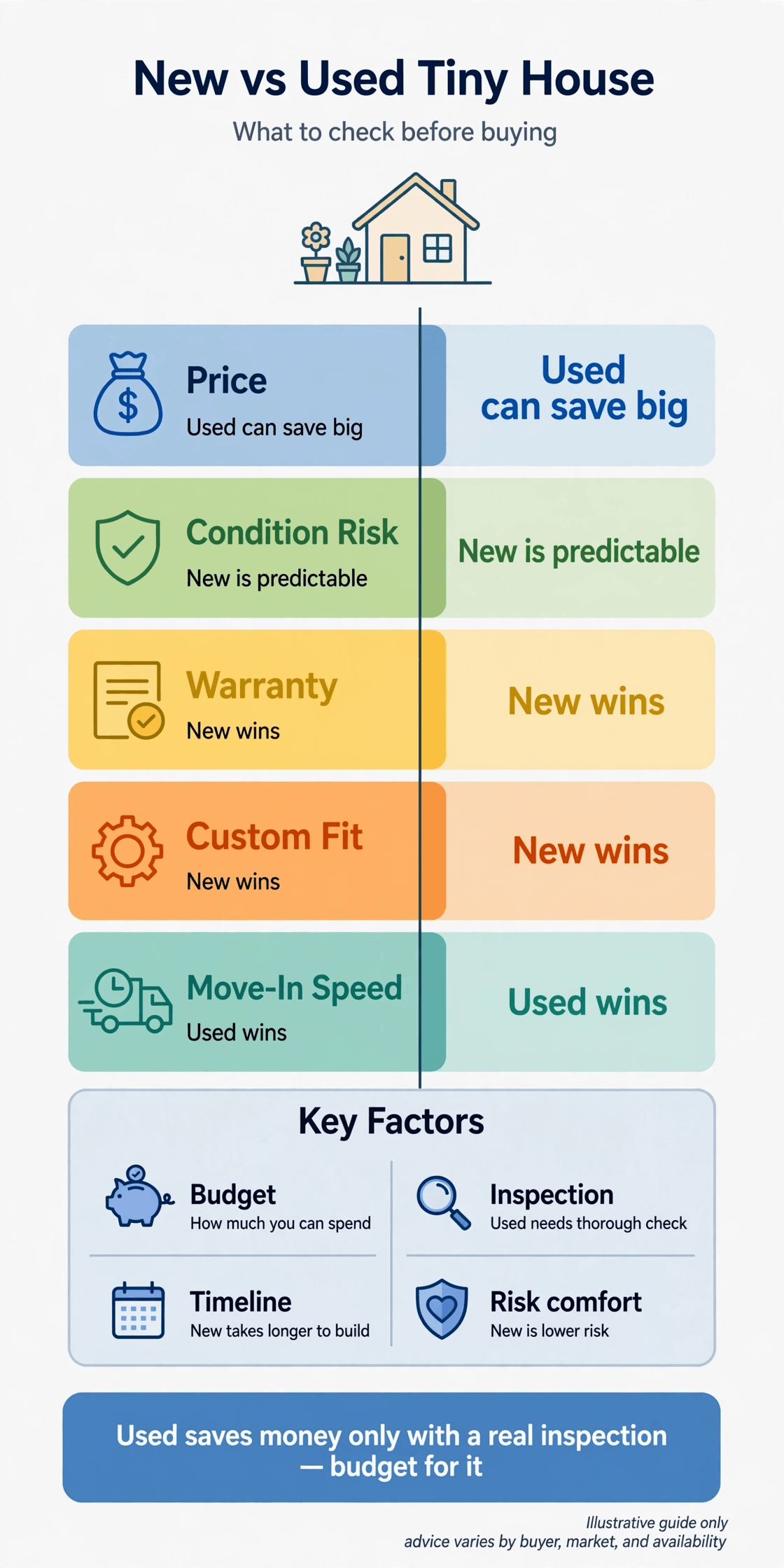
1. Price: What the Sticker Covers on a New Build vs a Used Listing
A new tiny house price is mostly transparent. The quote normally bundles the trailer, the shell, insulation, interior fit-out and the appliances the builder fits as standard, and every extra — a bigger water tank, a washer-dryer, upgraded windows — appears as a line you can accept or refuse. That clarity is valuable, but it also means the figure you first fall for is rarely the figure you pay. Delivery, siting, utility connections and the groundworks for your parking spot all sit outside the build quote, and they apply to both routes.
A used listing looks cheaper because the first owner has already absorbed those early costs and the steepest drop in value. Browse current listings alongside our overview of finding tiny homes for sale locally and you will see how wide the spread can be for homes of similar size. The catch is that a low asking price sometimes reflects work the seller knows is coming: tired tyres, a soft floor patch or an ageing water heater. Treat the gap between new and used prices as your repair budget until an inspection proves otherwise, not as money saved.
2. Condition Risk: Where Wear Hides in a Small Home
Condition risk is the single biggest difference between the two routes, because a tiny house concentrates every system into a few square metres. A slow plumbing leak that would stain one corner of a conventional house can rot a large share of a tiny floor. Water is the enemy to hunt for first: staining under sinks, soft spots around the shower, swollen trim at the base of walls and any musty smell that airing the home does not clear. On a new build, that history simply does not exist yet — materials start dry, seals are fresh and you are the first person to cook, shower and heat in the space.
On a used home, work from the trailer up. Surface rust is normal; deep corrosion around the hitch, cracked welds and perished tyres are not. Check the axle rating against the home’s weight — our guide to choosing trailer axles for a 14,000 lbs tiny house explains why underrated running gear is expensive to put right. Inside, run every tap, flush the toilet, fire the heater and open every window. A seller who welcomes that level of testing is telling you something; a seller who rushes you is telling you something else.
3. Warranty Cover: What a Builder Promise Actually Protects
A new tiny house usually carries two layers of protection. The builder’s warranty covers workmanship — the structure, the roof, the fit of doors and windows — for a defined period, while manufacturers cover individual appliances such as the heater, fridge and water pump. Read the wording before you rely on it. Some warranties shrink or vanish if the home is towed frequently, lived in full-time rather than used recreationally, or modified by anyone other than the builder. Ask who handles a claim if the builder stops trading, because a warranty is only as strong as the business standing behind it.
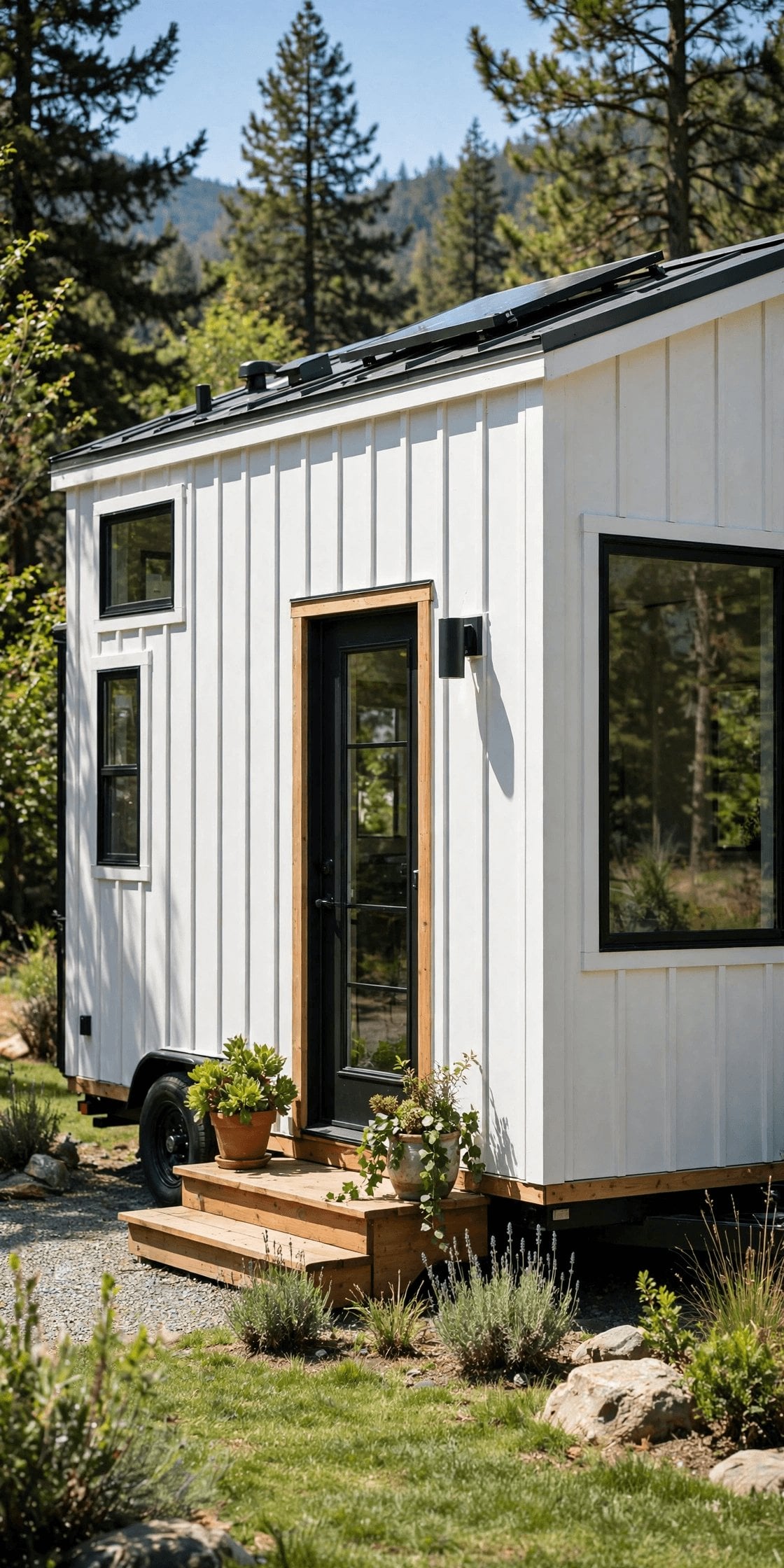
A used tiny house normally comes with none of that. Appliance warranties may still be running if the home is young, so ask for manuals, receipts and any transfer paperwork, but assume you are buying as seen. That is not a reason to avoid used homes — plenty are sold simply because a family grew or a job moved — but it changes the maths. The price should leave room for the failures a warranty would have caught, and an independent inspection matters far more when no one will fix problems for free after the sale.
4. Custom Fit: Designing Around Your Life vs Adapting to Someone Else’s
Order new and the home bends around your routines. Desk or no desk, bath or shower-only, a downstairs bedroom or a loft, storage stairs instead of a ladder — the layout conversation happens before a single board is cut. That freedom matters most to people with non-negotiable needs: a tall partner who needs headroom, a remote worker who needs a real office corner, or anyone planning to age in the home and avoid climbing at night. Custom fit also means systems sized for your climate and your power supply, not inherited compromises.
A used home asks you to adapt, and the honest question is how much adapting you will still enjoy in year three. Many layouts are sensible, because builders reuse floor plans that work, and small mismatches — a kitchen counter at the wrong height, storage in the wrong place — can be fixed with modest joinery. What cannot be fixed cheaply is the shell itself: ceiling height, window positions, the bathroom footprint and where the door swings. View a used home with a tape measure and your largest furniture dimensions written down, and judge the fixed bones, not the seller’s styling.
5. Move-In Speed: Build Queues, Delivery Slots and Ready Homes
Time is where the used route wins outright. A completed used home can change hands in days, and once payment, paperwork and transport are arranged, you could be making tea in it within a few weeks. For buyers escaping a rental deadline, relocating for work or parking on land that is ready now, that speed can outweigh every other factor. The home exists, you can stand in it, and the timeline has very few moving parts.
A new build runs on the builder’s calendar, not yours. Popular builders book out months ahead, and the build itself then has to survive material delays, inspection stages and a delivery slot that suits both the transporter and your site access. None of that is a flaw — a careful build takes the time it takes — but it means the new route suits buyers whose housing situation is stable while they wait. If you choose new, get the completion terms in writing, ask what happens if the date slips, and keep your current living plan flexible until the delivery is confirmed.
6. The Inspection Checklist: What to Check on Any Used Tiny House
If you take one tool to a used viewing, take this checklist — and a torch, a moisture meter if you can borrow one, and enough time to use them. Our step-by-step walkthrough of how to inspect a used tiny home before buying goes deeper on each area; the list below is the version to work through on the day.
- Trailer and chassis: rust depth, weld cracks, tyre age and wear, lights, brakes and hitch condition
- Roof and exterior: seam sealant, flashing around vents, siding damage and any signs of past leaks
- Water ingress: staining, soft flooring, swollen trim and musty smells, especially under the shower and sinks
- Plumbing: run every tap, check pressure, look for leaks and ask which pipe material was used
- Electrics: test every socket and light, ask for any certification and check the consumer unit
- Heating and ventilation: fire the heater, check flues and look for condensation or mould in corners
- Windows and doors: open and close everything; look for blown seals and frames that no longer sit square
- Paperwork: title or bill of sale, service receipts, appliance manuals and any warranty transfer documents
Two areas deserve extra patience. Plumbing first: the choice between PEX and copper piping in a tiny house affects how easily lines can be repaired or protected from freezing, so note what is fitted and where the runs are accessible. Structure second: framing that has twisted or settled after towing can show up as doors that bind and cracks at the corners, and those are negotiating points at best and walk-away faults at worst. Photograph everything, write down every fault while it is fresh, and price the repairs before you make an offer — not after.
7. Financing, Insurance and Paperwork: Proving What the Home Is Worth
Money lenders and insurers like paperwork, and a new tiny house generates it naturally: a builder’s invoice, a specification sheet and a clear statement of what the home is and what it cost. That trail makes valuation simpler whether the home is treated as a vehicle, a structure or personal property in your area — categories vary widely, so confirm how your lender and insurer classify tiny houses before you commit to either route. A used home can absolutely be financed and insured, but expect to work harder to evidence its value and condition.
Paperwork is also where used purchases carry a quiet risk: ownership history. Ask for the title or a bill of sale that matches the seller’s name, check for any outstanding finance attached to the home or its trailer, and make sure the sale documents describe the home accurately, including its trailer identification where one exists. On a new build, keep every stage payment receipt and the final handover documents together; they become the history file that supports your own resale later. Whichever route you choose, never let the excitement of the viewing outrun the documents — a home you cannot prove you own is a problem no discount can fix.
8. First-Year Running Costs: Planned Extras vs Inherited Repairs
The first year in a new tiny house tends to cost what you planned: furnishings, curtains, perhaps skirting and the small tools every new home demands. Systems are under warranty, seals are tight and insulation performs as specified, so heating bills follow the design rather than the previous owner’s habits. If you want to predict those bills, the insulation specification is the number to study — our comparison of spray foam, rockwool and sheep’s wool insulation for tiny houses shows how much the choice changes winter comfort.
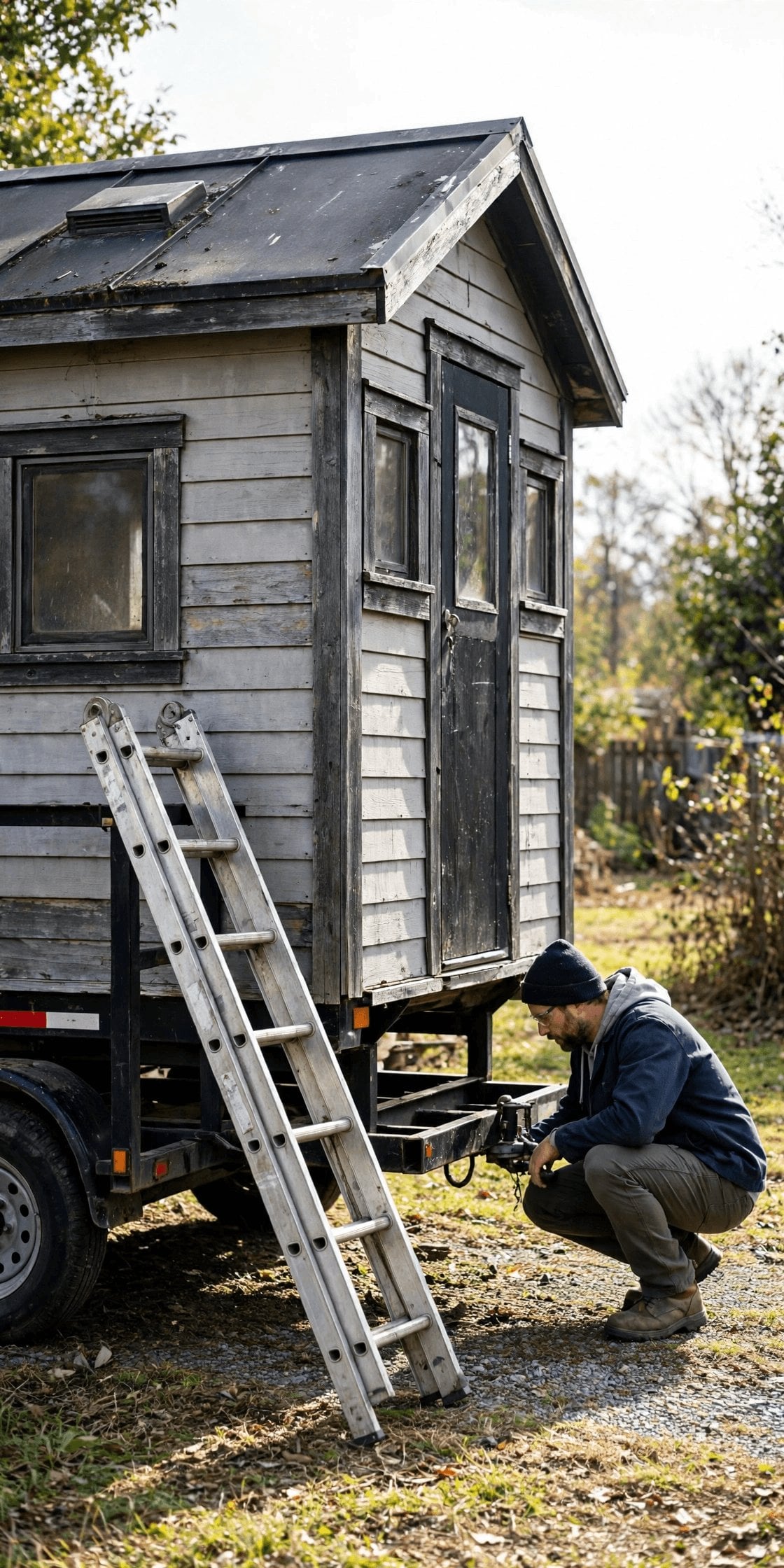
A used home front-loads its surprises into that same first year. Budget honestly for the unglamorous list: resealing the roof seams, servicing the heater, replacing perished window seals and refreshing tired flooring. Exterior joints deserve early attention, because sealing and weatherproofing sill plates and corners is cheap insurance against the water damage that quietly writes off small homes. None of this makes a used purchase a mistake — a well-kept three-year-old home may need nothing but a service — but the discount you negotiated should sit in a repair fund, not be spent, until the home has lived through all four seasons with you.
9. Resale and Depreciation: How Each Route Holds Its Value
Tiny houses do not follow one tidy depreciation curve, because condition, builder reputation and local demand all pull at the price. A new home from a recognised builder tends to hold value better in its early years: the brand reassures the next buyer, the specification is documented and the warranty story is easy to tell. A no-name build of identical quality may lose more, simply because buyers cannot verify what they cannot research. If resale matters to you, that paperwork trail is an asset in its own right.
Buying used is, in effect, letting the first owner pay for that early drop. A well-maintained used home bought at a fair price can hold its value remarkably well from that point on, especially if you improve the documented weak spots — fresh seals, serviced systems, tidy records — during your ownership. The risk sits at the other end: an old home with unknown history and visible wear narrows your buyer pool to bargain hunters. Either way, the homes that resell best share the same traits: dry, documented, legally easy to move and honest about their age.
10. Off-Grid Fit: Power, Water and Waste on Both Routes
If your tiny house will live away from hookups, judge both routes by their systems, not their styling. A new build lets you specify off-grid hardware from the start: a solar array and battery bank sized for your loads, a water tank that matches your stays, and a toilet system that suits your land and local rules. Everything is wired and plumbed as one design, which makes later troubleshooting far simpler. Our guide to tiny house utilities for off-grid power, water and sewage lays out the combinations that work together.
A used off-grid home can be a bargain or a bundle of compromises, and the difference is in the details. Batteries age whether they are used or not, panels lose a little output each year, and a previous owner’s power budget may be half of yours. Ask for the system’s age, its real capacity today and the receipts for any replacements, then test the home unplugged if the seller allows it. A used home with a young, well-documented system is a genuinely good buy; one with tired batteries priced as if they were new is not.
Final Considerations
So, who should pick which? Choose new if your budget stretches to it, your timeline can absorb a build queue, and you value a warranty, a documented history and a layout shaped around your life — especially if you plan to keep the home for many years or live in it full-time. The higher price buys certainty, and for many buyers that certainty is the product.
Choose used if speed matters, the local market has well-kept homes listed fairly, and you are willing to inspect hard, negotiate on evidence and hold a repair fund for the first year. A dry, documented used home from a careful owner can be the best value in tiny living. Whichever side you land on, let the checklist — not the listing photos — make the final decision, and walk away from any home, new or used, whose seller cannot answer straight questions about its history, its systems and its paperwork.


0 Comments