

A weekend retreat asks a different question from a full-time home. It does not need to be perfect every day; it needs to be wonderful on Friday night, easy on Sunday morning and untroubled while you are away from it for weeks at a time. For many people that choice narrows to two beloved shapes, and the tiny house vs cabin debate is really about whether your escape should be a place or a vehicle for reaching places. A tiny house promises a retreat that can change its view. A cabin promises a retreat that deepens in one view, year after year, until the path to its door feels like part of your own memory.
Both deliver the essential retreat ingredients: smallness, simplicity, a fire or a view and a decisive break from the weekday world. They differ honestly in mobility, upfront cost, comfort and space, in what they ask of land and officials, and in how they behave when the time comes to sell. This comparison is written for the second-home decision specifically, not the full-time one, because a building used forty weekends a decade is judged by different standards from a building used every day. Read it with your own Fridays in mind, and by the final verdict you should know which shape your escapes actually want to take.
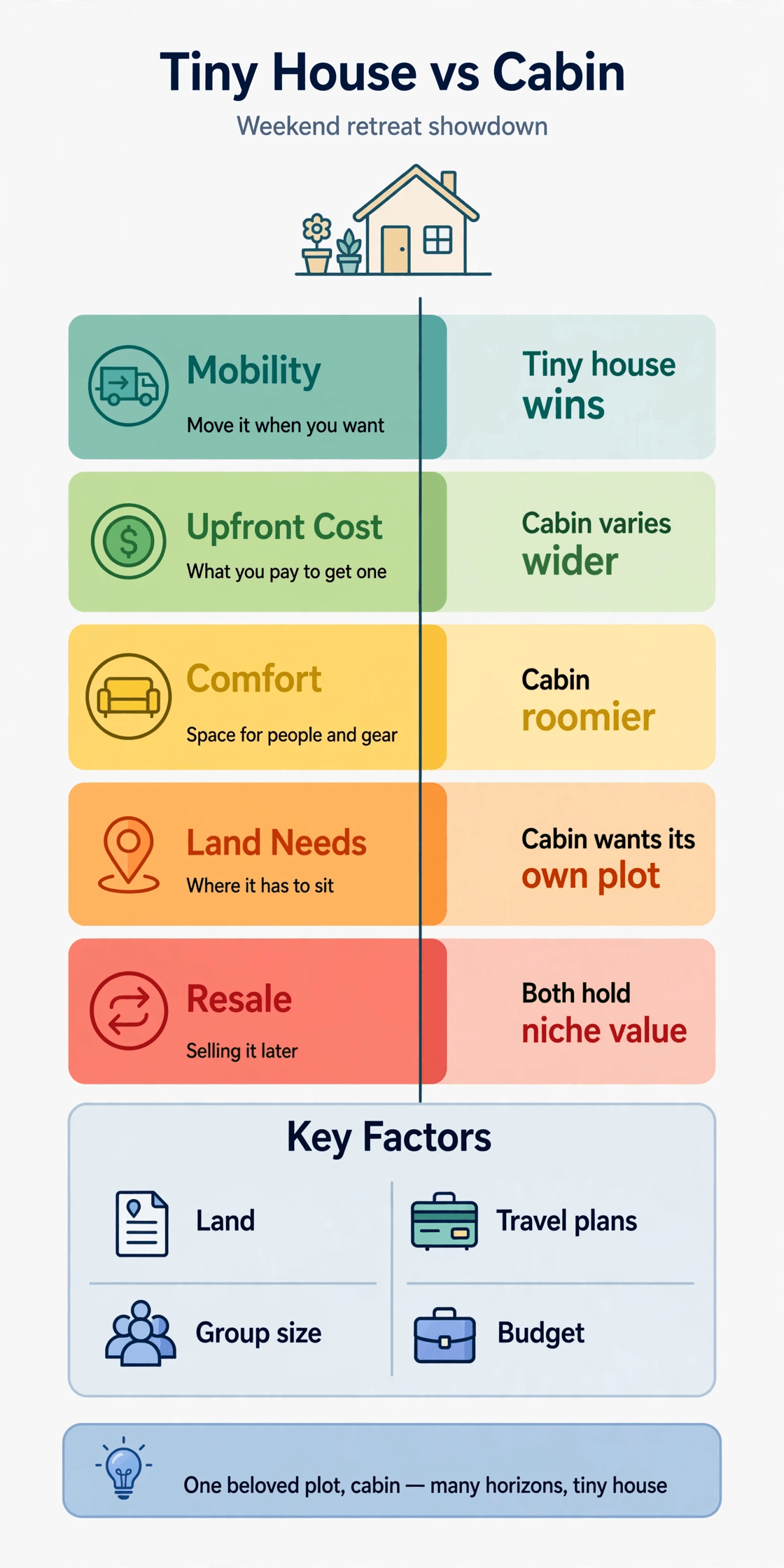
Tiny House vs Cabin at a Glance
| Criterion | Tiny House | Cabin |
|---|---|---|
| Mobility | High for wheeled models: the retreat can move sites or sell anywhere | None in practice: the cabin belongs to its plot |
| Upfront cost | One purchase, finished and ready; land can come later or change | Build or buy plus the land itself, committed from the start |
| Comfort and space | Compact and clever; sleeps few, gathers fewer | Usually roomier; real beds, a table for everyone, a porch |
| Land needs | Minimal: a pad, a friend’s field, a rented pitch, subject to rules | A plot of your own, with access, services and permissions |
| Resale | Sold as an object to a wide market; condition is everything | Sold with land as a property; value follows the location |
| Guests and gatherings | Intimate; best for couples and very close friends | Social; room for family, children and traditions to form |
| Winter readiness | Small volume heats fast; systems need frost care when empty | Mass and space forgive more; classic cold-arrival ritual |
| Best suited to | Restless explorers, land-not-yet owners, minimalists | Place-lovers, families, and keepers of one beloved landscape |
1. Two Kinds of Escape: A Home That Can Travel, a Place That Waits
The tiny house retreat is built around a radical idea: the escape does not have to be a destination you own, only a home you take with you. On its trailer it can winter near skiing and summer by a lake, sit on rented land while you search for your own, or serve as a guest house, a studio and a starter home across different chapters of one life. Its owners tend to talk about freedom in terms of options, because the building itself never forecloses any. Even parked semi-permanently, it keeps one foot in the future, and that quality colours every other decision about systems and setup, as the whole-picture planning in our tiny house utilities guide to power, water and off-grid sewage makes clear.
The cabin is built around the opposite, equally radical idea: return. Same bend in the river, same neighbour, same light through the same trees, with your family’s history slowly soaking into the floorboards. A cabin’s value compounds emotionally in a way no mobile object can match, because the place and the building become a single thing in your mind. Owners talk about freedom too, but they mean freedom from deciding: the retreat is simply there, stocked, known and waiting, its routines worn smooth by repetition. Neither philosophy is the mature one. They are different answers to the question of what a person is actually escaping to, novelty or belonging.
2. Mobility: Hook Up and Go Against Rooted in One Place
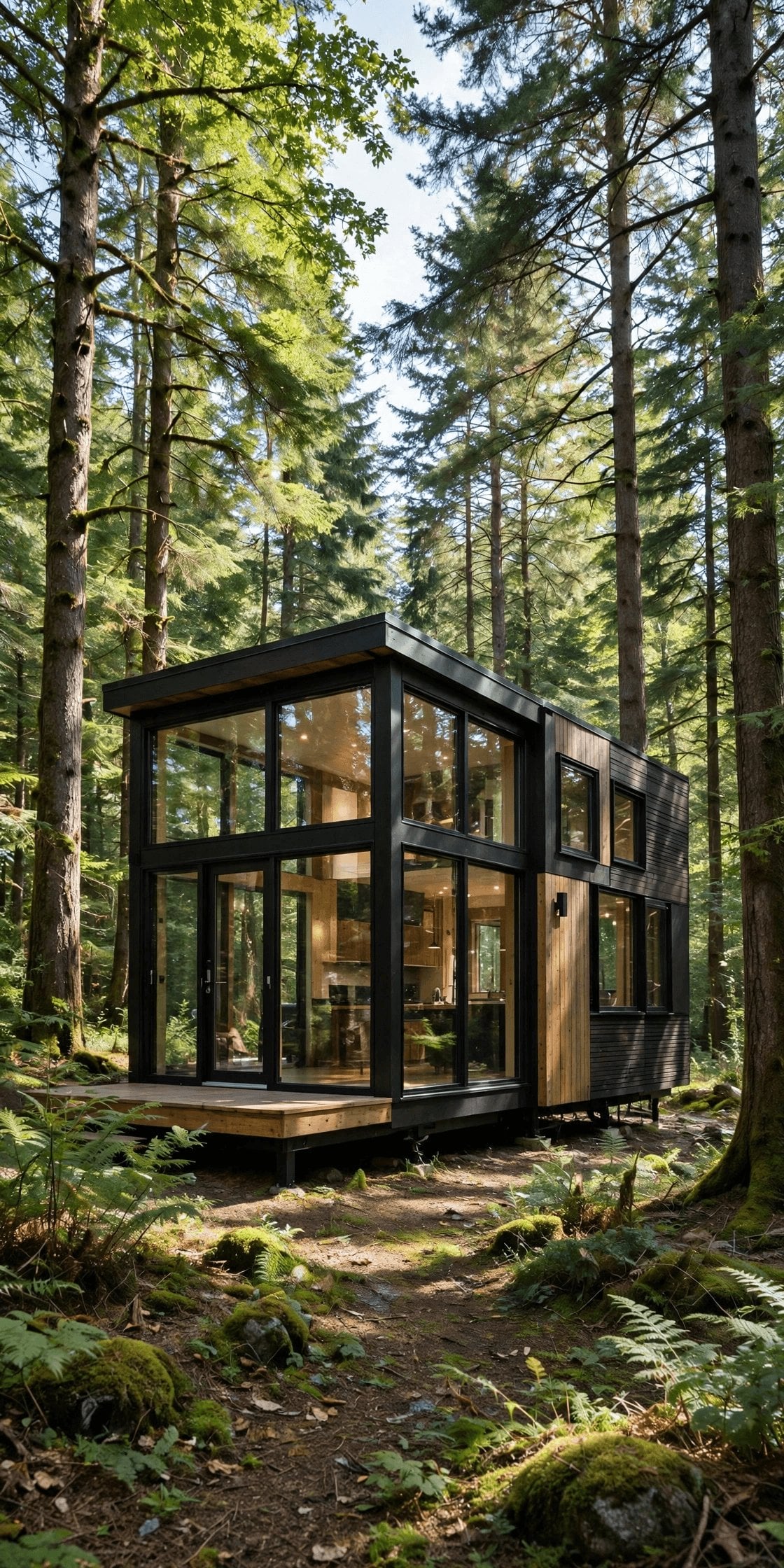
Mobility is the tiny house’s headline, and for retreat use it has a particular shine. Plans change across a decade of weekends: a favourite area becomes crowded, a new region calls, family moves, or the land you borrowed is sold. A wheeled tiny house answers all of that with a tow vehicle and a weekend of work. It can also earn its keep between escapes in ways a fixed cabin cannot, housing a guest at home, sheltering a relative through a transition, or being sold into an entirely different market from the one you bought it in. The retreat that can leave is never trapped by its own geography.
Honesty requires the footnote, though. Most wheeled tiny houses move rarely, because moving one is a genuine operation involving weight, route, tyres, brakes and a fresh legal place to land, and many owners discover they love one site as faithfully as any cabin owner. The cabin, meanwhile, converts its immobility into virtues this comparison will keep meeting: it can be bigger, heavier, cheaper per square foot and connected to permanent services precisely because it never has to travel. Mobility, then, should be priced as an option you might use rather than a feature you definitely will. If you can name the circumstances that would make you move your retreat, the tiny house’s premium in compromises is probably worth paying. If you cannot, you may be buying flexibility to admire rather than to use.
3. Upfront Cost: Finished Tiny Houses Against Cabin Kits and Builds
The tiny house usually presents the simpler invoice. One finished object, bought outright or built for a knowable total, and, crucially, no land purchase is forced into the same transaction. Owners can spread the two big decisions across years: house now, land later, rented or borrowed ground in between. That sequencing is the tiny house’s real financial superpower for retreat buyers, whose budgets often arrive in stages. Against it stands the discipline that the finished price is the finished price only if systems, delivery and siting were included, a warning this site repeats because it is the most common way small-home budgets quietly double.
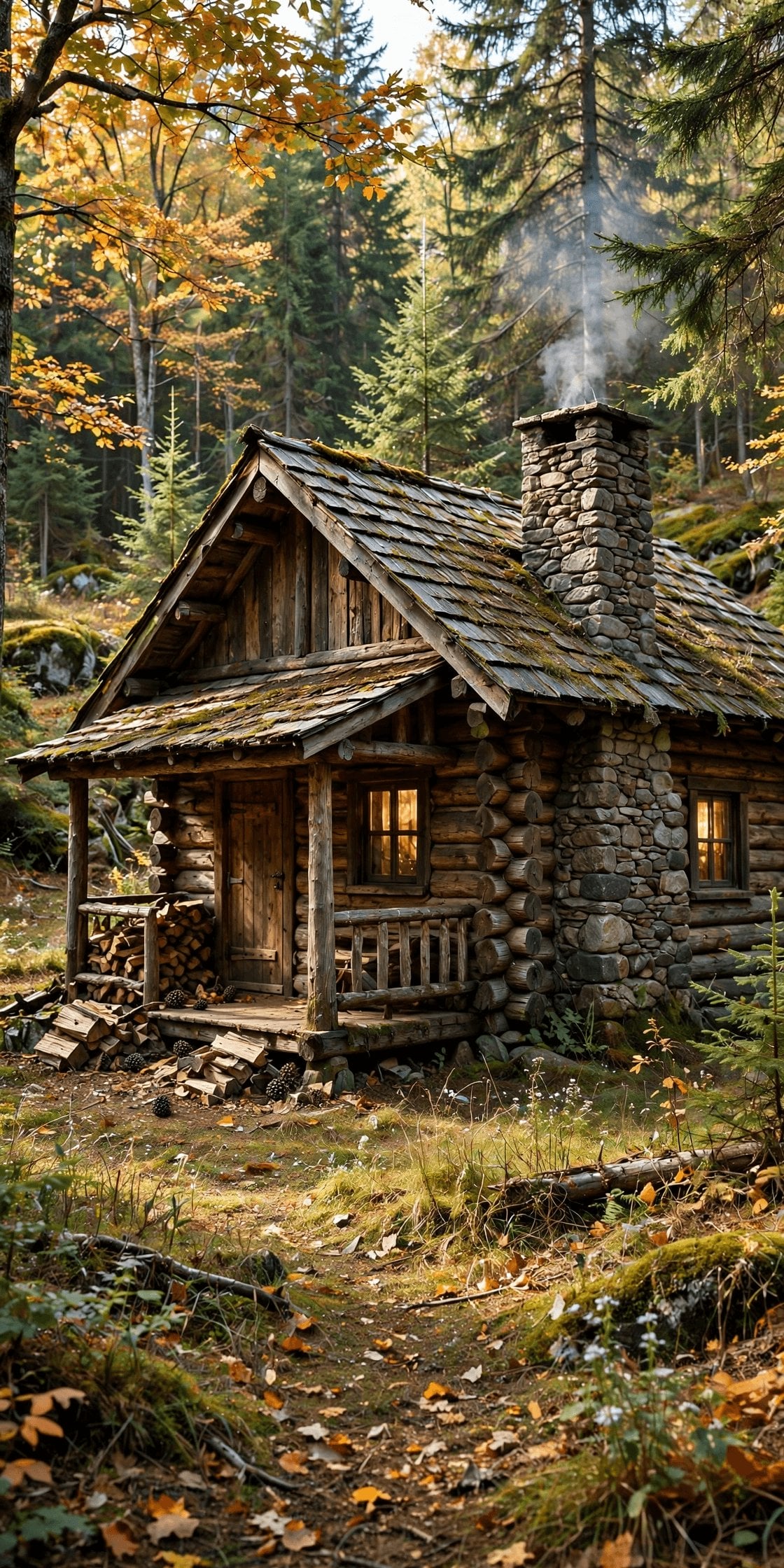
A cabin’s cost story has two chapters: the plot and the building. Land can be the bargain of a lifetime in a place nobody else has noticed, or the dominant cost in anywhere beloved, and its price does not care how humble the cabin on it will be. The building itself is often cheaper per unit of space than a tiny house, especially as a self-built or kit project using conventional methods, because nothing must be engineered to travel. Cabins also welcome phased improvement beautifully: weathertight this year, plumbed next, porch when there is money. Comparing totals fairly means comparing complete retreats, building plus legal ground to stand on, and browsing tiny homes for sale, from budget used models to new turnkey builds will anchor what the mobile half of that equation really costs in the current market.
4. Comfort and Space: Compact Efficiency Against Room to Spread Out
A tiny house retreat is comfortable the way a well-designed boat is comfortable: everything within reach, every surface earning its place, two people moving in an unspoken choreography. For a couple whose weekends are spent outdoors, that snugness is not a compromise at all; the building is a sleeping, cooking and shelter machine, and the landscape provides the living room. Its limits appear precisely when the retreat must absorb weather or people: a rained-in day with restless occupants, a third adult, a dog the size of a small sofa. Then the cleverness stops feeling like design and starts feeling like negotiation.
A cabin plays a longer game. Real rooms, or at least real corners, a table that seats the whole party, muddy-boot space by the door and beds that are beds rather than conversions: these are the comforts that make a retreat work across decades, family sizes and seasons. The space also changes the social mathematics, because a cabin can host the gatherings around which traditions form. None of this requires a large cabin; it requires only that the building was sized for lingering rather than merely sleeping. The plumbing follows the same logic, with permanent bathrooms simply easier to give a fixed building, though the layout discipline in our tiny house plumbing layout guide to efficient drain-waste-vent design shows how much comfort a small footprint can hold when it is planned rather than improvised.
5. Heating, Insulation and Arriving at a Cold Retreat
Every retreat owner knows the cold arrival: the Friday-night door opening onto air that smells of shut-up timber and last month. Here the tiny house has a genuine, underrated advantage. Its volume is so small that a modest heat source transforms it quickly, and a well-insulated tiny home can go from journey’s end to shirtsleeves in the time it takes to unpack the car. Its systems are equally compact to protect when you leave, though drain-down discipline matters, because a small home’s pipes freeze as eagerly as any other building’s when a hard week arrives between visits.
A cabin warms more slowly and forgives more generously. Its greater mass and volume hold a chill longer on arrival, the stove-lighting ritual is part of the genre for a reason, and in exchange a solidly built cabin with decent insulation holds its warmth through the night with less attention. Traditional cabin construction, heavy timber, modest windows, a porch buffering the door, evolved in cold places because it works. Heating choices drive both experiences, and the sizing logic in propane vs electric in tiny houses, with tank sizing and energy demand calculations applies to any small retreat that must be warm on demand and safe while empty. Plan the empty weeks as carefully as the occupied ones; a retreat’s heating system serves absence more hours than presence.
6. Land Needs: Pads, Access and Foundations Against Plots and Permissions
The tiny house asks little of land: a level, accessible pad, permission to be there, and arrangements for water, power and waste that can range from full hookups to self-contained systems. That lightness is what lets owners borrow, rent or buy in stages, and what makes the tiny house the natural retreat for people whose land story is not yet written. Its demands are legal more than physical, since rules about living or staying in a wheeled unit vary sharply by place, and a pad without permission is just a prettier problem. Access deserves respect too: a site a delivery truck can reach in October mud is worth more than a lovelier one it cannot.
A cabin asks for land in the full, permanent sense: a plot you own or hold securely, surveyed, accessible in all seasons you intend to visit, and capable of taking foundations, drainage and whatever services the build requires. That is a heavier commitment and also a simpler one, because everything about a cabin’s siting is the ordinary business of rural property. Site work for either path rewards the same early homework, and the sequencing in our tiny house building checklist, from land and site work to systems, translates directly: water, access and waste decided before structures, not discovered after them. The cabin buyer is purchasing certainty about place; the tiny house buyer is purchasing postponement of that same purchase, and both are rational things to buy with retreat money.
7. Permits and Classification: Vehicles, Dwellings and Recreational Rules
Officials will meet your retreat before you do, on paper, and the two buildings introduce themselves very differently. A cabin is a building, assessed through the familiar machinery of building control, foundations, habitation standards and, in many areas, rules specific to recreational or seasonal dwellings that may limit year-round use. The process can be slow and entirely unglamorous, but it ends in a structure whose legal existence is not in question, insurable and saleable as real property. For a building meant to anchor decades of family use, that settled status is worth a good deal of form-filling.
A wheeled tiny house often arrives classified as something other than a building, a vehicle or recreational unit, which can make placing it wonderfully simple in receptive places and strangely difficult in others where the categories collide with rules about camping, minimum dwellings or length of stay. Recreational use sometimes fits the rules better than full-time living does, which is one reason the tiny house shines as a retreat specifically. The only safe method is the one this site recommends for every small build: ask the actual authority for your actual plot, in writing, before money moves. Both buildings can be welcome; both can be refused; the difference is that the cabin’s answer tends to be knowable and permanent, while the tiny house’s answer may depend on a classification that another official, another year, reads differently.
8. Guests, Family and the Social Life of a Retreat
Retreats are social technology. The tiny house hosts the way a tent hosts, gloriously for the right two to four people in the right weather, with togetherness as the entire programme. Couples, a parent and child, two friends who have shared smaller spaces than this: for them the intimacy is the luxury, and a tiny retreat concentrates a weekend the way a lens concentrates light. What it cannot do is absorb the expanding cast of real life, grandchildren, partners, the friend going through a divorce who needs the spare bed for a month, without the whole building reorganising around the addition.
The cabin was practically invented for the expanding cast. A bunk corner, a sleeping loft, a porch bed in summer: cabins accumulate sleeping arrangements the way they accumulate spare chairs, and a family can grow into one across twenty years without the building ever feeling mis-sold. Guest logistics follow the same pattern, including the unglamorous systems, where a fixed cabin can support a straightforward bathroom, and a tiny retreat may lean on simpler arrangements, one reason our comparison of tiny house composting toilets, commercial units versus DIY builds is such useful retreat reading. Choose by the gatherings you actually intend. A retreat bought for a family mythology and used by a solitary couple is as mis-sized as the reverse, only more expensive.
9. Maintenance From a Distance: Leaving Each Home Alone for Weeks
A retreat spends most of its life empty, and empty buildings have their own needs. The tiny house’s smallness is again an asset: fewer systems, a short checklist, water drained or protected, power isolated, food removed, and the whole inspection takes minutes. Its vulnerabilities are a traveller’s, tyres and seals aging in the sun, a roof that flexes microscopically with temperature, and the standing advice to visit or have someone visit through the hardest weather, because small problems in an unattended building have unlimited time to become large ones.
A cabin left alone follows the older rural rhythm: shutters or their modern equivalent, gutters cleared before leaf-fall, the porch stacked, the water off at the main, and a building whose sheer conventionality means any neighbour or local tradesperson understands its systems at a glance. Remote monitoring and modest off-grid power have changed this picture for both buildings, letting owners check temperatures and cameras from home, and the sizing method in our guide to solar panel kits for tiny homes and sizing an off-grid battery bank suits a security-and-monitoring setup as readily as a full household system. Neither building should be left to true neglect; both reward owners who treat closing-up and opening-up as rituals rather than chores, because in retreat ownership those thresholds are half the pleasure anyway.
10. Resale: Liquid Little Homes Against Land-Tied Cabins
When the retreat chapter closes, the two buildings sell entirely different things. A tiny house sells itself: an object, photographed, inspected and towed away by its next owner, into a market that is national in reach because the product can travel to the buyer. That liquidity is real, and so is its condition-dependence; a documented, well-kept tiny house from a known maker is an easy yes, while an undocumented self-build must persuade every buyer individually. Depreciation behaves more like a vehicle or a boat than like property, and owners who bought the tiny house for use rather than appreciation will find the numbers perfectly acceptable.
A cabin sells a place. Its value rides on the land beneath it, the view from its porch and the legal status of the building on that plot, rising or falling with the local property story rather than the market for small homes. A well-kept cabin on good land is the closest thing in this comparison to a conventional property asset, capable of holding or growing value across the same decades it hosted your family. It is also slower to sell, bound to one market and one set of buyers looking in one beloved area. Liquidity against rootedness: the same trade that opened this comparison closes it, and your answer has probably been consistent all the way through, which is exactly how you know it is your answer and not the internet’s.
Final Considerations
Choose the tiny house for your retreat if the freedom to move is a freedom you will genuinely use, if your land story is unfinished, if your party is small and your weekends are spent mostly outdoors, and if you love the idea that the same little home can serve different chapters of your life in different places. Choose it, too, if buying finished and escaping soon matters more than building slowly and escaping eventually. Choose the cabin if there is one landscape your heart keeps returning to, if your retreat must absorb family and friends across decades, if you want a building whose legal and physical permanence you never have to think about again, and if the slow compounding of memories in a single place sounds not like a limitation but like the entire point.
Before deciding, run the two honest tests this comparison keeps suggesting. Name the year you would actually move a tiny retreat, and price the cabin’s land as carefully as its logs, because each building’s famous advantage evaporates when examined at the level of your own calendar and your own map. Then visit both in the off-season if you can, on a wet weekend rather than a golden one. Retreats are not bought for their best days. They are bought for all the ordinary, restorative, slightly damp Fridays that make up a life of escaping well, and the right building is simply the one still welcoming you, without argument, on the hundredth of them.


0 Comments