

Every tiny house starts with the same big decision, and the diy vs builder tiny house choice shapes everything that follows: your budget, your calendar and, frankly, your weekends for the next year or more. Building it yourself promises a lower cash bill and a home fitted to you like a glove. Hiring a builder promises a managed process, a warranty and a move-in date you can circle on a calendar. Both routes end at the same small front door, but what it costs to get there — in money, in hours and in stress — differs far more than the brochures admit.
This comparison prices both routes honestly, including the value of the hours a self-build quietly consumes, and weighs them across five dimensions: total cost, time, quality control, custom freedom and the trust a future buyer will place in the finished home. There is no universal winner. There is only the route that matches your skills, your schedule and your appetite for risk — and by the final section you should know which one is yours, and exactly what it will ask of you.
Diy vs Builder Tiny House at a Glance
Start with the short version. The table below lines the two routes up side by side; the sections after it dig into the numbers, the hours and the trade-offs that a table cannot show.
| Criterion | DIY Build | Professional Builder |
|---|---|---|
| Total cost | Lower cash outlay if your time is free; tools and mistakes add up | Higher price, but quoted in advance and itemised |
| Your hours | Hundreds of hours of labour, evenings and weekends | A handful of decision meetings and site visits |
| Build time | Commonly many months around work and life | A defined build slot with a completion target |
| Quality control | Exactly your standard — and exactly your skill level | Workshop process, snagging stages and warranty cover |
| Custom freedom | Total; every shelf and socket is your call | High within the builder’s floor plans and options list |
| Compliance | Your job to research, document and certify | Builder supplies certificates and a paperwork trail |
| Rework risk | You pay, in money and time, for every mistake | Defects are the builder’s problem during warranty |
| Resale trust | Depends on documentation and visible finish quality | Brand name and records reassure buyers |
1. Total Cost: Materials, Tools and the Honest Price of Your Own Hours
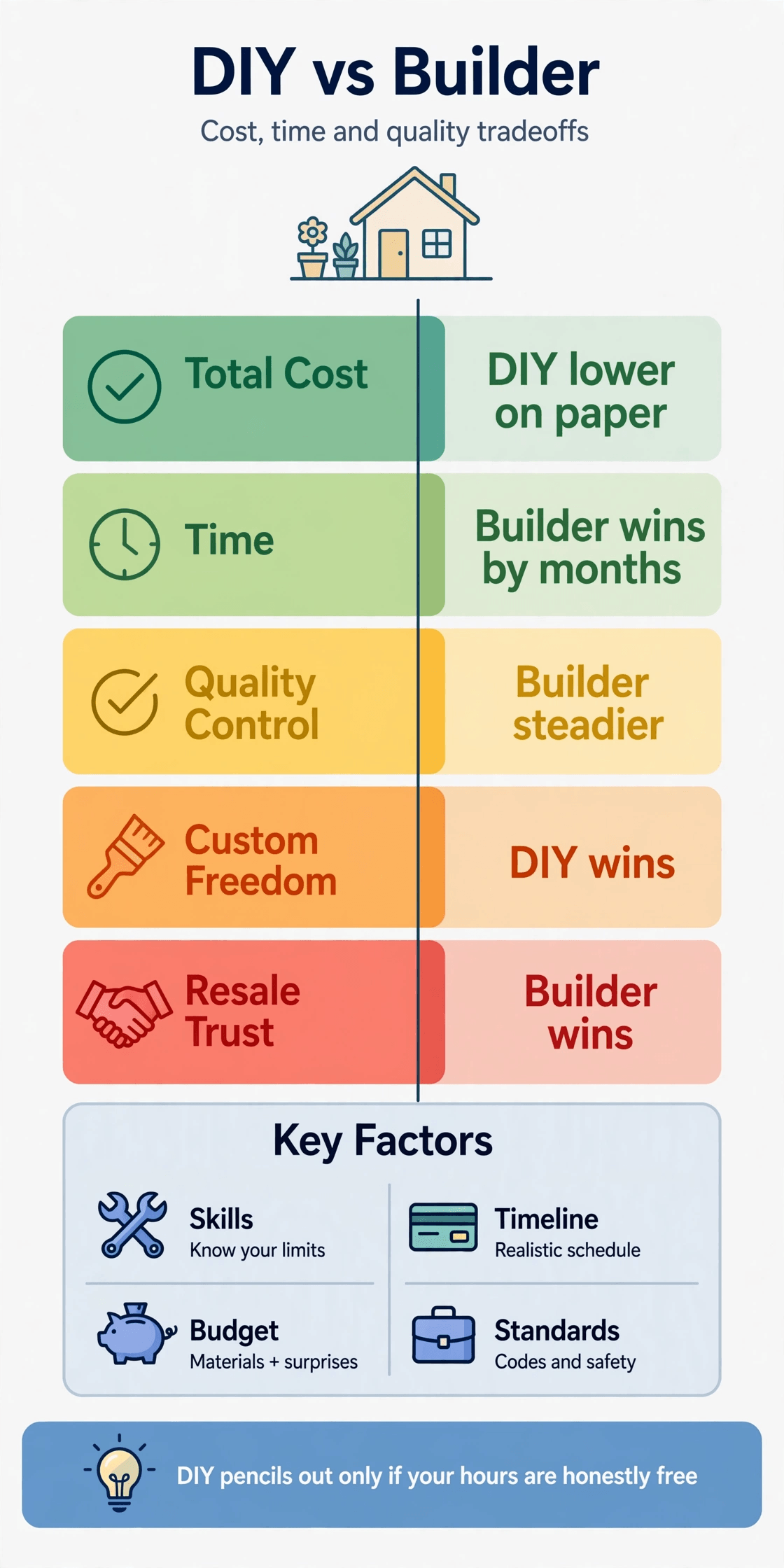
The self-build’s headline advantage is real: you remove the builder’s labour and margin, which together make up a large share of a finished home’s price. What you buy instead is a long list of materials, a trailer, tool purchases or hire, delivery charges, and a steady drip of consumables — blades, fixings, sealants, sandpaper — that no spreadsheet ever quite predicts. Price those items carefully and the DIY route still usually wins on cash. Then do the honest second calculation.
Price your own hours. A tiny house build consumes hundreds of hours spread across months: framing weekends, wiring evenings, plumbing puzzles at midnight. Value those hours at even a modest rate — what you could earn instead, or what rest and family time are worth to you — and the gap narrows fast. Our breakdown of choosing the right trailer axles for a 14,000 lbs tiny house shows how one early component decision alone can swing a budget. The builder’s quote, by contrast, bundles labour, overheads and profit into one number agreed before work starts. It is a bigger number, but it is a known number, and for many buyers that certainty is worth paying for.
2. Time: Evenings and Weekends vs a Builder’s Production Schedule
Ask self-builders what the build really cost and many answer in seasons, not months. A DIY tiny house grows in the margins of a life: after work, at weekends, around weather, deliveries and the learning curve attached to every new task. That slow pace is not failure — it is the nature of a one-person workshop — but it means a home that a professional team finishes within a single build slot can occupy a self-builder for the better part of a year, sometimes longer.
A builder compresses the same work because it is their full-time system: jigs already made, suppliers on account, trades sequenced so the electrician is not waiting on the plumber. You trade control of the calendar for that efficiency, joining a queue and accepting their start date. The practical question is which clock you can live with. If you are paying rent while you build, months of extra rent can quietly eat the DIY saving; if your land and living situation are free and stable, the slow route may cost you nothing but patience.
3. Quality Control: Your Standards, Your Skills, Their Process
Quality in a self-build is a direct printout of two things: how high your standards are, and how far your current skills can chase them. The advantage is intimacy — you can fuss over the hidden details no inspector will ever see, add the extra bead of sealant, and redo a joint at nine in the evening because it bothers you. Nobody will ever care about your home more than you do, and a careful amateur’s best work is genuinely excellent.
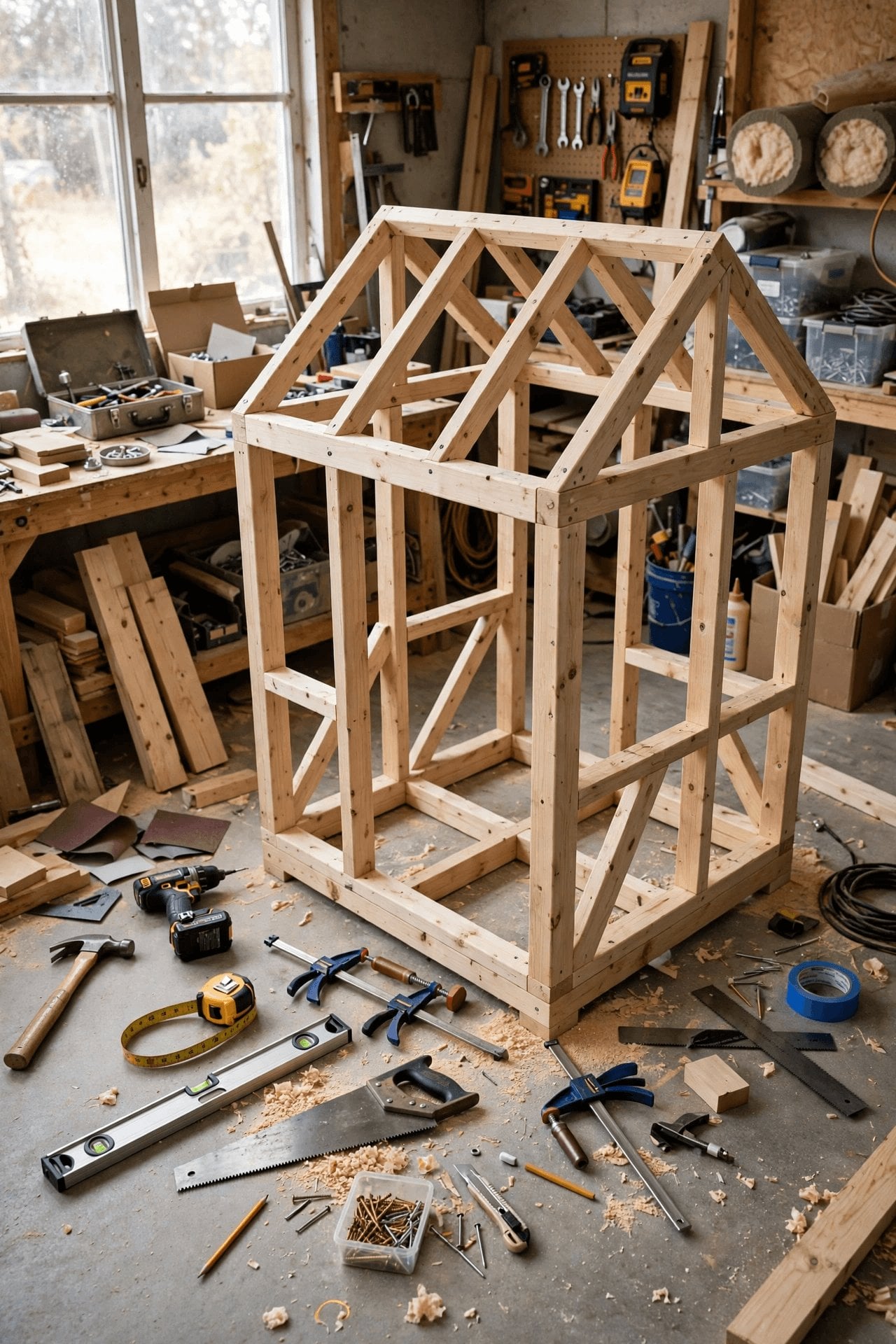
The risk is the mirror image: nobody checks your work but you. A builder’s workshop runs on repetition — the fiftieth wall frame is straighter than the fifth — with snagging, sign-off stages and, in many cases, third-party inspection built into the process. Finishes show the difference most clearly; details like lightweight interior wall finishes for tiny houses look simple until you are the one scribing panels into corners that are not quite square. Judge your own finish honestly on a small project first. If your practice work frustrates you, a whole house of it will too.
4. Custom Freedom: Total Design Control vs a Proven Options List
This is the self-build’s emotional trump card. Every dimension is negotiable: the window over the sink sized to your view, the desk at exactly your elbow height, storage built around your actual hobbies instead of a designer’s assumptions. If your body, your work or your family does not fit standard floor plans — and many people go tiny precisely because standard housing does not fit them — designing from a blank page is not a luxury. It is the point.
Builders have narrowed this gap more than most people expect. Good tiny house companies work from proven floor plans but let you move partitions, swap a loft for a downstairs bed, choose finishes and pre-wire for your own appliances. What you cannot have is the truly one-off: the odd angle, the salvaged feature window, the layout that only makes sense to you. Decide whether your custom needs are real requirements or nice-to-haves. If a builder’s options list covers your requirements, the freedom you give up may be freedom you never actually needed.
5. Skills and the Learning Curve: What You Must Know Before You Start
A tiny house is a kind teacher and a strict examiner. The skills list is long — framing, roofing, basic electrics, plumbing, insulation, ventilation, interior finishing — and each trade has one or two details that separate a home that lasts from one that quietly rots or trips its breakers. The good news is that every skill is learnable and the tiny house community documents its builds generously. The honest caveat is timing: you will learn each trade on the house you intend to live in, and your first attempt is the one you keep.
Some areas punish beginners harder than others. Structural work is one: understanding how loads travel, and details like stopping framing from twisting on the highway, matter the moment the home moves. Electrics and gas work are another, and in many places they legally require licensed professionals regardless of route — budget for those trades even in a full self-build. A builder’s price quietly includes a decade of these lessons already learned. Price your own education honestly: some of it will be paid for in re-done work.
6. Compliance and Certification: Paperwork, Inspections and Insurability
However it is built, a tiny house has to be legal to park, insurable to own and safe to sleep in — and the paperwork burden lands very differently on the two routes. A professional builder supplies it as part of the product: build specifications, electrical certification, weight documentation and, where applicable, evidence that the home meets the standard it was built to. That file follows the home for life, smoothing insurance, finance and resale at every later step.
The self-builder assembles that file alone, and must first discover which rules even apply — a moving target that varies by region and by whether the home is classed as a vehicle, a caravan or a dwelling. Systems design is part of compliance too: planning the plumbing layout and DWV design correctly is far easier before the walls close than after an inspector starts asking questions. None of this is impossible, and thousands of self-builders manage it. Just count research and documentation as a real phase of the build, not an afterthought.
7. Risk and Rework: Who Pays When Something Goes Wrong
Every build, amateur or professional, hits problems: a warped delivery, a leak found late, a measurement that was confident and wrong. The difference is who absorbs the cost. In a self-build, every mistake sends its invoice to the same person — in replacement materials, in lost weekends, and occasionally in the morale to keep going. A small contingency fund and a stubborn temperament are not optional extras on this route; they are structural.
With a builder, defects within the warranty period are their problem to fix, and their price already spreads that risk across all their customers. What you give up is immediacy: warranty repairs join a queue, and disputes about whether a fault counts as a defect or as wear and tear do happen. Many rework disasters on either route trace back to water, which is why details like sealing sill plates and corners properly matter far beyond their modest cost. Choose the route whose risks you are genuinely equipped to carry — financially and emotionally.
8. Resale Trust: How Buyers Read a Self-Build vs a Known Brand
One day, someone else will stand in your tiny house with a checklist, and what they are really pricing is trust. A recognised builder’s name does half that work instantly: the buyer can research the company, read reviews and assume a documented standard of construction. The home still gets inspected, but it starts the negotiation believed.
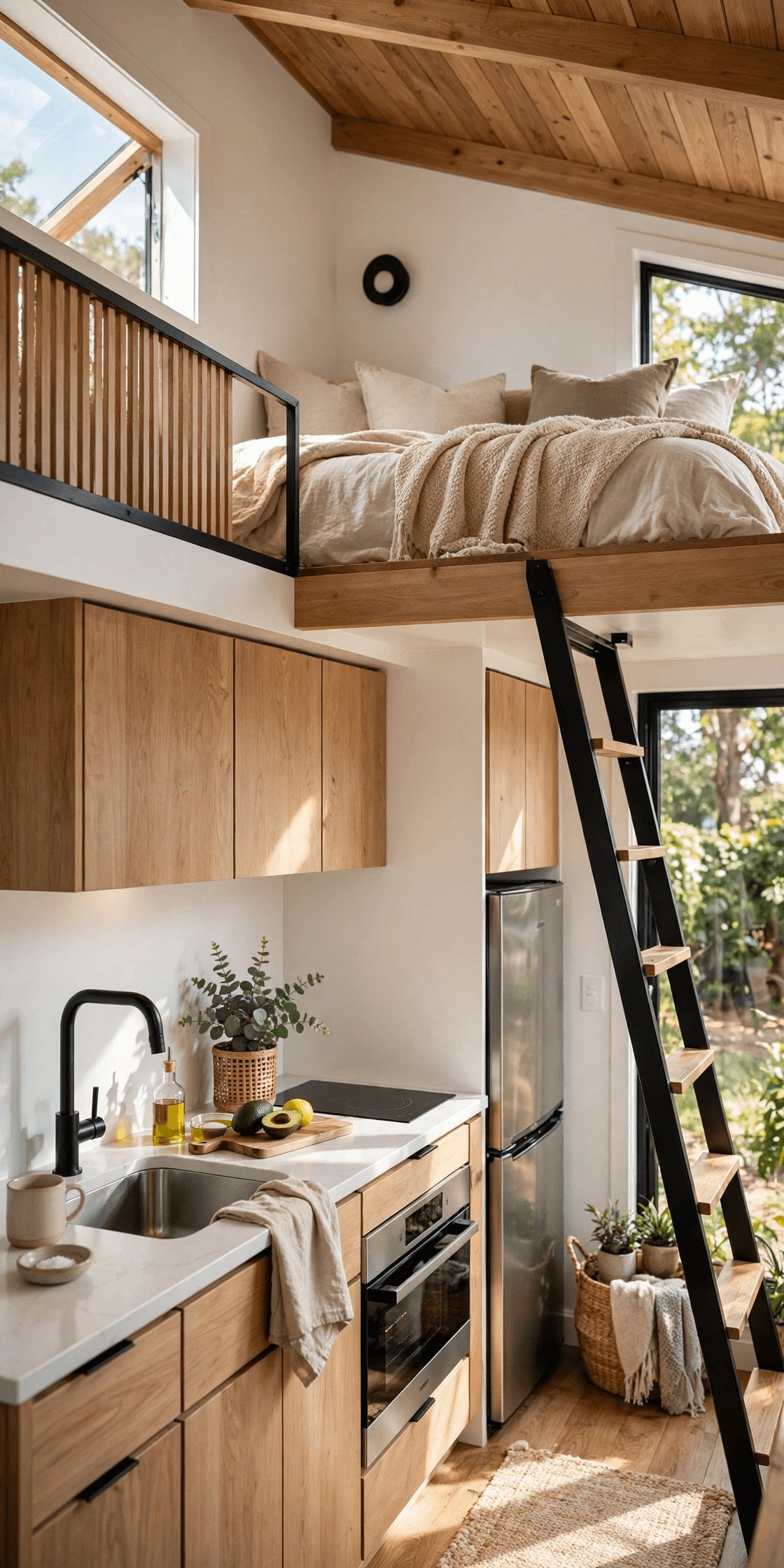
A self-build starts the same negotiation doubted — unfairly, sometimes, but predictably. The way to close that gap is evidence: dated build photos, receipts, certificates for the regulated work, an honest list of materials and systems, and a finish that looks cared for rather than improvised. A well-documented self-build, with a photo record of what sits inside its walls, can genuinely out-trust a tired brand-name home. Without records, expect buyers to discount for everything they cannot see — because the hidden work is exactly where a bad build hides.
9. Hybrid Routes: Shell Builds, Partial Fit-Outs and Hired Trades
The choice is not truly binary, and for many people the smart answer sits in the middle. Builders commonly offer stages: a watertight shell on a trailer, a shell plus first-fix systems, or everything except the interior finishes. You hand the structural, weather-critical work to professionals and keep the satisfying, lower-risk fit-out for yourself. Tasks like installing a mini-split in a tiny house yourself or building storage such as DIY tongue boxes for propane and power suit confident owners and save real money without gambling the structure.
Price a hybrid honestly before assuming it is the best of both worlds. Builders charge properly for the stages they complete, coordination between their work and yours takes effort, and warranties can blur at the seams — so agree in writing exactly where their responsibility ends and yours begins. Done well, though, a hybrid build delivers a certified, watertight structure, a shorter total timeline than a full self-build, and an interior that is unmistakably yours. For first-time builders with more enthusiasm than experience, it is often the wisest of the three routes.
10. Living in the Result: Pride, Knowledge and Long-Term Care
The comparison does not end at handover, because the two routes produce different owners. A self-builder knows their home the way a sailor knows a boat: every wire run, every pipe joint, every quirk of the framing. When something drips, creaks or trips at two in the morning, diagnosis starts from memory rather than a manual. That knowledge compounds across years of maintenance — and the pride of living in a home your own hands built is a real, durable pleasure that owners rarely overstate.
A bought home trades some of that intimacy for distance: problems are warranty calls first and learning experiences second, and systems like getting ventilation right with an HRV or ERV arrive already designed rather than discovered the hard way. Neither owner is happier by default. But be honest about which relationship you want with the place you live in — maker or customer — because you will be living that choice long after the cost and time arguments are forgotten.
Final Considerations
So, who should pick which? Build it yourself if you have — or are eager to earn — solid practical skills, if your time is genuinely cheaper than a builder’s labour, and if the custom details you want are real needs that a catalogue cannot meet. Go in with a contingency fund, a documentation habit and respect for the regulated trades, and the DIY route can save money and deliver a home nobody else could have built for you.
Hire a builder if your timeline is fixed, your skills are untested, or you want warranty cover, certified paperwork and a value the next buyer will trust at a glance — the premium buys process, proof and peace of mind. And if you sit honestly between the two, price the hybrid shell route before you decide. The wrong choice is not DIY or builder; it is choosing either one for someone else’s reasons.


0 Comments