
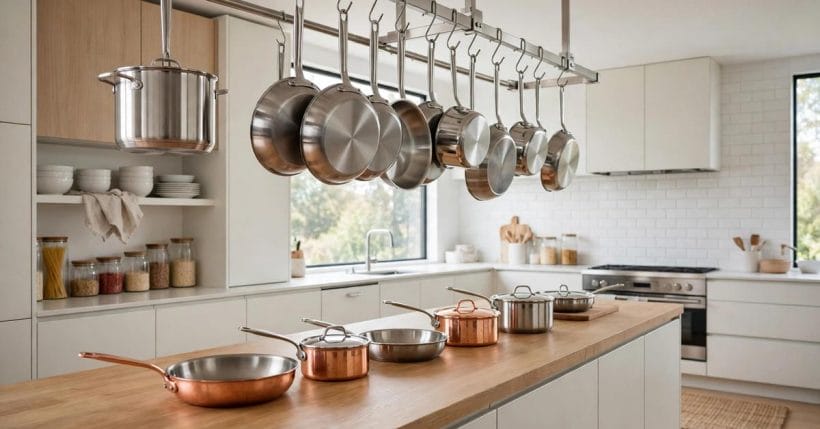
Pots and pans are among the hardest things in a kitchen to store well. They are heavy, awkwardly shaped, and often sold in sets that do not stack neatly, so a cupboard that looks tidy on one day can turn into a noisy pile by the end of the week. Lids slide, handles catch, and the pan at the bottom of the stack is always the one that is needed. A good storage idea does more than hide the clutter. It gives every piece a place that is easy to reach, easy to return, and kind to the surfaces of the pans themselves.
This guide gathers ten stylish ways to store pots and pans, each one suited to a different kind of kitchen. Some ideas put cookware on display, turning it into part of the room. Others tuck it away behind doors and drawers, so the kitchen looks calm even when it is in full use. None of them depends on a particular layout, and none of them asks a kitchen to be large. The best choice is usually the one that matches how often each pan is used, how much wall or cupboard space is free, and how the room already looks. Among the many tiny house storage ideas that suit a small home, pot and pan storage rewards a little planning more than most, because the pieces are used every day and their weight makes a poor arrangement obvious at once.
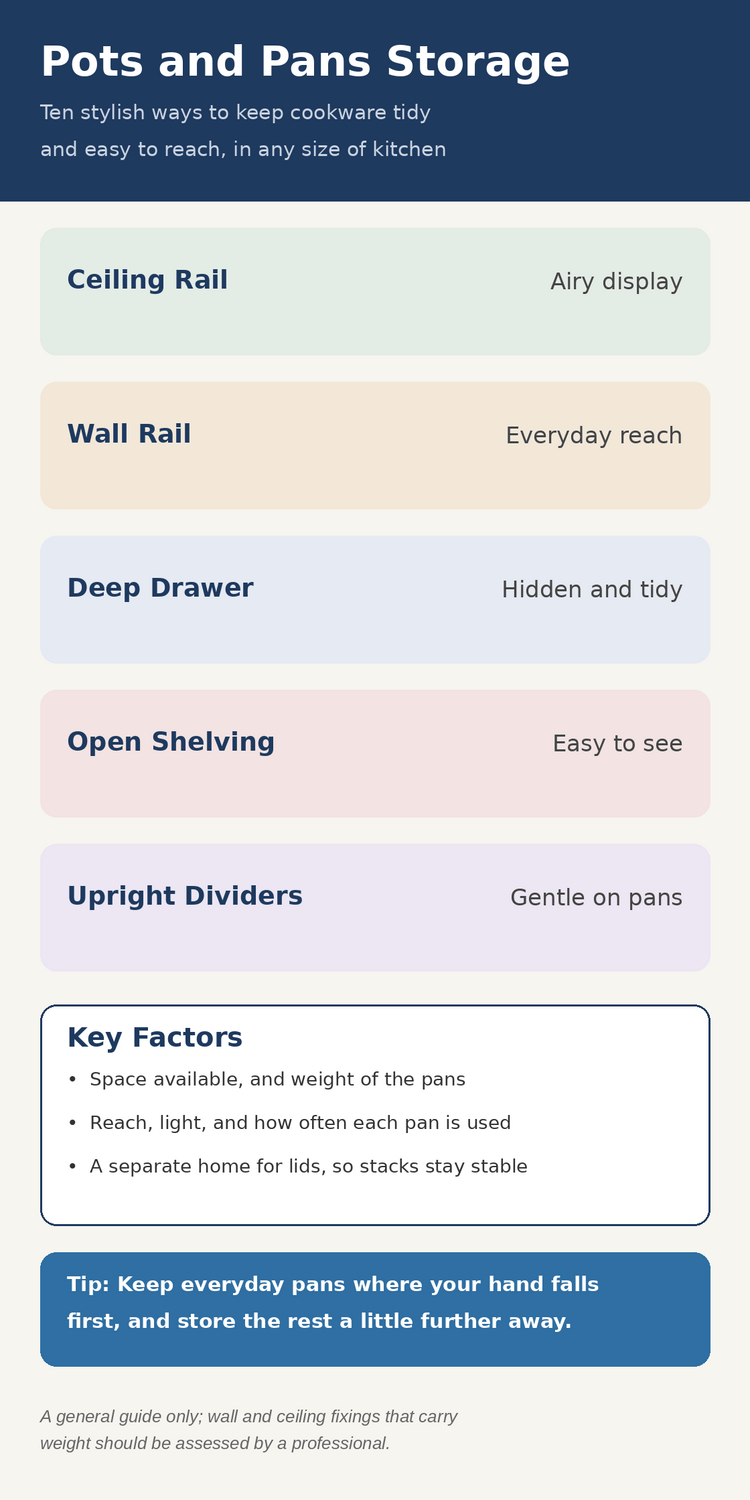
Before choosing, it helps to look at the collection with fresh eyes. Which pans are used several times a week, and which ones come out only now and then? An everyday set earns the easiest spot, while a rarely used piece can sit higher, deeper, or further back without causing trouble. Lids deserve the same thought, since a lid without a home will wander to the top of every pile. The ideas below cover hanging, shelving, drawers, doors, and cupboards, and they can be combined: a rail for the daily pans, a drawer for the rest, and a separate home for lids often works better than a single solution asked to do everything. The ideas for hanging pots and pans near the start of this guide suit kitchens where wall or ceiling space is free, while the later ideas suit kitchens where everything needs to sit behind a closed door.
1. Hang Pans from a Ceiling Rail
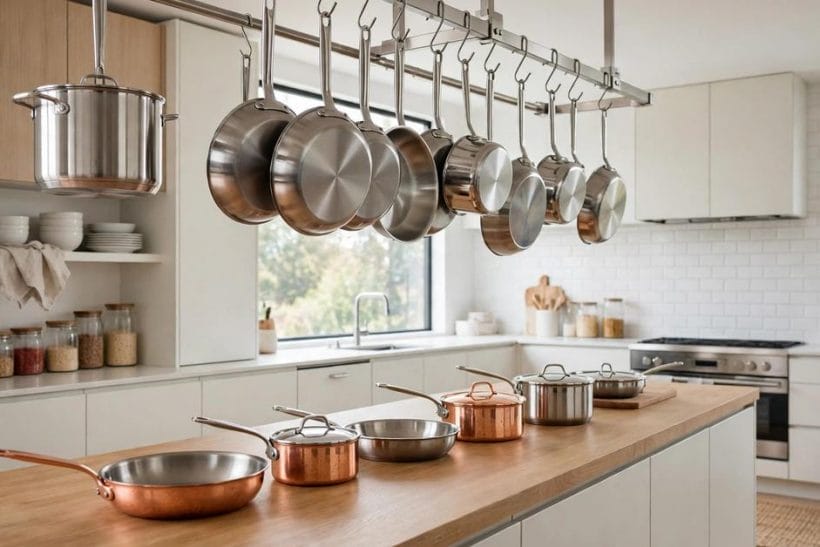
A ceiling rail turns empty air above an island or a worktop into useful storage, and it gives a kitchen a warm, working character at once. Pans hang where they can be seen and reached, handles pointing down, so choosing one is a matter of lifting it from its hook rather than unstacking several pieces. The display suits kitchens with a generous ceiling height and a clear stretch of space below, where hanging pans will not crowd a walkway or hang over a place where people stand to talk. In a small kitchen the same idea can work over a single run of worktop, provided the rail is kept short and the pans do not block light from a window.
Choosing and placing a ceiling rail deserves care, because the rail carries real weight once it is loaded. The ceiling structure and the load it can bear should be assessed by a professional, and the rail should be positioned where pans hang clear of heads, doors, and cooking steam. A rail that is too long looks cluttered, while a rail that is too short forces pans to crowd together and knock against each other. It is worth hanging the most used pieces first and leaving space between them, so each pan can be lifted off without disturbing its neighbours. Lighter pieces sit happily at the ends, and the whole arrangement reads as a deliberate display rather than a place where things were simply hung to get them out of the way.
The style of the rail matters as much as its position. A dark metal rail suits a kitchen with steel and stone, while a warm timber rail softens a room with wooden worktops and painted cabinets. Hooks that match the rail keep the look calm, and pans hung in a loose order of size, largest to smallest, look tidier than a random jumble. Some cooks like to group pans by use, keeping everyday pieces together and setting larger pieces at one end. However the rail is arranged, it should be easy to wipe down, and the pans themselves should be dry before they are hung, so that marks and moisture do not build up on the rail or on the pieces below.
2. Hang Pans from a Wall Rail
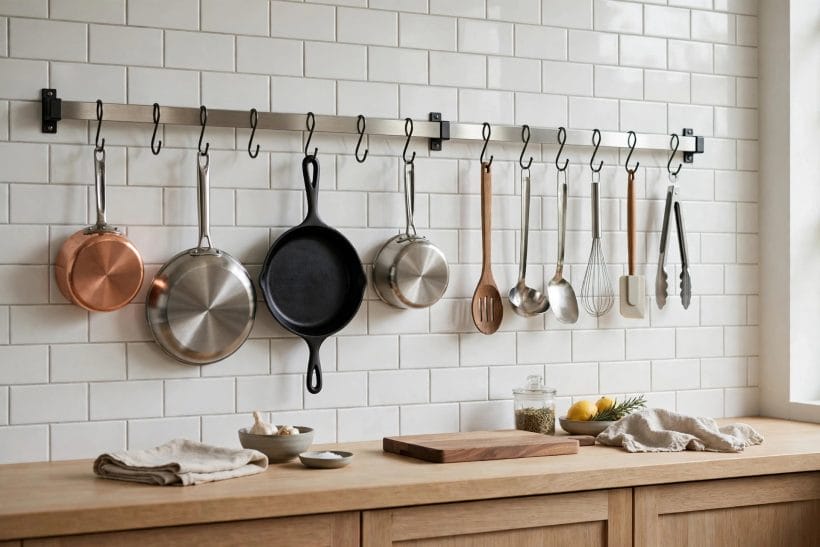
A wall rail is the simplest hanging idea of all, and often the most practical. A single rail fixed along a free stretch of wall holds a row of pans at arm height, where they can be reached without a step or a stretch. It suits kitchens with little cupboard space, kitchens where the cookware is attractive enough to display, and kitchens where a blank wall above a worktop would otherwise go unused. The row of pans becomes a feature in its own right, adding shape and shine to a plain wall.
As with a ceiling rail, the wall behind the rail must be able to carry the load, so wall-mounting of this kind should be assessed by a professional rather than treated as a casual fitting job. Once the rail is in place, the placing of the pans is what makes the idea succeed. Everyday pieces belong at the most comfortable height, with larger or heavier pieces closer to the centre of the rail where the support is strongest. Hooks of a similar style keep the row looking orderly, and a little space between pans stops them from clattering together whenever one is lifted away. A small shelf above the rail can hold lids or smaller pieces, turning a single rail into a compact storage wall.
A wall rail also makes it easy to see what is owned at a glance, which helps to keep a collection in check. When every pan has a hook, a new piece has to earn its place, and a pan that has not been used in a long while becomes obvious. The rail itself needs only an occasional wipe, and the wall behind it benefits from a surface that can be cleaned easily. For kitchens where space is tight, a short rail beside the main work area can hold just the daily pieces, while the rest of the collection lives in a cupboard or drawer, giving the best of both display and concealment.
3. Pair a Rail with Open Shelving
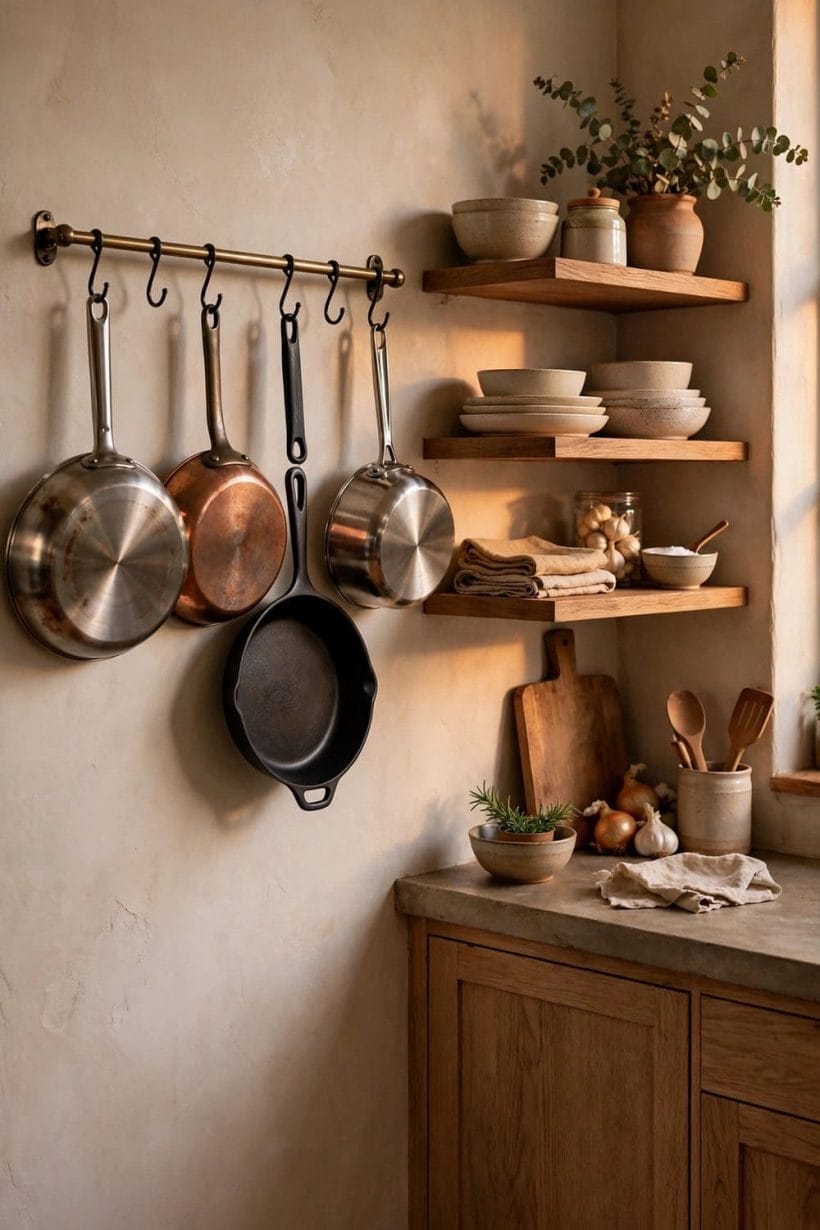
Pairing a hanging rail with open shelving gives a kitchen both movement and rest. The rail holds the pans that are grabbed daily, while the shelves beside it hold lids, smaller pieces, and the bowls and boards that belong nearby. The combination looks natural because it mirrors the way a kitchen is actually used: heavy pieces hang where they can be lifted down, and lighter things sit where they can be seen and reached without a search. It suits a corner or a short wall where a single storage idea on its own would leave gaps.
The pairing works best when the rail and the shelves share a material or a finish, so the wall reads as one arrangement rather than two separate ideas. Timber shelves beside a dark rail, for example, feel settled and warm, while matching metal keeps a modern kitchen crisp. Shelves should not be loaded so full that nothing can be lifted out without moving something else, and the lowest shelf should sit clear of the worktop so that the surface below stays usable. Pans on the rail need the same breathing room as on a rail alone, with space between hooks and a comfortable height for the heaviest piece.
This combined wall also helps a kitchen feel personal without becoming cluttered. A few well-chosen pieces on the shelves, such as a stack of bowls or a row of jars, soften the metal of the rail and the pans. The key is restraint: the shelves are part of the storage, not a display cabinet, so anything that lives there should be used regularly. When the rail and the shelves are planned together, the wall becomes a working part of the kitchen that looks considered from across the room and proves its worth every time a meal is prepared.
4. Store Pans in a Deep Drawer
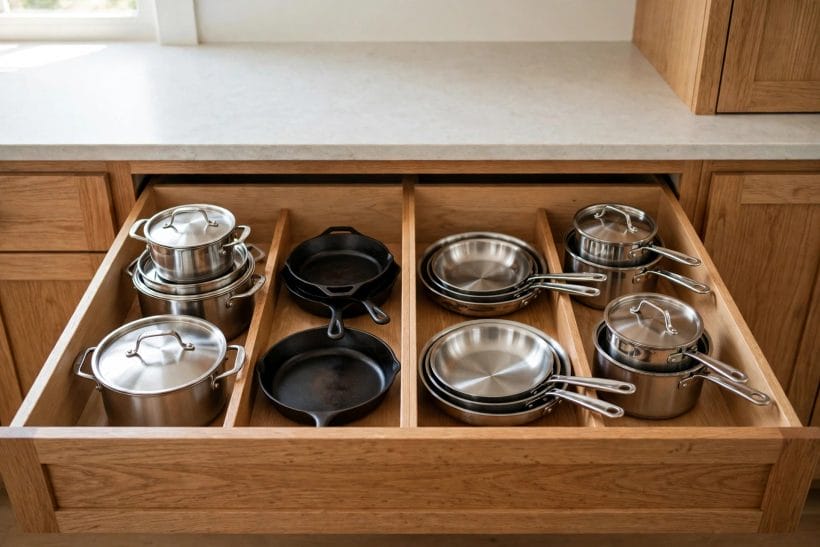
A deep drawer is often the tidiest home for pots and pans, because it hides them completely while keeping them within easy reach. Instead of crouching to peer into a low cupboard, the cook pulls the drawer open and sees the whole collection from above. Pans can be arranged in rows with dividers, or stacked in small groups with the largest at the bottom, and the drawer closes to leave the kitchen looking calm. This idea suits kitchens where a clean, uncluttered face matters, and where hanging or open storage would feel too busy.
Dividers make the difference between a drawer that stays tidy and one that slowly becomes a jumble. Adjustable dividers or simple upright separators keep pans from sliding when the drawer opens and closes, and they let each piece keep its own space. Lids can sit in a separate section of the same drawer, or in a shallow drawer above, so that a lid is never buried under a stack. It is worth leaving a little spare room in the drawer rather than filling it to the brim, since a drawer that is hard to close will soon be left half open and the tidiness will be lost.
A deep drawer also protects pans from knocks, because each piece stays where it was placed instead of being dragged across a shelf. The drawer front can match the rest of the kitchen, so the storage disappears into the room entirely. For anyone who prefers a kitchen that looks serene when it is not in use, and who does not mind opening a drawer to find a pan, this is one of the most satisfying ideas in this guide. The many kitchen ideas that favour hidden storage tend to return to the deep drawer for exactly this reason: it is quiet, practical, and kind to both the cook and the cookware.
5. Keep Pans on Open Shelving
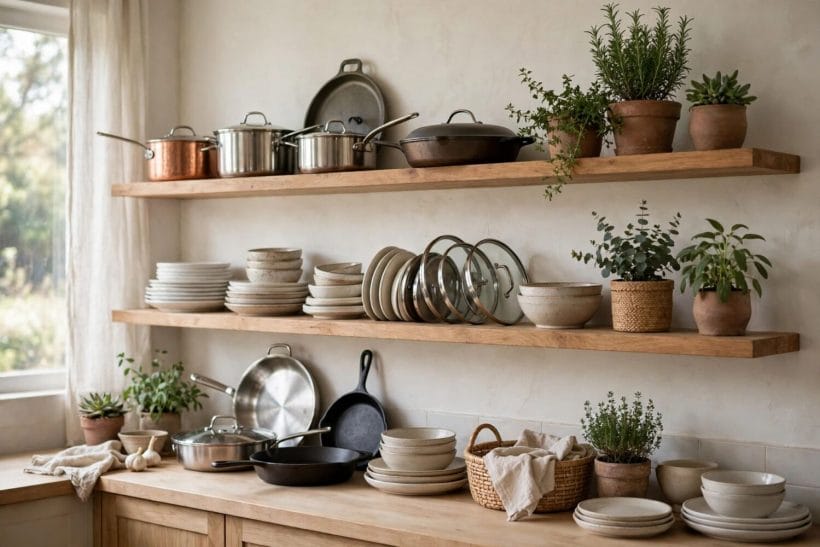
Open shelving puts pots and pans where they can be seen, chosen, and returned without opening a door or pulling a drawer. It suits kitchens with a free wall, a wide alcove, or a stretch above a worktop, and it gives the room a relaxed, lived-in feeling. Pans arranged in a row, largest first, look handsome on timber shelves, and the shelves themselves become part of the kitchen’s character. This idea works best for pieces that are used often, since anything on open shelving gathers dust if it sits untouched.
Arranging open shelves takes a light touch. Heavy pieces belong on the lowest shelf, where they can be lifted without reaching overhead, and lighter pieces and lids can sit higher. Stacking should be kept shallow, with no more than a couple of pieces in a stack, so that the pan at the bottom is not trapped. A little space at the end of each shelf keeps the arrangement from looking cramped, and the shelves should be wiped regularly, along with the pans that live there. In a small kitchen, open shelving can make the room feel larger, because the eye travels past the shelves to the wall behind them rather than stopping at a closed door.
Open shelving also invites a mix of storage and decoration, provided the balance stays in favour of storage. A plant or a stack of bowls at the end of a shelf softens the row of pans, but the shelves should never become so decorated that the pans have nowhere to sit. For cooks who like to see their tools and reach for them without thinking, open shelving is a cheerful, honest solution. The small kitchen ideas that use open shelving well all share the same rule: keep the shelves for what is used, keep the stacks shallow, and let the wall breathe.
6. Use a Pegboard Panel
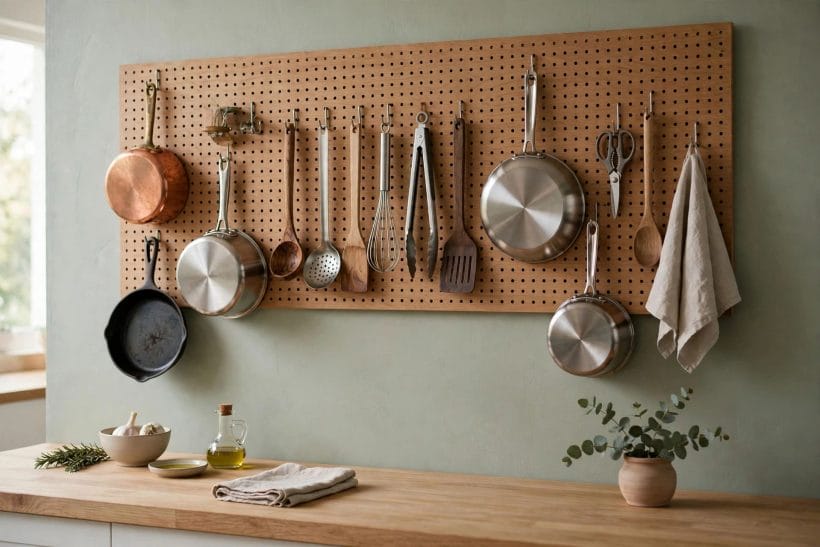
A pegboard panel turns a wall into a flexible storage board, where hooks can be moved as the collection changes. Pans, lids, and tools hang side by side in a pattern that can be rearranged whenever a new piece arrives or an old one leaves. The panel suits kitchens where the collection is always evolving, and where a fixed rail would soon feel too rigid. It also suits a narrow wall or the end of a run of cabinets, where a full rail or a set of shelves would not fit.
The charm of a pegboard lies in its order. Outlining the shape of each pan on the board, or simply grouping pieces by size and use, keeps the panel looking intentional rather than improvised. Hooks of a consistent style help, and the heaviest pieces should hang where the panel is best supported, with the load spread across the board rather than gathered in one corner. As with any wall-mounted storage, the panel and its fixings should be assessed by a professional where the wall must carry weight, so that the board stays secure when it is fully loaded.
A pegboard can be painted to match the kitchen, turning a practical board into a feature wall, or left in natural timber for a warmer, workshop feel. The board should be kept within easy reach, with the most used pans at a comfortable height and less used pieces towards the edges. Because every piece is visible, the panel also makes it simple to notice when a collection has grown beyond what the kitchen can hold. For a cook who enjoys rearranging and refining, a pegboard is storage that stays as flexible as the kitchen itself.
7. Keep Lids on the Cabinet Door
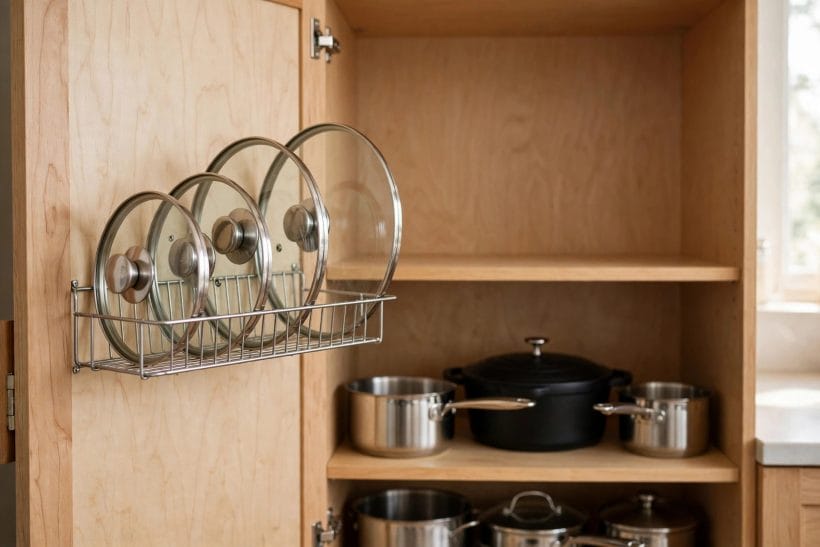
Lids are the quiet troublemakers of pot and pan storage. They are flat, awkward, and easy to lose inside a cupboard, yet every pan needs its lid to hand. A rack fitted to the inside of a cabinet door gives lids a home of their own, upright and visible the moment the door opens. The pans themselves can then live on the shelves inside the cupboard without a lid balanced on top of every stack, and the whole cupboard becomes easier to use.
A door rack suits lids of different sizes, since the rack can hold them in a row with the largest at one end. The rack should be chosen to suit the depth of the door and the weight of the lids, and it should sit clear of the shelves inside so that the door still closes smoothly. Keeping lids upright also protects them, because a lid stored flat under a stack can be scratched or bent, while a lid in a rack stays separate and clean. The idea costs little space, since the inside of a door is otherwise unused, and it can transform a cupboard that previously felt chaotic.
This small change often makes the largest difference to daily cooking, because the search for a lid is what slows a meal down. With lids on the door and pans on the shelves, everything is found in a single opening of the cupboard. The arrangement also suits a kitchen where the overall look matters, since nothing about it shows from outside: the cabinet fronts stay plain, and the tidiness is revealed only when the door opens. Among the tiny house interior design ideas that make a small kitchen feel larger, using the inside of a door is a favourite, because it creates storage from space that was already there.
8. Stand Pans on a Freestanding Rack
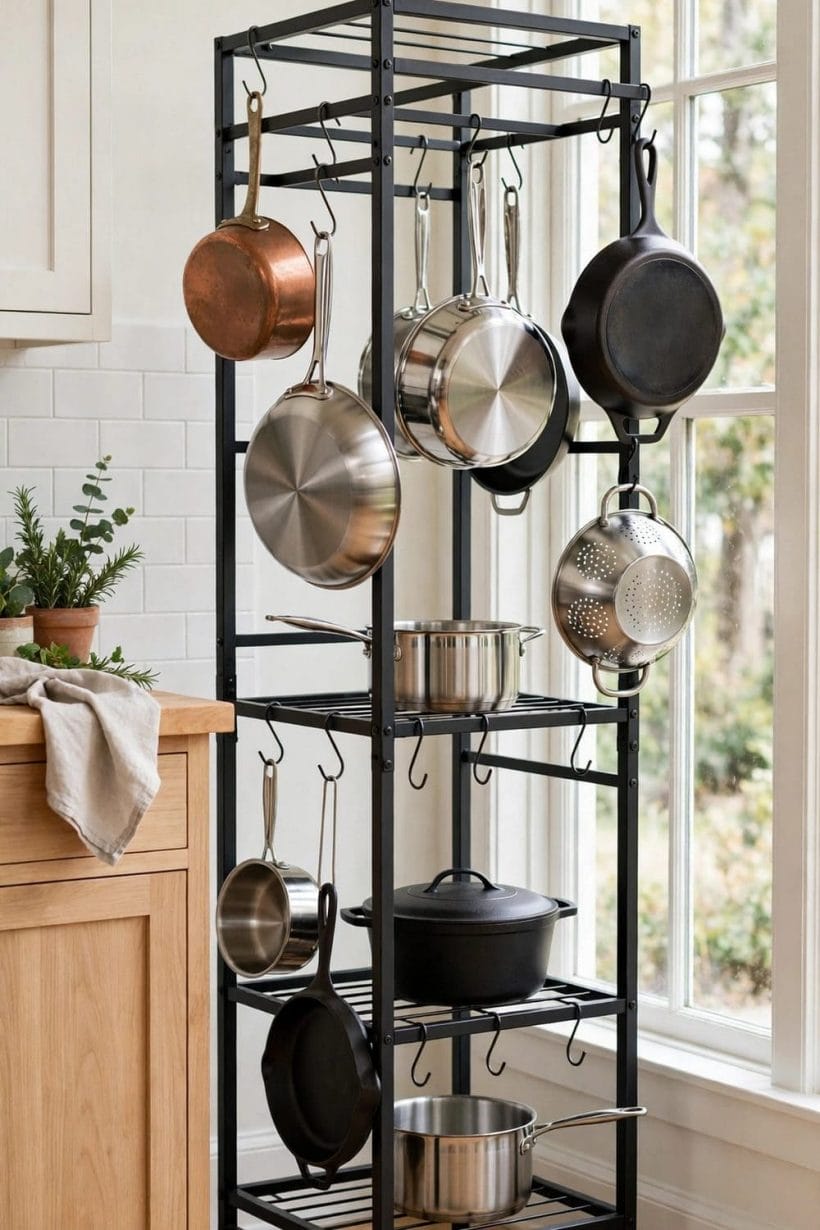
A freestanding rack needs no wall and no fitting, which makes it one of the most flexible ideas in this guide. The rack stands in a corner, beside a worktop, or at the end of a run of cabinets, holding pans on hooks or tiers where they can be reached from either side. It suits rented kitchens, kitchens where the walls cannot carry a rail, and kitchens where the layout may change. When the room is rearranged, the rack simply moves with it.
Choosing a rack is a matter of balance and proportion. A rack that is too tall for its base will feel unsteady when loaded, while a rack that is too small will crowd the pans together. The heaviest pieces belong low, where they keep the rack steady, and the most used pieces belong at a comfortable height. A rack with a simple frame and a dark or timber finish blends into most kitchens, while a very ornate rack can dominate a small room. The floor beneath the rack should be easy to clean, since a rack in a corner can gather dust if it is never moved.
A freestanding rack also gives a kitchen a sense of a working pantry, a place where tools are kept ready rather than hidden away. It is easy to add a hook for a new pan or to move a piece to a different tier as habits change. For anyone who wants hanging storage without committing to a wall or ceiling fixing, a freestanding rack offers the same easy reach with none of the permanence, and it can be the first step towards a larger hanging arrangement later on.
9. File Pans Upright with Dividers
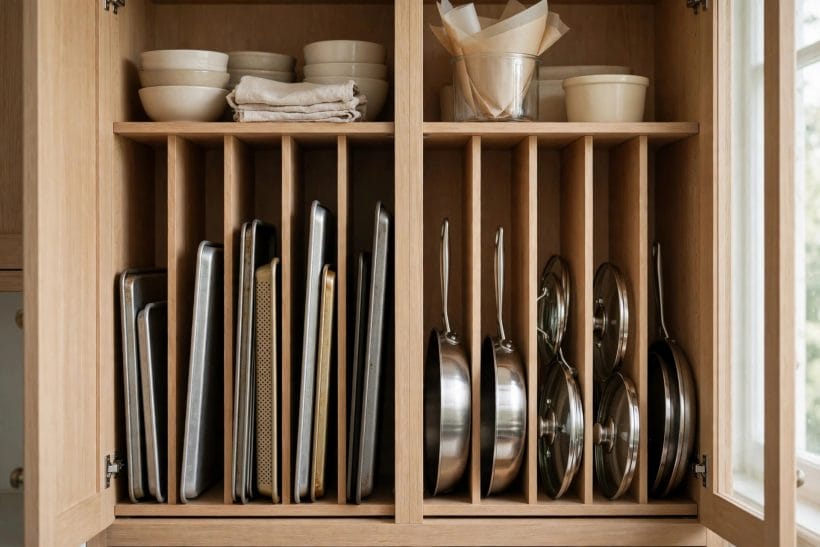
Filing pans upright, like books on a shelf, is a gentle and surprisingly tidy way to store them. Vertical dividers inside a cupboard or a deep drawer hold each pan on its edge, so that any piece can be slid out without lifting the ones above it. The idea suits shallow pans, trays, and lids especially well, and it works in a cupboard that is too narrow for stacking. It also protects surfaces, since pans stored upright do not rest on each other and cannot scratch each other when they are moved.
Dividers can be fixed or adjustable, and the spacing should suit the thickness of the pieces they hold. Pans of a similar depth sit happily side by side, while a very deep pot may still be better stacked in a drawer. The upright file works best when the cupboard is not overfilled: a little space between dividers lets each pan slide out smoothly, and a crowded file becomes as frustrating as a crowded stack. Labelling is rarely needed, because the edge of each pan is visible, and the cook can see the whole collection at a glance.
This idea pairs well with other storage in the same kitchen. A cupboard filed upright can hold the trays and shallow pans, while deeper pots live in a drawer and lids live on a door. Together, the three homes cover a whole collection without any single cupboard doing too much. The approach suits kitchens where calm and order matter, and where the cook would rather slide a pan out than unstack a pile. In the wider world of home design ideas, filing upright is a quiet example of a simple change that makes a daily task easier, without changing the look of the room at all.
10. Stack with Care in a Cupboard
Stacking in a cupboard is the classic way to store pots and pans, and it still works well when it is done with care. The largest pan sits at the bottom, smaller pieces nest inside it, and lids are kept separately so that the stack stays stable. The cupboard should be deep enough for the largest piece without forcing the door, and the shelf above should leave room to lift the top piece clear. When a stack is kept shallow and the pieces inside it are similar in shape, the cupboard stays usable rather than becoming a pile that must be rebuilt after every use.
A soft layer between pieces helps to protect surfaces, especially where a pan rests inside another. A cloth, a liner, or a simple protector between nested pieces stops scratches and keeps the stack quiet when the cupboard is opened. It is worth keeping the everyday stack small: the pans used most often can live in one cupboard, while pieces used rarely can live higher up or in a different cupboard altogether. That way the daily stack is never deep enough to become a chore, and the rarely used pieces are not disturbed every time a pan is needed.
Stacking also benefits from a regular review. A collection grows quietly, and a cupboard that once held a stack comfortably can slowly become overfull. Taking everything out now and then, checking which pieces are still used, and returning only those that earn their place keeps the cupboard honest. A cupboard that is stacked with care looks ordinary from outside, which is part of its appeal: the kitchen stays calm, the pans stay protected, and the cook knows exactly where each piece lives, even if the storage itself is the simplest idea in this guide.
Final Considerations
The ten ideas above share a simple principle: every pan and every lid deserves a place that is easy to reach, easy to return, and suited to its size and weight. Hanging ideas suit kitchens with free wall or ceiling space and a love of display, while drawers, dividers, and cupboards suit kitchens where a calm, closed face matters more. A rail, a drawer, and a door rack used together will often beat any single idea used alone, because different pieces have different needs. The best arrangement is the one that is still tidy after a busy week, not the one that looks perfect on the day it is arranged.
Weight, reach, and light are the three things to weigh before settling on a choice. Heavy pieces should sit low or where support is strongest, everyday pieces should sit where the hand falls naturally, and hanging pieces should never block light or crowd a walkway. Wall and ceiling fixings that carry weight should always be assessed by a professional, and the placing of pans should be planned before anything is hung, so that the finished arrangement looks deliberate. A kitchen that is planned in this way feels easier to cook in, easier to tidy, and easier to enjoy, because the tools are where they belong and the room itself stays calm.
Finally, it is worth letting the collection settle before adding more storage. Live with a new arrangement for a while, notice which pan is reached for first and which one is never touched, and adjust the placing to suit real habits rather than imagined ones. Storage that follows habit lasts, while storage that fights habit is soon abandoned. The ideas for hanging pots and pans in this guide, together with the drawer, shelf, divider, and cupboard ideas that follow them, offer a starting point for any kitchen, large or small. Chosen with care and kept with a light touch, they turn a daily frustration into a quiet pleasure, and they leave the kitchen looking as good as it works. For further inspiration, the interior design ideas across this site show how the same principles of order, light, and proportion shape rooms well beyond the kitchen.

0 Comments