
Every off-grid tiny home eventually faces the same foundational question: where will the water come from, every single day, in every season? For most owners the honest answer narrows to two proven sources, and the debate over rainwater vs well water off grid is really a debate about control. Rainwater puts the sky, your roof and your storage tanks in charge. A well puts the ground beneath your land in charge. Both can supply a tiny home completely, both can fail you if they are planned casually, and both reward owners who understand them as systems rather than single purchases.
This comparison works through the two options attribute by attribute, because the right choice is rarely about which source is better in the abstract. It is about which source matches your rainfall pattern, your geology, your budget shape and the amount of routine care you are genuinely willing to do. A household that loves seasonal rhythms and simple, visible infrastructure often thrives on harvested rain. A household that wants water to behave like a utility, quietly and constantly, usually leans toward a well. Read the sections in order, note where your own land and habits keep agreeing with one side, and the verdict at the end should feel less like a guess and more like recognition.
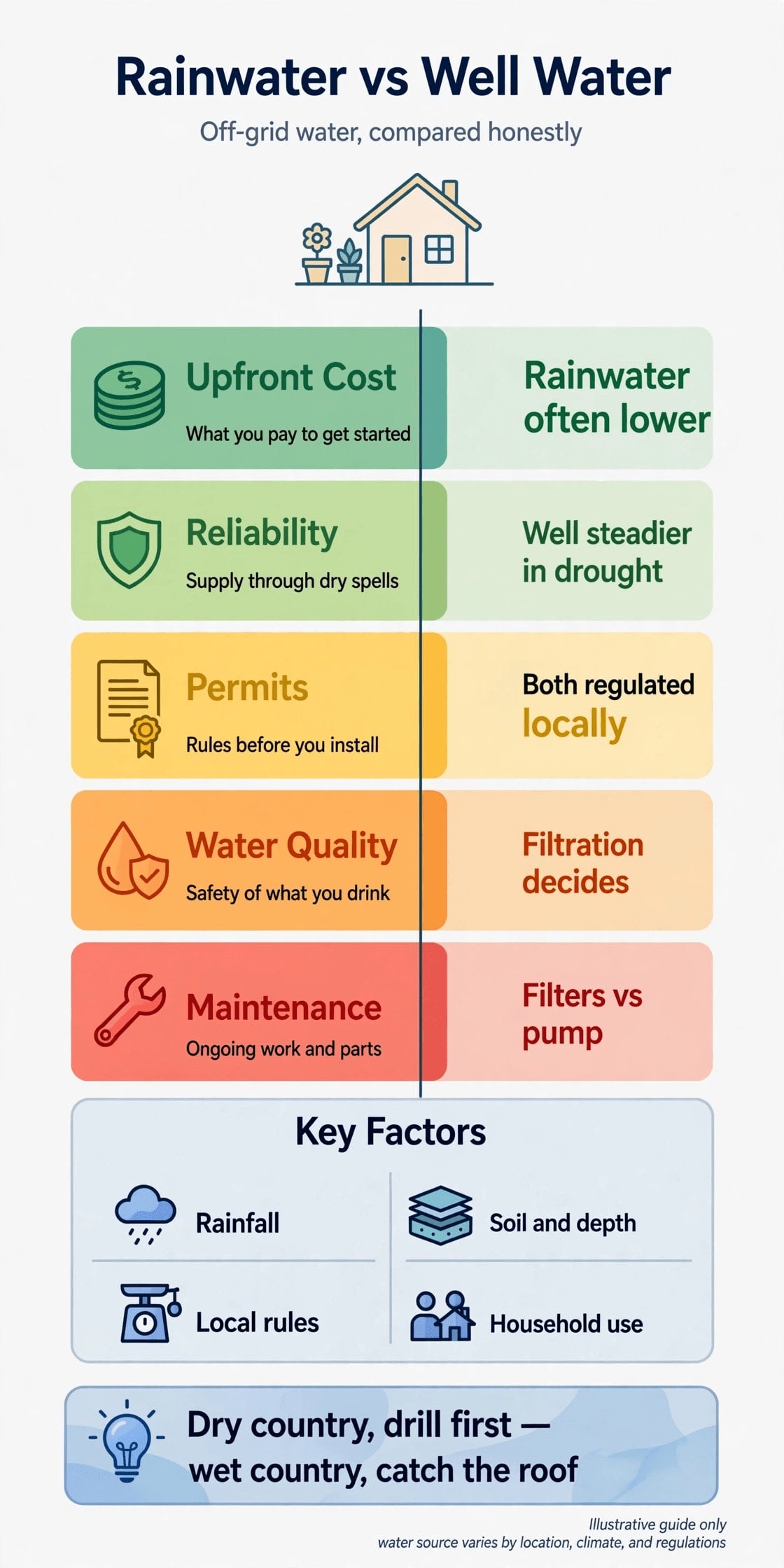
Rainwater vs Well Water Off Grid at a Glance
| Criterion | Rainwater Harvesting | Well Water |
|---|---|---|
| Upfront cost | Usually lower to start; grows with tank size and treatment | Usually higher to start; drilling is the big single expense |
| Drought reliability | Depends on stored volume and how long dry spells last | Generally steadier, as groundwater changes more slowly |
| Permits and regulation | Often light for collection, stricter when used for drinking | Drilling permits and setback rules are common |
| Water quality | Soft and low in minerals, but exposed to roof and air contamination | Mineral content varies; may carry iron, hardness or local contaminants |
| Filtration needs | Debris screening, sediment filtration and disinfection for potable use | Testing-led treatment, from softening to targeted filters |
| Maintenance | Frequent small tasks: gutters, screens, first-flush diverters, tanks | Less frequent but more technical: pump, pressure tank, testing |
| Power dependence | Can partly run on gravity; pumps improve pressure | Almost always needs a powered pump |
| Best suited to | Wet or seasonal climates, small households, phased budgets | Dry climates, higher daily demand, long-term single plots |
1. How Each System Actually Works: Collection Surfaces, Aquifers and Everything Between
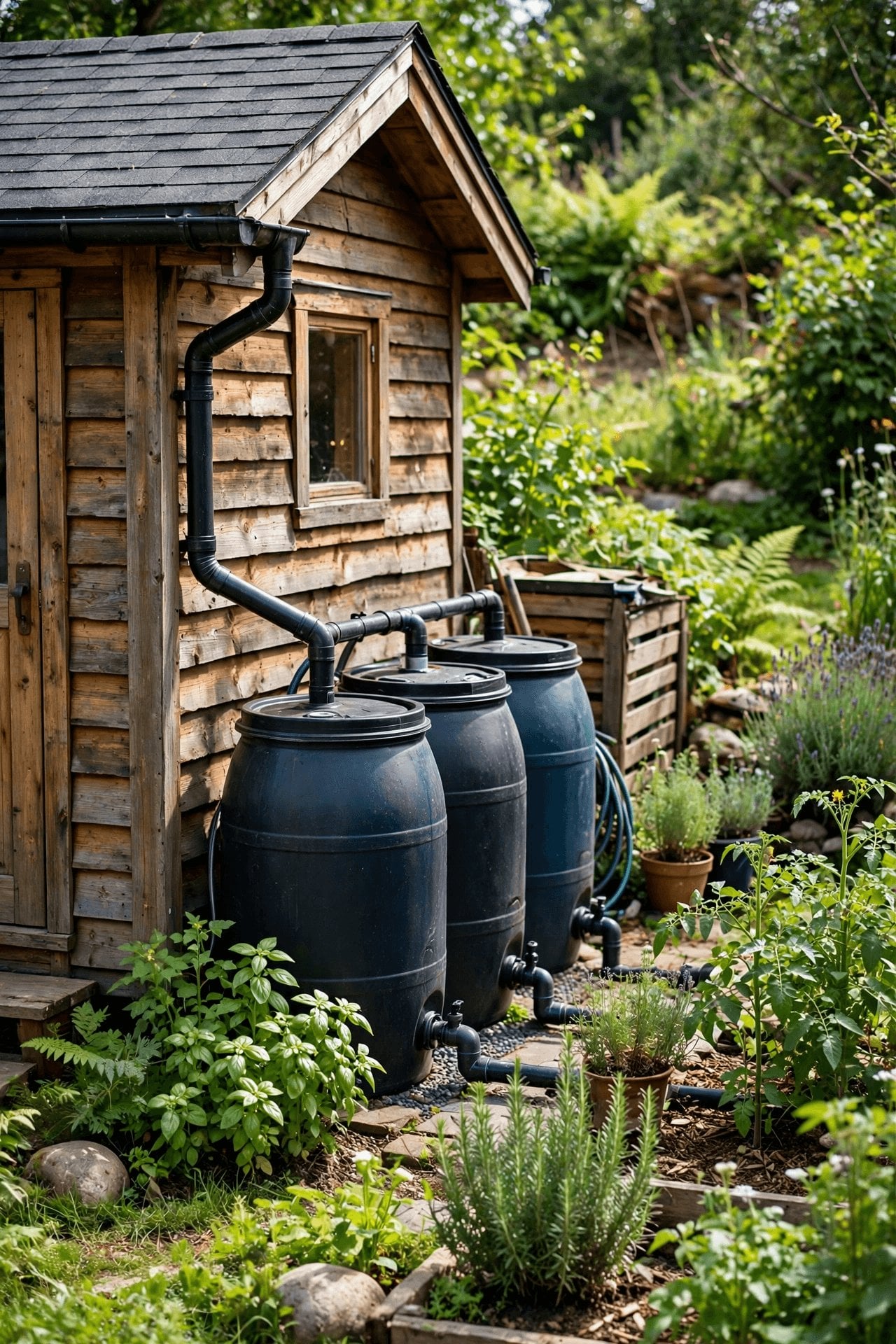
A rainwater system is a chain, and every link is visible. Rain lands on a roof, runs into gutters, passes through screens and a first-flush diverter that discards the dirtiest opening flow, then settles into a cistern or tank. From storage, a pump or gravity feed pushes water through filters and into the tiny home. Nothing in that chain is hidden, which is why rainwater appeals to owners who like infrastructure they can inspect with their own eyes. It is also why the system is only ever as good as its weakest link: a neglected gutter quietly degrades everything downstream of it.
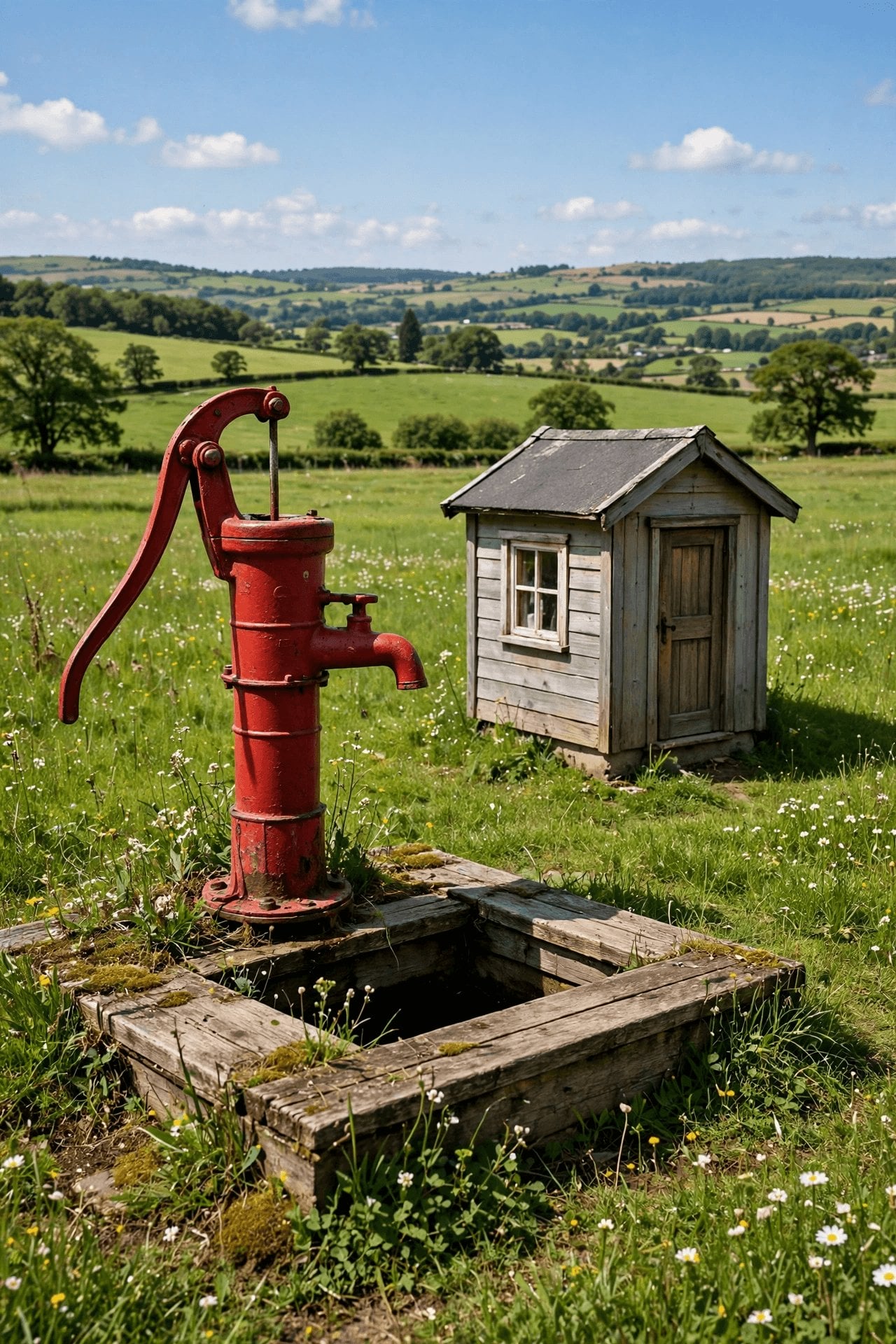
A well system is shorter on the surface and deeper underneath. A drilled or driven well reaches groundwater held in soil and rock, a submersible or surface pump lifts that water into a pressure tank, and the home draws from there. The invisible part is the aquifer itself, a resource you share with the land and, often, with neighbours. Understanding how these two sources sit inside a complete utility picture matters, and our tiny house utilities guide to power, water and off-grid sewage shows how water supply decisions interact with power sizing, drainage and waste from the very first sketch of a build.
2. Upfront Cost: Tanks and Gutters Against Drilling Rigs and Pumps
Rainwater usually wins the first-budget conversation. A modest system can begin with gutters, a food-grade tank, basic screening and a small pump, and it can grow in stages as money allows, adding storage or better treatment later. That phased shape suits tiny home owners who are building in steps. The honest warning is that phased does not mean cheap forever. Large potable-grade storage, freeze protection and proper disinfection can lift a serious rainwater installation into territory that surprises people who priced only the tank on day one.
A well concentrates its cost at the front. Drilling is priced by depth and geology, and neither is fully predictable before the rig arrives, which makes a well the harder system to budget precisely. Casing, pump, pressure tank, trenching and electrical work follow the drilling itself. What you buy for that heavier opening spend is completeness: once a productive well is equipped, the core supply is finished rather than staged. Owners comparing the two should compare finished, drinkable, pressurised systems, not a bare tank against a completed well, because that mismatched comparison is where most budget mistakes begin.
There is also a difference in how the two budgets behave over time. Rainwater spending continues in small, planned instalments: another tank when the household grows, better filtration when drinking use begins, a replacement pump years down the line. Well spending tends to arrive in rare, larger events, such as pump replacement or treatment upgrades, with quiet years in between. Neither pattern is wrong, but they suit different financial temperaments. Households that prefer predictable small outlays usually settle comfortably into rainwater economics, while households that would rather complete a major project once and budget for occasional repairs often prefer the well, even at the higher opening figure.
3. Drought Reliability: Stored Rain Against Slow-Moving Groundwater
Rainwater reliability is arithmetic you can hold in your head. Your roof collects what the sky delivers, your tank holds a buffer, and your household draws the buffer down. In a climate with regular rainfall, even modest storage feels abundant. In a long dry spell, the same system becomes a countdown, and the owners who cope best are the ones who sized storage for the dry season they actually get, not the average rainfall printed in a brochure. Conservation habits, low-flow fixtures and a realistic sense of daily use matter as much as tank size.
Groundwater moves to a slower rhythm. Aquifers respond to seasons over months and years rather than weeks, so a well that is sound today is rarely empty next month because the rain paused. That steadiness is the well’s strongest card in dry regions. It is not immunity, though. Shallow wells can decline in extended drought, and a well’s yield is fixed by geology in a way no pump upgrade can fully change. Before committing, ask what neighbouring wells produce and at what depth, because local drilling experience is the most honest reliability data you will ever get.
4. Permits and Regulation: Collection Rules, Drilling Permits and Potable Standards
Rainwater regulation is a patchwork. In many places, collecting rain from your own roof for garden or household non-drinking use attracts little attention, while using it as drinking water brings treatment and testing expectations, and a few jurisdictions still restrict collection itself. Tiny homes add a second layer: if your home sits in a grey zone locally, the water system may be examined as part of a wider habitability conversation. The practical move is to ask your local authority and health department direct questions before buying tanks, and to keep whatever written answers you receive.
Wells are more uniformly regulated. Drilling permits, licensed driller requirements, minimum distances from septic systems and property lines, and completion reporting are all common, and records of a properly drilled well can support a future sale. Owners researching how tiny homes legally obtain water in different setups will find the overview in how tiny houses get water, from wells to hauled supply useful background. Neither system should be installed on a verbal assumption. Regulation rarely stops a determined owner, but it regularly reshapes cost, placement and paperwork, and discovering that after installation is the expensive way round.
5. Water Quality: Soft Rain, Mineral Wells and What Testing Actually Reveals
Fresh rainwater is naturally soft and low in dissolved minerals, which is gentle on fixtures, kind to soaps and pleasant to drink once it is properly treated. Its risks arrive during collection. Roofs accumulate dust, pollen, bird droppings and leaf debris, and roofing materials themselves can influence what washes off. That is why potable rainwater is never just rain in a tank; it is rain that has passed screening, settling and disinfection, in a tank kept dark, sealed and clean. Treated casually, rainwater quality drifts. Treated as a system, it is consistently good.
Well water quality is written by geology. It may be beautifully clean straight from the ground, or it may carry hardness, iron, manganese, sulphur odour or, in some areas, agricultural or naturally occurring contaminants that only a laboratory test will reveal. Taste is not a test, and clarity is not a test either. Whatever source you choose, water decisions sit alongside the other hygiene systems of a small home, which is why our comparison of tiny house composting toilets, commercial units versus DIY builds is worth reading as part of the same whole-house sanitation picture. Test a well before you buy land where testing is possible, and test any drinking supply again after installation.
Season quietly changes both sources, and planning for that change is part of quality management. Rainwater arriving after a long dry, dusty spell carries a heavier load than rain in a wet month, which is exactly what first-flush diverters and sensible storage hygiene are designed to handle. Well water can shift too, with water tables rising and falling and surface influences finding their way into shallow sources after heavy rain. The practical response is the same in both cases: test at more than one point in the year, keep records, and treat any change in taste, colour or odour as information to investigate rather than a nuisance to ignore.
6. Filtration and Treatment: Building the Right Train for Each Source
Rainwater treatment is best imagined as a train of defences. Leaf screens and first-flush diverters keep the worst debris out of storage. Sediment filtration catches what gets through. Carbon filtration improves taste and reduces a range of chemical concerns, and a properly maintained ultraviolet unit or equivalent disinfection step addresses microbes at the point of use. Each stage has a job, and skipping the early cheap stages forces the later expensive ones to work harder and fail sooner. Cartridge changes and lamp replacements are small, predictable costs that belong in the household calendar.
Well water treatment starts from the test result rather than a catalogue. Hard water points toward softening, iron points toward oxidation or dedicated iron filtration, and bacterial findings point toward disinfection and a search for the entry route. The common mistake is buying treatment before testing, then owning expensive equipment aimed at a problem your water does not have. Power matters here too, because pumps, UV units and some treatment systems all draw electricity, so the sizing logic in our guide to solar panel kits for tiny homes and sizing an off-grid battery bank should be read alongside any water plan that depends on daily pumping.
7. Storage, Pressure and Daily Living: Showers, Laundry and Winter Mornings
Daily comfort is where abstract comparisons become physical. Rainwater households think in stored volume: a long shower, a laundry load and a sink of dishes all spend the same finite reserve, and a small pressure pump decides whether the shower feels normal or apologetic. Gravity can help where a tank sits above the home, but most tiny homes rely on a pump and a small pressure vessel, which makes pump quality and placement, out of the frost and within easy reach, genuine quality-of-life decisions rather than details.
A well household thinks in flow and pressure instead. The aquifer refills the system as you use it, so the experience feels closer to a conventional supply, provided the well’s yield and the pump are matched to demand. Both sources eventually meet the same internal plumbing, and the layout choices in our tiny house plumbing layout guide to efficient drain-waste-vent design apply equally to either. In winter, both systems share one enemy: exposed pipework and tanks in freezing air. Burial depth, insulation and a drain-down plan for absences protect rainwater and well installations alike, and cold-climate owners should design for the worst week of the year, not the average one.
Households also change, and daily living should be planned with some headroom. A second person, regular guests, a vegetable garden or a small workshop can all lift demand well beyond the tidy estimate made at the design table. Rainwater systems answer growth mainly with more storage and stricter conservation, which is simple but finite. Well systems answer with yield they either have or do not, which is why confirming sustainable flow matters so much before purchase. Whichever source you choose, leave physical room, in pipework, in space and in the budget, for the household you might become rather than only the one you are today.
8. Maintenance: Frequent Small Chores Against Infrequent Technical Jobs
Rainwater maintenance is a rhythm of small, visible tasks. Gutters want clearing, screens want washing, first-flush diverters want emptying, and tanks want periodic inspection and occasional cleaning. Filters cycle through replacements, and after storms or long absences a thoughtful owner checks the system the way a sailor checks rigging. None of it is difficult, and almost all of it can be done with basic tools, which is part of the appeal. The cost of neglect is gradual and forgiving at first, then suddenly not, because quality problems build quietly inside a closed tank.
Well maintenance asks less often and demands more when it calls. Pumps and pressure tanks have working lives measured in years, water testing should repeat on a sensible schedule, and problems underground usually mean calling a professional with the right equipment. The honest trade-off is frequency against skill. Rainwater suits owners who will happily spend twenty minutes a month on chores they fully understand. Wells suit owners who prefer to save for occasional specialist help and otherwise forget the system exists. Be truthful about which person you are, because a system maintained in the style it needs will outlast a technically superior system maintained reluctantly.
9. Land, Roof and Climate Fit: Reading Your Own Site Honestly
Rainwater begins with a roof audit. You need a suitable collection surface, room for storage where gravity, access and frost protection can be managed, and rainfall that arrives in a pattern your storage can bridge. A small or complex roof, heavy tree cover dropping debris, or a long rainless season all argue against relying on rain alone. None of them are automatic disqualifiers, but each one pushes cost upward, and honest owners price the site they have rather than the site in the photograph that inspired them.
A well begins below the surface. Depth to water, rock type, likely yield and water quality are set by geology you cannot negotiate with, and the only reliable forecast is the experience of nearby wells. Access for a drilling rig matters too, as does a legal, sensible position for the well head relative to drainage and septic placement. Working through a structured site review, much like the stages in our tiny house building checklist, from land and site work to systems, helps you place water decisions where they belong: early, before foundations, driveways and outbuildings start quietly ruling locations in or out.
The most useful site research is conversational. Talk to the nearest neighbours about their wells, their dry seasons and the month their tanks usually run lowest. Ask local drillers what they typically find in your immediate area and what they would want to know before quoting. Check what your roof is actually made of and whether its material is considered suitable for potable collection, and look at where water naturally runs and pools on your land after heavy rain. None of this research costs much, and all of it is worth more than generic advice, because water systems succeed or fail on the specifics of one particular plot.
10. Hybrid Systems and Backup Thinking: The Option Many Owners End Up Choosing
Plenty of experienced off-grid households refuse to choose only one source. A well may carry drinking and daily demand while rainwater feeds gardens, flushing and outdoor work, easing pressure on the aquifer and the pump. Or rainwater may be the primary supply with a well, a hauled-water connection or a storage top-up arrangement as the dry-season safety net. Hybrids cost more to install than a single simple system, but they convert a single point of failure into a managed inconvenience, and for households whose work, animals or health depend on water certainty, that conversion is the real product being bought.
Even a single-source home should think in backups. A spare pump, a manual or low-power way to draw water, stored drinking water for a few days and basic treatment you can use without electricity all turn emergencies into chores. Energy backup belongs in the same conversation, since pumps and treatment depend on power, and the trade-offs explored in propane vs electric in tiny houses, with tank sizing and energy demand calculations will help you decide how your home rides through an outage. Resilience is rarely one big purchase. It is a series of small, deliberate decisions made while nothing is going wrong.
Final Considerations
Choose rainwater if your climate delivers rain in a pattern storage can realistically bridge, your roof and plot suit collection, your budget works better in stages, and you genuinely enjoy small, regular maintenance tasks you can do yourself. It rewards attentive owners with soft water, visible infrastructure and a supply that feels personally managed, and it punishes only one thing reliably: being ignored. Choose a well if your rainfall is scarce or erratic, your daily demand is higher, you want water that behaves like a quiet utility, and you can carry a larger, less predictable upfront cost in exchange for steadiness and professional-grade permanence.
Before deciding, do the three pieces of homework this comparison keeps returning to. Check your local rules for both collection and drilling in writing. Test or research your groundwater through neighbouring wells and, where possible, real samples. And sketch your daily water use honestly, including laundry, guests, animals and gardens, because both systems fail first on paper, in households that underestimated themselves. Get those three things right, and either source can serve an off-grid tiny home faithfully for years. The best system is not the one that wins comparisons. It is the one that matches your land, your climate and your habits so closely that you stop thinking about it, which is, in the end, exactly what water at home is supposed to feel like.


0 Comments