

No fixture shapes tiny house life like the toilet. It dictates the plumbing, the legality, the maintenance routine and the daily experience — and the gap between a good composting toilet and a bad one is the gap between odorless and a story you tell for years. This is the honest commercial-versus-DIY comparison: how the systems work, what they cost, and which one will not stink.
Tiny House Composting Toilets: At a Glance
A composting toilet removes blackwater from the tiny house equation entirely: no septic tank, no sewer connection, no dump station, and no water flushed away with every use. In its place comes a small, deliberate routine — separate the urine, cover the solids with carbon material, and let a continuously running vent fan carry moisture and odor outside. Run well, the system is genuinely odorless; run badly, it becomes the story every tiny house skeptic quotes back at you. The choice that decides which outcome you get is the one this guide is built around: a factory-engineered commercial unit with certified components and a warranty, or a do-it-yourself system built from a bucket, a diverter seat and your own care. The ten sections below follow the original comparison in order — why the toilet is the whole system, how composting actually works, the commercial players, the DIY spectrum, the head-to-head verdicts, the urine question, the finished compost, the legal patchwork, the full five-year costs, and the decision guide that matches a system to a household.
| Topic | What It Covers | Key Fact or Figure |
|---|---|---|
| 1. The Toilet Is the System | Why this one fixture decides plumbing, legality and routine | No blackwater plumbing at all |
| 2. How They Work | Separation, carbon cover and continuous venting | 12V or 120V vent fan |
| 3. Commercial Units | Self-contained, central and incinerating systems | $1,000–5,000 |
| 4. DIY Systems | Bucket, urine-diverting and advanced home builds | $50–1,000 |
| 5. Head-to-Head | Odor, capacity, emptying, guests and resale | Solids every 3–6 weeks vs 3–5 days |
| 6. The Urine Question | Bottles, drains and garden dispersal | Bottle emptied every 2–4 days |
| 7. The Finished Compost | Outdoor finishing and safe use | 6–12 months in a sealed bin |
| 8. Legality | The permit patchwork, jurisdiction by jurisdiction | Listed units are the easiest path |
| 9. Costs in Full | Five-year totals against septic and sewer | ~$1,800 commercial vs ~$15,000+ septic |
| 10. Choosing | Matching the system to the household | Guests and permits point commercial |
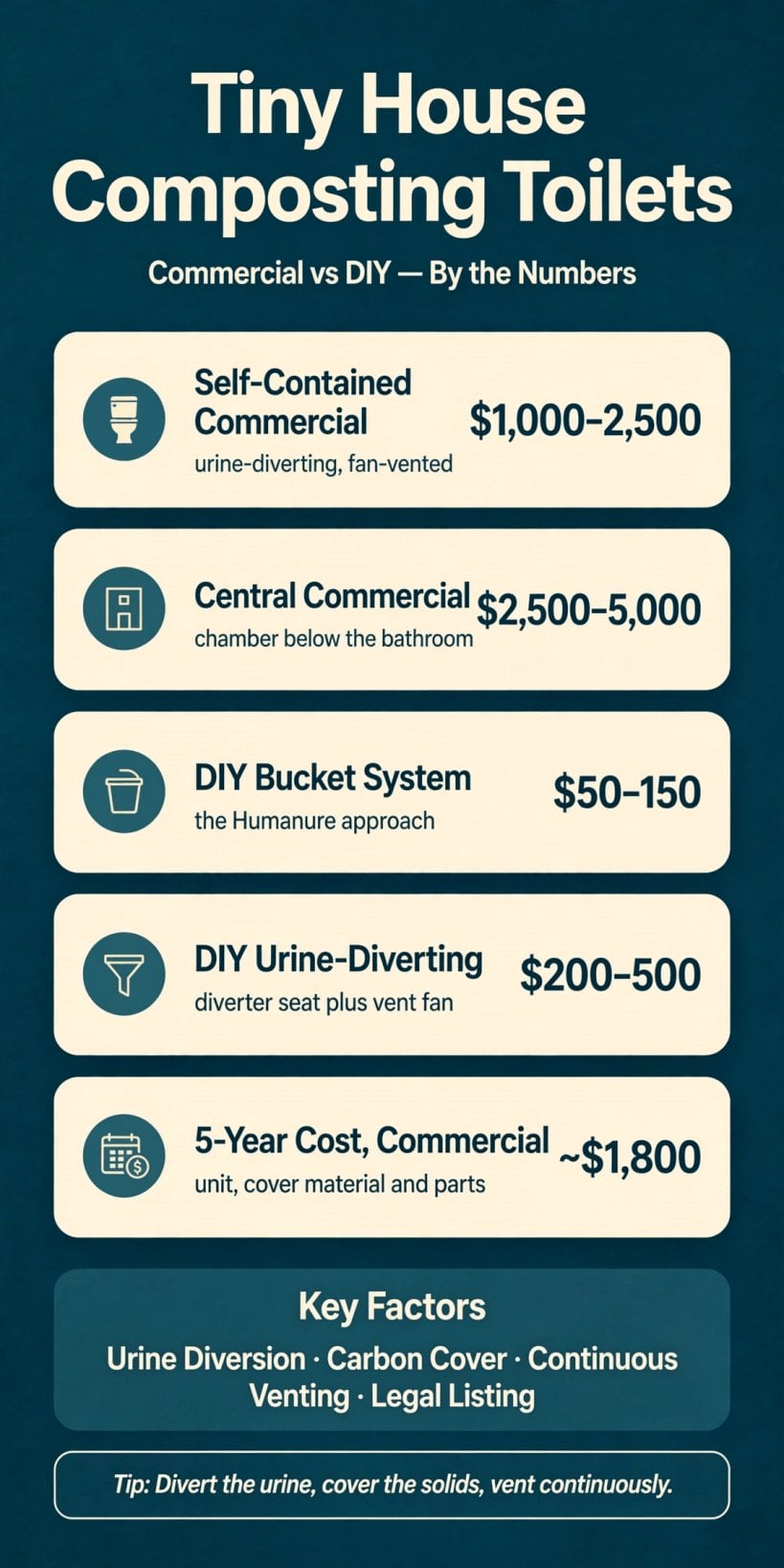
The systems by the numbers: commercial units at $1,000–5,000 against DIY builds at $50–1,000, and a five-year cost of roughly $1,800 standing against $15,000 or more for septic.
1. The Toilet Is the System
In a tiny house, the toilet choice shapes the plumbing, the legality, the maintenance routine and the daily experience more than any other fixture in the build. A conventional flush toilet drags an entire infrastructure behind it — water supply, blackwater pipework, a septic system or sewer hookup, and a legal classification that follows from all three. A composting toilet cuts that chain at the first link. It frees the tiny house from blackwater plumbing entirely: no septic, no sewer, no dump station, and a bathroom that can sit anywhere in the floor plan instead of wherever the drain line allows.
That freedom is why tiny house composting toilets sit at the center of so many off-grid designs — the sanitation decision and the water decision become the same decision, as the systems in our guide to tiny house utilities for power, water and off-grid sewage show. But the freedom comes with a condition. The gap between a good composting toilet and a bad one is the gap between “odorless and effortless” and a nightmare, and the difference is rarely the concept — it is the execution: the airflow, the separation, the routine. This guide compares commercial units against DIY systems honestly, because both can land on either side of that gap.
2. How Composting Toilets Actually Work
The principle has three moving parts. First, separation: liquids are kept apart from solids, with urine diverted to a bottle or a drain while solids drop into a chamber below the seat. Second, carbon cover: after each use, a scoop of cover material — coconut coir, peat moss or sawdust — goes over the solids, which balances the carbon-to-nitrogen ratio, absorbs moisture and smothers odor at the source. Third, ventilation: a small fan, running on 12V or 120V, vents moisture and odor outside continuously, and that steady outward airflow is what keeps the bathroom itself smelling like nothing.
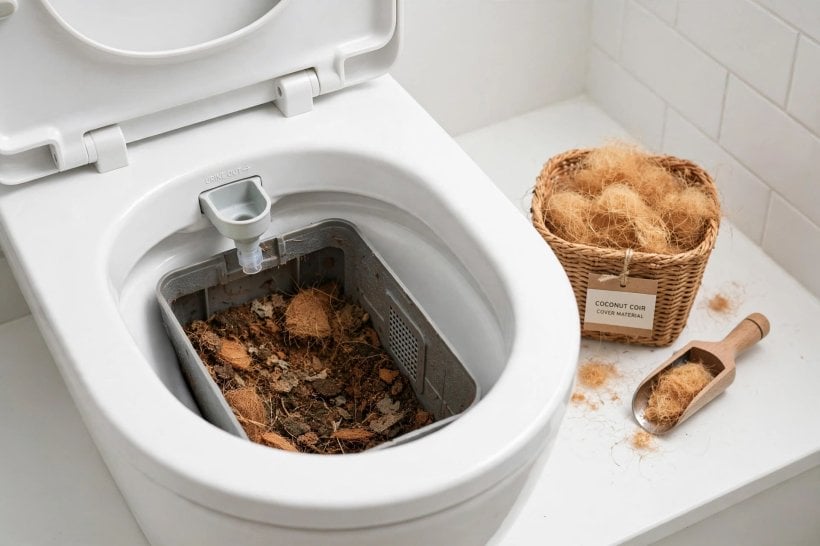
Given those three parts, aerobic decomposition does the quiet work: solids reduce to a fraction of their volume over weeks, while liquids are managed entirely separately. The key insight — the one that surprises most newcomers — is that the unit is a desiccating and separating toilet more than a true composter. The actual composting finishes outside the unit, in an outdoor bin, in most installations. Understand that, and the whole category makes sense: the toilet’s job is separation, drying and odorless storage; the garden bin’s job is finishing.
3. Commercial Units: The Main Players
The established commercial landscape has three tiers. Self-contained units ($1,000–2,500) are the familiar names of the category: urine-diverting, fan-vented, everything in one housing, sized for full-time use by two people. Central or remote systems ($2,500–5,000) move the composting chamber below or beside the bathroom, which buys larger capacity, less frequent emptying, and a better fit for families. Incinerating toilets ($2,000–4,000) leave the composting idea behind altogether: electric or propane heat reduces waste to ash, making them the premium odorless option — at the price of high energy use.
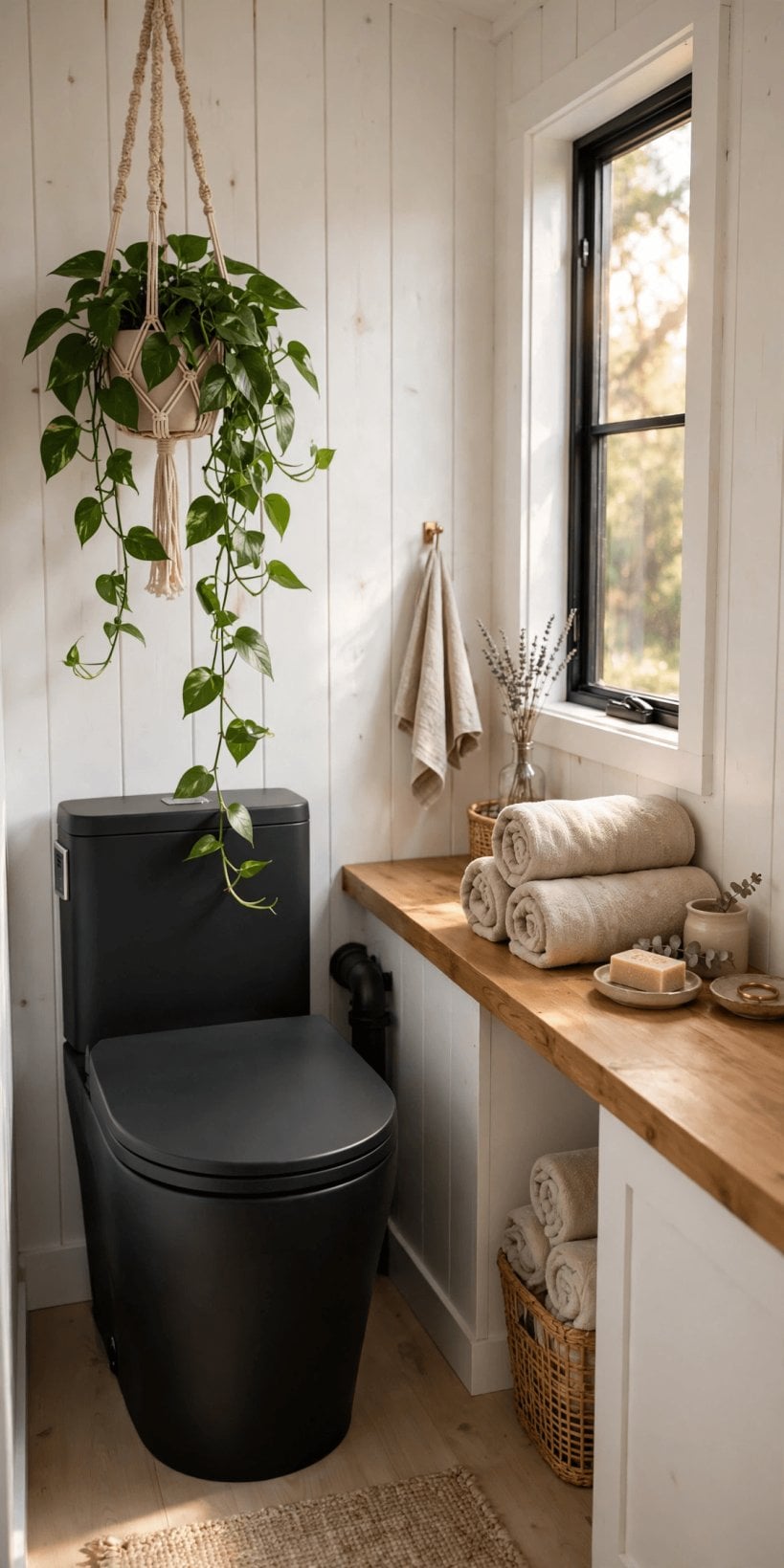
What the money actually buys is worth naming, because it is not the plastic. It buys engineered airflow — the refined, tested ventilation path that is the difference between odorless and not. It buys certified components, which matter when an inspector or an insurer asks what the unit is. It buys a warranty, and customer support when something goes wrong in February. A commercial unit is, in effect, the manufacturer’s years of airflow mistakes already made and corrected on their bench instead of in your bathroom — which is why the category commands its prices even though the underlying physics is simple.
4. DIY Systems: The Bucket and Beyond
The DIY spectrum runs from five gallons to a small building project. At the base sits the simple bucket system ($50–150): a 5-gallon bucket, a toilet seat, and cover material, emptied every few days into an outdoor compost bin — the Humanure approach, named for the method built around exactly this discipline. In the middle, the urine-diverting DIY build ($200–500) adds a diverter seat ($80–150) plus built containers and a vent fan, and captures most of the commercial benefit at a fraction of the price. At the top, advanced DIY ($500–1,000) means custom chambers and solar vent fans integrated into the bathroom build itself.
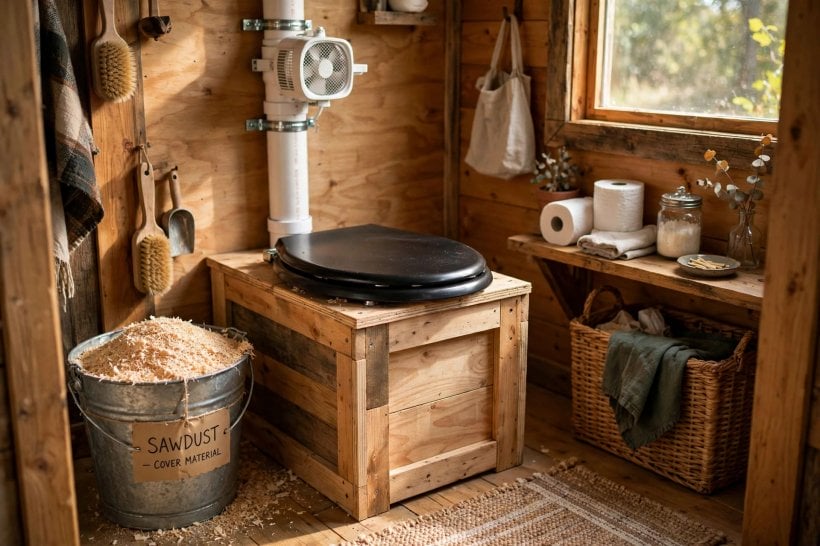
The honest assessment: DIY works, and works well, when built carefully — the physics is genuinely simple, and a well-made diverting build runs the same separation-cover-vent routine as a unit costing ten times more. What DIY lacks is equally specific. It lacks the engineered airflow refinement, so small design errors show up as odor rather than being designed out. It lacks the warranty — when a DIY system fails, the support line is the mirror. And it lacks the “it just works” factor that matters most when guests use it, which is the subject the head-to-head takes up next. None of that disqualifies DIY; it defines the skill the builder has to supply personally.
5. Head-to-Head: The Real Comparison
Run the two approaches against each other on the criteria that decide daily life, and a pattern emerges. On odor control, commercial wins through engineered ventilation — good DIY runs it close, and bad DIY is infamous. On capacity, central commercial systems win for families, while a self-contained commercial unit and a good DIY build are roughly level for couples. On emptying frequency, the lifestyle difference is significant: a commercial self-contained unit’s solids chamber needs attention every 3–6 weeks, while the DIY bucket asks every 3–5 days. On upfront cost, DIY wins decisively — $50–1,000 against $1,000–5,000 is not a margin, it is a different budget category.
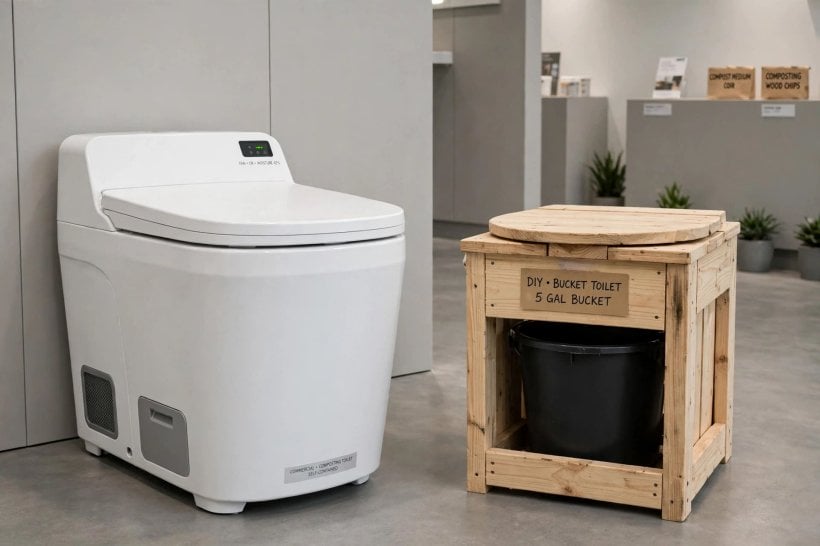
The remaining criteria tilt the other way. On guest-friendliness, commercial wins: an intuitive, forgiving unit needs no instruction card, while a DIY bucket system can intimidate visitors who have never met one. On maintenance skill, commercial needs less of it; DIY rewards the owner who is comfortable managing the system they built. And on resale and housing credibility, commercial units photograph and appraise better — permitted builds often specify commercial units outright. The summary is not “commercial good, DIY bad.” It is that commercial buys convenience, credentials and forgiveness, while DIY buys the same sanitation outcome at a tenth of the price, paid partly in attention. Where a household values its attention decides the winner.
6. The Urine Question
Urine management is the operational core of the whole system, and it is the part nobody warns you about. In a separating toilet, diverted urine has three destinations. It can go to a bottle — emptied every 2–4 days for two people, which makes it the most frequent chore in the house. It can go to a plumbed drain running to greywater, the route the layouts in our roundup of off-grid tiny house water systems plan for from the start. Or it can be diluted and dispersed in the garden: diluted 10:1, urine is excellent fertilizer — the permaculture bonus hiding inside the chore list.
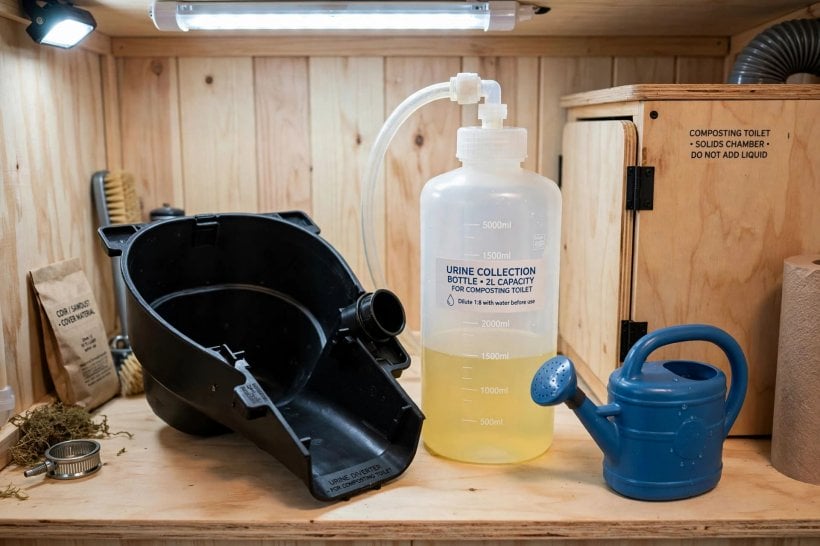
The counter-example proves the design rule: non-diverting systems mix everything together, and the result is wetter, smellier and harder to manage — which is precisely why modern designs all divert. Whatever system you run, the rhythm is the same: the urine routine is the daily discipline, the solids routine is the monthly one, and confusing the two is how newcomers conclude the whole idea stinks. One sizing warning completes the picture: size the urine handling for your actual occupancy, because guests double the frequency — a bottle that serves a couple for three days serves a houseful for one.
7. The Finished Compost: What Happens Next
The solids chamber does not produce finished compost; it produces a partially composted material that needs finishing. The standard move is a transfer to an outdoor compost bin — sealed and animal-proof — where the material rests for 6–12 months of further decomposition. After that finishing period, the conservative rule governs its use: ornamental plantings, not food crops, a restriction that regulations in many places require outright. Handled this way, the end of the process is unremarkable, which is the highest praise sanitation can earn.
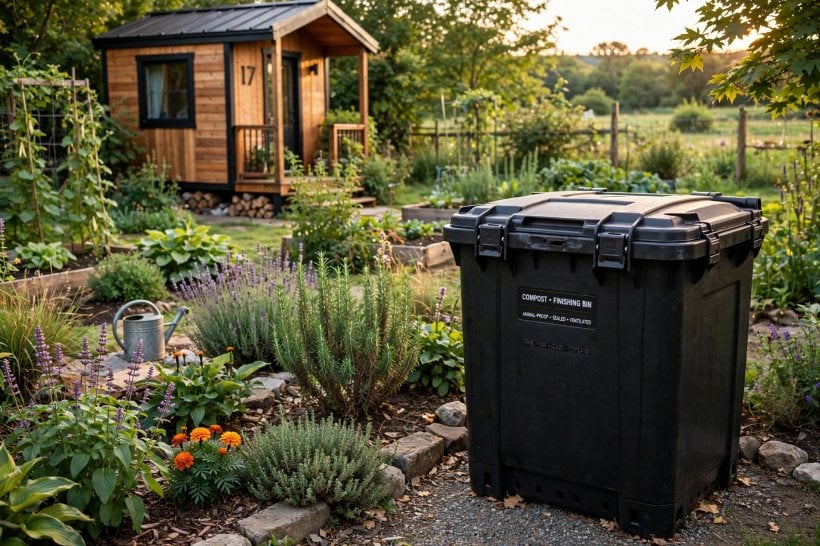
The volume reality is reassuringly small: two full-time people produce roughly 5–10 gallons of finished material per month — a bin, not a burden. And the “ick” factor, the objection every newcomer raises first, fades within weeks of actually running a system. The material at emptying looks and smells like damp soil when the system runs correctly, because that is close to what it has become. Owners planning the bathroom around all of this will find the space side of the equation in our tour of tiny house bathroom designs and layouts that actually fit — the toilet choice and the room it stands in are designed together, or fought over later.
8. Legality: The Patchwork
Composting toilet legality varies by jurisdiction, and the variation is the story. Some jurisdictions explicitly permit listed commercial units — the easiest path of all, because the listing itself is the approval. Some allow composting toilets with conditions: a greywater plan, a backup septic system, or professional installation. Some are simply silent, which creates the gray zone — and the rule there is to get written approval before building, because silence is not permission. And some prohibit them outright, usually where conventional septic is mandated. The same classification questions run through our guide to zoning laws for tiny houses and talking to officials, and the foundation-code side of tiny home legality is covered in our explainer on IRC Appendix Q for tiny homes.
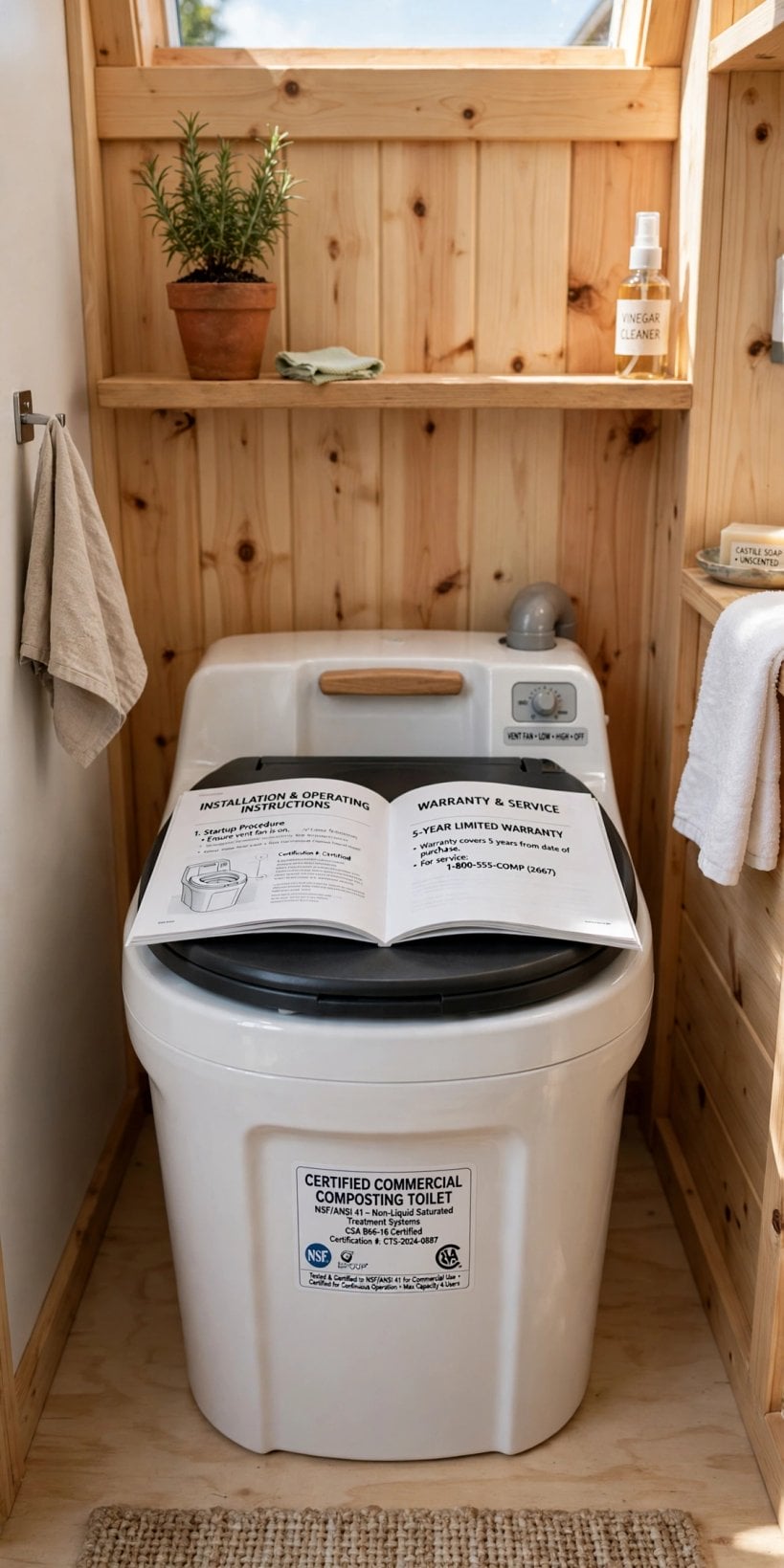
The strategy that survives the patchwork has three steps. Lead with a commercial listed unit, because inspectors trust certifications they can look up. Present the greywater plan alongside it, so the official sees the complete sanitation story rather than a single fixture to worry about. And get the approval in writing before purchasing anything. A DIY build is not automatically excluded by this strategy — but it starts the conversation without the certification that does the persuading, which is a real cost to weigh against the savings. The toilet is the wrong place for a legal gamble: it is the fixture inspectors ask about first and forgive last.
9. Costs: The Full Picture
The five-year cost comparison for a couple is where the category makes its economic case. A commercial self-contained setup totals roughly $1,800 across five years: a $1,500 unit, $200 of cover material and $100 of parts. A DIY diverting build totals roughly $600: a $400 build and the same $200 of cover material. Set either against the conventional alternative and the gap is stark — a septic system runs $12,000–25,000 installed plus $300 of pumping, landing at roughly $15,000 or more over the same five years. The composting toilet saves $10,000–20,000 over septic; where septic is the alternative, the economic argument is overwhelming.
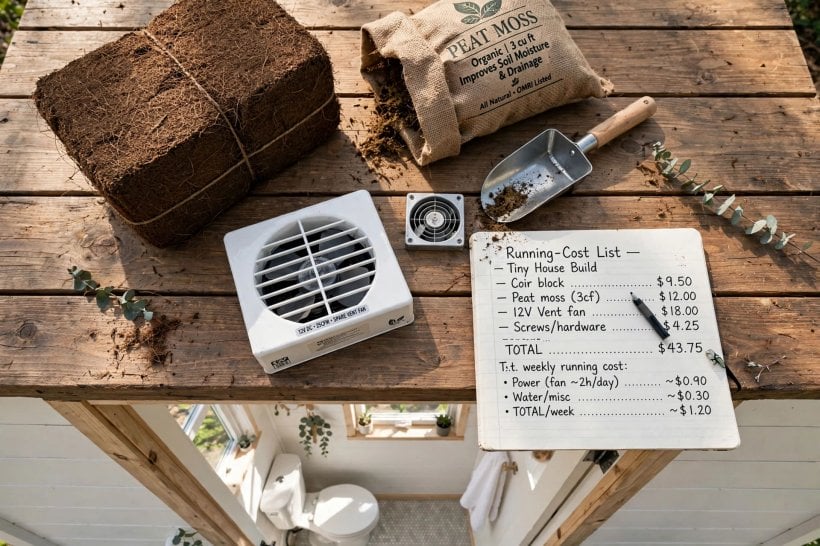
Against a sewer connection ($2,000–8,000), the math is closer — but composting still wins on independence, because the saving is not only money: it is the freedom to place the house where no sewer line runs, the same freedom weighed in our guide to how to prepare land for a tiny house. Read the three totals as three philosophies. Septic buys convention at infrastructure prices. A commercial unit buys certified independence at appliance prices. A DIY build buys the same independence at materials prices, with the difference paid in the owner’s own attention. The five-year frame matters: cover material and parts are the only recurring lines, and they are small enough that the toilet’s running cost rounds to a utility bill of nearly zero.
10. Choosing: The Decision Guide
The decision resolves into matching the system to the household, and the original comparison’s verdicts hold up well. Choose a commercial self-contained unit if it is your first composting toilet, if you host guests, if you want the warranty, or if permitting favors listed units — four common situations, and the category exists for exactly them. Choose a central commercial system if there are three or more full-time occupants, if you want minimal emptying, or if the bathroom layout allows a below-floor chamber. Choose DIY diverting if the budget is tight, you are handy, occupancy is one or two people, and you are comfortable managing the system you built.
Choose the bucket if the situation is temporary, the budget is extreme, or you follow the Humanure method deliberately — it is a complete system, not a compromise, when done right. And consider incinerating if odor tolerance is zero, electricity or propane is abundant, and the budget allows: ash has no routine at all, which for some households is worth every watt. Households still weighing the wider off-grid package will find the toilet’s place in it mapped in our guide to how to live off grid in a tiny house. Notice what the decision never turns on: ideology. The right answer is the one whose routine — every 2–4 days, every 3–5 days, or every 3–6 weeks — fits the household that has to perform it.
Final Considerations
The composting toilet is the tiny house’s declaration of independence from the sewer grid — and it works, odorlessly and reliably, when the system matches the household. That is the whole verdict on tiny house composting toilets: commercial units buy engineering and peace of mind; DIY systems buy economy and self-reliance; and the price difference between them is paid, one way or another, in money or in attention. Either way, the principles never change: divert the urine, cover the solids, vent continuously, and manage the finished material responsibly. Get those four right and the most feared fixture in alternative housing becomes the most boring one — which is exactly what you want from a toilet.


0 Comments