

A tiny house keeps its value in the home itself, but the ground beneath it follows entirely different economics depending on whether you rent it or own it. The renting vs owning land tiny house decision decides what you pay upfront, how secure your home’s position really is, whether the money you spend builds anything of lasting value, and how easily you can leave when life changes its mind. Renters trade ownership for lightness: small startup costs, simple agreements and an exit that mostly involves a tow vehicle. Owners trade money and effort for permanence: a deed, an asset and a patch of earth that answers to them.
This guide compares the two honestly, attribute by attribute, with costs kept qualitative because land prices vary more than almost anything else in tiny living. We will look at upfront and monthly costs, tenure security, equity, moving flexibility, whose rules you live under, who benefits when you improve the land, and the paperwork each path involves. We will also cover the blended routes, community lots, family land and lease-to-own arrangements, because many households end up somewhere between the pure options. By the final verdict you should know which side of the fence fits your finances, your plans and your temperament.
Renting vs Owning Land Tiny House at a Glance
The table below compresses the comparison into the criteria that matter most when a tiny home needs ground. Read it for the quick answer, then use the numbered sections for the detail behind each row.
| Criterion | Renting the Land | Owning the Land |
|---|---|---|
| Upfront cost | Small: deposit, first month, hookup setup | Large: purchase price, fees, surveys, services |
| Tenure security | Depends on your agreement and the owner’s plans | Strongest available: the deed is yours |
| Equity | None in the land; payments end when you leave | Land value is yours, for better or worse |
| Move flexibility | High: end the agreement and tow away | Low: leaving usually means selling the land |
| Rule exposure | Landlord or site rules plus public law | Public law only: zoning, codes, covenants |
| Monthly shape | Continuous rent, may rise over time | Taxes, insurance and your own maintenance |
| Improving land | Improvements mostly benefit the owner | Every improvement adds to your own asset |
| Best for | Testing tiny life, mobile years, small budgets | Settling down, gardeners, long-term planners |
1. The Basic Choice: Paying for Use vs Buying the Ground
Renting land means paying for permission: a lot in a community, a corner of a farm, a private parcel leased from its owner, or a space in a park. Your money buys the right to place your home there under an agreement, for as long as that agreement runs and its terms are kept. The land, its services and its future all remain somebody else’s property and somebody else’s decision. What you hold is flexibility and a low barrier to entry, which for many tiny households, especially in their first years, is exactly the right thing to hold.
Owning land means the ground itself joins your balance sheet. You hold the deed, you decide what happens on the parcel within the law, and the value of the land, rising or falling, belongs to you. Our guide to where to buy tiny house lots maps where owners actually find parcels that suit small homes. Ownership in tiny living has a special flavour, though: your house may be legally a vehicle while your land is real estate, and the relationship between those two facts shapes financing, insurance and resale in ways the rest of this guide will keep returning to.
2. Upfront Cost: A Small Start vs a Large Commitment
Renting is the cheapest door into tiny living by a wide margin. The upfront bill is usually a deposit, the first month or two of rent, and whatever it costs to position the house and connect to services that already exist. There is no purchase to finance, no survey to commission and no legal process to feed. That lightness matters beyond the first year: money not sunk into land stays available for the house itself, for a better build, or for the emergency fund that makes small-space living feel calm rather than precarious.
Buying land is the opposite shape: a large commitment before the house even arrives. Beyond the purchase price sit legal fees, surveys, possible financing costs and, on undeveloped parcels, the project of bringing in access, power and water. The finance side deserves early honesty, and our guide to how to finance a tiny house explains how lenders treat homes and land differently. None of this makes buying wrong; it makes buying a decision to schedule carefully, ideally after you know tiny living suits you, because unwinding a land purchase is slower than ending a rental.
3. The Monthly Picture: Rent That Continues vs Costs That Shrink
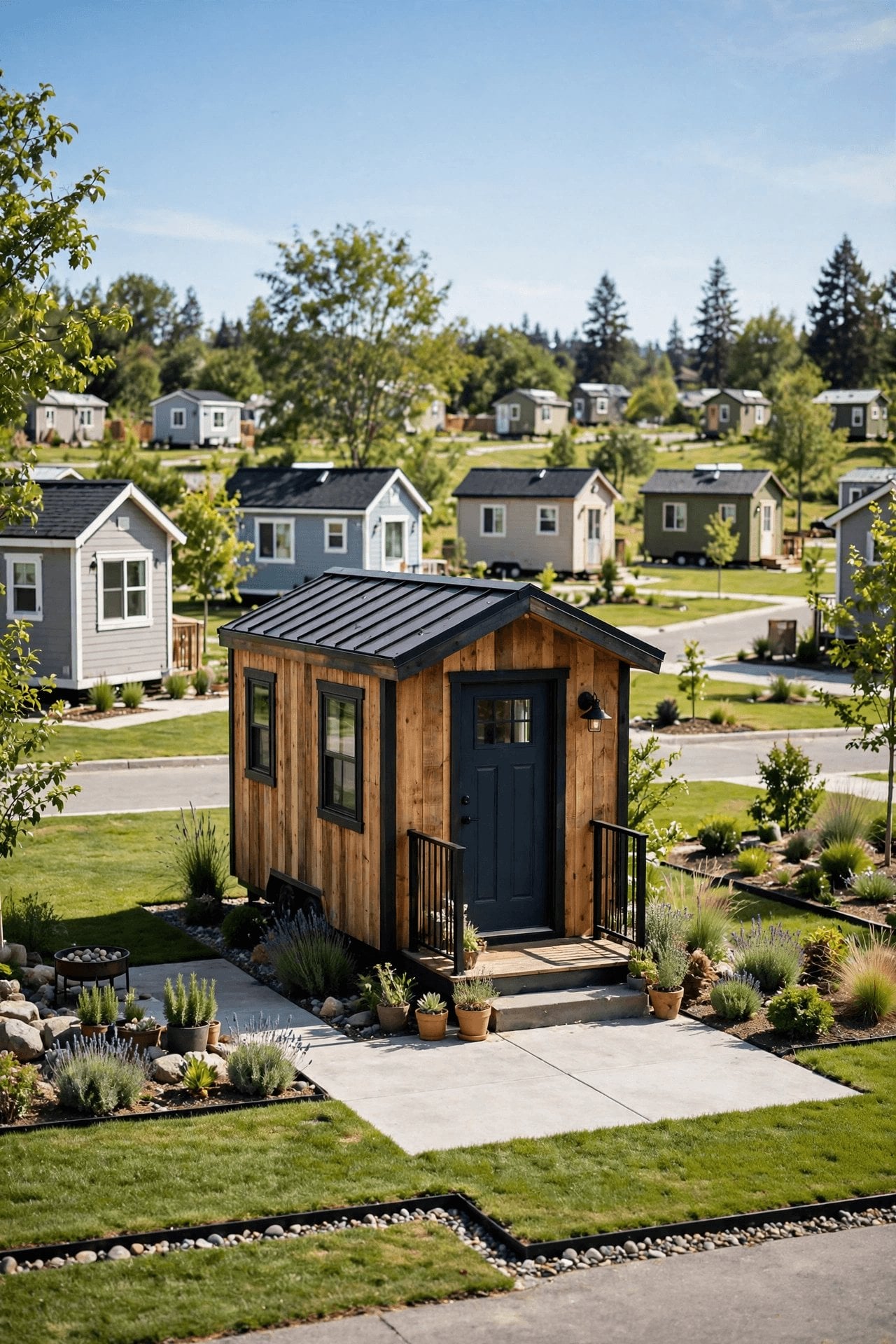
A renter’s monthly land cost is simple, predictable and permanent: the rent leaves your account every month you live there, and it can rise when agreements renew. In a serviced community lot, that payment often bundles water, waste and shared upkeep, which softens the comparison, but the structure never changes. You are buying your position month by month, and the day you stop paying, the position ends. Budgeting is easy; building value is not part of the arrangement.
An owner’s monthly picture starts heavier and grows lighter. Early on there may be a land loan alongside property taxes, insurance and the cost of establishing services. Over time the loan can end, leaving taxes and maintenance as the main outgoings, often well below comparable rent, and every payment has been shrinking a debt on an asset rather than purchasing another month. The honest counterweight: maintenance on owned land is yours alone, and a failed well, a storm-damaged access track or a new fence arrives on your desk, not a landlord’s.
4. Tenure Security: Notice Periods vs the Deed
Security is where renting asks for clear eyes. Your right to stay is exactly as strong as your agreement and the owner’s intentions: landlords sell land, change its use, retire, pass property to family, or simply decide not to renew. Good agreements with fair notice periods reduce the risk, and long leases reduce it further, but the structural fact remains that your home sits on land controlled by someone else. For a house that is expensive and awkward to move, that is not a theoretical concern; it deserves a written agreement you have actually read.
Ownership replaces that negotiation with a deed. Nobody can decline to renew your own land. Your security is limited by law, by your ability to pay taxes and any loan, and by genuine public processes, not by another person’s plans. For households putting down gardens, workshops, roots and years, that certainty is often the real product being bought, worth more than the financial maths alone. It is also why buying usually makes most sense when the location itself, not just the lifestyle, is one you actively want to keep.
5. Equity: What Your Money Builds and What It Does Not
Rent builds no equity in land, and it is important to say so without drama. Years of faithful payments leave you with exactly what you started with: a house, and a payment history. That is not wasted money; it bought housing, flexibility and sleep-at-night simplicity every month. But households who frame renting as a temporary step should notice the trap: because rent is comfortable and ownership is effortful, temporary arrangements have a way of quietly becoming permanent while the equity column stays at zero.
Ownership puts your housing money to double duty. Payments reduce a loan while the land itself, in most markets over long periods, holds or grows its value, and improvements you make add to an asset you own rather than to a landlord’s. Land equity can later fund a move, a bigger project or a more comfortable old age, and it passes to family in a way a rental agreement never can. The risk side is equally real: land can fall in value, and an illiquid asset is not an emergency fund. Equity is a long game, which is precisely why it pairs with long plans.
6. Move Flexibility: Unhitch and Go vs Sell Before You Leave
A tiny house on rented land keeps the founding promise of the movement: it can move. When work relocates, family needs you elsewhere or a better situation appears, the renter’s exit is mostly logistics: give notice, settle the agreement, prepare the house and tow. Our practical guide to the tiny house moving process and transport costs lays out what that day actually involves. Renters who keep their houses genuinely road-ready, rather than slowly entombed in decks and sheds, hold an option owners largely give up: the ability to change their minds cheaply.
Owners who decide to leave face a property transaction, not a tow. Selling land takes time, its own costs and a buyer, and the more you have invested in services and landscaping, the more your life is woven into a parcel that must be sold as a whole or left tenanted. Some owners embrace this by renting the land to the next tiny dweller; others plan from the start to sell house and land together. Neither is a flaw, but go in knowing that buying land is how a mobile house becomes, in practice, a settled one.
7. Rule Exposure: A Landlord’s Terms vs Public Law Only
Renters live under two layers of rules: the public law that governs everyone, and the private terms of their agreement. Those terms can cover guests, vehicles, pets, noise, exterior appearance, subletting and even how long you may be away, and breaking them can cost you your placement. The quality of a rental therefore depends heavily on the character and clarity of the landlord. A fair written agreement with a reasonable owner is a perfectly good life; a vague handshake with an unpredictable one is a risk no low rent fully compensates.
Owners answer to one layer only: the law itself. Zoning, building and health codes, and any covenants recorded on the land set the boundaries, and inside those boundaries the decisions are yours. That freedom still requires homework, because a parcel’s zoning decides whether your home may legally stand there at all, and our guide to zoning laws for tiny houses and talking to officials shows how to confirm it before you buy. Freedom from a landlord is real, but it is freedom inside a legal frame, and owners carry the full weight of staying inside it.
8. Improving the Land: Whose Trees, Whose Fence, Whose Well?
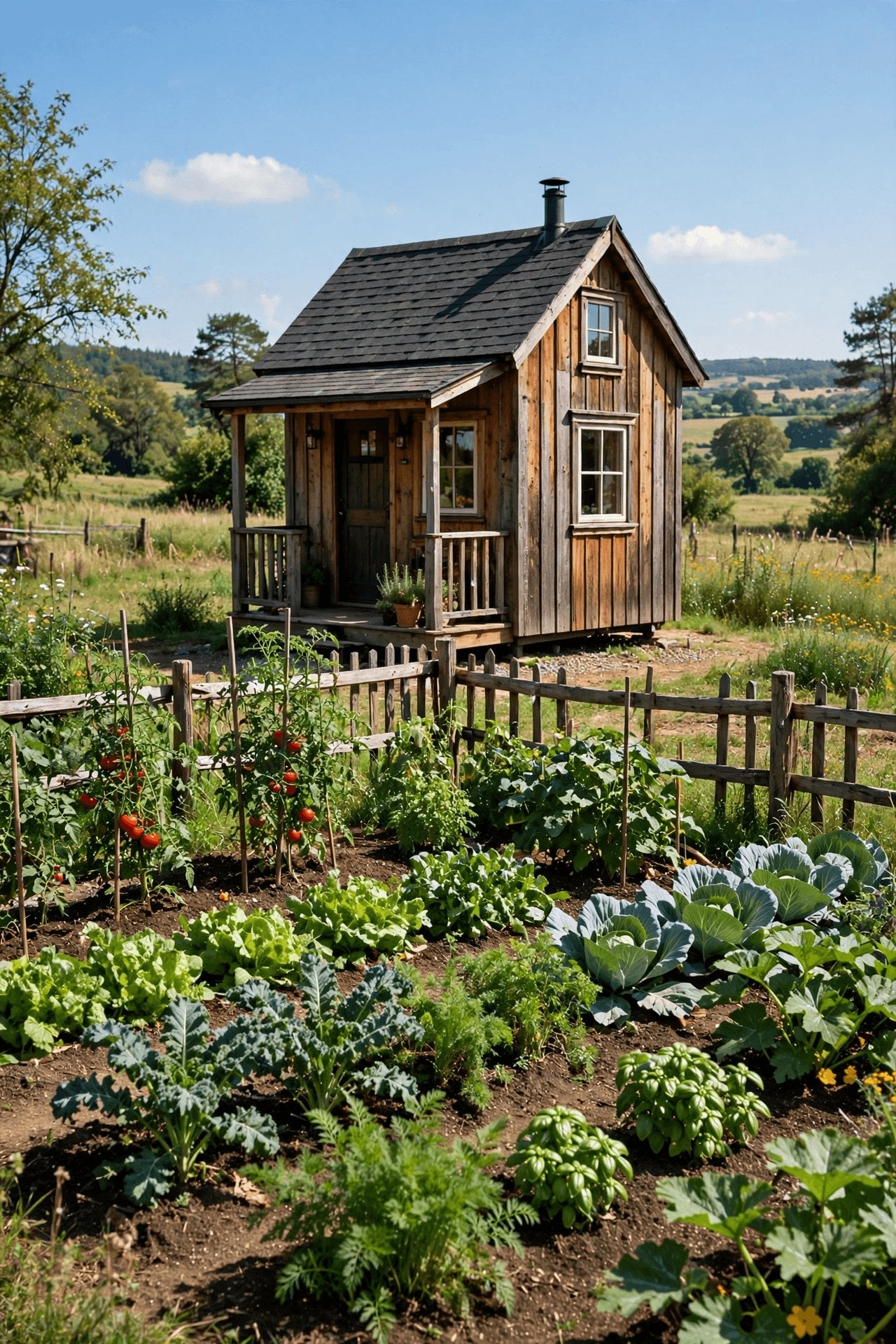
Every improvement raises the same question for a renter: when I leave, this stays, so is it worth it? Planting trees, building terraces, installing services and landscaping all enrich the owner’s asset at the renter’s expense, which is why wise renters invest mainly in improvements that are portable, cheap or enjoyable enough to justify on their own terms, and why any substantial work deserves the owner’s written agreement first, ideally with how it will be treated at the end of the tenancy settled in advance.
For owners the same spending is an investment in their own ground. Our step-by-step guide to how to prepare your land for a tiny house covers the sequence from access to services, and on your own parcel every hour of it compounds: the orchard matures for you, the workshop serves your projects, the well and septic are assets on your sale documents one day. This compounding is the quiet engine of the ownership case. Land rewards patience, and tiny homeowners who stay longest tend to be the ones who planted earliest.
9. Financing and Paperwork: Agreements, Loans and Insurers
Renting keeps paperwork thin: an agreement, a deposit record, and insurance for your home and belongings. That last item deserves attention in both paths, because a house on wheels confuses insurers just as it confuses lenders, and our guide to tiny house insurance for homes on wheels vs foundations explains the distinctions that decide real cover. Renters should also confirm whether their agreement requires specific insurance, and whether the landlord’s policy, it usually does not, extends any protection to their home.
Buying multiplies the paper: purchase contracts, title checks, surveys, loan documents where financing is used, and registration of services and permits, all before the taxes and insurance renewals of ordinary landownership begin. None of it is unmanageable, and professionals exist for every step, but it is a project in itself, measured in weeks and fees. Households who hate administration should count this honestly: part of what rent buys is freedom from ever thinking about most of these documents, and part of what ownership buys is needing to.
10. Blended Paths: Community Lots, Family Land and Lease-to-Own
Reality offers middle paths worth knowing. A purchased or long-leased lot in a community combines ownership-style security with ready services and neighbours, and our comparison of tiny house communities vs RV parks helps sort the models on offer. Family land can be the kindest arrangement of all, or a source of lasting tension, and it deserves the same written clarity as any commercial lease, precisely because everyone involved wants the relationship to survive the paperwork. Lease-to-own agreements convert rent into a future purchase and can suit both parties when prices, timelines and exit terms are spelled out by a professional.
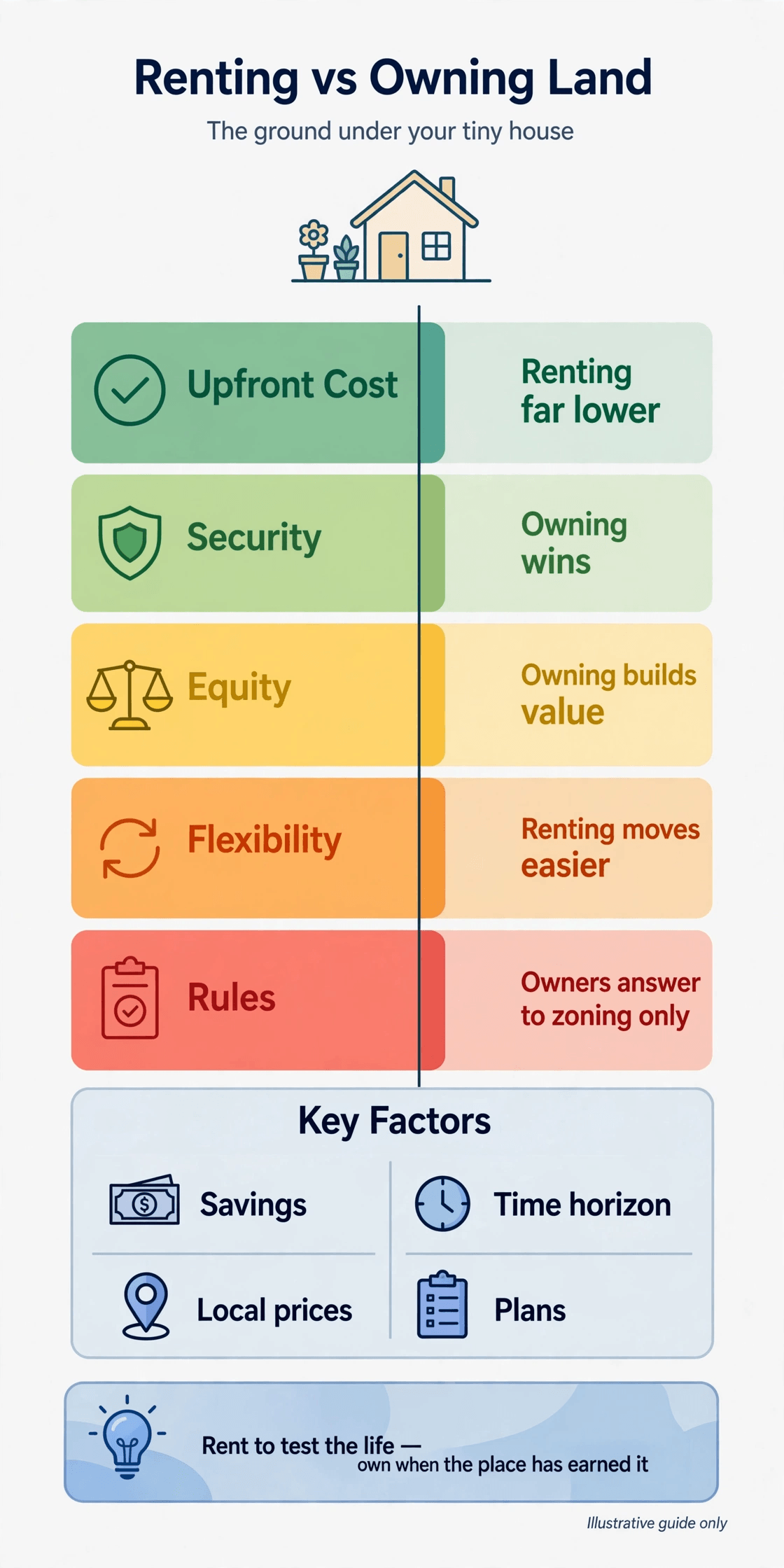
Whichever blend tempts you, judge it by the same five measures used throughout this guide: what it costs upfront and monthly, how secure your tenure truly is, whether your money builds equity, how easily you can leave, and whose rules govern your daily life. Blends fail when they are chosen for their marketing rather than their terms. Read the agreement as if the friendly person across the table will one day be replaced by a stranger enforcing it, because eventually, on a long enough timeline, agreements outlive the people who shook hands on them.
Final Considerations
Choose renting if you are testing tiny living, expect to move within a few years, want the smallest possible upfront cost, or value the freedom to change your mind more than the value building under you. Rent well: get a fair written agreement, keep the house movable, and treat the absence of land equity as the known price of your flexibility rather than a surprise you discover later.
Choose owning if your plans point at staying, your finances can carry the purchase without starving the rest of your life, and you want the security, equity and improving-compound of land that answers to you. Buy carefully: verify the zoning before the emotion, price the services before the celebration, and plant early. The house is the same house either way. The ground decides whether you are a guest in your own life or the author of the place, so pick the role you actually want to play.


0 Comments