

Building the house is only half the project. The other half is the patch of earth it sits on, and that choice quietly decides your monthly costs, your privacy, your legal peace of mind and even your social life. The tiny house community vs private land decision is the fork in the road that every tiny homeowner meets, usually before the trailer is even finished. One path leads to a ready-made lot in a village of small homes, with hookups waiting and neighbours who understand the life. The other leads to a piece of land that is yours alone, with all the freedom and all the responsibility that ownership or a private lease implies.
Neither path is the grown-up choice and neither is the compromise. They are two different lifestyles that happen to share the same house. This guide compares them attribute by attribute: what each costs month to month in honest, qualitative terms, how their rules differ, how private each really feels, how ready the hookups are on day one, and how much community comes built in. We will also look at legal standing, how easy each is to leave, and which households thrive in each setting, so that by the final verdict you can hear your own situation described and choose your ground with open eyes.
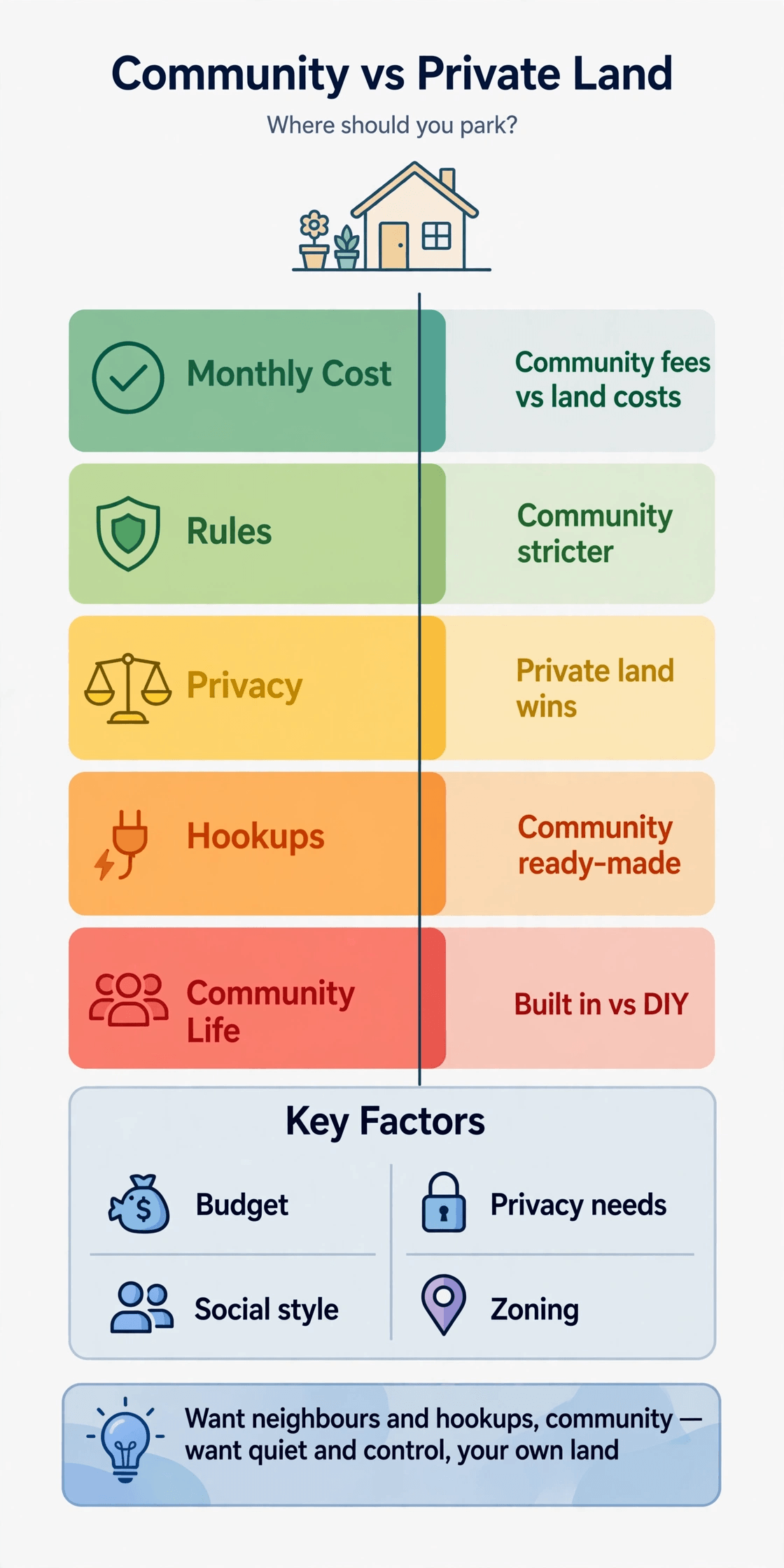
Tiny House Community vs Private Land at a Glance
The table below compresses the comparison into the criteria that decide where a tiny home should park. Read it for the quick answer, then use the numbered sections for the lived detail behind each row.
| Criterion | Community | Solo Land |
|---|---|---|
| Monthly cost | Predictable lot rent, usually with services bundled | Lower once land is owned; taxes and upkeep remain |
| Rules | Shared guidelines on noise, guests, upkeep and parking | Your rules on your land, within local law |
| Privacy | Neighbours close by; screening varies by design | Distance and landscape give real seclusion |
| Hookups | Ready on day one: power, water, waste handled | You arrange and pay for every connection |
| Community life | Built in: shared spaces and like-minded people | You build your own social world from scratch |
| Legal certainty | Placement is the community’s whole purpose | Depends on zoning and permits for your parcel |
| Leaving | Usually simple: end the lot agreement and tow away | Easy on wheels, harder once services are buried |
| Best for | First placements, social households, low hassle | Privacy seekers, long-term roots, self-reliance |
1. The Two Ways to Park: A Quick Orientation
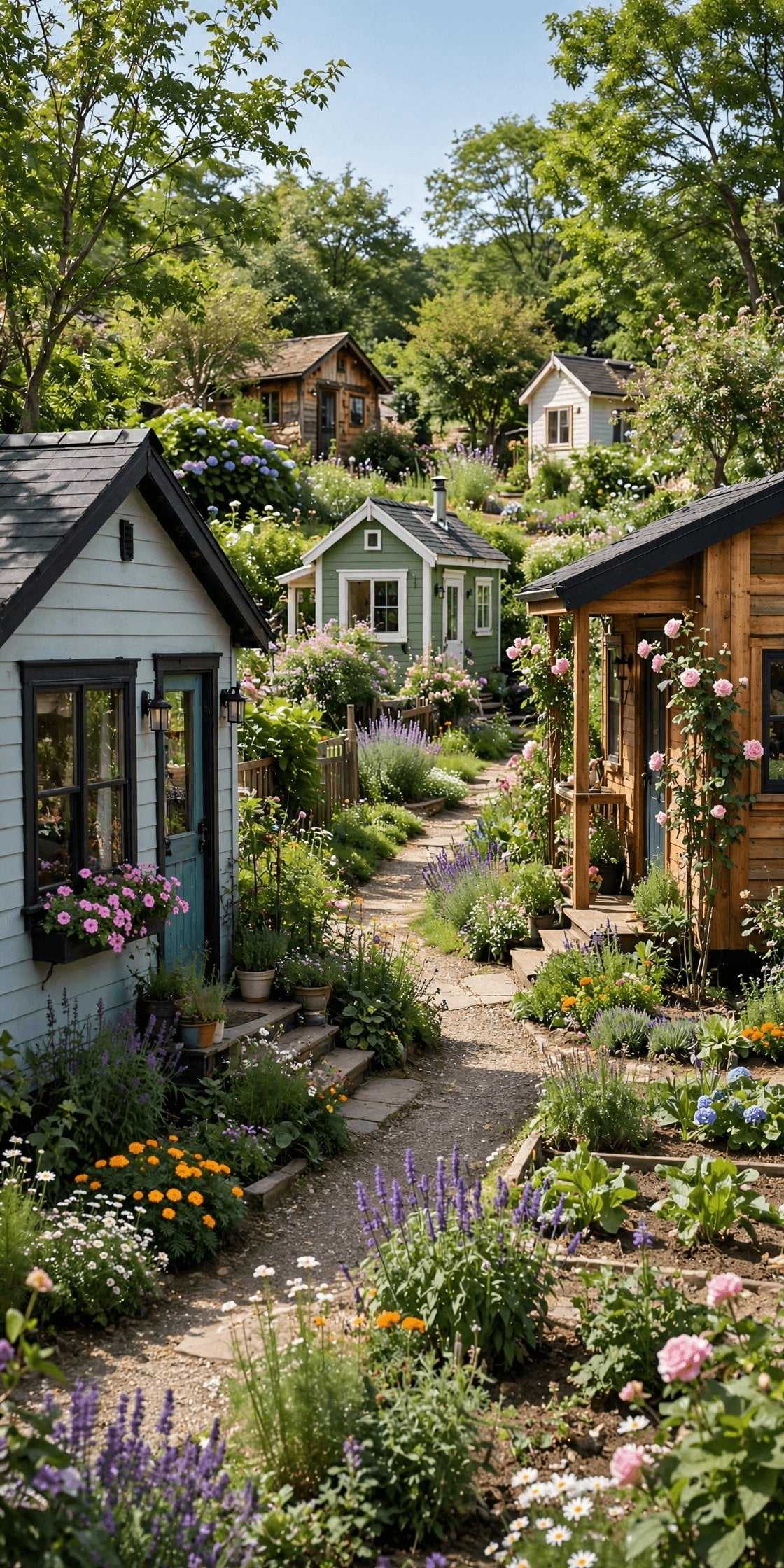
A tiny house community is a piece of land deliberately organised for small homes: individual lots arranged around shared infrastructure, run by an owner, a cooperative or a residents’ association. Lots are usually rented, sometimes sold, and the placement of your home there is legal by design, because the community itself was permitted for exactly this use. Sizes range from a handful of homes on a farm corner to full villages with common houses, gardens and workshops. What they share is intention: somebody planned for tiny homes to be there.
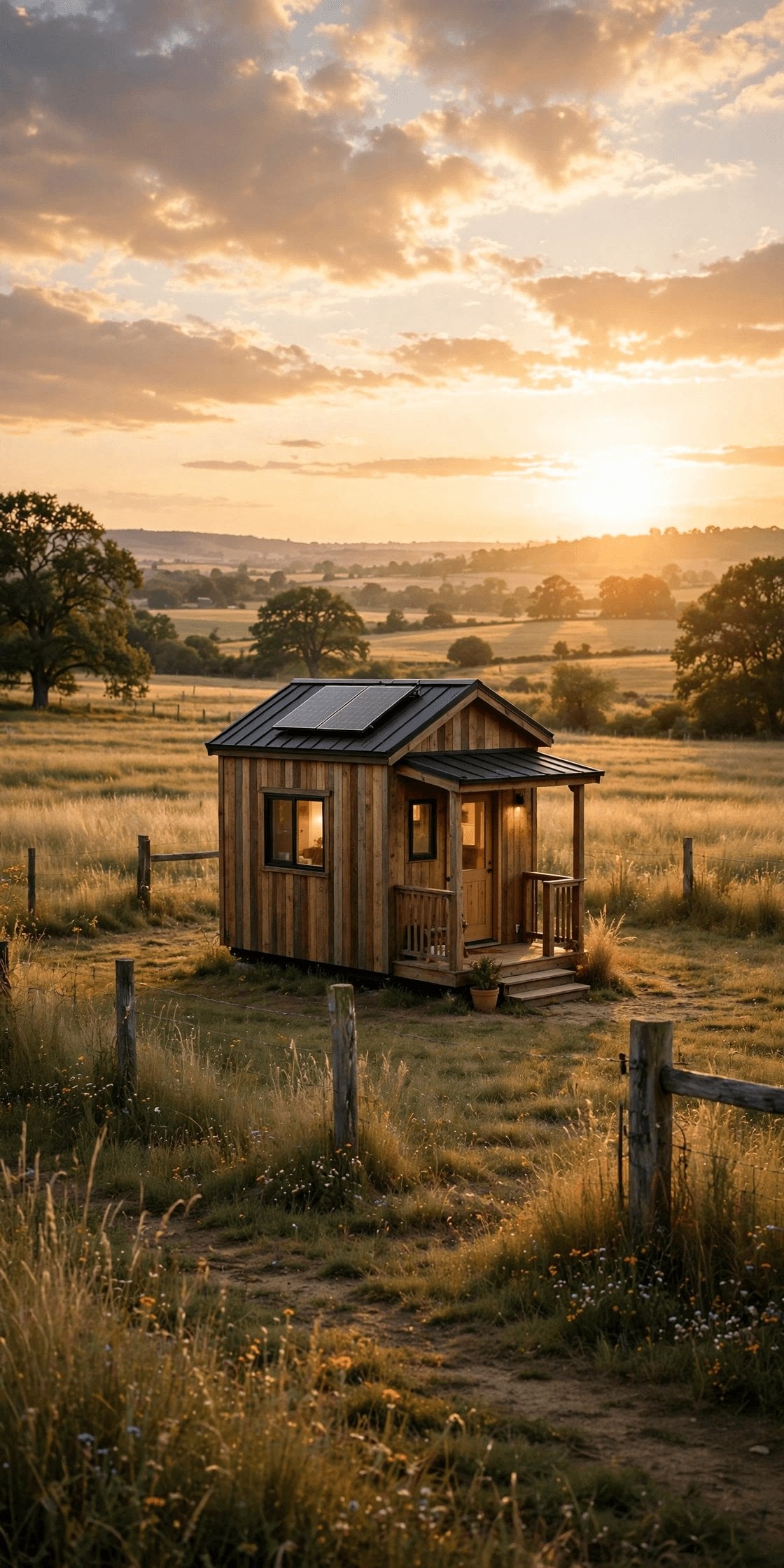
Solo land means your home stands alone on a parcel: land you own, land you lease from a private owner, or occasionally a corner of a friend’s or family’s property. Nothing about the parcel was prepared with your house in mind until you prepared it. That blank page is the appeal and the challenge. If you are still picturing the two options, our comparison of tiny house communities vs RV parks and their differences is a useful neighbouring read, because many parks sit somewhere between these two poles.
2. Monthly Cost: Predictable Rent vs the Price of Your Own Ground
Community living converts land into a subscription. Lot rent arrives every month, typically bundled with some combination of water, waste handling, shared-space upkeep and sometimes power, which makes budgeting calm and predictable. There is no land purchase to finance and no surprise bill for a failed well pump, because the infrastructure is the operator’s problem. The honest trade-off is permanence of payment: the rent never ends while you live there, it can rise over time, and years of payments build no equity in the ground beneath your home.
Solo land reverses the shape of the cost. Buying a parcel is the large, difficult expense, often with financing, surveys and legal fees around it, and our guide to where to buy tiny house lots walks through where those parcels are found. After purchase, though, monthly outgoings can shrink to property taxes, insurance and your own maintenance, which is why long-term owners often come out ahead. Leasing private land sits between the two: cheaper than buying, less secure than either. Compare the shapes over your real time horizon, not just the first year.
3. Rules: Shared Guidelines vs Your Own Boundaries
Every community has rules, and good ones are a feature rather than a flaw. Expect written expectations about quiet hours, guest stays, vehicle parking, exterior upkeep, pets and how your lot should look, enforced by a manager or association with the power, in serious cases, to end your agreement. For households who like knowing exactly where they stand, that clarity is relaxing. For households who experience any external rulebook as friction, even a gentle one will eventually itch, so read the actual document before you fall in love with a lot.
On your own land the rulebook shrinks to the law itself: zoning, building and health codes, and any covenants attached to the parcel. Within those lines, the choices are yours: guests stay as long as you like, the garden grows where you plant it, and nobody inspects your skirting. The responsibility is also entirely yours, including the homework of confirming what the law on your parcel actually says, which is why the legal section below matters so much more for solo land than for a community lot.
4. Privacy: Neighbours by Design vs Distance by Default
Privacy in a community is designed rather than guaranteed by distance. Lots sit closer together than most rural parcels, and your outdoor life happens within sight and earshot of other small homes. Well-planned communities soften this with staggered lots, planting, fences and shared land that absorbs activity, and many residents find the result cosy rather than exposed: private enough at home, sociable by choice. Poorly planned ones feel like a car park with better marketing. Visit at different times of day, stand on the lot, and listen before you sign.
Solo land offers the privacy of geography. With acres or even a generous single parcel around you, the nearest neighbour can be a hedge, a hill or a valley away, and the soundscape is weather and wildlife rather than other people’s evenings. For writers, night-shift workers, musicians, dog owners and anyone recharging a social battery, that seclusion is the entire point. Its shadow side is real too: privacy and isolation are the same thing on a bad week, and help is never just across the path when something goes wrong at midnight.
5. Ready Hookups: Plug In on Day One vs Build It Yourself
The community’s strongest practical card is readiness. You tow in, position the house, and connect to power, water and waste points that were installed for exactly your purpose. Internet options are usually established, roads and drainage are somebody else’s engineering, and your first night can genuinely be your first night living in the home. For first-time tiny dwellers, that soft landing is worth real money, because it removes the entire infrastructure project from the year you are also learning to live small.
Solo land asks you to become your own utility company. Power might mean a grid connection, a solar build or both; water might mean a mains tap, a well or delivery; waste means septic, a holding arrangement or a composting strategy. Our step-by-step guide to how to prepare your land for a tiny house shows the honest sequence, from access and levelling to services. Every one of those projects costs money and calendar time before the house feels finished, and several need permits. The reward is a parcel set up precisely your way, with capacity you chose rather than inherited.
6. Community Life: Built-In Neighbours vs a Social Life You Build
A good community hands you a social world on arrival: shared gardens, common buildings, skill swaps, borrowed tools, watched houses while you travel, and neighbours who already understand why your life fits in one room. Our tour of tiny house villages and successful legal communities shows how varied that world can be, and our look at off-grid alternative communities, cohousing and ecovillages covers the more intentional end of the spectrum. For people moving alone, downsizing after a busy family life, or arriving in a new region, this built-in belonging is often the deciding joy.
On solo land, community is a project rather than a provision. You will build it from neighbours along the road, the nearest town, clubs, work and deliberate invitations, and it can absolutely become rich and local in a way community life sometimes is not. But it takes longer, it depends on your effort in the seasons when effort is scarce, and some solo households honestly report a lonely first winter before roots take. Neither answer is better in the abstract. The right question is whether you recharge by gathering or by retreating, because your land will give you more of whichever you choose.
7. Legal Standing: Approved by Design vs Proven Parcel by Parcel
In a permitted community, the legal question was answered before you arrived. The land use allows tiny homes, the lots comply, and your task is the comparatively small one of keeping your own home and agreement in good standing. That certainty has practical value with lenders, insurers and your own sleep. It is also fragile in one specific way: it belongs to the community, not to you, and if the community is sold or its direction changes, your certainty is renegotiated on somebody else’s timetable.
On solo land the legal work is yours, and it is parcel-specific: zoning category, whether a tiny house on wheels counts as a dwelling, an RV or a temporary structure, minimum size rules, and whether an accessory dwelling route exists. Our guide to zoning laws for tiny houses and talking to officials explains how to have that conversation productively, and the truly committed can even read our walkthrough on how to start your own tiny house community to see what approval involves from the other side. Do this homework before money changes hands; a parcel that cannot legally hold your home is not a bargain at any price.
8. Moving On: Leaving a Lot vs Leaving Your Land
Communities are built for turnover, and that is a genuine freedom. When work moves, family calls or the road simply tempts you again, the usual pattern is notice given, lot agreement ended, house hitched and gone, with no property to sell behind you. Your home stays an asset that travels, and your next chapter can start in weeks. The discipline is to keep the house genuinely movable: wheels and systems maintained, and not so many sheds, decks and plantings that leaving becomes a demolition project.
Solo land splits into two stories. On a lightly prepared leased parcel, leaving can be almost as simple as from a community. On owned land with buried services, a septic system, foundations and landscaping, your investment is in the ground, and leaving means selling or renting the parcel, or accepting that the setup stays behind for the next chapter. That is not a reason to avoid roots; it is a reason to plant them deliberately, in a place you would happily stay if the tempting new plan never appears.
9. Safety, Security and Support in Daily Life
Company is a security system. In a community, unfamiliar vehicles get noticed, absences get watched over, parcels and packages have somewhere safe to land, and a fall, a fire or a frozen pipe is likely to be discovered by a neighbour quickly. Shared lighting, maintained roads and other people simply being around change the risk picture of living in a small, light structure, and many solo dwellers, especially those living alone, rate this quiet vigilance among the community’s best features.
Solo land asks you to provide your own version: gates and lighting where they help, a relationship with the nearest neighbours even if they are far, a plan for storms, deliveries and emergencies, and communication that works when the power does not. Plenty of rural households manage this happily for decades, and distance genuinely deters the casual opportunist. Just count the work honestly when you compare options, because on your own land the safety column of the spreadsheet is filled in by you, in every season.
10. Long-Term Fit: Seasons, Life Stages and Second Thoughts
Think in seasons and life stages rather than in absolutes. A community lot is a superb first landing: lower upfront cost, instant infrastructure, a legal address and a built-in education in tiny living, with the exit always open. Many households use exactly that as a deliberate first chapter, learning their consumption, their tolerance for neighbours and their real space needs before committing capital to land. Others arrive and simply stay, because the social fabric turns out to be the thing they wanted all along.
Solo land tends to reward the settled chapter: gardens that take years, workshops, animals, family close by, and the deep calm of a place arranged entirely around your habits. It asks more of you at the start and during every storm, repair and paperwork renewal, and gives back autonomy in a currency renters never hold. If you can, prototype before you commit: a season renting in a community teaches more than a month of research, and a leased rural parcel can test your appetite for solitude before a purchase makes it permanent.
Final Considerations
Pick the community if you want to start living tiny soon, value ready hookups and legal certainty, enjoy people around you, and like knowing your monthly land cost in advance. It suits first placements, solo dwellers who want neighbours, and anyone whose next few years may involve moving again. Choose it with your eyes open about rules and rising rents, choose the specific community as carefully as the house itself, and it can be a warm, easy place to land.
Pick solo land if privacy, autonomy and long-term roots matter more to you than convenience, and if you are ready to be your own infrastructure, security and social department. It suits owners planning to stay, households with animals, projects and noise of their own, and anyone who dreams in gardens and workshops. The house is the same house in both stories. What changes is the life wrapped around it, so choose the ground that matches the life you actually want to live.


0 Comments