

Old shutters are too good to throw away: they are flat, light, slatted for air and light, and already sized like panels, because that is what they are. These old shutter ideas take a pair from a reclamation pile or your own window renovation and turn them into furniture, storage, garden kit and decoration — starting with a clean, a repair check and a coat of paint.
1. Repurposed Shutters at a Glance
| Question | Short answer |
|---|---|
| What should I check first? | Sound timber or composite, working slats, no rot or loose joints, and — on very old painted pieces — take sensible precautions with unknown old paint. |
| What tools cover most projects? | A drill, screws, hinges, hooks, sandpaper and paint; a saw only where a shutter must be cut to size. |
| Indoors or outdoors? | Both, but outdoor projects need exterior finishes and fixings, and soft or repaired timber fares better under cover. |
| Paint or keep the patina? | Your call — a single painted colour unifies a mismatched pair; sound original wear is part of the charm for rustic schemes. |
| Which project is easiest? | A wall-mounted organiser or display needs no cutting and only a few hooks, clips or hinges. |
Begin every project the same way. Wash the shutter, let it dry fully, and work each slat with a fingertip to find the loose ones; a dab of wood glue and pressure usually settles a rattling louvre. Tighten hinges, remove rusty hardware you will not reuse, fill redundant screw holes and sand splinters — especially on edges hands will meet often. Ten minutes of this preparation is the difference between a finished piece and a painted problem.
Decide the finish before you build, not after. Paint while the shutter is flat and bare, and you will reach between slats far more easily than once it is hinged into a screen or fixed above a bed. A primer suited to the existing surface, followed by a washable topcoat indoors or an exterior paint outside, gives the cheerful, unified colour that makes salvaged timber read as intentional furniture.
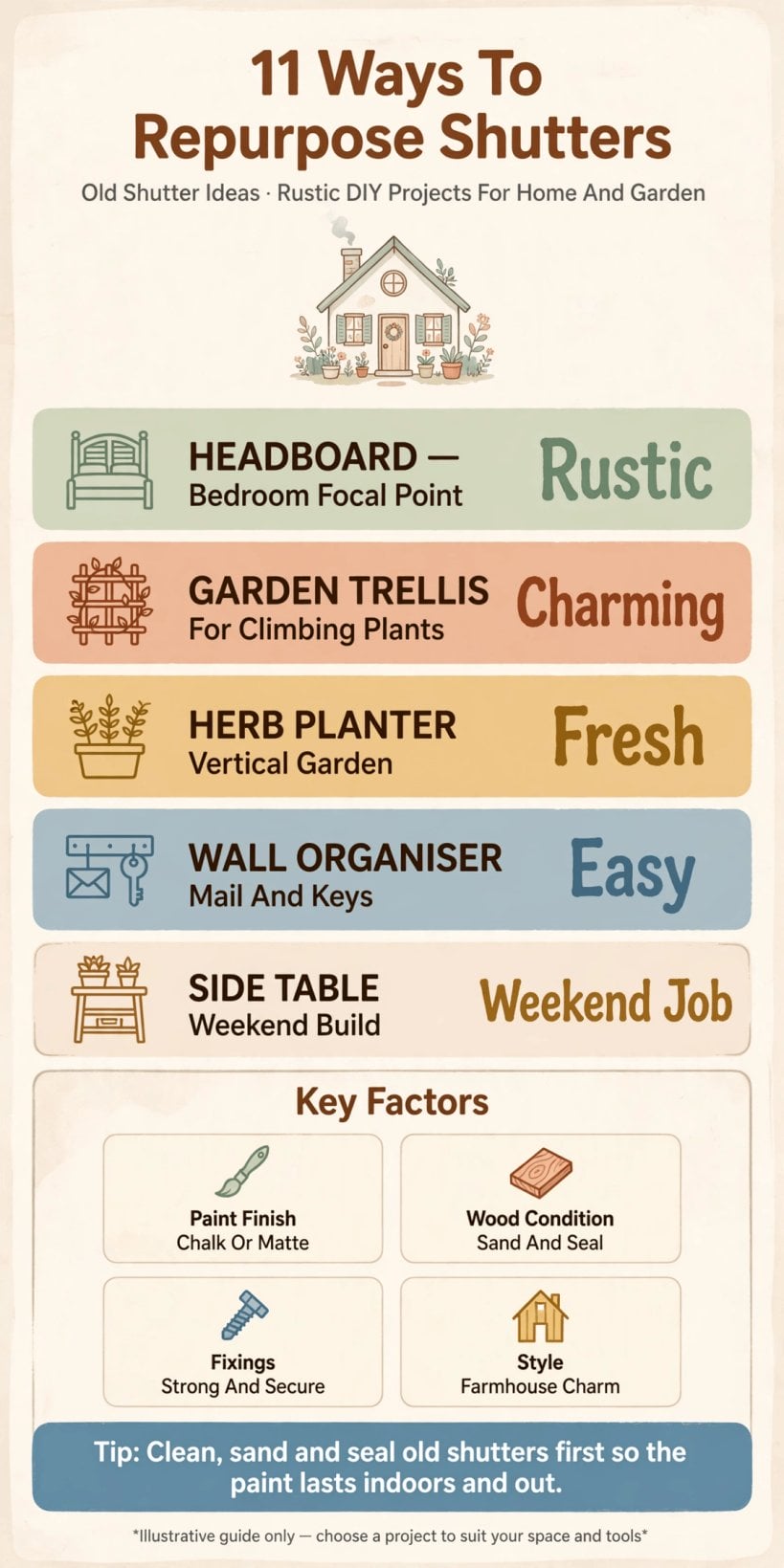
Preparation, finishes and the eleven projects at a glance — clean, repair and paint while the shutter is still flat.
2. Idea One: A Shutter Headboard
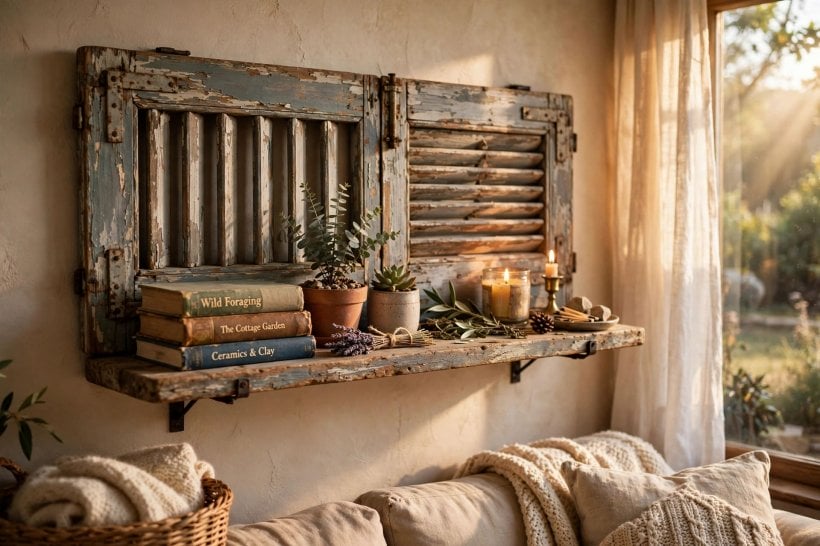
A row of shutters makes a headboard with instant architecture: vertical rhythm, soft shadow and a height most flat panels lack. Join two, three or four shutters side by side with flat battens screwed across the back, at top and bottom, so the row behaves as one rigid panel. Fix the finished headboard through its battens into wall studs or solid fixings — never rely on the bed frame alone to hold a panel of this weight above sleepers’ heads.
Paint is what makes this idea sing. One colour across shutters from different sources erases their separate histories and leaves only the pattern; a soft white or sage suits calm bedrooms, while deep green or ink makes the slatted texture dramatic behind pale bedding. Run the colour onto the wall edges of the panel or add a simple top cap of timber to finish the silhouette and give the eye a full stop.
Height is flexible in a way bought headboards rarely are: hang the panel so its bottom edge disappears behind the mattress and its top lands where the proportions of your wall look best. The layered, make-do confidence of the bedrooms in these tiny house bedroom ideas is the spirit to copy — a salvaged panel, properly fixed and freshly painted, looks more personal than most things you could buy new.
3. Idea Two: A Folding Room-Divider Screen
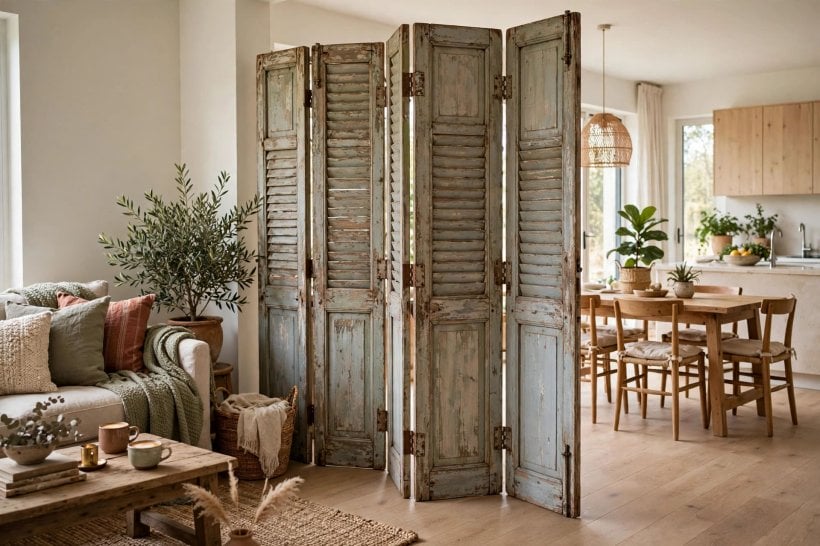
Hinge three or four shutters edge to edge, alternating the hinge direction, and they become a folding screen that stands in the classic zigzag. A screen earns its keep everywhere: it hides a home-working desk at the end of the day, gives a studio or open-plan room a sleeping corner, screens a guest bed, or simply breaks a long wall with texture and shadow.
Louvred slats are the screen’s secret advantage over solid panels — they divide a view while letting light and air keep moving, so both halves of the room stay connected. Check stability once hinged: a screen should stand with a relaxed zigzag, not fully stretched flat, and small glides or felt pads under each foot protect floors and quiet the fold. If a shutter is shorter than its neighbours, level the tops with the screen standing and mark any trim needed before painting.
Finish both faces, because both will be seen, and consider painting each face in the colour of the zone it turns towards — calm on the sleeping side, livelier on the living side. It is the most architectural of all the projects here, and the one that most changes a room for the least construction, much like the flexible partitions admired in this tiny house living room ideas collection.
4. Idea Three: A Garden Trellis for Climbers
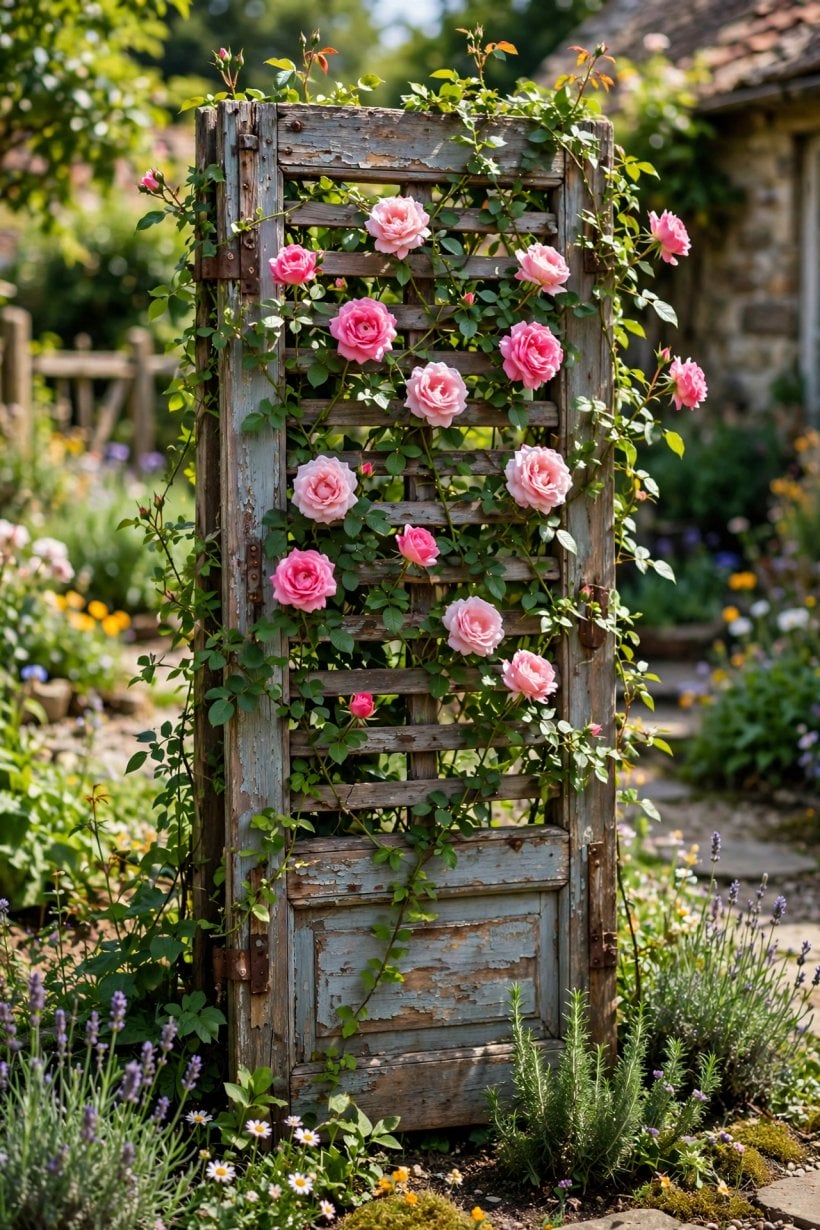
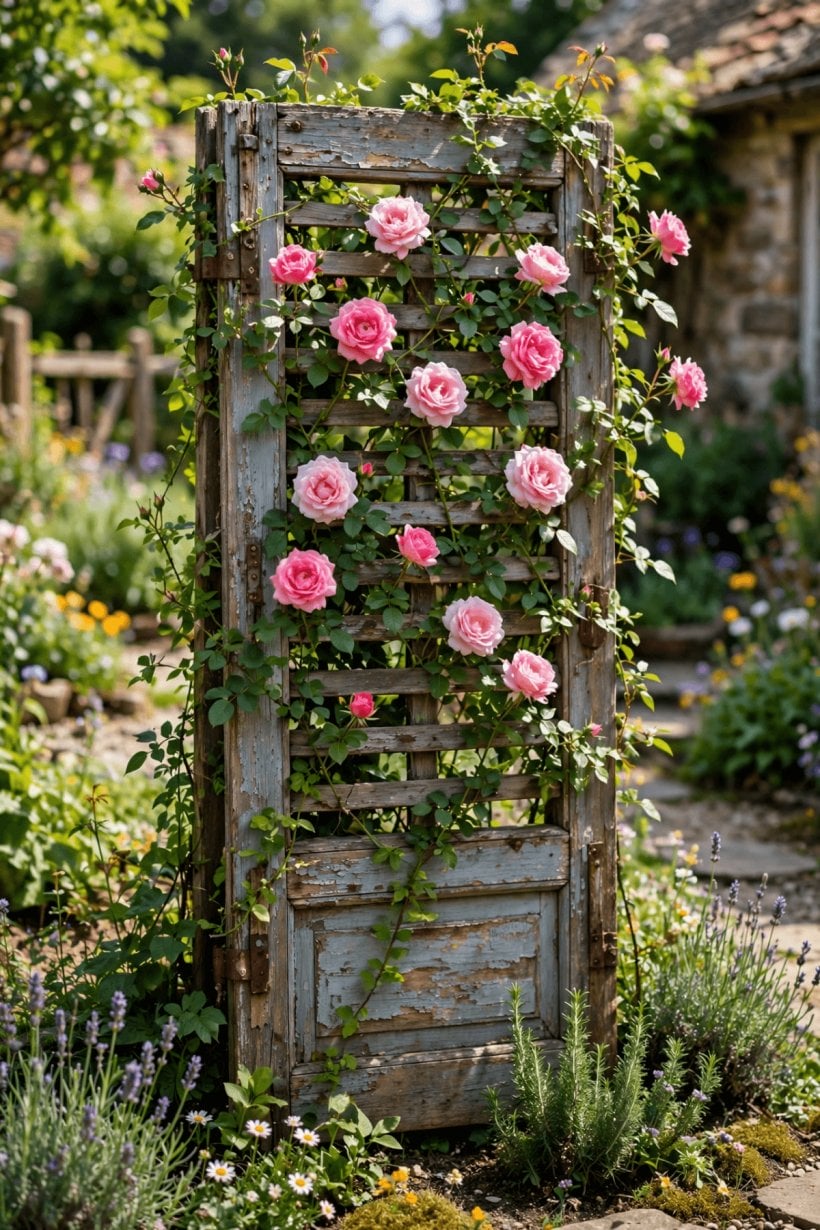
In the garden, a shutter is a trellis that has already been built. Its rails and slats give climbing plants a ladder of handholds, its proportions suit a narrow border or a pot on a patio, and its painted colour can tie a planting scheme to the house. Fix it to a wall, fence or sturdy posts with spacers behind, so plants can twine behind the slats and air can move — a shutter screwed flat hard against a wall gives tendrils nowhere to go.
Choose the site for the plant, not the shutter: a climber that wants sun will sulk in shade however pretty its support is. Set the shutter’s feet on a brick, a stone or a metal shoe rather than in soil, because end grain sitting in damp earth is where garden timber always fails first. Exterior paint or a clear outdoor finish, renewed when it dulls, keeps a softwood shutter useful for seasons rather than months.
Sweet peas, clematis-style climbers, beans in a kitchen garden or a potted jasmine by a door all take happily to slats. The effect is deliberately informal — a green, flowering panel that changes weekly. Gardeners who like structure with softness will recognise the approach from these tiny house landscaping ideas, where supports and planting are planned together rather than added as an afterthought.
5. Idea Four: A Vertical Herb or Flower Planter
Lean or mount a shutter and its slats become shelves and slots for small pots: clip-on pots, hooked tins or little troughs fixed along the rails turn one shutter into a vertical herb garden that takes almost no floor space. Herbs suit the arrangement especially well — they are happiest in small pots, picked little and often, and happiest of all within arm’s reach of the kitchen door.
Think about water before you plant. Pots on a shutter drip, so site the planter over soil, gravel or a patio that shrugs off splashes, and put the thirstiest plants lowest, where the run-off from above reaches them. Line any wooden troughs, ensure every container drains, and fix the shutter itself as securely as you would a trellis — a planted shutter in full leaf, wet from watering, is heavier than it looks.
Painted a cheerful colour and planted with green, a shutter planter is decoration as much as gardening, and it earns a place on a balcony or in a tiny courtyard where a conventional bed cannot fit. Swap pots seasonally — violas and bulbs, then herbs and trailing flowers — and the same shutter gives you a changing display all year without a single new hole in the wall.
6. Idea Five: An Entryway Organiser
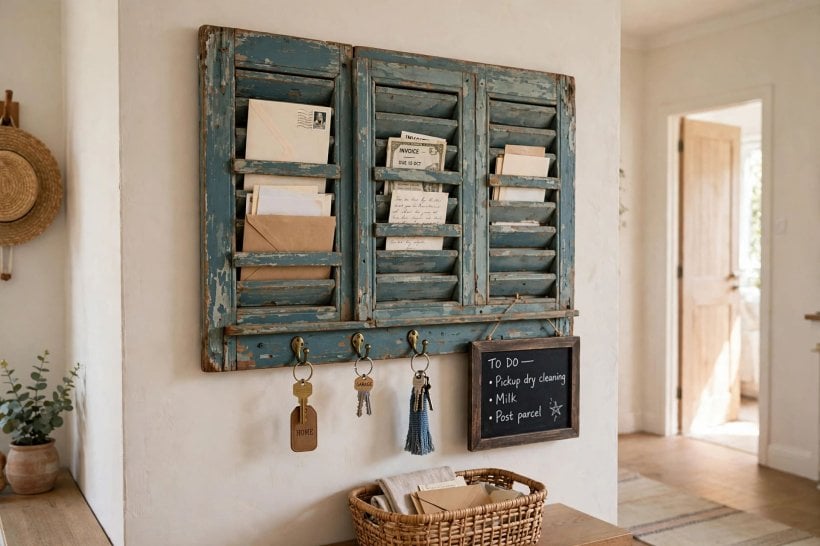
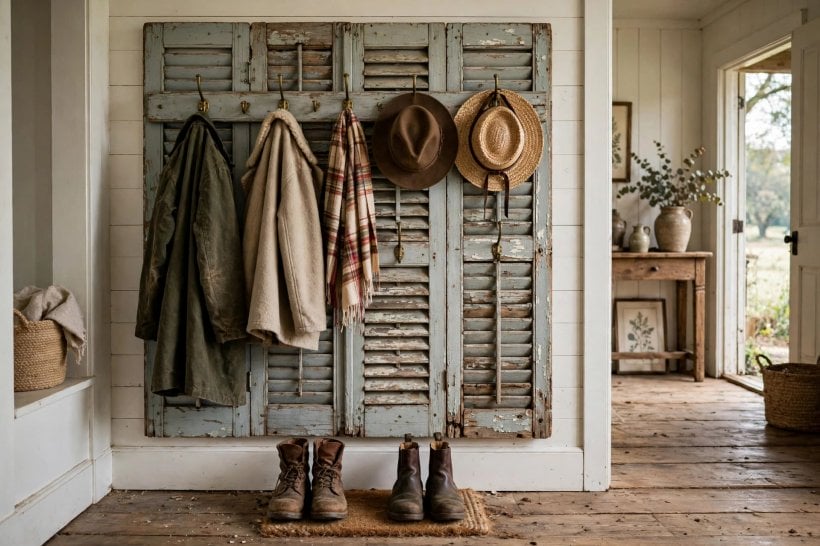
Mount a shutter by the front door and add hooks along its rails, a small shelf or letter rack, and perhaps a mirror tile or a chalkboard panel, and the daily scatter of keys, post, dog leads and notices gains a single home. The slats themselves are useful — postcards, reminders and outgoing letters slide between louvres and stay visible instead of vanishing into a pile.
Fix it properly into studs or solid wall fixings, because a loaded organiser is pulled at every day by people in a hurry. Position hooks at heights the household actually uses — low ones for children, a dedicated hook for the dog lead by the handle end of the hallway — and a small dish or cup on the shelf for coins and the front-door key’s spare. Painted to match the hall woodwork, the organiser reads as furniture; painted in a contrasting colour, it becomes the cheerful full stop of the entry.
This is the fastest project in the list and the one most households feel daily. In a compact hall the principle is pure small-space discipline, the same thinking behind the storage in this bedroom interior design for tiny houses guide: everything used daily gets a named place, within reach, at the point where it is used.
7. Idea Six: A Photo, Art and Memo Display
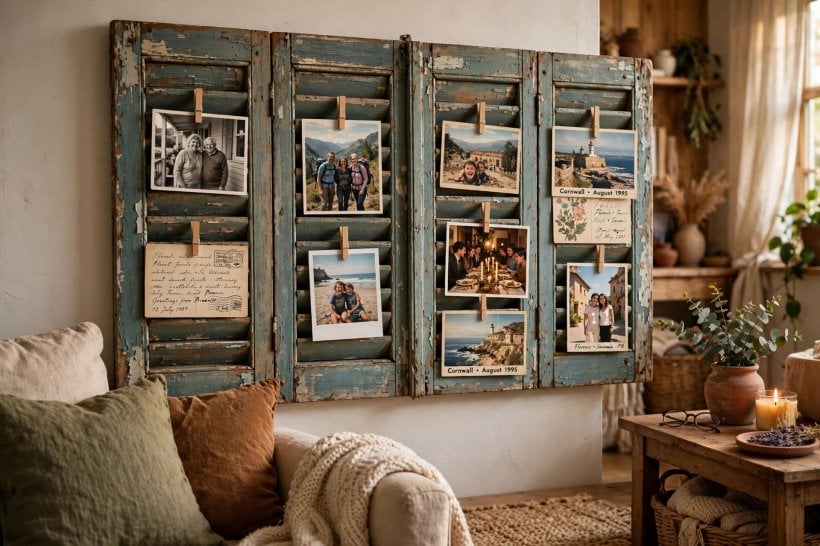
Louvres are ready-made display rails. Photographs, postcards, children’s drawings and invitations tuck between slats at a slight angle, held by friction alone or with small clips and mini pegs clipped over the slats for a firmer grip. The display changes in seconds, needs no frames, no glass and no new holes, and grows organically across a shutter the way a family’s year actually unfolds.
Give the idea a home where change is welcome: a kitchen wall, a study, a child’s bedroom or a hallway gallery. Paint the shutter to disappear into the wall for a floating effect, or in a bold colour to frame the collection as one artwork. Include some slats left deliberately empty so new arrivals always have somewhere to land — a display with no spare capacity stops being used, however charming it began.
For a desk or home office, a smaller shutter section works as an upright memo board within sight of the chair, holding the current list where it cannot be buried under paperwork. It is the analogue, unhurried cousin of a pinboard, and in a room dressed with salvaged pieces — the mood of this tiny barn house interior — it looks entirely at home among timber and texture.
8. Idea Seven: Cupboard and Cabinet Door Fronts
A sound shutter is, by construction, a door waiting for a frame — it began life hinged, after all. Used as cupboard fronts in a utility room, pantry, boot room or freestanding larder, shutters bring ventilation as a bonus: air moves through louvres, which is kind to stored produce, linens, shoes and cleaning kit alike. A matched pair on a wide cupboard, or a single shutter on a narrow one, gives plain storage a cottage character no flat door can imitate.
Measure honestly and be ready to trim rails or add a surrounding frame where the salvaged size and the cupboard opening disagree; shutters forgive small adjustments at their outer rails far better than in the slatted field. Rehang on hinges suited to the weight, add a knob or cup handle at a comfortable height, and consider a magnetic catch to keep louvred doors closing crisply rather than standing ajar.
Paint unifies a run of fronts even when the shutters behind the paint began as near-matches rather than a true set. In a kitchen or utility scheme that mixes old and new, that consistency matters — it is the same judgement call as in these colourful tiny house interior rooms, where one confident colour carries a collection of different pieces and makes them read as a set.
9. Idea Eight: A Side Table or Console Top
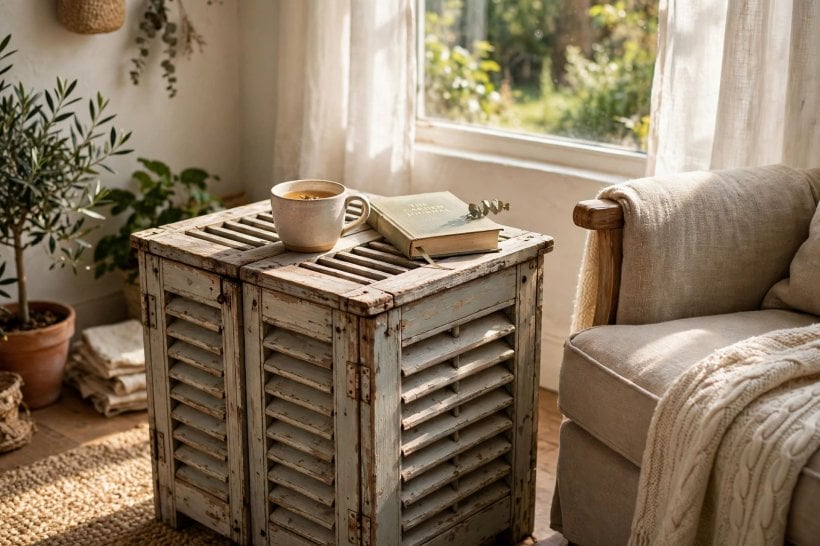
Laid flat and fixed to a simple frame, trestles or a pair of low cabinets, one or two shutters become a table top with texture built in. The slatted surface suits a hall console, a potting bench, a side table beside a reading chair or a narrow desk where a laptop and a lamp need little depth. A sheet of glass or a clear protector cut to size gives a smooth writing and coffee-cup surface while leaving the slats visible beneath.
Build the base square and level, and fix the shutter top down at several points so it cannot rack or lift; shutters are light, and a light top on a light base feels unsteady until it is properly tied together. Check the slats’ direction for the job you intend — across the width reads as a classic console, along the length emphasises a narrow table against a wall. Seal the top well if drinks will live on it, because slats and ring marks are natural enemies.
This project suits a first attempt at furniture-making: the joinery is simple, the materials are forgiving and the result is genuinely useful. It pairs naturally with the bench-and-table resourcefulness celebrated in the guide on how to build your own tiny house — make what you need, from what you have, to the size your room actually wants.
10. Idea Nine: A Porch or Balcony Privacy Screen
Outdoors, a hinged pair or a fixed run of shutters makes a privacy screen that blocks a sightline without building a wall. On a porch it can shelter a chair from a neighbour’s window; on a balcony it filters sun as well as views, throwing the striped shade that louvres were invented for; by a seating area in the garden it makes a room-like enclosure that still breathes on a still evening.
Anchor matters more outdoors than in. A screen is a sail in a gust, so fix posts or feet properly, hinge pairs so they can be folded away in a storm, and use exterior fixings throughout. Exterior paint, refreshed before it fails rather than after, is the maintenance bargain: a screen recoated on a calm morning every few seasons stays sound, while one left to peel becomes next year’s repair project.
Planting completes the idea. A pot or climber at the base softens the screen’s feet, and the combination of painted timber, green leaves and striped light is prettier than either a fence panel or a curtain of fabric at the same cost. It extends the same garden logic as the trellis — old timber, honestly used, in the service of a more private and more pleasant place to sit.
11. Idea Ten: A Cover for an Unused Fireplace
An unused fireplace is a draughty black rectangle in the middle of a room’s best wall, and a shutter cut or chosen to size covers it with texture and colour instead. Fixed with removable clips or simply leaned and weighted as a decorative panel where safety allows, a painted shutter closes the visual hole, keeps dust and draughts down, and gives the hearth a dressed look — candles, a plant or a stack of books can stand in front of it.
Be practical about the circumstances: this is a cover for a fireplace that is genuinely out of use, and it must come away easily if the chimney is ever swept or the fire reinstated — so note what you have done in your house records. Never place a timber panel in front of a fire that is lit, and keep the chimney’s ventilation needs in mind if the flue requires an air path; a louvred shutter, happily, allows some air movement by its very nature.
Painted black, the shutter nearly disappears and lets the surround speak; painted in the room’s accent colour, it becomes the focal point the empty grate never was. Add a small wreath, a picture light or a seasonal garland and the dead fireplace becomes the most decorated square metre of the room — a very shutter-like trick of turning a problem panel into the feature itself.
12. Idea Eleven: A Jewellery and Desk Organiser
The last idea is the smallest and, for some, the most satisfying. A single shutter, or a cut-down section, mounted above a dressing table or desk becomes an organiser that uses its slats as rails: earrings hook through louvres in pairs, necklaces hang from small hooks along the rails, and notes, glasses and keepsakes tuck between slats where they are seen rather than lost. Painted to match the room, it looks like a decorative panel that happens to hold a working collection.
Choose a shutter with sound, closely spaced slats for this job, and add a narrow shelf or a row of cup hooks beneath for bracelets, watches and the pieces that do not hang. A mirror tile fixed to one section turns the organiser into a complete getting-ready station in a few inches of wall — a blessing in a small bedroom, a guest room or a teenager’s domain where every surface already has a job.
As a gift, a small painted organiser made from a shutter with a family connection — from the house itself, or a grandparent’s home — carries a story no shop-bought equivalent can match. That is, in the end, the argument for every project in this list: the materials are humble, but the history is personal, and a home furnished partly with its own past feels different from one furnished entirely from a warehouse.
Final Considerations
Eleven projects, one simple material. The shutters that work hardest are the sound ones, cleaned, repaired and painted before they are built into anything; the projects that succeed are the ones fixed properly, finished for the place they will live, and chosen for a need the household actually has — a screen where a screen is wanted, an organiser where the clutter actually lands.
Start with the entryway organiser or the display if you are new to this, and with the headboard or screen when you are ready for a room-changing piece. Keep any spare shutters from the same source — a matched extra is future gold for the next project. Few salvaged materials give so much back for so little intervention, and none brings its own pattern, shadow and history quite so ready-made.


0 Comments